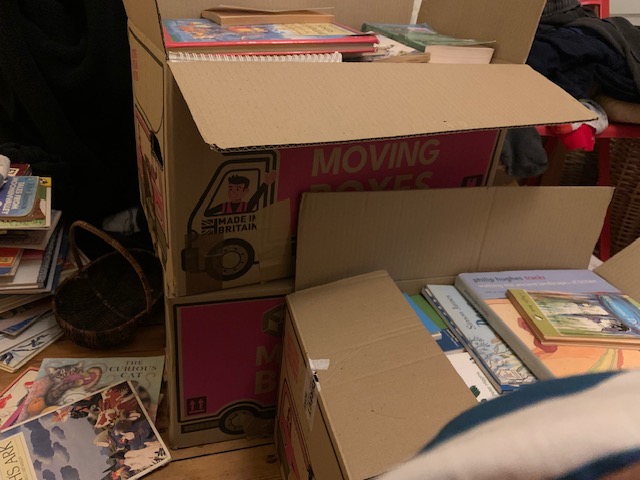
In making “my” study accessible, some of the books, a lot of my books, are having to go. How to choose?
Lots more tidying is required, and with it a commensurate saying goodbye. This isn’t some magic decluttering nor yet an account of my following tidying “gurus” such as Marie Kondo. Far from it: there is no sparkling joy https://youtu.be/x4Nrd68bhH0?si=3LoZa2ghKZtp7oY0 and while part of that is that I won’t be buying into the hype, part of it is that the getting rid aspect has a number of other themes attached to it.
Harry’s Numbers by Jill Waterman is going to the charity shop: so many memories of reading and re-reading at the children’s grandma’s house: and there’s Bonne Nuit, a board book for bedtime given me by a priest to whom I was teaching English, to read to the children. Read out loud in French, read too in my clumsy translation in English, I remember most my trying to read it with a child under each arm. What to look for in Summer: ah yes, all those Ladybirds dug out on trips back to Yorkshire or bought at jumble sales. The seasonal idylls were only eclipsed by the description of the Farm, and again a discussion of how the farm next door to Grandad’s wasn’t like that… Thomas the Tank Engine; Norse Myths; The Velveteen Rabbit…
And with each of these the abiding memory is a child or two or three snuggled with me at bedtime, and of me (and sometimes them) falling asleep while we read together.
At work as well as at home, there were John Burningham’s Would You Rather – hot debates with wriggly children in Reception about having your house surrounded by jungle and Eric Carle’s Brown Bear, Brown Bear What Do You See which so often became a chanted Nursery spell with its own increasing momentum. So many more.
Do I keep books that I shared at school (and as a University tutor) because I feel I was good at reading them? Is it that shallow? Or do I take a breath and collapse all the memories into the boxes along with (so far) well over a hundred books?
Most of them are going, and if Alligators All Around stays, that too has a sense of sadness to it: will a keen-eyed adult never read this to a group of laughing five-year-olds again?
Oh, enough of the melancholy.
But what is that title all about? It’s a line from a poem in the book of the prophet Isaiah, where the King laments that he will leave his life half-spent, his life “taken away, rolled up like a shepherd’s tent.” The Latin text is sonorous:
Generatio mea ablata est et convoluta est a me quasi tabernaculum pastorum. Praecisa est velut a texente vita mea. Is. 38:11
And what Hezekiah feels, that all his meaning, his capacity for life have been tidied away, rolled up as something temporary and no longer needed.
This is where the knife digs deep. I think I mourn the passing of these books because it signifies the passing of a self-image that was powerful and affirming. All self-image seems to me to be in part myth. It is a powerful and long standing myth, and giving more of it up requires me to wrench the image of the scholar in his [sic: such is the myth, although not the reality] study from how I view myself and any future work.
So it’s book 5 of Heartstopper, and Nick and Charlie, after a painfully long time for the readers (although less for the characters) are prepared, have motive and opportunity… and from coy first kisses way back in book 1 are going to have …
Well, what are they going to have, and what do the readers have to read into text and image?
Conversations around sex and young adult literature seem to me to centre around two questions: Do the characters have to have sex? and How appropriate is the depiction of what they do? Since Alice Oseman’s style allows the (pretty inescapable) sex to take place, she is caught needing to decide on what to show. And it is “pretty inescapable,” in that the kissing that takes up the physical side of Nick and Charlie’s relationship from Ch 3 of Book 1 only starts to build much later – but build it does.
This has attracted a number of critical responses, summed up (and to a large extent demolished) in vlogs like this from Obviously Queer and elsewhere. [Heartstopper] “is unapologetically showing queer love being wholesome innocent and slow.” If this is not the case in other teen product or even in real life, the slowness of the developing relationship is charming, and leaves emotional room for the and finally of Book 5. This is a key scene, taking place some days before the excerpt below, and note that the reader is left to fill in at least some of the blanks.
It is clear from the conversations between characters that the blanks are to do with penetrative sex, and that after a very long period of awkward relationship development (the line “Why are we like this?” is a refrain in a number of scenes), we are seeing-yet-not-seeing something incredibly intimate, decorated with giggles and whispers, with trainers and trousers discarded, so with the condoms and lube Nick has bought in Oxford being brought out from his suitcase we have little room to doubt what’s going to happen. “Okay, let’s go” may sound more like the start of a rollercoaster ride than a key point in their relationship, but Oseman is entitled to depict these two star-crossed lovers as having fun.
Heartstopper Book 5, Ch 7, 1563
And this might be where the reader gets a shock: is it acceptable to see this as fun?
Of course it is. They may have taken what seems to me to be a very long time getting there, and Nick and Charlie, one of the satellite texts in the Heartstopper canon, suggests it was a bit nerve-wracking for the young characters to start, but maybe when we think of what is acceptable to be shown, we see Oseman’s skill at changing narratives. This is not about the mechanics (or geography, if you prefer the metaphor) of sex, or the metaphysics of love and sex, but simply about fun.
Is it right to depict sex as fun instead of guilt ridden (or even a liberation from guilt)? How does the adult gatekeeper react to this sidestepping of traditional attitudes and narratives? The argument about Lyra and Will in Pullman’s The Amber Spyglass (no time to talk about the do-they-or-don’t-they? or the Bowdlerisation of the US edition) suggests to me a deeply concerning attitide from adult readers: brought up on the post- D H Lawrence bonk fest, it is almost as if adults need to see the sex and then disapprove of it. Oseman is telling is This is Not Our World, even if once it was.
… begins “Dear Nicholas,” which is maybe as it should, but is also quite wrong; nobody calls me that. The last person to do so as a normal thing, my brother Glenn, died a couple of years ago. It is a signifier of the database form of address and alerted me to the formal tone of what was to come. Do I mean “formal”?
The contents of the first letter were mostly plain statements of facts: a list of symptoms and who had referred me to whom, test results, and a brief note on what the writer of the letter had found.
Childe Rowland to the dark tower came…
Nothing surprising. Factual, and the obvious word, clinical. Colourless, in contrast to my Technicolor emotions.
What was surprising were the omissions. The monster is not named; timescales for tests are shakey; the Big Timescales of prognosis are not mentioned. This is clinical, and those in charge for now of my health are also in charge of what can be expressed. The formal language if anything highlights what is not being said.
Henry Marsh has insights into this formality. He suggests that “faced by piles of paperwork and test results (now largely online) it is difficult to keep in mind that each result has an anxious patient attached to it” and that “much of what goes on in hospitals – the regimentation, the uniforms, the notices everywhere – is about emphasising the gap between staff and patients, and helping the staff overcome their natural empathy.”
“Patients want certainty but doctors can only deal in uncertainty.” This is something I shall have to hold on to.
***
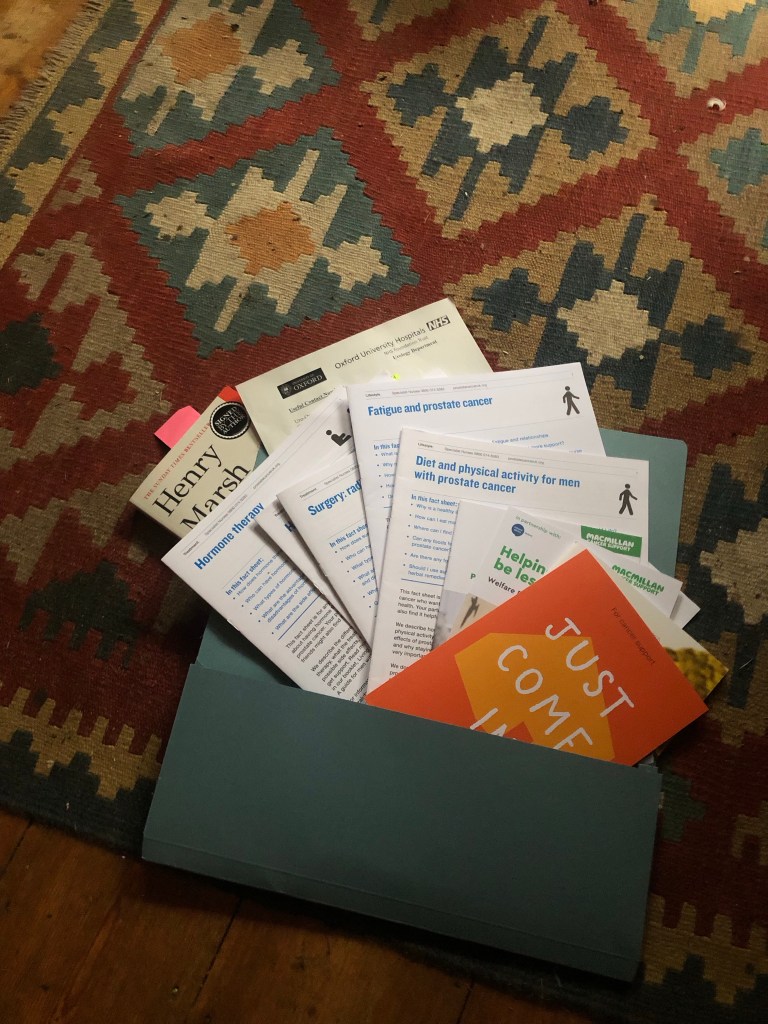
Or not: a watershed crossed in late November and (to muddle my imagery) the dam bursts with info.
Information Pack
But even in the information flood there is uncertainty, and I look at all these guides like a first year undergraduate looks at a course handbook: so much to take in; how much of this is relevant?
***
So the latest letter is clearer, and today (11.12.23) is the day this word becomes flesh (why yes, this is all coloured in by the purples, reds and greens of Advent) with a F2F meeting. There is the scribble of results that is no more enlightening than the old-fashioned, mythic doctors’ bad handwriting, and then the veil is parted:
Unfortunately.
The job not got, the offer withdrawn, the bad news word. The heart races, sinks, I don’t know: rereading the text in the rush that follows I am struck by the name Gleason which takes me to the bull that tramples through Puck of Pooks Hill – thence my mind hears the yammering at my elbow of all those crazy, violent, vivid dreams that keep my sleep broken. Now Stop! Max said. And the wild things are stopped as by a lion-tamer’s whip and chair, stopped by another word:
However.
Watersheds and floods; dark towers and brave rescues; lion taming and þursen and the wild rumpus. Good, picaresque nonsense, jumbled fairytales to give shape, colour and texture to the bare outlines of grey corridors and professional friendliness and the heart-crunching worry of boring my friends.
Which is maybe what I’m doing here. Not a wild rumpus, not even an Ariadne thread, just a confusing set of encounters with images given a high fantasy gilding.
Time to stop and get ready for my consultation? Just one more thing, another letter:
A letter from the Blood Donor Service, in response to my having to withdraw from donation. It talks of ambassadors like you encouraging others to give blood…I hope you’ll continue spreading the word.
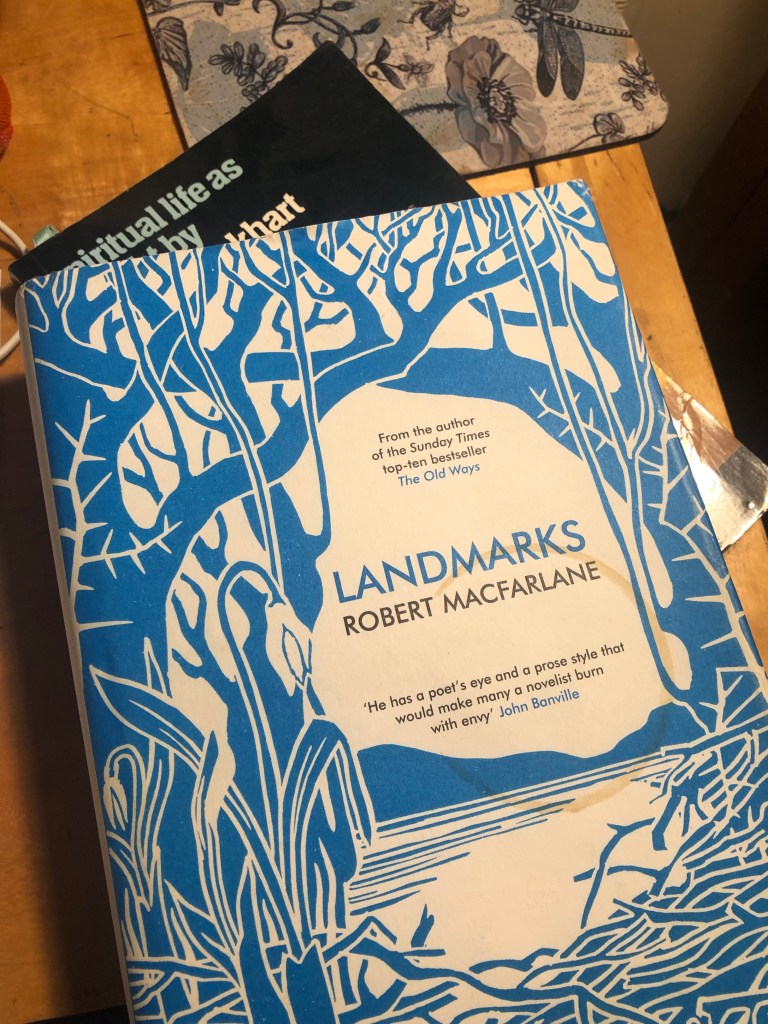
I started this post in February on what I described as “an odd day,” where I had been looking for material on meditation and spirituality, mostly because I was fretting about a postgraduate class on Early Childlhood spirituality that I was due to teach. One book leads to another like something out of The Name of the Rose, so for entirely different reasons than I’ve ended up with, I was looking at Rob Macfarlane’s great book Landmarks. I came across his account of the Kalevala (Landmarks, Ch6, by the way) and Vainamoinen Finds the Lost-Words:
Robert Macfarlane: Landmarks cover
Its hero, Vainamoinen, is trying to build an enchanted ship of oak wood in which he will be able to sail to safety ‘over the rough sea-billows.” But he is unable to conclude his shipbuilding for want of three magic words…
And along with various other things I’ve been reading, here was the image I was looking for – not for my class on spirituality, but actually for an entirely different class on Play. To Macfarlane, the finding of the lost words is the key or maybe even the origin-text, it seems to me, to his – and Jackie Morris’ – beautiful collaboration The Lost Words and the works that have come from it. For me it provides an entry into the search that Vainamoinen undertakes, and with it a search a lot of educationalists are seduced into undertaking: a set of spells from the past that will give us just a few magic words that will enable us to create the way we want to go across the rough seas of educational theory. To get there we have to look all over the place – see Rob Macfarlane’s account where Vainamoinen searches through improbabilities of swallow’s brains, swan’s heads and the like – until we face a place of conflict: in the Kalevala this is a journey over the points of needles, the edges of swords and the blades of axes.
And it struck me that far, far too often, educators spent their time looking for the three magic words that will solve their problems, and that they will seek those words out despite the cost.
Pinning one’s hopes to a single answer – and in the story just cited, a simple formula – is hopeless when critically exploring something as complex as pedagogy. the Education Endowment Foundation (summary review) gets round this by assuming that everyone can sign up to the statement:
Learning requires information to be committed to long-term memory
Acquiring language, developmental considerations would seem to be set aside, alternative provisions and pedagogies forgotten or (as the salivating Twitterati are wont to do) denigrated and mocked, were it not for the statemant that
Our review is founded on the view that translation of evidence from basic science is neither simple nor unproblematic.
So while I had thought of a (deliberately) controversial title for this post:
Why CogSci is Rubbish
To be quickly followed by
Why Forest School is Rubbish
I really have to avoid the cheap tricks and hark back to the word I slipped in earlier in this post
Critically
And it has a lot of work to do, that little word. Who gets to be critical about the work teachers do? Are teachers meant to be professionals? Do they critique their work reflectively? Most topically, given this week’s unhappy occurrences, are we to see teachers as direct agents of Government, QUA[N]GOs like OFSTED, individual ministers and their inner circle, &c., in a trend of disempowerment and control that was certainly well under way by the late Eighties? Or are they reflective workers, whose tasks are quality assured, both internally and through independent scrutiny?
And this is where we come to the points of needles. When the Early Years practitioner comes to articles such as Brain Development and the Role of Experience in the Early Years (Tierney and Nelson, 2009) we read that
….experience shapes the structure of the brain…for healthy development of brain circuits, the individual needs to have healthy experiences
and we might be tempted to take this to mean that this vital role of experience is all. This, however, denies the assertion that
Applying the principles of cognitive science is harder than knowing the principles and one does not necessarily follow from the other. Principles do not determine specific teaching and learning strategies or approaches to implementation.
In the same way, the unreflective CogSci advocate might be tempted to retort “Ah, but this isn’t what I mean by the word ‘learning.’ We are in the Humpty Dumpty world where this exchange is enviaged by Lewis Carroll:
“When I use a word,” Humpty Dumpty said, in a rather scornful tone, “it means just what I choose it to mean – neither more nor less.” “The question is,” said Alice, “whether you can make words mean so many different things.”
The word is either insufficient for the observant practitioner or for the theoretician mindful of where their words will go. The same is true of the unreflective use of ideas such as “freedom” (freedom to be a child) or even “nature:” which brings me back to where I started last month.
It is easy for me to hone in on pedagogy whether underpinned by applied cognitive neuroscience or whittled hazel sticks – but we (I) need to be aware of our own three magic words, those words we try to somehow make their own unspoken axioms. And what would my three magic words be?
When I came back to this post last week I started with the idea of an axiom and, of course, started a Google search. The second question in the list that came up was
Does axiom mean truth?
Do I just assume that spirituality is a thing? Is play not merely a slippery concept but a clumsy agglomeration of phenomena? And what about outdoors – my garden? The Lye Valley? Is my looking at Margaret McMillan a search through ancient lore for The Answer?
I was thinking and writing on St George’s Day of the hymn/school assembly song “When a Knight Won his Spurs,” and the moral ogres and dragons it prompts us to battle. Another of this genre is “Glad that I Live am I,” which M sang to me as we walked Jeff the Dog this morning. This site gives various versions, none matching the comforting wham-bam-plunk of a school assembly. Nostalgia and spirituality is a different blog post, but some of these versions really don’t work for me, and none of them take me back to Blandford Infants.
These are the words.
Glad that I live am I; That the sky is blue; Glad for the country lanes And the fall of dew
After the sun the rain, After the rain the sun; This is the way of life, Till the work be done.
All that we need to do, Be we low or high, Is to see that we grow, Nearer the sky.
Do I mean “genre”? Perhaps for me they stick together just as the choices my teachers in State education made: vaguely religious lyrics urging a sort of morality in which we draw our understanding from the country lanes. No, it doesn’t make them bad lyrics. Yes, we sang “Praise my Soul the King of Heaven” and stuff too, but these stick in my head because of the odd mixture of woolly romantic nature appreciation and aspiration: Ladybird British Wild Flowers and an optimism I now see the twentieth century never really lived up to. They were all certainly different from Sundays, where as Roman Catholics we were still immersed in a vision of the Mass that Heaney (so to speak) celebrates. My dad can still sing a wonderful marching-band version of the music for the Easter rite of sprinkling Holy Water; I can still manage a lot of Compline with its Salva nos Domine vigilantes. This is a good source. And maybe this explains why knights winning their spurs and country lanes seemed something of an oddity to me. If Glad That I Live Am I was odd then, I think of it as more mainstream now: being outdoors is about wellbeing; the locus amoenus (a quick link here) being the locus salubris. Enough marking; enough screen time all round: when I post this blog I’m off for a run in the jolly springtime.
Perhaps the oddness resides in the nature of children’s spirituality. Perhaps closer to what I see in this mixture of ideals and imagery is Tony Eaude’s idea that spirituality is elusive, contested, as I explored some time back, something more basic, and wider, than religious faith or commitment. This would admit Lizette Reese’s final idea of growing nearer the sky, so that it becomes a metaphor rather than a child’s wish to grown nearer to heaven. I originally thought it was about growing taller. It may have that physical element, but there is more than that. As I’ve said before
It’s powerful stuff, all that wishing, all that desire for freedom
Someone on Twitter once sort of challenged me – or I provoked myself – to write as if Enid Blyton had strayed into Garner Country, or if Alan Garner had tried to write in the style of La Blyton. “Wot larx,” I thought – and although parody is not really something I can do very easily, I thought a quick go would be OK. After all, the Weirdstone begins with two children going on holiday, doesn’t it? How hard can this be?
Actually, it’s really difficult. Blyton, although occasionally mocked and frequently criticised – Joyce Grenfell is merciless – was hugely popular and does attempt a child’s-eye drama, but she has such a different point of view from what we see of Alan Garner, from use of language to views of landscape, that I am reminded of Wittgenstein’s often quoted ‘If a lion could speak, we could not understand him’ – see, for example this blog post. Would an Alan Garner world be comprehensible to Enid Blyton?
And yet, poorly little Joe in Treacle Walker might (possibly with a sigh) tear himself away from his Knockout comic to read some escape with spies and danger if such a thing seemed exciting, and The Mountain of Adventure might have gone in a more Aikenesque or Garnerish direction. Garner’s Mossocks might stand for Blyton’s Evans, and we are, after all, in a misty, hilly landscape…
I am being cheeky here.
Where the task becomes impossible is evident from my subtitle. Imagine the tragedy, the earthiness, the spirituality of Thursbitch being reduced to a tale of spies and scientists up in the hills… or (more fairly) to keep to Garner’s earlier work, aimed more at a young readership, Selina Place in Weirdstone or Gomrath being tamed into simply an unpleasant figure with a big house on the Cheshire plain? It is where this taming would be necessary that the parody becomes worthless.
Witness:
Brambles were waiting for them on the other side, but they tore themselves free and ran as best they could through the scrub and matted fringe of the wood.
Garner: Weirdstone Ch 16: The Wood of Radnor
which might have come from either author, whereas
In [Roland’s] narrow angle of vision there was nothing but mountains; peaks, crags, ice and black rock stabbed upwards. The porch seemed to be at the top of a cliff, or a knife-backed ridge. Roland had the sensation of a sheer drop behind him in tge room.
Garner: Elidor Ch 14: The High Places
That sheer drop is astonishing landscape painting, the view through the letterbox that seeps into the everyday, and the image, a little further on, of the lance-carrying men “with the beauty of steel,” riding stags in the shadow-light completes this, a short but utterly brilliant fantasy scene. There is little place in Blyton’s mystery novels even for “Athens in the woods of Warwickshire,” and there is a lack of nuance and transcendence in her more magical writing that sets her apart from Garner. I cannot escape the idea of “lack,” but at its simplest, these are worlds and words far, far from each other. We might as well begin a Blyton adventure in Llareggub, with Dylan Thomas.
The man who brought Mindfulness to the west, Thich Nhat Hahn, has died. Biographies, ceremonies and tributes are already coming in on Social Media. The passages that follow are really all that I want to say from my own perspective.
Recognition without judgement. Feelings, whether of compassion or irritation, should be welcomed, recognized and treated on an absolutely equal basis; because both are ourselves. The tangerine I am eating is me. The mustard greens I am planting are me. I plant with all my heart and mind. I \clean the teapot with the kind of attention I would have were I giving the baby Buddha or Jesus a bath. Nothing should be treated more carefully than anything else. In mindfulness, compassion, irritation, mustard green plant and teapot are all sacred.
Thich Nhat Hahn Miracle of Mindfulness.
and here he is on death:
I asked the leaf whether it was scared because it was autumn and the other leaves were falling. The leaf told me, “No. During the spring and summer I was very alive. I worked hard and helped nourish the tree, and much of me is in the tree. Please do not say I am just this form, because the firm of leaf is only a part of me. I am the whole tree. I know I am already inside the tree, and when I go back into the soil I will continue to nourish the tree. That’s why I do not worry. As I leave this branch and float to the ground, I will wave to the tree and I will tell her “I will see you again very soon.”
The quotation that forms the title comes from Evening: Zero Weather, a poem by Thomas Merton commemorating these chill days after Christmas (text here). His view – a land without wildlife, where liturgy is a refuge and a celebration after hard physical work – was not what I experienced. He and his monastic brethren are
…sunken in our adoration,
And plunge down, down into the fathoms of our secret joy
That swims with undefinable fire.
And we will never see the copper sunset
Linger a moment, like an echo on the frozen hill…
Thomas Merton, Evening: Zero Weather
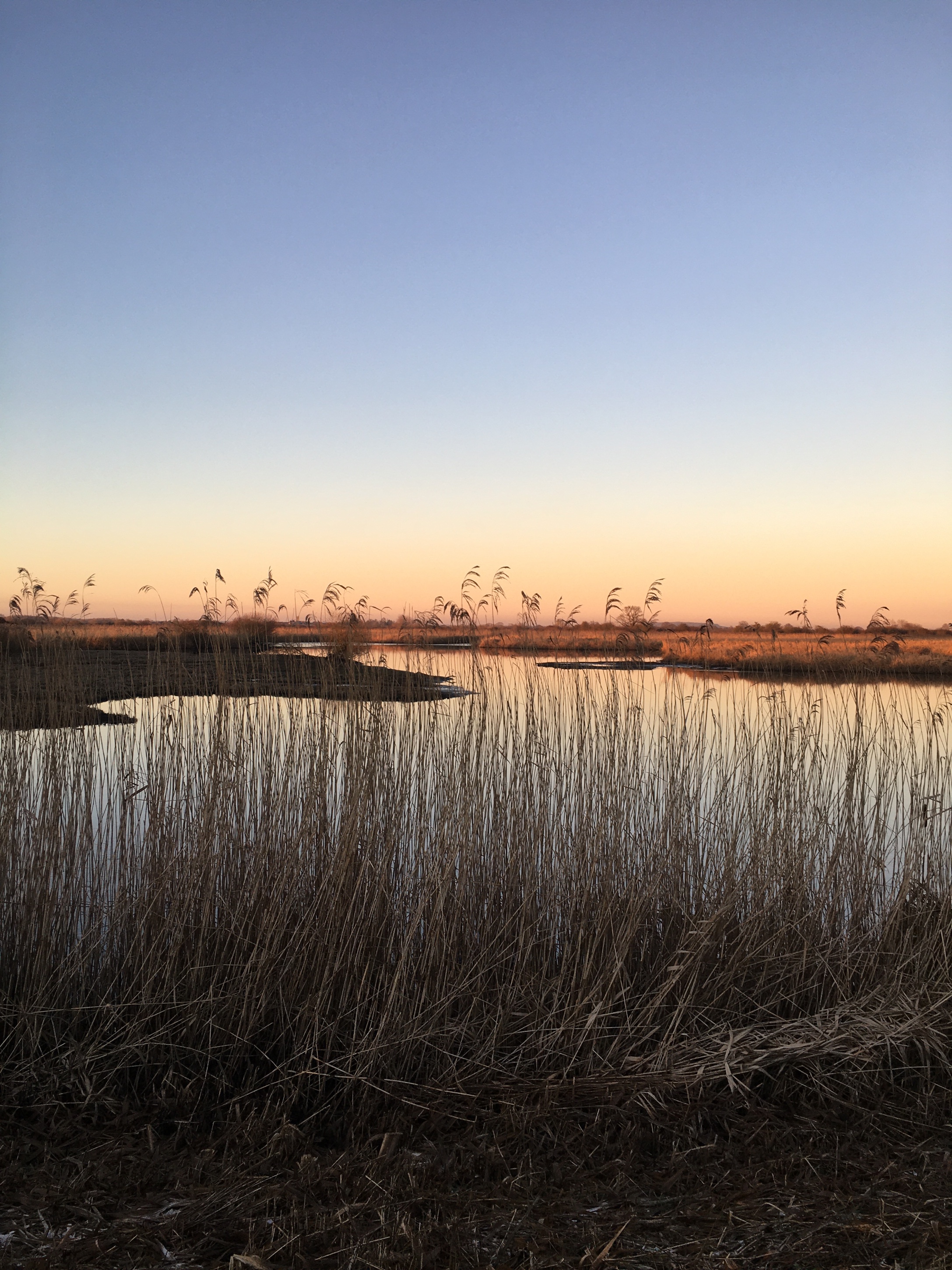
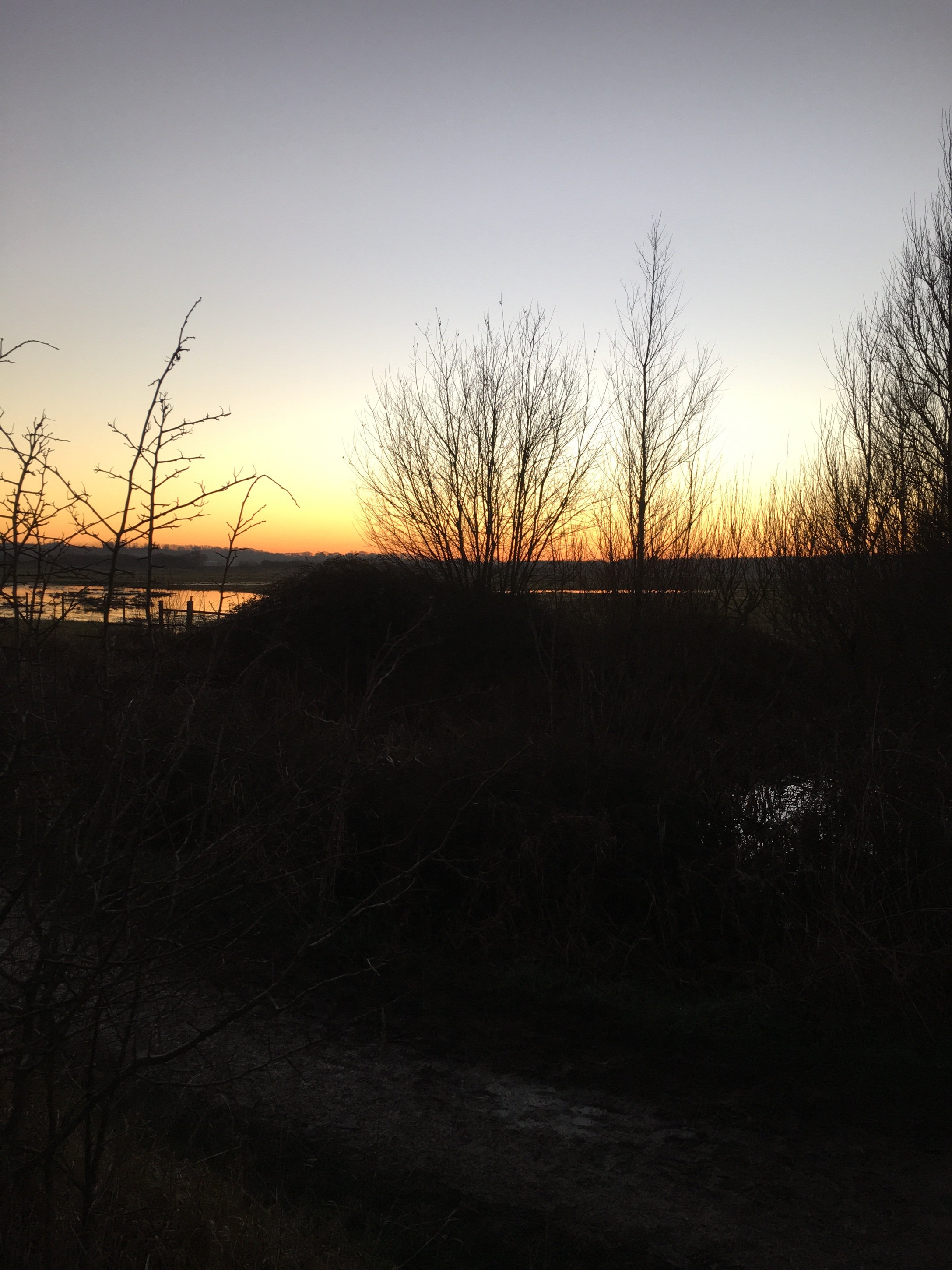
For our trip to the Otmoor Nature Reserve it was very different. We came in haste from the busy centre of Oxford through the twisty lanes and down to Otmoor, to throw back our hoods and watch the copper sunset and to see if we might get to watch the starlings and their drifting, balletic murmuration. We weren’t late, and more people came after us, some armed with sandwiches and massive-lensed cameras. In general we stood quiet, watching the other birds over the reeds and in the trees.
Shadows lengthen
The light was itself a revelation. The deeper golds and the encroaching blues were like something from a medieval stained glass window, lit from within – but in contrast to the enclosure of a building, we were engulfed in light and space spreading wider and wider.
And as it faded, our expectation grew. A Marsh Harrier grazes the tops of the reedbeds; a Heron flies over much higher; a flock of Lapwings tumbles hastily into the reeds, and one Dunnock spends a good five minutes rather eccentrically hopping between my boots and the brambles. And then, in ones and twos and then in larger groups, joining together or catching up with one in front, came the starlings. Thousands of them: rank on rank.
Just as a church often has a big congregation watching and a smaller number of active agents as singers and celebrants, in contrast here, the observers were few – maybe twenty of us? – and the celebrants we watched were many. Some birding is detailed, organised and serious – this is a good website to indicate what’s going on – but some is excited but familial, even jolly in a hushed sort of way. I’m not sure where Maggie and I were in this spectrum, but I do know that, amateur that I am, I was immensely moved.
The swirls and sudden plunges of each group were beautiful in themselves, like cloths shaken in the wind (Julian of Norwich’s image of sorrow as men shakyn a cloth in the wynde but we also talk of an exaltation of larks). All those animals moving to their rest. Do they pick somewhere different every night? Are they opportunistic? I wonder about that Harrier – could it grab from this abundance of life? Then I remember seeing a video of a Peregrine stooping, and I think of that marvellous appreciation of the hunting bird by J A Baker. All sorts of expectations and delights are tumbled in me, my own internal murmuration.
So the birds are rushing for shelter against predators and a chill night to come, and we are standing watching them – and it is dazzling. Why do we find this beautiful? The rich colours like they were being distilled to wintry essence, the rush of the birds (and their singing in the reeds that sounded like running water), the way the last of the sun catches in the ditches: there was an overload of beauty – but can we talk of this? Can there be too much?
Perhaps the simplicity of Mary Oliver is a way forward:
But mostly I stand in the dark field,
in the middle of the world, breathing
in and out. Life so far doesn’t have any other name
but breath and light, wind and rain.
If there’s a temple, I haven’t found it yet.
I simply go on drifting, in the heaven of the grass
and the weeds.
Mary Oliver: What Is There Beyond Knowing
I wish this were me, silent as I watch the crowds pass and gather over the fenny land beyond the trees and are then lost, but I bring too many words with me, I am already berating myself for my poor natural history knowledge; already, with photo after photo thinking of social media, of this blog. Percolating up, I remember Baker, but am also thinking of the Thomas Merton poem because I am pondering how this experience ties in with spirituality and I feel myself caught, somehow, between the intensity of nature and the anchoring of a moving encounter in something formal, regular. It is only when I come to write some notes that I realise how different this evening has been, inside-out and outside-in, from something enclosed, measured and organised. I am glad of the challenge. To use phrases from the Merton poem, the zero days before Lent are not just for huddling away, but for looking up, looking outwards, with eyes as clean as the cold sky.
C S Lewis, as first-person narrator of the opening chapters of his book Perelandra, is on his way to meet the protagonist, his colleague Elwin Ransom, whose voyage to Mars has disrupted politics at quite literally a cosmic level. Forces are at work to disrupt this planned meeting, and Lewis is walking along through the 40s blackout, assailed by doubts about the whole project, even his own sanity:
“They call it a breakdown at first,” said my mind, “and send you to a nursing home; later on they move you to an asylum.”
I was past the dead factory now, down in the fog, where it was very cold. Then came a moment–the first one–of absolute terror and I had to bite my lip to keep myself from screaming. It was only a cat that had run across the road, but I found myself completely unnerved. “Soon you will really be screaming,” said my inner tormentor, “running round and round, screaming, and you won’t be able to stop it.”
There was a little empty house by the side of the road, with most of the windows boarded up and one staring like the eye of a dead fish. Please understand that at ordinary times the idea of a “haunted house” means no more to me than it does to you. No more; but also, no less. At that moment it was nothing so definite as the thought of a ghost that came to me. It was just the word “haunted.” “Haunted” . . . “haunting” . . . what a quality there is in that first syllable! Would not a child who had never heard the word before and did not know its meaning shudder at the mere sound if, as the day was closing in, it heard one of its elders say to another “This house is haunted”?
C S Lewis Perelandra (“Voyage to Venus”) Ch 1
While the forces for good are depicted in some detail (an interesting essay here on the power of Lewis’ vision in the book) – and form part of the chorale that concludes this Voyage to Venus, the forces for evil remain only ever seen indirectly in this trilogy. Hinted at in the first volume of his Science Fiction trilogy, in the violent meanness and grubby colonialism of Out of the Silent Planet, they are felt in the Satanic possession of the scientist Weston* later in the Perelandra narrative, and then in complex ways in the pervasive and destructive work of the NICE in That Hideous Strength. At the start of Perelandra, we see the psychological impact of their power in how they try to terrify Lewis into turning back.
Lewis has a lot to say about landscape, both extraterrestrial (see his depiction of Venus (“Perelandra”) and Mars (“Malacandra” in the first book of the trilogy) and more clearly fantastic in Narnia. This passage (along with some in That Hideous Strength, but that’s for another time) shows his ability in describing an English landscape. Here it is an inimical outdoors that Lewis is writing about, a place of peril, a chapel of mischance. They are worth looking at: here is Marcus Sedgwick’s Dark Peak, in my mind as we come to the anniversary of my first visit to Thursbitch and Ludchurch; more here as I present the Wild Wood and the woods in Warrior Scarlet and others. The outdoors, as I have said before (maybe too often) are where the unwary get into trouble.
And Lewis is in trouble.
At last I came to the cross-roads by the little Wesleyan chapel where I had to turn to the left under the beech trees. I ought to be seeing the lights from Ransom’s windows by now–or was it past black-out time? My watch had stopped, and I didn’t know. It was dark enough but that might be due to the fog and the trees. It wasn’t the dark I was afraid of, you understand. We have all known times when inanimate objects seemed to have almost a facial expression, and it was the expression of this bit of road which I did not like. “It’s not true,” said my mind, “that people who are really going mad never think they’re going mad.” Suppose that real insanity had chosen this place in which to begin? In that case, of course, the black enmity of those dripping trees–their horrible expectancy–would be a hallucination. But that did not make it any better. To think that the spectre you see is an illusion does not rob him of his terrors…
Perelandra Ch1
And what terrors he puts into his landscape!
The basic terror confronting him is the animated nature of what he sees: the enmity of the trees, the one window staring. This is why, when the cat runs across the road he is terrified: for an instant this fear of the inanimate having will and purpose and movement takes over. It is not dissimilar from the fear of the boy Shasta in the fog in The Horse and His Boy, where the divine Aslan pads invisible beside him.
You’re not — not something dead, are you? Oh please — please do go away.
The Horse and His Boy, Ch11
and is in marked contrast to the area of England which starts Lewis’ SF trilogy, where the protagonist, Ransom, is on a walking holiday, and even dark bands of trees and a near-deserted house may hold misgivings but no terrors.
To return to his magnificent assertion
Would not a child who had never heard the word before and did not know its meaning shudder at the mere sound if, as the day was closing in, it heard one of its elders say to another “This house is haunted”?
New Buildings, Magdalen College. Photo by College President, Dinah Rose. Used with kind permission.
C S Lewis’ (and my) college, Magdalen, has had a number of ghost stories attached to it: the boy with the lantern seen in the small hours across the cloisters; a room in the old Grammar Hall where steps can be heard on the stairs, more recently the sighting of a group of shadowy figures and people hearing singing. I don’t know how ancient any of these stories are, although the boy and the steps on the stairs were current in the 70s. I wish I knew if Lewis had heard them – meaning either the stories or the singing and the footsteps – but certainly night time in an old Oxford college is a place to excite the imagination.
I am not sure Lewis in fiction or as the writer really believes there is an abstract power in the word “haunted,” although we should recognise, I think, that we have a number of cultural memes that are employed to notify us that something wicked this way comes. These emerge most powerfully in all sorts of ways in Perelandra, but get some reference in Ransom’s apprehension of some of the Martians in his first novel, appealing to an earlier, almost an infantile, complex of fears. Giants — ogres — ghosts — skeletons: those were its key words. In haunted, we have a socialised expectation: the sound of the word is associated with the fear the meaning excites, Whispers of living, echoes of warning, Phantoms of laughter on the edges of morning, as the trope in Bernstein’s Mass goes. It seems to me that using this tradition of the malevolent uncanny helps Lewis along very well, both in Out of the Silent Planet and in Perelandra. Bogeys, as Marina Warner suggests in her bookNo Go the Bogeyman, make present what we dread. This is currently being explored in Uncanny, a don’t-listen-with-the-lights-off series by Danny Robins for the BBC. Background sounds and music are brilliantly employed here, down to the slow, throaty theme song with the words “I know what I saw,” and its minor chords. The power of music to set a mood: here it is chillingly atmospheric.
The first seven notes of the Dies Irae (here is the chant) when part of a film score (a neat post here) suggest there are grim times coming (see the procession from The Devils where the link is explicit, or note the phrase adding another layer of menace to The Lion King), and Lewis suggests that haunted does the same. What he has done is to take us into a place where the connotations of haunted are given more work to do, and reflect the feverish imagination of Lewis-as-a-character. We don’t have to believe him, or associate the real Lewis with a belief in ghosts, but we can appreciate his ability to draw us in..
What we find ourselves exploring on this dreary path from a local train station is the fictionalised Lewis’ anxiety, and the landscape is his best aid. The dead factory is a great image, but even the down helps in down in the fog, and the cold, the dark, the little empty house by the side of the road, with most of the windows boarded up and one staring like the eye of a dead fish…. We seek the security of a building, whether we are Going on a Bear Hunt or resting in the Castle of Hautdesert on our way to the Green Chapel – cf Bachelard on “dreaming of security:” we might join Gawain in a sense of relief when he is welcomed and told
“Make yourself at home:” and it is a deep fear that Lewis plays on: buildings with plots and pitfalls we have not seen, or intrinsic menace, shift any hope of security away from us, and we may discover a home that turns out not to be home at all, a friend that turns out to be no friend, but something other:
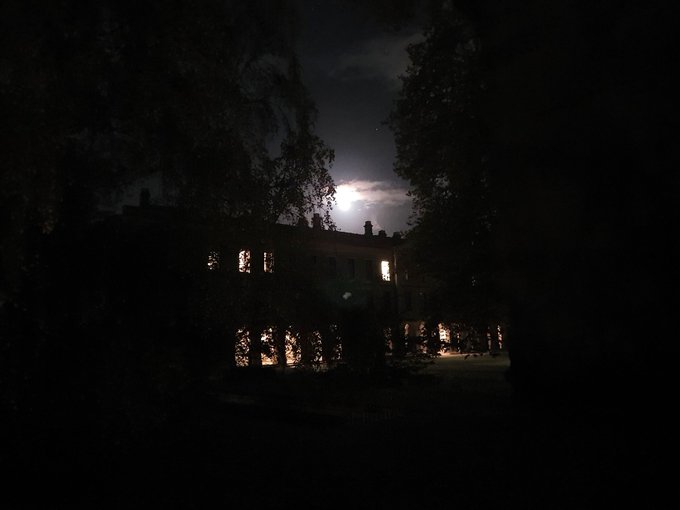
Full moon from my garden
Perhaps he would jump on me from behind. Perhaps I should see a figure that looked like Ransom standing with its back to me and when I spoke to it, it would turn round and show a face that was not human at all…
Perelandra, ch 1.
As Danny Robins explores What is it really like to live in… a haunted house? the comfortable family home that protects and nurtures us is violated by this fear, the fear that Michelle Paver exploits so well when, in Dark Matter, the narrator realises that the prowling, revenant fury outside his lonely hut can get in; it is the same as the moving sheets in the bedroom of M R James’ Oh Whistle and I’ll Come to you My Lad. The hotel room where M R James’ professor should be safe… the friend’s house where someone will make it all right… the arctic hut,,, the welcome at the castle… Yet the intrusion of the uncanny breaks one of the most serious barriers we have. As Solnit proposes:
the formal enclosed garden and the castle are corollaries to a dangerous world from which one needs to be protected literally and aesthetically
Rebecca Solnit: Wanderlust, ch 6 “The Path Out of the Garden.”
and as Warner suggests, Fears trace a map of society’s values. Perhaps not belonging is one of the deepest of them.
___________________________________
*and yes, I think of Professor Weston every time I visit the Weston library in the Bodleian. I do not, however, see it as a place inhabited by physicists possessed by Miltonian demons.
“The story could not be more simple or more perplexing” writes Peter Bradshaw in his review of The Green Knight, and this is as true of the new film as it is of the romance found in MD Cotton Nero A.x., Art 3. Here we are nearly at Michaelmas, a special time for me as I reflect on forty years of being married, and also the season when I think again and again of Gawain, and Garner, and the challenges of those trips up to the Peaks, and so this is well timed for me, even though The Green Knight has been much delayed, at last we get to see the new film.
It presents a game of colours and shadows that intrigues, delights (for the most part) and challenges: the costumes were fantasy-wonderful – the peculiar crown was a particular favourite of mine. The scenery was mostly well researched: if the forests were a bit Forestry Commission, the high moors looked wonderfully bleak – was that actually Thor’s cave in one scene? Maybe it was an odd way to get from St Winifrede’s Well to Lud’s Church, but in Oxford we get used to scenes of people crossing one quad into an entirely different college. Loads of fog, and silhouettes of the lost traveller while crows caw and perspectives shift. The Green Chapel – over-lush for Christmas, but teeming with a Spring promise of greenery – was everything one might imagine of Lud’s Church painted in mythic colours. While it is a retelling rather than a cinema version of the poem (but yes, there is a very quick flash of the MS at one point) it maintains much of the tension and the ambiguity, and sticks with one of the poem’s principal dilemmas: how does Gawain prove himself when he is so out of his depth? Yes, I did like it.
But there are holes in the film – some deliberate (unless I missed it, we are not given many names other than Gawain and his girlfriend: is this all in Gawain’s head, some sort of Mantel-like psychodrama?); some…well, I’m not sure. A lack of reveal about the witchiness of the plot was odd – and although the ‘magic’ of the women was brilliantly portrayed, I was unsure why we were left to infer quite what they were up to, with Gawain’s mother in on it all, and a creepy Morgana an olde auncien wyf for sure, unintroduced, wandering around Castle Bertilak. And are those ettins, the giants that sort of added atmosphere but not much else? And what was the fox there for? What was St Winifred doing there? A sort of nod to a topography of Gawain’s journey, or a quick footnote on the folklore of the headless? Lots of questions – and it won’t be a hard task to sit and watch it again – but did we really need quite such a dim and draughty pile for Camelot?
Ah yes, Camelot. It was a bold move to set distant castles on hilltops, and some times looking rather (let’s be generous) storybook – but once one of us had humphed “It’s only a model,” and Monty Python and the Holy Grail (that excellent parody of Medieval Mud and All imagery) had been mentioned, it took some time to recover.
Recover we did. Bertilak goes off hunting and so does Lady Bertilak, openly sexually assertive towards Gawain, and a sight more explicit than the poem – and she is given the best speech in the whole film, a quick mini-keynote on what the imagery of Green might signify. Then the kiss of Lord Bertilak to Gawain was just long enough, just suggestive enough to make you think that the Bertilaks are well aware of each other’s game. Gawain (well played by Dev Patel from young and lost in his first scene to old and lost in a scene towards the end) is caught between ‘real’ goodness and the fake goodness of simply keeping up the Christian chivalric code. How does this play out?
Bradshaw and I agree on how successful the atmosphere of “shroomy toxicity and inexplicable moral grandeur” is: the second half, with all that wet-dream (or whatever) tension and the might-be visions of eschewing the Green Knight’s blow is a genuine tour de force. I’m going to avoid spoilers – but the end is every bit as ambiguous as the end of the poem, and I have to say completely won me over. It’s only a game, the King tells us – but what kind of a game are we playing?









 nicktomjoe