
Fantastic animated version of Michael Foreman’s illustrations http://youtu.be/dR0L_aBp490 – but I’ll present this here sans paroles, letting the story speak for itself for now.
Tag: Traditional tales
Merlin, Arthur, Bath
No, not some odd piece of fan fiction: this weekend’s visit to Bath raised further questions about ‘real’ landscapes and traditional tales. It is certainly something of a tourist pull – I admit I felt it myself. Had the ‘real’ Arthur – or Merlin – sat where I sat on those steps? Might they have avoided the place as sordid, or unholy – or just plain ruined?
More thoughts here, anyway – or at any rate a long quotation from the Vita Merlini.
Alice
Some thoughts on Alice in Wonderland for the class Monday 16th August.
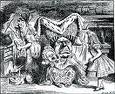
Key to my reading – and it is only my reading – of Alice is the theme that runs through a lot of my thinking: exploring the models of childhood in literature.
Looking at Chris Jenks’ dichotomy:
“The Apollonian child, the heir to sunshine and light, the espouser of poetry and beauty…angelic, innocent and untainted…”(Jenks 1996:73)
“The child is Dionysian in as much as it loves pleasure, it celebrates self-gratification….” (Jenks 1996:63)
Jenks C (1996) Childhood: Abingdon: Routledge
is Alice the barely reined-in Dionysian child, who, let loose in her dreams, finds her way home (to “dull reality”) by negotiating both models – in finding how to respond to the demands around her and stay sane – in other words, to grow up? Are we looking at some kind of spiritual quest for self-realisation? We might object that Carroll did not intend this – but again perhaps looking at what an author intended in a story made up just to while away an afternoon’s rowing is too fraught with difficulties. In any case, when Carroll is being didactic towards children – as in his Easter Letter – we know about it.
Of course the all-important commentary is the wonderful
Gardner M (ed) (2000) The annotated Alice: the definitive edition. London: Penguin
There are loads of other books, looking at Alice and Carroll biographically, from the point of view of psychoanalysts, logicians, mathematicians… An interesting way of looking at Alice might be to consider her not in the context of Victorian literature (and Alice abounds with cross-references here) but to the folk-tale inheritance and to her influence in later children’s literature: there is something of Red Riding Hood in Alice, but her literary ‘daughters’ (in Oxford terms at least) include Lucy from the Narnian chronicles and (perhaps by extension) Lyra from Pullman’s His Dark Materials. Is she also re-presented in the precocious Cordelia in Brideshead – or is the ‘secret door’ from Alice completely different for Sebastian and Charles?
For scholarship’s sake, I suppose I ought also to attempt a filmography, since my presentation makes mention of the Disney and Burton versions, but I haven’t time, since there are lots of others, too – a silent one from 1903 which I linked to here from YouTube being the earliest I can find.
And here, for what it’s worth, is the powerpoint:
Please note that since writing the Disney and Burton clips have been removed from YouTube for copyright reasons.
Wolves and humans
There are plenty of organizations concerned with wolves in the UK. This link takes us to a site selling hybrids very close to wolves not so much as pets as companions (the site warns) and this organisation is working to reintroduce
I visited these people, the UK Wolf Conservation Trust last nght. They see themsleves as principally concerned with education about wolves; their wolves act “as ambassadors” fulfilling the trust’s founder’s ambition “to dispel the myths and misconceptions that surround them.” It might be said therefore that by looking at long-term conservation through education they hold a middle way between the re-introduction approach and (if I can say this without sounding too damning) the “tamer nature” approach of domesticated wolf hybrids. Of course, taming, living with and breeding from wolves can’t just be dismissed as a modern fad; it could be argued it is one of our oldest animal-human relationships. I like to imagine the symbiosis of human hunters and wolf packs listening for and watching one another’s hunting movements (and maybe a long period where ‘we’ scavenged off ‘them’ and maybe vice versa – and the even longer period [which we are still in] where we compete for space and food, and then at some point in one of those periods, that first time a wolf stood cautiously to one side and some human threw her or him a piece of offal… Pure mythology on my part.
But if that’s my aetiological myth, I felt close to it at Howl Night last night. Hearing wolves howl spontaneously as the twilight deepened was wonderful; managing to tune my voice into howling with a wolf – specifically this wolf – got me thinking about why our voices can be so alike. A sort of convergent evolution suggests itself – the need to communicate in similar terrains for similar tasks with similar groups – and this leads me to the big question I want to explore,one I’m always exploring really: what is this relationship founded on, and what are its characteristics?
It strikes me there are two elements that I can explore – two interrelated issues I’ve already touched on in this post, but which I need to come back to: competition and symbiosis.
Do we fear and love the wolf because it competes – or competed at least – with us, especially when we moved to raising livestock which it took? It might be argued that we developed, perhaps, a respect, an understanding of it – but at the same time a rivalry, even a fear that occasional confrontations will have done nothing to dispel. Perhaps Steven Mithen’s fascinating book the Singing Neanderthals (an interesting critique is here) might have some insight – I must have a look back at this. I also wonder whether we fear and love the wolf because we have lived close to it, tamed and shaped it, and the pure wolf seems somehow to remind of this process? Is the former what gives us the werewolf, the predatory danger, and the latter gives us the named and befriended ambassadors we met and howled with last night?
The landscape of traditional tales
I am writing this when any sensible, diurnal person would be long in bed – where, as a penitential exercise, the monks of La Grande Chartreuse are about to perform the ‘reclaim the night’ they have done since their inception. But with a conference bid to complete tomorrow, and with Mark Rowlands’ enjoyable The Philosopher and the Wolf just finished, it’s time, I feel, to move into a more reasoned look at a question I’ve been mulling over for years, the question of where, exactly, is the landscape of traditional tales?
The most immediate answer is that I know where it used to be; it used to be on the doorstep of the storyteller. But of course it doesn’t stay where we left it, not least because we, the audience, have moved off. We moved off from clearings to common land to enclosed fields, and then to the towns, with our stories as cultural baggage in the handcart. We moved into a wolf-free country, then into a country where there is less darkness. We might argue that the stories we brought with us retained their currency because we brought the darkness with us too – but maybe this is a little fanciful, and while it might take us some way to an answer to a spiritual question, it doesn’t help me answer my research question much.
More on this when I can, in the research pages.
Correction and addition
I am no longer sure that the wolves were what was A l’envers in my previous post. What often moves around I this story is not, of course, the wolf, who remains the familiar predatory, possibly sexual bzou (this link has a lot of detail but I’m unsure about all the content!), but the girl. Is she little? Is she dressed in red, or grey, or what?
Why this should have struck me in the bath while reading Mark Rowlands‘ book on living with his wolf, I don’t really know, but perhaps I need to think more about the figures of the wild if I’m going to write about the outdoors, than about the children who go into the woods. More weasels, fewer moles.
Or at least, it’s a separate section – what one meets in the (fictional) outdoors.

Like this Cynocephalus.
More wolves – this time, a l’envers
I have two books in front of me as I write. One is the book I was going to write about – Sandra Beckett’s Recycling Red Riding Hood – the other (Rosa’s) is the movie companion for New Moon
It strikes me that the relationship between Bella and the Native American werewolves is in some ways a Conte a l’envers, as Beckett describes them.
Working from the writings of Gianni Rodari (who has more than seventeen entries in the Beckett index), she explores how Red Riding Hood has become such a universal tale that it is possible to play with the plot (including the Perrault text and images) as a tale told “Upside Down, Inside Out and Backwards.” And in finding a heroine like Bella Swan, and placing her in the situation she does, Stephanie Meyer effectively creates a Conte a L’Envers, a mixed-up version where a young woman in the woods is the one who holds the power over the wolves who are her friends, her would-be lovers. Bella smacks a werewolf on the nose as if he were a boy stepping out of line in a soap-opera prom; we are somewhere Angela Carter might recognise.
As something of a footnote, it is interesting to see this reversal taken even further in the movie book I have in front of me, where the wolves, however terrifying they are as wolves, are, in human form, mostly young and lacking in much body hair, exemplified in the website a – very far from the older, predatory wolves in so much of the Red Riding Hood iconography, yet drawing on the idea of the wargus (see this entry) as on the margins of society.
Beckett takes the wonderful Zipes exploration of Red Riding Hood to a new stage. She uses a European overview – rather she uses an understanding of countless retellings in Europe – to look at what Rodari calls A sbagliare le storie, Getting Stories Wrong, and what other contemporary writers identify as Upside-down stories. Ths method is exemplary; it allows Beckett to explore the variety of Riding Hood stories (if Zipes removes the ‘little,’ Beckett presents a rainbow of different coloured hoods!), and in doing so to look again at what makes this story so special. Hats off to her – hoods down, whatever – for updating the critical literature to include exploration of two lacunae in Zipes’ book: The wolves in the Ahlbergs, notably in Jeremiah in the Dark Woods and the Jolly Postman, and the RRH tales of Roald Dahl’s Revolting Rhymes.
Suffolk Chalk Pits
More questions than answers in this post: a work in progress.
The more I think of there really being chalk pits in Suffolk, the more I want to explore more deeply my assumptions about the universal mythic landscape. A sideline about a pub called “The Lime Burners” and here is their link – suggests to me all those out-of-town (or out of settlement) occupations that might have been part of the storyteller’s landscape. Quarriers, limekiln workers, miners (like the seven dwarfs?), charcoal burners – all people whose occupation maybe allowed them a little latitude. It is interesting that charcoal is now something of a tourist attraction, even mentionedin the sanitised Suffolk walks discussed here. I suspect no-one on these well-signposted walks will discover demonic figures gleefully plotting by a fire!
Is this part of a warning myth, as I’ve speculated before? Part of a recognition that people away from the huddle of village and town are not recognised? Not “one of us”?
Philip Pullman, in today’s Observer, is deep in Bettelheimland when he talks about the Fairy Tale protagonists and their struggle for Independence and adulthood – and maybe this is where the two themes intertwine, although this is merely conjecture:
Is there a warning about the ‘others’ in the woods because they are dangerous, or because they represent a possible different set of choices? A world away from the close-knit and settled farming community?
Or is it that, for adventures to take place for the young, the protective adult needs to be absent?
It doesn’t answer my query about Tom Tit Tot, though.
I got away to a place in the wood I’d never seen before

A significant detail in Jacobs’ telling of Tom Tit Tot, especially since this story has a cognate in Rumplestiltskin that has rather that precedence over the English version, and according to a much earlier commentator, has much in common with a range of stories world wide in which magic secrets overheard allow someone to escape some nemesis. The English story, of course, needs the demonic Tom not to be readily available, but his not expecting to be overlooked is itself worth mentioning. The creature is in ‘an old chalk pit’ – a hollow away from sight, like the dwelling of Stig in Clive King’s book – but an oddly accurate topographical detail. Does this suggest a particular place to the original tellers and audiences? Or a particular kind of place?
If we assume Edward Clodd is correct that this is a Suffolk tale, we could ask where are “The Woods,” or “Woods with Chalk Pits?” This one, perhaps? But does a mythic landscape need this? At times it does: stories that explain why a geographical feature is how it is depend on the audience knowing the site and wanting an explanation of the feature. Sometimes the post eventum nature of this might seem obvious, as in the Robin Hood connections in Sherwood or the strong suggestions of such at Tintagel. At times certain features are needed for the story: a church, a path (a crossroads for Bzou – see earlier posts), but in general woods becomes The Wood so that The Witch can live in them; they are universalized by being used as the stage set for mythology.
Outside Over There: The story of the Grandmother
It was interesting reciting the edgy DeLaRue/Zipes’ reconstruction of the Story of the Grandmother to PGCE students in the woods today, those lovely dappled woods where the magpies chatter and one group saw a deer and we all felt at ease with children in the outdoors. In some ways it felt rather like the side-by-side comparison of Red Riding Hood stories on Katherine Harris’ site or rather the student project on the site
And it set me in mind of the power and transferability of Sendak’s Outside Over There, represented in Labyrinth , where themes such as burgeoning sexuality, sibling rivalry – not to mention the more complex issues of siblings and new babies in reconstituted families – are dealt with so openly. Is OOT more menacing because of the subtler treatment of the themes? Or is it merely ambiguous to the point of being open to any interpretation?
 nicktomjoe
