Omens

It’s a spring day as March comes to its “out like a lamb” ending. The sun is shining and I’m out on Warneford Meadow, treading through tufty grass, and along paths worn by commuters. It is our local Green and a valuable space, with a rich and (I suspect) growing biodiversity.   I am one of a number of visitors, human and non-human – and as I trot down one of the paths I see a bunch of magpies. The Opies record the rhyme as:

One for sorrow
Two for mirth
Three for a wedding
Four for a death.

Lots of other versions are on record, testimony to the respect  people (maybe) had for these striking birds as messengers.  The Boke of Saint Albans has, in its lists of the Compaynys of beestys and fowlys has a tiding of [mag]pies (but beware: I’m not sure I trust a list with  Superfluyte of Nonnys or Noonpacience of Wyves)…

One for sorrow,
Two for joy,
Three for a girl,
Four for a boy,
Five for silver,
Six for gold,
Seven for a secret,
Never to be told.
Eight for a wish
Nine for a kiss
Ten a surprise you must not to miss.

(It received a boost by being the theme tune for the Thames TV production of Magpie, ITV’s Blue Peter Rival, when perhaps other customs and rhymes have fallen by the wayside – but that began when  I was the key audience: a long time ago, now.)

Back to Warneford Meadow as I slog over a possible Roman settlement and try not to think about the Quis Est Iste Qui Venit of such a run.   Nine magpies, then as I approach it’s four then seven and then just one. What do we make of portents whose mobility makes the I Ching look solid?  Well, of course, we don’t, in general; it’s a bit of mind play while I run.

I remember that as I qualified as a teacher, the National Curriculum was just coming in, and the course leader was ending his goodbye speech to the PGCE with “May you live in interesting times.”  He did not foresee where we might be today: if we were only contending with conflicting views about curriculum that would be enough, but we have Schoolsweek announcing scandal upon scandal, Unionist bands and racists openly on the streets in London vying for publicity (and no, they don’t get links) with crowds and crowds of people with more politeness and less threatened violence, a Parliamentary struggle the likes of which I have never seen before… These are interesting times, but not in a good way. There are no signs or portents to match all of this rubbish.

And while I trundle my sixty-something way and wonder about what the list of magpie numbers might portend (I really did get the one above the other week), part of my mind is wondering: instead of nines and sevens am I just seeing magpie after magpie after magpie? Sorrow and sorrow and sorrow?  I don’t think I have ever felt gloomier about the state of my country and my profession.

So instead of corvid fortune telling, I will end with part of my play list for running:

Nina Simone whose version of Billy Taylor’s anthem to Freedom has been a lifesaver this winter.

And while we’re at it, her singing of Randy Newman’s great hymn to compassion.

Sod the magpies, stuff the omens: this is what we need.

Back into Storyland

Let’s start with the lyrics:

When a knight won his spurs in the stories of old
He was gentle and brave he was gallant and bold
With a shield on his arm and a lance in his hand
For God and for valor he rode through the land

No charger have I, and no sword by my side
Yet still to adventure and battle I ride
Though back into storyland giants have fled
And the knights are no more and the dragons are dead

Let faith be my shield and let joy be my steed
Against the dragons of anger the ogres of greed
And let me set free with the sword of my youth
From the castle of darkness the power of the truth.


I loved this song as a child: perfect Junior School Assembly stuff. I sang it in college with my friend Robert, too: a shared memory of school even though we hadn’t known each other. It colours, also, my understanding of fantasy literature: the wistfulness is something of a challenge and full of the pull of nostalgia, and for me (some way from assembly in Harlow), this folksy version by Martin Simpson of it really rings a chord.

I’m not swapping from wolves to dragons as an interest, but just to record, for National Storytelling Day, the wonderful variety of dragons. Here are some of my favourites, drawn, I ought to say, from the European tradition. The song I’ve cited above always reminds me these days of Tomie de Paola’s The Knight and the Dragon, where the luckless knight and dragon come to terms with each other, make peace and live happily. But there is also Eustace in  C S Lewis whose encounter with – and transformation into – a dragon are an allegory of sin and redemption; there is Rosemary Manning’s urbane and charming R Dragon, standing for the whole of Cornwall, wistful for the time of Arthur; the urbane and vain dragon defeated by The Paper Bag Princess… And there is Smaug the Stupendous.

It seems to me that dragons are (like wolves) personifications of a certain type of aggression, and that the fire they are often surrounded by is its potent symbol. Michael Martchenko‘s wonderful fire in the Paper Bag Princess has it all: all-consuming but ultimately exhausting. And at an uncertain hour, when anger is rife, maybe storytelling can remind us of this: those dragons of fear and anger (and criticism and self-doubt) are in the end going to burn themselves out.

Sauron’s Mission Statement

O Felix Culpa, O happy fault. (Here at 6’14” in English and here at 5’49”  in the original Latin).  Lent is here, the Easter celebrations (from which this quotation comes) will soon be here. And I’m thinking about Evil, or more specifically what fantasy writers envisage their real big baddies are after. I don’t find it straightforward.

In one of the best recent meditations on good and evil – maybe the Best, and certainly the funniest – Good Omens,  Adam, the child who is supposed to be the AntiChrist is entertained with this rhyme:

Oh the grand old Duke of York
He had Ten Thousand Men
He Marched them Up to the Top of the Hill
And Crushed all the nations of the world and brought them under the rule of Satan our master.

This comedy underlies one of the principal themes of the book, in which the mundane and the transcendent meet in drily witty distjuncture and/or a poignant juxtaposition of ideas.

And there never was an apple, in Adam’s opinion, that wasn’t worth the trouble you got into for eating it.

O Felix Culpa.  This is a comic-book version – a satire, really – of the Bosch-like vision of Hell: at heart Pratchett and Gaiman are looking at an anthropology of good and evil, not a grand theodicy, and Adam, the boy at the centre of Armageddon escapes the wrath of God, the disapproval of his demonic progenitor and the very real discipline of his earthly father to and go and play, “half angel, half devil, all human…” with an apple or two he has scrumped on the way.

And in this satire of the Apocalypse, Hell is seen not only as painted in C16th horror, but as an antiquated and bullying bureaucracy; Heaven is imperious and out of touch, The downright nastiness of a Medieval Inferno is offset by an inability to manage modern technology; rank on rank the hosts of Heaven don’t really know what God plans are for Armageddon. These failures of evil occur elsewhere: the Big Bad  (were)Wolf in Grandma’s bed is fooled by Red Riding Hood needing a poo, and his descendants, such as Catherine Storr’s Stupid Wolf,  or Wile E Coyote  have similar problems.If we were to apply to other narratives the same comic mismatches, we might find Sauron losing his keys or Voldemort not managing a bus timetable.

Very often Bad does not triumph, it seems, because it is inefficient. This inefficiency  allows Good to triumph and Evil to defeat itself. Maybe the best look at the ineffectual evil sidekick for me are Pain and Panic, whose plain idiocy is a thorn in the flesh for Disney’s marvellously impatient Hades in Hercules.  However, although minor characters in Rowling’s battle for domination are allowed comic inefficiency, and the mean squabbles of orcs allows Tolkien a sideways swipe at something that falls short of Evil, a dull, malicious nastiness, there are in the big baddies of fantasy depictions of evil that go beyond the silly, the clumsy, the mean. What stirs in Earthsea, the intrusive Dark in Susan Cooper’s sequence: these are not to be discounted as minor threats.  It therefore becomes important to ask: what are they evil for? Why are these presences evil?

What these great Lords of Darkness are hoping to gain is not always clear. If we suppose Sauron gains the One Ring, and the new Age that is ushered in is his dominance, the destruction of all beauty, the enslaving of the free peoples, then what? And why?

Sauron is given a backstory in the Silmarillion in the Lucifer-like fall of his master Melkor, Morgoth, the dark Enemy of the World, so that

…he rose like a shadow of Morgoth and a ghost of his malice, and walked behind him on the same ruinous path down into the void.

but this is still insufficient. Malice might be at the heart of the dominating and destructive works of Sauron and Melkor, and a part of their destruction, but at the start we are not really sure what they intend but destruction.

At one level, they are evil the way they are evil in order to provide the foil the good guys need: that there is a personal element to Voldemort’s hatred of Harry Potter is one of the strengths of the series; the growing malaise in Earthsea likewise gives the books their unique flavour. At another level it can be argued that these evils reflect a societal understanding of what evil does, and in many cases there is either an explicit description of how that evil has come about in the story or in a further text (such as the Silmarrillion): a Fall, of sorts, and a touchstone for what the author/audience might see as evil.

But how do they make sense of their existence? What, to turn to my title, are their aims and mission? What is their spirituality? In a moment of clarity, does Sauron at some point think “today was a day well spent”? What are Sauron, or Voldemort, or Cooper’s Riders left with if they triumph? It seems to me they have (only) Milton’s vision of

Regions of sorrow, doleful shades, where peace
And rest can never dwell, hope never comes
That comes to all; but torture without end
Still urges, and a fiery Deluge, fed
With ever-burning Sulphur unconsum’d…

Perhaps that Nash-Tolkien  vision from the World War (think Menin Road or Wire as images of destruction, both linked here in the IWM) is simply of a grim, spreading, malicious destruction. The malice of the orcs, the cruel, sniping pettiness of Rowling’s OfSTED-like Dolores Umbrage are part of the bigger project as they pick apart anything good or beautiful.

The overall project, the destruction of human endeavours to be complete, at one, seeking peace and truth is what Sauron and Cooper’s Dark (and maybe Voldemort) are trying for.  To see this vision we might compare Nash’s Ypres Salient at Night with Tolkien’s account of the triumph of evil in the Fifth Battle:

Great was the triumph of Morgoth, and his design was accomplished in a manner after his own heart: for Men took the lives of Men and betrayed the Eldar, and fear and hatred were aroused among those that should have been united against him.

In other words, for Tolkien’s personification of evil, the engendering of destructive hatred is the end…

For Rowling? Apart from his vendetta against Harry Potter we only seem to have Voldemort’s desire for power: the struggle to frighten, to subjugate, to use those who admire and fear that power to bring more people under his rule. Is there a weakness in the narrative here – or is the threat of this fear, the menace that comes with his followers enough? Sauron  brings about strife and disunity; Voldemort seeks power and uses fear to recreate the world to his own ends. That leaves me with Cooper’s Dark and LeGuin’s failing powers. I think they are a subtler depiction of evil and will have to wait for another day.

Persisting Fairy Tales

Once (of course) upon a time, there lived three disciplines, and they lived in a cottage in the woods or possibly on separate parts of a campus. The Big one was called Anthropology, the Middle-sized one was called Folklore and the Teeny-tiny one was called Children’s Literature…

And one day Alan Garner and a whole load of other people threw open to all of them (rather more than three!)  the question

Where are your stories?

That question, which he asks in story-form as well as lectures, might be seen as being as disruptive as the breaking-and-entering “delinquent little tot” Goldilocks’ intrusion into the bears’ cottage. In Boneland – not Children’s Literature, I know – Garner asks his storytelling ancestor this massive question about the roles of story and culture. The Man says he “dreams in Ludcruck…the cave of the world” and in response to the question about stories, begins with an origin tale about Crane. The Man’s stories (which are, after all, Garner’s stories) continue to ring true for the human newcomers to what we now might call the Peak District, and so his dancing and singing are not in vain: the stories are handed on. Garner talks about this relationship of place and story passionately, eloquently. They become origin stories, spirit stories, and mix with concerns through the ages to give Garner his alfar and his Morrigan. This kind of reconstruction and continuity gives a lot of power to the way Garner (and Townsend and Rowling and Pullman and Lewis….) themselves tell stories, drawing some of their authority (if that’s the word) from storytelling of past times. If there is continuity here it is because folklore scholarship has enabled a sort of  continuity of sources. Leafield’s Cure-all Water, its Black Dog, all the Black Dogs maybe, and the standing stones at Rollright and elsewhere are examined by writers such as Katherine Briggs and Neil Phillip and often re-presented by Briggs, Lively, Rowling et al. One form of continuity.

We see another in the engaged and detailed work exploring landscape and language in Rob Macfarlane’s Landmarks which, as he writes of Richard Jeffries, is

fascinated by the strange braidings of the human and the natural.

Here, language is seen to contain elements of older land use, beliefs and practices. Sparrow-beaks explain fossilised sharks teeth and a tuft of grass looking like a bull’s forehead is bull-pated in Northamptonshire.

I have written before about folk tales that explain places, and how these “fairy” tales do provide a sort of continuity, although I think that possibly the syncretism of European story and British folk tales brings its own obscurity: Garner is on his own ground by Seven Firs and Goldenstone, but he is not suggesting that le Petit Chaperon Rouge lived in Congleton.

Where we get into trickier areas is when folklore is pulled into service elsewhere. Gargoyles and grotesques become evidence of a continuing belief in goblins; stories of boggarts become somehow real. I have looked behind me in darkening woods, been impatient to leave a lonely valley, and must acknowledge the pull of this argument, just as Garner steps (nimbly) between his own writing and rural practices and traditions in discussing the roots of his great novel Thursbitch. This talk is chilling, enlightening, inspirational – so that Big Bad Wolves, the Green Knight, Garner’s vision of story and space walking together pepper this blog:  turn but a stone and start a þurs. 

But can this is universalised?   I suppose my problem comes down to how much is understood but not spoken and certainly not (until recently) written. Can we see a Jack-in-The-Green and know for certainty this is the same as the carving on that roof boss, and that this is a continuing belief?  Can we really link Star Carr and Abbots Bromley? Did my great-grandma know quite who she might be warding off by crossing the fire-irons at night?

I would love to see those links clearly. We have tantalising hints, shadows, half-stories (Katherine Briggs’ doctoral work documenting the continuing traditions in literature in folklore across the Interregnum is fascinating) that might lead us in all sorts of directions, and Garner’s defence of place and story should not be overlooked. Rob Macfarlane’s “strange braidings” go between town and country but also between present and past, and how far back they link and join we can speculate  – but we cannot know. Briggs puts it well when she comments on the recurring concerns in Arthurian stories:

A remarkable thing about the Arthurian stories is the way in which primitive themes reappear amongst the most sophisticated embroideries. It seems as if the matter of Britain had a magnetic quality which attracted every type of myth towards it

This “magnetic quality,” it seems to me, is a good image of how Children’s Literature, especially when it explores themes that themselves arise from traditional tales, draws to itself fears and triumphs from former times. Piers Torday’s There May be A Castle is a good example, where quests and knights and woods and danger are explored: Abi Elphinstone, too, works magic here. Perhaps our best bet is to see that similar concerns – fears of the outside as well as celebrating its joys, the worrying menace of wolfish men, women placed outside the Christian context by their (sometimes useful) cunning, half-seen wanderers in a twilight wood –   continue to be represented in cult and place and story.

Apologies for the weak ending here: I think what it means for me is that, studying Children’s Literature I have to pay due attention to Anthropology and Folklore as fundamental to my understanding of so many works I want to study. You can see it clear as day in Garner’s Elidor or Weirdstone – but what about other books – younger children’s books, for example –  I am trying to look at, where the outdoors is a challenging place?


A Carol

…from John Masefield’s The Box of Delights. Presented here without comment – which perhaps is for a future post. – except that in Masefield the even lines are indented.

George took his lantern from the nail
And lit it at the fire-a;
He said, “The snow does so assail,
I’ll shut the cows in byre-a.”

Amid the snow, by byre door,
A man and woman lay-a
George pitied them, they were so poor,
And brought them to the hay-a.

At midnight, while the inn kept feasts,
And trump and whistle blew-a,
George heard a trouble in the beasts
And to the stable drew-a.

And there within the manger bars
A little child new born-a,
All bright below a cross of stars
And in his brow a thorn-a.

The oxen lowed to see their King,
The happy donkey brayed-a,
The cocks and hens on perch did sing,
And George knelt down and prayed-a.

And straight a knocking on the door,
And torches burning red-a,
The two great kings and Melchoir
With robes and wine and bread-a.

And all the night time rolled away
With angels dancing down-a;
Now praise we that dear Babe today
That bears the Cross and Crown-a.

Oldtales

Reading Peter Dickinson’s The Kin is intriguing. I am not yet finished, but want to take a bit of time to think about stories of origin and how he creates and presents them in between the narrative chapters, the things he calls the Oldtales. Origin stories are interesting in Dickinson because they illuminate the actual tale of the children of the Moonhawk Kin, and their relationship to the places through which their Kin travel.

However, preparing a blog on them I thought I would go back to source books that in turn illuminate “our” own origins (the “our” is in doubt, of course, because of the ways in which increasingly we view our origins: Chris Stringer and Adam Rutherford, for example,  give us lively accounts of a trail of humanity that does not include Adam and Eve).  I went back to Mircea Eliade to read of the ‘African High Gods,’ of Ngai, of Ndjambi Karunga, and to read the beautiful Hymn to Shamash from Mesopotamia and prayers of a !Kung hunter – and I thought of the stories in Genesis that explain Mamre and Moriah, Beersheba and Bethel. The connections to Peter Dickinson (whose books tell us he was, as a long-term project, often to be found exploring myth and religion in his writings) are really interesting, but didn’t illuminate what I was looking for. How does these stories resonate with the reader?  Joseph Campbell’s Hero with a Thousand Faces brings me, tantalisingly, to the Bacchae and thence to Thursbitch (“O Bonny Bull”), but again and again I find myself looking at the first stories in Genesis.

They are worth a read in an attempt to see quite what they have to say about earlier views of where we come from, but as Robert Alter in his Art of Biblical Narrative suggests, we need

…some detailed awareness of the grid of conventions upon which, and against which, the individual work operates… am elaborate set of tacit agreements between artist and audience about the ordering of the art work…

and he warns that when we look at biblical narrative

we have lost most of the keys to the conventions out of which it was shaped.

This gives Dickinson a free hand in creating the stories that illuminate the main narrative, of course, and the creation of the Good Places, the multiplication of the sons of An and Ammu – so that these “folk tales” are all distinct, sort of working with the main narrative, sometimes not (yet) – but the opposite is true when we look at our own old tales. We are encouraged, I think, to see them as part of a single book, The Bible, when it might be better to see the biblical texts as a collection – and Genesis itself to be a collection within the collection. All of a sudden I am back in my Old Testament tutorials as an undergraduate, reading Gerhard von Rad.

Von Rad proposes a number of narrative sources, “woven together more or less skillfully by a redactor.”  This, in part, explains the two creation stories at the start of the Genesis collection “In the beginning God created the heaven and the earth” and then “These are the generations of the heavens and of the earth when they were created, in the day that the Lord God made the earth and the heavens” which leads to the next story beginning “Now the serpent was more subtil than any beast of the field which the Lord God had made.”  The gods (in the plural form Elohim: we are already into controversy here, but remember that “God said, Let us make man in our image, after our likeness” not to mention the “sons of God” in chapter 6) make choices about the world: reading these stories out of their stained-glass attitudes we have a different sort of world, closer to the movements of Dickinson’s Black Antelope, where the text of Genesis is “de-Biblified,” taken as origin-text rather than sacred story.

Except, maybe, all origin-tales, to sound “right” to us, have an element of sacred story about them?  I think I have a lot more to think about.


Codicil: 

The amazing Neil Philip, on Twitter, has helpfully informed me and Mat:

The Genesis Rabba, a Jewish commentary of c.400 CE, says that while G-d created Adam in his own image, this likeness to G-d only lasted until Enosh, son of Adam’s 3rd son Seth, after which humanity degraded and acquired faces like apes. Also says humans had tails like animals.

Loads and loads more to think about then!


Place: literature as guide

This blog – or rather its predecessor – explored place rather a lot. This summer’s trip to Santorini was in part inspired by reading Clive King’s The 22 Letters; Gawain and Ludchurch (“Lud’s Church”) are all over it, too.  I have read about places and gone there; I have gone to places and read about them. I read The Canterbury Tales and Mydans’ novel about Thomas Becket and then went to Canterbury.   It set me thinking: what might I have made of Paris if I had read Vango first?  (After all, after I’d read Becket and its – erm – inspiration,  the novel by the great medievalist Helen Waddell, I was disappointed to find so little left of the Paris they describe. In fact, although there is more around Notre Dame than is immediately obvious, there is more tangible stuff left of Clive King’s Ancient Thera in the tablets of Linear B and the archaeological museums than there is of the ill-fated lodgings of the twelfth century canons of Paris.)  How do we, as adults, use the written word to tell children about the physical world? How might we (or do we) use story? How might this, in itself, change the visitor’s ideas?

And if Vango might have changed my view of Paris, what of Selznick’s Hugo Cabret? Or Kipling’s or Milne’s Sussex? I could go on…  and that’s before we start thinkng of places responding to their visitors – where Canterbury’s rebuild was prompted by its visitors, and Paris still holds the echoes of the Hemingways and Steins so wonderfully celebrated and parodied in the film Anastasia in Paris Holds the Key to Your Heart (of course Paris is particularly susceptible to this myth-making, as is Oxford, my city of aquatint and commuting).

But  then we come (of course) to Garner. The creation of the Alderley phenomenon, drawing on myth and legend, changes a bit of whimsical parkland with a few stories attached into a mythic landscape out of all proportion to the stories that we can find readily. It does so almost entirely because of the authochthonic outlook of Alan Garner. We find ourselves in this place or that seeking to see with his eyes, following his train of thought, his access to myth and legend. We are tempted to try and see his Alderley, his Thursbitch, his Ludcruck.  Gawain and Beowulf are in his sights; we peer into his horizons and try to see what he is pointing out.

But let’s broaden this out. As I have discussed before, there are clearly places that have myths or legends attached, where stories have been piled up. The Cheshire/Derbyshire border is one such; maybe Oxford is another, or Paris, or Tintagel. Part of the project I seem to be involved with is the uncovering of these story cairns – but there is another part: it is the job of the critic of children’s literature – or some of us – to look not only at what has been collected, but also at the effect of the stories on the visitors to the landscape.

What does the young visitor make (and here we are in the recent Twitter conversation that started my thinking) of Venice having read about the pig Olivia and her visit? And how might the adult draw on this in September to help the impressions of the visit stay vivid?

Shelving

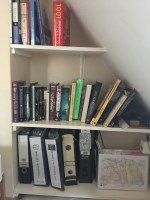
After years of accumulating homeliness, leaving my Brookes office was a dreadful thing to do; hasty, almost punitive. We left for Greece the day after my Brookes contract came to an end, with thoughts of Prospero set adrift echoing through my reading. My books of img_9972magic – of Wild Spaces Wild Magic – were set up, but the rest was just boxes of stuff.

The boxes were sulking when I returned, but with a  bit of coaxing, they began to find ways into the study. Joe helped by taking me to Ikea and then helping with building the shelves. I did that job I had called “tonking”when I was a library assistant: setting the shelf heights by sorting out the supports or tonks. And after that it was shelving.

I decided to divide the books into “children’s literature” and “lecturer-type” books, with Wild Spaces Books on their own, starting with Molly Bang’s Picture This, through some (but not all) the Robert MacFarlanes, ending with Z is for Jack Zipes. There were boxes of liturgical and Biblical books – a very nice Liber Usualis, for example, and my battered Greek New Testament – too, but I set them to one side. I looked at the children’s literature and set to. They were in boxes roughly alphabetically, so that a pile of Anholts came out together, and more Mairi Hedderwick than I thought I had; but they weren’t in strict order, and there were gaps. This means that books that had not met for years suddenly were leaning against one another: Sheila Cassidy’s retelling of the Creation was up against Michael Foreman’s eco-committed texts on one side and David Almond’s Skellig on the other. More arrive and these congruences shift: Roald Dahl and Lauren Child budge in; Noel Langley’s Land of Green Ginger, with its rather dubious racial stereotypes, squeezes in with Virginia Kroll’s Masai and I. It’s a bit like rush hour, but they all do get  in.

Size is an issue, and while I create “Outsize” shelves, for a while it looks like MacFarlane and Morris’ The Lost Words has no home, until moving the Little Tollers downstairs makes space in Wild Spaces Wild Magic, between Landmarks and W G Hoskins The Making of the English Landscape. Some of these juxtapositions are just right.

Biblical and liturgical find a home like the sparrow in psalm 83.

img_0245

The grown-up books fill higher shelves, partly in case grandchildren want to browse the lower ones for books that are “for” them, but here it begins again: for a good while, Philip Pullman’s Daemon Voices snuggled next to Rob Pope’s English Studies, until Francis Pryor arrived with Steven Pinker and the Opies. Julie Fisher rested against Ralph Waldo Emerson for a while (or was Emerson the one doing the leaning?); Caspar Henderson and Geoffrey Grigson met briefly, as did Jackie Musgrave and T H White.

It’s all a lovely conceit, as if this crowded Tube train of office shelving means that Simon Schama and Chris Stringer will get chatting as their covers touch, or Katharine Briggs
will strike up a conversation with Jane Carroll as they squeeze together.   But of course they won’t. It may be that George Monbiot does talk to Sara Maitland, but they don’t do so on my shelves. Here, that’s my job. Because if this blog has point beyond a rather vain showing you (dear Reader) round some of a really quite small collection, it is this: books “talk” to each other only in the person who reads attentively and makes connections. We become passionate about this idea or that, but it is the reader who is in a position to connect playing outdoors as the Last Child in the Woods with the Hermits and the New Monasticism of the eleventh century (Louv and Leyser). Alcuin of York reminisces O quam dulcis vita fuit dum sedebamus in quieti … inter librorum copias, but I might respond O how sweet life is, Blessed Alcuin, where we sit and read in quiet and let the ideas inspire and jolt and fizz and mix…

We are where the debate takes place, where critical thinking emerges. Not reading alone, but thinking and speaking and mulling and writing – and maybe reshelving our ideas in a different order from time to time.

Take Off Your Shoes

A reflection on the sacredness of an “interior space” has to start (for me)

Lud

with a confrontational image of the sacred, something commanding awe and wonder.  Guess which I might choose?

However, I also have to admit that although this is one of those places I have encountered the huge and numinous, I kept my hiking boots firmly on. We are already into the language and symbol and metaphor. With Lud for me the enormity is an understandable link back in time to ponder what “sacred” might mean: is it just about respect, or something rather more complex?

What’s with the shoes?  The taking-off of real or metaphorical shoes is meant to signify vulnerability, maybe.  Certainly the practice is really ancient, and certainly is met with in a number of places in the Hebrew Bible (see this site for a compendium from a Christian counselling perspective, although some of its emphases I am not at liberty to explore here). I don’t have a good photo of my own for a Christian parallel, although this might suffice:

This link should take you to Monreale and this too, and perhaps best of all (but not the easiest to navigate) this –  to the luminous (and somehow ambiguous) face of Christ above the High Altar. It suggests to me a steady gaze at the penitent, the needy: it suggests compassion. The text Christ the Pantocrator holds is “I am the Light of the World” in Latin and Greek. Compassion illuminates.

And that brings me to the Tweet (21st April) from Dennis Tirch cited by Jon Reid:

A good relationship is a sacred space that can safely contain how we think and feel, along with our potentially painful histories + the whole of who we are.

Sacredness is an interesting concept there. We could take this as a metaphor, a bit as Steven Mithen uses Western Church architecture to explore mental structure. We might take a more sacramental view, and without wanting to baptise the temples of another set of beliefs, I want to explore this.

For me, the sacred is not so much forbidden but ungraspable,  attained only by grace.  As Bonaventure puts it:

Ask it of grace, not of learning; ask it of desire, not of understanding…

It is that thing that the earlier hymn-writer puts so beautifully and tentatively:

Expertus potest credere…
The one who has experience of it can believe…

In Tirsch’s soundbite, the sacred is not defined by how it might be attained but by how it is  boundaried by reverence. It is a place where one is liberated but contained. As Merton describes in his poem about deep religious experience  Freedom as Experience,

Our lives revolve about You as the planets swing upon the sun…
Imprisoned in the fortunes of Your adamant
We can no longer move, for we are free.

Is this the same as the relationship Tirsch is discussing? Maybe not, but it has some similarities: this friendship allows (to use Christian theological language) the outpouring of grace – of charity, forgiveness, acceptance – that is not a million miles from prayer. It also carries with it the sense of awesomeness, the sense that the unwary word, the nit-picking analysis could “break the spell.” Hemmerle in Rahner’s Encyclopedia of Theology rolls out a wonderful concept:

How is our understanding of being to to justice to the coming and summons of the holy? Not by counting the holy among the topics which it has comprehended, but by submitting itself to the holy.

A sense of the sacred is a sense of the intangible, the awesome: an “I can do this” disrespect takes away something vital. We need emptying,  kenosis, as Paul would call it, not harpagmon, a something to be grasped. When relating to another person we need more than simply respect: we need to set aside a tick-list mentality. It is as true of relationships as of liturgy.

Accounts in the first books of the Bible talk about various sanctuary places, the Burning Bush being one, the hilltop where Abraham prepares to sacrifice his son being another, there are others, too: Mamre, Shechem, threshing floors, High Places. In the therapeutic context that Tirsch proposes, perhaps Jacob’s encounters are the best: Bethel where the ladder of ascending and descending angels helps Jacob understand the renewal of the convenat, and Peniel, the wrestling place where Jacob cannot hope to leave unscathed but in which he seeks (in vain) to know the Name of God. We are called to deal, as Belden Lane writes (Backpacking with the Saints, ch 4), with our own disillusionment, accepting the courage to be imperfect. The sacred ground of the relationship is a special place because the other person teaches us

…that one’s worth isn’t rooted in one’s ability to excel. I can be what little I am, without incrimination. What I accomplish isn’t what allows me to be loved.

The heart of compassion.

Allegory Time. I think it is worth acknowledging that this set of concepts is much more easily represented in metaphor (as with Bonaventure) but that this leaves us to deal with the ambiguity this may bring. We are able to talk of space and landscape (see this post) only while we recognise this is an insufficient language.  A sacred space sounds like an apse, maybe a stone circle, but really it is a set of complex social interactions: from handshakes to hugs, from eye contact to taking to heart what is being left unspoken. We also, like Jacob, may not come away with a relationship sorted: we seek to know the name of the other person when really, as Tirsch points out, we might simply get to hold and contain them in their bleakest thoughts.

The sacred space of relationship requires three understandings, it seems to me:

  • That this relationship is a matter of attentive regard for the other person in a compassionate, non-judgmental way;
  • That we need to be aware of the joy – and sometimes disquiet – of going out beyond our normal boundaries;
  • That this requires respect: both (or all? Are these relationships always dyads?) participants have to regard this relationship as  potentially restorative and dynamic. and yet trespassable and fragile.

Hence the shoes: we have to tread lightly.


Addendum:

As I was inexpertly scribbling the above, Maria Popova’s Brain Pickings site posted this piece on Thich Nhat Hahn and Love. It says it rather better.

Outdoor Learning – “Lost like my name…”

The poem by Fuller I cite in one of the research diary posts on Looking for Ludchurch is there to underline how important this project is – and how when we invest something with credibility or significance, we give it power to make or mar us. I am still in the process of digesting it all. The entries for the Wild Spaces, Wild Magic visit days take me through a process I am clear I have not yet finished:

The First is a poem I am still unsure of, although colleagues and friends have been kind.

The Second was the visit to Thursbitch, so unlike what had come before (blogged in detail here) it almost – almost – was not the same place. Except Mat and I sat in Thoon.

The Third is the account of the first visit as people better prepared to the Green Chapel. I remain wary of identification of the place, but with Ralph Elliott’s book, with Garner in our ears, with the Google project to do, this was another different experience.

The pace and tone changes in the Fourth, for Friday afternoon, when Debbie arrives, Mat comes back from Ludchurch, Roger and Jane arrive and with as little commentary as possible we take our new visitors up to the Green Chapel. Then that evening read together the stanzas of the Gawain poet.

Saturday morning, grey skies and a last whole-group visit to Ludchurch: this is my Fifth diary entry, the one I have most difficulty with. Not that it was bad, in any way – but I needed to set the order of event out clearly.

Entry Six is my attempt to recount the visit that stays with me, my walk alone up through the evening wood to say goodbye to the Green Knight, and to reflect on how challenging that- and the writing and thinking of the day – had all seemed.

Why “a language learned but nothing understood/Lost like my name within the magic wood”? Because Caliban’s despair at his lot echoes my own impatience: I want to write weighty, interesting pieces, to communicate my utter love for this valley in the autumn, for the myths that run through it (and other places such as along the Ridgeway) or for the people I worked with this weekend in Gradbach – and yet I see that so often my image of myself gets knocked when I try, and I end up somewhere as intellectually or spiritually or emotionally magical as writing about literature and landscape but feel disempowered. Like Gawain I have  “groned for gref and grame” (line 2502); all the tricks of academia are at my disposal, just like all the trappings of knighthood are for Gawain – but we both return with a simpler lesson. I read the message to be to stop posing and get on. 

So I’m back, and now the work starts: turning this – all this – into papers, into projects for students, into return trips.  This is, after all, what we went out into the wilderness to do.