EPPSE and beyond

October’s report on pre-school and early home learning effects on A-level outcomes (DFE-RR472A) has some heartening things to say for us who are struggling as Children’s Centres are closing, reshaping or simply looking gloomily at their money being taken away. Lasting impact to AS level; lasting impact beyond that for young people whose background is more problematic.

I’m going to put up part of the executive summary, partly for my students (yes, you: now look up the full text, linked above), but also because it never hurts to keep saying these things:

Pre-school
• There are continuing effects of pre-school at age 17. EPPSE students who had attended any pre-school were more likely to enter AS-level exams (mostly taken at age 17) than those who had not. In addition, if they attended a high quality pre-school they were twice as likely as those who hadn’t attended pre-school to take AS-levels.
• However, for most students the pre-school effect had disappeared by the time they took A-levels (generally at age 18) as there were no continuing effects of pre-school at entry to A-level exams or on the grades students achieved in them.
• Separate analysis for the Sutton Trust (Sammons, Toth and Sylva, 2015) showed that there is lasting impact of pre-school for the specific sub-group of disadvantaged young people who were classed as ‘high achievers’ at the end of primary school.
Home learning environment
• The quality of the home learning environment EPPSE students experienced before they attended school does have a continuing effect at ages 17 and 18. EPPSE students who experienced a good early HLE were more likely to enter AS-levels, A-levels, and have higher attainment in terms of KS5 point scores.

And beyond? Well, the implications for how we and the Higher Education students with whom we engage see the role of Early Childhood is a start: coming into the sector “to make a difference” really does seem to work.

For whom do we write the (outdoors) curriculum?

Morey Schwartz asked in 2006 (J. CURRICULUM STUDIES, 2006, VOL. 38, NO. 4, 449–457) “For whom do we write the curriculum?” and proposes an interesting model around the “rehearsal curriculum:”

“The teacher finds an exciting blueprint in the curriculum that enables her or him to teach from a new perspective—something that could not have been possible without studying the curriculum. In other words, our ‘curriculum-users’ have become the actual ‘curriculum-receivers’. While the curriculum may be designed for students, it is the way that it engages and educates teachers that constitutes the key to its success…

“A rehearsal curriculum is written in a way that prepares teachers for the teaching experience by prompting them to go through the same process of learning that will be used in the classroom.”(2006:454)

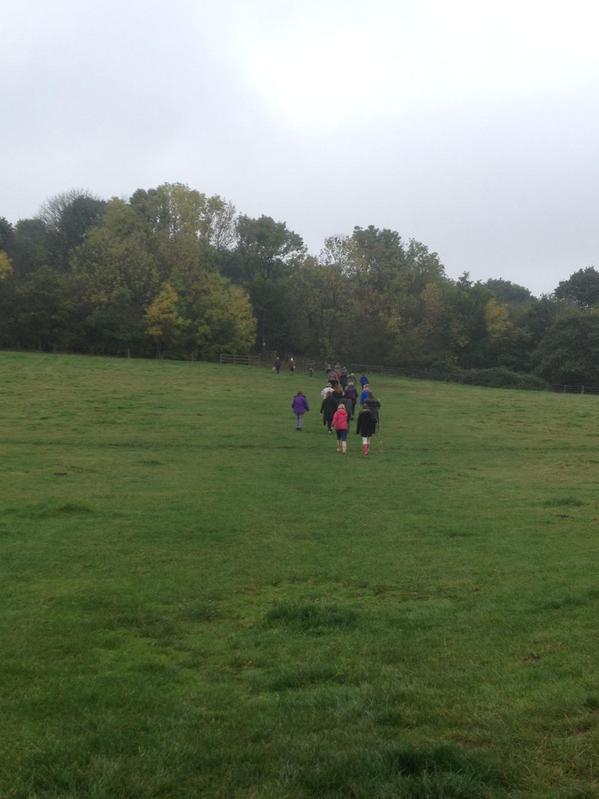
I reflected on this as I walked up for my preparatory visit to Cumnor Hurst along the path beyond the campus.  Here are things the students might pick up; here are things I must warn them about; these are the affordances; these are hazards. In some ways it’s not that different from checking the provision in the garden at the start of the nursery day.

However, it has another side to it if we move deeper into the world of educational metaphor. My rehearsal curriculum not only entails a revision of my (self-chosen) learning tasks, for also all those previous rounds of reflection on outdoor learning, the sessions that have gone well, and those that have not – and why. Serious reflection does allow for what Schwartz calls “disjuncture,” and this can be a challenge to the educator (and I remembered the time the students were unwilling to walk any more than 20 mins from campus). This is in line, of course, with the kind of activity I might think of as a spur to quality reflection – and indeed is a point for reflection/evidence is the HEA/Brookes OCSLD audit I’ve been looking at today which asks me to reflect on “Successful engagement in appropriate teaching practices” – because for me, successful engagement isn’t about being a Superteacher (I have been wary of these since my PGCE nearly thirty years ago), it’s about knowing what goes well, what went well, and how it can be improved.

So there’s my first marker on the path: engagement is about reflection, not just delivery. What do the students pick up? If it’s about engagement at HE level, surely the picking up is partly an independent thing: they pick up what might be afforded by the learning, not the things I list.  Their engagement starts from the pact we make in teaching and learning. We engage together, and my “writing” a syllabus/curriculum for outdoor learning begins from this principle.

U70124 arrive at Cumnor Hurst

But if academics see themselves not as creators of syllabi or curricula but as consumers (as Schwartz is suggesting), then the whole process of module design takes on a new dimension. “Module design” is never a creatio ex nihilo; it never springs from nowhere, but has some important elements in its formation:

  • Context in terms of the academic project on a macro level: why University?
  • Content in terms of the local context: why this course? Why this level?
  • Content in terms of restraints – social; resource-driven; interest-driven.

And if we see module design as an iterative process, all three of these come into play each time we open up the module to redesign – termly/by semester, weekly, session by session.

Why is what I have planned for Friday worth thinking about for a University course? Why, for example, do we really not need pond dipping in the module? How do I keep the content of the module current (recent research, the ever-shifting grounds of policy, the constantly changing needs of different student groups), and how do I present the course at an appropriate level?  How (and I began to ponder this in the summer, under Strawberries) do I keep it current without jumping on bandwagons? Has the team got the staff, the kit, the environment it needs? Will the students “get something out of” the class? Will I? For whom do we write the outdoors curriculum – and do I include myself in the plan to learn? Engagement takes into account constraints and context as well as some nebulous “what I want to teach.”

If I follow Schwartz’ argument, the fact that I am asking these questions indicates I see my curriculum (if I can call it that) as a “rehearsal curriculum:” the challenge moves onto how I know I am learning, enacting the things I’ve been reflecting on: how do I ensure (although I dread the word) impact?

On that note of challenge or self-doubt, I’ll leave it there for now: I have a class to prepare for tomorrow.

PGCE Placement – a guest blog

Jen Day (who is to be found here) sent her PGCE students this message at the midweek for their first placement in School Based Training. Without saying much more than I love it, it is reproduced here without comment:

Dear PGCEs,

It’s Wednesday and, as I did last week, I thought I’d send you a few musings and well wishes. Today is 21/10/2015. For those of you who don’t know, this is the day that Marty McFly went ‘Back to the Future’ in the popular 80’s sci-fi film. As a result, I thought I’d take you back in time and tell you a story.

I would like to share with you my own first week on SBT1. I, like you, trained to teach at Oxford Brookes. I lived in the older Harcourt Hill halls (J block, my name is still graffiti’d under the stairs!)

I didn’t have a car, so for my first placement I got a lift with the lovely lady that I was paired with for placement. Let us call her Ethel for the purposes of this email. To me, Ethel seemed like a being from another planet. We had no common ground at all, or so it seemed.

Each morning Ethel would be waiting to pick me up in her car at 6.45am. On the first morning I overslept because I had been up late the night before panicking. This was not a good start. Ethel patiently sat outside peeping the horn of her ancient Volvo until I emerged from my student hovel, looking frazzled and dazed. Ethel liked to listen to Radio 4. She didn’t take kindly when I offered up my mixed tape of Spice Girls and Take That tunes (I did say we were going back in time!). The 45 minute journey seemed to take forever. I am embarrassed to say that I took a nap to avoid any small talk.

The first day went reasonably well. We met the staff, the children, the parents. There were so many new names that I felt like I had forgotten all of them, including my own. I was taught how to use the photocopier, where the art cupboard was and what time break started. I instantly forgot all of that too.

Ethel, on the other hand, forgot nothing. It transpired that she had worked as a Teaching Assistant before. She befriended the staff with ease, she knew tricks on the photocopier that even the school secretary didn’t know, and she took lots of notes in a little official looking notebook to help her remember things. On meeting the headteacher, I glanced at Ethel and thought that he may as well offer her a job on the spot.

By Wednesday my confidence was in tatters. I still couldn’t remember more than three of the children’s names (the good, the bad and the ugly.) I had forgotten to bring my teaching file in. I’d been observing the class teacher and thinking that I’d never be able to control the class like she did, or inspire them to do their best work. I’d been pouring over real lesson plans for the very first time, petrified by their length and detail.

The teacher called us over at the end of the day. “Tomorrow I think that you should both teach part of a lesson.” Ethel beamed. This was the opportunity she had been waiting for. “Ethel can lead a 15 minute maths warm up game, and Jen can lead 15 minutes at the start of literacy. We’re doing multiplication and fairy tales. Good luck!”

On the way home Ethel managed to come up with what seemed like 500 outstanding potential maths activities. “It’ll just be so hard to pick one” she trilled. I had nothing. Not a single idea. I got to my room, I phoned my Mum, I had a little cry. One of the other girls I lived with walked past my door and asked what was wrong. I told her. “Get over yourself, it’s only 15 minutes!”, came her comforting response, “Just do some hot seating. A little drama or something.”

And so I did. Hot seating with Red Riding Hood and the Big, Bad Wolf. I found some props out of the Halloween outfits belonging to my flatmates. I practiced my Big, Bad Wolf voice in the mirror. I wrote a hugely detailed lesson plan. On reflection it was way more detailed than you really need for 15 minutes, but I wanted to do it right.

The next day my lesson starter went down well. The children behaved. They listened. They laughed. I was elated. I could do it! What’s more, I really enjoyed those moments talking to the children and finding out what they knew. This teaching lark was quite addictive.

In the car on the way home I was absolutely thrilled. I couldn’t wait to teach a whole literacy lesson the following week. The teacher and I were to plan it together the next day based on some of her plans from the previous year.

Ethel parked the Volvo up by my halls and I was taking off my seat belt when suddenly she burst into tears.

“I don’t think I can do this!” she sobbed.

I was aghast. But Ethel, you’re amazing at this already and it’s only day four.

“The children didn’t laugh in my maths activity like they did in yours.”

But, Ethel, in your lesson they actually learnt something new! I’m not sure they learnt anything in mine, for all that they enjoyed it.

“The children like you better because you’re younger than me and you understand what they’re into.”

But, Ethel, I am absolutely terrified of the parents and the other teachers. It doesn’t really matter that I know what music the kids are into.

“You never have to take notes like I do, you just seem to remember everything!”

But, Ethel, I haven’t remembered a thing! I just keep asking questions of the three kids whose name I know. Half of the time I’m acting confident because I’m scared that someone will spot that I’m not good enough.

“When we met the headteacher I’m certain that he was thinking that he’d give you a job in the future.”

But, Ethel, I was thinking exactly the same about you.

We had a hug. We resolved that we were in this experience together. We acknowledged our different strengths. We promised to support one another in our weaknesses.

It turned out that me and Ethel did have things in common all along. We were both anxious about passing the placement. We both wanted the teacher to be impressed and for the children to like us. We both wanted to get a job at the end of the course.

We both loved teaching, we just had different styles. And that was ok.
So let’s go ‘Back to the Future’…

Ethel is a Head Teacher now, and she’s amazing.

You’re going to be amazing too.

Your experiences won’t be exactly the same as mine, it is likely they will be very different. But please remember this. Comparing yourself to what you think another person is like by watching them, comparing your day to a snapshot of someone else’s day on Facebook or Twitter, comparing yourself to someone with different life experiences will only make you glum. There is only one you. As Oscar Wilde said ‘be yourself, everyone else is taken.’

Fatherhood I

One of the joys of the team here at the moment is the real energy there is towards research. and looking outwards to more fluid forms of communication such as blogging.
Mat Tobin, for example, has recently blogged on why picturebooks matter, and it’s our shared interest here that has made us gravitate to each other on a shared project around fatherhood and children’s picturebooks.

Very often in books in which children have adventures, the parents are absent, and in some the very absence of the parent exacerbates the crisis (I’m thinking of Sendak’s Outside Over There, particularly, but there’s the gentler story of Joe’s Cafe – and  for older children we might consider the death of Torak’s father, and in YA fiction Patrick Ness’ A Monster Calls or the complexities of Dacid Almond’s Billy Dean).

So just to kick me off on this (next stop looking in detail at Tina Miller on Fatherhood and exploring her ideas of the masculinisation of the home !), I’m posing three questions:

  • Why do parents have to be absent for a “good” story?
  • Are weak parents a substitute for absent parents?
  • What about the unlikeable parent – the buffoon, the bully?


Maintained Nursery Schools

Killing any birds with any number of stones is not easy in election time. This blog post, short though it is, maybe is over-ambitious.

This information is intended largely for the enlightenment of my own students (do I own students?) as their write their assignments for Early Years in the UK Context – but since it is of wider significance, and came to me as a personal communication from my MP, I thought it could go here for more public perusal.

Letter from SOS to Rt Hon A Smith

These are politically senstive times, so I will present it without commentary, except to say that the letter in response to my own letter to Andrew Smith, who took up the matter with Nicky Morgan: the date is explained in other correspondence by the letter from the Secretary of State for Education Nicky Morgan in Sept not reaching Andrew Smith until this month.

Do use the reply facility if you wish.


Visual Methodologies

Hmmmm.

I’m re-reading Gillian Rose on Visual Methodology, and she has given me a lot to think about.  I’d like to see if I can apply her ideas to some children’s work such as this:

climbing 001


So let’s look at this in more detail.

There are two figures, arms down by their sides, under or at least near a complex climbing frame. Writing explains that the child feels s/he is “very good at playing on the climbing frame.”

Now, I know who did this (I have obscured a name, although I do have the young artist’s permission to share this drawing) and the context, but if we apply Rose’s criteria to it, we need to ask:

  • What is being shown? What are the components of the image?
  • How are they arranged?
  • Is this a contradictory image?
  • What knowledges are being deployed?

At the basic level, what is shown is as I’ve said above, a climbing frame and two figures in proximity to it. There are two components as I read it: humans and climbing frame.   If part of the questioning we need to undertake is around what has been missed out, what is not there is interesting too, however. It might be that we can distinguish here a sort of intransitivity: the climbing frame is not being climbed, and the figures are not climbing it. In the picture there is no sky or grass, no distraction from other equipment. Does this argue for there being a lack of need from the adult for a ‘holding activity’? “Just [go away for five minutes and] colour in the sky”? Or does it argue for purpose or maybe even haste in the interaction between adult and child?

But we might also suggest a third component: the writing, both by the child and the adult. Image and text work together, and are part of the same tradition (of which child and adult are aware) as the picture story book.  The arrangement is one in which this convention is upheld.

Where it is skewed, where it has an element of contradiction,  is in the adult intervention. What is the purpose of this object? The title gives it away: this is a piece of school record keeping, very probably created at the request of an adult “to go in your file.” The child’s writing (and adult transcription) and title and date suggest that this is part of a record-keeping system that tells someone (see below) something (again: more to think of here) about how the child artist-writer sees themselves.

So what knowledges are being deployed? In brief, as a first go at this I propose that we can discern:

  • an understanding of how text and image can work together;
  • an understanding of how to represent the various elements of the climbing frame (including climbers);
  • some understanding of purpose and power in adult-child relationships.

So in looking at this power relationship, we come to the reason the work was created. I suspect, as I said, that this is at the request of the adult – and therefore, to some extent, the adult is the intended reader, the sponsor of the activity. Even in the context of physical play, the child is constrained, as is the adult, to use the event to spawn other events closer to the curricular needs, not of the child, but of the adult: play and the observation (or in this case the self-evaluation) makes it have a purpose the adult world might value.


Beyond the Motivational

This from Carl Hendrick is such a good blog post I have to point to it, even if my comments after it are lightweight.

“This type of stuff is obviously well intentioned but beyond symbolising a culture that privileges the media-soundbite over critical reflection, it does I think signify an increasing shift towards psychological interventions aimed at changing student self perception and represents a somewhat base and quite reductive approach to an extremely complex set of issues.”

I wonder how students would feel if instead of feedback such as “You must work on creating paragraphs with a tight and logical structure” we wrote “The first step to change is wanting to,” or “Life isn’t about finding yourself. Life is about creating yourself.”
[Read more here if you really want to.]


Attention sp

William Pooley raises some interesting questions here about attention span. Should we be “so willing to assume that every individual has a fixed ‘span’ (which can be stretched, or curtailed, perhaps, but still exists as a kind of objective measure)”?   The notion of us needing to maintain or enhance our focus is something Jason Elsom raised earlier this week in his tweet “How to focus in the age of…  SQUIRREL!!!” (@JasonElsom).  In both cases there are undertones of the now well-disseminated TED talk by Ken Robinson in which he claims too much of education is anaesthetising children.

I’d like, however, just to take an anecdotal sideways look at this.

Boys, we all know (because we are told we all know) have poor fine motor control, poor attention span., &c., &c. While William P is right that a serious study needs to be done on attention (I once found some interesting evidence of English monks in the Middle Ages muttering about long, rambling sermons, and attention during prayer has long been the focus of spiritual writers, but that’s even more of a digression), he is also right that this discourse of attention itself needs sustained enquiry. What follows is merely a snapshot.

Evan was having a good time – on and off – with the cars one week. Evan was four. One day he found that smashing trucks down a plank meant that the car crash was more spectacular than brumming them together. He built a ramp with planks and bricks to stop the trucks from falling off the sides. So far, an hour has passed. Group time, tidy-up time. Home time.

The next day he returns to the play, builds up the ramp, asks for some technical help about stopping the planks from sliding off the bricks (masking tape) and returns to his exploration of car crashes. He spends half and hour on this, goes to the loo, comes back – you can see where this is going. His key worker comes and sits with him from time to time, asking questions, finding masking tape, suggesting better cars – and by now fetching them from down the classroom where Evan is by now getting them to zip to. Two hours pass that day.

By the end of the third day, Evan has, in effect, devised an experiment to see whether how steep the ramp is affects how far the cars go. His key worker’s job on his Foundation Stage Profile is nearly done – if that’s a factor here.

My point is that the ‘discourse of attention span,’ when it hits the early years needs to take account of motivation: “Can concentrate on a self-chosen task” is a different thing (almost) entirely from “Can do as s/he is told for at least five minutes without wandering off.” Confusing the two risks misunderstanding the nature of self-motivated learning.


Thoughts on Leadership, Management and Ethos

A colleague of mine, an expert in how groups and professionals communicate, once asked me what I felt makes a good leader. I gave her a copy of the Rule of St Benedict.  Oxford Brookes, as I write, is searching for a new Vice-Chancellor; schools continue to face crises as they interview over and over for suitable candidates for headships; ‘my’ PGCE students are gathering their reflections of themselves as they prepare for the step into job applications, as they present themselves, even if only in an initial, local stage, as leaders in education. I still feel Benedict (and the tradition he gives impetus to) have a lot to offer in terms of insights on leadership.

Three things come together this week all (perhaps it’s unsurprising) from Catholic Christian tradition. The first is just part of the publicity, if you like, around Pope Francis’ latest visits. It’s not explicitly Benedictine, but does have a lot in common with the Benedictine rule. Francis is praised for his “Humanity, Humility and Humour,” a “bridge-builder (the first meaning of Pontifex),” a “shepherd who smells like his sheep.”

The second is today’s minor feast of St Placid, the boy monk who almost drowned, and his rescuer, St Maurus, whose obedience to St Benedict (according to St Gregory) effects a miracle. The miracle story might be seen as a message of how important unquestioning obedience is; it might also be seen as a parable of how a leader perceives need, delegates – and (at the end of the story) is unwilling to grab the glory for themselves.

The last was the feast of St Aelred on Monday, whose success in building up the community of Rievaulx was matched by his own penitence (life was not easy in the monastery for a Refusenik of the luxuria of the Scottish court) and his wish to be gentle, kind to his brothers. A short reflection from the ever-busy nuns of Holy Trinity can be found here; a Dominican reflection is here.

Leadership, in these cases, all seem summed up for me in St Aelred’s reflection on being an Abbot.  Aelred’s prayer, the Oratio Pastoralis, is poorly represented on the internet. Here is a taste of it, in my own very wobbly précis/translation.

Teach me, sweet Lord, to bring back trouble-makers, encourage the faint-hearted and support the weak. Let me adapt to the unique qualities of each person, to their character, their likes, their strengths, to their capacity to receive… and since (either because of my physical and spiritual limits or some deep-seated shortcoming) I cannot really help them develop through the example of  my late nights or my penitence, grant me by your mercy to be able to edify them by my humility, love, patience and mercy.

And again, the message comes out clearly, even if through the stained glass of the Middle Ages: humility, humanity… Humour, perhaps, springs from the previous two: if it is a human function, perhaps it could be seen as a prerequisite of a human manager.  There is an element of inclusivity here, a willingness to forgive, to develop people, to see them as individuals. How you might put all this in a job description for a leader, or to be specific an educational leader, I am not at all sure – but they are the essential qualities, I think.


Work in a Chill Month

There is the story that someone is admitted to Hell and is allowed their choice – one choice, and for ever – of punishment. It’s all very Hieronymous Bosch until the man finds a room in which everyone is sitting around drinking tea. The only drawback seems to be that the residents of this particular circle of the Inferno are knee deep in the worst floods of human waste. The stench is appalling but they are sitting about drinking tea.
“Well,” thinks this man, ” of all the punishments I have seen, this one seems the least horrendous.” And he opts for it.
“Are you sure?” he is asked. The man nods. He is ushered in, the door is shut, he is given a cup of tea to drink.
He takes only one sip, when a klaxon sounds, and a demonic voice calls out, “OK, everyone, back on your heads.”

And here we are, all back on our heads (if you like), back to it, with marking and staffing and curriculum design taking up all our time, and brain space being picked at by God-awful news from the wider world.  We know it’s the same with schools, where colleagues are beleaguered, over-worked, victims of the “can you just?” request (as in “can you just write the governors a paper on…” “could I ask you just to set up meetings with the parents?” &c., &c.). It is therefore something of a joy to come across Miss Smith’s clever and positive blog post: Teaching is Wonderful. Read it. Enjoy it. Warm up January.