After years of accumulating homeliness, leaving my Brookes office was a dreadful thing to do; hasty, almost punitive. We left for Greece the day after my Brookes contract came to an end, with thoughts of Prospero set adrift echoing through my reading. My books of magic – of Wild Spaces Wild Magic – were set up, but the rest was just boxes of stuff.
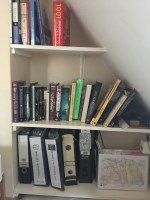
The boxes were sulking when I returned, but with a bit of coaxing, they began to find ways into the study. Joe helped by taking me to Ikea and then helping with building the shelves. I did that job I had called “tonking”when I was a library assistant: setting the shelf heights by sorting out the supports or tonks. And after that it was shelving.
I decided to divide the books into “children’s literature” and “lecturer-type” books, with Wild Spaces Books on their own, starting with Molly Bang’s Picture This, through some (but not all) the Robert MacFarlanes, ending with Z is for Jack Zipes. There were boxes of liturgical and Biblical books – a very nice Liber Usualis, for example, and my battered Greek New Testament – too, but I set them to one side. I looked at the children’s literature and set to. They were in boxes roughly alphabetically, so that a pile of Anholts came out together, and more Mairi Hedderwick than I thought I had; but they weren’t in strict order, and there were gaps. This means that books that had not met for years suddenly were leaning against one another: Sheila Cassidy’s retelling of the Creation was up against Michael Foreman’s eco-committed texts on one side and David Almond’s Skellig on the other. More arrive and these congruences shift: Roald Dahl and Lauren Child budge in; Noel Langley’s Land of Green Ginger, with its rather dubious racial stereotypes, squeezes in with Virginia Kroll’s Masai and I. It’s a bit like rush hour, but they all do get in.
Size is an issue, and while I create “Outsize” shelves, for a while it looks like MacFarlane and Morris’ The Lost Words has no home, until moving the Little Tollers downstairs makes space in Wild Spaces Wild Magic, between Landmarks and W G Hoskins The Making of the English Landscape. Some of these juxtapositions are just right.
Biblical and liturgical find a home like the sparrow in psalm 83.
The grown-up books fill higher shelves, partly in case grandchildren want to browse the lower ones for books that are “for” them, but here it begins again: for a good while, Philip Pullman’s Daemon Voices snuggled next to Rob Pope’s English Studies, until Francis Pryor arrived with Steven Pinker and the Opies. Julie Fisher rested against Ralph Waldo Emerson for a while (or was Emerson the one doing the leaning?); Caspar Henderson and Geoffrey Grigson met briefly, as did Jackie Musgrave and T H White.
It’s all a lovely conceit, as if this crowded Tube train of office shelving means that Simon Schama and Chris Stringer will get chatting as their covers touch, or Katharine Briggs
will strike up a conversation with Jane Carroll as they squeeze together. But of course they won’t. It may be that George Monbiot does talk to Sara Maitland, but they don’t do so on my shelves. Here, that’s my job. Because if this blog has point beyond a rather vain showing you (dear Reader) round some of a really quite small collection, it is this: books “talk” to each other only in the person who reads attentively and makes connections. We become passionate about this idea or that, but it is the reader who is in a position to connect playing outdoors as the Last Child in the Woods with the Hermits and the New Monasticism of the eleventh century (Louv and Leyser). Alcuin of York reminisces O quam dulcis vita fuit dum sedebamus in quieti … inter librorum copias, but I might respond O how sweet life is, Blessed Alcuin, where we sit and read in quiet and let the ideas inspire and jolt and fizz and mix…
We are where the debate takes place, where critical thinking emerges. Not reading alone, but thinking and speaking and mulling and writing – and maybe reshelving our ideas in a different order from time to time.
I’m reading for the umpteenth time a really good book on outdoors, the Kaplans‘ The Experience of Nature. Rachel and Stephen Kaplan make some really important points in their book. It maybe didn’t have quite the impact in UK (although such themes are recurring: see here, for example, from Bowler et al., 2010) as it would have had if it had been published, say, ten years later, and needs outdoor people to come back to again and again. I think that many of the ideas they come up with are assimilated by other, later writers or that others come to similar conclusions. Reading Chapter 6 on Restorative Environments was, when I read it for the first time, a bit like coming home.
The argument – by Ch 6 – is around what they term “mental fatigue” and the potential restorative role for the outdoors, although they admit this does not explain at this point what is being worn down. They come to the conclusion it is a facility with focus, and refine their idea as “Directed Attention Fatigue” in which basic tasks cannot be competently completed: we have less capacity for detailed attention, leading to basic errors, less sensitivity to social cues, less ability to persist. The next section is key:
The struggle to pay attention in cluttered and confusing environments turns out to be central to what is experienced as mental fatigue….One way to achieve this is through sleep… Sleep however has limitations as a way to achieve recovery. Ideally one would provide rest for directed attention during one’s waking hours as well. Achieving this requires environments and tasks that make minimal demands on directed attention.
Ingeniously they then propose ways of “getting away” which in turn are seen as insufficient, until the writers synthesise their arguments and come to their key notions:
Being Away
Extent
Fascination
(Action and) Compatibility
It is these four aspects I want to explore really quite briefly and from a set of personal experiences rather than anything remotely challenging the deep understandings that the Kaplans bring out in their book.
Being Away
When in 2009 I called my (?ecocritical) study of Sendak, Butterworth and Childs ‘Escape into the outdoors?’ (in Deep Into Nature, linked here) I talked about the unwary getting into trouble “out there.” I was thinking about the ways in which children’s literature encourages a mental escape, but that the space brings challenge. Ida and Max for Maurice Sendak, Charlie and Lola for Lauren Childs, Nick Butterworth’s Percy the Park Keeper all help the reader see beyond the page, behind the bedroom or wherever – even beyond reading in a garden on a sunny afternoon. Mini Grey has some lovely insights here, especially where she states that “books are windows and doors into experiencing being someone else.” Windows and doors to outside. It is not always a nice place (for Ida in Outside Over There it is a “mental and emotional landscape of sibling jealousy and childhood anxiety”) but it is an “away” that brings a different way of being. However, the personal experience of the Wild Spaces Wild Magic project and the simple delight of an afternoon walk in Wychwood Forest suggest to me that the embodied mind needs an embodied escape, an experience of release from the everyday being enhanced by perception of beauty. As the Kaplans propose, reviewing the work of Fly (1986),
…”experiencing nature” or “enjoying the natural surroundings’ received the strongest endorsement…. environments that foster a sense of safety and competence, where a quick assessment leads to the judgement that one could readily make one’s way and could explore without great risk were the more preferred.
What I am therefore to make of my fall from the rope swing (not pictured here but much enjoyed by my students on Twitter)? I suggest it’s complex: on one hand a simple misjudgment of my own capability and a need to belong or impress; on the other, the safety – the lack of great risk – is social/emotional: falling with a friend around to laugh rather than mock is a lesser risk than the fall itself. A pratfall: the humour is in the tumble; the affection is in the humour.
Would I have attempted that swing on my own? Where might the stranger walk? What part does confidence play? Ludchurch on my own was a greater challenge than with Mat and Roger and Jane and Debbie. Maybe the social stuff (see below) is important to me, and “embodied” implies “relational.” Maybe the Kaplans’ notion that social cues are dulled by certain contexts can be turned on its head and that the social aspects of “nature” should be considered. Maybe we need to create spaces for us to be away, or be away with people, to heal, or to sustain our wellbeing.
Extent
The view out to the North West from Wychwood Forest in April ’18 (the first shot) was wonderful, the view (here) down the valley from Thoon with Mat in November ’17 was tremendous, enlightening; there may be significance in the fact that they both had far-away horizons. Both encompassed
the imagined as well as the seen…a promise of continuation of the world beyond what is immediately perceived,
It might be possible to see extent as having a powerful pull on the role of landscape in literature, maybe drawing on Romantic notions of Nature – but we would have to admit the claustrophobia of Garner’s valleys somehow: extent might immediately be about vistas, but in play and literature it is also about possible worlds. The Kaplans’ “whole other world” might in fact be literature based entirely: would that negate their argument, or subvert it by suggesting that reading was an effective escape into the outdoors?
Fascination
A fascinating stimulus is one that calls forth involuntary attention.
This suggests to me that part of the fascination might be that is it in part spontaneous. That is not to say that some of it isn’t contrived or predicted: sunrises are unpredictable because of the weather, but they always happen; Forest School might always be Thursdays but what happens when you find that weird log to balance on? The tension around how much “nature,” in England at least, is landscape, shaped land, means that the fascination we feel is always to some extent contrived: Mat at Alderley Edge is photographing in an area made wild by the Garner family in previous generations, partly to entertain the local landowners and the visitors from Manchester. He is taking pictures of a lovely, autumnal wood, he is fascinated by the potential to Alan Garner and Garner’s readers, but it is in a contrived space.
[Humans] are fascinated by attempting to recognise in instances where recognition is difficult but not impossible.
They are explicit in citing here
scenes high in mystery.
Alderley Edge’s shaped land is just that; Garner’s writings (quite apart from the stories he draws on) are enough to give it that mystery, so in coming to an end of a too-brief discussion of fascination, I come to awe and wonder, and hence into the Kaplan’s final category.
I am back feeling whole and dreaming in Ludcruck.
Action and Compatibility
…The natural environment is particularly interesting…in that it communicates a sense of reality…[R]ather than leading to control the wilderness experience leads to a sense of awe and wonder and at the same time relatedness.
Relatedness is interesting if problematic. “The only place you could be a hermit was in the centre of the stage on the Albert Hall,” as someone once told me. I know that the Kaplans are viewing this relatedness as being to “nature,” and Belden Lane’s book Backpacking with the Saints sees this connectedness as being as a solitary affair. However, in choosing the photos for this post I do note how much of my experience of the outdoors is social. There are writers who would see spirituality as having a keen social element, so that the discovery of values and transcendence is, as Ping Ho Wong puts it in the article A conceptual investigation into the possibility of spiritual education, also seen as arising from within a culture. I wonder whether this social aspect needs exploring further? Not only because without Mat I would never have explored the Wild Spaces of Garner Country, and without Jon would not have found the rope swing, but that without Maggie I would not have had someone to sit with in what Rob Macfarlane calls the “blue so deep, sea-deep” shimmer of bluebells above Nettlebed and caught their subtle, Endymion smell.
There was a point, I imagine, when only illness – long and debilitating or short – was what brought the working life to an end universally. “Grow old in your work” is the advice of a wisdom writer 200 BCE (Sirach ch 11) and I read it as an encouragement. However, I find myself wondering, as I start thinking about retirement: what is my vocation?
Sunday’s readings in Mass were about the call of the disciples, and yesterday we remembered three great saints, Paul the Hermit, and the Benedictines Maurus and Placid. The boy Samuel is called at the start of his mission, the earliest disciples move from John the Baptist to Jesus; Paul the Hermit flees to the desert; Maurus and Placid attach themselves to the Patriarch of Western Monasticism; the youthful Antony we remember today (17th Jan) disposes of his responsibilities and flees to the desert – and somewhere inside me I wonder “what will I do when I grow up?”
And today more rows on Twitter about Bold Beginnings, with an OfSTED spokesperson being bullish, and Prof Michael Rosen growling like a dog at a bullbaiting… No: they are all really sincere, trying to make sense of their positions or trying to explain what they think and feel to others. Such is the (to go to the Hardyesque or Cold Comfort country fair metaphor again) cockpit of passion and professionalism. Most of the time I love it or at least follow it with a keen eye: today….
Today I want to try and figure out what I’m doing here. What does it mean at this end of my working life (and do I mean “end,” given my first comments?) to find my work “rewarding,” or to say “I love my job”? This is given added flavour by the fact that tomorrow’s class for my PGCE students is about writing a personal statement. What does it mean to be a professional?
The first question might be whether vocation and profession are coterminous. I shy away from the statements about “passion” and “reward” when describing my job. I have no passion for much of the paper that litters my desk and my reward is fundamentally pay. How about taking pride? Yes, I take pride in a class that goes well, I enjoy talking to all sorts of students and coworkers, and it has come as something of a surprise at this end of my working life to find I have friends deeply woven into my appreciation of a working day. But was that why I became a teacher in the first place? To have friends? If so, I think I have waited a long time. I wonder whether this is a half truth, or a simplified story. Maybe teaching appeals because of the relational aspect of the work.
This particular hare was started by my good colleague Georgina Glenny, whose research seminar today talked a lot, in among her subject (the difficulty of designing for “interventions”) about pedagogy and relationships. I did not become a teacher – in any of the sectors I’ve experienced – because of the standards agenda. I did not become a teacher because I read a book on teaching. I don’t even think I principally chose to teach to “make a difference.” I think I became a teacher because I discern that I am good at getting on with people, by and large; I enjoy people’s company. I really enjoy watching people learn, and helping people to learn, and the best places I’ve found to do this are Nurseries and Universities. As part of that I came, through my own children and then through those I worked with, to love their worlds, and drawing on my own reading history the literature that illuminates it, from Moomins to present day reading such as Raymie Nightingale. I know other people see the job differently, and other people who share my kick from watching learning see it better in other places. Is this vocation? I come (back) to the early monastics, to the advice from Abba Nisteros:
Not all good works are alike, For Scripture says that Abraham was hospitable and God was with him. Elias loved solitary prayer and God was with him. David was humble and God was with him. Therefore whatever you see your soul to desire according to God do that thing and you shall keep your heart safe.
Even without God this makes sense. Do what your heart tells you and you can keep it safe. Love your work is at least part of this.
However.
This takes me to a good (although not conclusive) place, but won’t do for a person spec. and a personal statement. What we need is a way to communicate passion, commitment, love without cliche or threadbare argument, or laying ourselves open to overwork. This is as true of the profession as a whole as it is of the novice looking for a first job. Except for the mere contrarians, this is true of The Twitterers; except for the pale pen-pushers this is true of policy makers and enforcers; except for the person who has lost their way and should have left the profession years ago, this is true of teachers and educators from one end of the sector to the other. We need, bluntly, to know what we profess.
But I wonder – I worry – that we are so individualist that the personal statement is just that: a personal vision, squeezed and pushed into the different shape that may be acceptable for a job.
A not dissimilar set of occurrences to the one I’ve discussed before about memory of books I have read springs immediately to mind. Here, rather than a narrative, is a brief litany of the saints whose practice suggested teaching (in some form or another) might be for me. Not included are those teachers whose dodgy or eccentric behaviour made me think “I could teach – but not like that”), nor yet those teachers who made a bad call and, for example, taught me I was useless at maths – so, sorry, Miss Thorn, Fr Lobo, Mr Lawson, Mr Foley, you gave me lots to think about, but your inclusion would have raised more questions for me.
Mrs Newsome: my kind and gentle Reception class teacher;
Mr Kilner: allowing drama and voice recording and C S Lewis more or less at the drop of a hat;
Mrs Rawlins, my Y6 teacher: for giving us the best end-of-day story times;
Mr Brown: you had no idea what you were getting from a very hands-on school to see me through the last, unhappy months of Primary – but you listened, and you tried and you talked to me and my parents;
Miss Parkinson: for allowing huge swathes of time to let Y7 and 8 be times where we all explored stuff together;
Mr Gunningham: for the Latin, and the patience, and the wit;
Fr Flannery: for the Latin and the Greek and the RE and the humorable impatience at our adolescence;
Mr Barlow: for not fitting the frame of teacher or Jesuit with much compliance but still getting us there with energy and engagement;
Mr (now Fr., and Professor) John Saward: for tutorials in which he displayed a real interest – and did so in meetings that extended well beyond the time allocated;
Fr Brian Findlay: every boy should have such a mentor. I think you can see some of his mannerisms in Ian Hislop and I have to admit a great deal of my fake erudition is put on in mimicking Brian’s real depth;
The great Maggie: her imaginative planning and ideas sustained me in my first job; her PGCE dissertation on ecology and storytelling sits on my office shelf and still gets read; her anecdotes are recycled in many of my lectures;
Leslie Grundy: visionary headteacher who made me want to do nursery and taught me how to do it;
Julie Fisher: who gave me the framework to try to put intelligent pedagogy into action;
and Brookes colleagues who taught or continue to teach me how to do it, day after day. But I’ll stop with just my first leader and mentor at Brookes, Helena Mitchell, so this doesn’t become an Oscars list.
This weekend I will be doing something – I am so nervous I can’t really talk it up, although the event itself will be marvellous – at the Oxford Reading Spree about reading in the EYFS. I could
fulminate about phonics
chide people on child-initiated learning
do other things on how to share books in group time that could have an alliterative title, but I can’t be bothered.
but in fact what I’m going to talk about is parental partnership and particularly about books.
Gillian Morrow and Nigel Malin, in the heady days of reasonably funded Early Years, proposed a model of parents and professionals working together. They suggested that partnership “which is often depicted in terms of a hierarchy of levels, for example from non-participation to partnership and control” can sometimes be seen by professionals “as a matter of ‘giving’” – and I wonder whether this means a giving but with the right to take back. Power really remains with the setting, and the role of the educator is to make up for parental deficiencies. In Morrow and Malin’s more dynamic model, we see this undergoing changes. Most teachers will, I think, recognise that changes in relationship between parent and professional are not necessarily easy, but their research is primarily into parents’ decision-making through committees, and one of the workers’ responses to the increased empowerment is telling:
…one of the good things has been becoming a lot less precious about your professional status. People on the Parents’ Committee respect you not because of your job role but because of their relationship with you
I return to this as I think about reading.
How well do we act as advocates for reading? How easy is it to fall back on institutional lines of power?
I have recently heard (but now cannot trace) the story of the school that threatened a child with detention if the parents didn’t read with the child three times in a week; I remember a parent’s anger at reading in the child’s reading record a telling-off for not keeping the reading record up-to-date… These are indicative of a power relationship in which a home-school agreement is for the parents to agree to comply. They/we comply with what the school deems fitting. This is, I think assumed in the legislation, which states that a home-school agreement must contain “the responsibilities which the parents of such pupils are expected to discharge in connection with the education of their children” – assumed, I think, that it is the school that sets those expectations. This seems to me a far cry from the EYFS statement that
[c]hildren learn and develop well in enabling environments, in which their experiences respond to their individual needs and there is a strong partnership between practitioners and parents and/or carers…
So what is this strong partnership – and especially when we are talking about fostering literacy in EYFS – what does the professional have to do? Assume or require compliance? Or become the dancer, inviting parent and child to join? And if the latter, how much does the professional need to understand that long story from the first, cuddly book-sharing to the child making their own choices in a library?
This is what I will be exploring, all in 20 mins, on Saturday. No pressure, then.
Gillian Morrow & Nigel Malin, (2004) Parents and professionals working together: turning the rhetoric into reality Early Years Volume 24, 2004 – Issue 2, Pages 163-177 http://dx.doi.org.oxfordbrookes.idm.oclc.org/10.1080/0957514032000733019)
This post, as I begin it, is an instant “Save Draft,” since it will take a lot of unpicking. Even as I write I see the CLIP Carnegie Kate Greenaway list is out with Tidy, Wolves of Currumpaw and Wild Animals of the North in there. Popularity, pleasure, professional judgement come together. Complex stuff.
Do I read because something is popular?
Not always, but sometimes I have to, if only to keep up to date with other people’s ideas or trends in production. A Hello Kitty version of Red Riding Hood recently stands out as a low point. I persevered with Harry Potter because I thought I should, and was glad I did.
Do I read children’s books for pleasure?
For my own pleasure, as well as the pleasure of sharing? I get pleasure from the innocence – whether knowing or otherwise on the author’s part – which I can see even if I don’t really participate in it. Granted , as Hollindale so gnomically says “ours is the age of Lord of the Flies,” where even the bear-protagonist of Jon Klassen is vengeful and murderous, there is in much children’s literature a lightness that is engaging.
I like the simplicity, whether (again) knowing or unknowing. The foxy-looking gentleman leading Jemima Puddleduck astray; the bromance (an anachronistic term) of Esca and Marcus Flavius Aquila; the inversion of roles in the Three Little Wolves and the Big Bad Pig: they are tricksy, or challenging, funny and poignant but simple in the storytelling in some way I haven’t yet teased out, somehow. I know I am in danger here of seeming as if I like the descent into liking the easy read, and I will only protest (using Julien Benda’s phrase (revisited by Hollindale) Le Trahison Des Clercs, the way that intellectuals do not stay true to their “calling”) that it is the subtlety and playfulness of the design and language that I find attractive, not the easiness. There’s so much more to say on this, but this will do for now.
I get pleasure from good design, from inventive use of colour, interesting cadences in prose, from irony and jokiness. I get pleasure – and did as a child – at the knowing wink towards the world of the adult in the Moomins (I like it less in Dahl). I suppose I get pleasure in the play of ideas: it’s a bit like reading poetry, where rhythm and cadence and imagery and word choice and the appreciation of all of them together makes for the biggest part of my pleasure in reading. Look at these lines from R S Thomas for example:
What is the Christmas without
snow? We need it
as bread of a cold
climate, ermine to trim
our sins with, a brief
sleeve for charity’s
scarecrow to wear its heart
on, bold as a robin.
My pleasure comes from appreciation of the shared experiences, but also from the way the words are placed, with care and attention, the slipperiness of simile and metaphor, of sacrament and observation.
And I get pleasure from the debate I have with colleagues about something we delight in together. Children’s literature is one of the reasons I came to Brookes, with my original work title of “Senior Lecturer in Early Childhood Studies, Communication, Language and Literacy. ” It is a joy to find that discussion still alive in the last years of my work.
Professional Judgment comes in somewhere?
Because of my job and my chosen area of research (now here’s a circular argument bowling down the hill of criticism!) , yes.
I can cite two voices in announcing the prize lists today :
There are journeys to be made, friendships to discover, characters to fall in love with and worlds to truly immerse oneself in.
Questions of identity, friendship and responsibility, both to others and to the natural world, are key themes this year. It is also hugely heartening to see our shortlisted writers and illustrators tackling potentially difficult and big ideas…
And I like those descriptions of the values that professionals see in books. I’d like my students to appreciate these views.
Well, there’s a question.
I’ve been asked to be a voice in a school at a presentation for parents:
The core purpose of the event is to help potential applicants to consider more fully what they should ask themselves as they look into the breadth, depth and format of u/g courses available in the UK; and to help parents to understand more fully what students need to be doing doing now and during summer holidays, to strengthen their applicant profile. The sessions also reinforce understanding of personal skills, traits and level of academic ability that universities are looking for.
And so I’m starting way, way back, not at the philosophy per se but at the history that brings me to be back in Dorset over 50 years after I left it.
Schooling began for me in the Reception Class in Blandford Forum, all high-up windows, and time in the sandpit and water tray. I narrowly escaped being registered as Christopher, a hazard I encountered from then on until I hit twenty, for some reason. My friend Paul was crying and I had to be brave for him, something I felt a bit unfair, since I rather wanted a quick cry, too.
Maths and I parted company the following year, when I was kept in for not learning what I would now call number bonds to twenty. Reading and I were already best friends; my mum and dad bought me the next reading book in the scheme we used –The Tip and Mitten McKee Readers – whenever I needed it. I learned to tell the time, learned to hate jigsaws, became a dreadful non-completer throughout my life (as a consequence of the 300-piece jigsaw incident), got engaged to Susan in the year above (it didn’t last)…. I had a wart on my right hand, and still find myself curling my right hand if I’m thinking of directions. My infant career ended and I moved to Blandford Junior, only to make a much bigger move quickly when we moved to Harlow in Essex, but not before learning to hate carrots and football and that I was a bit “behind” for not being able to tie my shoe laces.
And here began my interest in education. No high windows in Harlow New Town. We had books for problem solving, cuisenaire rods (which I never mastered), and the ability to go back to a water tray I had forgotten for three years. I went into the infant wing to help with reading – only to be puzzled by ITA. I learned more about unfairness, I learned some French, some pottery, misread C S Lewis, murdered the descant recorder (but I still play) and got the best school report ever:
Nicholas is a mine of useless information; if he can find a job where he can use all this stuff, his fortune will be made.
And at the end of what would now be Y6 but then was Top Juniors, we moved to Burnley, to Todmorden Road Juniors. I suppose my name is in here somewhere, but I see the school’s closed now. Two months I wouldn’t wish on anyone, despite the kindly interest of Mr Brown, my teacher, who must have seen something worth taking an interest in and who I floored by asking about Elidor. High Windows. Maths in the morning, Maths in the afternoon. Tech drawing for the boys, sewing for the girls. The cane and being beaten up after school.
So my interest in education began from a very practical standpoint. Why is this school like this, and that school like that? Are they all aiming for the same thing?
And what I’d really like to say at this talk I’m giving is this:
If you are interested in what makes schools the bizarre mixture they are of workhouse and adventure park, or if you are interested in engaging with small, lost people who can’t tie their laces – or gnomy little lads who hide in books, or – erm – overconfident recorder players – then education is for you. It could be the mixture of theory and practice that is an Education Studies course; it could be a more profession-facing course like a BA leading to Qualified Teacher Status. But think about why education has the power to fascinate, to engage, to challenge, and maybe think about why is still has that power over me, as I near 60. Just don’t model your UCAS statement on this blog post.
Dave Aldridge has released an interesting blog post I want to respond to or at least use as a springboard for a personal rant. Where Dave asks “What, then, will become of the proposed LEA chains?” I guess he is dealing with that uncomfortable truth that the big businesses behind academies will – or may – not want to take on smaller schools, rural areas, some of the seemingly insoluble issues that lead to “poor quality pupils.” [NB: the website of the original report seems to have been taken down] That the state provides the “safety net” (I’m not sure of this shorthand metaphor) seems eminently reasonable; if the government has decided not to be the major player in what was a national initiative, well, we, the electorate, voted them in, sort of. Today it seems “we, the people” voted for a string of idiocies.
I join Dave Aldridge in his disquiet. However, I would be more sanguine about this if it weren’t for the dreadful other things we are seeing from this government at the moment: high-handed bullying around dodgy dealings on the NHS; rich people making decisions about their taxes that takes money from public services – and then covering it up; the opposition of the current government to taking in refugee children under the “Dubs Amendment.” This Kindertransport moment (the PM says it isn’t) is where I give up. If, as the Secretary of State for Education has said, this is a “broadly Christian country” (a phrase I believe she used to justify her position at the time in opposing equality in marriage, presumably based in part on a reading of Leviticus 20:13 or Romans 1:27), then where is our broadly Christian Government going to stand on Deuteronomy 10:18, 19, where God “takes no bribe…and executes justice for the fatherless and loves the stranger,” or the vilifications of the prophet Amos (e.g. Ch 8) against those who trample on the needy, eager to resume their unfair trading? And if the mention of Amos makes anyone think this is all a bit Amos Starkadder, then 2 Corinthians 8 is a more human take. Be kind: it seems that kindness – the recognition that we are all the same kind, all human, all with needs and talents and joys and disasters – is exactly what is being written out of our lives systematically.
So this is my Catiline question (I know I am not alone in using it) : Quousque tandem abutere, Catilina, patientia nostra? How long will you abuse our patience? If “accuracy is for snake-oil pussies,” if High Street tycoons can make a packet and then walk away, it is as if the last election entitles only to attend feeding time at a pool of crocodiles.
Yes, it goes without saying that these views do not necessarily represent an official position by my employers.
And yes, I know Cicero would not necessarily approve of my use of his phrase in this argument.
There is a myth about teacher training (well, tbh there are thousands: this is but one!) that somehow the completion of an ITT (ITE) programme from a BA/BEd, through a Masters-led PGCE or School-centred programme to “You have a degree, here’s six weeks on how to cope” means that at the end you are a teacher. Compliant and complex, informed and (to some extent) uniform, here is the student who was Rosie or Ryan and suddenly “Here is Miss Smith, here is Mr Jones, your new teacher.”
It’s September the whatever, and the job you applied for, schmoozed for (and perhaps when you got it felt smug about or trepidacious over) is yours, and you’ve met the team and put a mug in the cupboard in the staffroom and the headteacher introduces you to the class, and you shut the door and smile and you are the teacher.
You know you are a teacher because… Answers on a postcard. The NUT guidance asks the question “I have QTS: What’s next?” What indeed?
One of the key things that may keep you in the profession, it seems to me, is how you learn on School Based Training. I’ve written about the “hard and harsh” – what St Benedict calls the dura et aspera – of parenting before and teaching is not dissimilar, with the important difference that your school-based training gives you a chance to see teaching for real in a way that many modern parents don’t get to see bringing up babies. Seeing it without rose-tinted specs may be just what you need to keep you going in three years’ time. On a placement you get to (this list is a bit tongue-in-cheek):
iron;
smile at people you don’t like;
sing;
be someone special for children;
learn children’s limits of patience, attention, social skills – and how (and when) to stretch them;
learn your own limits of patience, attention, social skills – and how (and when) to stretch them;
learn your own language of teaching – do you like “stretching” and “pushing” as models of learning?
learn to treasure weekends – switching off is an important skill, if only so you are switched on on Mondays!
You also get to dress up for World Book Day. Something elaborate like the Very Hungry Caterpillar (“How the heck will I teach in this?”) or something less so (“George from George’s Marvellous Medicine? But I’ll just look like any boy!”)? Something ambiguous (“Mrs Twit? Will they notice I dressed up?”) or something ambitious (“Aslan? I’ll roast in this costume!”).
So how do you learn on School Based Training?
Very Hungry Caterpillars aside, you learn by doing, by picking up (consciously and unconsciously) on how to use your teacher voice, your real smile, or how to identify the people to charm (and please remember the parents!!!) – and by making mistakes.
By not backing up your records before you dropped the laptop;
by dropping the paintings from the class while they were still not annotated;
by saying something so vastly comic you could hardly keep from laughing out loud (“So while we are learning the /sh/ sound, what could we be shovelling?” [You meant ‘shiny things;’ that’s not what your TA thought]);
by forgetting the head’s name with her standing right next to you…
And by wishing you’d gone as Miss Trunchbull instead.
What is the equipment the lecturer needs? St Benedict gives a quick list of what a monk needs – interesting to note the needle, I always think – and the communal way of living of Benedict’s first communities finds other tools safely in the cellarer’s stores or in the library. What do I need that the University can provide me with?
What it provides me with (apart from being couched in terms of office space, desk, bookshelves, &c) is not so very different from what the early monastics sought: management; a structured semester (if not a day); tools.
But today (15th Jan) is the feast of SS Maurus and Placid, and other, Benedictine writers such as IBenedictines are writing today much more coherently on aspects of the feast. The only thing that struck me – partly after feeling put upon yesterday (and messing up some paperwork) – was that it is very well to talk about HE provision and entitlement, and dress it up in early medieval clothes, but that is to overlook other aspects of organisation: that odd new(ish) [?] idea of followership, and what Benedict rails against: grumbling.
But is questioning the same thing? An ex-colleague (and neighbour) retweeted this news from Oregon this morning. What does the follower do when parts of an organisation need changing? I suggest that the answer is (in part at least) again found in Benedict, back with the Cellarer:
“…one who is wise, of mature character, sober, not a great eater, not haughty, not excitable, not offensive, not slow, not wasteful”
Because this obedience – in the sense we see it in Placid and Maurus – is a community practice, an “ethos statement,” where an organisation listens to its constituents. Followership is therefore not as new an idea as I teased with earlier; it is a modern-dress version of a proper obedience, in which trust is at the heart and the leaders are listening and responsive as much as anyone.

 magic – of Wild Spaces Wild Magic – were set up, but the rest was just boxes of stuff.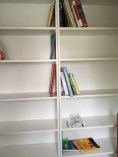


 nicktomjoe