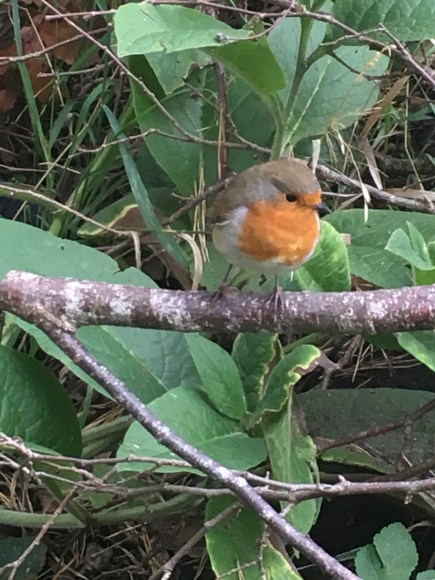
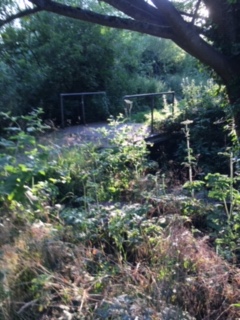
Stillness, dancing and sunlight

A quick anthology (an extract and four short poems) to exemplify one of the aspects of “dancing above the hollow place,” that complex and simple phrase of Ursula Le Guin’s in The Farthest Shore that I first explored a couple of years ago.

First, T S Eliot, striving to express the apophatic in East Coker:

I said to my soul, be still, and wait without hope

For hope would be hope for the wrong thing; wait without love,

For love would be love of the wrong thing; there is yet faith

But the faith and the love and the hope are all in the waiting.

Wait without thought, for you are not ready for thought:

So the darkness shall be the light, and the stillness the dancing.

Whisper of running streams, and winter lightning.

And then his younger contemporary, Thomas Merton:

When in the soul of the serene disciple

With no more Fathers to imitate

Poverty is a success,

It is a small thing to say the roof is gone:

He has not even a home.

Stars, as well as friends,

Are angry with the noble ruin.

Saints depart in several directions.

Be still:

There is no longer any need of comment.

It was a lucky wind

That blew away his halo with his cares,

A lucky sea that drowned his reputation.

Here you will find

Neither a proverb nor a memorandum.

There are no ways,

No methods to admire

Where poverty is no achievement.

His God lives in his emptiness like an affliction.

What choice remains?

Well, to be ordinary is not a choice:

It is the usual freedom

Of men without visions.

Then the great and painful Elizabeth Jennings, whose poem Teresa of Avila for me has the saint and her experiences just right:

Spain. The wild dust, the whipped corn, earth easy for footsteps, shallow to starving seeds. High sky at night like walls. Silences surrounding Avila.

She, teased by questions, aching for reassurance. Calm in confession before incredulous priests. Then back – to the pure illumination, the profound personal prayer, the four waters.

Water from the well first, drawn up painfully. Clinking of pails. Dry lips at the well-head. Parched grass bending. And the dry heart too – waiting for prayer.

Then the water wheel, turning smoothly. Somebody helping unseen. A keen hand put out, gently sliding the wheel. Then water under the aghast spirit refreshed and quenched.

Not this only. Other waters also, clear from a spring or a pool. Pouring from a Fountain like child’s play- but the child is everywhere. And she, kneeling, cooling her spirit at the water, comes nearer, nearer.

Then the entire cleansing, utterly from nowhere. No wind ruffled it, no shadows slid across it. Her mind met it, her will approved. And all beyonds, backwaters, dry words of old prayers were lost in it. The water was only itself.

And she knelt there, waited for the shadows to cross the light which the water made, waited for familiar childhood illuminations (the lamp by the bed, the candle in church, sun beckoned by horizons) – but this light was none of these, was only how the water looked, how the will turned and was still. Even though the image of light itself withdrew, and the dry dust on the winds of Spain outside her halted. Moments spread not into hours but stood still. No dove brought the tokens of peace. She was the peace that her prayers had promised. And the silences suffered no shadows.

And lastly, although I can’t replicate his indents in the text, R S Thomas’ Waiting, the final stanza of which is also in my breviary:

Face to face? Ah, no

God: such language falsifies

the relation. Nor side by side

nor near you, nor anywhere

in time and space.

. Say you were,

when I came, your name

vouching for you, ubiquitous

in its explanations. The

earth bore and they reaped:

God, they said, looking

in your direction. The wind

changed: over the drowned

body it was you

they spat at.

. Young

I pronounced you. Older

I still do, but seldomer

now, leaning far out

over an immense depth, letting

your name go and waiting,

somewhere between faith and doubt,

for the echoes of its arrival.
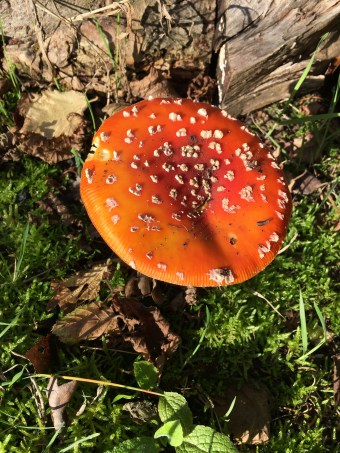
Carnival chaos

To recap some of my thoughts about Hallowe’en. The use of such conquering fear of the dark activities seems to me pretty obvious:

winter nights enlarge/The number of their hours

and we can make the best of it by smiling at the dark. Thomas Campion‘s lyrics have it just right, and youthful revels have their place in the honey love of the closing-in evenings.

The pro and con tensions in part arise from the abuses these revels engender. “Psychos” and “Slutty Vampires” sit uncomfortably with my English folk-horror. Yet they’re not wholly American: Trick or Treat at least has an element of bargaining amid the demanding money with menaces, unlike much of its ancestor, Mischief Night, whose joys seem vengeful or gleefully malign. A door latch has a drawing pin attached to it with dog poo, so the unwary person who pricks his thumb goes at once to suck it… a sooty chicken is induced to cause havoc at a WI meeting…

Yes, these are both occurrences from North Yorkshire I’ve been told about.  They are the same Carnival as the Big Skeleton, the Little Skeleton and the Dog Skeleton go in for as they riot their way home in Funnybones, or the menacing pumpkin head that gets its comeuppance in the story of the hopping pumpkin  who meets an ignominious end with a goat (this is a link to a longer text than the one I tell).  But the Carnival is there because we are at a sort of seasonal fault-line, where summer’s lease is up and the dark is at the door.

There is a sense for me that this big change is the Autumn answer to May Day. The nights close in, the socialisation is indoors, defined, more visible, with the freedoms of warmer weather lost or at least traded for friends and firesides.  When C S Lewis envisages this in the hearts of his heroes in That Hideous Strength they think of
…stiff grass, hen-roosts, dark places in the middle of woods, graves. Then of the Sun’s dying, the Earth gripped, suffocated, in airless cold, the black sky lit only with stars.

No mischief or carnival here s we stare into the dark.  Mischief, however, is close friends with these shadows and darkness, of the almost-known, the footsteps partly recognised. It is the younger sibling of more menace, and this is partly why it is disquieting: does it licence the bully, the vandal? In looking into the shadows, does it, as Kathleen Raine so evocatively puts it:

Let in the dark,

Let in the dead…

(Northumbrian Sequence IV is cited in extenso here in my post about poetry and spirituality)?

It seems to me that this week or so – Hallowe’en to Remembrance/Martinmas – is a real blending of a gleeful naughtiness, the swede or pumpkin lantern and the restlessness of wind and dark, wet evenings, as the chaos of Carnival mimics and mocks – and presages – the chaos and pain of the storms of winter and death, “þis andwearde lif manna on eorðan” “Talis vita hominum praesens in terris…”

So when we smile at the shadows when we look at books for (and with) children, how do we approach death and disaster?  The too-brief nod recently to the BBC adaptation of Phillip Pullman’s His Dark Materials asks about the Beeb’s decisions to show it pre-watershed. We might similarly ask about Erlbruch’s Death, Duck and Tulip, that strange and lovely meditation on the role of death in our lives – or Thummler’s Sheets, or McCaughrean’s Where the World Ends, or Ness’ A Monster Calls…  In fact, although the list isn’t endless, there are plenty of books that offer wonderful and painful insights as they look at death and pain and loss.

The good writer who perceives a good story need not shy away from the issues; the reader who comes to these texts comes prepared for challenge, maybe for tears – but trusts the writer to deliver something that will bring them safely to shore. Raine puts it well when she suggests that in our innocence it is still within us to

bind in human form
A living power so great,
A living impulse great and wild

and (for me the subtlest line)

Have pity on the raven’s cry


Starting out

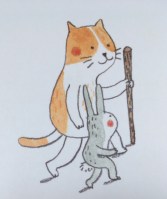
Just a quick thought for the students on two of the three modules I’m teaching this semester, based on the relationship between the cat and the rabbit in the wonderful Up The Mountain. My comments here might be something to follow up, but are in no way important for what follows here. I hope this works for the three modules* but maybe in different ways: I have to say that from the outset I’m writing this really for the first years: for “my” Ed Studies students, and then for the first year Outdoor Learning people in Early Childhood.

img_9968The model that the book Up The Mountain explores is one of friendship and apprenticeship. The author wrote it in memory of her grandmother “who loved nature and books” – and that pretty much sums up my attitude to this semester’s teaching: warmth, love of Nature, love of books. 

However, if this were all, I think I would be wondering if this was worth a degree. Just as sometimes I look at CPD that people report as inspirational and think “that was a day’s worth?” I worry that coming out of the undergraduate process thinking that one or two tutors were nice people and that being outside is lovely is just too weak. Of course, in the CDP example and the undergraduate one, this précis is too wishy-washy to be a decent overview of what anyone has learn, but what do I want students to do when starting out in  Higher Education?  I find myself as old Mrs Badger, watching the little cat explore, and grow – and pass on his delight to the (even littler) rabbit who joins his journey.  Perhaps the imagery doesn’t extend too far, a delight though the book is.

But to move away from metaphor, let’s take Doodles, the therapy dog whose work is described in Cheryl Drabble’s book and her blog. Why use a book like this in the Introduction to Education Studies? Well, because it describes and uses the disciplines of Education Studies in a compassionate and engaged context. Real children and young people, along with their educators, have encountered and appear to benefit from a different way of working. How do we know this works?  Do we define curriculum in such a way that the experience of education has room for “cute, fluffy, handsome, pretty and furry”?**

We will, of course, read about the uses and abuses of cherrypicking educational practices and about the ways theory can and can’t be used – from Developmentally Appropriate Practice to looking at models of (dis)advantage – but Cheryl Drabbles’ dog allows us to ask big questions through a practical lens.  For example:

  • Should schools be therapeutic spaces – or should the task of learning itself be enough to raise self-esteem and motivate? How does “belonging” fit with one’s identity as a learner – or an educator (thanks, Jon, for the timely reminder on this last point as I prepare a class on the Sociology of Education)?
  • If a dog is right for one school, should all schools get one? How might  practice in a school where pupils have significant needs for physical and/or cognitive support be different from other schools? Should they be seen as different?
  • What is the role of the professional as an autonomous worker? How do educational institutions work as teams – and (see above) how does belonging and having a voice in a team look in practice?
  • What does the documentation of a National Curriculum have to say about what society might aspire for? Does this aspiration close doors or open them?

All this from a small dog?

We might, by moving beyond the text itself into exploring what we mean by distinguishing between research and news media, ask

  • What makes an argument valid?
  • Does “it works for us” clinch an argument, validate a practice?
  • How does research work in a messy world of so many variables?

All this in twelve weeks?

No, and no. We (the students and I) are beginning to pose these questions, just as we are beginning to put together the skills the students will need for the next few years and beyond.  And of course it’s not Doodles – or even Cheryl Drabble’s book about him and his impact on her school – that gives us these things. We are using the idea of a therapy dog, and what people have said about therapy dogs (and mutatis mutandis the experiences we are having outdoors in the other modules and what people write about being outdoors) as ways of starting to explore the Big Questions both in the abstract and the concrete. We are also starting to look at the conventions that Higher Education (sort of) seeks to impose on its neophytes.  So – to end with practical questions – if we are using (as many students are) the e-version of the book, how are you going to reference a quotation from it? How might you summarise some of Drabble’s conclusions?

41taXukT7rL._SX316_BO1,204,203,200_.jpg

*The three modules are: the first year module Introduction to the Study of Education and the first and second/third year modules Young Children’s Outdoor Learning. Doodles makes his appearance especially in the first of these.

**Drabble, C (2019) Introducing a School Dog: a practical guide. London: Jessica Kingsley.  Drabble (2019:98)

Robin

It’s National Poetry Day and I’m clearing old woody clippings from an allotment that is, thanks to Rosa, coming back to life like something in Frances Hodgson Burnett. As with yesterday’s digging, I am accompanied by a robin. It is friendly enough to allow me to photograph it from close up. I love its jet-jewel eye and the way its chest moves as a bubbling song comes from somewhere in its tiny body. I love its daring proximity – it flies so close at one point, a wing brushes my leg.

Its closeness and seeming trust mean I am able to photograph it – but miss the Mafiosi magpies who swoop and bicker close by, and am nowhere near fast enough for the dive of a sparrowhawk as it twists into the trees, after some luckless songbird. After the robin? My little friend?

The theme of this poetry day is truth, and I do wonder how truth exhibits itself – or is exhibited in Nature Writing. There are the monumental and disturbing images from Underland, and the small but detailed work of taxonomy and the science of magnifiers; there is the work from Peter Fiennes on woodland, and the research from Mat about language and landscape – and then there is this robin, and the magpies and the hawk. Guardian nature writing; CaedmonGilbert White; Edgelands and the Shell Country Alphabet: they all bring something to the kaleidoscape that seeks to explore and explain and act as advocate. There is a cloud of witnesses here.

But to think about truth in Nature Writing (why those upper case letters?) and a short poem I was brought back – by that killer robin, terror of the worms I was turning over, and by the sparrowhawk that set the wrens in ear-achingly shrill panic – to the ambiguity of our gaze. The robin as my friend – or as belligerent defender of her/his turf? Sparrowhawk as dangerous thief – or as a beautiful trajectory on an autumn day?

And that gave me the poem for today, a marvel in concise, painterly imagery from Anne Stevenson, and a sharp reminder of the way our truth, our human truth is only ours, not universal:

Gannets Diving

The sea is dark
by virtue of its white lips;
the gannets, white,
by virtue of their dark wings.

Gannet into sea.

Cross the white bolt
with the dark bride.

Act of your name, Lord,
though it does not appear so
to you in the speared fish.


The sparrowhawk didn’t get the robin, by the way.

A Good Story

I commented on Richard Powers’ book when I was part-way through, making connections between Robert Macfarlane’s magisterial (for me almost scriptural) Underland and Powers’ rich and mind-expanding The Overstory. For what it’s worth, the link is here. This is just a codicil, really, trying to make sense of what I think eco-literature might be.

Powers’  narratives are rich and engrossing, and while I see Patricia Westerford as having the key storyline – another character towards the end of the book hearing one of her lectures suggests this might be the author’s intention – others will follow this disparate fellowship of artists and activists, cowards and heroes in different ways. It is Westerford, the lost-then-found scientist of forest and human interbeing, who has the message from an ecological perspective:

“A fluid changing web of purposeful lives dependent on each other”

and

“Our brains evolved to solve the forest…to see green is to grasp the Earth’s intentions.”

However, there is more than just sermonising here. The deliberately rhizomatic storylines, in which characters reach out, connect, have meaning gives the novel a keep-your-wits-about-you edge: challenging  and yet engrossing. The endings for the human dramatis personae are ambigous at least. Dodging round the spoilers I can just say that one character, facing a Hellish future, nonetheless finds purpose in his life past and to come, gains the one crumb of comfort possible to him: that he knows what his purpose has been, and is: to give the moral purpose of his ecological insights the story they need.

I was very conscious of this impetus – perhaps it is what has driven my reading of these final sections of The Overstory – when I was in the Lye Valley at the weekend. Lye Valley is a short walk from where I live, a SSSI, a small, very rare piece of fenland, only, really, kept up by strenuous conservation. I was impressed by the Friends of Lye Valley‘s efforts as much as I was concerned by the encroachment. IMG_0719Not the silly vandalism of arson, harsh though that is, but the more calculated threatened developments that will alter precious run-off and the way light touches some areas, of potential pollution and game-play from developers, Councils and Trusts. How small conscience-easing grants alone will not in the end preserve such a small piece of wetland in the suburbs of a land-needy city. Change is of course inevitable in so many ways: my copy of W G Hoskins Making of the English Landscape opens, I see, at the 1795 map of Middle Barton, and his comments about village development; my mind turns to the assarts of Leafield and the encroachments on and enclosures of the great forest.
I loved the Grass of Parnassus in among the wet grasses of the Lye Valley, and how its mention in a low countries herbal in the C16th might come from a visit to this very site; I loved the lousewort, the service tree  – but these are not enough to make a story, even in tiny England, let alone in a world of Amazonian fires, and in any case, what would our whingeing be to an aspiring farmer in the C18th or a family looking for land in the C14th? When as Jack Zipes says

To have a fairy tale published is like a symbolic public announcement, an intercession on behalf of oneself, of children, of civilization

I wonder if this also applies to a book as big as The Overstory or Underland?  An intercession (not a sermon) on behalf of civilization?  So is this really the purpose of ecoliterature? Not to persuade in itself – The Overstory doesn’t do that – but to give a story on which imagination and theory can come together?

[…]

I am – seriously – interrupted as I type by a blue tit fluttering and tapping the window frame, looking (I suspect) for spiders to eat. Spiders that are maybe here because of the little evening flies that I attract by having my light on.  Another little story.  I lose the thread, and have other work to do but will post this anyway, ending with half a parable. Maybe that’s all we have at the moment: collections of half-parables.


Lewis, Merlin and Our Most Perilous Time

My mention of Jane and the Pendragon in my earlier post suggested to me that some of the good things about C S Lewis’ problematic text That Hideous Strength come from the interplay between the modern world and the enigmatic emergence of Merlin, meeting with his leader, Elwin Ransom, the Pendragon, a Cambridge academic who by chance or design now holds the fate of an embattled world in his hand. In a comfortable country house in England the two men are in discussion about how to save Britain – the Arthurian Logres – from the grasp of its power-hungry and immoral leaders:

Suddenly the magician. smote his hand upon his knee.
“Mehercule!” he cried.“Are we not going too fast? if you are the Pendragon, I am the High Council of Logres and I will counsel you. If the Powers must tear me in pieces to break our enemies, God’s will be done. But is it yet come to that? This Saxon king of yours who sits at Windsor, now. Is there no help in him?”
“He has no power in this matter.”
“Then is he not weak enough to be overthrown?”
“I have no wish to overthrow him. He is the king. He was crowned and anointed by the Archbishop. In the order of Logres. I may be Pendragon, but in the order of Britain I am the King’s man.”
“Is it then his great men — the counts and legates and bishops — who do the evil and he does not know. of it?”
“It is — though they are not exactly the sort of great men you have in mind.”
“And are we not big enough to meet them in plain battle?”
“We are four men, some women, and a bear.”
“I saw the time when Logres was only myself and one man and two boys, and one of those was a churl.Yet we conquered.”
“It could not be done now.They have an engine called the Press whereby the people are deceived.We should die without even being heard of.”
“But what of the true clerks? Is there no help in them? It cannot be that all your priests and bishops are corrupted.”
“The Faith itself is torn in pieces since your day and speaks with a divided voice. Even if it were made whole, the Christians are but a tenth part of the people.There is no help there.”
“Then let us seek help from over sea. Is there no Christian prince in Neustria or Ireland or Benwick who would come in and cleanse Britain if he were called?”
“There is no Christian prince left. These other countries are even as Britain, or else sunk deeper still in the disease.”
“Then we must go higher.We must go to him whose office it is to put down tyrants and give life to dying kingdoms.We must call on the Emperor.”
“There is no Emperor.”
“No Emperor…” began Merlin, and then his voice died away. He sat still for some minutes wrestling with a world which he had never envisaged.

No Emperor.  Lewis’ meditation on the collapse of morality and faith comes immediately after the Second World War, another episode in the devastation of Europe in the C20th.  It is a fantasy novel, of course, and has moments of comedy, insight – and a troubling theological sexism. It would make a wonderfully quirky film – with some very notable rewriting.  It is a harking-back to a golden age that Lewis tries explicitly in some of the Narnia books, and indeed the kings and queens and heroes who come to rescue Narnia are in some ways reimaginings of the Arthurian rescue: they do not sleep under a hill, but take another life in our mundane England.

It is this that Susan Cooper is answering in her charge when her Merlin tells the children that their task is to take up the Matter of Britain themselves, not as fantasy readers or antiquarian scholars but by engaging with the power that harms and grasps and mocks. Cooper’s Merlin is more worldly wise than Lewis’ when she has him say “ the evil that is inside men is at the last a matter for men to control.” I have discussed this hard lesson before – but it is a hard lesson. Arthur will not do it; no Archbishop or Monarch is going to save us: we have to do it. Lewis’ Merlin, under the guidance of his Pendragon, rises to the challenge, and the difference between Cooper and Lewis is that his Science Fiction does have rescuers, in the tutelary spirits of the solar system who endow Merlin with supernatural power. Lewis is playing with allegory here, and in the passage cited above shows how the disjunction can be an effective plot line. Cooper saves her message for the last pages of her sequence of books, and the message is clear: in times of crisis, of confrontation, a new post-War morality requires us to step up, to make choices and to act on them.

And the “Most perilous time”?  A line from a monk on the eve of the dissolution of his monastery, another period of question, of violence, manipulation and painful reemergence. Not always are these moments of crisis just the matter of fiction.

Corvid, my Corvid

So I was standing in a large auditorium reading the names of people who were being awarded doctorates. There were more than I expected – in fact more and more seem to appear on the sheaf of papers I was reading from. I dropped the papers, and picked them up in any order. The hall kept getting bigger, I kept seeing more people, and the titles of their theses were, over and over, relevant or interesting to me. I mugged my way through the ceremony, trying to make some sense of the papers in front of me. All those people with doctorates and I couldn’t manage to read their names clearly enough.

And then I woke up, woke up with a sense of failure – and remembered that last night I had agreed to sign my withdrawal form from my own doctoral/MPhil experience. I signed it this morning, and the should’ve, could’ve, might’ve shadows make my tasks today – reading more of Hawkes’ A Land in the Bodleian and setting up teaching for the next semester – seem at first glance empty of significance.

But – like all but one of the psalms – I cannot leave it there. The title of my research still holds good: A critical investigation of themes in the depiction of the outdoors environment in young children’s picture books and one of the things reading and reading and thinking Ludchurch duskand talking about this have brought me is a closer look at landscape and the ways people interact with it. It has brought me all sorts of authors and ideas: Macfarlane, Garner, Gawain, Ludchurch;  it continues to allow me to work with and learn from Mat and Roger, to read with joy and understanding, to think  about the pressing issues of our ecological failures, to take pleasure (as well as feel concern) as I look at the world I walk in.
So here is Mary Oliver (of course) in her poem

Landscape

Isn’t it plain the sheets of moss, except that
they have no tongues, could lecture
all day if they wanted about

spiritual patience? Isn’t it clear
the black oaks along the path are standing
as though they were the most fragile of flowers?

Every morning I walk like this around
the pond, thinking: if the doors of my heart
ever close, I am as good as dead.

Every morning, so far, I’m alive. And now
the crows break off from the rest of the darkness
and burst up into the sky – as though

all night they had thought of what they would like
their lives to be, and imagined
their strong, thick wings.

cropped-img_6934

Spiritual patience, and the ambition of crows.


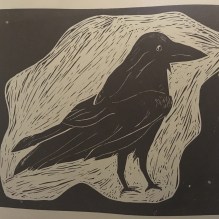
And thank you, Annie, for the raven linocut I’m finishing with. I might want to fly with the wings of eagles, but a keen eyed scavenger with a rude clarion cronk (thanks, Chris!) will do me just fine –

– and is probably just right. 

Emmett and Caleb and

The book Emmett and Caleb is a simple story about two friends, an exploration of friendship DE186CC4-0C87-4FD2-B161-7040A806FA69not unlike DuBuc’s Up the Mountain. Hottois and Renon give us a bear and a deer who live next door to each other, and we follow them through a year and through the ups and downs of their friendship. They live in a world where a deer can check the internet in bed, and where a bear can roast chestnuts.

Ian Eagleton has already laid bare much of the complexity around this relationship in his revealing interview with the author, which is linked here. Karen Hottois says so much in her responses I couldn’t better it. There is lots more, both in the book and the interview  – nature, landscape, the seasons, freedom: I’ve tagged this post “spirituality” precisely because of this richness and the interior life of the characters it reveals.

Sarah Ardizonne the translator has deliberately chosen to use the word “love” where the French original uses “aimer, ” as an indicator of the relationship between the two characters, and Karen Hottois is clear about her intention when she talks with Ian:

To me, Emmett and Caleb are friends but I did indeed deliberately write in such a way that they might be something else. First of all because I think that the contours of a relationship aren’t always clear-cut and because I wanted my readers (children and parents alike) to be able to interpret it as they want. Nothing gives me more pleasure than when I’m told that same-sex parents enjoy the book and can identify with it.

Let’s unpick that paragraph a moment. Hottois isn’t sidestepping the question about the relationship between the two animals at all; rather she is meeting a very big question about friendship head-on.  What language do we use for a strong male-male relationship?

To start with I want to return to this blog post from a while back. I based it on the illuminating messages of Dennis Tirsch, which I expanded to say that

The sacred is not defined by how it might be attained but by how it is  boundaried by reverence.

And this caution, this reverence, is what gives me great joy when reading Emmett and  Caleb – as much as when a friend calls me to meet.  It is there too in the physicality of relationships: hugs, the touch of a hand, whatever; and in the ways these physical expressions of friendship are like and unlike the ones that are part and parcel of being a dad, or even part and parcel of more involved romantic and intimate relationships. Except I’m not sure I like intimacy as a euphemism: Emmett and Caleb do not have a sexual relationship that we can see, but their relationship is certainly intimate. In a certain sense  whether their relationship is sexual doesn’t matter in the story: real intimacy is what is at the heart of the book.

Now, this sounds like a cop-out. “They don’t need to be gay like that, just really good friends” sounds like something from my parents, and that’s not what I think at all.  I do think that Love is a powerful word, and maybe it is scarily powerful for many men, but physical expressions of intimacy are not impossible. I take joy when I meet a friend in the Weston Cafe for coffee; likewise I have friends I can cry with, share poems with; friends I have taken a cup of tea in bed; friends I can dance with, borrow clothes off; friends I kiss when I haven’t got a cold; friends I have lent my dressing gown to (and readers of Emmett and Caleb will understand the references). With some friends I share really difficult stuff about my emotions, or about the pains of growing old, or the schlep of parenthood.  The Venn diagrams for all these would look like a kaleidoscope, and changes in culture change the patterns we discern, but it isn’t easy, because the word Love is not always accessible to men.

Sometimes that feels unfair: love is such a complex and involving thing, but it should be possible for men to use the term.  It’s there, but not nameable. It “dares not speak its name” because its meaning is so often seen as not complex, a simple dart of Cupid.  I cannot deny the two characters in this book that feeling, of course: books are interpretation places and anyone who comes to a book can approach it and savour it as they wish.   I can also see the tender and committed affection between bear and deer  at various points when they are tearful, or sharing the winter cold, or whatever – but it is as complicated for Emmett and Caleb as it is for us. I called this post Emmet and Caleb and because whatever the interpretation of their relationship, it stands for so many others.  They stand for me and my friends. When the deer and the bear struggle to express their feelings and they tussle about poems and messages, I am fully in agreement with Karen Hottois when she says that

the contours of a relationship aren’t always clear-cut.

This emerged last year in the context of professional use of the word Love, too, which I discussed and is increasingly present in children’s literature. In Keith Negley’s Tough Guys (Have Feelings Too) , which I have mentioned before, and which comes up in the work on masculinities and fatherhood Mat and to some extent I have been exploring, seriously characteristic, even caricature male figures – superheroes, wrestlers – are shown to have a similar relationship to their emotions. I am glad they are vulnerable – very glad this vulnerability is on show in a book for children.  Mat calls it an “optimistic and liberating story of starting down the road to a sense of emotional freedom for the modern man and father.“ Emmett and Caleb, too, live in a world where they enjoy the change of seasons, a last dance at the end of a party, thinking about each other’s birthdays… They do not live in a bloke culture where everything is painfully clear cut. And I am glad they don’t – and again, glad that this relationship is open to interpretation, to discussion, to ambiguity. My world is like that, too.

To concentrate on who Emmett and Caleb might be “in real life” or what that real life might consist of is to miss something important: the role of closeness in male friendship, a sustaining, honest closeness.

Emmett brought Caleb his dressing gown. They stayed there, keeping each other warm.

Together, like that, they could last the whole winter.

Yes, we read this and really believe they could.


Underland and Overstory

He still binges on old-school reading. At night he pores over mind-bending epics that reveal the true scandals of time and matter. Sweeping tales of generational spaceship arks…There’s a story he’s waiting for, long before he comes across it.

Richard Powers, The Overstory, Neelay Mehta

I read.  I read fast, slow, recite, note, on line, in paper books, out loud, in silence.  I’m not unusual in this, even in the binge-reading of some of the books that have come my way recently.  I do find it tiring, sometimes, even, oddly unnerving to see a TBR (To Be Read) pile mounting – but still compulsive. Like Patricia in The Overstory:

Then the reading, her nightly thousand-mile walk to the gulf. When her eyes won’t stay open any longer, she finishes with verse…

The walk for me includes all those classics unread, new books set to educate and delight, those well-loved books from the past that I have loved long since and lost awhile; re-reading is about depth but is also about limit and comfort, too (I finish with M R James more often: verse just makes me want to write)… The urge to read is maybe one reason why I go back to well-loved favourites ( for example, I have just got my third copy of C S Lewis’ That Hideous Strength*), even when tired at the end of a day.

Just sometimes, however, a pile of books present themselves that are of such quality that any sense of “one sodding thing after another” (to reuse the judgement on history from one of Alan Bennett’s  History Boys) is completely lost. As the title of this post suggests, they are Rob Macfarlane’s magisterial Underland and Richard Powers’ The Overstory.  In this case it’s two books: not really a pile.

“Reading,” Margaret Meek suggests, “demands explanations beyond the information given about the surface features of language, important as that undoubtedly is.”  It is with this in mind that I reached nearly half-way through Overstory and found this line, the culmination (or at least first-act closer) of the story of a botanist who discovers that forests are themselves ecological systems with their own means of communication:

There are a hundred thousand species of love, separately invented, each more ingenious than the last, and every one of them keeps making things.

The echoes with Underland and the wonderfully named Merlin Sheldrake do not need repeating. Woodlands are not there to be judged as needing tidying.   – except that the human users want things a certain way. On the way I often run, for example, there is a young dead badger: already a bit bloated, with flies on its fur and the sweet smell starting. Do I look at it as part of a massive pattern, a fractal maybe, which at my level is discernible as flies and fungus and young trees and older ones, soil that was the badger’s life – or do I impose my need, even the drive of my spirituality (misplaced, I think) to show it respect?  In reading Underland and then The Overstory, I know how illiterate I am, like Powers’ prisoner, here:

If he could read, if he could translate…If he were only a slightly different creature, then he might learn all about how the sun shone and the rain fell and which way the wind blew against this trunk for how hard and long. He might decode the vast projects that the soil organised, the murderous freezes, the suffering and the struggle, shortfalls and surpluses, the attacks repelled, the years of luxury, the storms outlived, the sum of all the threats and chances that came from every direction in every season this tree has ever lived.

Leave the badger by the path in the wood, move it, bury it?  Clear it up, and the pattern shifts: do we intrude by trying to make sense or enter the dance? Write about the history of Warneford Meadow in an effort to explain these scrubby trees to one side in what is grandly called a wildlife corridor? Look (as Paul Kingsnorth does in his essay on Burnham Beeches in Arboreal) at the networks of mycelial threads even here?  Maybe seeing it is our part in the pattern?  I confess that, in reading these books, I have been feeling elated and dismayed, disepmowered and propelled to try and and understand. And if we don’t try, then, bleakly as one character finds 

All that’s left to sell up here is nostalgia.

All we have left is commodification, where even story is no longer an invitation to greater understanding but simply the cheap tricks of landscape depiction, a collection of backdrops and no more.

Arboreal, Common Ground, Underland, The Overstory and so much magnificent writing all stand as a challenge.

Turn but a stone and start a wing

or miss the many-splendoured thing?

IMG_0245


_____________

*As a diversion: To me Lewis’ That Hideous Strength is a book at once of its time and horrifyingly prescient in its vision of popularist seizing of media and power that is accompanied by radical and appalling dehumanisation. I admire some bits (the almost-not-there Institute Director who roams the corridors: every academic has known him), I love others (the discussion between Merlin and the C20th academic who has to bring him up to date), and have to say I wince at others – not least the final paragraphs). Of its time is a periphrasis or maybe euphemism for the fact that it is all terribly clubbable, Oxbridgy stuff with a deep theology of sexism thrown in…  So why the re-read?

The Great Events?

55BCE, 597CE, 793CE, 1066CE, 1282CE, 1534CE, 1588CE, 1649CE, 1707CE, 1714CE, 1922CE…  pick your date for an event or series of events that define England, or Britain. There are others, and the ones I have chosen may say more about my poor historical knowledge or prejudice than anything. There are also occurrences which pass without comment at the time or which we cannot date certainly because no record exists: when really does Britain cease to be Roman? Or when did the last wolf die? Why does one date matter? Will the referendum on 23rd June 2016 be eclipsed by a final unequivocal date or will that be the one history picks as the The Date We Left Europe? The Date Things Changed?

We cannot dictate, and maybe can’t predict with certainty. Perhaps something else will intervene to take precedence – the failure of electricity, a catastrophic event such as the melting of the polar ice? What does strike me is that this simplistic history suggests that one date was important, and that the messiness before or after are somehow lesser occurrences that don’t matter. And that the massive changes were not contested, opposed, or that those who did contest were ridiculed, sacked, sidelined, imprisoned, killed. I feel as if I signed the Terms and Conditions for C21st without reading them, and I think of Tom Holland’s brilliant book on the Millennium, where in effect Western Europe did try and sign particular Ts&Cs only to find a new millennium just as complex and hard. A single date just doesn’t work. 1066 is one date: do we (and I need to exclude historians here, of course) consider the harrying of the North?

The counsellors in the decades/centuries of Christian consolidation; subjugated  Saxons after the death of Harold in 1066; recusant Catholics – all these people would attest that these great events are never simple. These “events that shaped Britain” were the cause of pain and unquiet: families divided, economic disturbance… and we are seeing the same in our time, in ways I never thought to see, never wanted to see. “Project Fear,” in which the UK suffers terrible upheaval, may not come to pass, or it may – but this evening I am wondering quite what will come. I suspect it’s going to be big, and an unpleasant change. I am gloomy, and predict a rowing back from liberties won, well-being improved. I feel the sharp tug of solastalgia.

Why is this part of this blog? Over the next few days I will have the pleasure of being outside with learners of various kinds. Some theory, lots of practice: a challenge for me, but a very welcome one. I will be making a plea – directly and indirectly – for the pleasure of being outside to be seen as a driver of a life well lived. Ecological wrongdoing in the Anthropocene will impact on people’s wellbeing; economic changes, greed and “austerity” planning may mean that parks and woodland will change. But I hope that people – maybe the young people I meet or the families they will work with – will still see the energy of plants and bugs and the movement of clouds and look for joy and delight and maybe transcendence.

Because all these things are transient, this Jeremiad included. And I think that with the little time I have, I want to help people find joy in the small things, and see our interconnectedness with bigger ones:

I want you to walk out into the fields
where the water is shining, and the rice has risen.
I want you to stand there, far from the white tablecloth.
I want you to fill your hands with the mud, like a blessing.

Yes, Mary Oliver does it again, this time in her poem Rice.