Escape, extent and serendipity

There was a time long ago – say, last Sunday afternoon – when nipping off for a run seemed easy and natural. And on Monday, when Jeff and I went for a walk – well, it seemed a normal thing. Bloke. Dog. Biscuits. Sunshine. The political clouds of isolation and the warning that people had to be more responsible were looming, but dogs gotta walk, and man’s gotta be sensible about “social isolation.” That seemed about it.

Jeff the dog and I went to South Park and Warneford Meadow. We got muddy, he more than I, we looked at the various corvids and the people playing basketball, he ate dog biscuits and I didn’t, and we were sensible about keeping ourselves to ourselves. We didn’t do the reckless “last weekend before we have to be indoors” congregating, but yes, it seemed that keeping to guidelines was easy. A new politeness was emerging around how far apart we needed to be from people we passed, it’s true, but in any case they weren’t people either of us knew, not even nodding acquaintances. A quick chat with the basketballers a good 4m away and then we moved on. We got closer to magpies, to be honest. Three for a girl, if I remember rightly.

Only with yesterday evening’s pronouncements did that mood really change, and I think in retrospect we pushed it a bit. Maybe it was my day’s exercise. It will have to stand as such.

Wind back a week and I am with Mat high on the Downs, and you could not wish for a lovelier day. Sunny again, breezy, a sharp-eyed, sharp-minded kestrel of a good friend, everything bright and fair. As I discussed here, human relation to place is, for Robert Mcfarlane, grounded in language; but language is itself grounded in relationship. I’m coming back to this.
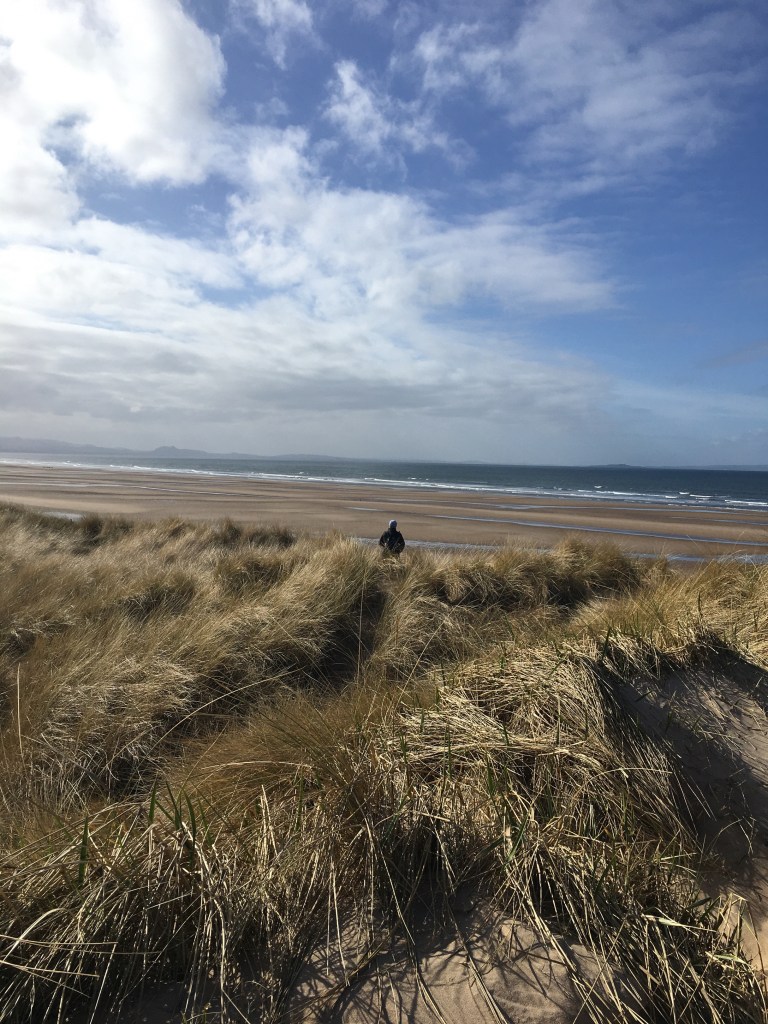
Back to the Friday before and Lizzie, Maggie and I walk through the Aberlady nature reserve and across the beach to Gullane. A bright sun, a brisk wind. Family enjoying one another’s company.

But these are not excuses to show snapshots. What is it that gave these trips significance? Why feel better after them? They both lacked the challenge of Rob Macfarlane’s exploration of the treacherous Broomway or even the experience of our face-to-face encounter at Ludchurch. What is it that some trips into the outdoors bring? and how do we represent that in time and place without it being, like these photos, just a grown-up version of What I did on My Holidays?

The absolutely seminal book on the psychology of the outdoors for me is the 1989 book The Experience of Nature, by Rachel and Stephen Kaplan. In it, they explore dimensions that may provide a framework for how “nature” helps and supports psychological wellbeing. Extent; fascination; action and compatibility. Because their work looks to the “wilderness” they address the nation of escape as well, which they view with some caution because it has in it “an absence of some aspect of life that is ordinarily present and presumably not always preferred.” I can see their point, but given that it is early work (thirty years ago) and has been superseded in many ways (partly by the new nature writing itself), I want to raise the question of escape with someone. Here, further off on the Aberlady sand dune, is Maggie; Mat not only drove the two of us to Uffington, his insights enriched our visit. We are “political animals” – not because we are forever tuned into the depressing power games (or, if you like, selfless and inspirational leadership) that cram our news until we cannot see what’s actually happening – but because we are defined by how we live in the company of others. I go out on my own but with me come meetings to have, people I want to see (or don’t), ideas to bounce off others. I bring the city with me. And similarly I contend that a visit to Uffington means I am “with” (metaphorically) Rosemary Sutcliff, or that to go to Ludchurch “with” Alan Garner is not to travel alone. In some ways, the accompanying author or characters provide what the Kaplans call action and compatibility, and of course are the spur to action via the notion of fascination. We go “Backpacking with the Saints” according to Belden Lane (article here; link to the [excellent] book is here. Name the saints that come with you.

Lane, a “scholar in recovery” takes with him insights from the Desert Monastics and “a few lines of Rumi” and is wedded to the silence that wilderness can bring. Not as far into my recovery I have taken Gawain, most recently Sun Horse Moon Horse and the Land of the White Horse. Somewhere in my mental backpack are lines and vistas from writers such as Robert Macfarlane, C S Lewis, Oliver Rackham…. This isn’t a boast: I sometimes wonder whether I could leave them in the car. Would this then be more of an escape, or given the liberating nature of some of this writing, less of one? And what about extent? Do we need the wide open wilderness of the Ozarks are we OK with the view from the White Horse down into the farmlands of Oxfordshire and Wiltshire? I think of Aberlady, where I have no literary baggage to bring: an escape, as the Kaplans would see it from particular content, “a rest from pursuing certain purposes.” I wonder if writing about his wilderness hikes took the edge off the experience from Beldin Lane…

But for the trips that fall under the Wild Spaces Wild Magic umbrella I really have to take the authors firmly in my hand and my mind: last week for example I was reading the episode of Lubrin Dhu’s planning of the White Horse from Rosemary Sutcliff and looking for where she might have sited the Wych Elm. She comes with me and by extension the characters she calls into being; David Miles comes with me – my copy of his book has a smudge of Uffington soil on the page of his site plan (p101, if you’re interested); Mat of course comes with me. Identifying where this Wych Elm might have been, we find some wild apple trees by chance and wonder: are these the inspiration for the sacred apple trees in Sun Horse Moon Horse?

Social aspects of serendipity (see for example Morrissey’s “An autoethnographic inquiry into the role of serendipity in becoming a teacher educator/researcher,” International Journal of Qualitative Studies in Education, 2014) seem to me to work alongside the changeability of being outside. Less is in the enquirers’ control, expectations have to change. Two pairs of eyes are able (sometimes) to be more alert to these changes: sagacity (Morrissey again) enhances serendipity but are two heads better than one? If we are aware of the dangers of shoring up each other’s ideas, might collaboration, like identifying mistakes (Morrissey) “also uncover for the researcher… fears, preconceptions or beliefs …of which he/she had hitherto been unaware”?

And if we are accompanied by the cloud of witnesses from literature – such as nature writers and their places, fiction writers and their characters – then we might address two notions (or one single notion with two aspects? I’m not sure as I write) of psychogeography and autoethnography. How much, in other words, does setting (in its broadest sense) and personal history of setting enhance or detract from personal reading of landscape? I am conscious of the dilemmas where Dyson writes “In recognising that I was a subject and an object of the research I realised that at the same time I was and could be both an insider and an outsider within the culture that I was investigating.” (From his article My Story in a Profession of Stories: Auto Ethnography – an Empowering Methodology for Educators, https://ro.ecu.edu.au/ajte/ 2007). I rejoice in being on the Downs with Mat; I am very glad we have purpose in a book I love; I am exhilarated in the chill breeze and bright sun. To change from his journey metaphor to one of wind or water, being the reader and a colleague in an investigating team involves recognising how all sorts of things flow over one another: the reader and her/his history; the researcher and her/his concerns and limitations; the authors under investigation, their sources, their motives, their depiction of place and character; and being a research partner multiplies these complexities. For me this links with Rob Macfarlane’s lines from his introduction to The Living Mountain:

…the world itself is therefore not the unchanging object…but instead endlessly relational. It is made manifest only by only by presenting itself to a variety of views, and our perception of it is made possible by our bodies and their sensory-motor functions… We have come increasingly to forget that our minds are shaped by the bodily experience of being in the world – its spaces, textures, sounds, smells and habits…

We are human, language-loving and people-loving; we are also placed: physically located on a windy ridge above a deserted farmhouse in the Peak district, or searching for a tree that may never have been at the foot of the Downs.

To conclude with Belden Lane, who may be close to an answer here (I know I’m not): The Spanish philosopher Ortega y Gasset once said, Tell me the place where you live, and I’ll tell you who you are. I think he also could have said, Tell me the place to which you are drawn, and I’ll tell you who you are becoming. 
Inner Tube at Mike’s House

One of the delights of using dictation software – and I use it increasingly to note down quotations – is the wild guesses it makes about words. Has it got used to me with place names such as Ludchurch or Uffington? I don’t know. As this blog post’s title suggests, it certainly wasn’t prepared for the dark and sacred depths of “the inner tomb at Maeshowe.” Maeshowe or Maes Howe, whose significance (detailed in very modern terms here) lies in its being, along with the rest of the complex archaeology of the area, such an astonishing “example of an architectural ensemble and archaeological landscape…” Even the dry report cannot escape a tone of wonder.

But I have to come clean and admit where I am: in my study in Headington, reading Kathleen Jamie’s splendid Surfacing. It has some spellbindingly great writing, and shares insights from all sorts of digging and wandering and wondering and loving from Sutherland (and back again) through the discarded bikes and tundra-preserved past of the Yup’ik and the eyes and spirals of the Noltland dig and the rummage through the layers of the author’s own life. Careful here, Nick, not to unearth too much: the book demands its own read.

But at least I can share a few things: all, this time, from the central section (as I read it) of Jamie’s visits to the Orkneys. It is full of lovely lines and images: If seals could watch Netflix, they would and I walked down to the shore, feeling like a child again, glad of hard to know there is still room in the world for a summers day and a cow called Daisy.

The author is shown a warehouse of finds:

Graeme opened one particular box to show me a slender implement reminiscent of those nibbled pens we used at school, to practise joined up handwriting. It could have come from his own school house.

“You see how the tip is stained dark?” He said. “We think it was used for tattooing…“

Hazel and Graeme showed me more beads, some made of animal teeth, and half-made beads, lots of beads. Thick pins of bone, as long as your hand, presumably used for fastening clothing…

For a moment, out of the twenty-first–century plastic boxes stacked in the gloomy Victorian store, they emerged a vision of people closed in animal hides, bearing spiral-designed pots, with hair braided, hanging with beads, people crazy about cattle, young people prematurely old, as we would think now.

Jamie has already asked about Neolithic ghosts, concluding, maybe rather sadly, that Ghosts have a half-life, it seems, lingering just a few hundred years, till they too fade away. I am reminded of the ghostly Lord Kildonan whose haunting fades with the years in M R James’s Residence at Whitminster – only to reemerge some years later in a different form. It could be an allegory of sorts for the antiquarian. Here in the Victorian warehouse however, she seems able to conjure such spirits like Prospero as she speculates on the Neolithic settlers:

Different groups, with their different clothing and accents, tools and designs arriving here, but very soon after their arrival, there will be no one alive who could remember the journey. Doubtless there were stories. Origin stories. Contact with other peoples of the same ilk, who spoke the same language, at other settlements. Great ceremonial gatherings, informed by movements of sun and moon, risings and settings, alignments of stones. The midwinter sunrise shines down the passageway at Newgrange, the midwinter sunset illuminates the inner tomb at Maeshowe.

How did they know that, these kids of twenty or thirty years old, with their bone and stone tools?

I am reminded of the poem of Frances Horovitz Poem found at Chesters Museum, Hadrian’s Wall (from her Snow Light, Water Light, and found in this collection) which likewise looks at finds at contemplates a culture long gone. Starting with the confident To Jove, best and greatest she chants the museum labels – billhook, holdfast, trivet/latch lifter, nail lifter, snaffle bit… until she reaches the unknowns and uncertainties dedication partly obliterated/with human figure in rude relief… All a bit of a challenge for the dictation software, because they are outside the range of frequency to be picked up by the software: just not used enough? So I am back thinking of the Lost Words – but then, oddly, of the book that inspired so many daydreams when Maggie and I were first married, John SeymoursSelf Sufficiency. Such daydreams – and tonight is simply the Allotment AGM, and I am “doing the teas.”

One of the joys of the modern nature writers is that they will not only write of the sod lit hut by a seal-oil lamp but also of the welcome cuppa, not only a song about time and change but also about pub night and Wifi. The Inner Tube at Mike’s House would not be out of place. Kathleen Jamie is a writer whose poetic instinct draws us into her world of spirituality and history and topography; she is another of those writers, Rob Macfarlane, Peter Fiennes, Rob Cowen… travel writers, nature writers, topographers in what Robert Mac’s Cambridge page calls Geohumanities. A neat (and maybe not uncritical) review of Macfarlane and Jamie and the phenomenon of British nature writing appears here.

As an aside: the more I think of that term, the more I like it. It is Geohumanities (as a metonymy) that impells the glossaries in Landmarks; that makes connections (reliable or not) in Watkins’ The Old Straight Track, that watch the revelation of Yup’ik past in Surfacing… I am beginning to wonder whether it is a term that could be applied to fiction, too: to Peter Dickinson’s The Kin, or Rosemary Sutcliff’s Sun Horse Moon Horse. I don’t think I have an answer.

If all goes well, I will be taking time soon with my friend Mat on Uffington White Horse. In my hand I will have my (now signed!) copy of David MilesThe Land of the White Horse. On my ‘phone I will have a collection of poems about the place: Jon Stallworthy, G K Chesterton, and if I can find it in time, Kevin Crossley-Holland‘s poem which celebrates the Ridgeway – and of course Frances Horovitz. They all speak – in very different ways – of how landscape and language interrelate: Chesterton is full of a great battle that made England; Horovitz has a mystical white horse that she urges to strike fire to the earth from air. But behind all of this will be the repeated challenge of Kathleen Jamie that all the writers I’m lauding here are answering, as she asks again and again:

Why feel anything? Do you understand? Did you hear something move out of the corner of your eye? The path is at your feet, see?

Frogs are Nothing Fancy

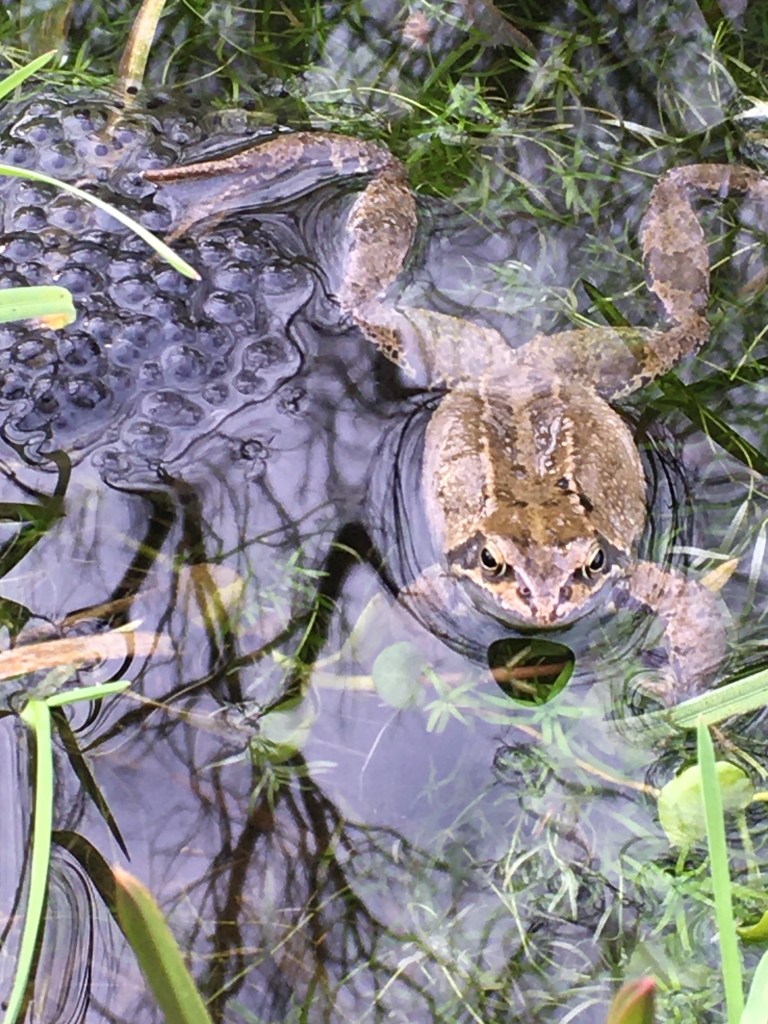
Except in some ways they are. They were today, down in the Lye Valley. In among the “warm thick slobber/of frogspawn that grew like clotted water” as Seamus Heaney puts it, were maybe a hundred frogs. Alerted by a notice from social media, I took Ivy, keen and energetic to see the frogs spawning in the fenny ponds near our house.

They weren’t Heaney’s “slime kings,” “their blunt heads farting,” but a congregation of animals, a welcome sign of spring on a warm afternoon. Not coarse, and not apocalyptic, just frogs: welcome, exuberantly sexual and productive. One watched us carefully as she sat in her grey cloud of eggs, her sides heaving; others climbed, swam, grabbed, and croaked like a distant motorbike starting up.

My immediate thought is that Bashō has it right: keep to the bare thing itself (a nice explanation of Bashō’s famous frog haiku and some translations are to be found here; more, with Zen comments, here) in a few terse lines: eschew the grandiose. Today at Mass, the preacher interrupted his own flow to correct his phrasing around a (very good) point of his sermon on Christology and spirituality and say “O dear, what pretentious twaddle!” – and perhaps Bashō does better with his short invitation to join him by the pond.

Continue reading “Frogs are Nothing Fancy”

Gifts Reserved for Age?

A storm was gathering yesterday that has hit us good and proper today. I had been for a walk and a coffee and came out from the pub to see the lights on in St Andrews across the way. Evening Prayer time in a warm, quiet, dark church.

And when I got home I looked up the words from T S Eliot because, I wanted, I suppose, some more of that sense of contemplation that Eliot tries for:

So, while the light fails
On a winter’s afternoon, in a secluded chapel,
History is now and England…

The aesthetic pathway of spirituality may be cultural, maybe victim to changing fashions or simply growing up, but it is not to be forgotten: it creates the thin places, or sharpens the senses to see those places where prayer has been valid, where the other and the now meet. Thin places. In the church the silent near-dark was stunning, and all those poems from all those Thomases,   Thomas Merton and R S Thomas and T S Eliot (not to mention Dylan Thomas’ “close and holy darkness”) were somehow at my elbow. And maybe the incense smudge of a memory of the church when I was a child, after Compline and Benediction, or the quiet of Magdalen after Night Prayer…
But tonight it is different, and the blustery grey has been superseded by a Wild Hunt of a storm. Time then to go back in my mind to another thin place, to the little, basic cottage on the North York moors where this poem from Kathleen Raine was posted up by a previous inhabitant, and said so much about a keener, wilder, maybe more dangerous spirituality. I have cited it before.

Let in the wind,
Let in the rain,
Let in the moors tonight,
The storm beats on my window-pane,
Night stands at my bed-foot,
Let in the fear,
Let in the pain,
Let in the trees that toss and groan,
Let in the north tonight.

Let in the nameless formless power
That beats upon my door,
Let in the ice, let in the snow,
The banshee howling on the moor,
The bracken-bush on the bleak hillside,
Let in the dead tonight.

The whistling ghost behind the dyke,
The dead that rot in the mire,
Let in the thronging ancestors,
The unfilled desire,
Let in the wraith of the dead earl,
Let in the dead tonight.

Let in the cold,
Let in the wet,
Let in the loneliness,
Let in the quick,
Let in the dead,
Let in the unpeopled skies.

Oh how can virgin fingers weave
A covering for the void,
How can my fearful heart conceive
Gigantic solitude?
How can a house so small contain
A company so great?
Let in the dark,
Let in the dead,
Let in your love tonight.
Let in the snow that numbs the grave,
Let in the acorn-tree,
The mountain stream and mountain stone,
Let in the bitter sea.

Fearful is my virgin heart
And frail my virgin form,
And must I then take pity on
The raging of the storm
That rose up from the great abyss
Before the earth was made,
That pours the stars in cataracts
And shakes this violent world?

Let in the fire,
Let in the power,
Let in the invading might.

Gentle must my fingers be
And pitiful my heart
Since I must bind in human form
A living power so great,
A living impulse great and wild
That cries about my house
With all the violence of desire
Desiring this my peace.

Inosculation

Just sometimes a day in January makes me want to believe in spring.  A chilly day down the allotment – should have been the morning but we pressed on – and my task was to finish some hazel coppicing. img_1988Well, actually my task was to tidy the absolute dog’s breakfast I had made of the hazel I had undertaken to coppice on some communal land to one side of the plots. Hacking with a billhook like William Ager had been immensely satisfying but really untidy; a mixture of billhook, bowsaw and ordinary handsaw meant I managed better. At least occupied with coppicing there was was no diggin’ to be done in the claggy soil.

Two rods stand tall on one hazel stool, and turn round each other. At one point they meet, touch and begin a process of fusing together known as inosculation, a joining together: the term has its root in the Latin word for kissing. I am, because of how my mind works, really quite moved by the metaphor – but recognise that I need to get to work. The two rods have, I guess, been working at this for years, but now I need to get cutting. I sort of hope that I can cut the fusion out as a whole piece (but in the end I can’t)… but the time the hazel has taken and the time it takes my saw to undo the fusion seem out of all proportion.
Old man on an allotment hazel stand: hardly great forestry or John Seymour-like land management. Forest School is not survival training; allotmenting is not farming. But once in a while, what we potter about at is something that is in the shadows of a bigger husbandry and a longer history: the stone axe; the horse, the enclosures.  And the kissing metaphor makes me think of so many nature writers’ respect and tenderness for the landscapes they represent. So when I come home, thinking of how this work is explored, I look at various texts. Edward Parnell’s exploring of the ghostlands of literature and his own biography; Thomas Merton’s monks whose “saws sing holy sonnets;” the changing and unchanging downs of the White Horse in David Miles’ book… and then into other writers on my shelves, where I am struck by this:

What a bare desert of a place the world would be without its woods and trees. How long would man live once he had broken the balance.

Ian Niall, in Fresh Woods and Pastures New (Little Toller did one with lovely illustrations by Barbara Greg) is keen eyed and dreadfully prescient about deforestation.

When he cuts down the planting, the copse, the old oak wood, it takes him a little while to see that the drainage is different, that the soil washing into the hollow, and new crops of rock are in his field. The lumbermen come and haul away the timber and every yard of the fields on either side changes in nature, new weeds, new grasses, more sun, less humus, water-logged drains in wet weather, overflowing ditches. A year or two, and the man sees what he has done, but how long must he wait to see it as it once was?

Believing in spring feels easy on a chill, bright January day: believing in a world where we can find ways to harvest from the earth when it looks like the Anthropocene crisis is upon us in the Amazon, Jakarta and Australia feels a lot harder. “Man sees what he has done:” but can we step back from it, somehow? Can we realise our need to reconnect, to re-fuse with the world we live in?

Down in Yon Forest

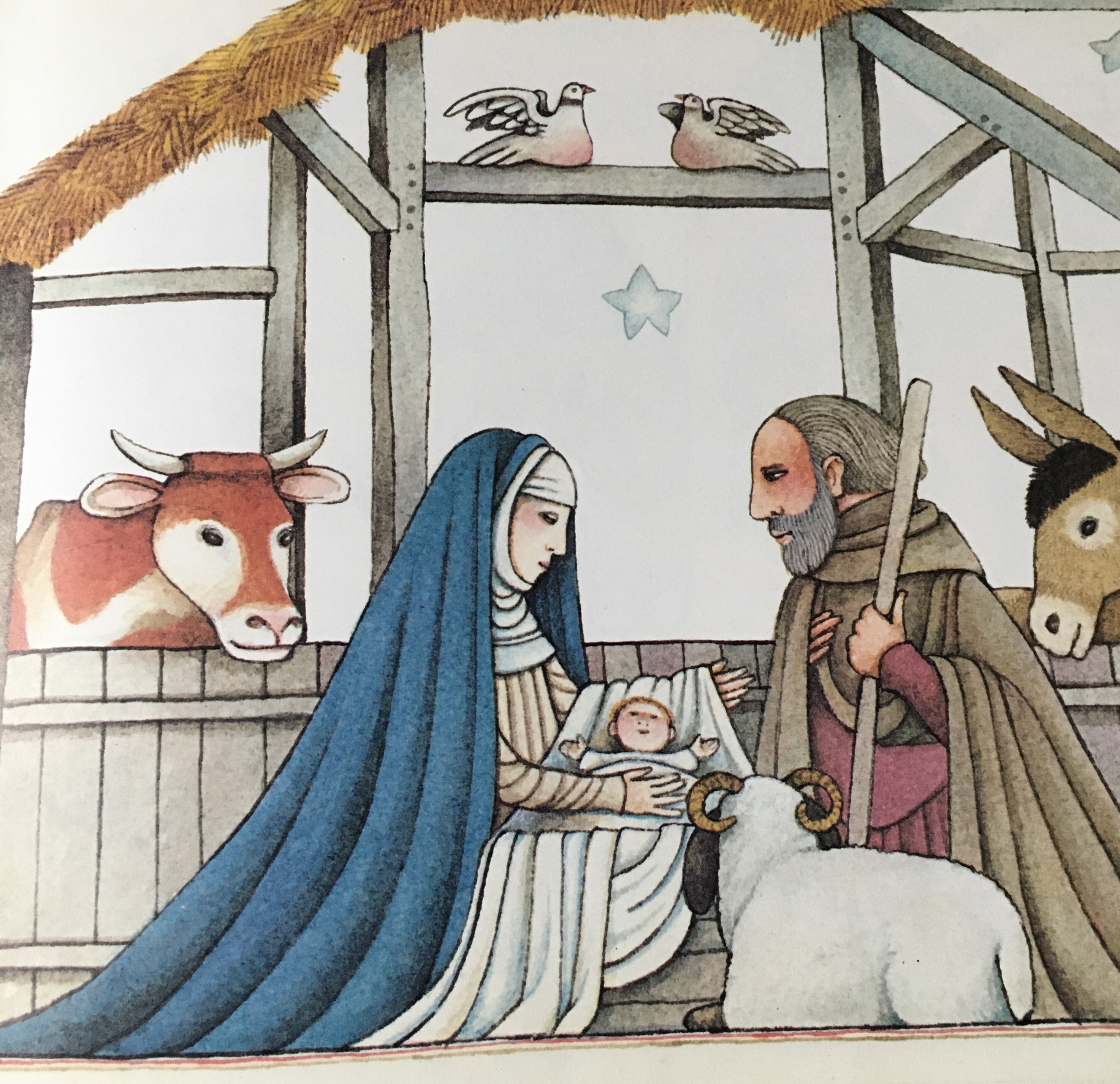
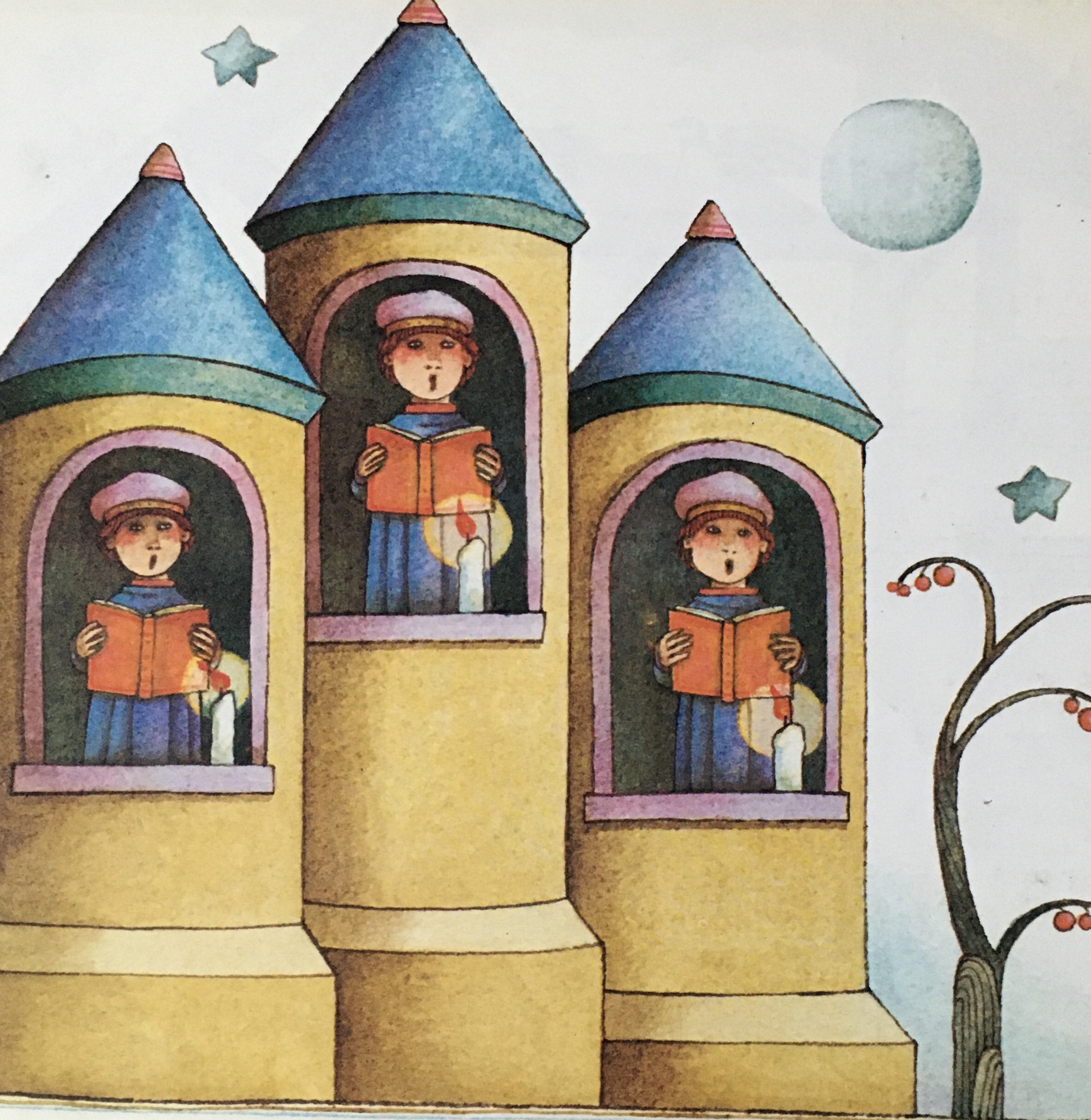
This is a bit of a mish-mash, with all sorts of sources bunged together. I’d like to think of it as an enquiry into why Christmas a time of nostalgia but suspect it is a pile of stuff under a Christmas tree with no labels: sort through the pile and see what you can find. But why do we look back at Christmas? img_1806-1Why does the glorious The Friendly Beasts by Tomie de Paola have choristers and candles to sign/sing us to the stable? It is as if the validity of Christmas in some ways springs from this appeal to the past. Is it because Christianity has created a feast in which “history” is one of the most important guests?  I’m not sure. De Paola often has this sense of tradition, such as his retelling of Italian folk tales, the beautiful Clown of God, and representations of Bible stories – and the Night Before Christmas, which is our family’s standard version of the poem (follow this link to Jake Hayes who has some lovely photos of this version). There is some of that, certainly, right from St Luke’s dating of events and the genealogies he and St Matthew produce. Perhaps it is also because, in the partial extirpation of a pagan Yule, one of the things that remains is an echo that says “remember how it used to be…” – and could this be an attempt to return to a (mythical) Christmas of our own childhoods?  And then maybe in England that nostalgia includes a sorrowing for some good old days, a golden age around  1500 CE or maybe 1600, or 1800…  There is more than one ghost of Christmas past, I suspect, and maybe as well as our personal ones we carry ones for our society too, whether we acknowledge them or not.

It is not only Dickens that feels the weight of past Christmasses. Cole Hawlings who “does date from pagan times” in The Box of Delights sings the rescued Cathedral staff back to their Midnight Mass  where they are greeted by the monks from years past

…for on such a Christmas Eve what one of them would keep away?

and Tolly’s dream-like experience of Midnight Mass moves between his own twentieth century and the past of his family in the seventeenth. As I have just cited recently, Susan Cooper celebrates this looking back when celebrating the Solstice:

All the long echoes sing the same delight,
This shortest day…

What is the attraction of the past for this festival?

In the run-up to this Christmas I come back (again) to poets Thomas Merton and R S Thomas. Here are two poems that seem to me typical of their approach to Christmas. Merton first of all, surrounded by the traditions of his faith and practice like Duccio’s Maesta or Martini’s: All those hopes and fears of all the years gathered around the Virgin and Child:

Flocks feed by darkness with a noise whispers,
In the dry grass of pastures,
and lull the solemn night with their weak bells.

The little towns upon the rocky hills
Look down as meek as children:
Because they have seen come this holy time.

God’s glory, now, is kindled gentler than low candlelight
Under the rafters of a barn:
Eternal Peace is sleeping in the hay,
And Wisdom is born in secret in a straw-roofed stable.

And O! Make holy music in the stars, you happy angels.
You shepherds, gather on the hill.
Look up, you timid flocks, where the three kings
Are coming through the wintry trees;

While we unnumbered children of the wicked centuries
Come after with our penances and prayers,
And lay them down in the sweet smelling hay
Beside the wise men’s golden jars.

Merton: Carol

and Thomas, well, Thomas is aware of the biting wind of doubt and silence in the Nada Nada Nada, Y En El Monte Nada of St John of the Cross. Here he captures a Christmas purity that I think is hard to beat:

The moon is born
and a child is born,
lying among white clothes
as the moon among clouds.

They both shine, but
the light from the one
is abroad in the universe
as among broken glass.

Thomas: Nativity

RST is like this: grounded but bleak, with a now rather than a history in his poem. This is often his way, I think (although not always): a doubting impatience in the spiritual –

Will you continue to torment us?
If you are ubiquitous, why
not be here when we say : Now?

Thomas: Could Be

I have been a student of your love

and have not graduated. Setting
my own questions, I bungled
the examination…

Thomas: Incarnation

Merton,  however, pours out his love not only for the God he seeks in monastic profession but also in places for the life itself:

The sun that plays in the amazing church
Melts all the rigor of those cowls as grey as stone – Or in the evening gloom that clouds them through those tintless panes,
The choirs fall down in tidal waves
And thunder on the darkened forms in a white surf of Glorias.

Merton: St Ailred

I’m not sure I can answer my own question, to be honest: Christmas is a time of looking back, looking forward – and inwards too. For me, the tensions between the very grounded (and dark) spirituality of R S Thomas and the almost ecstatic exuberance of Thomas Merton is resolved in a medieval lyric:

This is the text:

Lully, lullay, lully, lullay,
The fawcon hath born my mak away.

He bare him up, he bare him down,
He bare him into an orchard brown.

In that orchard ther was an hall
That was hangid with purpill and pall.

And in that hall ther was a bede;
Hit was hangid with gold so rede.

And yn that bed ther lythe a knyght,
His woundes bledyng day and nyght.

By that bedes side ther kneleth a may,
And she wepeth both nyght and day.

And by that bedes side ther stondith a ston :
Corpus Christi wretyn thereon.

It is known as a Christmas carol in a slightly altered version, where the moon shines bright on a saviour… born this night, but the earliest version seems to me to be a visit to the Sacrament where the Passion is clearly discerned.  Benjamin Britten’s version is here, but the version of Britten’s setting I know best and love is Jeff Buckley’s anguished countertenor.

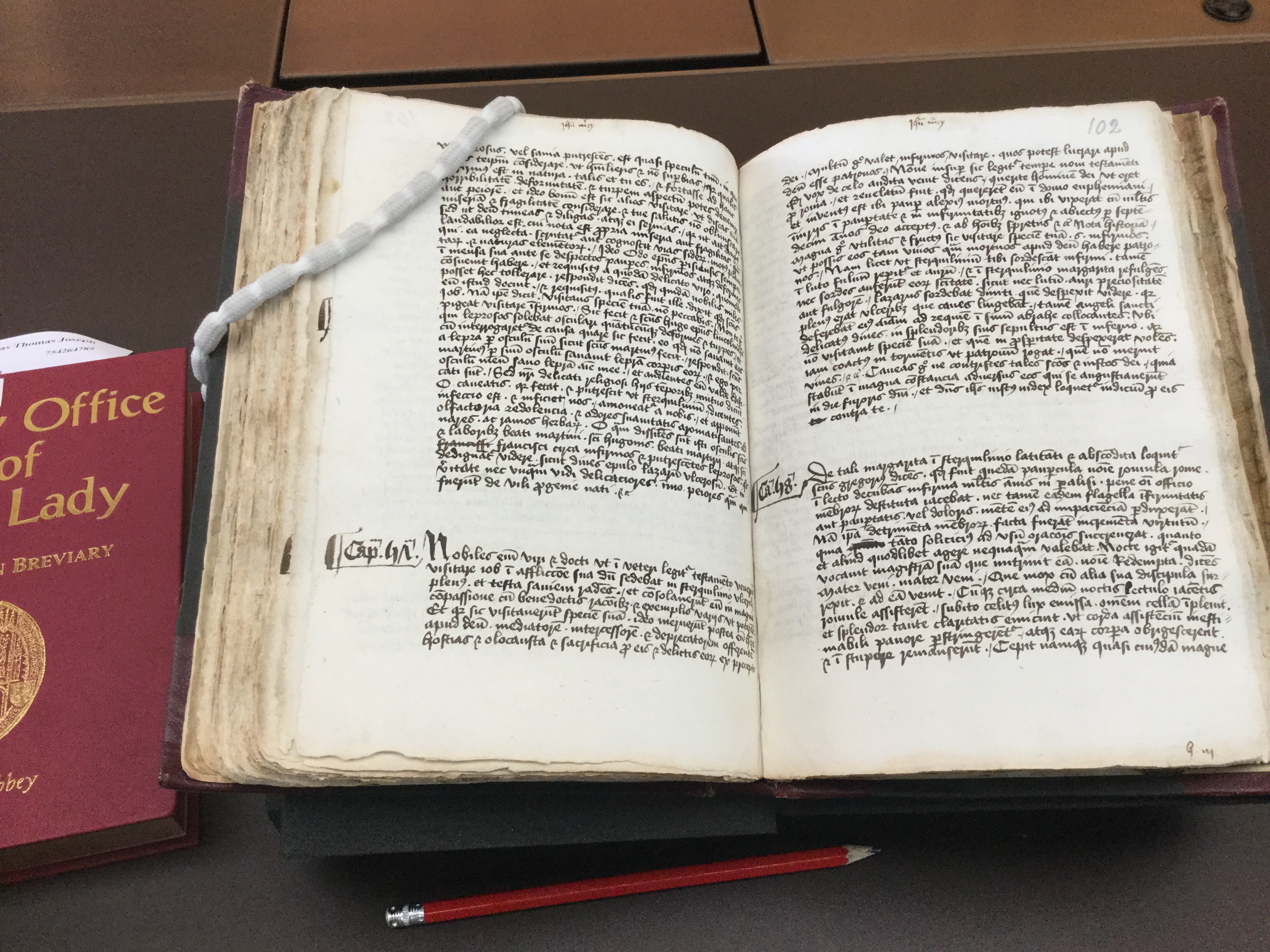
But let’s go back a bit. Here I am, in the mid-70s, eighteen or nineteen years old, and opening my new Breviary for the first time, exploring what it has in it. It has an appendix of poems as well as hymns and in coming for the first time to the Corpus Christi carol I remember myself (a year or so before) back to a little gothic church in the hills above Guildford.

Lully lulley; lully lulley.

The fawcon hath born my mak away.

So why the falcon? And why the lullaby refrain? The idea of being suddenly snatched now makes me think of a sparrowhawk or peregrine, but I will let my C16th predecessor (who doubtless was more at home with such things as this MS/blog from the British Library suggest) have her/his way. In a near-sleep, dreamlike state, a soul is snatched away to a hall –

He bare hym up, he bare hym down;

He bare hym into an orchard brown.

…and in the hall in a wood (or Eden after the Fall, its trees bare), sees the truth of the link between Passion and Eucharist.

The trees surrounding the Franciscan Friary church (now Chilworth Abbey) could well be leafless in winter, and at any rate the “truth” of this matters less than what the image said to me in my late teens: a religious experience that was sudden and rooted in mediaeval imagery brought me (I am unsure who “my mak” is otherwise) to an altar, to the reserved sacrament on its bed. We might well be beyond the limits of medieval orthodoxy here, in the realm of the eternally bleeding Fisher King perhaps, as we look at the knight in bed and his attending virgin. The song remains sited for me in a small monastic/friary choir, all gothic and quiet. What strikes me some forty-odd years later is how powerful the medieval imagery is.

This seems to me to be important for a number of reasons, and at the moment, prominent in these for me is that whatever we make of this kind of medievalism it remains a touchstone of Christian – or perhaps Catholic Christian – piety. It allows us back into a time (or a mythology) where there was space for a rich visual and linguistic expression of religious practice. I might contest this, sometimes – a sort of liturgical Sealed Knot where historical re-enactment is what it’s all about – but I cannot deny its power. It allows me to read The Cloud of Unknowing, or Bl Julian of Norwich with a sense of continuity that draws on aesthetics as much as reason or ipsissima verba. It opens a door, as it were, to the MSS I love to read.

I sometimes wonder whether, somewhere along the line, I learned (probably wrongly) that this allowed me to say “I belonged;” I belonged to something big and beatific. Seeing it at Chilworth was therefore a step towards the belonging I felt for a time at Magdalen and then Ampleforth and then Blackfriars. And therefore for me Christmas might be some kind of looking backwards to see what Christmas means; to some extent, looking at might-have-beens.

Gaudete

Rejoice.

img_1787

This blog post has turned into a bit of a sermon on the place of joy. I hope it has a wider audience but let’s start Churchy: apologies if anyone can see the formatting glitches further down.

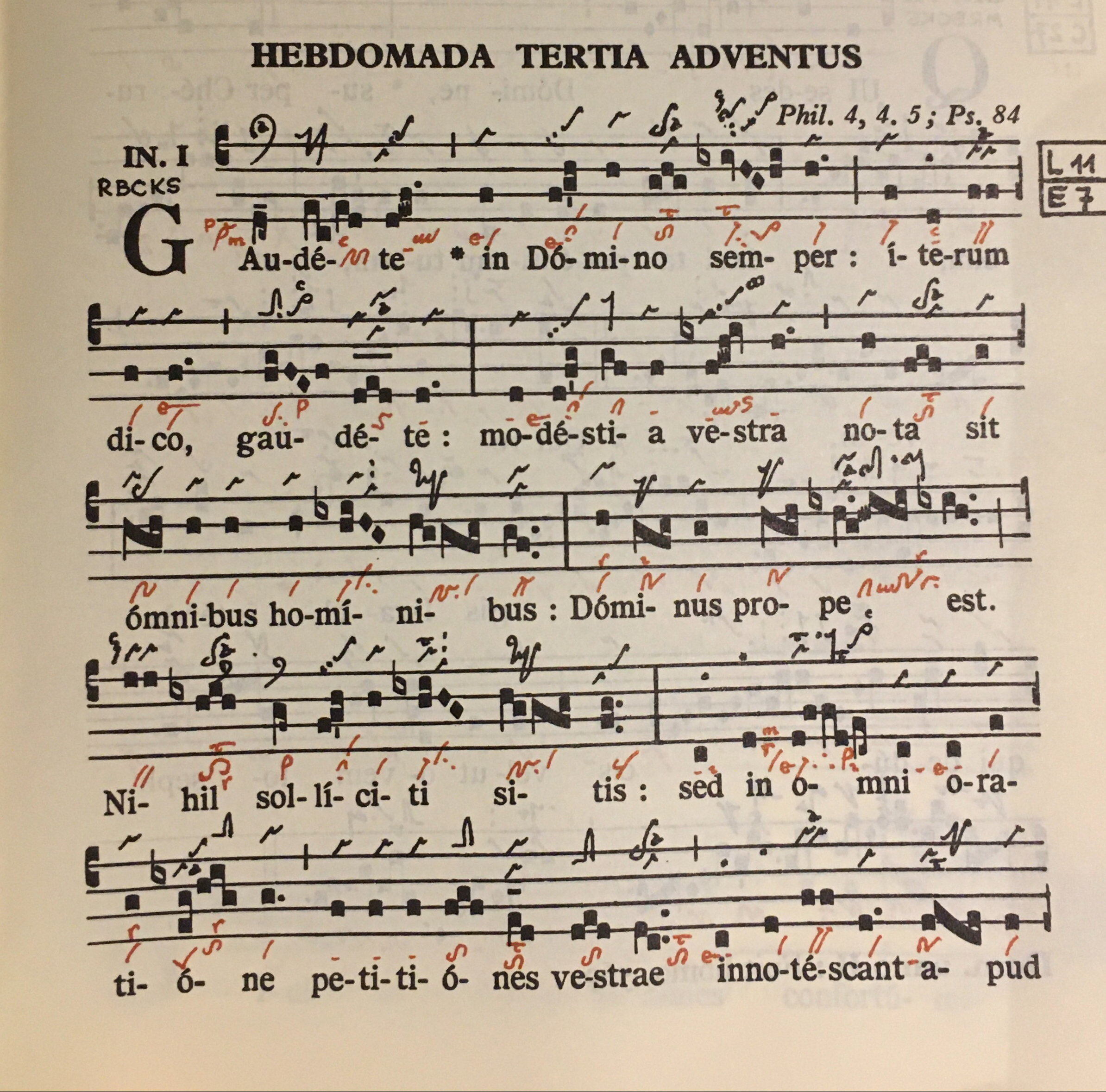
Today in the Roman Rite, the priest and deacon wear a colour that only comes out twice a year, a light, bright pink called rose . It indicates, to gloss over much of its symbolism and history, a day “off” from the penitential season of Advent. The opening song of the Mass begins “Rejoice,” as the comparable Sunday in Lent begins “Be glad.” The chant, or part of it, is in the photo, and this link takes you to it being sung. Note: it isn’t the carol popularised by Steeleye Span, but a song of waiting.

But what if you don’t feel like rejoicing?

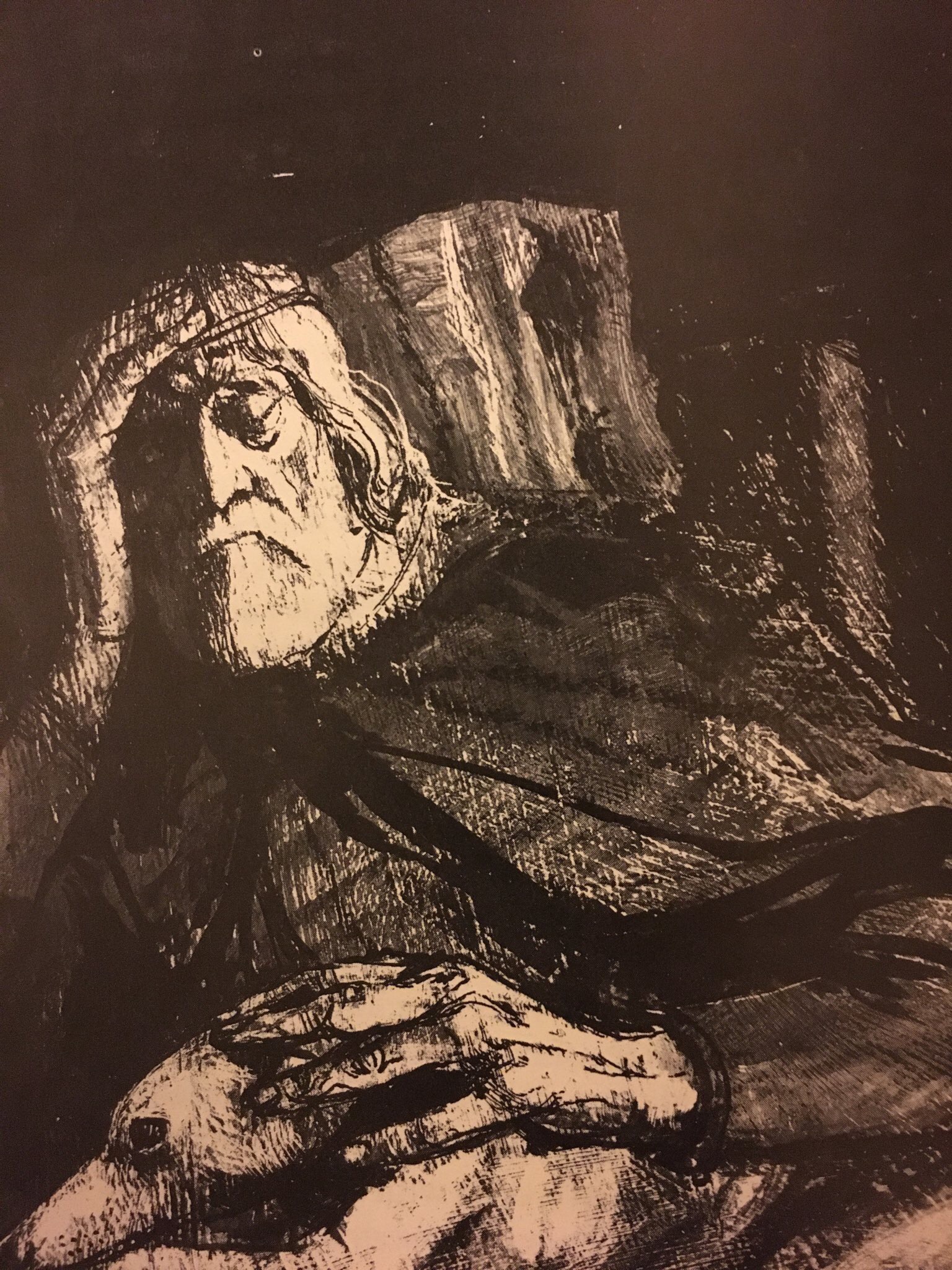
The next image is of the defeated and dispirited Arthur in the Book of Merlyn. img_1751He has, it seems, nothing left, although the book and Arthur’s lessons about what it is to be human have some way to go. The unrequited desire, the longing for fulfilment, for liberation: exhausting.
The text of the chant is one of the most famous lines of the apostle Paul in the letter to the Christians in Philippi. The exhortation to rejoice is one “in the Lord,” in expectation of the end of days: “The Lord is at hand… Take no care for anything…” but it is not a smug grin that the Philippians are to put on. We are not at a happy-clappy bus stop to heaven. Puddleglum is right.

I also wonder whether this is “life coaching” in difficult times for a whole load of people, whether in the Christian community or not. It’s about acceptance, about not being dragged down, not being lost in despair. God knows, I find the enforced jollity of Christmas hard, and this year is threatening to be as hard as the last in some ways.

So I want to jump ahead a few verses to advice from St Paul perhaps we could all listen to:

Finally… whatever is true, whatever is noble, whatever is right, whatever is pure, whatever is lovely, whatever is admirable–if anything is excellent or praiseworthy–think about such things.


Puddleglum

Above Dr Slop and Mr Slope And Mrs Proudie and all the Blooms, Flashmans [sic], Golightlies and Trunchballs (and Honeys) and other characters with significant names – even Agnes Nutter – one character in fiction stands out for me as having not so much a name as a character description:

Puddleglum the Marsh Wiggle in C S Lewis’ The Silver Chair.

The Narnian ancestor of Fungus the Bogeyman, Puddleglum is never one to look on the bright side of life. His fenny existence is as dull and damp and depressing as his expectations are low. When Eustace and Jill and Puddleglum reach the giants’ gastle, he very typically says “We’ve done the silliest thing in the world by coming at all: but now
that we are here, we’d best put a bold face on it.” I might have wished him voiced by one of the more lugubrious characters created by Les Dawson or some maungy character from Last of the Summer Wine.  Today, 13.12.19, maybe I could voice it myself.

And the genius of Lewis’s depicting such a gloomy character is that The Silver Chair is enlivened by the warmth with which Puddleglum is presented: a comic character ” as doleful as a funeral,” a caricature of an adult whose task seems to be to depress the enthusiasm of the child protagonists. But then comes this, his best speech, and the heart of Lewis’ contra mundum (or at least contra Senior Common Room) beliefs: fighting the lulling enchantments of the Witch who wants to entrap the heroes in her Underland, he stamps on her fire and returns to her:
“One word, Ma’am,” he said, coming back from the fire; limping, because of the pain. “One word. All you’ve been saying is quite right, I shouldn’t wonder. I’m a chap who always liked to know the worst and then put the best face I can on it. So I won’t deny any of what you said. But there’s one thing more to be said, even so. Suppose we have only dreamed, or made up, all those things — trees and grass and sun and moon and stars and Aslan himself. Suppose we have. Then all I can say is that, in that case, the made-up things seem a good deal more important than the real ones. Suppose this black pit of a kingdom of yours is the only world. Well, it strikes me as a pretty poor one. And that’s a funny thing, when you come to think of it. We’re just babies making up a game, if you’re right. But four babies playing a game can make a play-world which licks your real world hollow. That’s why I’m going to stand by the play-world. I’m on Aslan’s side even if there isn’t any Aslan to lead it. I’m going to live as like a Narnian as I can even if there isn’t any Narnia. So, thanking you kindly for our supper, if these two gentlemen and the young lady are ready, we’re leaving your court at once and setting out in the dark to spend our lives looking for Overland. Not that our lives will be very long, I should think; but that’s small loss if the world’s as dull a place as you say.”
The Silver Chair (and I have to admit it is my favourite of the Narnian chronicles) deals with enslavement to enchantment as the allegory of sin with such vivid detail – the eponymous silver chair being the beautiful instrument that holds Prince Rilian in thrall to the Witch – that it makes me wonder whether Lewis is doing something autobiographical here. One of the beauties of the storytelling is that it works at all sorts of levels, religious and non-religious spirituality: sin and redemption; exile and homecoming. And what are we in thrall to? And who liberates whom?
And if we are on a quest to find a way to be free, what is the role of Puddleglum in our lives?
There is a danger in seeing a superficial mindfulness as the touchstone of happiness, “I have been mindful today” being the spiritual equivalent of “I must, I must improve my bust.” What Puddleglum does is remind us that jollity is not happiness, that it is not always necessary to look forward to a glorious dawn in order to be righteous or holy or whatever. And today I think of the cruelty of the death of St Lucy, the plight of many in a false dawn for a brand new (= same old, same old) Britain, and I wonder if, with so little cause for carolings, I can be glum for a while, and alongside Puddleglum can “take a serious view of life” – and still be prepared to stamp out, when needed, the seductive sweetness of a sorcerer‘s fire.

Statio

The year’s midnight. 

“Always winter and never Christmas.” C S Lewis’ ultimate baddie, the White Witch, keeps Narnia frozen in a time when the natural cycle of death and birth cannot continue. Will Stanton in Cooper’s The Dark is Rising has his midwinter birthday interrupted, threatened, brought into its rightful place by the crises in the book. Kay Harker’s dream (or not-a-dream) sees the Christmas of Merrie England restored when the dark powers of   sorcery threaten to destroy it. I feel I also have to note en passant the most terrifying version of this for me, Michelle Paver’s adult work Dark Matter, where the narrator faces months of night time and solitude – and something far worse out on the Arctic ice. The time in late December is reenacted in these stories as a time of crisis, and the subtext seems to me to be a worry that as the days darken, the sun will not return, no hope for love “At the next world, that is, at the next spring.” A fear that This is It.

As Catherine Butler in Four British Fantasists suggests of the interplay between magic and humanity in Cooper’s Dark is Rising sequence

The Light is opposed in turn by the Dark, and most of the activity of the other mythical and historical figures involved in the sequence is related in some way or another to their struggle. Given Cooper’s insistence (as in the description of Herne) on the wildness of some of these figures, this moral alignment of their magical power might be problematic.

Problematic indeed. The complexity of this vision is one of the things that Masefield is beginning to explore, and that Lewis more or less avoids, but which Cooper meets head-on in The Dark is Rising – and in more meditative and lyrical form in a poem she first published in 1974.

The publication of Susan Cooper and Carson Ellis’ The Shortest Day , which re-presents Cooper’s 1970s contribution to a larger work, has prompted renewed interest (it never really goes away) in the interplay between UK fantasy writers and the folklore they draw on. There are some lovely reviews already out (e.g. Kirkus, Brainpickings (who [of course] beat me to the Dillard reference, although that doesn’t often stop me) praising the text and artwork, and this is not a review but some thoughts at a tangent. Again, I am not alone in this tack: Calmgrove’s Christmas Delights (which already sounds like a box of candied fruits) has a wonderful post exploring a selection of writers from Nesbit to Masefield, and then Lewis, and so to Cooper herself. By celebrating Solstice (check out Solstice here)  she sets up not a Pagan in the sense of antiChristian but an unChristian, a preChristian festivity, gloriously underlined by the images Ellis gives us, as wanderers move through a land that they increasingly mark as their own.

Through all the frosty ages you can hear them

Echoing behind us – Listen!!

All the long echoes sing the same delight,

This shortest day…

In Ellis’s paintings we see the “precarious business” as the palaeoanthropologist Chris Stringer puts it, of early humanity’s existence in our inhospitable winter, and we see our efforts – the our, I think, underwires the charm and power of this book – at keeping the dangers and demons at bay across the centuries.  It is a similar nostalgia (thank you again, Chris Lovegrove, for this insight into Masefield ) to the gathering of the ancestral (ghostly) Oldknows in Tolly’s first Christmas in Lucy Boston’s Green Knowe, that we celebrated on our visit. All those long echoes in the stones of Hemingford Grey.

It sends me back to Ronald Hutton and his Stations of the Sun. In the opening chapters he carefully dissects Christmas customs with judiciously chosen details (I was intrigued by the mummers who menaced people having been “drinking, playing at cards and fiddling all day in disguised habits”) and drops in details that have resonances elsewhere, such as the apotropaic torch rituals in the Staffordshire moorlands town of Stanton.  It has to be remembered that Hutton, although with strong ties to various aspects of Paganism, is suitably cautious in his methodology:  Hutton looks at the Roman feasts of midwinter, Saturnalia and Kalendae, and then states

The new Christian feast of the Nativity extinguished or absorbed both of them, and a string of other holy days sprang up in its wake…

before going on to explain the rise of the Twelve days and the Epiphany/Theophany in the Western and Eastern Churches.

In most of northern and central Europe, where the cold and darkness were much greater…it would have run into local patterns of pre-Christian seasonal celebrations….

But Hutton warns us that

Literary sources do not tell us anything conclusive about the midwinter festival practices of the ancient British Isles…

He find the early English sources more enlightening than many others, and his trail leads him to the conflation (as he suggests) of a Modranicht, or Mother Night, a middum wintra, with the Nativity. The festivities may predate Christian Christmas or draw on earlier practices*… And then he turns his gaze on Yule (jol, jul, juul), the jolly time of Norse festivities.

Stations of the Sun is not a pagan handbook but a scholarly exploration, suggesting that seasonal rituals were fluid, open to change, to diminishing and reinterpretation. It is right, therefore, that in his conclusion some 400 pages and a ring-round year of celebrations later he writes:

It is one of the arguments of this book that the rhythms of the British year are timeless and impose certain perpetual patterns upon calendar customs: a yearning for light, greenery and warmth and joy in midwinter, a propensity to celebrate the spring with symbols of rebirth…

[However] What is also plain is that the last couple of centuries, in this as in every other aspect of British life, have produced a completely unprecedented amount of change… No amount of nostalgia or anxiety for a rapidly diminishing or deteriorating natural environment can alter the essential irrelevance which it now possesses for the daily lives and seasonal habits of most of the British; however, this very fact may cause it to play an ever greater part in religious symbolism.

And not only there, I think.  Children’s literature – the work written “for children” and the work written meditating on childhood – seems to me often drawn to these natural cycles, and most of all to the changes of dark and light, for which the stores of story and ritual and symbol stand ready for writers and artists to draw on. I do wonder about the place of folklore and a kind of vision of archaic beliefs in the writings of fantasy – and marvel at the power of this time of year to bring out our need to explore these themes…

IMG_7731

*

Oh, I see you haven’t spelled Station right – and what is that about anyway?

I have, and this is my final point. To return to another of Hutton’s delightful side-comments, he suggests that Yule is connected not only to the world “jolly”  but perhaps to the word we know as wheel;  I can’t help thinking of the Sun Cross, the sign of the Old Ones in Cooper’s The Dark is Rising, and the ‘ring with the longways cross” the Oak Lady wears in The Box of Delights, but the symbol of the sun as wheeling around might suggest that while we think of Solstice as when the sun stands still, another version might be that it is that tipping point before a wheel starts to turn again. Nature holds its breath, much as St Bernard suggests we all do when the Angel presents Mary with her choice at the Annunciation (Nota Bene: this impassioned, dramatic passage from Bernard is set in Roman Rite breviaries as the non-scriptural reading for 20th December).  The holding of our breath: can we get out of this darkest time? The site Spirituality and Practice has a brief extract on Statio as the sacred pause.  The moment, maybe, before the liturgy starts, where everyone is standing ready, not awkwardly waiting but attentive. Birdwatching for the moment of grace. This is not to say that the Solstice is now simply that for Christian practice or post-Christian jollity – but that the winter Solstice in particular invites us to pause, to listen as the new world turns and does it all again.


*Bede is his source here. Hutton is, in case you are wondering, suitably cautious when we get to Easter and its original. 


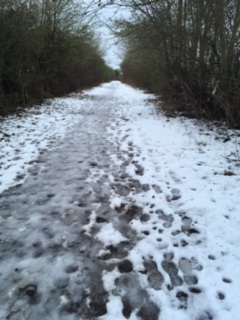
PS:  The photo, by the way, is not an Old Way or my own Old Road outside my front door, but unexpected snow before Christmas a few years ago, taken on the feast of St Lucy, the old “Shortest Day” that John Donne celebrates (and I cited at the start of this post) and the birthday (not the feast) of Bl Lucy of Narnia. Well, sort of.


Merlyn

I am reading T H White’s The Book of Merlyn again after a long break.

The paper trail is not edifying so maybe it needs acknowledging – at least, the messiness needs some acknowledging. It is a mess of the biographies of two men: William Mayne and T H White. There remain all sorts of issues about how we celebrate the creativity of people whose personal lives did not measure up to the standards we would wish. That is at least some acknowledgement…  

I came back to the Sword in the Stone again having read William Mayne’s The Worm in the Well, which echoes it. I asked when I’d read it if Mayne’s flaws deafen me to his message of reconciliation and renewal; I find myself asking over and over the same with T H White – something I was alerted to in Helen Macdonald’s H is for Hawk. But for the purposes of this blog post (which will largely be quotation from the Book of Merlyn) I am going to set aside the author and look at the text.

I know I’ve written about the magic patriarch before, when Merlin, Merriman et al have come up from my reading (here, for example, where I mention White explicitly, and then here, for the “humanist rabbit pulled from a transcendental hat,” and most recently here) but Merlyn – note the spelling – is here at the moment because of T H White’s lost-and-found masterpiece and its subject. Setting aside the moving first sections, the re-encounter of Merlyn with his former pupil (now beaten and old and depressed) the substance of the story brings us to Badger’s sett, to, in effect, an Oxbridge Senior Common Room in the grand old style, the Combination Room, where Arthur is tasked by Merlyn and the animal committee to make sense  of the human condition, in the last night before Arthur’s final battle.

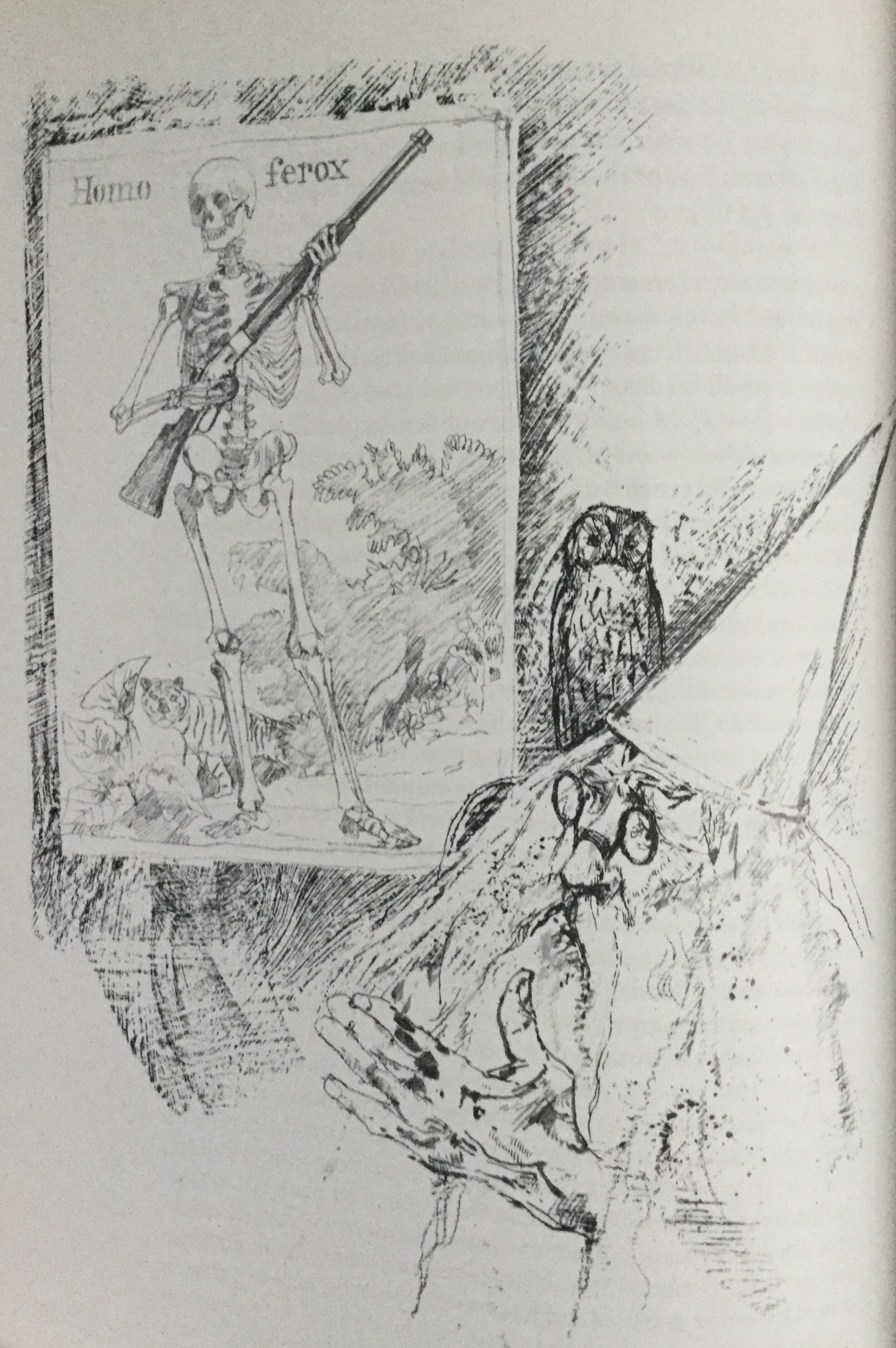
White’s construction of Merlyn’s prophetic powers is that he is living his life in the opposite direction to the rest of us. Merlyn has known the insanities of C20th totalitarian regimes (White wrote the book as part of his struggle about whether he should maintain his pacifism), refers affectionately (but not without criticism) to his friend Karl Marx, and gets muddled in trying to explain to Arthur that the whole story they are in is on a book – the book I am holding. img_1629The gentle, bookish comedy aside, this allows Merlyn the painful knowldege that Arthur is to die in battle the next day, and for White/Merlyn to comment on fascism and communism, and for King Arthur, lost and tired,  to ponder his path, as (with the the magician’s assistance) he visits ants, geese and takes advice from the donnish Badger and the Plain People of England in the shape of the Hedgehog… What makes Arthur Arthur? What makes a Human Homo Ferox rather than Homo Sapiens? Facing defeat of everything he thought he stood for, yet surrounded by his animal advisers and under the magic of the querulous Merlyn (beautifully depicted by Trevor Stubley), Arthur, the aged king, is exhausted:

There was a thing which he had been wanting to think about. His face, with the hooded eyes, ceased to be like the boy’s of long ago. He looked tired, and was the king: which made the others watch him seriously, with fear and sorrow.

They were good and kind he knew. They were people whose respect he valued. But their problem was not the human one…It was true indeed that man was ferocious, as the animals had said. They could say it abstractly, even with a certain didactic glee, but for him it was the concrete: it was for him to live among yahoos in flesh and blood. He was one of them himself, cruel and silly like them, and bound to them by the strange continuum of human consciousness…

One of them himself. Politics, ethics, where to belong and whether to resist: these are not abstractions for White (in exile in Ireland in 1942 as he writes), or for Arthur – or for us. As he writes, Tolkien’s Fellowship are paused at Balin’s tomb in Moria, Lewis’ protagonist in The Great Divorce is sent back to everyday life in Oxford rather than face the terrible sunrise of the parousia: it is a decade of loss and darkness and doubt. Life should have been sorted in the War to End Wars that ended in 1919 – and hadn’t been. Arthur continues to ponder:

…he had been working all his life. He knew he was not a clever man.… Just when he had given up, just when he had been weeping and defeated, just when the old ox had dropped in the traces, they had come again to prick him to his feet. They had come to teach a further lesson, And to send him on.

But he had never had a happiness of his own, never had him self: never since he was a little boy in the Forest Sauvage.… He wanted to have some life; to lie upon the Earth, and smell it: to look up into the sky like anthropos, and to lose himself in clouds. He knew suddenly that nobody, living upon the remotest, most barren crag in the ocean, could complain of a dull landscape so long as he would lift up his eyes.

And I know how he feels: to have some life seems to me to be a core desire – certainly for Arthur, whose life has, throughout the books, been so rarely his own.

Is this last part of this post a spoilier? I find it hard to say: the book has a moving ending, the various endings to the legends providing their own kind of speculative fiction.  The sleeping king of so many folktales? Avalon? Edinburgh? and White has to make his own move about his position on war and resistance. But before he does, he finds space for his own legend of Arthur Rex quondam et futurus:

I am inclined to believe that my beloved Arthur of the future is sitting at this very moment among his learned friends, in the Combination Room of the College of Life, and that they are thinking away in there for all they are worth, about the best means   to help our curious species: and I for one hope that some day, when not only England but the World has need of them, and when it is ready to listen to reason, if it ever is, they will issue from their rath in joy and power: and then, perhaps, they will give us happiness in the world once more and chivalry, and the old medieval blessing of certain simple people – who tried, at any rate, in their own way, to still the ancient brutal dream…

But defeating the barbarities of Attila or Sauron or Mordred remains only a hope, an aspiration, and I return (as ever) to Susan Cooper’s bleak but rousing Merriman:

You may not lie idly expecting the second coming of anybody now, because the world is yours and it is up to you.

A different , maybe more grounded Merlin and a different hope to the poor hope of the exiled White.