This is me:
and my brother. 
He is quite a bit older than me, and is, in fact, my older half-brother. This is the story:
Our mum has a baby, my brother Glenn, but her husband Jack is killed at sea in WWII. Eventually (in the 50s) she marries my dad, another sailor, Ray, and I come along. A series of miscarriages and my brother being abroad mean I am, more or less, an only child at this time. Mum dies the year I go to University and my brother and I lose touch. We are eventually brought back together some ten years ago. I am, physically at least, quite like Glenn – to be honest, a shorter and -erm – less athletic version of my brother (and of his son, my half-nephew, Ben).
(I also have another half-brother and half-sister, Mark and Hannah, who are the children of my dad’s second marriage, to Val. Hannah is only about six months older than my oldest child, Joe, but for this post I want to mention Glenn and me).
Glenn is a fool and I am not. That is to say, his role in his local Morris side is that of a fool and I am in no way nimble enough to be a Morris Man. We share common interests in folklore, although mine tend to be bookish and his practical. We are both gardeners. We both have beards and white hair. I had quite a bit of contact with Glenn as I was growing up: I loved it when he came home, loved going on his motorbike from Blandford to Badbury Rings, loved going to visit him and his family – loved his garden, and walking on the wide beaches of the North East coast. In some ways he gave me experiences of outdoors, folklore and family that stay with me. Habitus. We aren’t twins separated at birth – but I am astonished by how strong I now perceive his influence on me to be. Was it really his dancing that led me to Wild Spaces, Wild Magic? How does his social circle of beardy beer drinkers influence my choice of appearance and choice of beverage? Was it our mum’s deep admiration of him that convinced me that here (in some respects) was what growing up was about? How, in the twenty or so years we didn’t meet, did those choices Glenn had made tell me about being who I am?
I am (as I have been before) reflecting on “history’s curved shell,” as R S Thomas says in his poem Eheu Fugaces, on how pasts come together in the present, on these strands of influence, and the more I think, the more I find the Nature/Nurture argument often too simplistic. There are physical differences as well as emotional ones, beliefs and life decisions we have made that are different, life circumstances (his losing his dad so young, for example) that are just not replicated… Where do our choices come from, and how are they determined by people we meet, or see, or imagine? How do we look back at attitudes and choices?
*
To change tack: lots of things conspire to get me thinking about my family at the moment, but (for the purposes of this blog), I want to think about the struggle for identity so vividly described in Anthea Simmons’ Lightning Mary, a fictionalised account of the early life of Mary Anning. In it, Mary is trying, with a “head full of pain and sorrow and anger” to establish what it means to be a scientist, coming from a poor background with numerous hardships; how does she identify as a woman without being seen as a potential wife and mother?
“Did I ask to be a woman? I did not… I hate babies and husbands and men and being poor and the sickness and the toil and the injustice. What have we done? Why are we to be punished so?”
Into Mary’s mouth are put the cries of impatience of generations. Her mother responds,
“Whoever told you that life was fair, Mary? Not I. It is what it is.”
The injustices and hardships are depicted brilliantly in the book: her clashes with the landed gentry and “proper” scientists, her sustaining but troubled friendship with the precious young Henry de la Beche… Mary becomes a real heroine, although as Simmons acknowledges in her afterword, her story is “profoundly sad,” and the novel ends, rightly, on a down-beat.
My brother’s and my story is not (so far!!!) sad, and neither of us, I think, is a frustrated genius, “born to blush unseen” but we (all) tread the difficult line between self-identity, the urge to be Henry de la Beche’s “friend and scientist” and Anning’s mother’s line that “life is what it is.” But our similarities and differences do highlight the ambiguities and tensions of upbringing and choice, of lack of freedom in various generations, of societal expectations. For us it is just ordinary life, in so many ways, but for Anning it was painful and frustrating.
“There were days, dark days, when I felt as if I had lined up for a race and then been told to take two steps back because I was poor, and then two steps back because Father had been a Dissenter, and then ten steps back because I was not a man…”
Anning in the novel is prickly and wilful, but also determined, resourceful – and ultimately doomed (the passive voce is important, I think) to be by-passed by the scientific revolutionaries with whom she deals. The book is a rallying- cry for young woman thinking about science as a career. It is also a plea for educators to remember how complex the stepping stones of privilege and the nets of disadvantage can be.

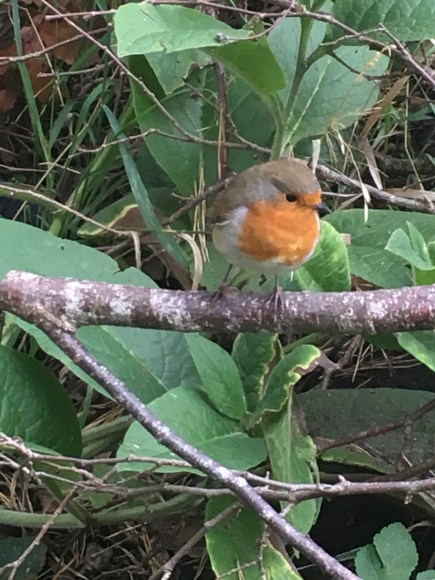 It is friendly enough to allow me to photograph it from close up. I love its jet-jewel eye and the way its chest moves as a bubbling song comes from somewhere in its tiny body. I love its daring proximity – it flies so close at one point, a wing brushes my leg.
 Not the silly vandalism of arson, harsh though that is, but the more calculated threatened developments that will alter precious run-off and the way light touches some areas, of potential pollution and game-play from developers, Councils and Trusts. How small conscience-easing grants alone will not in the end preserve such a small piece of wetland in the suburbs of a land-needy city. Change is of course inevitable in so many ways: my copy of W G Hoskins
  not unlike DuBuc’s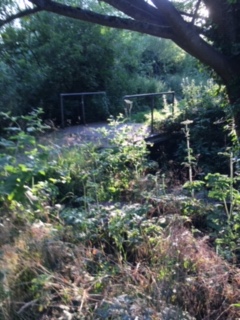
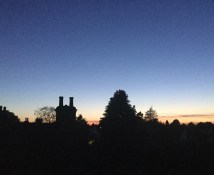 and a quick compulsive posting of the evening skyline) to find a book. The first to hand is the battered (and ergo much loved) family copy of the Tale of Squirrel Nutkin. Since I won’t be exploring this Potter in my
  with “no nice manners” who takes his jesting too far. These characters and situations matter to children as they explore the “what ifs” of denying respect, especially in a literary landscape where being good is rewarded. With Squirrel Nutkin (and many of Beatrix Potter’s male anti-heroes) we are looking into the same, magically enticing world (although in reverse) as the unfortunate Bertha in
  nicktomjoe