
In making “my” study accessible, some of the books, a lot of my books, are having to go. How to choose?
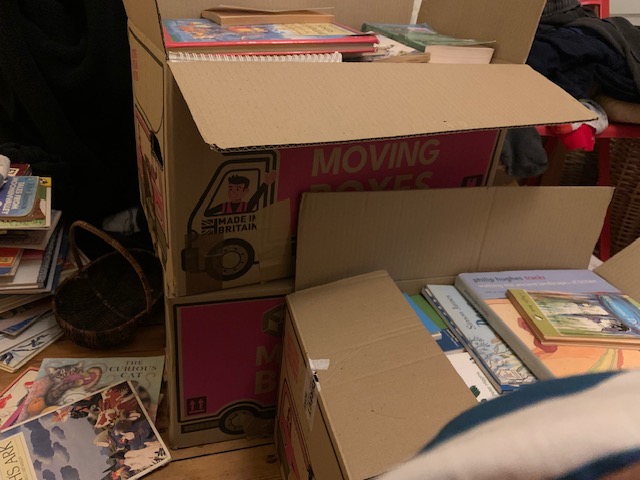
Lots more tidying is required, and with it a commensurate saying goodbye. This isn’t some magic decluttering nor yet an account of my following tidying “gurus” such as Marie Kondo. Far from it: there is no sparkling joy https://youtu.be/x4Nrd68bhH0?si=3LoZa2ghKZtp7oY0 and while part of that is that I won’t be buying into the hype, part of it is that the getting rid aspect has a number of other themes attached to it.
Harry’s Numbers by Jill Waterman is going to the charity shop: so many memories of reading and re-reading at the children’s grandma’s house: and there’s Bonne Nuit, a board book for bedtime given me by a priest to whom I was teaching English, to read to the children. Read out loud in French, read too in my clumsy translation in English, I remember most my trying to read it with a child under each arm. What to look for in Summer: ah yes, all those Ladybirds dug out on trips back to Yorkshire or bought at jumble sales. The seasonal idylls were only eclipsed by the description of the Farm, and again a discussion of how the farm next door to Grandad’s wasn’t like that… Thomas the Tank Engine; Norse Myths; The Velveteen Rabbit…
And with each of these the abiding memory is a child or two or three snuggled with me at bedtime, and of me (and sometimes them) falling asleep while we read together.
At work as well as at home, there were John Burningham’s Would You Rather – hot debates with wriggly children in Reception about having your house surrounded by jungle and Eric Carle’s Brown Bear, Brown Bear What Do You See which so often became a chanted Nursery spell with its own increasing momentum. So many more.
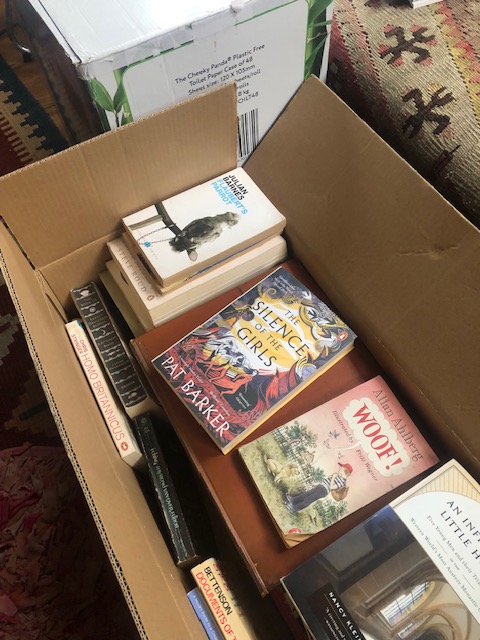
Do I keep books that I shared at school (and as a University tutor) because I feel I was good at reading them? Is it that shallow? Or do I take a breath and collapse all the memories into the boxes along with (so far) well over a hundred books?
Most of them are going, and if Alligators All Around stays, that too has a sense of sadness to it: will a keen-eyed adult never read this to a group of laughing five-year-olds again?
Oh, enough of the melancholy.
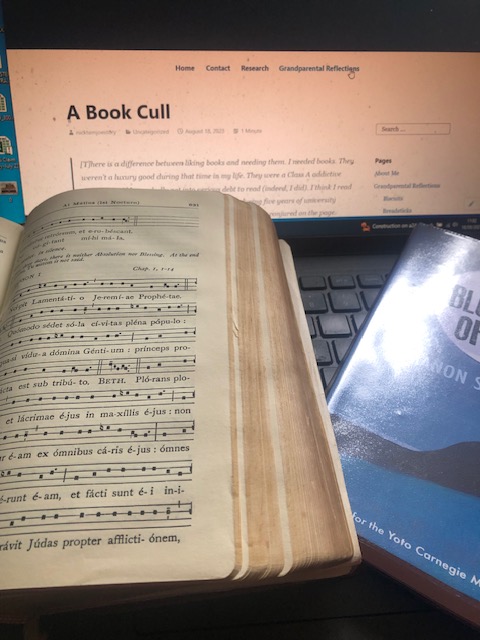
But what is that title all about? It’s a line from a poem in the book of the prophet Isaiah, where the King laments that he will leave his life half-spent, his life “taken away, rolled up like a shepherd’s tent.” The Latin text is sonorous:
Generatio mea ablata est et convoluta est a me quasi tabernaculum pastorum. Praecisa est velut a texente vita mea. Is. 38:11
And what Hezekiah feels, that all his meaning, his capacity for life have been tidied away, rolled up as something temporary and no longer needed.
This is where the knife digs deep. I think I mourn the passing of these books because it signifies the passing of a self-image that was powerful and affirming. All self-image seems to me to be in part myth. It is a powerful and long standing myth, and giving more of it up requires me to wrench the image of the scholar in his [sic: such is the myth, although not the reality] study from how I view myself and any future work.

 nicktomjoe