Whilst

Up to my (shall we say?) knees with marking and just want to consider one little word. Actually it’s a word that stands for a whole set of assumptions about academic writing. Whilst.

It reminds me of the Grandma who once, in the springtime of the world, came to pick up her grandchild from Nursery. The unfortunate dialogue went something like this:

Granny: Hurry up, Mikey, we need to go.
[Mikey continues to play]
Granny: If you don’t come soon your headteacher will smack you for being naughty.
[I don’t normally intervene and certainly not to contradict a carer but I wade in]
Me: I’m sorry, Mrs S, but we don’t ever smack children; please don’t give Mikey the idea that we do.
Granny: But I’m giving you permission to smack him. Insofar as you are in charge in this establishment I am permitting you to exercise your rights in loco parentis.

Now, this isn’t about smacking or school-based discipline or home-school relationships, but voice. I can see what I did wrong there – but I still think Mikey needed to know I wasn’t going to hit him – but listen to Granny. She didn’t normally talk like this, but she changes gear massively with that Insofar. The awful phrase in loco parentis just adds to the sense that this person is claiming some kind of authority by sounding, well, as if they have some. My dreaded signal while (sorry: whilst) marking does the same. What it too often introduces – like Granny’s insofar – is a sort of strangled over-writing (I still feel much the same about the new(ish) translation of the Roman rite liturgy, if I’m honest, with its sub-Cranmerian verbosity but that is by-the-by).

When I see whilst I have to acknowledge that sometimes it does sounds better.   I suppose I could write “don’t use this:” after all, I do have a button in Grademark that just says “Avoid,” but whilst has so much hanging on it I feel I need to explain myself.  No-one (in my modules at least) will get marked down for just using whilst, or even (usually) for the occasional “you” or an odd lapse in references. My hunter instincts may be roused, but I will not routinely chase the hare. Does that metaphor work?

I could have called this blog post “please consider keeping your sentences shorter and more straightforward: you will be able to “lead your reader” more effectively if you make less use of phrases such as ‘through this research journal article  it has been discovered…'” but I don’t think it’s as catchy, even though I use that phrase (or similar) often enough when I give written feedback. What whilst says to me is “I’m drowning here: how the fuck do I make myself sound like the kind of people I’ve been reading?”

And that is a challenge that assignment feedback can hardly start on. How do we give the complex and sometimes mixed messages about how to join the writers’ club? What about the comment “missing apostrophe” or “italics not needed in Harvard”? How is a student to know where to start with all of this? Or, to make this personal, how do I take my chatty, ranty blog posts and change the voice to get an article from this idea or that?

Students, young writers be aware at least of this:

You are not joining us in an exercise of perfection, but in a struggle for clarity.
Experts

Apparently the dominant idea of this Age that someone on Twitter called the twatocene (pithy or what?) is that we have had enough of experts. Beautifully encapsulated by the “ I prop up the bar and you can’t tell me what’s right” school of philosophy, the dismissal of experts I think was originally from Michael Gove – a man who, allegedly, reads and thinks and has brought that reading and thinking to his work.  An expert telling us we have no need of experts? He was joined in the twatosphere by the “ Leeds born and bred” Shadow Justice Secretary this weekend, and signalled, for me, an ungainly collapse of any remaining hope of intelligent debate from politicians.

Therefore, in wanting to propose some resources (see below), I find I need to say that I think we do need experts. We need people we want to listen to – and people we don’t. The ITT student who gathered a whole crowd of Tweety onlookers telling her she was right to walk out when she disagreed with a lecturer, the minister or shadow minister who thinks that this  “no experts” line will allow her or him to sidestep a question when someone with some knowledge objects to their line of argument (and then, smooth-faced, to return to their think-tanks of  – erm – apparent experts), or the crabby old academic who might have Twitter and a blog at his disposal but really is just mumbling “things ain’t what they were in my day” – we all need challenging. The expert – the person who has tried it out, the person with the reading and thinking and doing to give them authority – has to be heard (and courteously).  This is not, by the way, a plea for some bizarre civility to allow numb-nut racists  or Climate-Change deniers access to any part of the social media they choose, or to bleat at people about balance when they don’t get it – and the ad absurdum arguments there are beyond me to tackle.

So when I see the SoS for Education advocating lots of outdoor experience I might (and did) sigh deeply at how this really mustn’t become number-crunching target fodder – but I agree with his overall intent and I let it pass. I might debate his sources, or the implications of his plan, but don’t dismiss the National Trust as “experts I don’t need.” Easy one, because by and large I am in sympathy.

When I see the Schools Minister and friends advocate for more content (what they seem to want to call a knowledge-based curriculum) in Early Years, again I might (and did) sigh deeply and since I am not at all sure about the overall argument or the detail of delivery, I will think about it and debate it – and maybe get frustrated at weasel words or underhand dealing – but I don’t dismiss the participants as “experts I don’t need.” Less easy – in fact quite tricky. But it has to be done.

Dismissing the epidemic of young people’s mental health as a snowflake phenomenon would be destructive dismissal of experts. Dismissing advice on children’s activity as just impracticable in today’s curriculum is also plain idiotic. Neither of them make for easy reading – as a parent, an educator, a rather inactive older bloke – but at least they have not been subject to dismissal. The 20-odd-page government-commissioned report on austerity was, however, dismissed loftily by one minister with the words “I don’t know who this UN man is”  and the Work and Pensions Secretary condemned it as “political.” And here I come to the end:

These documents are all political, and they all come from experts in one way or another.

  • Climbing trees not only has ability/disability written into its aspirations it has issues of access, local funding, government spending….
  • A knowledge-rich curriculum has all sorts of issues about who gets to say what and what is not acceptable as cultural capital, or where libraries and sited and funded;
  • Why so many people (young and old) are sick at heart, and what we can do about it is tied up with everything from student loans to mobile phones – and the biggest question is at what pin-point entry-level intervention beleaguered and distracted politicians want to aim their funding;
  • Where in the curriculum we design vigorous exercise – and how its expert teachers are supported and training (and – again – funded) are big questions; these are not freebies, if done properly;
  • And finally, how has it come to be that  “the country’s most respected charitable groups, its leading think tanks, its parliamentary committees, independent authorities like the National Audit Office, and many others, have all drawn attention to the dramatic decline in the fortunes of the least well off in this country”?

“Expert” is being redefined by pundits of all shapes, sizes and political parties as “people who know more than I do and with whom I disagree.” Yes, I stand by the fact that we are seeing an ungainly collapse in any sense of real debate. Come on, please: you’re not playing for points at a college debating society, nor are we paying politicians to put their fingers in their ears when an expert disagrees with them.


Using Children’s Literature

I need to preface what I am going to write here by saying that I know that adults read for themselves or for children for a wide, wide range of reasons, and that the key reason why many of us are involved in children’s literature is at its heart pedagogic: we read because we want our students to appreciate our passion, whether they are three in nursery or thirteen in secondary school or training to be teachers or established teachers exploring at postgraduate level. I therefore do understand why teachers ask “Is this suitable for Y2s?” and “Could I use this with the Y7s?”  It’s just that this is not where this blog post is starting from.

If we think about literature at any level – let’s say a hard-but-marvellous book like Tristram Shandy, or the much-loved Rubaiyat of Omar Khayyam – we are confronted by questions like

  • Do I understand this?
  • Does it teach me anything?
  • Does it give me pleasure?

before (or alongside the moment where) we move into questions such as

  • What does this text tell us about the historical context of its composition?
  • How does the author use language to convey character?
  • Does the narrative structure (or lack of it) illuminate something about the writer’s ideas?

It is true, it seems to me, that the thoughtful reader moves beyond what Bachelard calls “sentimental resonances” produced by text or image.  It may be that what Chambers (and others, standing on the shoulders of giants) suggests about developing a community of readers is partly about moving beyond the simple pleasure to the more analytical or critical joys of exploring text and design and language and… and…  I find myself getting lost, or maybe I just get the feeling it would be good to come to something of a critical approach, the single, sharp insight on what Children’s Literature is and does, a spearhead.

When I look (as I often have done; as I am doing this evening) at Rob Pope’s English Studies Book, I wonder where Children’s Lit fits into the complexity of English Studies. Are we looking at close reading, with the text-centredness also taking into account the hand-in-hand nature of image and text in picturebooks where it might need to? Are we, as critics and consumers, reading a culture and doing so by consuming a cultural product/object? Do my gender/sexuality, ethnicity, culture come into play? Just as Pope suggests “No-one has a single, pure and fixed position.”

And here we are at the nub of the issue. Not only do we as critics not have a single apparatus to wheel in to view Children’s Literature, it may be that we cannot view Children’s Literature , in all its complexity, as a unified subject for discussion. Can we really look at The Secret Garden as part of the same phenomenon as Revolting Rhymes simply because they are both accessible to Primary-aged children? We might follow Tolkien though his themes such as Escape and Fantasy and see recurrent themes, but how much are these really uniting Elphinstone’s Sky Song with the Rosen/Oxenbury Bear Hunt or The Children of Green Knowe with My Father’s Arms are a Boat? Am I trying to make a unified subect because working with children by sharing books (or working with people who will work with children sharing books) is somehow more straightforward than facing complexity?

elidor6

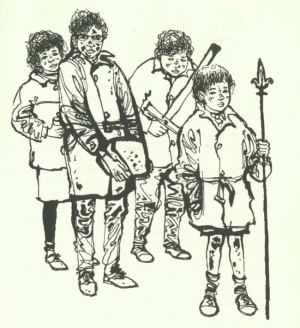
Let me come back to spearhead as an interesting image. It reminds me (for some reason) of the spear hefted by Roland, one of the children in Elidor (Jake Hayes’ blog is a beaut) – and that took me further, to Charles Keeping’s image of the weary children – and that took me in turn to the four gifts the children have entrusted to them: spear, sword, cauldron and stone.  While I’m not suggesting that Garner has consciously presented here an allegory of lit crit, it does strike me that these four treasures (in all their C20th grubbiness) can be asked to stand for the notion that we need more than one thing to preserve the magic, to allow for the critical-but-not-dismissive/destructive eye. The close reading of one reader; the eye to sources and history from another; the pedagogic “Can I use this for my science project?” or”we’re doing fairy tales, where should I start?” or “where is the vocab I need to teach?” of others.  Maybe we need them all, the field is so diverse.

Adults and children read for a wide, wide range of reasons; we enter not a single section of a bookshop, but a richly unfolding section upon section of fantasy, pathos, travel, speculation, high adventure and myth. We call it Children’s Literature when really it might at least have a  plural. “What are your researching, Nick?” “Oh, Children’s Literatures.”

And now I have lots more to think about.

*

Bachelard, G (1958, translation 1964) The Poetics of Space, trans Maria Jolas. New York: Penguin USA

(I am indebted to Nikki Gamble for discussing Bachelard on Twitter and moving me to explore his work)

Chambers, A (nd) Booktalk http://www.aidanchambers.co.uk/booktalk.htm and The Reading Environment http://www.aidanchambers.co.uk/readingenviro.htm accessed 29.10.18

Halford, D and Zaghini, E  (2004) Folk and Fairy Tales: a Book Guide. London: Booktrust

Lesnik-Oberstein, K (1994) Children’s Literature: Criticism and the Fictional Child. Oxford: OUP

Pope, R (1998) The English Studies Book. London: Routledge

Tolkien, J  (1964) Tree and Leaf. London: George Allen and Unwin


Love

Love is a really difficult term, partly because it is over-used (“I love your hair!” “I love this blog!” “I love Santorini”), partly because it is so much more than this debased coinage: a risky, radical, affectionate, often sacrificial thing, it binds people together, may have an element of commitment and/or sexual attraction – all sorts may happen in the words “I love you.” It was therefore interesting to read this blog post which suggests that “we often substitute the word love with other safer words / phrases like unconditional positive regard, respect, care or compassion.” It draws on this document by a team in Sheffield and the research behind it. It is a fascinating piece of work, and makes me wish I were still teaching the module on Professional Roles or the other new values and practice modules in Oxford Brookes Early Childhood Studies. The interview findings pp12ff are enlightening in the EY practitioners’ discussion of physicality, affection, attention, “reading what is needed to make a child feel loved at any moment in time…” Enlightening is a weak word: this is amazingly honest, difficult, complex sometimes beautiful stuff.

As an early years practitioner (much, much less than I used to be, I know), I found it especially interesting how male practitioners felt drawn to the concept of Professional Love. It is worth noting that the fragile status I found when I first taught four-year-olds in the 80s is still there: the emotional, tactile and joyous stuff can still be pulled from us very quickly by suspicion and by the appalling behaviour of some people.  I remain cautious in my use of the word partly because of this, though I have used it about “loving my job” in a previous post.

However, I hope I’m not splitting hairs when I contest the earlier idea that unconditional positive regard, respect, care or compassion are safer words. I’m not sure at all about the first phrase, partly because it smacks of jargon. “What motivates you to work with young children, Nick?” ” The feelings of unconditional positive regard…” Just no; not for me.

I do think, however, that compassion is rather different from love. It is broader, for starters, maybe more analytical. It feels tougher, too: love as affection is breakable in too many ways, whereas compassion is a harder thing to break; love – this Professional Love – is reported as about touch, kissing,  whereas compassion goes to the child who is in pain and demonstrating that pain through difficult behaviour whatever their age. They are both valuable and the Jools Page report is ground-breaking in many ways – but perhaps they are dealing with different aspects of professional behaviour. I am always, for example, on edge when I read about relationships and pedagogy appropriate to a 15 yo being applied to a 5 yo (this summer’s Twitter has been depressingly full of this nonsensical secondary-based mansplaining) and maybe I am guilty of something just as woolly here too. Perhaps if we thought more about how we show care care and concern, if we thought about the love we show and the love children need, we would be better prepared for the onslaughts on our practice that come from people who are driven by a need to get children to learn stuff soon and quickly – so many Red Queens dragging children along…

Maybe I am confusing a broader concept of compassion with the behaviour of Professional Love in Early Years practice? Just in the same way the arguments against a therapeutic ethos in schools cannot be applied to children for whom attachment is a key element of their time in an institution (sorry if this is convoluted, but it isn’t just Early Years children), maybe I need to think further about the role of affection for all children. It certainly won’t be a hug and a kiss for a ten-year-old – but it might be time learning the recorder with him, or  lending a copy of a book that she might really like… and it might be time to recognise that the profession needs to reclaim terms such as “love” and “affection.” It is complex stuff, as Jools Page and team acknowledge – but it is about as radical a departure from targets and goals as we can get in framing our practice – and still allows us to be passionate about wellbeing, and the long-term aim of working with children and families.


Final thought.

I am nervous posting this; exploring “professional love” is an odd thing for a Catholic to write at this time, with the Pope (rightly) in impassioned pleas to recognise how the Church abandoned its children to abuse. However, reading the reports of what has happened, it does strike me that love was the single thing missing from the cases explored. I’m not linking into the reports – I find them deeply, deeply distressing – but it is clear that the things driving the cover-ups were fear and concern for reputation; the things driving the abuse were as far from the love we should be showing as professionals as can be.

Snow

I wasn’t going to say anything about how wonderful it was being out in the snow at a school on Tuesday. After all, schools and their communities should be able to go about their business without intrusion except in particular and boundaried circumstances.  So, while this post isn’t really about School A and certainly not about Child B or Teacher C, it starts from my sitting on the cold ground in the school’s outdoor area, talking to a small person. She has a small, flaky bit of snow and sand mixture in her palm, and her eagerness to share with me is coupled with amazing patience and delicacy. And I’m mentioning the school, the teachers and the child here as a thank you: thank you for letting me back into the world I love of young people learning.

Hardly a critical incident, but scroll through the zero days of this week to a tweet which alerts me to the practice of a “no touch” policy towards snow. It might have stones in it, it might be dirty, children might throw it… and therefore it stirs me to ask

what do children gain from touching snow?

We could play the Curriculum Game, which goes something like this: we predict or observe along the lines of the current official curriculum system and structure. “Touching snow is about the following three things…” It is like a magnificent game where the children are the callers, the practitioners trying to score against this box or that on a complex and shifting bingo card of language and ideas and physicality. We could play the short game, based on spotting characteristics of effective learning, or the individual long game, based on Child A and their grasp of this or that developmental aspect. Similarly, there’s the predictive game, which starts from snow and guesses where the bingo tokens will come out: what a child can do becomes what the practitioners guess the child might learn.

We could play (insofar as it’s a different game) a Spiritual Game. Not to reduce spirituality (as some writers have done) to another set of learning goals, but to talk about children’s awe, the delight at novelty and uncertainty. It is, maybe, the same “sense of joy and opportunity” that lead medieval writers to think about what Marion Glasscoe has called the “games of faith.” I think this is what writers from Margaret MacMillan on have tried to express when they describe childhood in terms of innocence and freedom: it is the engaged encounters with the unfamiliar that engender delight.

Finally (for now) we might think about a Game of Life.  I have mentioned before, for example, the challenges of working with tactile-defensive undergraduates, whose world is (for me) limited by their ineluctable reticence around soil and mud and moss.  I also know that (quite apart from what the weather might do overnight) with a small amount of snow people talk about not being able to get to work, about a “snow day.” I do know people shouldn’t ignore real danger; I also know, however, that our divorce from nature leads to fear of it. Cold is cold; snow is snow. It is a sort of divorce: not just the split of a binary, but a loss of a whole lot of relationships. Two people break up and this friend  goes one way, that friend another; the music collection goes to one person, the dining chairs go to another. Who wants that vase?  Humanity (uppercase H) leaves Nature (uppercase N) and loses snow as well, and maybe slush and snowdrops. The disquiet I (and others) experience around loss of language and direct knowing of something as simple as snow is part of this schism.   Tragically we become first uncomfortable strangers then we grow unfamiliar, then mistrustful. What goes on when we reconnect is tentative but threshold-like: the snow becomes something we know, welcome or unwelcome as context dictates. This final aspect involves the other two: we learn the “snowness of snow” just as in early Maths we appreciate the “threeness of three,”and then we also see snow as wonder, as a source of fun, of poetry or science or expressive arts: we see it as snow.

What do we gain from touching snow? Maybe we gain some facility with active learning, or some more vocabulary, or skills with moving or handling. Maybe we gain a sense of wonderthat the bright crystal pile in our hands turns (back) to water. Maybe we learn something simple about who we are and how we live.

But very little of any of the three ways of looking at our learning comes from looking at snow through the window or via a video link, but comes from what the first epistle of John says of Christ, that “which we have seen with our eyes, which we have looked upon, and our hands have handled.”

A Litany

“Who first made you want to be a teacher?”

A not dissimilar set of occurrences to the one I’ve discussed before about memory of books I have read springs immediately to mind. Here, rather than a narrative, is a brief litany of the saints whose practice suggested teaching (in some form or another) might be for me. Not included are those teachers whose dodgy or eccentric behaviour made me think “I could teach – but not like that”), nor yet those teachers who made a bad call and, for example, taught me I was useless at maths – so, sorry, Miss Thorn, Fr Lobo, Mr Lawson, Mr Foley, you gave me lots to think about, but your inclusion would have raised more questions for me.

Mrs Newsome: my kind and gentle Reception class teacher;

Mr Kilner: allowing drama and voice recording and C S Lewis more or less at the drop of a hat;

Mrs Rawlins, my Y6 teacher: for giving us the best end-of-day story times;

Mr Brown: you had no idea what you were getting from a very hands-on school to see me through the last, unhappy months of Primary – but you listened, and you tried and you talked to me and my parents;

Miss Parkinson: for allowing huge swathes of time to let Y7 and 8 be times where we all explored stuff together;

Mr Gunningham: for the Latin, and the patience, and the wit;

Fr Flannery: for the Latin and the Greek and the RE and the humorable impatience at our adolescence;

Mr Barlow: for not fitting the frame of teacher or Jesuit with much compliance but still getting us there with energy and engagement;

Mr (now Fr., and Professor) John Saward: for tutorials in which he displayed a real interest – and did so in meetings that extended well beyond the time allocated;

Fr Brian Findlay: every boy should have such a mentor. I think you can see some of his mannerisms in Ian Hislop and I have to admit a great deal of my fake erudition is put on in mimicking Brian’s real depth;

The great Maggie: her imaginative planning and ideas sustained me in my first job; her PGCE dissertation on ecology and storytelling sits on my office shelf and still gets read; her anecdotes are recycled in many of my lectures;

Leslie Grundy: visionary headteacher who made me want to do nursery and taught me how to do it;

Julie Fisher: who gave me the framework to try to put intelligent pedagogy into action;

and Brookes colleagues who taught or continue to teach me how to do it, day after day. But I’ll stop with just my first leader and mentor at Brookes, Helena Mitchell, so this doesn’t become an Oscars list.

Thank you to all of them, living and dead.


Lists and Canons

As I write the title I am aware of the ways both “lists” and “canon” (or at any rate “cannon”) have military connections. There is also a certain sense of struggle or battle  when meeting the kind of lists that come my way. I am referring to the “Hundred Books to Read Before You Die” (HBTRBYD) variety. Here is one, the Fifteen Best Children’s Books of All Time.  Yes, Of All Time.

Little White Horses, Hobbits, Boys in Dresses  and Velveteen Rabbits are all in place, along with Pippi Longstocking and the Philosopher’s Stone (I may be wrong about this one). I looked in vain for Michael Rosen hunting bears. I really like Francis Spufford’s The Boy that Books Built, although I wasn’t at all sure why that was there. Perhaps the writer’s lists got muddled, and that was the reference tome. I would have preferred the new Oxford Companion to Children’s Literature as a guide, but maybe I am misreading the Spufford and it really is “for children” rather than “about childhood” (for a lengthy argument on targets and destinations for older young readers, I’m sure the eloquent and energetic Patrick Ness will give anyone a run for their money, but my mind changed on this – or at least any certainty I had blown up –  when I read The Case of Peter Pan, or, The Impossibility of Children’s Fiction).  It’s interesting to note how age-skewed these are, although there is some material published in this millennium. I rather suspect there has been a quota system applied, about date of publication, translated or not, maybe even something about “target gender” or some other such idea.

The Bestness has to apply in all sorts of areas.

The Best of All Time has a canonical feel to it.

HBTRBYD is like that. Maybe it’s the intimation of mortality does it.

And here is another, the Top Ten Books About Trees. Because I feel a lot of sympathy for this thoughtful list – and indeed for the project of literature and landscape, I felt I could use this one to explore the idea of a list and a canon. Ignore the fact that the writer is in part writing a plug for her own book, The Long, Long Life of Trees: her motive is subsumed into the choices she makes, and in any case her book does look good. Here is Fiona Stafford’s list, shorn (pleached? pruned?) of her evaluative comments.

Howards End by EM Forster
Meetings With Remarkable Trees by Thomas Pakenham
The Dead by James Joyce
Outline by Paul Nash
Dante’s Inferno
Sylva by John Evelyn
Whispers in the Graveyard by Theresa Breslin
Poems Descriptive of Rural Life and Scenery by John Clare
The Woodlanders by Thomas Hardy
Apple Acre by Adrian Bell

And of course my removing her comments really removes the point of the article: the list is nothing without the critical commentary. What is Dante doing there? What does Apple Acre have that Wild Life in a Southern Country doesn’t have? Where are the books that are on my desk (somewhere) even now as I type: the rich Arboreal, or the enlightening poetry collection Into the Forest or the quirky Gossip from the Forest?  The chapters from Landscape and Memory? Robert Macfarlane? Rob Cowen? The point of the articles, from Telegraph to Guardian is not that they are canonical, but that they stimulate debate.  You, dear writer, can dress it how you like, but I may not agree that Emile and the Detectives is one of the best children’s books of all time, although I remember it fondly. You might equally howl at my suggestion that we replace it with The Owl Service (a commentary website here) or More Than This or a graphic work such as Nimona.  These are your choices, I have mine (and I would probably include We’re Going on a Bear Hunt, but what might I get rid of?). Trying to make it into something with should and must (and death) is sensationalist.

The debate is what this is about. The danger comes, I think, when it is couched in terms of what you must read. HBTRBYD works on the premise there is an implicit failure in your not having read The Great Gatsby (“The BAE across the Bay” as my daughter described it on the bus to me this morning)  or The Glass Bead Game. Tick, I win: I have read more than you.  There might be arguments, of course, for literary works that are the building blocks of one’s cultural capital, although endless quizzes on the computer don’t seem to be able to come up with a decent answer, and shifting cultural experiences make this a Protean task to say the least (“What book of the Odyssey does Proteus come from, Swarbrick?”) . These arguments seem to me to be ones in which we do see a piece of literature as a building block: no Milton without the King James Bible, no Lord of the Rings without Beowulf, no Matilda without Oliver Twist &c., &c., and I have said enough about Alan Garner whose breadcrumbs of harking-back to other myths and landscapes through all his writings are almost a pedagogic approach in themselves. No Thursbitch without Gilgamesh?

So is there a difference between a list and a canon? At a basic level, no: a canon is just a list. However, the idea of a canon as somehow a required list, a hallowed thing in itself, makes me worried, especially when we come to thinking about children in school. “I think Y6 will love this” is a good day’s trek for Michelle Paver‘s young shaman/hunter Torak away from “They must have read this before Y7 or before University.” Several contributors to the Oxford Reading Spree gave us lists of books that had inspired them, but what was noticeable was that no-one (unless I saw the whole thing through rose-tinted specs) told us what children must read. These were lists, not a canon: an invitation, not a rule.

So what purpose do these lists really serve? They can do one of three things: one, the HBTRBYD method, is to score points like first year undergraduates did to me, to my near-compete despair, in 1976/77; the next is to stimulate debate about what might be on this list or that; the last is to stimulate the reader to move into a new area, pick up a new book. Whispers in the Graveyard sounds worth a look; what’s A Boy and a Bear in a Boat like? I can then make up my own mind about what quality looks like – and the more I read, the better my guess about that might be.

Come and Join the Dance

This weekend I will be doing something – I am so nervous I can’t really talk it up, although the event itself will be marvellous – at the Oxford Reading Spree about reading in the EYFS. I could

  • fulminate about phonics
  • chide people on child-initiated learning
  • do other things on how to share books in group time that could have an alliterative title, but I can’t be bothered.

but in fact what I’m going to talk about is parental partnership and particularly about books.

Gillian Morrow and Nigel Malin, in the heady days of reasonably funded Early Years, proposed a model of parents and professionals working together. They suggested that partnership “which is often depicted in terms of a hierarchy of levels, for example from non-participation to partnership and control” can sometimes be seen by professionals “as a matter of ‘giving’” – and I wonder whether this means a giving but with the right to take back. Power really remains with the setting, and the role of the educator is to make up for parental deficiencies.  In Morrow and Malin’s more dynamic model, we see this undergoing changes. Most teachers will, I think, recognise that  changes in relationship between parent and professional are not necessarily easy, but their research is primarily into parents’ decision-making through committees, and one of the workers’ responses to the increased empowerment is telling:

…one of the good things has been becoming a lot less precious about your professional status. People on the Parents’ Committee respect you not because of your job role but because of their relationship with you

I return to this as I think about reading.

How well do we act as advocates for reading? How easy is it to fall back on institutional lines of power?

I have recently heard (but now cannot trace) the story of the school that threatened a child with detention if the parents didn’t read with the child three times in a week; I remember a parent’s anger at reading in the child’s reading record a telling-off for not keeping the reading record up-to-date…  These are indicative of a power relationship in which a home-school agreement is for the parents to agree to comply. They/we comply with what the school deems fitting. This is, I think assumed in the legislation, which states that a home-school agreement must contain “the responsibilities which the parents of such pupils are expected to discharge in connection with the education of their children” – assumed, I think, that it is the school that sets those expectations. This seems to me a far cry from the EYFS statement that

[c]hildren learn and develop well in enabling environments, in which their experiences respond to their individual needs and there is a strong partnership between practitioners and parents and/or carers…

So what is this strong partnership – and especially when we are talking about fostering literacy in EYFS – what does the professional have to do? Assume or require compliance? Or become the dancer, inviting parent and child to join? And if the latter, how much does the professional need to understand that long story from the first, cuddly book-sharing to the child making their own choices in a library?

This is what I will be exploring, all in 20 mins, on Saturday. No pressure, then.


Gillian Morrow  & Nigel Malin, (2004) Parents and professionals working together: turning the rhetoric into reality  Early Years Volume 24, 2004 – Issue 2, Pages 163-177  http://dx.doi.org.oxfordbrookes.idm.oclc.org/10.1080/0957514032000733019)


Memory, Narrative and a Reader

First off, note the title, gentle reader: I am going to avoid the notion of “the Reader.” I simply don’t know what those words mean, although I can see they are a convention for “anyone who picks words off a page, screen, clay tablet, &c.” And I am not talking about the named and nameless writers and readers who have gone before me over 8000 and more years, from unnamed composers of lists and spells through Aeschylus (neatly explored here)  to Baudelaire (“Hypocrite lecteur, mon semblable, mon frere!”). This is a blog post – as I’m afraid they all are these days –  about me, a personal snippet of a pale reflection of Francis Spufford’s The Child that Books Built. I have begun this sketchy narrative before.

A reader. Nine, ten, as I said before. His first read of Narnia is still in his mind, as is Batman. He is read Clive King at school (22 Letters) and on TV (Stig of the Dump), likewise Rosemary Sutcliff,  and Moomins, Green Knowe, Elidor come into his reading life (enough of the third person: it’s getting tedious), sorry.  The children’s librarian in Harlow suggests I try The Hobbit after one of the Sutcliff books – possibly The Shield Ring. She gets special permission, when I finish Lord of the Rings, for me to borrow the LPs of Wagner from the adult library. This much, at least, is in praise of a woman whose name I do not know, whose task was to take an interest in young people’s reading.

I suggested in an earlier post that the rupture of my reading brought me to read and re-read Tolkien because he represented something bookish, grown-up and at the same time a continuation of my “top Junior” reading. Hollindale’s keen eye spots, in Catherine Storr’s use of “childish” a word that makes her sound apologetic. Perhaps when I got to secondary school in Burnley  I was apologetic for my earlier childhood, unable to frame myself as a reader as convincingly as I had in Harlow. My reading was wide, or at least quirky, and my clumsy medievalism, founded on a family view of English Catholicism, starts here, as does my reading of Buddhism through the seriously strange writings of Lobsang Rampa: my dad’s influence both times. My mum bought me adult C S Lewis and we read Daphne du Maurier or listened to dramatisations on the radio. I read her Dennis Wheatley stories of demonic rituals and posh people – and the appendices to Lord of the Rings. So I was still reading new stuff when we moved again, back to North London. So much for story, now to some thinking.

What has often struck me is the fact that I had big pockets of my childhood that appear fragmented or unrecognised. Burnley is vivid, with Gilbert and Sullivan, lots of Church, wild countryside and (at the time) troubling explorations of sex. Harlow had retreated into a time I couldn’t quite remember.  It was as if I had lost the thread of the narrative, skipped a chapter so that it didn’t make sense. I loved the windy hills, I ogled the harp in a music shop in Blackburn, but as an adult  couldn’t quite put these into place. This is where I am struggling at the moment: not the very idea of why I love children’s literature, but why the rediscovery of books from my own past reading are such a revelation. What memories return.

The Shield Ring gives me a clue to harps and wild hills: what astonished me is that I had forgotten my love for the heroes Bjorn the Harper and Frytha through whose eyes we see so much of Lake Land. So – although this really does need to go on and on – I’ll stop with Hollindale’s idea of what childness might do in an author’s purpose. “The past child as a living agent in the adult self” is acknowledged in some authors as part of why they write. Authors from Garner and Sutcliff are explicit about this; it can be guessed (only guessed, I think) in a wistfulness for a past time in Tolkien. I wonder however whether this is also present me for as I read again books I loved before we moved north: they awake for me a real and steady set of pictures of my “middle childhood,” brief years from eight to ten, and they do so because the literature, the text (not the interpretation) remain constant, there for me to discover, at an opportune moment, ideas, story lines, phrases, characters “that I had loved long since and lost awhile.”


My Outdoor Learning

Last weekend (the final weekend in Oct 2016) I went outside.

Not to the allotment, and not to the Kalahari: a sort-of-adventurous outside for a 59-year-old academic who was a great hiker in his early teens but since then…

Well,  this is where we went.

thursbitch

And the “we” is Mat Tobin and I.

The notes of the work leading up to the trip and then the weekend’s notes are here:

It’s very obvious what we did well, and equally obvious what I didn’t prepare for properly.  Ah well, it was a first go. Others have also attempted it – cf Emily Morrison. There are even YouTube clips. As Garner and Langland say we “blostrede forth as bestes ouer baches and hulles,” and saw, and learned and came back.

What I want to think about here is how children’s experiences of “going out of their comfort zone” might parallel mine. I am struck by an impressive autoethnographic study by another colleague, Jon Reid, whose imaginative leaps have compared the metaphorical journey into doctoral study with physical travel.  It would be too cheeky – not to say intrusive –  to use his ideas verbatim, but let me just pull up one idea: that learning is very easily translated into journey imagery, and that the relationship is so intimate that “outdoor learning” might even seem a tautology.

It isn’t, of course: I’m not saying that no-one learns indoors, or that learning outside is automatic, or something so process-led that merely travelling is to arrive.  I simply can’t (yet?) get my head round the learning we did, since it was bound up in three elements:

  • Who I am and the past that brings me here, both positive and negative;
  • The experience of planning, doing, seeing;
  • Peak experiences.

“What did you go out into the wilderness to see? A reed shaken by the wind?” What did we go out to see? What do we ask children to do when we take them outside? There is a challenge, maybe even a hint of sarcasm in Jesus’ question to the comfortable bandwagonners in Matthew 11. What attracted me to the weekend? A love of being outside, a sense of challenge, a friendship. What did I go out to see? I went to find Thoon and found Lud.

The planning taught me a lot of skills, from Digimaps to revitalising my small skills with OS on the ground. The doing – the emailing for a taxi, sorting accommodation &c., &c. – was small beer compared with the journey up, the staying in Cheshire. I could have stayed for a week, repeated the visits we made, taken a lot more time over every aspect. I talk a lot to students about the value of first-hand experience, but here I was out doing stuff  myself: the verge by John Turner’s stone; the oddness of Jenkin Chapel; the wet underfoot past Gradbach and the sound of the water on the stones – the clonter. A series of little things making one big event of discovery.

And the huge experiences. The face in Ludchurch, the struggle to Thursbitch, the hardness of the journey from the valley to the Tor (and Mat’s driving us back to Oxford). I feel – as I suspect Garner intends us to – torn between the opinions of the scientist Sal whose mental state is allowing her the insights in Thursbitch that drive her story, and the hesitation of her devoted companion, the Jesuit medic Ian. Where they discuss “sentient landscape” encapsulates my own dilemma:

“Are you telling me, after all we’ve seen and done here, that this is just any old gritstone anticline?”

“I’d say that it’s a powerful and dramatic sub-Alpine environment. But what I accept as appearing to be strong atmosphere is no more than our projection of our own experience and emotion onto a circumscribed place.”

“How can a man with your job talk such crap?”

And this brings me to my pedagogic questions: do we take children out for peak experiences or something more subtle? When we talk about the “learning journey” where does this metaphor (here it comes again) lead us? Is there a spiritual dimension to the week-by-week going to Forest School – and does it need actively fostering or is it just there? What do we send children out to see? Reeds shaken in the wind or something bigger?