The landscape of the Dad

Patriarchs live in deserts. On what modern readers might see as the positive side, they produce water for the thirsty, food for the hungry, and field forty years’ worth of “Can we go back?” and “Are we nearly there?” The Patriarch Moses and God work together on this one: Dayenu.

They also act in a (euphemism alert) risky way – Abraham’s attempted sacrifice of Isaac [an interesting blog post here] is not a model for parenthood easily adopted.
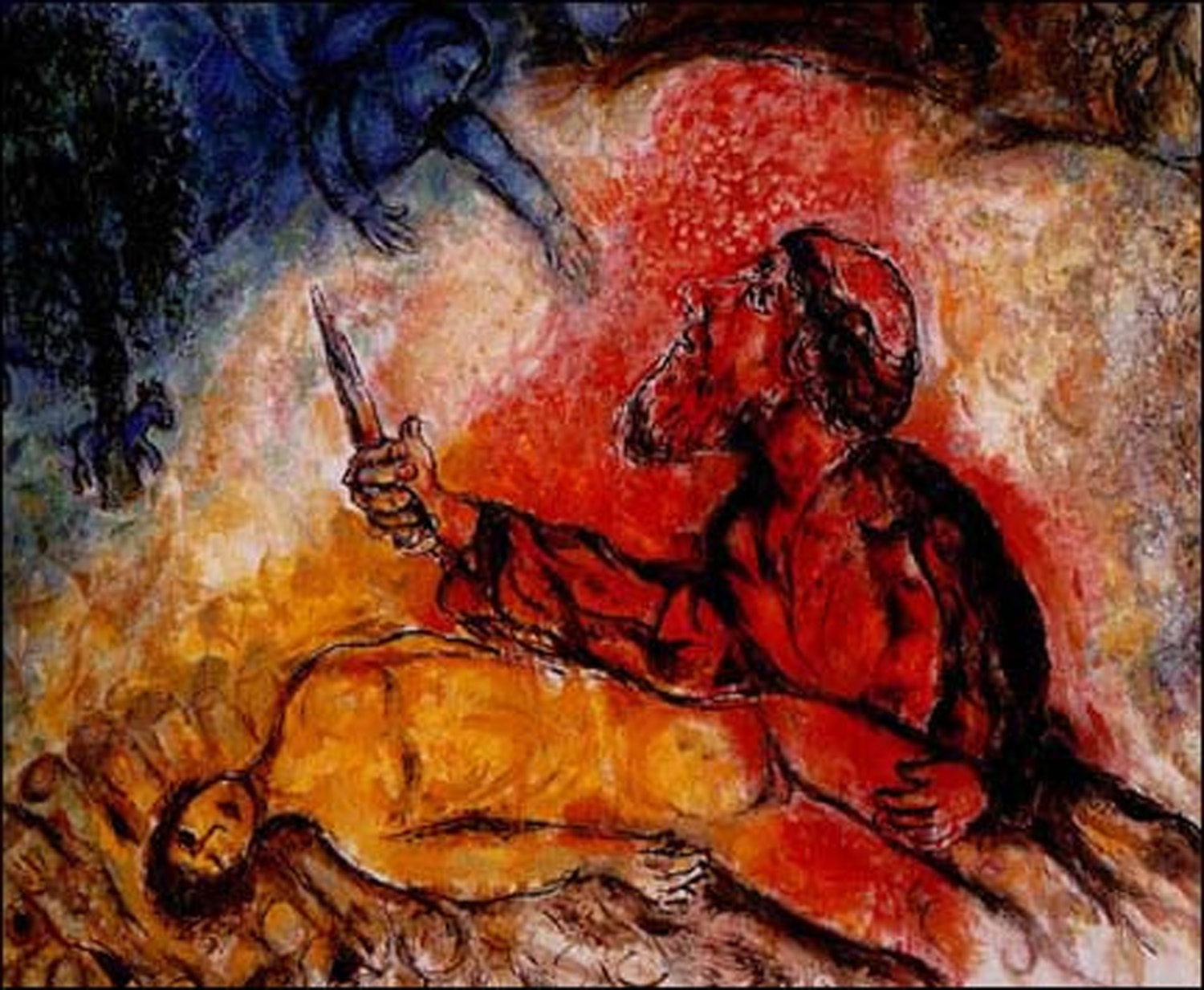
Chagall, Abraham ready to sacrifice his Son dv 1960-6

Dads live somewhere else. As Mat Tobin has recently explored with Keith Negley in response to his wonderful book Tough Guys (Have Feelings Too), they might live with a landscape that is a  “metaphor for frustration,” or in a cityscape that is created from block colours, but it seems to me that it is often rooted, in young children’s books, in a recognisable reality. It might not always be a positive thing to have your dad in the quotidianum  – think of the dad in Antony Browne’s Zoo, or Lauren’s Child’s Clarice Bean and her grumpy absentee  – but they are at least the common-or-garden dad. Even the fantastic, crazy world of classic Babar has Celesteville, and French family life is lived out in a gentle satire. It’s as if a dad cannot be a dad without reference to the everyday.

So the landscape of the Patriarch, even when geographically locatable, is in many ways the landscape of myth and legend (I have discussed legend-landscapes before), and the landscape of the dad is emotionally, socially (and geographically? I’m beginning to doubt this – see below) rooted in the recognisable. What might the exceptions be to this? A v quick list for me (as much as anyone) to think about:

  • Julia Donaldson’s Gruffalo’s Child, Cave Baby and Stick Man;
  • Tove Janson’s Moominpapa (passim);
  • The dads in the Ahlbergs’ Happy Families books;
  • Roald Dahl’s Fantastic Mr Fox.

What these all have in common is that the application of dadness to these fantastic contexts require an understanding of the everyday dad to interpret the fantastic –   “Interpretation calls upon the interpreter to render explicit a work’s meaning today. ” (Palmer, R (1969) Hermeneutics. Evanston: Northwest University Press. p 245).  We read these dads into their story party because of their relationship to the other dads we know.  Celesteville could be suburban France (or suburban European anywhere), the Gruffalo’s Child has an everyday dad-daughter relationship at its heart, and so on.

And so back to Keith Negley’s Tough Guys – and little more than to post anyone reading this to the significance of Keith Negley’s first response to Mat’s question about exploring masculinity: for Negley the project is in part for his own son (and iteratively for his own father?) and portraying in a positive way the emotional vulnerability the author-illustrator has “struggled with.” The last endpapers of Tough Guys – sampled by Mat here – show men in caring adult (dad or quasi-dad?) roles [the clever self-subversion being that it is the boys who are the superheroes: a real surprise to me]. The dads are Everyman dads, although they are unsited, depicted on a white background, they are doing the everyday stuff, playing with the boys. The interpreting reader brings to these vignettes the living room, the park, the garden.

The landscape of the dad, the everydayness of the relationships can therefore be aspirational – how a dad “ought” to be, or critical –  how a dad “ought not” to be; but in either sense there must be something in the relationship that shows we are in the world of the dad, not the desert of the Patriarch.



Nature writing

image


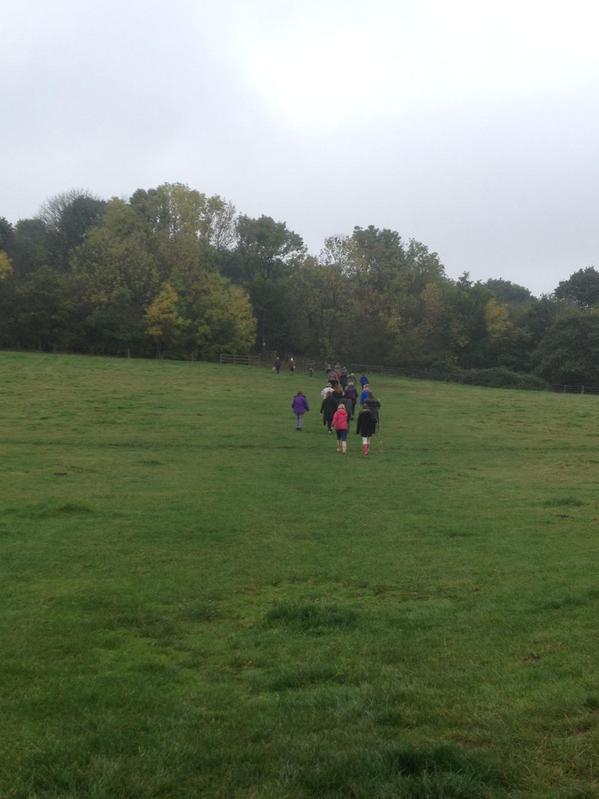
“We went on a worck to the medow and we called for an owl. the owl calld back.”

We went out into the dark to Warneford Meadow – daughter, son-in-law, two grandchildren, with my new Tawny Owl call, a little flute-type thing that you can make “to-whoooo.” We used the owl call, and in the distance (how far, I don’t know) we heard an owl call.

And on the way home, Maisy, making that unreproducible high-pitched squeak young children can do (and which I associate with our pre-language ape-troupe ancestors, with no evidence, really), got a call-back from a barn owl in the trees by the hospital.

Magic. Such magic I am putting it here without further comment.

For whom do we write the (outdoors) curriculum?

Morey Schwartz asked in 2006 (J. CURRICULUM STUDIES, 2006, VOL. 38, NO. 4, 449–457) “For whom do we write the curriculum?” and proposes an interesting model around the “rehearsal curriculum:”

“The teacher finds an exciting blueprint in the curriculum that enables her or him to teach from a new perspective—something that could not have been possible without studying the curriculum. In other words, our ‘curriculum-users’ have become the actual ‘curriculum-receivers’. While the curriculum may be designed for students, it is the way that it engages and educates teachers that constitutes the key to its success…

“A rehearsal curriculum is written in a way that prepares teachers for the teaching experience by prompting them to go through the same process of learning that will be used in the classroom.”(2006:454)

I reflected on this as I walked up for my preparatory visit to Cumnor Hurst along the path beyond the campus.  Here are things the students might pick up; here are things I must warn them about; these are the affordances; these are hazards. In some ways it’s not that different from checking the provision in the garden at the start of the nursery day.

However, it has another side to it if we move deeper into the world of educational metaphor. My rehearsal curriculum not only entails a revision of my (self-chosen) learning tasks, for also all those previous rounds of reflection on outdoor learning, the sessions that have gone well, and those that have not – and why. Serious reflection does allow for what Schwartz calls “disjuncture,” and this can be a challenge to the educator (and I remembered the time the students were unwilling to walk any more than 20 mins from campus). This is in line, of course, with the kind of activity I might think of as a spur to quality reflection – and indeed is a point for reflection/evidence is the HEA/Brookes OCSLD audit I’ve been looking at today which asks me to reflect on “Successful engagement in appropriate teaching practices” – because for me, successful engagement isn’t about being a Superteacher (I have been wary of these since my PGCE nearly thirty years ago), it’s about knowing what goes well, what went well, and how it can be improved.

So there’s my first marker on the path: engagement is about reflection, not just delivery. What do the students pick up? If it’s about engagement at HE level, surely the picking up is partly an independent thing: they pick up what might be afforded by the learning, not the things I list.  Their engagement starts from the pact we make in teaching and learning. We engage together, and my “writing” a syllabus/curriculum for outdoor learning begins from this principle.

U70124 arrive at Cumnor Hurst

But if academics see themselves not as creators of syllabi or curricula but as consumers (as Schwartz is suggesting), then the whole process of module design takes on a new dimension. “Module design” is never a creatio ex nihilo; it never springs from nowhere, but has some important elements in its formation:

  • Context in terms of the academic project on a macro level: why University?
  • Content in terms of the local context: why this course? Why this level?
  • Content in terms of restraints – social; resource-driven; interest-driven.

And if we see module design as an iterative process, all three of these come into play each time we open up the module to redesign – termly/by semester, weekly, session by session.

Why is what I have planned for Friday worth thinking about for a University course? Why, for example, do we really not need pond dipping in the module? How do I keep the content of the module current (recent research, the ever-shifting grounds of policy, the constantly changing needs of different student groups), and how do I present the course at an appropriate level?  How (and I began to ponder this in the summer, under Strawberries) do I keep it current without jumping on bandwagons? Has the team got the staff, the kit, the environment it needs? Will the students “get something out of” the class? Will I? For whom do we write the outdoors curriculum – and do I include myself in the plan to learn? Engagement takes into account constraints and context as well as some nebulous “what I want to teach.”

If I follow Schwartz’ argument, the fact that I am asking these questions indicates I see my curriculum (if I can call it that) as a “rehearsal curriculum:” the challenge moves onto how I know I am learning, enacting the things I’ve been reflecting on: how do I ensure (although I dread the word) impact?

On that note of challenge or self-doubt, I’ll leave it there for now: I have a class to prepare for tomorrow.

Strawberries

Critical incident:
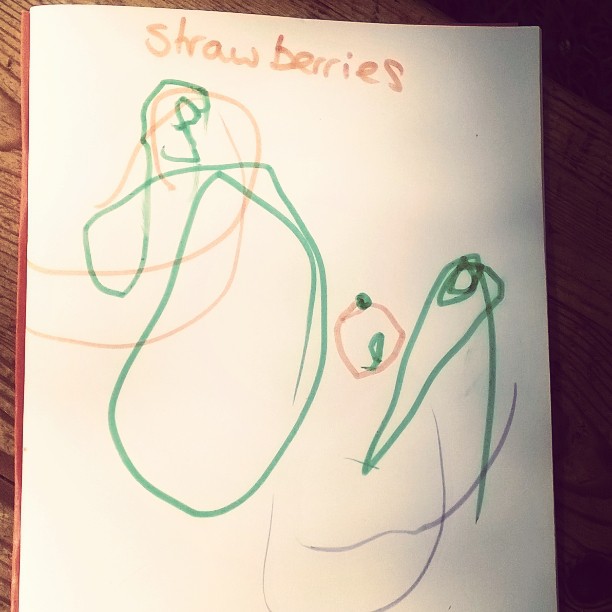
5 yo picks strawberries, puts them in a bowl, takes them out one by one and either eats them or shares them with me. Some are left for a while, and then she requests a knife, which she uses to chop the rest up. They are left in the bowl, and eventually (when they are inedibly squashy), she returns to them and feeds them (at my suggestion) to the garden chickens.

Reflection

It is an idyllic scene in a garden in June. The child is engaged, her 2yo little sister too (see the drawing below), and there are plenty of opportunities for maths and science and language development  – a real “understanding of the world,” if we remove that term from the curriculum straight-jacket.  It would be very tempting to say that “every child should have the chance to pick strawberries.”

strawberries

That’s the phrase that needs unravelling: it brings with it assumptions about class, expectations, entitlement and the unattended questions about who decides on  a child’s experiences.

Class

This is all taking place in a lawned, private garden with chickens. We may not be talking an estate, but equally the incident is not one on a subsistence farm; we are talking, in current property terms, about a dwelling firmly in the middle classes. So the expectation itself that this is a valuable experience is already close to the idea of comfortable living. The “gaze about the multiplicity of who a child might be and how she might understand her world” (MacNaughton 2005:143) has been blinkered from the start by an unexplored attitude about the normalcy of middle class in the UK.

Entitlement

The “should” is itself therefore problematic. The work of Tina Miller on fathers (see previous blog post) suggests that just as fathering is part of/arises from  a set of views about “embodied selves and structural histories,”  (Miller 2010:38) so too do the practices of Northern-European childhoods. The “should” that may suggest fathers behave in certain ways also acts in a number of ways in the case of children. Proposals of “what children need” pepper Early Education books, and it is right that we have inspiration, leadership, direction – but the “should” is sometimes unexplored, and very often uncontested.  A child “should” be outside because of the tradition of children (particularly boys) being outside to play:

Let the amusements of a child be as much as possible out of doors; let him spend the greater part of every day in the open air; let him exert himself as much as he please, his feelings will tell him when to restand when to begin again; let him be what Nature intended him to be–a happy, laughing, joyous child. Do not let him be always poring over books (1878: 179)

This “nursery inheritance” (cf Brooker 2005: 117ff) brings with it a moral imperative that is likewise unchallenged.  When we talk about entitlement – and we should – what are we using as a yardstick? Do we see strawberry picking as valuable experiential learning about healthy eating? Or as another step in the induction into the middle class? Or an understanding of life processes? Or a replication of a dimly remembered rural past?

Who decides?

Let’s suppose this experience is viewed by someone – well-meaning and powerful – as a key experience for children. On what basis have they decided this? How do they implement it?

  • Is this the practitioner who sees a child enjoying strawberries and thinks about replicating this next year?
  • Is it the parent (or grandparent) who enjoys the time with a child and thinks “this is worth doing”?
  • What would it be like if the Secretary of State were to see the strawberry incident and say

“Every child should have the opportunity to pick and eat strawberries”?

This is not so far-fetched, even though the vision of government-regulated (and measured) strawberry-picking is a reductio ad absurdum.

How does a new project get off the ground? What criteria decide that this or that phonics scheme, or behaviour management approach “works” – and works for whom? This appears to be at the heart of a new book out of the IoE, which I look forward to reading.

To go back to the strawberries, we might ask (and in particular ask our students to enquire of their own experiences)

  • what makes this valuable?
  • what criteria do I use to give this value?
  • how do I communicate its value to the child, to the child’s parents, to managers and policy makers?

How am I an effective advocate for children, not just someone who sees a bandwagon and jumps on it?

References

Brooker, L (2005) “Learning to be a Child: cultural diversity and early years ideology”  in N Yelland (ed) Critical Issues in Early Childhood Education. Maidenhead, Open University Press.

Chavasse, P  (1878, 13th Ed) Advice to a Mother on the Management of her Children. Birmingham. available online http://www.gutenberg.org/cache/epub/6595/pg6595.html

Mac Naugton, G (2005) Doing Foucault in Early Childhood Studies. Abingdon:Routledge

Miller, T (2010) Making Sense of Fatherhood. Cambridge: Cambridge University Press

Wyse, D et al (2015) Exploring Education and Childhood: From current certainties to new visions. Abingdon:Routledge

Using visual methodology to look at childhood.

“Childhood,” that fluid concept that may (or may not) include infancy and may (or may not) embrace young people up to 18, gets looked at using all sorts of research tools which may (or may not – I’ll stop doing this now) provide valid data. Aries’ own use of visual material has been criticised for its subjectivity in selection and judgment, and I’m sure the four pictures I used in my research presentation could likewise be pulled apart.

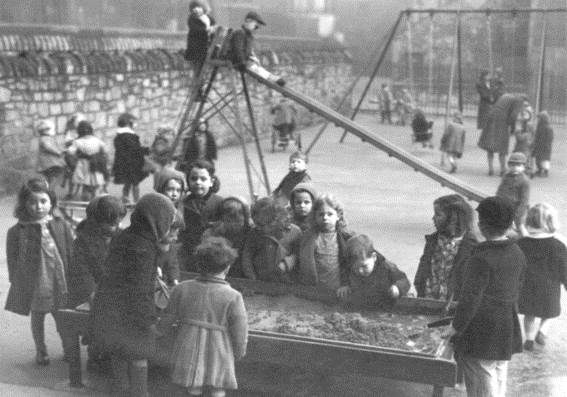
What I attempted to do at our Faculty Research Conference was to try to think in terms of methodology to look at a similar event – children playing outdoors – through different media: a four year old’s drawing; an historical photograph; children’s book illustration.

The child’s drawing I have already discussed.

This was the photograph I chose

Cowgate Nursery
Cowgate Nursery

– a substitute for the one I really wanted, from Margaret MacMillan’s passionate plea for Early Childhood provision from 1923, for which I couldn’t get a clear enough reproduction. My only real points here were about how we are unaware, by and large of how “participatory and collaborative” (Pink, 2001:58-9)  this is, and if there might be here (Burke, 2001: 117) a “possibility of idealisation” – positive or negative? Is this an ideal – an example of what schools often label “Best Practice”? Or maybe a plea for more of these institutions? Or part of a study of the urban poor – and in contrast to what?

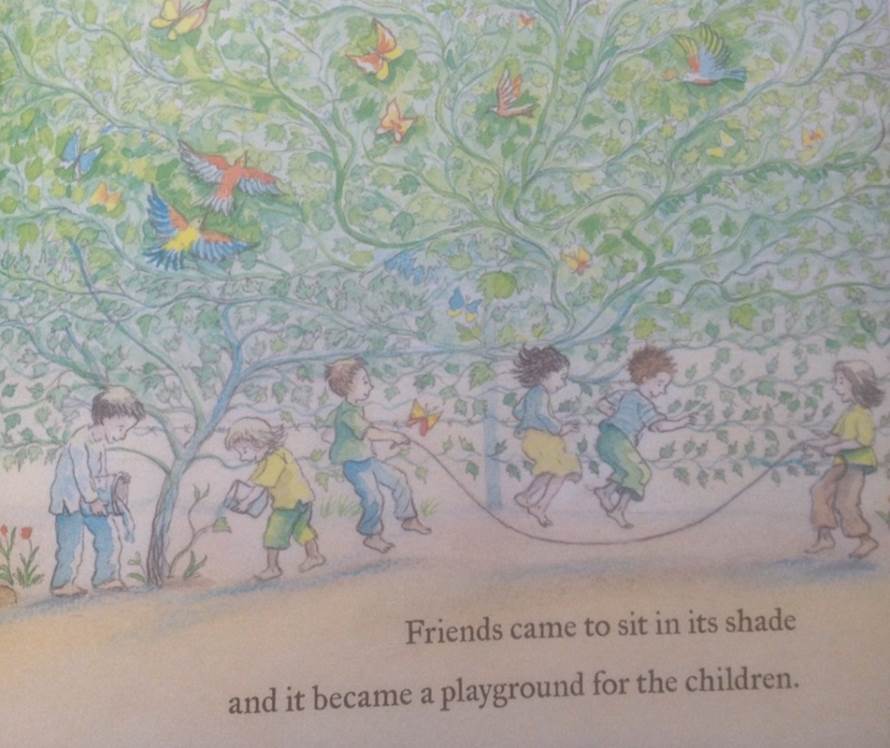
The heart of what I presented was around Michael Foreman’s reflection on his time in Gaza

The first children play in the shadow of the vine
A Child’s Garden


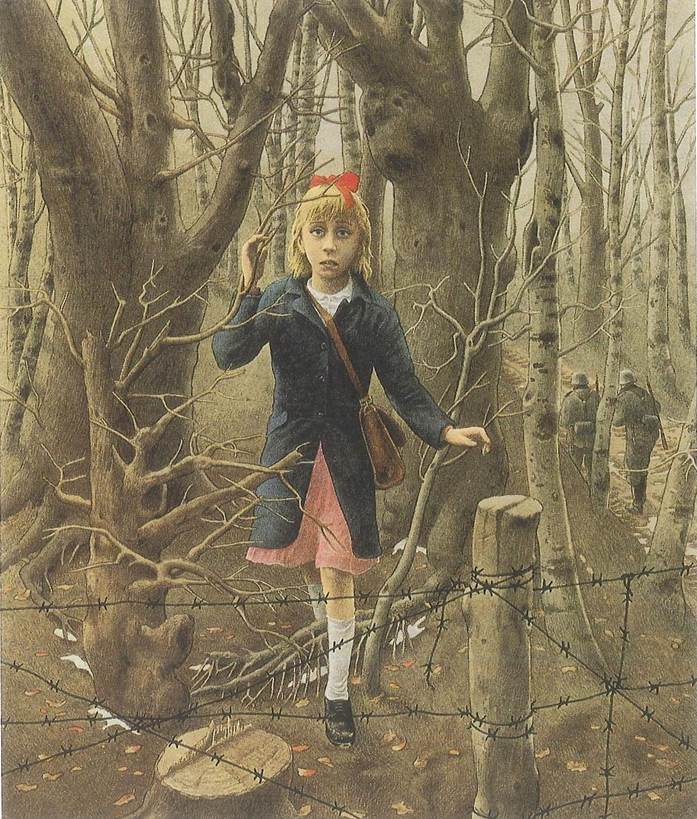
and Roberto Innocenti’s moving and ambiguous story of a young German child’s encounter with the Holocaust.

The girl discovers the camp
Rose Blanche


I looked at composition to some extent (what is Innocenti’s girl staring at in horror?), and at the symbolism both illustrators managed to use (e.g. the notion of the vine as the symbol of a flourishing Israel at peace), but all I was really able to do in 15 mins was to suggest that for all three sets of images context is important, and that for the illustrations all this becomes much more complex; in an analysis of illustrations in children’s literature context includes, it seems to me:

  • Narrative (what comes before and after the single image)
  • Intertextuality (reference in word and image to other works)
  • Multiple readership and multiple views

I think I crammed a lot more into 15 mins than this precis suggests – and here are the articles and  books I used to help me on my way.

Anning, A and Ring, K (2004) Making Sense of Children’s Drawings. Maidenhead: Open University Press.

Burke, P (2001) Eyewitnessing: the use of images as historical evidence. London: Reaktion Books

Foreman, M (2009) A Child’s Garden. London: Walker Books

Foreman, M (2009) Picture Books and the Environment: a lifelong concern in J Harding et al (eds) Deep into Nature: Ecology, Environment and Children’s Literature. IBBY/NCRCL Papers 15. Lichfield: Pied Piper Publishing

Innocenti, R and McEwan, I (1985) Rose Blanche. London: Red Fox

Pink, S (2001) Doing Visual Ethnography. London: Sage

Pink, S (2008) “Analysing Visual Experience” in M Pickering (ed) Research Methods for Cultural Studies. Edinburgh, Edinburgh University Press.

Rose, G (2001) Visual Methodologies. London: Sage

Rose, G (2014) On the relation between ‘visual research methods’ and contemporary visual culture. The Sociological Review, Vol. 62, 24–46

Sipe, L. (1998). “How Picture Books Work: A Semiotically Framed Theory of Text-Picture Relationships.” Children’s Literature in Education 29(2): 97-108.

Styles, M. and Salisbury., M.  (2012). Children’s Picturebooks: the art of visual storytelling London, Laurence King.

Ancient Darkness and other landscapes

Sitting at the end of a hectic day in the prestigious John Henry Brookes building at work, having handed in the exam paperwork and completed another piece of documentation for the treadmill of quality assurance, I am looking forward to immersing myself, after tea, in the final book of Michelle Paver’s Chronicles of Ancient Darkness, the wintry denouement (perhaps) of the hero Torak’s six-book confrontation with the evils of his Neolithic northern European world. I have loved these books – and may  come back to them after they’re finished for further exploration and comment.

It is in some ways a perfect escape from the worries of my present work: a young man pits himself against cold, and dark and the fear of death. The trivial round, the common task is not a quest. Torak’s Neolithic Scandinavia is as far as I could get from my life as an academic: I am not young, not a hunter in the antiqua silva, but sitting with a coffee in front of me, having had too much screen time, thinking not about arrow heads and tracking in the forest but about deadlines, learning outcomes, emails. It would be foolish to see me as having a part in this story, however attractive the three main characters are. It would be self-aggrandising, too, to envisage my struggling to make sense  of quality assurance as the lone battler against the dragon, or whatever. I don’t want to do that: Beowulf, Frodo and Torak did not have to prepare a report for Faculty Executive, any more than I have to find Grendel’s mere, or Mordor, or the Mountain of Ghosts.

Instead, spare a brief thought today for a little-remembered medieval saint: St William of York. He is an ideal for me today. Essentially an administrator born with a whole box of silver spoons, William gets all sorts of political and ecclesiastical preferment which are often not quite the gift one might expect. However, he is reported as undertaking them with a singularly assiduous charity. The darkness he fought was against the temptations of what today we would call class and background, against the uncharitable fight for power which denies the underdog.

I can’t see a children’s story in something so unheroic, any more than I can see any kind of ripping yarn in chairing a meeting or filling in a tedious pro forma.  But I do feel like some of what I have done today has been at least useful. Maybe I’m admitting that traditional tales of the outdoors quest are all very well, but they can only stand as an allegory for the everyday lives we live, or which we are preparing students and children for.

I’m not sure whether Torak and his wolf pack brother would understand any of that, of course, but it raises any number of questions for me:

  • Why do we need physical range in a narrative? Why does the sea journey or the vast forest appeal?
  • And what does landscape add in terms of danger?


Visual Methodologies

Hmmmm.

I’m re-reading Gillian Rose on Visual Methodology, and she has given me a lot to think about.  I’d like to see if I can apply her ideas to some children’s work such as this:

climbing 001


So let’s look at this in more detail.

There are two figures, arms down by their sides, under or at least near a complex climbing frame. Writing explains that the child feels s/he is “very good at playing on the climbing frame.”

Now, I know who did this (I have obscured a name, although I do have the young artist’s permission to share this drawing) and the context, but if we apply Rose’s criteria to it, we need to ask:

  • What is being shown? What are the components of the image?
  • How are they arranged?
  • Is this a contradictory image?
  • What knowledges are being deployed?

At the basic level, what is shown is as I’ve said above, a climbing frame and two figures in proximity to it. There are two components as I read it: humans and climbing frame.   If part of the questioning we need to undertake is around what has been missed out, what is not there is interesting too, however. It might be that we can distinguish here a sort of intransitivity: the climbing frame is not being climbed, and the figures are not climbing it. In the picture there is no sky or grass, no distraction from other equipment. Does this argue for there being a lack of need from the adult for a ‘holding activity’? “Just [go away for five minutes and] colour in the sky”? Or does it argue for purpose or maybe even haste in the interaction between adult and child?

But we might also suggest a third component: the writing, both by the child and the adult. Image and text work together, and are part of the same tradition (of which child and adult are aware) as the picture story book.  The arrangement is one in which this convention is upheld.

Where it is skewed, where it has an element of contradiction,  is in the adult intervention. What is the purpose of this object? The title gives it away: this is a piece of school record keeping, very probably created at the request of an adult “to go in your file.” The child’s writing (and adult transcription) and title and date suggest that this is part of a record-keeping system that tells someone (see below) something (again: more to think of here) about how the child artist-writer sees themselves.

So what knowledges are being deployed? In brief, as a first go at this I propose that we can discern:

  • an understanding of how text and image can work together;
  • an understanding of how to represent the various elements of the climbing frame (including climbers);
  • some understanding of purpose and power in adult-child relationships.

So in looking at this power relationship, we come to the reason the work was created. I suspect, as I said, that this is at the request of the adult – and therefore, to some extent, the adult is the intended reader, the sponsor of the activity. Even in the context of physical play, the child is constrained, as is the adult, to use the event to spawn other events closer to the curricular needs, not of the child, but of the adult: play and the observation (or in this case the self-evaluation) makes it have a purpose the adult world might value.


Lost Words

A lot was made recently of the decision by the Oxford Dictionaries to take out some words from one dictionary and put in others.   The choices that were especially criticised were the ones where “nature” words were lost in favour of computing words.  I’m not sure where I stand on this; it is the task of the lexicographer, and especially one working with a word-limit to make such decisions.  What words do children use? What do they need?

The excellent Landreader project makes some really good points in this blog post, not least the suggestion that the list of words to be taken from the Junior Dictionary  can be seen as a  “prose-poetry supplement to be administered like a multivitamin as a defense against lexical malnutrition” – a neat turn of phrase.  It’s neat because of the word “need.” What words do children need, and why?

They need words to talk about things – ivy, a starling, catkins. They might need a dictionary to help them understand something on the edge of their current world – the stream that gives its name to  Boundary Brook Road,  the kingfisher in Kingfisher School. They might also want – and this is where a dictionary helps immensely – to inform when a reader meets something new and unexpected – minnow, newt, porpoise.

This has limits, of course: the Landreader project has a glossary which introduces the visitor to words beyond usual use: sleech,  or drumble, or twitten. Intriguing though they are, they are not really for the Junior Dictionary. But are we really to think that heron and poppy are becoming part of the same world? That the comic  linguistic vagaries of Rambling Syd Rumpo might also now include conker and stoat?

Safer to stay at home

The Teddy Bears’ Picnic is an odd mix of cuteness – bears gaily gadding about &c – and danger. From a sweet picture of playing and shouting, the text and the key move (2 mins 13 sec) to a more sombre tone:

“You’d better not go alone.”

“Lovely – but safer to stay at home.”

It’s as if the Teddy Bears are involved in the scene from the Bacchae that King Pentheus is lured into watching. A  pastoral scene: a little valley, shaded by pines, a very rural scene where Pentheus watches the ritual abandon of the Bacchae who are “unawares” – until  Dionysos reveals the watching king and the terrible tragedy unfolds.

What would the Teddy Bears have done if we, the watchers hadn’t stayed at home? They would have torn us, as Agave does her son, limb from limb – because they are not Teddies; they are bears.

The Teddy Bears’ Picnic is perhaps the last gasp of this understanding, arising from the event in 1902 when “Teddy” Roosevelt encountered a bear – a real bear – on a hunting trip. Bears (until the Teddy) sat alongside wolves as dangerous; the tension of wild and dangerous versus tame and cuddly is evident in the change of tone in the song.

And with this tension comes the greater dilemma: how safe it is Out There?


Expect scuffles

The short but clever blog post from Gareth E Rees http://www.unofficialbritain.com/the-united-kingdom-of-the-remembered-dead/ raises some interesting questions about public landscape and memory, using the insights of memorials.

I won’t spoil the impact by citing the neat ending, much as I’d like to share it, but the notion of memory is an important one. “Jodie” and “Duncan” – or Mrs A, Mr B, Chris and Deb, Ena, whoever – being remembered brings with it a certain appropriation, Gareth maintains. He may be right: I sit on a bench in this park and know that the view was appreciated by someone else.

Of course, I don’t mind that. Lucy Boston’s Green Knowe series of books are meditations on her house and its history, and are built on just this point, for example.

The bigger questions around landscape and myth, however, that I’ve explored before, impinge here, particularly when we think of landscapes as mutable. Can we alter this view, when Fred loved it so much? And more particularly, can we acknowledge the manes, lares et penates of previous inhabitants?

There is a bench I know that overlooks an old gravel pit and a railway siding. In the misty moisty, mornings of September it is beautiful: quiet, with grebes, mallards, the occasional plop of a fish or the silent flight of a heron. The bench has a commemoration on it.  The commemoration does not, I presume, remember when the gravel pit was in full operation, or when a local railway line ran through what is now the park. It remembers Mrs X “who loved this spot” for much the same reasons as many people do now. Her ghost, if you like, resonates with current feeling.

Another ghost, perhaps, of the Neolithic marsh dwellers of South Oxford, or the Normans who built their Grand Pont across the wetland might want to contest her view, our view. Where does our conservation stop? Whom do we recognise? Where does conservation of a nineteenth or twentieth century landscape become a matter of public interest? How do we represent landscape as mutable without laying in open to any and every change – or recognise that change is not always bad?

And can [children’s] literature represent this mutability and beauty at one and the same time?