This blog – or rather its predecessor – explored place rather a lot. This summer’s trip to Santorini was in part inspired by reading Clive King’s The 22 Letters; Gawain and Ludchurch (“Lud’s Church”) are all over it, too. I have read about places and gone there; I have gone to places and read about them. I read The Canterbury Tales and Mydans’ novel about Thomas Becket and then went to Canterbury. It set me thinking: what might I have made of Paris if I had read Vango first? (After all, after I’d read Becket and its – erm – inspiration, the novel by the great medievalist Helen Waddell, I was disappointed to find so little left of the Paris they describe. In fact, although there is more around Notre Dame than is immediately obvious, there is more tangible stuff left of Clive King’s Ancient Thera in the tablets of Linear B and the archaeological museums than there is of the ill-fated lodgings of the twelfth century canons of Paris.) How do we, as adults, use the written word to tell children about the physical world? How might we (or do we) use story? How might this, in itself, change the visitor’s ideas?
And if Vango might have changed my view of Paris, what of Selznick’s Hugo Cabret? Or Kipling’s or Milne’s Sussex? I could go on… and that’s before we start thinkng of places responding to their visitors – where Canterbury’s rebuild was prompted by its visitors, and Paris still holds the echoes of the Hemingways and Steins so wonderfully celebrated and parodied in the film Anastasia in Paris Holds the Key to Your Heart (of course Paris is particularly susceptible to this myth-making, as is Oxford, my city of aquatint and commuting).
But then we come (of course) to Garner. The creation of the Alderley phenomenon, drawing on myth and legend, changes a bit of whimsical parkland with a few stories attached into a mythic landscape out of all proportion to the stories that we can find readily. It does so almost entirely because of the authochthonic outlook of Alan Garner. We find ourselves in this place or that seeking to see with his eyes, following his train of thought, his access to myth and legend. We are tempted to try and see his Alderley, his Thursbitch, his Ludcruck. Gawain and Beowulf are in his sights; we peer into his horizons and try to see what he is pointing out.
But let’s broaden this out. As I have discussed before, there are clearly places that have myths or legends attached, where stories have been piled up. The Cheshire/Derbyshire border is one such; maybe Oxford is another, or Paris, or Tintagel. Part of the project I seem to be involved with is the uncovering of these story cairns – but there is another part: it is the job of the critic of children’s literature – or some of us – to look not only at what has been collected, but also at the effect of the stories on the visitors to the landscape.
What does the young visitor make (and here we are in the recent Twitter conversation that started my thinking) of Venice having read about the pig Olivia and her visit? And how might the adult draw on this in September to help the impressions of the visit stay vivid?
Marianne Dubuc’s Up the Mountain is worth considering when anyone says that a picture book is simple. It does not have the visual fireworks of Gaiman and McKean’s Wolves in the Walls or the political complexity of Foreman’s A Child’s Garden but the straightforward story (outlined below) has a lot to offer.
I find it is sometimes challenging when reading educators’ social media about “Where would you have this book?” and ” What use could you make of this book?” to stop and think of a book as an object in itself: the visual aspects, the pace and language of the narrative… That’s not to deny teachers for a moment a very exciting way to explore and widen their own understanding of “children’s books” – but just that sometimes a book calls me to step away from the pedagogy. Up the Mountain does that for me. Yes, it fits with projects on Outdoors, it could be used to discuss age, and friendship, and exploring, maps and maths, wildlife, ability…
But that’s why it is a really enticing book. “Very old” Mrs Badger, on her Sunday walk up the mountain meets the little cat Leo who overcomes his reticence and joins her in the walk – that Sunday and “for many a Sunday after that,” until Mrs Badger no longer has the strength and it is up to Leo to rediscover the mountain. It is a plain enough narrative, with an easy pace and lovely drawings, and as Leo makes the “splendid” mountain his own, it has a poignant and subtle message about growing up and passing on the things you have experienced and grown to love – as Leo does at the end of the book. This is a story my 5yo granddaughter will love, but the unspoken affection, the relationships between character and landscape, the exploration of tradition and enthusiasm mean I can return to this over and again for my own pleasure.
So how do we step back from being pedagogues to being simple readers? Easy enough for me in semi-retirement, maybe, easier still with research partners to spur me on, but the following are just some rough-and-ready thoughts.
Reading widely helps: if you stick to the ones you know, you are missing out. Not just because this book or that is perfect for this child or that, but because your own enjoyment is endangered, rendered threadbare. On social media recently, a new teacher asked about the book for this next term. My response was to suggest she read a book she will enjoy reading, and the best way to find those is to read widely. The commmuity of people reading and discussing “children’s books” (or fantasy or whatever) is rich, wide and very charitable. Look at Sarah or Dimitra for starters…
Re-visiting half-forgotten or set aside books or series: have you “done” the lovely Owl Babies a lot? What about On the Way Home? Or if you set aside something (a besetting sin of mine) ask yourself why, and whether it’s worth returning to it. Finish the Stone Book Quartet. I bet there’s a Moomin story sitting unexplored – or what about Jansson’s adult books??? There’s a whole different thread…
Treating the books destined for the classroom just as you would your holiday reading: You don’t intend to put Margaret Atwood’s Hagseed in the classroom but how did you read it? Did you take its psychological messages about bereavement and revenge to heart, or did you read it as a comic exploration of a Shakespeare play? Did you read and re-read, or did you race through it? Did you share it with a friend or a partner? Or a book group? Or on Goodreads? What did you “get out of reading it”? I read seasonally: Moomins in the autumn, maybe, and Lucy Boston’s Children of Green Knowe in December… How do you read? What do you enjoy? Why do I like Up the Mountain so much? Is it that poignant subtext of Mrs Badger saying goodbye to her beloved Sunday walks? The gentle loyalty of Leo? A bit of self-reflection might let you think differently about the children’s books not as a resource but as a source of wonder and enjoyment.
Reading about authors – reading other people’s critiques of authors’ discussions and interviews (I have to link to Mat Tobin here, but check out Simon and Martin and others, too), author biographies, books by the author outside their usual genre. No, for some people that’s not the way they want to go, but for some those lavish books of Maurice Sendak’s artworks or the simple self-revelation of Alan Ahlberg’s The Bucket are just the thing to get you looking at the books children read in a different light.
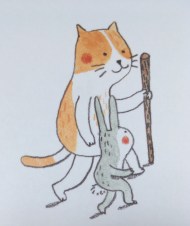
And then finally. Once you have enjoyed the illustrations, seen the way prose and picture work together (or in opposition), enjoyed that way that little cat peers out at Mrs Badger and how the bunny later echoes the incident, finally figured out the relationship between Sally Gardner’s wolves and John Masefield’s – then start looking at the classroom, and again, Mat has the resources … Too late to do this for this summer, I know, but this is, after all, simply a reflection as the weather cools. Time for the Moomins for me, then… More mountains and small beasts.
…the delight of solitarinesse? I am not sure this is always the case. Dowland’s song is lovely, and does all those Elizabethan/Jacobean things about how countryside allows escape – from court, from love, from mess. The re-read of this play (I’ve sprinkled some allusions throughout this post) has given me much to think about tonight. However, just as the Duke in As You Like It retreats to the Forest of Arden not alone but with his company, the social aspect of the pictures below cannot be denied. Hey nonny no.
Maria Popova’s Brainpickings Blog is a mine of beautiful sources for all sorts of things. Here, she excerpts some of the writings of Hermann Hesse on trees, which sparked some thoughts on Twitter and in me. What makes a place special? Is it simply memory? Here I want to post some pictures and some brief explanations with really no thought but to explore some of the sites that have meant something to me over the past two or so years. So this is really just a resource for further reflection, taking account of space, memory and relationship. They aren’t in chronological order, or really in order of importance, except that the last is the most recent.
I’ll start at Wittenham Clumps, where I learned the value of Forest School back in 2000. This is a later picture, of course, with two grandchildren making dens. I’ll come back to Forest School, that almost incidental thing that was therapy for me after Theo died and then went on the inform my educational world view. Making dens in the Wittenham Woods, watching physical skills and inventiveness and imagination come together is still a great joy.
But the next has to be the first dawn looking to Ludchurch from Gradbach. The rising of the sun and the running of the deer. Wild Spaces Wild Magic defines so much of my work-thinking over the past two years: that it has such personal significance is down to the “geological pantocrator,” the pareidolic Green Knight (here in the initial project outline), and to the quiet glory of this dawn – and (back to the humans) to the team. It was mat who showed me that face, and if I have lost my heart to the project it is in part because of that experience, and then this glorious autumn morning, and also to the variety of gifts of the team – Debbie, Jane, Roger, Mat:They make me think and feel and create (and fail and pick myself up) but it is this half an hour at dawn in a solitary wooded valley that was a moment of transcendence with
…tongues in trees, books in the running brooks,
Sermons in stones and good in every thing.
***
To create a methodological framework for this, I suppose I am looking for a visual approach to autoethnographic study – but in reality, I am not there yet. Where I am, or where I was the other week at any rate, was seeing woods not as a place of solitary contemplation as in my previous post, but as a place of meeting. A place of shelter, companionship, release, exploration: Who Will Go Walk? Here then, to end, is a series of photos: Nettlebed, a place of glory in bluebell time, where in Rob Macfarlane’s words “Each step in taken in an ocean” and where in autumn Maggie and I have walked the red-gold of beech leaves. I could wish this were the site of Cooper’s fantasy sequence, so powerful it is, so amazing the visits I make with Maggie.
And then there’s Wychwood, the “strange caper” where I broke my finger trying to keep up with Jon. The memory stays, brings a smile. The finger is still wonky. Maybe the woods, like Arden, like a monastery, like life’s different contexts, are places we are accompanied by our follies? Maybe I needed to learn I am more “Full of wise saws, and modern instances,” a bit like this blog, than a nimble Orlando under a greenwood tree.
I cannot omit the 2016 autumn trip with Mat on the first, splendid visit to Alderley Edge. Here he is photographing away in the woods on our weekend in Garner Country. I’m not sure we found anything of real insight at Alderley that tentative first morning – but it does deserve another trip, maybe on its own. The Edge was maybe eclipsed for me by the later activities of the weekend, notable, of course, the meeting with the Green Knight, whose photos are all over this blog, and in whose magic wood on our last trip I felt both lost and found.
Nearly there. Three more shots: my local nature reserve, the Lye Valley where the ways the woods open out into fen are like a curtain drawing back… again the grandchildren, or two of them: watching them teaches me more than reading about outdoor learning. ..
…and the domestic woods at Harcourt where much of my Outdoor Learning practical work takes place… and yes, I did smoor that little fire. What started as what I think of (unkindly) as my hobby module has become a major part of my understanding of my role.
And finally to say nothing much but to bring the blog post to a finish, here are Chris and Jon and me. Woods and friendship again. Solitary they can be, as in the previous blog I cited – but they are also places of meeting. Another form of therapy?
“We live in one envelope with a multitude of voices…”
In a marvellous blog post on a marvellous book, Mat Tobin explores the role of the sea as it affects the psychological landscape of the book Town is By the Sea. It raises a challenge for me about how I understand and select what I mean by “landscape.” Of course the very syllables of landscape tell us about the shaping of the “dry land” and mirrors the foundation text of the opening of Genesis “And God called the dry land Earth; and the gathering together of the waters called he Seas” (1:10). Who shapes the sea? Genesis and Job give the Judeao-Christian response. Job, full of glimpses of nature and acute turns of phrase, is of course worth a look, but is clear who shapes the sea:
He bindeth up the waters in his thick clouds; and the cloud is not rent under them.
He holdeth back the face of his throne, and spreadeth his cloud upon it.
He hath compassed the waters with bounds, until the day and night come to an end.
The pillars of heaven tremble and are astonished at his reproof.
He divideth the sea with his power, and by his understanding he smiteth through the proud… (Job 26)
Where wast thou when I laid the foundations of the earth? declare, if thou hast understanding
Who hath laid the measures thereof, if thou knowest? or who hath stretched the line upon it?
Whereupon are the foundations thereof fastened? or who laid the corner stone thereof;
When the morning stars sang together, and all the sons of God shouted for joy?
Or who shut up the sea with doors, when it brake forth, as if it had issued out of the womb?
When I made the cloud the garment thereof, and thick darkness a swaddlingband for it,
And brake up for it my decreed place, and set bars and doors,
And said, Hitherto shalt thou come, but no further: and here shall thy proud waves be stayed? (Job 38)
We are left in no doubt about the beauty and terror of the sea, and the descendants of these passages are Melville’s Ishmael in Moby Dick and R S Thomas in the religious meditation Sea Watching
You must wear your eyes out
as others their knees…
In contrast, Richard Greene sets his own journey from his native Newfoundland resolutely as a people study. In “Islands in Memory,” in Crossing the Straits, he does talk (as I think Schwartz and Smith do, at one level) of
Grey stones and poverty
engendering a discontent
that is hospitable, quaint
in the tourist’s eye…
ledgers of seasonal obligation,
tricks of credit,
lies over what a fish was worth,
but more so
the sea that stood outside
all resentment…
but in the eponymous poem, Greene centres on the people, the solid, repeating practices of crossing by ferry from Newfoundland to Nova Scotia
and Newfoundlanders crossing
the Straits see water enough in warmer times
to forego the prospect now, but this moment
of pent chances, between home and home,
is not mine alone, and for most who travel
there is some tear in memory between
the longed for and the given, what they left
and what they are. Nova Scotia looms…
The sea is a highway to a new place, just as in Town is By the Sea it offers beauty and rest, a wider horizon of light – but it is an ambiguous offering, since the town also offers (?or maybe demands) stability…
desire for change and new opportunities. Small, tight communities have a way of holding on to you and not letting go. Their comforting sense of familiarity, of friends and their families, homes and play spaces or shops, sea fronts and country lanes beguile you in believing you cannot live without them.
A multitude of voices – a multitude of views, The visuals of the sea are fascinating in Town is By the Sea (Simon Smith has a subtly animated version here in his own review), where the sea is often “all silver and shadow and vision of things not seen” as Montgomery says in Anne of Green Gables. The play of light in Town is By the Sea immediately makes me think of this model, as it were, of light and beauty, although Martin Galway does wisely point out that there is a lot to be said about line and colour in this book – as Thomas puts it “Light’s peculiar grace/In cold splendour” (Song at the Year’s Turning). In Town is By the Sea the wide sweep of light is in opposition to the claustrophobic mine under the sea…
But there is still more to think about when we look at sea and seaside. Here, in what is proudly announced as Allan Ahlberg’s 137th book, a mum takes the children and the dog shopping, and – a bit like Bear Hunt – they encounter a seaside with buildings – Fife or Dorset, Cellardyke or Lyme… It is not all that different from the Nova Scotia mining town in Town is By the Sea in that we seem to need to define sea by where it isn’t… With the poet of Job, we are depicting sea as boundaried and measured by human experience.
The structure and conventions William Grill employs in Shackleton’s Journey mean he is able to be bolder, so that the ship is almost there just for scale in one picture
From William Grill’s “Shackleton’s Journey”
and not there at all in the other.
From William Grill’s “Shackleton’s Journey”
This is a different sea again: almost as inhospitable as it can be.
Iain Sinclair, who begins this post, deserves a fuller quotation here, from his Edge of the Orison:
He (John Clare) had to learn the difficult thing, in different places we are different people. We live in one envelope with a multitude of voices, lulling us by regular habits, of rising, labouring, eating, taking pleasure and exercise: other selves, in suspension, slumber but remain wakeful.
Picturebook artists are as aware of this as Sinclair, I think, and share the insights too of Philip Hoare whose work on sea and culture in The Sea Inside could be seen as running alongside Peter Fiennes’ Oak and Ash and Thorn, dealing with marine rather than arboreal culture(s) we encounter and shape. Hoare gets is right when he says that the coastal terrain
may be managed by man [sic], but it has been edited by the wind.
Edited by wind and wave and light and bird and… all of these editorial hands, or debating voices, whichever metaphor we choose. The woods in Fiennes’ book likewise are cleared, colonised, full of missed histories and unknowable opportunities; his scale is time, where Hoare’s is spatial. Hoare is right when he challenges his reader
Take out your atlas and look at it.
You can’t. Just as no two-dimensional map of the world represents the true proportions of its continental masses, so no chart represents the reality of its greatest ocean.
Maybe this is a place for fiction. Town is by the Sea gives us a beautiful but threatening presence, and the threat – and something of the scale – is in William Grill. There is an attempt to domesticate in much of the seaside of children’s literature, but all of these give different faces to a goddess with many personas. Maybe we are better off in the richness of poetry and fiction and picture, back in the pagan mysteries of Susan Cooper’s Greenwitch instead? Or maybe we admire and classify but cannot fully comprehend this vast presence in the world we crawl about on?
The facts defy that paltry layer of land which we call home.
This is just a blog post, and can’t approach the work of Hoare and Fiennes, but the danger is that the openness of the sea (like the Great Wood where the unwary can get lost) is that the “multitude of voices” means “There is no such place as home” as Hoare reminds us in his bleak final pages.
I’m reading three books connected with trees and well-being at once at the moment: at Mat’s suggestion, Mythago Wood by Robert Holdstock; Max Adams’ The Wisdom of Trees and partly at Jon’s prompting Paul Gilbert’s Overcoming Depression. In the first, the Antiqua Silva asserts itself over a troubled house; in the second, there is appreciation of beauty, of effect, of the impact of the tree in Western culture; in the third I am exhorted to find/create an image of a safe space. Might I imagine a wood, full of green light? Woodland as therapeutic space: this blog returns to it again.
It appears that dasotherapy (or thasotherapy?) is not the neologism I’d thought: it occurs in a spa in Belarus. That’s not quite the use I’d hoped for, though, either. as I think about the Trees and Wellbeing conference that (almost) served as punctuation to an emotional rollercoaster of a fortnight – or month, or two months…
So when today I had some news I needed to turn over I’m my head, I went for a walk. A bit of time in the quiet green. Dasotherapy. Still not sure of the word.
I am immensely lucky I have the beautiful grounds of Harcourt campus as part of my work place. A muntjac was browsing, two magpies fighting or mating – bickering, whatever – in the canopy of weedy ash and sycamore. It is not the canopy of Chiltern beechwood but in its way is beautiful. It may not be grand, but it is full of life and growth. I think of Roger Deakin’s accounts of walnuts in Ortok and ash in Suffolk; of Richard Mabey’s Unofficial Countryside and the marginalia of landscapes; and then of his Nature Cure. Mabey speculates here at his lyrical best, describing his fens (but in truth praising any ecosystem):
…there is a general movement towards the development of woodland…but against this there is a corresponding, intrinsic drive towards variety, flexibility, subtle forms of symbiosis and partnership.
I feel like here I almost catch up with him. There seem to me to be all sorts of reactions to woods- places of awe, of menace, of folklore or inspiration to “high” culture, or an impetus to preserve, or to admire the invasive… but today in this scrubby green sanctuary, the volatility of woodland strikes me: young woodland, with trees competing for sunlight. Today I don’t need the ancient menace of Mythago to tell me how movable a wood is, or Ward’s Ancient Oak in Max Adams to tell me how we grow old, how life is unstable and mutable. We operate on different timescales, but we too are seedlings, race for the light, and overreach ourselves and fade. Talis vita hominum- today, not to do with sparrows.
A mindful time in meditation might mean all sorts. Frequently for me it means trying to look over the shoulder of worries and needs to a quieter place. Consider the wonderful line in the poem by RS Thomas, The Moor, linked here: What God there was made himself felt. I’m really not very good at it. It’s as if I know the words but can’t fit them to the tune. I know what it means for the “breath to be held like a cap in the hand,” or to “look with kind attention at my distractions” but can’t ever really get it right. There may not be a “right” to “get,” of course…
So it was with some surprise that an early morning in the run-up to Pentecost found me in the garden trying to be mindful, trying not to try, trying not to notice I wasn’t trying… It was, as the poet Rick Greene writes, “earlier than history by an hour.”
Dawn.
And the blackbird flew across the garden, with that wonderful liquid chortle….and a wren hopped about after the chickens’ mealworms, scolding , needle, pin, “sharp-song, briar-song, thorn-song” as Rob Macfarlane puts it. And then the littler of the two squirrels came across the shed roof and I watched it run along the fence, heading for Jo next door’s bird table. They came, and they went, and I watched them come and go… and I wondered (and wondered so much I thought I’d blog it) if this is what Martin Laird is getting at in his books. Here he is in Into the Silent Land.
The thinking mind that “whirls about” is constantly concerned with thoughts, concepts and images, and we obviously need this dimension of mind to meet the demands of the day, to think, to reflect on and enjoy life. But the thinking mind has a professional hazard. If it is not engaged in its primary task of reason, given half a chance it fizzes and boils with obsessive thoughts and feelings. There are, however, deeper demands, deeper encounters of life, love and God, and there is far more to being alive than riding breathlessly around in the emotional roller coaster of obsessive thinking…This profound ignorance of our innermost depths presents a singularly convincing case. This is the human condition and we have all eaten of its fruit. But this is a lie. It is a lie spun largely out of inner noise and mental clutter.
Maybe my chasing thoughts is just like chasing the squirrel (not something I do) or following the wren as it picks about on the lawn. I let them go: the cool, dark of the garden is the thing, not the scurrying busy animals. Maybe this is another thing we learn from being outside: that there are aspects of our mental states that are mirrored by what we see around us. Maybe, at a deeper level (or a more convoluted metaphor), I need to see myself as a place where thoughts scurry about, when what I came to do was enjoy the peace and the dim calm of the morning.
I’m reading for the umpteenth time a really good book on outdoors, the Kaplans‘ The Experience of Nature. Rachel and Stephen Kaplan make some really important points in their book. It maybe didn’t have quite the impact in UK (although such themes are recurring: see here, for example, from Bowler et al., 2010) as it would have had if it had been published, say, ten years later, and needs outdoor people to come back to again and again. I think that many of the ideas they come up with are assimilated by other, later writers or that others come to similar conclusions. Reading Chapter 6 on Restorative Environments was, when I read it for the first time, a bit like coming home.
The argument – by Ch 6 – is around what they term “mental fatigue” and the potential restorative role for the outdoors, although they admit this does not explain at this point what is being worn down. They come to the conclusion it is a facility with focus, and refine their idea as “Directed Attention Fatigue” in which basic tasks cannot be competently completed: we have less capacity for detailed attention, leading to basic errors, less sensitivity to social cues, less ability to persist. The next section is key:
The struggle to pay attention in cluttered and confusing environments turns out to be central to what is experienced as mental fatigue….One way to achieve this is through sleep… Sleep however has limitations as a way to achieve recovery. Ideally one would provide rest for directed attention during one’s waking hours as well. Achieving this requires environments and tasks that make minimal demands on directed attention.
Ingeniously they then propose ways of “getting away” which in turn are seen as insufficient, until the writers synthesise their arguments and come to their key notions:
Being Away
Extent
Fascination
(Action and) Compatibility
It is these four aspects I want to explore really quite briefly and from a set of personal experiences rather than anything remotely challenging the deep understandings that the Kaplans bring out in their book.
Being Away
When in 2009 I called my (?ecocritical) study of Sendak, Butterworth and Childs ‘Escape into the outdoors?’ (in Deep Into Nature, linked here) I talked about the unwary getting into trouble “out there.” I was thinking about the ways in which children’s literature encourages a mental escape, but that the space brings challenge. Ida and Max for Maurice Sendak, Charlie and Lola for Lauren Childs, Nick Butterworth’s Percy the Park Keeper all help the reader see beyond the page, behind the bedroom or wherever – even beyond reading in a garden on a sunny afternoon. Mini Grey has some lovely insights here, especially where she states that “books are windows and doors into experiencing being someone else.” Windows and doors to outside. It is not always a nice place (for Ida in Outside Over There it is a “mental and emotional landscape of sibling jealousy and childhood anxiety”) but it is an “away” that brings a different way of being. However, the personal experience of the Wild Spaces Wild Magic project and the simple delight of an afternoon walk in Wychwood Forest suggest to me that the embodied mind needs an embodied escape, an experience of release from the everyday being enhanced by perception of beauty. As the Kaplans propose, reviewing the work of Fly (1986),
…”experiencing nature” or “enjoying the natural surroundings’ received the strongest endorsement…. environments that foster a sense of safety and competence, where a quick assessment leads to the judgement that one could readily make one’s way and could explore without great risk were the more preferred.
What I am therefore to make of my fall from the rope swing (not pictured here but much enjoyed by my students on Twitter)? I suggest it’s complex: on one hand a simple misjudgment of my own capability and a need to belong or impress; on the other, the safety – the lack of great risk – is social/emotional: falling with a friend around to laugh rather than mock is a lesser risk than the fall itself. A pratfall: the humour is in the tumble; the affection is in the humour.
Would I have attempted that swing on my own? Where might the stranger walk? What part does confidence play? Ludchurch on my own was a greater challenge than with Mat and Roger and Jane and Debbie. Maybe the social stuff (see below) is important to me, and “embodied” implies “relational.” Maybe the Kaplans’ notion that social cues are dulled by certain contexts can be turned on its head and that the social aspects of “nature” should be considered. Maybe we need to create spaces for us to be away, or be away with people, to heal, or to sustain our wellbeing.
Extent
The view out to the North West from Wychwood Forest in April ’18 (the first shot) was wonderful, the view (here) down the valley from Thoon with Mat in November ’17 was tremendous, enlightening; there may be significance in the fact that they both had far-away horizons. Both encompassed
the imagined as well as the seen…a promise of continuation of the world beyond what is immediately perceived,
It might be possible to see extent as having a powerful pull on the role of landscape in literature, maybe drawing on Romantic notions of Nature – but we would have to admit the claustrophobia of Garner’s valleys somehow: extent might immediately be about vistas, but in play and literature it is also about possible worlds. The Kaplans’ “whole other world” might in fact be literature based entirely: would that negate their argument, or subvert it by suggesting that reading was an effective escape into the outdoors?
Fascination
A fascinating stimulus is one that calls forth involuntary attention.
This suggests to me that part of the fascination might be that is it in part spontaneous. That is not to say that some of it isn’t contrived or predicted: sunrises are unpredictable because of the weather, but they always happen; Forest School might always be Thursdays but what happens when you find that weird log to balance on? The tension around how much “nature,” in England at least, is landscape, shaped land, means that the fascination we feel is always to some extent contrived: Mat at Alderley Edge is photographing in an area made wild by the Garner family in previous generations, partly to entertain the local landowners and the visitors from Manchester. He is taking pictures of a lovely, autumnal wood, he is fascinated by the potential to Alan Garner and Garner’s readers, but it is in a contrived space.
[Humans] are fascinated by attempting to recognise in instances where recognition is difficult but not impossible.
They are explicit in citing here
scenes high in mystery.
Alderley Edge’s shaped land is just that; Garner’s writings (quite apart from the stories he draws on) are enough to give it that mystery, so in coming to an end of a too-brief discussion of fascination, I come to awe and wonder, and hence into the Kaplan’s final category.
I am back feeling whole and dreaming in Ludcruck.
Action and Compatibility
…The natural environment is particularly interesting…in that it communicates a sense of reality…[R]ather than leading to control the wilderness experience leads to a sense of awe and wonder and at the same time relatedness.
Relatedness is interesting if problematic. “The only place you could be a hermit was in the centre of the stage on the Albert Hall,” as someone once told me. I know that the Kaplans are viewing this relatedness as being to “nature,” and Belden Lane’s book Backpacking with the Saints sees this connectedness as being as a solitary affair. However, in choosing the photos for this post I do note how much of my experience of the outdoors is social. There are writers who would see spirituality as having a keen social element, so that the discovery of values and transcendence is, as Ping Ho Wong puts it in the article A conceptual investigation into the possibility of spiritual education, also seen as arising from within a culture. I wonder whether this social aspect needs exploring further? Not only because without Mat I would never have explored the Wild Spaces of Garner Country, and without Jon would not have found the rope swing, but that without Maggie I would not have had someone to sit with in what Rob Macfarlane calls the “blue so deep, sea-deep” shimmer of bluebells above Nettlebed and caught their subtle, Endymion smell.
“The trouble is, Nick, you don’t know who you are.”
It’s true. This Lent I have been occupied by a phrase from the letter of St James: purify [your] hearts, dipsychoi, people with divided souls. Like some kind of fidget toy, I’ve twisted it this way and that, coming back again and again to wondering about honesty, authenticity and truth. The headline challenge from a friend this week came with greater force than the discussion in Confession the weekend before. Three or four, or even more voices and choices have been raised in me and around me, and the nail is hit home with that phrase: “you don’t know who you are.”Dipsychos, a person with a divided soul, and it is friendships, two revelatory friendships in particular, that have shone a light on that division. This post isn’t about them, really, but is trying to make some sense of this “unknowing” model in terms of my work and my research.
It would be lovely to talk about how being outside clears my head, about “the mountains, the solitary wooded valleys,” but is it just about walking?
When Rob Macfarlane writes, it’s not just about walking; in today’s looking at my relationship with Garner’s Thoon and Ludchurch it seems hardly to be about walking for me at all, but a sort of pilgrimage (that overstates it) towards a personal integration. When I have written about “being real” before it has been about creating a relationship with place through story; this post, this week’s thinking is about me making sense of me through people, through place, through story but as I attempt it…
Photo from Oct 16 of first visi
…I am back to Ludchurch and the disquiet I felt when I met that dark place, the darkening wood and the disempowerment of the Green Knight in the dusk. Maybe what I turned from there, the thing that chased me from Thursbitch for weeks after our first visit, was a shapeless Big Thing made of what I couldn’t see: an anxiety that I cannot find a self under all the guises I carry. One of the coats I wear is about the research, the language and literature reading and thinking and walking I have been involved in, the Wild Spaces Wild Magic project. I come back to it again today in something of the spirit of Richard Mabey’s Nature Cure, where he suggests that walking can be “like gazing into a crystal ball.” Walking, maybe, and reflecting on that walking – but he also warns that “the imagining and mythologising of nature is an ambivalent process.” So while pressure of work and demands of family mean not much one-foot-in-front-of-another walking has been going on, there has been a lot of (very ambivalent) crystal ball scrying: it has been a week where time and again, sitting in my office or in my meditation or as I drift off to sleep I have walked from the Gradbach hostel up to the Green Chapel, and as I reflect on this I keep coming back to the blog post and the John Fuller poem I cite often, where in the one I claim I am my own Gawain and in the other Caliban concludes, angrily:
… I think it is not good
To be unhappy with your freedom or
My language (learnt, but nothing understood),
Lost like my name within the magic wood.
This Good Friday evening, the first night of Passover, let me add some more thoughts.
Perhaps it is the rhythm of spring and Liturgy in both Christian and Jewish traditions have been (in part) agents of bringing me to a point where I have to acknowledge, as Rob Macfarlane describes it in The Old Ways, “the co-present ghosts of the former and the future.” The ghosts of past relationships and the uncertainty of present ones; the ghosts of past half-finished research so beautifully topped by more able medievalists at home and elsewhere; the hopes and fears of all the years. Maybe “imagining and mythologising [of anything] is an ambivalent process” – solvitur ambulando, but I feel like I am on a fatigue run, carrying so much. It feels like time to stop running: to change the metaphor, it feels like time to look to the ordering of my life, to make sense of the bits I am carrying, like a hiker rummaging in a disordered rucksack, or a mosaicist faced with the task of creating a picture from random tesserae.
The poet who “got me through” the bleak and beautiful four years of studying and working in Durham, Anne Stevenson, challenges the reader at Easter with the lines
What god will arise and slouch
through this realm of rubbish?
And I think the place I am at the moment is just what she describes in NorthEaster: a realm of rubbish with real flashes of beauty. That is to say that I am unconvinced by the Olympic myth of “anyone can be what they want to be,” but I am in sympathy with Auden (in lines again I have come to this Lent):
Instruct is in the civil art
of making from the muddled heart
a desert and a city where
the thoughts that have to labour there
may find locality and peace
and pent-up feelings their release…
Let Fuller and Anne Stevenson end this. She complains in her poem A Sepia Garden of creating identity as
the daily irritation,
the cramped frustration of attempting
the jigsaw with pieces missing
and my plaintive joining Caliban in saying
…I framed what syllables I could
because we all create who we are with what we have. The trouble is I’m not sure what the picture I’m creating should look like.
What is a ruin? Some initial thoughts on applying Jane Carroll’s topoanalysis to Thursbitch and Ludchurch.
Whether there are night-ravens or pelicans in one’s insomnia (the psalm commentaries spend some time on the animals in Psalm 102: I think I encounter them both sometimes) there is an undeniable power to the lament over the fallen city that marks the exilic poetry of the Hebrew Bible. It is the definining shock of the kingdom of Judah: the central symbol of trust is smashed into smithereens of hope and despair. The echoes comes down not only into Judaism but into the Catholic liturgy which in Tenebrae sings of the city that sits alone that was so full of people, and then of the destruction of a people and society. It gives us the beauty of the second Isaiah-poet, the wretchedness of Jeremiah: it creeps, too, into the landscape of “bare ruined choirs,” in post-dissolution monastic history and in Shakespeare. Just as it is woven into Judaism, the collapse of Romano-British society and then centuries later the destruction of the monastic presence have woven ruins into English history. The heritage industry feeds on the failing grandeur.
But Thoon and Thursbitch are not such a grand site. Upland clearances and enclosures bring about the same destruction in other, more domestic ways, and I guess the abandoning of the farm at Thursbitch is one of these. A farm, discernible by a brook, grass meadows, higher hills. I am reminded of the deserted upland farm buildings in Cooper’s The Grey King. Domestic tragedy.
What did we go out into the wilderness to see?
When Looking for Thursbitch became finding Thoon on a windy autumn afternoon, we found last year what we had missed before, a place central to Garner’s Thursbitch, the high seat from which one of the central actions of the book is observed. In this first picture, Mat is looking down from just below Thoon to the green pastures by Thursbitch. If we are looking for Biblical parallels this is one of the unorthodox High Places so mistrusted by the prophets, now peopled, perhaps, only by working farmers, walkers and the curious. The ruin of the farm is poignant, some walls, a sense of rooms and purpose, but little else. Perhaps.
Jane Carroll’s point (in her book Landscape in Children’s Literature) is that a ruin connects as well as divides: “the lapsed topos …provides the strongest connection between past and present”… “by physicalizing the human past, the ruin, like the grave, becomes a memento mori.” She is writing about the Dark is Rising’s young hero, Will, discovering links to the Roman past of Caerleon, and is leading the readers through the ambiguity (I love how my predictive text wants first Mabinogion then LeGuin for my mistyping) of past and present to the powerful vision of a humanist future. Garner is looking elsewhere, not for the Matter of Britain (at least, not directly) but for the Matter of Humanity. Story becomes the bigger thing, maybe the Big Thing itself, of which the þurs is only a metaphor. Sal and Jack are those who have “wrought that shall break the teeth of Time,” as Yeats has it, and Garner gathers us into this story, here – Carroll uses the idea of “poetry that contemplates the dust,” where death unites across time. For me, her most powerful section in the whole book is where Carroll argues around the ruin ( the cave, the grave) as a site of folkloric as well as physical excavation. It is in Boneland that landscape and memory jumble into so many half-told stories, and for us it was impossible to do more, on our last visit, than choose one path – Gawain – and dig with/travel along it. In Boneland Garner all but passes (there’s another post to write) Thursbitch and links Alderley, that autochthonic centre of Garner Country with its myths and creations, to Lud’s Church, Ludchurch, that Garner renames Ludcruck. Can a crack in the Rock, the stuff of so many of the high rocks around here be counted as a ruin? It is no Caerleon and no Aquae Sulis this chill, mossy fissure, but when contemplated as the possible site a poet has given to a key encounter in English literature, is it in some way at least the same sort of space, claiming attention as a ruin? Is it possible for a natural phenomenon to move from what Carroll calls a sanctuary topos to a lapsed topos? Or (and this is where I think I’m coming to) can Carroll’s topoi all coexist in one place? Ludchurch, it seems to me, is sanctuary as Green Chapel, green as a Wilderness and magical Green Space, a pathway (and it certainly has that, both in attaining it and passing through) and the sense of abandonment. Is it possible for a sanctuary to be a ruin? And what of that oddity of pilgrimage, the Camino, the ley, the sacred road? Not to deny Carroll’s powerful assertions of the distinctions between her topoi, it is as if, as significant narrative elements in Garner, they can be seen as merging into one.
An indeterminate space such as Ludchurch has a final challenge, the one we find (or look for and miss) when seeking something beyond the ruin. Carroll proposes the past-present-future of the ruin, the lapsed topos as not without hope. For me this is about the spiritual aspect of Ludchurch, centred for me on my final image: even in a damp evening, or (as it must be now as I write) a chill gone-midnight darkness, it still seems to me a place of immense significance, where, maybe “prayer has been valid” (another perhaps), or where at least some sense of transcendence is rooted in the slow fall of rock, the trickle of waters, the challenge the Green Knight gives Gawain to be honest, to grow, to meet Something Big and return wiser. Is there another topos, the place of enlightenment, or is this where Cooper’s Oldway Lane and the Mountain in Lewis’s Till We Have Faces and the selva oscura in Dante (and at Gradbach) show their narrative power?
The AHRC Favourite Nature Books project closes its nominations at the end of November. I made a nomination in the end, but with a very heavy heart: it felt like taking one book and saying goodbye to the others. I am wary of lists, as I’ve said before, back in April. However, I do feel I want to record some of the books I considered, a sort of cheat list of ten books I have thought about as contenders for my “favourite.”
Rob and Jackie’s The Lost Words
Roger Deakin Wildwood
Caspar Henderson The Book of Barely Imagined Beings
Oliver Rackham’s Woodlands
Paul Farley and Michael Symmons Roberts Edgelands
Philip Hoare The Sea Inside
Annie Dillard Pilgrim at Tinker Creek
Richard Fortey Life: an unauthorised biography
Richard Mabey Weeds
Robert Macfarlane Landmarks
and of course there are others I’m sure I’ve overlooked. I couldn’t really decide: we live in an age where Nature Writing (if we want to think of this as a genre: there’s an essay there for starters!) is of a very high quality and justifiably well promoted. There were criteria in this selection, in that I wanted to choose only one from each author but cheated with Robert Macfarlane because of how different Landmarks is from Lost Words and is anyway the latter is a joint creation – but in the end I wonder how different they are…
But I didn’t include writings that indirectly provoke me to think about nature – novels, for example – or poetry, so no Heaney or Thomas. So that indirect provoking also means no Garner, no Cooper, no Paver, no Pullman… I noticed after I’d compiled it that there are no children’s books unless Lost Words counts.
This is a lot harder than it looks, but at least my one nomination is in, for what it’s worth.
It was Landmarks, in case you wondered. I just can’t think of the other nine (and then some) not getting washed up on the desert island.



 They
They 


 nicktomjoe