
He still binges on old-school reading. At night he pores over mind-bending epics that reveal the true scandals of time and matter. Sweeping tales of generational spaceship arks…There’s a story he’s waiting for, long before he comes across it.
Richard Powers, The Overstory, Neelay Mehta
I read. I read fast, slow, recite, note, on line, in paper books, out loud, in silence. I’m not unusual in this, even in the binge-reading of some of the books that have come my way recently. I do find it tiring, sometimes, even, oddly unnerving to see a TBR (To Be Read) pile mounting – but still compulsive. Like Patricia in The Overstory:
Then the reading, her nightly thousand-mile walk to the gulf. When her eyes won’t stay open any longer, she finishes with verse…
The walk for me includes all those classics unread, new books set to educate and delight, those well-loved books from the past that I have loved long since and lost awhile; re-reading is about depth but is also about limit and comfort, too (I finish with M R James more often: verse just makes me want to write)… The urge to read is maybe one reason why I go back to well-loved favourites ( for example, I have just got my third copy of C S Lewis’ That Hideous Strength*), even when tired at the end of a day.
Just sometimes, however, a pile of books present themselves that are of such quality that any sense of “one sodding thing after another” (to reuse the judgement on history from one of Alan Bennett’s History Boys) is completely lost. As the title of this post suggests, they are Rob Macfarlane’s magisterial Underland and Richard Powers’ The Overstory. In this case it’s two books: not really a pile.
“Reading,” Margaret Meek suggests, “demands explanations beyond the information given about the surface features of language, important as that undoubtedly is.” It is with this in mind that I reached nearly half-way through Overstory and found this line, the culmination (or at least first-act closer) of the story of a botanist who discovers that forests are themselves ecological systems with their own means of communication:
There are a hundred thousand species of love, separately invented, each more ingenious than the last, and every one of them keeps making things.
The echoes with Underland and the wonderfully named Merlin Sheldrake do not need repeating. Woodlands are not there to be judged as needing tidying. – except that the human users want things a certain way. On the way I often run, for example, there is a young dead badger: already a bit bloated, with flies on its fur and the sweet smell starting. Do I look at it as part of a massive pattern, a fractal maybe, which at my level is discernible as flies and fungus and young trees and older ones, soil that was the badger’s life – or do I impose my need, even the drive of my spirituality (misplaced, I think) to show it respect? In reading Underland and then The Overstory, I know how illiterate I am, like Powers’ prisoner, here:
If he could read, if he could translate…If he were only a slightly different creature, then he might learn all about how the sun shone and the rain fell and which way the wind blew against this trunk for how hard and long. He might decode the vast projects that the soil organised, the murderous freezes, the suffering and the struggle, shortfalls and surpluses, the attacks repelled, the years of luxury, the storms outlived, the sum of all the threats and chances that came from every direction in every season this tree has ever lived.
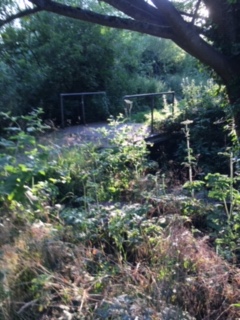
Leave the badger by the path in the wood, move it, bury it? Clear it up, and the pattern shifts: do we intrude by trying to make sense or enter the dance? Write about the history of Warneford Meadow in an effort to explain these scrubby trees to one side in what is grandly called a wildlife corridor? Look (as Paul Kingsnorth does in his essay on Burnham Beeches in Arboreal) at the networks of mycelial threads even here? Maybe seeing it is our part in the pattern? I confess that, in reading these books, I have been feeling elated and dismayed, disepmowered and propelled to try and and understand. And if we don’t try, then, bleakly as one character finds
All that’s left to sell up here is nostalgia.
All we have left is commodification, where even story is no longer an invitation to greater understanding but simply the cheap tricks of landscape depiction, a collection of backdrops and no more.
Arboreal, Common Ground, Underland, The Overstory and so much magnificent writing all stand as a challenge.
Turn but a stone and start a wing
or miss the many-splendoured thing?
_____________
*As a diversion: To me Lewis’ That Hideous Strength is a book at once of its time and horrifyingly prescient in its vision of popularist seizing of media and power that is accompanied by radical and appalling dehumanisation. I admire some bits (the almost-not-there Institute Director who roams the corridors: every academic has known him), I love others (the discussion between Merlin and the C20th academic who has to bring him up to date), and have to say I wince at others – not least the final paragraphs). Of its time is a periphrasis or maybe euphemism for the fact that it is all terribly clubbable, Oxbridgy stuff with a deep theology of sexism thrown in… So why the re-read?
 Anna from Home Start has been kind enough to let me reuse the pictures she took, and I’m vain enough to have picked this photo. “You’ve got your gob open,” was the immediate family comment. Yes, I have: it is at once in the same tradition and a long way from all those MSS of the medieval Magister spouting in a lecture. I was reminded sharply while I was working with their volunteers of the story in Kevin Crossley-Holland and Jill Paton Walsh’s
 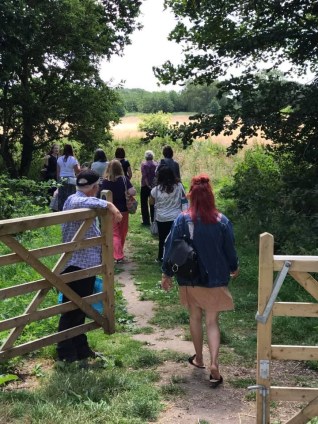 tory is not all that happens outside. The very experience itself affords the chance to chat, to wander, to find a new way or a new place – and this is the problem with story as outdoor pedagogy: it is still too close to the teacher-as-Master. Again, this was something we discussed, and I confessed how hard I find it not to jump in and explain: this is called n…; that x is brilliant because it smells like… While there is clearly a place for “the naming of parts,” for the acquisition of agreed names, there must also be time for independent discovery, for the friend who brings you an egg-shell they have found, for the ladybird on the hand, the sound of the wind in the grass, or even, simply – as one of the people I was with pointed out – that not all grass in green. Warneford Meadow lived up to my praise of it: the grasses were purple and tawny-gold.

 the wild wood as evening closes in. More modern writers have given us some great examples of snowy landscapes and confronting death: Philip Pullman works the theme extremely well in
  I love the idea of children being outside; I am unhappy when schools are elbowed into making sure children do this, that or the other outside the school day. We are told – and it already seems a bit defensive to highlight this in
 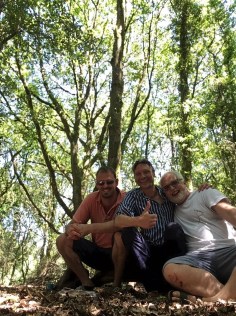 have sat in a local copse with a couple of mates and a beer… And this is all without mentioning my passion for exploring children’s literature and how it can represent the
  nicktomjoe