Dipping for Meanings

I presented the work of Geoffrey Bache Smith earlier this week, and I was wondering about who I might look at among other poets and writers of various kinds that explore their environment. Other poets? OK: I was browsing Mary Oliver’s second volume I came across this poem. No less plangent than Bache Smith in many ways, and with a great, straightforward look at a little bird she saw so long ago. Some thoughts follow, but the poem really does say it without my squawking.

Dipper

Once I saw

in a quick-falling, white-veined stream,

among the leafed islands of the wet rocks,

a small bird, and knew it

from the pages of a book; it was

the dipper, and dipping he was,

as well as, sometimes, on a rock-peak, starting up

the clear, strong pipe of his voice; at this,

there being no words to transcribe, I had to

bend forward, as it were,

into his frame of mind, catching

everything I could in the tone,

cadence, sweetness, and briskness

of his affirmative report.

Though not by words, it was

more than satisfactory way to the

bridge of understanding.  This happened

in Colorado

more than half a century ago –

more certainly, than half my lifetime ago –

and, just as certainly, he has been sleeping for decades

in the leaves besides the stream,

his crumble of white bones, his curl of flesh

comfortable even so.

And still I hear him –  

and whenever I open the ponderous book of riddles

he sits with his black feet hooked to the page,

his eyes cheerful, still burning with water-love –

and thus the world is full of leaves and feathers,

and comfort, and instruction. I do not even remember

your name, great river,

but since that hour I have lived

simply,

in the joy of the body as full and clear

as falling water; the pleasures of the mind

like a dark bird dipping in and out, tasting and singing.

And the first thing I wanted to note was that WordPress – measuring characters and words alone – says that this poem will take a minute to read. Scan down that, highlight a bit, move on. If I’m honest, Morning Prayer was a lot like that today. Did I actually say the Benedictus? I remember when I was seventeen (in the 70s) assisting at an old rite Mass – what would now be called the Extraordinary Form – where the priest got through the whole liturgy in ten minutes: a liturgical patter song I found it hard to keep up with. Such, perhaps, is familiarity, or maybe such is reading until we fine-tune that as something that is reading for the deepest meanings possible.

And with Dipper there are two I want to think about.

The first is MO’s choices of image and words. She is a writer who is wildly in love with each day’s inventions (“Of What Surrounds Me”) and who looks – as in Dipper – for the moment that excites the human response: gratefulness, compassion. One of her most popular poems, “Why I Wake Early” is, like Dipper, of this kind: a noticing of a something; a realisation of the importance of that event; an answer from the writer, and similarly the poem “Wild Geese” – with the line You do not have to be good which first brought her to my scattered attention – and “Landscape,” quoted here, where the crows as seen as realsiing thier dreams as they break off from the rest of the darkness/ and burst up into the sky. She challenges with these perceptions of natural events; the reader is confronted with the suggestion, the question sometimes, of how to seize the world with the same freshness as a grasshopper, or a bird.

Even this cannot be read quickly, or if it is skimmed through – I find I cannot read more than a couple before I “feel full” – I find I miss the impact of these sermons from nature, even from lines like these, from “When Death Comes.”:

I don’t want to find myself sighing and frightened,

or full of argument.

I don’t want to end up simply having visited this world.
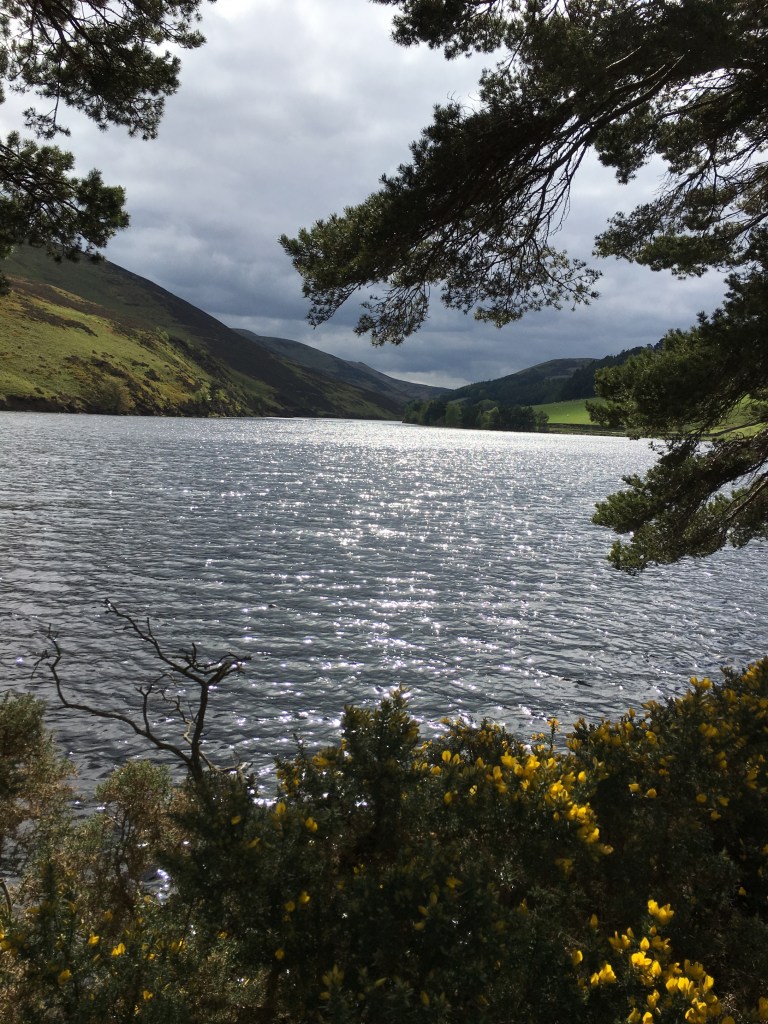
The second is an occurrence which suggests why this poem appeals to me. Visiting my daughter Lizzie in Edinburgh we went on a bus trip to Penicuik and off into the Pentlands. We saw a Dipper. I had known them since I took the Tell Me Why magazine in the 60s; I had seen them in Scotland once before. This, however, was a chance to sit and watch as the little bird zipped about and hopped in and out of a little burn just below the reservoir. I now recognise, having read the Mary Oliver poem above, those attributes of sweetness, and briskness she writes about. Slow watching of a bird – slow reading of a poem – the appreciation of the poem having observed the bird – the reading of the poem enlightening the memory of the bird: a virtuous circle in which understanding of the natural event and the reading of the poem are mutually supportive.

And then what about these Mary Oliver challenges to live life to the full? How does this first yes not negate a whole load of other choices? How do we distentangle “what comes with the package” from other choices we just let happen when we make a choice for A rather than B? Choices I made in my teens or twenties have implications even today, and life in my sixties seems just as precious but carries with it the ache of mistaken choices, baggage of all sorts. Hard not to feel like this at the moment: all those pre-lockdown times I went to a Garden Centre rather than out onto the hills – but then how would the allotment have been dug? I suspect Mary Oliver would suggest we look over the shoulder of such anxieties to the dippers and heron and crickets, or the jay as I dig, or Mat’s discovery on our trip of a Bloody Nosed Beetle?

Another final set of lines, then, from Mary Oliver, from “The Summer Day:”

Doesn’t everything die and last, and too soon?

Tell me, what is it you plan to do

with your one wild and precious life?

But it is a Summer morning, and maybe I need to do more than write about it.
Next year in…

The wish for restoration in the Passover Seder “Next year in Jerusalem” was poignant this year. Where will we be when the words are next used at the end of September? There is a great desire for a new dawn, a new day, but looking at the political landscape I can see bigotry and mauvaise foi, and I cannot see the wide spread of justice like an everflowing stream that so many of us desire. Utopias are precisely that: places that are ou-topoi, no-places. The British Library, in its excellent trail through the literature, explores a possible play on words between eutopia, a good place, and utopia, asking “Can a perfect world ever be realised?”

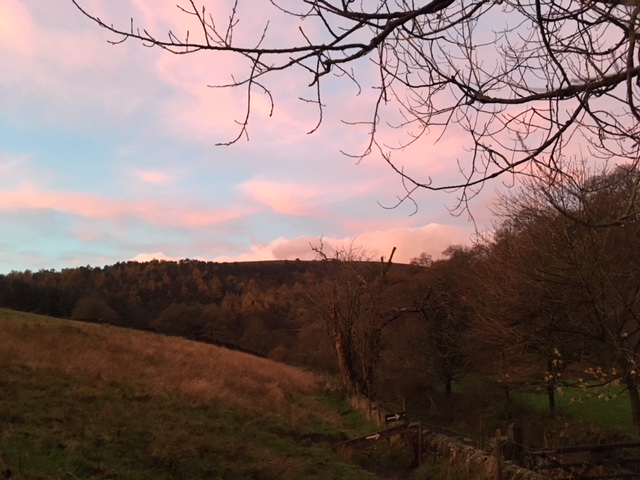
If, as Kathleen Jamie suggests of St Kilda, “their way of life broke on the wheel of the modern world,” it may be that this also signals how little validity there is in the harking-back of current political rhetoric. The eutopias of the past are Ealing Studio films (Comedies?) only: ou-topias. However, it’s possible to find personal places in a “when and where were you happiest?” sort of way. In Looking in the Distance, Richard Holloway is at his most plangent as he describes his “fierce and sorrowful anger” on a return to his old theological college: We know that nothing lasts yet the sudden awareness of our own finitude can surprise us into grief… But not always grief: they can be places of beauty and joy. The woods in Spring and Autumn above Nettlebed with Maggie might be such a place for me. Iconic for me (as anyone who has read back in my posts) is the visit just before we were were asked to stay home when Mat Tobin and I went to Uffington, the memory of which has sustained me when I have felt miserable during lockdown. Aberlady, Gradbach, Wychwood, Nettlebed… all sorts of places can do this, and can be the cloud of witnesses that surround us on a grey day or in a time of confinement. Here is a collage of photos of such places – places that are some of my eutopoi:

I notice how selective I am when choosing these photos: the hill of Ludchurch, Aberlady Bay, Uffington, the Lye Valley: outdoors places rather than, say, the churches of Rosslyn, Cordoba or Durham, or the Bodleian, or Magdalen.

These eutopoi suggest something about where I feel wholeness. However, I look at these airy, quiet places and see they are not the places I am regularly: the kitchen; the allotment; my preferred social media platforms… They are outdoors, rural or semirural heterotopias, where difference is key. I am often accompanied by people dear to me: I experience both the Kaplan’s notion of escape and a social aspect that I think is connected – for me – to their idea of fascination (the link here takes you to one of my explorations of their work). These good places might be a delight of solitude, but often for me have a human presence, a human perspective to them – but it is easy (maybe – under normal circumstances, at least), to pick a friend and go somewhere like this. The “human aspect” of fascination is about a compatible voice, a hand to hold.

So when I look to wholeness, wellness, I have to ask what the human aspect actually is. It’s a tough question when dealing with mental health, not just because, thrown on our own resources I come back time and again to my own mental health, but to a bigger question about “When This Is All Over:” what will wellbeing be like? I hope it will include pubs, hugs, time together, as well as all the bigger societal things, but thinking personally (and irrespective of the broader political machinations particularly) here I am struck by a suggestion from Jon Reid on Twitter today that has brought me right back to the present, a brilliantly simple humanistic examen that asks us to identify:

  • Three ways I have looked after and cared for myself and
  • Three ways I have looked after and cared for others

It is really tempting to see September (or January or 2022 or even the next scheduled General Election) as a time when everyone will vote for a humanity-based society where peace and justice take into account the needs of the most vulnerable, where society is a seen as a whole entity, full of interconnections and mutual dependencies, where truth is embedded in politics more than vote-grabbing, where care workers are paid properly… and yet I don’t believe it will come. So let’s take the “next year” wish and (to nick an idea wholesale from William Blake – but he is not alone in wishing it) build our own places of wellbeing and belonging, around three daily occurrences of self care and three of care for others. It will be up to us to kindle that hope into something bigger.

It is a start at least. Each pool of light might connect with others.

Escape, extent and serendipity

There was a time long ago – say, last Sunday afternoon – when nipping off for a run seemed easy and natural. And on Monday, when Jeff and I went for a walk – well, it seemed a normal thing. Bloke. Dog. Biscuits. Sunshine. The political clouds of isolation and the warning that people had to be more responsible were looming, but dogs gotta walk, and man’s gotta be sensible about “social isolation.” That seemed about it.

Jeff the dog and I went to South Park and Warneford Meadow. We got muddy, he more than I, we looked at the various corvids and the people playing basketball, he ate dog biscuits and I didn’t, and we were sensible about keeping ourselves to ourselves. We didn’t do the reckless “last weekend before we have to be indoors” congregating, but yes, it seemed that keeping to guidelines was easy. A new politeness was emerging around how far apart we needed to be from people we passed, it’s true, but in any case they weren’t people either of us knew, not even nodding acquaintances. A quick chat with the basketballers a good 4m away and then we moved on. We got closer to magpies, to be honest. Three for a girl, if I remember rightly.

Only with yesterday evening’s pronouncements did that mood really change, and I think in retrospect we pushed it a bit. Maybe it was my day’s exercise. It will have to stand as such.

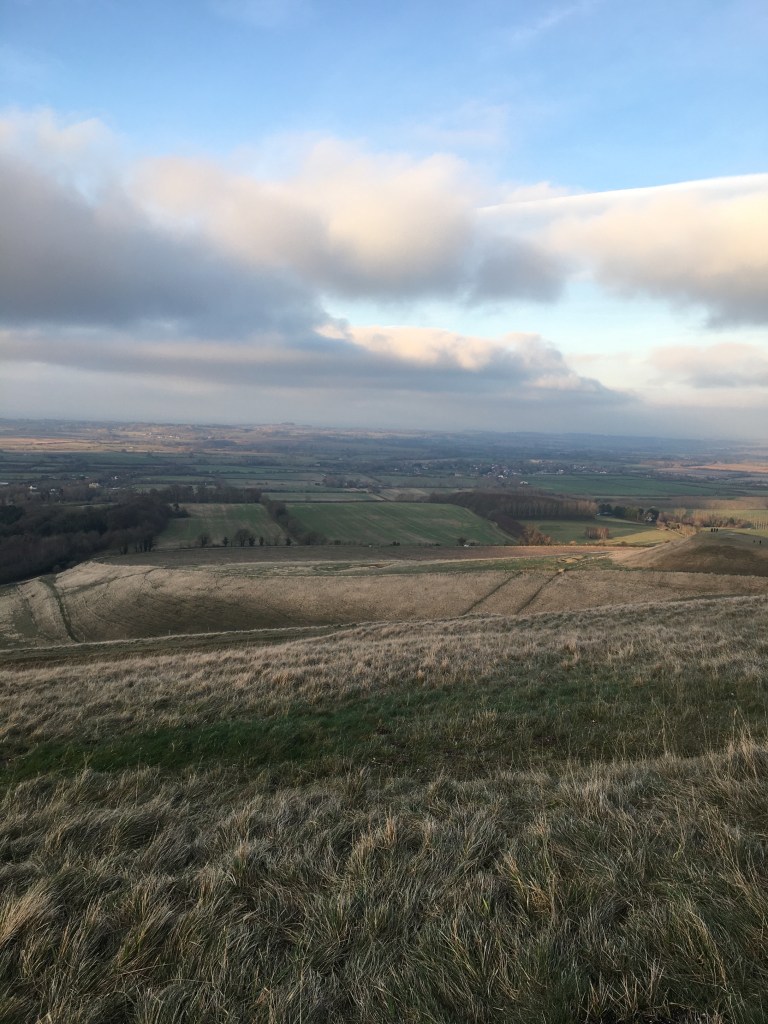
Wind back a week and I am with Mat high on the Downs, and you could not wish for a lovelier day. Sunny again, breezy, a sharp-eyed, sharp-minded kestrel of a good friend, everything bright and fair. As I discussed here, human relation to place is, for Robert Mcfarlane, grounded in language; but language is itself grounded in relationship. I’m coming back to this.

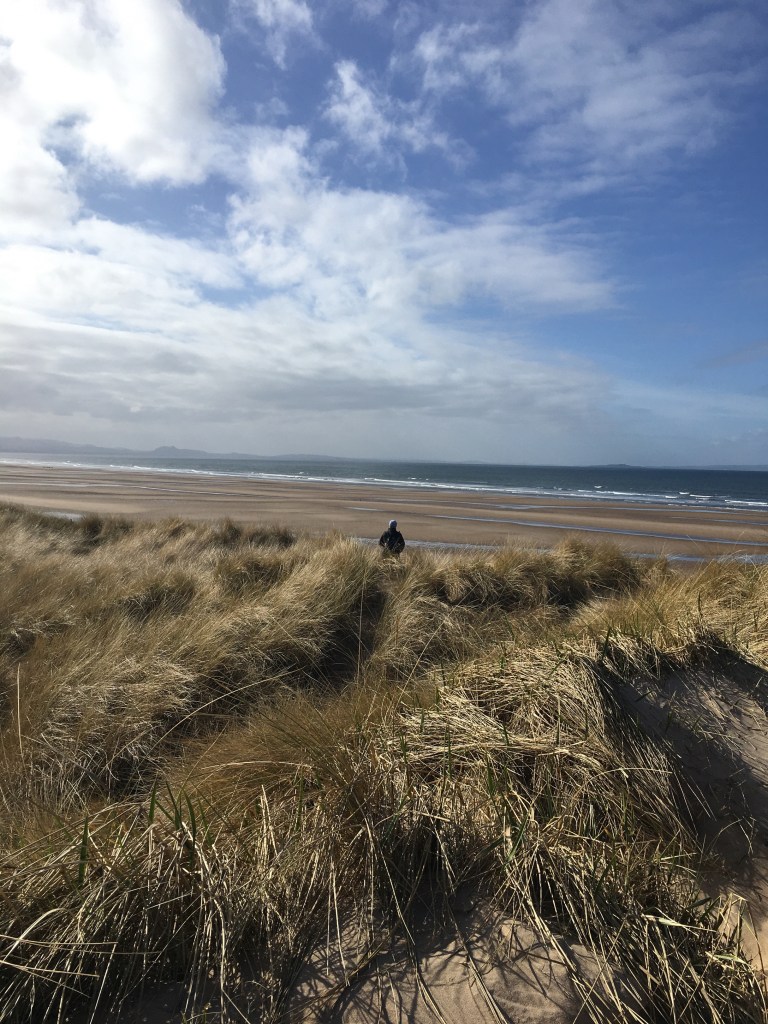
Back to the Friday before and Lizzie, Maggie and I walk through the Aberlady nature reserve and across the beach to Gullane. A bright sun, a brisk wind. Family enjoying one another’s company.

But these are not excuses to show snapshots. What is it that gave these trips significance? Why feel better after them? They both lacked the challenge of Rob Macfarlane’s exploration of the treacherous Broomway or even the experience of our face-to-face encounter at Ludchurch. What is it that some trips into the outdoors bring? and how do we represent that in time and place without it being, like these photos, just a grown-up version of What I did on My Holidays?

The absolutely seminal book on the psychology of the outdoors for me is the 1989 book The Experience of Nature, by Rachel and Stephen Kaplan. In it, they explore dimensions that may provide a framework for how “nature” helps and supports psychological wellbeing. Extent; fascination; action and compatibility. Because their work looks to the “wilderness” they address the nation of escape as well, which they view with some caution because it has in it “an absence of some aspect of life that is ordinarily present and presumably not always preferred.” I can see their point, but given that it is early work (thirty years ago) and has been superseded in many ways (partly by the new nature writing itself), I want to raise the question of escape with someone. Here, further off on the Aberlady sand dune, is Maggie; Mat not only drove the two of us to Uffington, his insights enriched our visit. We are “political animals” – not because we are forever tuned into the depressing power games (or, if you like, selfless and inspirational leadership) that cram our news until we cannot see what’s actually happening – but because we are defined by how we live in the company of others. I go out on my own but with me come meetings to have, people I want to see (or don’t), ideas to bounce off others. I bring the city with me. And similarly I contend that a visit to Uffington means I am “with” (metaphorically) Rosemary Sutcliff, or that to go to Ludchurch “with” Alan Garner is not to travel alone. In some ways, the accompanying author or characters provide what the Kaplans call action and compatibility, and of course are the spur to action via the notion of fascination. We go “Backpacking with the Saints” according to Belden Lane (article here; link to the [excellent] book is here. Name the saints that come with you.

Lane, a “scholar in recovery” takes with him insights from the Desert Monastics and “a few lines of Rumi” and is wedded to the silence that wilderness can bring. Not as far into my recovery I have taken Gawain, most recently Sun Horse Moon Horse and the Land of the White Horse. Somewhere in my mental backpack are lines and vistas from writers such as Robert Macfarlane, C S Lewis, Oliver Rackham…. This isn’t a boast: I sometimes wonder whether I could leave them in the car. Would this then be more of an escape, or given the liberating nature of some of this writing, less of one? And what about extent? Do we need the wide open wilderness of the Ozarks are we OK with the view from the White Horse down into the farmlands of Oxfordshire and Wiltshire? I think of Aberlady, where I have no literary baggage to bring: an escape, as the Kaplans would see it from particular content, “a rest from pursuing certain purposes.” I wonder if writing about his wilderness hikes took the edge off the experience from Beldin Lane…

But for the trips that fall under the Wild Spaces Wild Magic umbrella I really have to take the authors firmly in my hand and my mind: last week for example I was reading the episode of Lubrin Dhu’s planning of the White Horse from Rosemary Sutcliff and looking for where she might have sited the Wych Elm. She comes with me and by extension the characters she calls into being; David Miles comes with me – my copy of his book has a smudge of Uffington soil on the page of his site plan (p101, if you’re interested); Mat of course comes with me. Identifying where this Wych Elm might have been, we find some wild apple trees by chance and wonder: are these the inspiration for the sacred apple trees in Sun Horse Moon Horse?

Social aspects of serendipity (see for example Morrissey’s “An autoethnographic inquiry into the role of serendipity in becoming a teacher educator/researcher,” International Journal of Qualitative Studies in Education, 2014) seem to me to work alongside the changeability of being outside. Less is in the enquirers’ control, expectations have to change. Two pairs of eyes are able (sometimes) to be more alert to these changes: sagacity (Morrissey again) enhances serendipity but are two heads better than one? If we are aware of the dangers of shoring up each other’s ideas, might collaboration, like identifying mistakes (Morrissey) “also uncover for the researcher… fears, preconceptions or beliefs …of which he/she had hitherto been unaware”?

And if we are accompanied by the cloud of witnesses from literature – such as nature writers and their places, fiction writers and their characters – then we might address two notions (or one single notion with two aspects? I’m not sure as I write) of psychogeography and autoethnography. How much, in other words, does setting (in its broadest sense) and personal history of setting enhance or detract from personal reading of landscape? I am conscious of the dilemmas where Dyson writes “In recognising that I was a subject and an object of the research I realised that at the same time I was and could be both an insider and an outsider within the culture that I was investigating.” (From his article My Story in a Profession of Stories: Auto Ethnography – an Empowering Methodology for Educators, https://ro.ecu.edu.au/ajte/ 2007). I rejoice in being on the Downs with Mat; I am very glad we have purpose in a book I love; I am exhilarated in the chill breeze and bright sun. To change from his journey metaphor to one of wind or water, being the reader and a colleague in an investigating team involves recognising how all sorts of things flow over one another: the reader and her/his history; the researcher and her/his concerns and limitations; the authors under investigation, their sources, their motives, their depiction of place and character; and being a research partner multiplies these complexities. For me this links with Rob Macfarlane’s lines from his introduction to The Living Mountain:

…the world itself is therefore not the unchanging object…but instead endlessly relational. It is made manifest only by only by presenting itself to a variety of views, and our perception of it is made possible by our bodies and their sensory-motor functions… We have come increasingly to forget that our minds are shaped by the bodily experience of being in the world – its spaces, textures, sounds, smells and habits…

We are human, language-loving and people-loving; we are also placed: physically located on a windy ridge above a deserted farmhouse in the Peak district, or searching for a tree that may never have been at the foot of the Downs.

To conclude with Belden Lane, who may be close to an answer here (I know I’m not): The Spanish philosopher Ortega y Gasset once said, Tell me the place where you live, and I’ll tell you who you are. I think he also could have said, Tell me the place to which you are drawn, and I’ll tell you who you are becoming. 

Frogs are Nothing Fancy

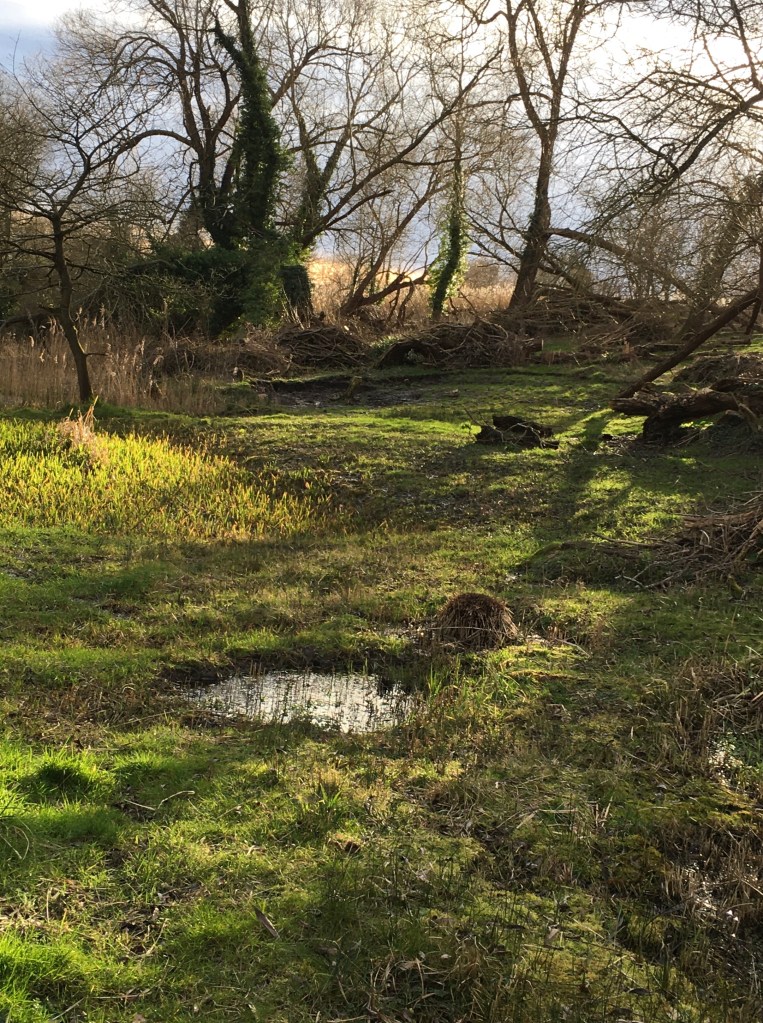
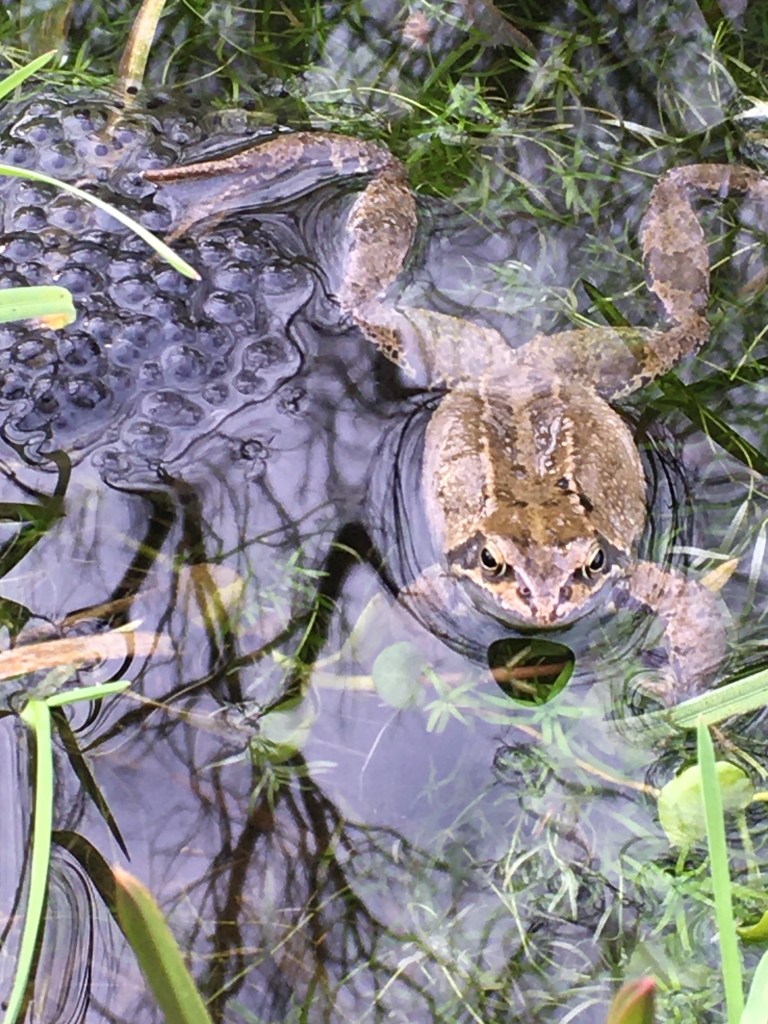
Except in some ways they are. They were today, down in the Lye Valley. In among the “warm thick slobber/of frogspawn that grew like clotted water” as Seamus Heaney puts it, were maybe a hundred frogs. Alerted by a notice from social media, I took Ivy, keen and energetic to see the frogs spawning in the fenny ponds near our house.

They weren’t Heaney’s “slime kings,” “their blunt heads farting,” but a congregation of animals, a welcome sign of spring on a warm afternoon. Not coarse, and not apocalyptic, just frogs: welcome, exuberantly sexual and productive. One watched us carefully as she sat in her grey cloud of eggs, her sides heaving; others climbed, swam, grabbed, and croaked like a distant motorbike starting up.

My immediate thought is that Bashō has it right: keep to the bare thing itself (a nice explanation of Bashō’s famous frog haiku and some translations are to be found here; more, with Zen comments, here) in a few terse lines: eschew the grandiose. Today at Mass, the preacher interrupted his own flow to correct his phrasing around a (very good) point of his sermon on Christology and spirituality and say “O dear, what pretentious twaddle!” – and perhaps Bashō does better with his short invitation to join him by the pond.

Continue reading “Frogs are Nothing Fancy”

Sword-grey sky, daffodil light

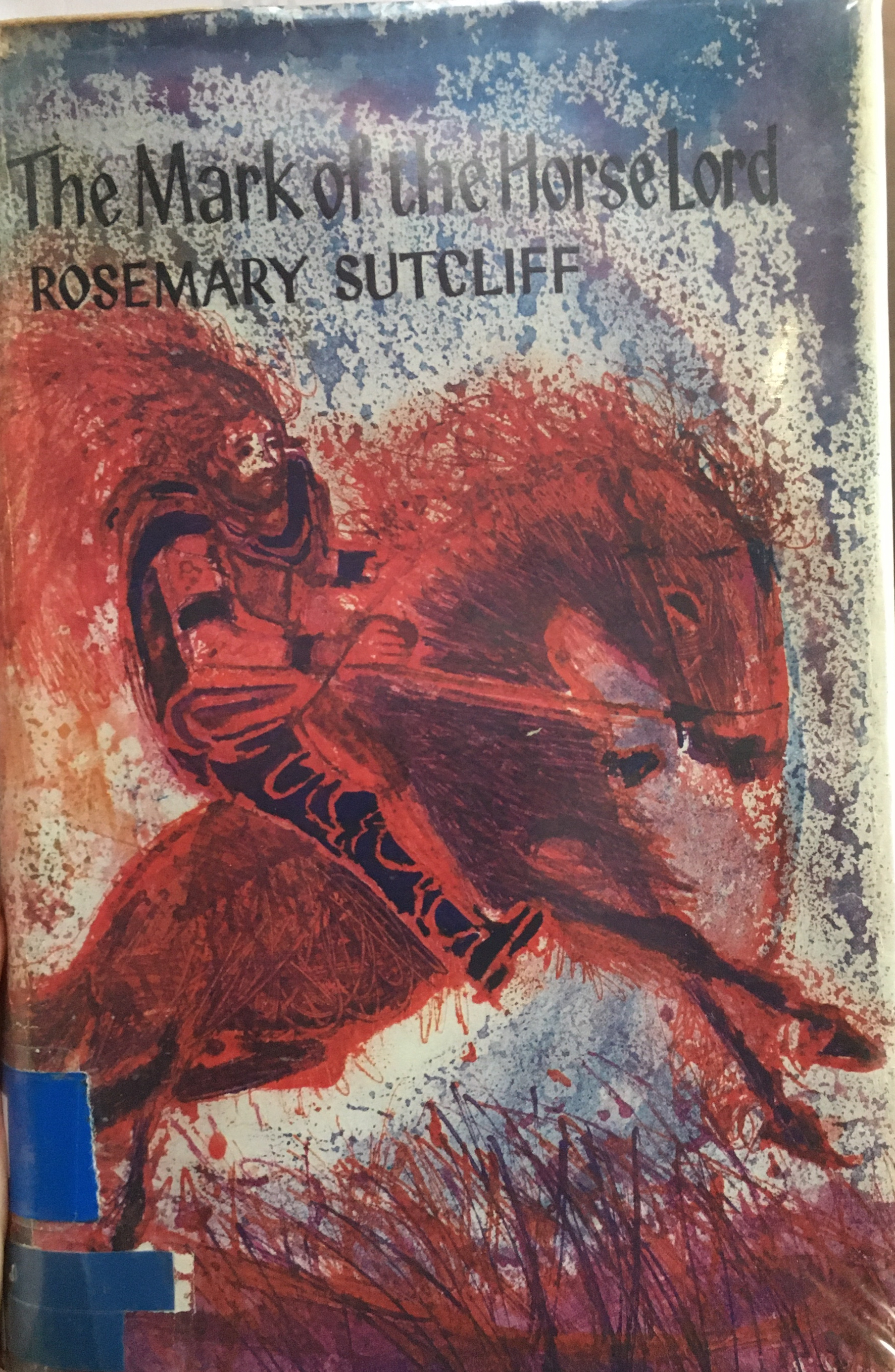
To do no more this morning than record this astonishing section from Rosemary Sutcliff’s Mark of the Horse Lord. The protagonist, newly made king of the peoples of what we might describe as Western Scotland, Red Phaedrus, img_2217
is out to catch the woman appointed as his wife. These are horse-people, as the book’s title suggests, and this rough “courtship” (here as in the Lantern Bearers Sutcliff does not shy away from the nature of marriage and being given in marriage and its impact on woman) is the bridgegroom’s chase after his bride. They are both mounted, and she has a head start as the groom’s party pursue her through the country of the Dál Riata.  Just look at this amazing use of colour and shade, and how Sutcliff anchors this in the landscape features – the whirlpool of the Old Woman, the mountain of Cruachan she has already introduced us to in map and in narrative.

The track was pulling up now, out of the great flats of Mhoin Mhor, and the quarry, striking away from it, was making north-eastward for the hills around Loch Abha head. And the wild hunt swept after her, hooves drumming through the blackened heather, skirting little tarns that reflected the sword-grey sky, startling the green plover from the pasture clearings. Far over to the west the clouds were breaking as they came up into the hills, and a bar of sodden daffodil light was broadening beyond the Island, casting an oily gleam over the wicked swirling water of the Old Woman, while away and northward, the high snows of Cruachan caught the westering beams and shone out sour-white against the storm-clouds dark behind.

Gifts Reserved for Age?

A storm was gathering yesterday that has hit us good and proper today. I had been for a walk and a coffee and came out from the pub to see the lights on in St Andrews across the way. Evening Prayer time in a warm, quiet, dark church.

And when I got home I looked up the words from T S Eliot because, I wanted, I suppose, some more of that sense of contemplation that Eliot tries for:

So, while the light fails
On a winter’s afternoon, in a secluded chapel,
History is now and England…

The aesthetic pathway of spirituality may be cultural, maybe victim to changing fashions or simply growing up, but it is not to be forgotten: it creates the thin places, or sharpens the senses to see those places where prayer has been valid, where the other and the now meet. Thin places. In the church the silent near-dark was stunning, and all those poems from all those Thomases,   Thomas Merton and R S Thomas and T S Eliot (not to mention Dylan Thomas’ “close and holy darkness”) were somehow at my elbow. And maybe the incense smudge of a memory of the church when I was a child, after Compline and Benediction, or the quiet of Magdalen after Night Prayer…
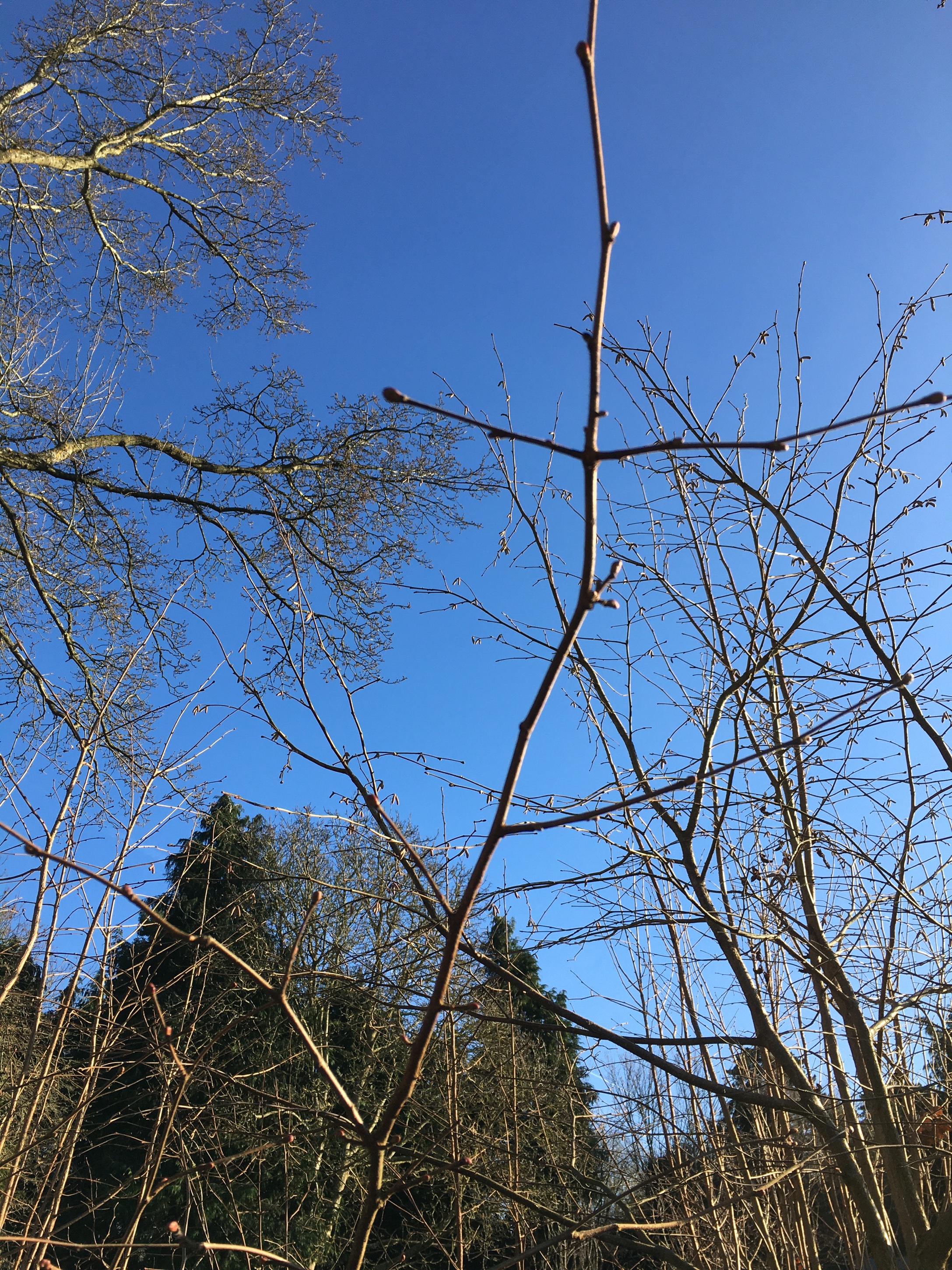
But tonight it is different, and the blustery grey has been superseded by a Wild Hunt of a storm. Time then to go back in my mind to another thin place, to the little, basic cottage on the North York moors where this poem from Kathleen Raine was posted up by a previous inhabitant, and said so much about a keener, wilder, maybe more dangerous spirituality. I have cited it before.

Let in the wind,
Let in the rain,
Let in the moors tonight,
The storm beats on my window-pane,
Night stands at my bed-foot,
Let in the fear,
Let in the pain,
Let in the trees that toss and groan,
Let in the north tonight.

Let in the nameless formless power
That beats upon my door,
Let in the ice, let in the snow,
The banshee howling on the moor,
The bracken-bush on the bleak hillside,
Let in the dead tonight.

The whistling ghost behind the dyke,
The dead that rot in the mire,
Let in the thronging ancestors,
The unfilled desire,
Let in the wraith of the dead earl,
Let in the dead tonight.

Let in the cold,
Let in the wet,
Let in the loneliness,
Let in the quick,
Let in the dead,
Let in the unpeopled skies.

Oh how can virgin fingers weave
A covering for the void,
How can my fearful heart conceive
Gigantic solitude?
How can a house so small contain
A company so great?
Let in the dark,
Let in the dead,
Let in your love tonight.
Let in the snow that numbs the grave,
Let in the acorn-tree,
The mountain stream and mountain stone,
Let in the bitter sea.

Fearful is my virgin heart
And frail my virgin form,
And must I then take pity on
The raging of the storm
That rose up from the great abyss
Before the earth was made,
That pours the stars in cataracts
And shakes this violent world?

Let in the fire,
Let in the power,
Let in the invading might.

Gentle must my fingers be
And pitiful my heart
Since I must bind in human form
A living power so great,
A living impulse great and wild
That cries about my house
With all the violence of desire
Desiring this my peace.

Inosculation

Just sometimes a day in January makes me want to believe in spring.  A chilly day down the allotment – should have been the morning but we pressed on – and my task was to finish some hazel coppicing. img_1988Well, actually my task was to tidy the absolute dog’s breakfast I had made of the hazel I had undertaken to coppice on some communal land to one side of the plots. Hacking with a billhook like William Ager had been immensely satisfying but really untidy; a mixture of billhook, bowsaw and ordinary handsaw meant I managed better. At least occupied with coppicing there was was no diggin’ to be done in the claggy soil.

Two rods stand tall on one hazel stool, and turn round each other. At one point they meet, touch and begin a process of fusing together known as inosculation, a joining together: the term has its root in the Latin word for kissing. I am, because of how my mind works, really quite moved by the metaphor – but recognise that I need to get to work. The two rods have, I guess, been working at this for years, but now I need to get cutting. I sort of hope that I can cut the fusion out as a whole piece (but in the end I can’t)… but the time the hazel has taken and the time it takes my saw to undo the fusion seem out of all proportion.
Old man on an allotment hazel stand: hardly great forestry or John Seymour-like land management. Forest School is not survival training; allotmenting is not farming. But once in a while, what we potter about at is something that is in the shadows of a bigger husbandry and a longer history: the stone axe; the horse, the enclosures.  And the kissing metaphor makes me think of so many nature writers’ respect and tenderness for the landscapes they represent. So when I come home, thinking of how this work is explored, I look at various texts. Edward Parnell’s exploring of the ghostlands of literature and his own biography; Thomas Merton’s monks whose “saws sing holy sonnets;” the changing and unchanging downs of the White Horse in David Miles’ book… and then into other writers on my shelves, where I am struck by this:

What a bare desert of a place the world would be without its woods and trees. How long would man live once he had broken the balance.

Ian Niall, in Fresh Woods and Pastures New (Little Toller did one with lovely illustrations by Barbara Greg) is keen eyed and dreadfully prescient about deforestation.

When he cuts down the planting, the copse, the old oak wood, it takes him a little while to see that the drainage is different, that the soil washing into the hollow, and new crops of rock are in his field. The lumbermen come and haul away the timber and every yard of the fields on either side changes in nature, new weeds, new grasses, more sun, less humus, water-logged drains in wet weather, overflowing ditches. A year or two, and the man sees what he has done, but how long must he wait to see it as it once was?

Believing in spring feels easy on a chill, bright January day: believing in a world where we can find ways to harvest from the earth when it looks like the Anthropocene crisis is upon us in the Amazon, Jakarta and Australia feels a lot harder. “Man sees what he has done:” but can we step back from it, somehow? Can we realise our need to reconnect, to re-fuse with the world we live in?

Carnival chaos

To recap some of my thoughts about Hallowe’en. The use of such conquering fear of the dark activities seems to me pretty obvious:

winter nights enlarge/The number of their hours

and we can make the best of it by smiling at the dark. Thomas Campion‘s lyrics have it just right, and youthful revels have their place in the honey love of the closing-in evenings.

The pro and con tensions in part arise from the abuses these revels engender. “Psychos” and “Slutty Vampires” sit uncomfortably with my English folk-horror. Yet they’re not wholly American: Trick or Treat at least has an element of bargaining amid the demanding money with menaces, unlike much of its ancestor, Mischief Night, whose joys seem vengeful or gleefully malign. A door latch has a drawing pin attached to it with dog poo, so the unwary person who pricks his thumb goes at once to suck it… a sooty chicken is induced to cause havoc at a WI meeting…

Yes, these are both occurrences from North Yorkshire I’ve been told about.  They are the same Carnival as the Big Skeleton, the Little Skeleton and the Dog Skeleton go in for as they riot their way home in Funnybones, or the menacing pumpkin head that gets its comeuppance in the story of the hopping pumpkin  who meets an ignominious end with a goat (this is a link to a longer text than the one I tell).  But the Carnival is there because we are at a sort of seasonal fault-line, where summer’s lease is up and the dark is at the door.

There is a sense for me that this big change is the Autumn answer to May Day. The nights close in, the socialisation is indoors, defined, more visible, with the freedoms of warmer weather lost or at least traded for friends and firesides.  When C S Lewis envisages this in the hearts of his heroes in That Hideous Strength they think of

…stiff grass, hen-roosts, dark places in the middle of woods, graves. Then of the Sun’s dying, the Earth gripped, suffocated, in airless cold, the black sky lit only with stars.

No mischief or carnival here s we stare into the dark.  Mischief, however, is close friends with these shadows and darkness, of the almost-known, the footsteps partly recognised. It is the younger sibling of more menace, and this is partly why it is disquieting: does it licence the bully, the vandal? In looking into the shadows, does it, as Kathleen Raine so evocatively puts it:

Let in the dark,

Let in the dead…

(Northumbrian Sequence IV is cited in extenso here in my post about poetry and spirituality)?

It seems to me that this week or so – Hallowe’en to Remembrance/Martinmas – is a real blending of a gleeful naughtiness, the swede or pumpkin lantern and the restlessness of wind and dark, wet evenings, as the chaos of Carnival mimics and mocks – and presages – the chaos and pain of the storms of winter and death, “þis andwearde lif manna on eorðan” “Talis vita hominum praesens in terris…”

So when we smile at the shadows when we look at books for (and with) children, how do we approach death and disaster?  The too-brief nod recently to the BBC adaptation of Phillip Pullman’s His Dark Materials asks about the Beeb’s decisions to show it pre-watershed. We might similarly ask about Erlbruch’s Death, Duck and Tulip, that strange and lovely meditation on the role of death in our lives – or Thummler’s Sheets, or McCaughrean’s Where the World Ends, or Ness’ A Monster Calls…  In fact, although the list isn’t endless, there are plenty of books that offer wonderful and painful insights as they look at death and pain and loss.

The good writer who perceives a good story need not shy away from the issues; the reader who comes to these texts comes prepared for challenge, maybe for tears – but trusts the writer to deliver something that will bring them safely to shore. Raine puts it well when she suggests that in our innocence it is still within us to

bind in human form
A living power so great,
A living impulse great and wild

and (for me the subtlest line)

Have pity on the raven’s cry


Robin

It’s National Poetry Day and I’m clearing old woody clippings from an allotment that is, thanks to Rosa, coming back to life like something in Frances Hodgson Burnett. As with yesterday’s digging, I am accompanied by a robin. It is friendly enough to allow me to photograph it from close up. I love its jet-jewel eye and the way its chest moves as a bubbling song comes from somewhere in its tiny body. I love its daring proximity – it flies so close at one point, a wing brushes my leg.
Its closeness and seeming trust mean I am able to photograph it – but miss the Mafiosi magpies who swoop and bicker close by, and am nowhere near fast enough for the dive of a sparrowhawk as it twists into the trees, after some luckless songbird. After the robin? My little friend?

The theme of this poetry day is truth, and I do wonder how truth exhibits itself – or is exhibited in Nature Writing. There are the monumental and disturbing images from Underland, and the small but detailed work of taxonomy and the science of magnifiers; there is the work from Peter Fiennes on woodland, and the research from Mat about language and landscape – and then there is this robin, and the magpies and the hawk. Guardian nature writing; CaedmonGilbert White; Edgelands and the Shell Country Alphabet: they all bring something to the kaleidoscape that seeks to explore and explain and act as advocate. There is a cloud of witnesses here.

But to think about truth in Nature Writing (why those upper case letters?) and a short poem I was brought back – by that killer robin, terror of the worms I was turning over, and by the sparrowhawk that set the wrens in ear-achingly shrill panic – to the ambiguity of our gaze. The robin as my friend – or as belligerent defender of her/his turf? Sparrowhawk as dangerous thief – or as a beautiful trajectory on an autumn day?

And that gave me the poem for today, a marvel in concise, painterly imagery from Anne Stevenson, and a sharp reminder of the way our truth, our human truth is only ours, not universal:

Gannets Diving

The sea is dark
by virtue of its white lips;
the gannets, white,
by virtue of their dark wings.

Gannet into sea.

Cross the white bolt
with the dark bride.

Act of your name, Lord,
though it does not appear so
to you in the speared fish.


The sparrowhawk didn’t get the robin, by the way.

Corvid, my Corvid

So I was standing in a large auditorium reading the names of people who were being awarded doctorates. There were more than I expected – in fact more and more seem to appear on the sheaf of papers I was reading from. I dropped the papers, and picked them up in any order. The hall kept getting bigger, I kept seeing more people, and the titles of their theses were, over and over, relevant or interesting to me. I mugged my way through the ceremony, trying to make some sense of the papers in front of me. All those people with doctorates and I couldn’t manage to read their names clearly enough.

And then I woke up, woke up with a sense of failure – and remembered that last night I had agreed to sign my withdrawal form from my own doctoral/MPhil experience. I signed it this morning, and the should’ve, could’ve, might’ve shadows make my tasks today – reading more of Hawkes’ A Land in the Bodleian and setting up teaching for the next semester – seem at first glance empty of significance.

But – like all but one of the psalms – I cannot leave it there. The title of my research still holds good: A critical investigation of themes in the depiction of the outdoors environment in young children’s picture books and one of the things reading and reading and thinking Ludchurch duskand talking about this have brought me is a closer look at landscape and the ways people interact with it. It has brought me all sorts of authors and ideas: Macfarlane, Garner, Gawain, Ludchurch;  it continues to allow me to work with and learn from Mat and Roger, to read with joy and understanding, to think  about the pressing issues of our ecological failures, to take pleasure (as well as feel concern) as I look at the world I walk in.
So here is Mary Oliver (of course) in her poem

Landscape

Isn’t it plain the sheets of moss, except that
they have no tongues, could lecture
all day if they wanted about

spiritual patience? Isn’t it clear
the black oaks along the path are standing
as though they were the most fragile of flowers?

Every morning I walk like this around
the pond, thinking: if the doors of my heart
ever close, I am as good as dead.

Every morning, so far, I’m alive. And now
the crows break off from the rest of the darkness
and burst up into the sky – as though

all night they had thought of what they would like
their lives to be, and imagined
their strong, thick wings.

cropped-img_6934

Spiritual patience, and the ambition of crows.


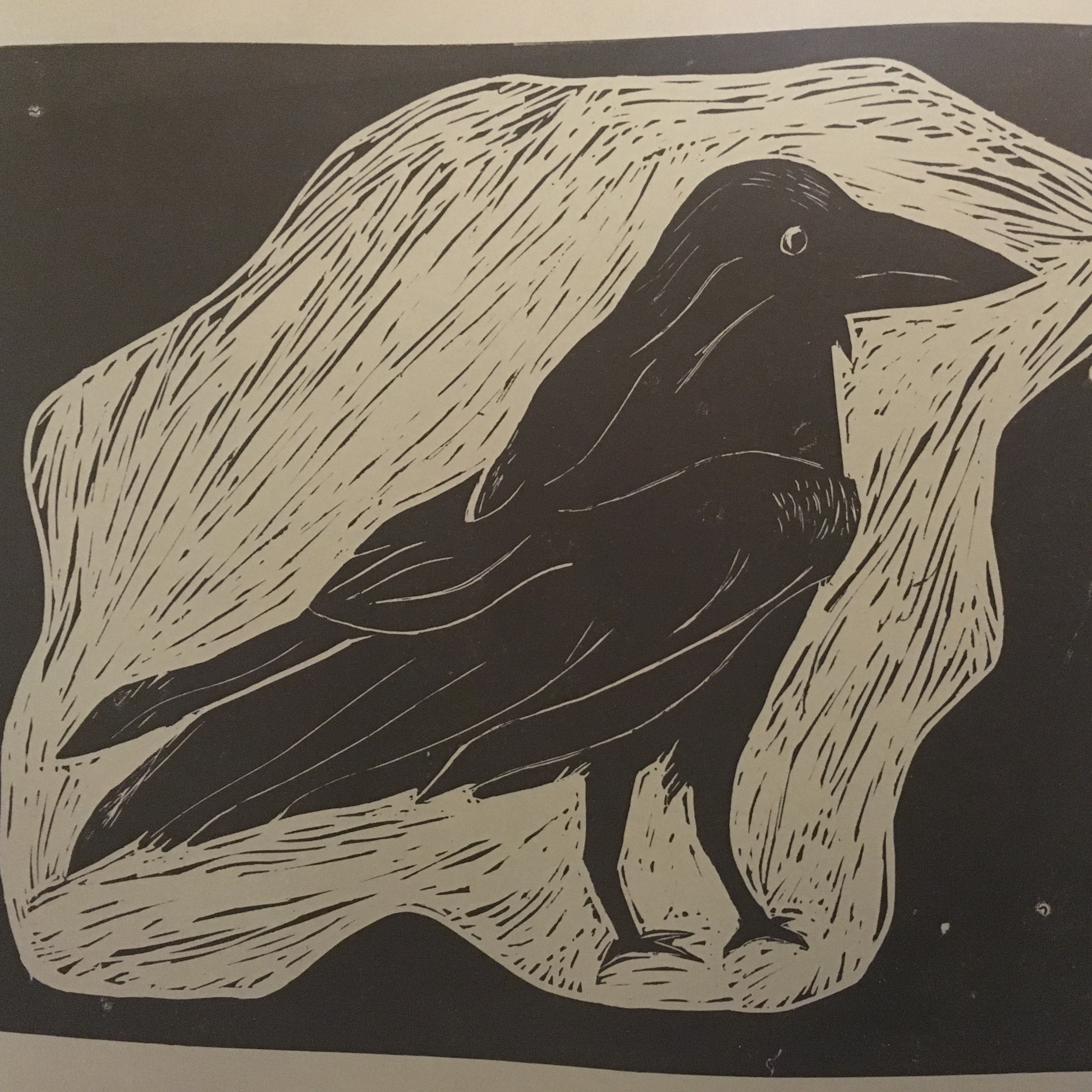
And thank you, Annie, for the raven linocut I’m finishing with. I might want to fly with the wings of eagles, but a keen eyed scavenger with a rude clarion cronk (thanks, Chris!) will do me just fine –

– and is probably just right.