Underland Thoughts I

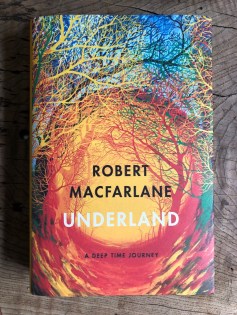
I’m not sure this isn’t really something for a Wild Spaces Wild Magic research page rather than a couple of blog posts, nor am I entirely sure what I can add to the massive work that is Rob Macfarlane’s Underland,  a moving, detailed, Bible Moralisée C66033DA-9011-4149-85C3-F6FC8F658B52that looks at landscape and souterane and human uses for and vision of the spaces we find or create.
Then don’t.

OK, instead I’m going to put together some of the images and lines that give me most to think about, whether in terms of the brilliance of their wordsmithing or because their message is worth pondering.

That’s not to say loads more isn’t wonderful: just go read it and make your mind up yourself.  I’m not copying the book out or appropriating the ideas: mine is an idiosyncratic selection (a bit of commentary may sometimes set a context), a few lines from a massive work that deserves a good slow read.  I said in my initial review on Goodreads how this could be a scripture for our time; perhaps this is my Lectio Divina.

____________

There is a lot to ponder in the opening pages:

I have often noticed how claustrophobia – much more so than vertigo – retains its disturbing power even when being experienced indirectly as narrative or description. p12*

This is the point at which Rob caught me, by moving from this into Garner’s claustrophobic description of the Alderley tunnels in Weirdstone and then into Gilgamesh.

Our ‘flat perspectives’ feel increasingly inadequate to the deep worlds we inhabit, and to the deep time legacies we are leaving. p13

then

…to think in deep time can be a means not of escaping our troubled present, but rather of re-imagining it; countermanding its quick greeds and furies with older, slower stories of making an unmaking. p15

The second chapter, Burial, is set in Britain.

We are often more tender to the dead than to the living, though it is the living who need our tenderness most. p27

It concerns cave-repository of the dead, but also the tragic death of Neil Moss, an early autumn descent in the Mendips to where

Language is crushed p49

Ch 3 moves to the intense research hidden from the noise of particles in Yorkshire, linked in the book to the network of (nearby and further afield, now ruined) Cistercian Abbeys

in which prayers were offered to a presence disinclined to disclose itself to the usual beseechings p67.

R S Thomas’s voice echoing quite literally de profundis, as Rob moves us past the Komodo Dragon-like mining machinery to a discussion of the term Anthropocene, and how we have reached here. This is one of my favourite passages, and will have to stand for so many:

We all carry trace fossils within us – the marks that the dead and the missed leave behind. Handwriting on an envelope; the wear on a wooden step left by footfall; the memory of a familiar gesture by someone gone, repeated so often it has worn its own groove in both air and mind: these are trace fossils too. Sometimes, in fact, all that is left behind by loss is trace – and sometimes empty volume can be easier to hold in the heart than presence itself.  p 79

If someone finds this blog and is wondering what to read at my funeral, that’s the passage.

The wood-wide web, discussed as we explore Epping Forest in Ch 4 is an idea so powerful I am still digesting it. Some beautiful, tender images and amazing ideas. The wonderfully named Merlin Sheldrake, and Rob’s own meditation on roots and language where

The real underland of language is not the roots of single words, but rather the soil of grammar and syntax, where habits of speech and therefore also habits of thought settle and interact over long periods of time. p112

And so on to Paris and the catacombs, for me the most terrifying and claustrophobic exploration in the book. The cataphiles and Hell Well. The Salle du Drapeau. London, and in a slate mine in Wales

a carchive, a slewing slope of wrecks p166

cars dumped to save scrappage.

Death is never far away, and we travel past a not-quite deserted Mithraeum to swimming deep in a submerged system, where a tunnel beckons the author:

The pull of the mouth through that eerily clear water was huge. Just as standing on the edge of a tower one feels drawn to fall, so I experienced a powerful longing to swim into the mouth until my air ran beautifully out. p200

Beautifully. The challenge to find beauty is not always about death and danger: Ch 6 ends with a lyrical description of an Adriatic beach at night where a chill current recalls the snow-fed starless rivers Rob has visited; in ch 7 a near-naked Macfarlane negotiates

the snowmelt bite of the water  p232

But the travelogue is not always beautiful, either: there are executions commemorated in Slovenian valleys, and much later there are warnings of the waste storage the  Anthropocene demands…

Even in the most overtly spiritual section, where we travel to visit the cave paintings of Lofoten, we are not far from a curious sense of disaster and mystical experience. He ties together the discoveries of Lascaux with the emergence of the news of the Nazi Death Camps, and on leaving the red-painted dancers Rob has

a strong sense of being watched…

What did I see in the dark? A shadow-play of pasts, events refusing sequence, the fingertip drawing its lines through time far from the well-lit world, there in the unfathomable cave. This was a place that absorbed those visitors who crossed its threshold – as it had me, another in the long history of meaning-seekers and meaning-makers in its shadows.  p284

What happens next is so deep, and it feels to me so important, I can’t write it out: we see Rob in mourning, and the tutelary genius loci is at best an ambiguous figure. That “strong sense of being watched,” the sentient landscape, brings me from the northerly storms to the Peak District, to Thursbitch and Ludchurch, and since this post started with Garner, I thnk it right to end it here.


*page references are to the Hamish Hamilton hardback, London 2019
More Dragons: St George’s Day

Ignoring the debates about how much the Church has baptized pagan celebrations, part of me wants to ask people to back off the appropriation of Christian festivals for secular ends, from the feast of All Uncomfortable Family Obligations (25th December) to Chocolate Bunny Day (which this year fell earlier this month).    It is perverse of me, I expect, to push the fact that today is celebrated by many/most Western Christian Churches as St George’s Day, the solemnity that remembers the martyrdom of a saint from the Middle East whose cultus spread during the crusades as a sort of military demi-god. The feast has moved because the week (“octave”) after Easter is deemed to be so special it clears the calendar of other celebrations. I shall not comment on the crusader link, and for now I’ll skirt round those other ways in which tales of George and his emblems and cross have supported or excused violence against the enemies of England or Western Christendom.  It is my fervent hope that, as I said earlier this year, those dragons are in the end going to burn themselves out, but today I find myself in some doubt.59610823_10161841658920341_2877297955658792960_n

Just briefly, however, to reflect on whose saint George is. Not in terms of whose patron saint he might be, if that means who he might support in a battle or a football match, or whatever (all of which seem pretty empty to me, although I recognise the power of Shakespeare both at the time of his writing Henry V and of Laurence Olivier’s stirring speech in his film version), but in terms of tradition.   Tradition is  powerful thing, of course, and the St George tradition renews itself through the institutions of English monarchy, flags on church buildings – and more recently by appropriation of a mythic, medieval past by right-wingers that reminds me uncomfortably of Romanita in Mussolini’s celebration of Vergil. Mind you, Vergil’s own plea to a mythic past is also open to exploration…

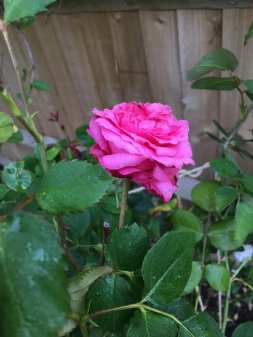
What are we left with?  Lots of English images of churches, flags, the rolling countryside of the story of a land fit for heroes that has given rise, indirectly, to the powerful love of landscape and nature that might yet save our environment? Shall I wind up the gramophone and start the Vaughan Williams or Holst … and go on a search for a Land of Hope and Glory of 1220, 1420 or 1950 that never really existed?  It is not to be denied that imagery, music, tradition are key to understanding identity, and these myths are important. Above is a nod, in some form, to the traditional iconography in the red(ish) rose in my back garden this morning, out early, out in time for St George’s day (the white Yorkshire rose is hanging back, I note). So when is St George’s Day? Does the tradition of 23rd April stand, and if we get a new national holiday, that will be it? Or is it something for Christians, with our own calendars, celebrating a saint from such uncertain past histories we are unsure who we are celebrating, or for people looking for an identity?  Do Christians cede St George to people in search of a mascot, a symbol of a (xenophobic, possibly violent and unthinking) nationalism? What did I celebrate when I opened my breviary today?

I have to wonder if what I celebrated was not St George, and certainly not Englishness, but a curmudgeon’s hankering after a faith identity that separates itself – or has been separated – from a nationalist identity, and this is born, in part, from the Reformation script that meant Catholics were seen as in some way foreign. Here we are at the us-and-them of identity: we are us because we are not them. Perhaps this is why a combative dragon-slayer fits so well.  Perhaps we are all looking at mythic pasts for identity guides.  Uncomfortable thoughts on a fine spring morning.

Omens

It’s a spring day as March comes to its “out like a lamb” ending. The sun is shining and I’m out on Warneford Meadow, treading through tufty grass, and along paths worn by commuters. It is our local Green and a valuable space, with a rich and (I suspect) growing biodiversity.   I am one of a number of visitors, human and non-human – and as I trot down one of the paths I see a bunch of magpies. The Opies record the rhyme as:

One for sorrow
Two for mirth
Three for a wedding
Four for a death.

Lots of other versions are on record, testimony to the respect  people (maybe) had for these striking birds as messengers.  The Boke of Saint Albans has, in its lists of the Compaynys of beestys and fowlys has a tiding of [mag]pies (but beware: I’m not sure I trust a list with  Superfluyte of Nonnys or Noonpacience of Wyves)…

One for sorrow,
Two for joy,
Three for a girl,
Four for a boy,
Five for silver,
Six for gold,
Seven for a secret,
Never to be told.
Eight for a wish
Nine for a kiss
Ten a surprise you must not to miss.

(It received a boost by being the theme tune for the Thames TV production of Magpie, ITV’s Blue Peter Rival, when perhaps other customs and rhymes have fallen by the wayside – but that began when  I was the key audience: a long time ago, now.)

Back to Warneford Meadow as I slog over a possible Roman settlement and try not to think about the Quis Est Iste Qui Venit of such a run.   Nine magpies, then as I approach it’s four then seven and then just one. What do we make of portents whose mobility makes the I Ching look solid?  Well, of course, we don’t, in general; it’s a bit of mind play while I run.

I remember that as I qualified as a teacher, the National Curriculum was just coming in, and the course leader was ending his goodbye speech to the PGCE with “May you live in interesting times.”  He did not foresee where we might be today: if we were only contending with conflicting views about curriculum that would be enough, but we have Schoolsweek announcing scandal upon scandal, Unionist bands and racists openly on the streets in London vying for publicity (and no, they don’t get links) with crowds and crowds of people with more politeness and less threatened violence, a Parliamentary struggle the likes of which I have never seen before… These are interesting times, but not in a good way. There are no signs or portents to match all of this rubbish.

And while I trundle my sixty-something way and wonder about what the list of magpie numbers might portend (I really did get the one above the other week), part of my mind is wondering: instead of nines and sevens am I just seeing magpie after magpie after magpie? Sorrow and sorrow and sorrow?  I don’t think I have ever felt gloomier about the state of my country and my profession.

So instead of corvid fortune telling, I will end with part of my play list for running:

Nina Simone whose version of Billy Taylor’s anthem to Freedom has been a lifesaver this winter.

And while we’re at it, her singing of Randy Newman’s great hymn to compassion.

Sod the magpies, stuff the omens: this is what we need.

Persisting Fairy Tales

Once (of course) upon a time, there lived three disciplines, and they lived in a cottage in the woods or possibly on separate parts of a campus. The Big one was called Anthropology, the Middle-sized one was called Folklore and the Teeny-tiny one was called Children’s Literature…

And one day Alan Garner and a whole load of other people threw open to all of them (rather more than three!)  the question

Where are your stories?

That question, which he asks in story-form as well as lectures, might be seen as being as disruptive as the breaking-and-entering “delinquent little tot” Goldilocks’ intrusion into the bears’ cottage. In Boneland – not Children’s Literature, I know – Garner asks his storytelling ancestor this massive question about the roles of story and culture. The Man says he “dreams in Ludcruck…the cave of the world” and in response to the question about stories, begins with an origin tale about Crane. The Man’s stories (which are, after all, Garner’s stories) continue to ring true for the human newcomers to what we now might call the Peak District, and so his dancing and singing are not in vain: the stories are handed on. Garner talks about this relationship of place and story passionately, eloquently. They become origin stories, spirit stories, and mix with concerns through the ages to give Garner his alfar and his Morrigan. This kind of reconstruction and continuity gives a lot of power to the way Garner (and Townsend and Rowling and Pullman and Lewis….) themselves tell stories, drawing some of their authority (if that’s the word) from storytelling of past times. If there is continuity here it is because folklore scholarship has enabled a sort of  continuity of sources. Leafield’s Cure-all Water, its Black Dog, all the Black Dogs maybe, and the standing stones at Rollright and elsewhere are examined by writers such as Katherine Briggs and Neil Phillip and often re-presented by Briggs, Lively, Rowling et al. One form of continuity.

We see another in the engaged and detailed work exploring landscape and language in Rob Macfarlane’s Landmarks which, as he writes of Richard Jeffries, is

fascinated by the strange braidings of the human and the natural.

Here, language is seen to contain elements of older land use, beliefs and practices. Sparrow-beaks explain fossilised sharks teeth and a tuft of grass looking like a bull’s forehead is bull-pated in Northamptonshire.

I have written before about folk tales that explain places, and how these “fairy” tales do provide a sort of continuity, although I think that possibly the syncretism of European story and British folk tales brings its own obscurity: Garner is on his own ground by Seven Firs and Goldenstone, but he is not suggesting that le Petit Chaperon Rouge lived in Congleton.

Where we get into trickier areas is when folklore is pulled into service elsewhere. Gargoyles and grotesques become evidence of a continuing belief in goblins; stories of boggarts become somehow real. I have looked behind me in darkening woods, been impatient to leave a lonely valley, and must acknowledge the pull of this argument, just as Garner steps (nimbly) between his own writing and rural practices and traditions in discussing the roots of his great novel Thursbitch. This talk is chilling, enlightening, inspirational – so that Big Bad Wolves, the Green Knight, Garner’s vision of story and space walking together pepper this blog:  turn but a stone and start a þurs. 

But can this is universalised?   I suppose my problem comes down to how much is understood but not spoken and certainly not (until recently) written. Can we see a Jack-in-The-Green and know for certainty this is the same as the carving on that roof boss, and that this is a continuing belief?  Can we really link Star Carr and Abbots Bromley? Did my great-grandma know quite who she might be warding off by crossing the fire-irons at night?

I would love to see those links clearly. We have tantalising hints, shadows, half-stories (Katherine Briggs’ doctoral work documenting the continuing traditions in literature in folklore across the Interregnum is fascinating) that might lead us in all sorts of directions, and Garner’s defence of place and story should not be overlooked. Rob Macfarlane’s “strange braidings” go between town and country but also between present and past, and how far back they link and join we can speculate  – but we cannot know. Briggs puts it well when she comments on the recurring concerns in Arthurian stories:

A remarkable thing about the Arthurian stories is the way in which primitive themes reappear amongst the most sophisticated embroideries. It seems as if the matter of Britain had a magnetic quality which attracted every type of myth towards it

This “magnetic quality,” it seems to me, is a good image of how Children’s Literature, especially when it explores themes that themselves arise from traditional tales, draws to itself fears and triumphs from former times. Piers Torday’s There May be A Castle is a good example, where quests and knights and woods and danger are explored: Abi Elphinstone, too, works magic here. Perhaps our best bet is to see that similar concerns – fears of the outside as well as celebrating its joys, the worrying menace of wolfish men, women placed outside the Christian context by their (sometimes useful) cunning, half-seen wanderers in a twilight wood –   continue to be represented in cult and place and story.

Apologies for the weak ending here: I think what it means for me is that, studying Children’s Literature I have to pay due attention to Anthropology and Folklore as fundamental to my understanding of so many works I want to study. You can see it clear as day in Garner’s Elidor or Weirdstone – but what about other books – younger children’s books, for example –  I am trying to look at, where the outdoors is a challenging place?


Wolf Moon

I missed the superbloodwolfmoon thing this week: cloud hid it in Oxford, although lots of amazing pictures emerged around the place. I tried, in compensation, to write a blog post linking back to my earlier explorations of Wolves and Red Riding Hood (my “Jack Zipes schitck” as someone described it) and the stuff I mull over a lot around outdoors and storytelling and wolves, and maybe (although this is where I stumbled and tripped) on the Black Dog of depression, nipping my heels nearly all this Christmas.

However, the death of Mary Oliver prompted me to buy a collection of her poems and comment on them. Social Media had all sorts going on – as is the way, some friendly and some not-so-friendly – but with today’s cold weather in England, I thought I would cite one of her bleaker pieces as apt for the weather and the moon:

Wolf Moon

Now in the season
of hungry mice,
cold rabbits
lean owls
hunkering with their lamp-eyes
in the leafless lanes
in the needled dark;
now is the season
when the kittle fox
comes to town
in the blue valley
or early morning;
now is the season
of iron rivers,
bloody crossings,
flaring winds,
birds frozen
in their tent of weeds,
their music spent
and blown like smoke
to the blue of the sky;
now is the season
of the hunter Death;
with his belt of knives,
his black snowshoes,
he means to cleanse
the earth of fat;
his gray shadows
are out and running – under
the moon, the pines,
down snow-filled trails they carry
the red whips of their music,
their footfalls quick as hammers,
from cabin to cabin,
from bed to bed,
from dreamer to dreamer.

Superb, and as bleak as the landscape and weather she is writing about.  It’s over ten years since I began to explore children’s literature as means to look at the outdoors, and literature continues to be a lens I use to look at how we react to landscape. My brother, I note (as I type), is in the snow at the Cat and Fiddle – close to Thursbitch in the snow. I think of Jack Turner, and the car off the road we saw in the fog by there:  worlds collide.

In Wolf Moon Oliver picks up the themes of Death and cold –  “his belt of knives,” “his gray shadows” –  in an almost Grendel (ettin or þurs)-like way; this is a Big Thing to terrify, with the wolves’ howling as the “red whips of their music” disturb the night. Because it is (perhaps) a simple point to make, but I feel it needs making: Mary Oliver is a good poet, not always writing comfortable nature poetry about childhood or inspirational lines about

I was thinking
so this is how you swim inward,
so this is how you flow outward,
so this is how you pray.

Five A.M. in the Pinewoods

and her sharp eye and the writing that comes from it is able to look at the aspects of nature that humanity finds inimical – and has, in some ways dedicated a lot of its evolutionary history to conquering.  She is able to write about the “roaring flamboyance” of the sea and the “hallowed lime” of owl pellets: the memento mori we can gain outdoors  that I mentioned in my earlier post.

The response of literature to the winter is itself interesting, and writers such as J R R Tolkien (think Caradhras the cruel) and Kenneth Grahame give vivid pictures of its dangers: although snow in The Wind in the Willows is softening, almost redemptive, the creepiness of Mole’s wintry experiences in the Wild Wood are very expressive “Then the faces began…Then the whistling began…Then the pattering began.” The winter wood; the dark wood; img_1355the wild wood as evening closes in. More modern writers have given us some great examples of snowy landscapes and confronting death: Philip Pullman works the theme extremely well in Northern Lights; Michelle Paver is terrifying in her adult book Dark Matter but also richly descrtiptive as Torak  battles the limits of human (and animal) endurance in the snow, and (again for adults – I wonder if this is significant) Garner deals with death and loss in the ice in Boneland, a death that stalks both strands of the book in different ways.

It seems to me that the immediate reaction is to see “outdoors” as somewhere positive, just in the same way as Mary Oliver is seen as uplifting – but we take on these broad judgments without thinking at our peril: literature does well to remind us that the outdoors is not always friendly, as sudden blizzards by Cat’s Tor can show.

Hope you’re OK, Mark.

“George took his lantern”

John Masefield ‘s The Box of Delights is a fantasy published in the 1930’s which draws on the hopes and fears of people after the first war, and set in the English landscape. We meet not only characters from the earlier work The Midnight Folk but the story deepens as the protagonist,  Kay, battles forces of witchcraft intent on destroying the traditional English Christmas by ruining  the thousandth midnight Christmas celebrations at the Cathedral.    The Box of Delights is a sequel that in many ways surpasses the nightmarish first book (pace Rob Maslen, who praises the Midnight Folk here) and its narrative strength means it has also made a radio play, a classic BBC TV adaptation and more recently a well received stage representation. All this is summed up very neatly here in the Guardian, and explored by Jake Hayes with his usual depth and perspicacity in his Tygertale blog for this Advent, and it is the language when we come to the denouement that I find striking  – I’m coming to this.

Throughout it is Kay’s relationship with Cole Hawlings that sustains the narrative. Cole is a travelling Punch and Judy Showman, but so much more than just an itinerant busker: like his successor, Susan Cooper’s Merriman Lyon, he is at the centre of a struggle against evil, represented (as in the previous book) by the murderously wicked Abner Brown. As with Merriman, we are allowed to see only snatches of the battles the adults are fighting; there are more than symbolic “wolves running,” allies we do not always recognise, dangers for the adults as well as for the children…  But there is an important set of differences: while Merriman/Merlin openly entrusts the Matter of a New Britain to the children in Cooper’s Silver on the Tree, Cole Hawlings, having helped Kay restore the rightful place of Midnight Mass in the embattled Cathedral, is still looking back: the nostalgia for Old England is strong in the final pages of The Box of Delights as, speeding towards the Cathedral, we hear the bells start up in all the little churches, and meet the monastic community of the Cathedral’s past. And while we are flying along in Herne the Hunter’s unicorn-pulled sleigh, to move the recently freed Bishop and Dean and choir (&c., &c.) from some kind of sub-Trollope or All-Gas-and-Gaiters imagery, we have a Christmas hymn in a folk idiom, which Masefield calls a carol: here is the text.  What surprised me on my first reading as a child, and still surprises me, is that Masefield gives the singing of it to the ambiguous dating-from-Pagan-times Cole Hawlings.

[Incidentally, the first time I heard this song, Móirín Na hEaglaise, sung by Nóirín Ní Riain, I thought of this carol, with the higher sections or answering melody being used in verses 4 and 7. I have tried it, although unsuccessfully: it may need something more robust, where maybe the last line of each verse is the “chorus after each stanza” Masefield notes].

The carol is a remarkable piece.  I’d like to look at a few details to see what they tell us about The Box of Delights:

Let’s start, like Masefield, with George. His very name seems to set the lyric in England, maybe even rural England, and it occurs in four of the verses. He is the figure of compassion, a carefulness that twice calls him to the byre (a beautifully localising word: again we are in rural England), where he first lets in a poor couple and then comes back because of the trouble and sees the Christ Child and then the kings.

Lantern, byre, hay, stable – even inn and snow – put the Nativity in the same landscape as The Box of Delights. The “-a” at the end of the shorter lines moves this further into the folk-song idiom, although what is and isn’t a folk song (a bit like what is and isn’t a carol) is disputable. Perhaps the most truly rural – or maybe best attempt – at a “country tone” is the line George heard a trouble in the beasts. It sounds like my Father in Law.   It is snowy and dark, George has a lantern to go to the stable/byre – and England receives its revelation.

And there within the manger bars
A little child new born-a,
All bright below a cross of stars
And in his brow a thorn-a.

The Mother, the Child, tenderness – but never too far from the cross and the Pieta: we are in Durer’s bleak theology, with those cross-like structures present in the nativity scene in his Madonna on a Grassy Bank.  George’s vision is mystical; we are with Durer, with Chesterton and Gill, in seeing a Gloria in Profundis, although what Masefield presents is a transcendent Child, a submarine vision of humanity divinised not “the height of the fall of God.”

What happens next is interesting from the point of view of a rural poem. The visitors are not shepherds but Kings. I am unsure whether to read anything into two great kings and Melchoir but will assume we needed Melchoir for scansion and rhyme. They bring Eucharistic gifts, too – and at a practical level welcome ones for the poor Family – bread and wine.  The ecclesiastical imagery is extended with the mention of robes. We have, by now, a crib scene – but where are the shepherds?

They – and we – are there in the person of George. The plain people of England (to misappropriate a phrase from Myles nagCopaleen) kneel down with the farm worker in homage of

that dear Babe today
That bears the Cross and Crown-a.

In looking back to a rural, more innocent time, we are at the heart of the nostalgia project that occupied so much thinking in the post-War period; we are also in that hankering for a countryside of freedom and adventure and risk that is at the heart of Masefield’s two books, and which informs Lewis, Garner and Cooper  — and… and …

And when Cole Hawlings – the theologian Ramon Lull – the pagan countryman and the lost medieval mystic – sings of this past time when George knelt down and prayed-a we are invited to a personal piety that is itself nostalgic, a recreation after The War to End Wars, of a pious peasantry, a dedicated episcopacy and (and here we are into a whole new set of thoughts about the villains in this story) the defeat of corrupt and self-serving greed. Not a bad wish for Christmas in the inter-war period; not a bad wish for this Christmas, either, but I am mindful of how Masefield’s vision played out in the following years: Masefield knows it is a “nice dream,” as Kay admits at the end of the book.

A World We Feel at Home In

It seems odd – maybe contrary to some netiquette that forbids self-publicity – to repost a blog, but with Dave Aldridge‘s appearance to discuss remembrance in Cambridge (and in general) still very current, I want to return to the noxious growlings of Gove against “Blackadder history” and how I looked at this in a blog post earlier. Here it is, with its warning that “it is not only ancient history that makes myths.” This isn’t really about Gove, or the trenches, or the youths who will dress up and march in streets and square next month, but about how we seek to mythologise bloody episodes as part of our story of belonging. Glorious victory at Rochester, Brunanburh, Hastings, the “famous victory” at Blenheim,  Prestonpans, Amiens and the Somme , the Baltic? Which is the most relevant now?  How do we use these stories? Is Hastings an awful warning about the dreadful continentals or a defining moment in land ownership and language? Is the Somme a warning never to trust politicians’ manipulation of the people or a blow for the freedom of Europe?

Yesterday was the 84th birthday of the great Alan Garner, and as I look at his work, and mindful of my blog post on fiction, memory and Roman Britain, the work of Rosemary Sutcliff, and then think of the Battle of Hastings, remembered last week, and the battles of more recent times we celebrate (is that the word?) in the Remembrance season I think I want just to add some of his thoughts on memory and landscape from The Voice That Thunders. In the first section, from the essay “Inner Time” Garner looks bleakly at the American myth, contrasted with his vision of Europe where myth is richly layered:

Man is an animal that tests boundaries. He is a ‘mearcstapa,” “boundary strider,” and the nature of myth is to help him understand boundaries, to cross them and to comprehend the new; so that, whenever Man reaches out , it is myth that supports him with a truth that is constant, although names and shapes may change… The Biblical, the Epic, the Romantic, the Gothic are all merestones, boundary markers, of their day and the pointers of ours. Three hundred years ago, the mystery was in the greenwood; last century, the nearest grave; now the nearest galaxy…

And then in his essay on Strandloper, he returns to his task in celebrating the autochthonic ideals of language and people and history in the First Peoples in Australia and in his native Cheshire:

[I have been trying] to celebrate the land and tongue of a culture that has been marginalised by a metropolitan intellectualism, that churns out canonical writers…who draw on the library, ignorant of the land; on the head, bereft of the heart. For true reading is creativity: the willingness to look into the open hand of the writer and to see what may, or may not, be there…

Garner has the energy, skill and creativity to be the offerer, the writer who presents us with ideas and wisdom and myth and legend.  Perhaps I was wrong in my earlier blog to have thrown all of this into a store room full of the “chill of secrets;” maybe the fiction writer – and the Remembrance marchers and the people protesting – is looking for the defining myth still. Just as the people recovering from the 1914-18 conflict rediscovered land and landscape – returning to a mixture of visions of pastoral and homes fit for heroes  – maybe the scambling and unquiet time we are in demands of us a new view of what we mean by “home” and a world we feel at home in.

The trouble is that myths are always shifting: flora changes on the Cheshire hills of Garner and the borders of Sutcliff; we need to read our landscape as closely as the text an author proposes –

The pity is that idiots have driven a chariot of the gods through the great wonders and the true mystery.

Place: literature as guide

This blog – or rather its predecessor – explored place rather a lot. This summer’s trip to Santorini was in part inspired by reading Clive King’s The 22 Letters; Gawain and Ludchurch (“Lud’s Church”) are all over it, too.  I have read about places and gone there; I have gone to places and read about them. I read The Canterbury Tales and Mydans’ novel about Thomas Becket and then went to Canterbury.   It set me thinking: what might I have made of Paris if I had read Vango first?  (After all, after I’d read Becket and its – erm – inspiration,  the novel by the great medievalist Helen Waddell, I was disappointed to find so little left of the Paris they describe. In fact, although there is more around Notre Dame than is immediately obvious, there is more tangible stuff left of Clive King’s Ancient Thera in the tablets of Linear B and the archaeological museums than there is of the ill-fated lodgings of the twelfth century canons of Paris.)  How do we, as adults, use the written word to tell children about the physical world? How might we (or do we) use story? How might this, in itself, change the visitor’s ideas?

And if Vango might have changed my view of Paris, what of Selznick’s Hugo Cabret? Or Kipling’s or Milne’s Sussex? I could go on…  and that’s before we start thinkng of places responding to their visitors – where Canterbury’s rebuild was prompted by its visitors, and Paris still holds the echoes of the Hemingways and Steins so wonderfully celebrated and parodied in the film Anastasia in Paris Holds the Key to Your Heart (of course Paris is particularly susceptible to this myth-making, as is Oxford, my city of aquatint and commuting).

But  then we come (of course) to Garner. The creation of the Alderley phenomenon, drawing on myth and legend, changes a bit of whimsical parkland with a few stories attached into a mythic landscape out of all proportion to the stories that we can find readily. It does so almost entirely because of the authochthonic outlook of Alan Garner. We find ourselves in this place or that seeking to see with his eyes, following his train of thought, his access to myth and legend. We are tempted to try and see his Alderley, his Thursbitch, his Ludcruck.  Gawain and Beowulf are in his sights; we peer into his horizons and try to see what he is pointing out.

But let’s broaden this out. As I have discussed before, there are clearly places that have myths or legends attached, where stories have been piled up. The Cheshire/Derbyshire border is one such; maybe Oxford is another, or Paris, or Tintagel. Part of the project I seem to be involved with is the uncovering of these story cairns – but there is another part: it is the job of the critic of children’s literature – or some of us – to look not only at what has been collected, but also at the effect of the stories on the visitors to the landscape.

What does the young visitor make (and here we are in the recent Twitter conversation that started my thinking) of Venice having read about the pig Olivia and her visit? And how might the adult draw on this in September to help the impressions of the visit stay vivid?

Mr Gawain, NQT

Now the new year draws closer. Night passes. The day pushes out the dark – as the Lord bids.

Now neȝeȝ ƿe Nw Ȝere and ƿe nyȝt passeȝ
Ƿe day dryueȝ to ƿe derk, as Dryȝtyn biddeȝ…

The new year comes in for the young knight Gawain as he awaits his fate at the hands of the Green Knight: a cocky, good-looking, well-prepared young man, Gawain in the medieval poem had set out from Camelot to meet his nemesis the Green Knight with high hopes – but it was more ambiguous than he’d thought, and now it’s crunch time.

I won’t labour this analogy, but I am conscious that my corner of edutwitter has been pondering the Polonius-like advice for people starting the adventure of a PGCEs or work as NQTs for some weeks now. The time is upon us; that new year is here. Arthur, stirring in Camelot maybe, wonders how Gawain is getting on, just as I sit in my study and wonder how the students I met last year – the “graduands” from our PGCE whom I will meet again on Saturday – are facing what seem like crucial days of in-service training and meeting-and-greeting the team, and then the parents and children…

Does any[one] have any advice on what to do in first lesson…

What sort of lessons should my first lessons with a class be when school starts?

Any last minute advice ?

And the advice about not-smiling (or smiling) before Christmas piles in from

Teaching is 50% words and 50% numbers…but always 100% you

to

I understand the need for motivation yadayadayada but sometimes I read utter drivel that is solely tweeted for the purpose of likes/retweets and they mean nothing at all!

Right: so bearing that last outburst in mind, this isn’t advice as such, but self-reflection. My biggest changes in terms of work were probably: starting out as an undergraduate so long ago they would be findings for a History of Ed dissertation (as in fact they almost were a couple of years ago!), when I was caught in the headlights until Christmas; my first job in a Faculty library, where all of a sudden I was on the other side of the counter (and loved it); my first day on a PGCE teaching practice (and actually all of my final TP!); my first days in my first teaching job; my first day as Head Teacher – and then this summer, leaving my job in Higher Education to sit in the study here or in the Bodleian. They all have a theme running through them: that I had very little idea what I supposed to do. As a Head – on my own at the start of September – I sat at the desk and thought “Now you’ve done it.” That’s how it feels on my own again today, too. As a library assistant I had people telling me what to do until I got the hand of it; as an NQT, I tried to do the “fake it ’til you make it” thing. It didn’t work and I sat in my classroom wondering what I was there for…

I’m not going to be crass and suggest that training is useless or that only experience teaches – that’s all silly stuff from people with axes to grind. I will say, however, that when I came to education – or to education management, or to teaching in Higher Ed (not mentioned above) or out at other end, at 60-odd, into my eyrie here at home – the things I brought with me were insufficient. It was maybe an easier transition into working in Higher Education precisely because I knew what the initial tasks were, and I knew they would be fun and hard and complex. I would argue that that is the nature of things: the journey teaches, and while I would seriously urge the twin activities of scholarship and practice going hand-in-hand, there is an underlying attitude also needed: a willingness to learn.

Coming to a new classroom (as a teacher or a learner) with “I am all prepared” as your blazon is to lack a vital element. You are already well-liked on Twitter? It may be you have stuff to learn from actual colleagues. You are well-read and a critical reader? It may be you have stuff to learn from the children or your tutors and mentors. You have worked in schools for ages? It may be you have stuff to learn lurking in the library. Whatever it is, it may be you have stuff to learn. Bloody hell, as I exit to the other side and wonder what my new life looks like I can see I do: loads to learn, from how friendships look to how professional communication now works.

E7C55279-0993-4D7C-A0D1-C5D9609D5121So the advice has to be to recognise that starting out on one of the vital stages of professional formation (a BA, BEd, a PGCE, an NQT year) is just that: a starting out.
And at the start, we all need a friend, preferably a huggable, flesh-and-blood person we know, not just a smile on social media and a “U OK hun?” or people joining you in a moan who don’t know you or your school. Gawain (to return to my original image, with this picture of the Green Knight and Gawain reconciled) could have done with a mentor earlier in his quest to show him ways up the mountain, and Mr Gawain, the NQT (or the new starter on the PGCE, or new head or whoever)  could do with some genuine compassionate mentorship – and thinking of Up the Mountain (see the previous post) I might as well include this clip here of the marvellous picturebook about friendship and mentorship because – well, because picturebooks are always a good place to end.

Up the Mountain

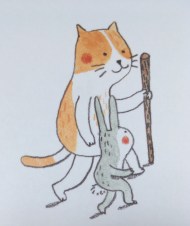
Marianne Dubuc’s Up the Mountain is worth considering when anyone says that a picture book is simple. It does not have the visual fireworks of Gaiman and McKean’s Wolves in the Walls or the political complexity of Foreman’s A Child’s Garden but the straightforward story (outlined below) has a lot to offer.

I find it is sometimes challenging when reading educators’ social media about “Where would you have this book?” and ” What use could you make of this book?” to stop and think of a book as an object in itself: the visual aspects, the pace and language of the narrative…   That’s not to deny teachers for a moment a very exciting way to explore and widen their own understanding of “children’s books” – but just that sometimes a book calls me to step away from the pedagogy. Up the Mountain does that for me.  Yes, it fits with projects on Outdoors, it could be used to discuss age, and friendship, and exploring, maps and maths, wildlife, ability…

img_9968.jpg
But that’s why it is a really enticing book. “Very old” Mrs Badger, on her Sunday walk up the mountain meets the little cat Leo who overcomes his reticence and joins her in the walk – that Sunday and “for many a Sunday after that,” until Mrs Badger no longer has the strength and it is up to Leo to rediscover the mountain. It is a plain enough narrative, with an easy pace and lovely drawings, and as Leo makes the “splendid” mountain his own, it has a poignant and subtle message about growing up and passing on the things you have experienced  and grown to love – as Leo does at the end of the book. This is a story my 5yo granddaughter will love, but the unspoken affection, the relationships between character and landscape, the exploration of tradition and enthusiasm mean I can return to this over and again for my own pleasure.

So how do we step back from being pedagogues to being simple readers? Easy enough for me in semi-retirement, maybe, easier still with research partners to spur me on, but the following are just some rough-and-ready thoughts.

Reading widely helps: if you stick to the ones you know, you are missing out.  Not just because this book or that is perfect for this child or that, but because your own enjoyment is endangered, rendered threadbare. On social media recently, a new teacher asked about the book for this next term. My response was to suggest she read a book she will enjoy reading, and the best way to find those is to read widely. The commmuity of people reading and discussing “children’s books” (or fantasy or whatever) is rich, wide and very charitable. Look at Sarah or Dimitra for starters…

Re-visiting half-forgotten or set aside books or series: have you “done” the lovely Owl Babies a lot? What about On the Way Home?  Or if you set aside something (a besetting sin of mine) ask yourself why, and whether it’s worth returning to it. Finish the Stone Book Quartet. I bet there’s a Moomin story sitting unexplored – or what about Jansson’s adult books???  There’s a whole different thread…

Treating the books destined for the classroom just as you would your holiday reading: You don’t intend to put Margaret Atwood’s Hagseed in the classroom but how did you read it? Did you take its psychological messages about bereavement and revenge to heart, or did you read it as a comic exploration of a Shakespeare play? Did you read and re-read, or did you race through it? Did you share it with a friend or a partner? Or a book group? Or on Goodreads? What did you “get out of reading it”? I read seasonally: Moomins in the autumn, maybe, and Lucy Boston’s Children of Green Knowe in December…  How do you read? What do you enjoy?  Why do I like Up the Mountain so much? Is it that poignant subtext of Mrs Badger saying goodbye to her beloved Sunday walks? The gentle loyalty of Leo? A bit of self-reflection might let you think differently about the children’s books not as a resource but as a source of wonder and enjoyment.

Reading about authors – reading other people’s critiques of authors’ discussions and interviews (I have to link to Mat Tobin here, but check out Simon and Martin and others, too), author biographies, books by the author outside their usual genre. No, for some people that’s not the way they want to go, but for some those lavish books of Maurice Sendak’s artworks or the simple self-revelation of Alan Ahlberg’s The Bucket are just the thing to get you looking at the books children read in a different light.


And then finally.  Once you have enjoyed the illustrations, seen the way prose and picture work together (or in opposition), enjoyed that way that little cat peers out at Mrs Badger and how the bunny later echoes the incident, finally figured out the relationship between Sally Gardner’s wolves and John Masefield’s – then start looking at the classroom, and again, Mat has the resources … Too late to do this for this summer, I know, but this is, after all, simply a reflection as the weather cools. Time for the Moomins for me, then… More mountains and small beasts.