Statio

The year’s midnight. 

“Always winter and never Christmas.” C S Lewis’ ultimate baddie, the White Witch, keeps Narnia frozen in a time when the natural cycle of death and birth cannot continue. Will Stanton in Cooper’s The Dark is Rising has his midwinter birthday interrupted, threatened, brought into its rightful place by the crises in the book. Kay Harker’s dream (or not-a-dream) sees the Christmas of Merrie England restored when the dark powers of   sorcery threaten to destroy it. I feel I also have to note en passant the most terrifying version of this for me, Michelle Paver’s adult work Dark Matter, where the narrator faces months of night time and solitude – and something far worse out on the Arctic ice. The time in late December is reenacted in these stories as a time of crisis, and the subtext seems to me to be a worry that as the days darken, the sun will not return, no hope for love “At the next world, that is, at the next spring.” A fear that This is It.

As Catherine Butler in Four British Fantasists suggests of the interplay between magic and humanity in Cooper’s Dark is Rising sequence

The Light is opposed in turn by the Dark, and most of the activity of the other mythical and historical figures involved in the sequence is related in some way or another to their struggle. Given Cooper’s insistence (as in the description of Herne) on the wildness of some of these figures, this moral alignment of their magical power might be problematic.

Problematic indeed. The complexity of this vision is one of the things that Masefield is beginning to explore, and that Lewis more or less avoids, but which Cooper meets head-on in The Dark is Rising – and in more meditative and lyrical form in a poem she first published in 1974.

The publication of Susan Cooper and Carson Ellis’ The Shortest Day , which re-presents Cooper’s 1970s contribution to a larger work, has prompted renewed interest (it never really goes away) in the interplay between UK fantasy writers and the folklore they draw on. There are some lovely reviews already out (e.g. Kirkus, Brainpickings (who [of course] beat me to the Dillard reference, although that doesn’t often stop me) praising the text and artwork, and this is not a review but some thoughts at a tangent. Again, I am not alone in this tack: Calmgrove’s Christmas Delights (which already sounds like a box of candied fruits) has a wonderful post exploring a selection of writers from Nesbit to Masefield, and then Lewis, and so to Cooper herself. By celebrating Solstice (check out Solstice here)  she sets up not a Pagan in the sense of antiChristian but an unChristian, a preChristian festivity, gloriously underlined by the images Ellis gives us, as wanderers move through a land that they increasingly mark as their own.

Through all the frosty ages you can hear them

Echoing behind us – Listen!!

All the long echoes sing the same delight,

This shortest day…

In Ellis’s paintings we see the “precarious business” as the palaeoanthropologist Chris Stringer puts it, of early humanity’s existence in our inhospitable winter, and we see our efforts – the our, I think, underwires the charm and power of this book – at keeping the dangers and demons at bay across the centuries.  It is a similar nostalgia (thank you again, Chris Lovegrove, for this insight into Masefield ) to the gathering of the ancestral (ghostly) Oldknows in Tolly’s first Christmas in Lucy Boston’s Green Knowe, that we celebrated on our visit. All those long echoes in the stones of Hemingford Grey.

It sends me back to Ronald Hutton and his Stations of the Sun. In the opening chapters he carefully dissects Christmas customs with judiciously chosen details (I was intrigued by the mummers who menaced people having been “drinking, playing at cards and fiddling all day in disguised habits”) and drops in details that have resonances elsewhere, such as the apotropaic torch rituals in the Staffordshire moorlands town of Stanton.  It has to be remembered that Hutton, although with strong ties to various aspects of Paganism, is suitably cautious in his methodology:  Hutton looks at the Roman feasts of midwinter, Saturnalia and Kalendae, and then states

The new Christian feast of the Nativity extinguished or absorbed both of them, and a string of other holy days sprang up in its wake…

before going on to explain the rise of the Twelve days and the Epiphany/Theophany in the Western and Eastern Churches.

In most of northern and central Europe, where the cold and darkness were much greater…it would have run into local patterns of pre-Christian seasonal celebrations….

But Hutton warns us that

Literary sources do not tell us anything conclusive about the midwinter festival practices of the ancient British Isles…

He find the early English sources more enlightening than many others, and his trail leads him to the conflation (as he suggests) of a Modranicht, or Mother Night, a middum wintra, with the Nativity. The festivities may predate Christian Christmas or draw on earlier practices*… And then he turns his gaze on Yule (jol, jul, juul), the jolly time of Norse festivities.

Stations of the Sun is not a pagan handbook but a scholarly exploration, suggesting that seasonal rituals were fluid, open to change, to diminishing and reinterpretation. It is right, therefore, that in his conclusion some 400 pages and a ring-round year of celebrations later he writes:

It is one of the arguments of this book that the rhythms of the British year are timeless and impose certain perpetual patterns upon calendar customs: a yearning for light, greenery and warmth and joy in midwinter, a propensity to celebrate the spring with symbols of rebirth…

[However] What is also plain is that the last couple of centuries, in this as in every other aspect of British life, have produced a completely unprecedented amount of change… No amount of nostalgia or anxiety for a rapidly diminishing or deteriorating natural environment can alter the essential irrelevance which it now possesses for the daily lives and seasonal habits of most of the British; however, this very fact may cause it to play an ever greater part in religious symbolism.

And not only there, I think.  Children’s literature – the work written “for children” and the work written meditating on childhood – seems to me often drawn to these natural cycles, and most of all to the changes of dark and light, for which the stores of story and ritual and symbol stand ready for writers and artists to draw on. I do wonder about the place of folklore and a kind of vision of archaic beliefs in the writings of fantasy – and marvel at the power of this time of year to bring out our need to explore these themes…
IMG_7731

*

Oh, I see you haven’t spelled Station right – and what is that about anyway?

I have, and this is my final point. To return to another of Hutton’s delightful side-comments, he suggests that Yule is connected not only to the world “jolly”  but perhaps to the word we know as wheel;  I can’t help thinking of the Sun Cross, the sign of the Old Ones in Cooper’s The Dark is Rising, and the ‘ring with the longways cross” the Oak Lady wears in The Box of Delights, but the symbol of the sun as wheeling around might suggest that while we think of Solstice as when the sun stands still, another version might be that it is that tipping point before a wheel starts to turn again. Nature holds its breath, much as St Bernard suggests we all do when the Angel presents Mary with her choice at the Annunciation (Nota Bene: this impassioned, dramatic passage from Bernard is set in Roman Rite breviaries as the non-scriptural reading for 20th December).  The holding of our breath: can we get out of this darkest time? The site Spirituality and Practice has a brief extract on Statio as the sacred pause.  The moment, maybe, before the liturgy starts, where everyone is standing ready, not awkwardly waiting but attentive. Birdwatching for the moment of grace. This is not to say that the Solstice is now simply that for Christian practice or post-Christian jollity – but that the winter Solstice in particular invites us to pause, to listen as the new world turns and does it all again.


*Bede is his source here. Hutton is, in case you are wondering, suitably cautious when we get to Easter and its original. 


PS:  The photo, by the way, is not an Old Way or my own Old Road outside my front door, but unexpected snow before Christmas a few years ago, taken on the feast of St Lucy, the old “Shortest Day” that John Donne celebrates (and I cited at the start of this post) and the birthday (not the feast) of Bl Lucy of Narnia. Well, sort of.


Merlyn

I am reading T H White’s The Book of Merlyn again after a long break.

The paper trail is not edifying so maybe it needs acknowledging – at least, the messiness needs some acknowledging. It is a mess of the biographies of two men: William Mayne and T H White. There remain all sorts of issues about how we celebrate the creativity of people whose personal lives did not measure up to the standards we would wish. That is at least some acknowledgement…  

I came back to the Sword in the Stone again having read William Mayne’s The Worm in the Well, which echoes it. I asked when I’d read it if Mayne’s flaws deafen me to his message of reconciliation and renewal; I find myself asking over and over the same with T H White – something I was alerted to in Helen Macdonald’s H is for Hawk. But for the purposes of this blog post (which will largely be quotation from the Book of Merlyn) I am going to set aside the author and look at the text.

I know I’ve written about the magic patriarch before, when Merlin, Merriman et al have come up from my reading (here, for example, where I mention White explicitly, and then here, for the “humanist rabbit pulled from a transcendental hat,” and most recently here) but Merlyn – note the spelling – is here at the moment because of T H White’s lost-and-found masterpiece and its subject. Setting aside the moving first sections, the re-encounter of Merlyn with his former pupil (now beaten and old and depressed) the substance of the story brings us to Badger’s sett, to, in effect, an Oxbridge Senior Common Room in the grand old style, the Combination Room, where Arthur is tasked by Merlyn and the animal committee to make sense  of the human condition, in the last night before Arthur’s final battle.

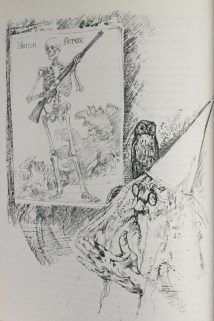
White’s construction of Merlyn’s prophetic powers is that he is living his life in the opposite direction to the rest of us. Merlyn has known the insanities of C20th totalitarian regimes (White wrote the book as part of his struggle about whether he should maintain his pacifism), refers affectionately (but not without criticism) to his friend Karl Marx, and gets muddled in trying to explain to Arthur that the whole story they are in is on a book – the book I am holding. img_1629The gentle, bookish comedy aside, this allows Merlyn the painful knowldege that Arthur is to die in battle the next day, and for White/Merlyn to comment on fascism and communism, and for King Arthur, lost and tired,  to ponder his path, as (with the the magician’s assistance) he visits ants, geese and takes advice from the donnish Badger and the Plain People of England in the shape of the Hedgehog… What makes Arthur Arthur? What makes a Human Homo Ferox rather than Homo Sapiens? Facing defeat of everything he thought he stood for, yet surrounded by his animal advisers and under the magic of the querulous Merlyn (beautifully depicted by Trevor Stubley), Arthur, the aged king, is exhausted:
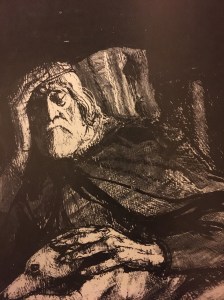
There was a thing which he had been wanting to think about. His face, with the hooded eyes, ceased to be like the boy’s of long ago. He looked tired, and was the king: which made the others watch him seriously, with fear and sorrow.

They were good and kind he knew. They were people whose respect he valued. But their problem was not the human one…It was true indeed that man was ferocious, as the animals had said. They could say it abstractly, even with a certain didactic glee, but for him it was the concrete: it was for him to live among yahoos in flesh and blood. He was one of them himself, cruel and silly like them, and bound to them by the strange continuum of human consciousness…

One of them himself. Politics, ethics, where to belong and whether to resist: these are not abstractions for White (in exile in Ireland in 1942 as he writes), or for Arthur – or for us. As he writes, Tolkien’s Fellowship are paused at Balin’s tomb in Moria, Lewis’ protagonist in The Great Divorce is sent back to everyday life in Oxford rather than face the terrible sunrise of the parousia: it is a decade of loss and darkness and doubt. Life should have been sorted in the War to End Wars that ended in 1919 – and hadn’t been. Arthur continues to ponder:

…he had been working all his life. He knew he was not a clever man.… Just when he had given up, just when he had been weeping and defeated, just when the old ox had dropped in the traces, they had come again to prick him to his feet. They had come to teach a further lesson, And to send him on.

But he had never had a happiness of his own, never had him self: never since he was a little boy in the Forest Sauvage.… He wanted to have some life; to lie upon the Earth, and smell it: to look up into the sky like anthropos, and to lose himself in clouds. He knew suddenly that nobody, living upon the remotest, most barren crag in the ocean, could complain of a dull landscape so long as he would lift up his eyes.

And I know how he feels: to have some life seems to me to be a core desire – certainly for Arthur, whose life has, throughout the books, been so rarely his own.

Is this last part of this post a spoilier? I find it hard to say: the book has a moving ending, the various endings to the legends providing their own kind of speculative fiction.  The sleeping king of so many folktales? Avalon? Edinburgh? and White has to make his own move about his position on war and resistance. But before he does, he finds space for his own legend of Arthur Rex quondam et futurus:

I am inclined to believe that my beloved Arthur of the future is sitting at this very moment among his learned friends, in the Combination Room of the College of Life, and that they are thinking away in there for all they are worth, about the best means   to help our curious species: and I for one hope that some day, when not only England but the World has need of them, and when it is ready to listen to reason, if it ever is, they will issue from their rath in joy and power: and then, perhaps, they will give us happiness in the world once more and chivalry, and the old medieval blessing of certain simple people – who tried, at any rate, in their own way, to still the ancient brutal dream…

But defeating the barbarities of Attila or Sauron or Mordred remains only a hope, an aspiration, and I return (as ever) to Susan Cooper’s bleak but rousing Merriman:

You may not lie idly expecting the second coming of anybody now, because the world is yours and it is up to you.

A different , maybe more grounded Merlin and a different hope to the poor hope of the exiled White.

Robin

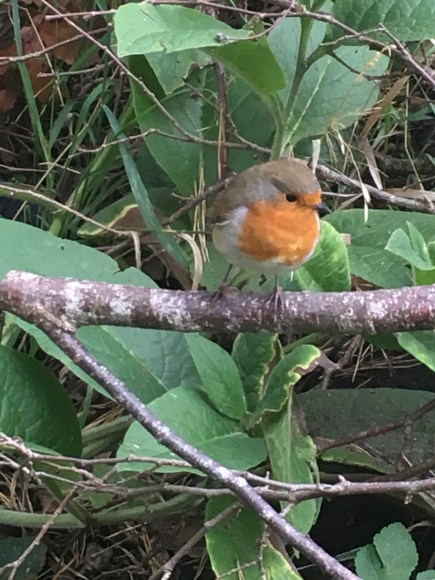
It’s National Poetry Day and I’m clearing old woody clippings from an allotment that is, thanks to Rosa, coming back to life like something in Frances Hodgson Burnett. As with yesterday’s digging, I am accompanied by a robin. It is friendly enough to allow me to photograph it from close up. I love its jet-jewel eye and the way its chest moves as a bubbling song comes from somewhere in its tiny body. I love its daring proximity – it flies so close at one point, a wing brushes my leg.

Its closeness and seeming trust mean I am able to photograph it – but miss the Mafiosi magpies who swoop and bicker close by, and am nowhere near fast enough for the dive of a sparrowhawk as it twists into the trees, after some luckless songbird. After the robin? My little friend?

The theme of this poetry day is truth, and I do wonder how truth exhibits itself – or is exhibited in Nature Writing. There are the monumental and disturbing images from Underland, and the small but detailed work of taxonomy and the science of magnifiers; there is the work from Peter Fiennes on woodland, and the research from Mat about language and landscape – and then there is this robin, and the magpies and the hawk. Guardian nature writing; CaedmonGilbert White; Edgelands and the Shell Country Alphabet: they all bring something to the kaleidoscape that seeks to explore and explain and act as advocate. There is a cloud of witnesses here.

But to think about truth in Nature Writing (why those upper case letters?) and a short poem I was brought back – by that killer robin, terror of the worms I was turning over, and by the sparrowhawk that set the wrens in ear-achingly shrill panic – to the ambiguity of our gaze. The robin as my friend – or as belligerent defender of her/his turf? Sparrowhawk as dangerous thief – or as a beautiful trajectory on an autumn day?

And that gave me the poem for today, a marvel in concise, painterly imagery from Anne Stevenson, and a sharp reminder of the way our truth, our human truth is only ours, not universal:

Gannets Diving

The sea is dark
by virtue of its white lips;
the gannets, white,
by virtue of their dark wings.

Gannet into sea.

Cross the white bolt
with the dark bride.

Act of your name, Lord,
though it does not appear so
to you in the speared fish.


The sparrowhawk didn’t get the robin, by the way.

A Good Story

I commented on Richard Powers’ book when I was part-way through, making connections between Robert Macfarlane’s magisterial (for me almost scriptural) Underland and Powers’ rich and mind-expanding The Overstory. For what it’s worth, the link is here. This is just a codicil, really, trying to make sense of what I think eco-literature might be.

Powers’  narratives are rich and engrossing, and while I see Patricia Westerford as having the key storyline – another character towards the end of the book hearing one of her lectures suggests this might be the author’s intention – others will follow this disparate fellowship of artists and activists, cowards and heroes in different ways. It is Westerford, the lost-then-found scientist of forest and human interbeing, who has the message from an ecological perspective:

“A fluid changing web of purposeful lives dependent on each other”

and

“Our brains evolved to solve the forest…to see green is to grasp the Earth’s intentions.”

However, there is more than just sermonising here. The deliberately rhizomatic storylines, in which characters reach out, connect, have meaning gives the novel a keep-your-wits-about-you edge: challenging  and yet engrossing. The endings for the human dramatis personae are ambigous at least. Dodging round the spoilers I can just say that one character, facing a Hellish future, nonetheless finds purpose in his life past and to come, gains the one crumb of comfort possible to him: that he knows what his purpose has been, and is: to give the moral purpose of his ecological insights the story they need.

I was very conscious of this impetus – perhaps it is what has driven my reading of these final sections of The Overstory – when I was in the Lye Valley at the weekend. Lye Valley is a short walk from where I live, a SSSI, a small, very rare piece of fenland, only, really, kept up by strenuous conservation. I was impressed by the Friends of Lye Valley‘s efforts as much as I was concerned by the encroachment. IMG_0719Not the silly vandalism of arson, harsh though that is, but the more calculated threatened developments that will alter precious run-off and the way light touches some areas, of potential pollution and game-play from developers, Councils and Trusts. How small conscience-easing grants alone will not in the end preserve such a small piece of wetland in the suburbs of a land-needy city. Change is of course inevitable in so many ways: my copy of W G Hoskins Making of the English Landscape opens, I see, at the 1795 map of Middle Barton, and his comments about village development; my mind turns to the assarts of Leafield and the encroachments on and enclosures of the great forest.
I loved the Grass of Parnassus in among the wet grasses of the Lye Valley, and how its mention in a low countries herbal in the C16th might come from a visit to this very site; I loved the lousewort, the service tree  – but these are not enough to make a story, even in tiny England, let alone in a world of Amazonian fires, and in any case, what would our whingeing be to an aspiring farmer in the C18th or a family looking for land in the C14th? When as Jack Zipes says

To have a fairy tale published is like a symbolic public announcement, an intercession on behalf of oneself, of children, of civilization

I wonder if this also applies to a book as big as The Overstory or Underland?  An intercession (not a sermon) on behalf of civilization?  So is this really the purpose of ecoliterature? Not to persuade in itself – The Overstory doesn’t do that – but to give a story on which imagination and theory can come together?

[…]

I am – seriously – interrupted as I type by a blue tit fluttering and tapping the window frame, looking (I suspect) for spiders to eat. Spiders that are maybe here because of the little evening flies that I attract by having my light on.  Another little story.  I lose the thread, and have other work to do but will post this anyway, ending with half a parable. Maybe that’s all we have at the moment: collections of half-parables.


Corvid, my Corvid

So I was standing in a large auditorium reading the names of people who were being awarded doctorates. There were more than I expected – in fact more and more seem to appear on the sheaf of papers I was reading from. I dropped the papers, and picked them up in any order. The hall kept getting bigger, I kept seeing more people, and the titles of their theses were, over and over, relevant or interesting to me. I mugged my way through the ceremony, trying to make some sense of the papers in front of me. All those people with doctorates and I couldn’t manage to read their names clearly enough.

And then I woke up, woke up with a sense of failure – and remembered that last night I had agreed to sign my withdrawal form from my own doctoral/MPhil experience. I signed it this morning, and the should’ve, could’ve, might’ve shadows make my tasks today – reading more of Hawkes’ A Land in the Bodleian and setting up teaching for the next semester – seem at first glance empty of significance.

But – like all but one of the psalms – I cannot leave it there. The title of my research still holds good: A critical investigation of themes in the depiction of the outdoors environment in young children’s picture books and one of the things reading and reading and thinking Ludchurch duskand talking about this have brought me is a closer look at landscape and the ways people interact with it. It has brought me all sorts of authors and ideas: Macfarlane, Garner, Gawain, Ludchurch;  it continues to allow me to work with and learn from Mat and Roger, to read with joy and understanding, to think  about the pressing issues of our ecological failures, to take pleasure (as well as feel concern) as I look at the world I walk in.
So here is Mary Oliver (of course) in her poem

Landscape

Isn’t it plain the sheets of moss, except that
they have no tongues, could lecture
all day if they wanted about

spiritual patience? Isn’t it clear
the black oaks along the path are standing
as though they were the most fragile of flowers?

Every morning I walk like this around
the pond, thinking: if the doors of my heart
ever close, I am as good as dead.

Every morning, so far, I’m alive. And now
the crows break off from the rest of the darkness
and burst up into the sky – as though

all night they had thought of what they would like
their lives to be, and imagined
their strong, thick wings.

cropped-img_6934

Spiritual patience, and the ambition of crows.


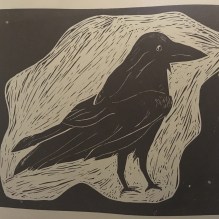
And thank you, Annie, for the raven linocut I’m finishing with. I might want to fly with the wings of eagles, but a keen eyed scavenger with a rude clarion cronk (thanks, Chris!) will do me just fine –

– and is probably just right. 

Emmett and Caleb and

The book Emmett and Caleb is a simple story about two friends, an exploration of friendship DE186CC4-0C87-4FD2-B161-7040A806FA69not unlike DuBuc’s Up the Mountain. Hottois and Renon give us a bear and a deer who live next door to each other, and we follow them through a year and through the ups and downs of their friendship. They live in a world where a deer can check the internet in bed, and where a bear can roast chestnuts.

Ian Eagleton has already laid bare much of the complexity around this relationship in his revealing interview with the author, which is linked here. Karen Hottois says so much in her responses I couldn’t better it. There is lots more, both in the book and the interview  – nature, landscape, the seasons, freedom: I’ve tagged this post “spirituality” precisely because of this richness and the interior life of the characters it reveals.

Sarah Ardizonne the translator has deliberately chosen to use the word “love” where the French original uses “aimer, ” as an indicator of the relationship between the two characters, and Karen Hottois is clear about her intention when she talks with Ian:

To me, Emmett and Caleb are friends but I did indeed deliberately write in such a way that they might be something else. First of all because I think that the contours of a relationship aren’t always clear-cut and because I wanted my readers (children and parents alike) to be able to interpret it as they want. Nothing gives me more pleasure than when I’m told that same-sex parents enjoy the book and can identify with it.

Let’s unpick that paragraph a moment. Hottois isn’t sidestepping the question about the relationship between the two animals at all; rather she is meeting a very big question about friendship head-on.  What language do we use for a strong male-male relationship?

To start with I want to return to this blog post from a while back. I based it on the illuminating messages of Dennis Tirsch, which I expanded to say that

The sacred is not defined by how it might be attained but by how it is  boundaried by reverence.

And this caution, this reverence, is what gives me great joy when reading Emmett and  Caleb – as much as when a friend calls me to meet.  It is there too in the physicality of relationships: hugs, the touch of a hand, whatever; and in the ways these physical expressions of friendship are like and unlike the ones that are part and parcel of being a dad, or even part and parcel of more involved romantic and intimate relationships. Except I’m not sure I like intimacy as a euphemism: Emmett and Caleb do not have a sexual relationship that we can see, but their relationship is certainly intimate. In a certain sense  whether their relationship is sexual doesn’t matter in the story: real intimacy is what is at the heart of the book.

Now, this sounds like a cop-out. “They don’t need to be gay like that, just really good friends” sounds like something from my parents, and that’s not what I think at all.  I do think that Love is a powerful word, and maybe it is scarily powerful for many men, but physical expressions of intimacy are not impossible. I take joy when I meet a friend in the Weston Cafe for coffee; likewise I have friends I can cry with, share poems with; friends I have taken a cup of tea in bed; friends I can dance with, borrow clothes off; friends I kiss when I haven’t got a cold; friends I have lent my dressing gown to (and readers of Emmett and Caleb will understand the references). With some friends I share really difficult stuff about my emotions, or about the pains of growing old, or the schlep of parenthood.  The Venn diagrams for all these would look like a kaleidoscope, and changes in culture change the patterns we discern, but it isn’t easy, because the word Love is not always accessible to men.

Sometimes that feels unfair: love is such a complex and involving thing, but it should be possible for men to use the term.  It’s there, but not nameable. It “dares not speak its name” because its meaning is so often seen as not complex, a simple dart of Cupid.  I cannot deny the two characters in this book that feeling, of course: books are interpretation places and anyone who comes to a book can approach it and savour it as they wish.   I can also see the tender and committed affection between bear and deer  at various points when they are tearful, or sharing the winter cold, or whatever – but it is as complicated for Emmett and Caleb as it is for us. I called this post Emmet and Caleb and because whatever the interpretation of their relationship, it stands for so many others.  They stand for me and my friends. When the deer and the bear struggle to express their feelings and they tussle about poems and messages, I am fully in agreement with Karen Hottois when she says that

the contours of a relationship aren’t always clear-cut.

This emerged last year in the context of professional use of the word Love, too, which I discussed and is increasingly present in children’s literature. In Keith Negley’s Tough Guys (Have Feelings Too) , which I have mentioned before, and which comes up in the work on masculinities and fatherhood Mat and to some extent I have been exploring, seriously characteristic, even caricature male figures – superheroes, wrestlers – are shown to have a similar relationship to their emotions. I am glad they are vulnerable – very glad this vulnerability is on show in a book for children.  Mat calls it an “optimistic and liberating story of starting down the road to a sense of emotional freedom for the modern man and father.“ Emmett and Caleb, too, live in a world where they enjoy the change of seasons, a last dance at the end of a party, thinking about each other’s birthdays… They do not live in a bloke culture where everything is painfully clear cut. And I am glad they don’t – and again, glad that this relationship is open to interpretation, to discussion, to ambiguity. My world is like that, too.

To concentrate on who Emmett and Caleb might be “in real life” or what that real life might consist of is to miss something important: the role of closeness in male friendship, a sustaining, honest closeness.

Emmett brought Caleb his dressing gown. They stayed there, keeping each other warm.

Together, like that, they could last the whole winter.

Yes, we read this and really believe they could.


Underland and Overstory

He still binges on old-school reading. At night he pores over mind-bending epics that reveal the true scandals of time and matter. Sweeping tales of generational spaceship arks…There’s a story he’s waiting for, long before he comes across it.

Richard Powers, The Overstory, Neelay Mehta

I read.  I read fast, slow, recite, note, on line, in paper books, out loud, in silence.  I’m not unusual in this, even in the binge-reading of some of the books that have come my way recently.  I do find it tiring, sometimes, even, oddly unnerving to see a TBR (To Be Read) pile mounting – but still compulsive. Like Patricia in The Overstory:

Then the reading, her nightly thousand-mile walk to the gulf. When her eyes won’t stay open any longer, she finishes with verse…

The walk for me includes all those classics unread, new books set to educate and delight, those well-loved books from the past that I have loved long since and lost awhile; re-reading is about depth but is also about limit and comfort, too (I finish with M R James more often: verse just makes me want to write)… The urge to read is maybe one reason why I go back to well-loved favourites ( for example, I have just got my third copy of C S Lewis’ That Hideous Strength*), even when tired at the end of a day.

Just sometimes, however, a pile of books present themselves that are of such quality that any sense of “one sodding thing after another” (to reuse the judgement on history from one of Alan Bennett’s  History Boys) is completely lost. As the title of this post suggests, they are Rob Macfarlane’s magisterial Underland and Richard Powers’ The Overstory.  In this case it’s two books: not really a pile.

“Reading,” Margaret Meek suggests, “demands explanations beyond the information given about the surface features of language, important as that undoubtedly is.”  It is with this in mind that I reached nearly half-way through Overstory and found this line, the culmination (or at least first-act closer) of the story of a botanist who discovers that forests are themselves ecological systems with their own means of communication:

There are a hundred thousand species of love, separately invented, each more ingenious than the last, and every one of them keeps making things.

The echoes with Underland and the wonderfully named Merlin Sheldrake do not need repeating. Woodlands are not there to be judged as needing tidying.   – except that the human users want things a certain way. On the way I often run, for example, there is a young dead badger: already a bit bloated, with flies on its fur and the sweet smell starting. Do I look at it as part of a massive pattern, a fractal maybe, which at my level is discernible as flies and fungus and young trees and older ones, soil that was the badger’s life – or do I impose my need, even the drive of my spirituality (misplaced, I think) to show it respect?  In reading Underland and then The Overstory, I know how illiterate I am, like Powers’ prisoner, here:

If he could read, if he could translate…If he were only a slightly different creature, then he might learn all about how the sun shone and the rain fell and which way the wind blew against this trunk for how hard and long. He might decode the vast projects that the soil organised, the murderous freezes, the suffering and the struggle, shortfalls and surpluses, the attacks repelled, the years of luxury, the storms outlived, the sum of all the threats and chances that came from every direction in every season this tree has ever lived.

Leave the badger by the path in the wood, move it, bury it?  Clear it up, and the pattern shifts: do we intrude by trying to make sense or enter the dance? Write about the history of Warneford Meadow in an effort to explain these scrubby trees to one side in what is grandly called a wildlife corridor? Look (as Paul Kingsnorth does in his essay on Burnham Beeches in Arboreal) at the networks of mycelial threads even here?  Maybe seeing it is our part in the pattern?  I confess that, in reading these books, I have been feeling elated and dismayed, disepmowered and propelled to try and and understand. And if we don’t try, then, bleakly as one character finds 

All that’s left to sell up here is nostalgia.

All we have left is commodification, where even story is no longer an invitation to greater understanding but simply the cheap tricks of landscape depiction, a collection of backdrops and no more.

Arboreal, Common Ground, Underland, The Overstory and so much magnificent writing all stand as a challenge.

Turn but a stone and start a wing

or miss the many-splendoured thing?

IMG_0245


_____________

*As a diversion: To me Lewis’ That Hideous Strength is a book at once of its time and horrifyingly prescient in its vision of popularist seizing of media and power that is accompanied by radical and appalling dehumanisation. I admire some bits (the almost-not-there Institute Director who roams the corridors: every academic has known him), I love others (the discussion between Merlin and the C20th academic who has to bring him up to date), and have to say I wince at others – not least the final paragraphs). Of its time is a periphrasis or maybe euphemism for the fact that it is all terribly clubbable, Oxbridgy stuff with a deep theology of sexism thrown in…  So why the re-read?

Story

I love being outside, and from camping and hiking with the Woodcraft Folk on, I’ve loved storytelling outside too. I love warm summer days teaching, and this time earlier in July with Home Start was a joy in so many ways (I mentioned them in the previous two posts). 8325C7B0-0434-46B0-8C8C-F84C42D6F1E4Anna from Home Start has been kind enough to let me reuse the pictures she took, and I’m vain enough to have picked this photo. “You’ve got your gob open,” was the immediate family comment. Yes, I have: it is at once in the same tradition and a long way from all those MSS of the medieval Magister spouting in a lecture.  I was reminded sharply while I was working with their volunteers of the story in Kevin Crossley-Holland and Jill Paton Walsh’s Wordhoard in which the new teacher in the monastery school lets the boys out to read and learn in the orchard.
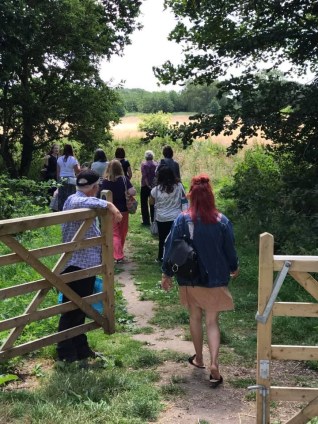
The perspicacious will also note that I’m not reading a story at this point, but discussing an article, down by my side – specifically Wyver et al (2010) The Ways to Restrict Children’s Freedom to Play: the problem of surplus safety, Contemporary Issues in Early Childhood Vol 11, no 3 – to explain something about safety and families. I love exploring that article; it is such a judicious mix of research synthesis and plain common sense.  But of course I did it with a story and it’s that pedagogic tool I first want to reflect on.

Teaching isn’t stand-up, I know, but there is always some room for a story in teaching, whether it’s through sharing a book (Anthony Browne this time; maybe Up The Mountain next time?), or a traditional tale told orally (next time I meet Home Start will be the autumn: I think hallowe’en pumpkins may get a look-in), or an anecdote to illustrate a point. This episode in our morning’s training was about giving parents permission – if such a thing is needed – to do a little bit of thinking ahead and then to let the children explore. The group picked up on the phrase surplus safety.  It’s not without risk, and the story I told was of a boy who fell while out of Forest School whose dad said to me “He never has an accident with me; he’s always in his pushchair.” The spin I put on it was that children need to be given opportunities. As Shirley Wyver and team point out:

They [sc children] will make postural adjustments to maximise stability and efficiency….

and they suggest that early protection from falling can limit the problem-solving a child needs to do on unfamiliar terrain. We discussed the section in Wyver’s article where she suggests it’s a mistake to think small children are not good walkers: children need to exercise (and so, often, do we). And walking brings us away from the adult as in charge, the story-teller/performer.

SDB7B4F32-2A3A-4B43-8D47-1D6FD937FACAtory is not all that happens outside. The very experience itself affords the chance to chat, to wander, to find a new way or a new place – and this is the problem with story as outdoor pedagogy: it is still too close to the teacher-as-Master. Again, this was something we discussed, and I confessed how hard I find it not to jump in and explain: this is called n…; that x is brilliant because it smells like…  While there is clearly a place for “the naming of parts,” for the acquisition of agreed names, there must also be time for independent discovery, for the friend who brings you an egg-shell they have found, for the ladybird on the hand, the sound of the wind in the grass, or even, simply – as one of the people I was with pointed out – that not all grass in green. Warneford Meadow lived up to my praise of it: the grasses were purple and tawny-gold.
The Great Events?

55BCE, 597CE, 793CE, 1066CE, 1282CE, 1534CE, 1588CE, 1649CE, 1707CE, 1714CE, 1922CE…  pick your date for an event or series of events that define England, or Britain. There are others, and the ones I have chosen may say more about my poor historical knowledge or prejudice than anything. There are also occurrences which pass without comment at the time or which we cannot date certainly because no record exists: when really does Britain cease to be Roman? Or when did the last wolf die? Why does one date matter? Will the referendum on 23rd June 2016 be eclipsed by a final unequivocal date or will that be the one history picks as the The Date We Left Europe? The Date Things Changed?

We cannot dictate, and maybe can’t predict with certainty. Perhaps something else will intervene to take precedence – the failure of electricity, a catastrophic event such as the melting of the polar ice? What does strike me is that this simplistic history suggests that one date was important, and that the messiness before or after are somehow lesser occurrences that don’t matter. And that the massive changes were not contested, opposed, or that those who did contest were ridiculed, sacked, sidelined, imprisoned, killed. I feel as if I signed the Terms and Conditions for C21st without reading them, and I think of Tom Holland’s brilliant book on the Millennium, where in effect Western Europe did try and sign particular Ts&Cs only to find a new millennium just as complex and hard. A single date just doesn’t work. 1066 is one date: do we (and I need to exclude historians here, of course) consider the harrying of the North?

The counsellors in the decades/centuries of Christian consolidation; subjugated  Saxons after the death of Harold in 1066; recusant Catholics – all these people would attest that these great events are never simple. These “events that shaped Britain” were the cause of pain and unquiet: families divided, economic disturbance… and we are seeing the same in our time, in ways I never thought to see, never wanted to see. “Project Fear,” in which the UK suffers terrible upheaval, may not come to pass, or it may – but this evening I am wondering quite what will come. I suspect it’s going to be big, and an unpleasant change. I am gloomy, and predict a rowing back from liberties won, well-being improved. I feel the sharp tug of solastalgia.

Why is this part of this blog? Over the next few days I will have the pleasure of being outside with learners of various kinds. Some theory, lots of practice: a challenge for me, but a very welcome one. I will be making a plea – directly and indirectly – for the pleasure of being outside to be seen as a driver of a life well lived. Ecological wrongdoing in the Anthropocene will impact on people’s wellbeing; economic changes, greed and “austerity” planning may mean that parks and woodland will change. But I hope that people – maybe the young people I meet or the families they will work with – will still see the energy of plants and bugs and the movement of clouds and look for joy and delight and maybe transcendence.

Because all these things are transient, this Jeremiad included. And I think that with the little time I have, I want to help people find joy in the small things, and see our interconnectedness with bigger ones:

I want you to walk out into the fields
where the water is shining, and the rice has risen.
I want you to stand there, far from the white tablecloth.
I want you to fill your hands with the mud, like a blessing.

Yes, Mary Oliver does it again, this time in her poem Rice.

Underland Thoughts II

More selections and thoughts arising from them as I revisit Rob Macfarlane’s Underland. Again, quotations will dominate, with the uncomfortable balancing act of celebrating a great work and wanting to preserve its voice, yet not wanting simply to reproduce it. If you have got this far with me and haven’t bought the book, maybe you should. I am tempted to buy another copy and have it interleaved so I can take note after note.

To back track a little. The previous post left the author in a storm by the caves of ancient cave art, where his journey is remembered

…mostly as metals. Silver of the pass. Iron of the bay and its clouds. Rare gold of the sky. Zinc of the storm in its full fury. Bronze and copper of the sea to the south as I escape.   p254*

We are still, in ch 9, in Norway, now looking at the Maelstrom,

the underland of the sea   p291

and the complexities of the economics of oil and fishing. The pace changes, and human characters – never far from the narrative throughout most of Underland – are more important. Human geography – and our need to sanitise our use of resources:

Those industries [extracting oil] understand the market need for alienated labour, hidden infrastructure and the strategic concealment of both the slow violence of environmental degradation and the quick violence of accidents.   p311

I had not heard the term solastalgia, the “distress cause by environmental change,” so this is eye-opening:

the unhappiness of people whose landscapes were being transformed about them by forces beyond their control… We might consider John Clare a solastalgic poet, witnessing his native Northamptonshire countryside disrupted by enclosure in the 1810s… a modern uncanny, in which a familiar place is rendered unrecognizable by climate change or corporate action: the home becomes unhomely around its inhabitants.   p317

and we walk a shoreline of human detritus.

Nature is no longer only a remote peak shining in the sun or a raptor hunting over birch woods – it is also tidelines thickened with drift plastic, or methane clathrates decomposing over millions of square miles of warming permafrost.   p321

Kulusk now, in Greenland, and the global melt releasing anthrax and revealing hidden military bases.

unweder – unweather  p334

and

uggianaqtuq – to behave strangely  p335

and because this section is about exploration of the underland of Greenland, Rob gives us a meditation on ice:

Ice has a memory. It remembers in detail and it remembers for a million years or more.

Ice remembers forest fires and rising sea. Ice remembers the chemical composition of the air around the start of the last Ice Age, 110,000 years ago. It remembers  how many days of sunshine fell upon it in a summer 50,000 years ago.  It remembers the temperature in the clouds at a moment of snowfall early in the Holocene… It remembers the smelting boom of the Romans…

Ice has a memory and the colour of this memory is blue.   p337-8

And then we are off into a glacial landscape where orange lichens and emerald leaves of dwarf willow stand out. The boom of breaking ice, and in the Northern Lights

The mountains shoot jade searchlights into space.     p346

Rob descends into a moulin, a meltwater shaft in a glacier,

a portal giving access to the blue underland of ice.   p369

and witnesses – with a vivid, almost Chthulhu-like horror a short quotation could not reproduce – the upsurge of a massive berg, ice broken from a glacier.

The penultimate section, ch 12, is no less shocking: our exploration of the “tomb” (RMc’s word) or deep storage facility for our nuclear waste:

The tombs that we have constructed to receive these remains are known as geological repositories, and they are the Cloaca Maxima – the Great Sewer – of our species.    p400

They are designed to outlast us, something I find appalling. And even though much of what we create will outlast the individual maker, this is legacy on an altogether different scale.  Death haunts so much of this book – echoing the human pattern of burial to preserve or to conceal – until we meet the challenge:

What legacies will we leave behind, not only for the generations that succeed us, but also for the epochs and species that will come after ours? Are we being good ancestors?     p410

How do we tell these people/these creatures of a time to come not to disturb the toxic giant we are interring?

Oh, Underland has so much more, even in my own reading, IMG_0149to highlight, to praise, to explore, to discuss, but this is a book to read slowly and then to return to. These notes are for me, really, and some of what I see or connect with seems nefas to share here.   As a final non-sharing, I will say that the last, short section, a return home like in The Wild Places, reduced me to tears.

________________

*Page references are to Macfarlane, R (2019). Underland: a deep time journey. London: Hamish Hamilton.

NB The Guardian has a resource of stuff they have produced around Robert Macfarlane, which includes his own very thoughtful illustrated essay arising out of Underland.