HE and EY – what really makes for quality teaching?

Some while back I made a point about how cycling might be underpinned by similar principles to the key themes of EYFS, and it reminded me of how often I made a similar point about teaching in Early Years and teaching in HE when I first came to Oxford Brookes on my CertTHE (not perhaps always successfully). But recent conversations face to face and on Twitter prompt me to revisit the key themes of EYFS and what might constitute good pedagogy in HE.

Here are the outlines of the key principles:

  • every child is a unique child, who is constantly learning and can be resilient, capable, confident and self-assured;
  • children learn to be strong and independent through positive relationships;
  • children learn and develop well in enabling environments, in which their experiences respond to their individual needs and there is a strong partnership between practitioners and parents and/or carers; and
  • children develop and learn in different ways and at different rates.

and with a bit of translation:

  • Every student is unique, who is constantly learning and can be resilient, capable, confident and self-assured; but how do we show that we are working on this principle? How does systems-led HE do this except on a personal contact level?
  • Students learn to be strong and independent through positive relationships; and what do lecturers do to foster these relationships?
  • Students learn and develop well in enabling environments, in which their experiences respond to their individual needs and there is a strong partnership between lecturers and student support… And how do we ensure that enabling can happen in stuffy or chilly classrooms, in over-flashy or dowdy work areas? Who enables? Save us from the Student Enablement SubCommittee!

But what about “students develop and learn in different ways and at different rates”? Can we recognise this? Should we? Where does flexibility support learned helplessness? Where does system-first higher ed fail the rising number of students who come to University with a long way to go emotionally or academically?
 

For whom do we write the (outdoors) curriculum?

Morey Schwartz asked in 2006 (J. CURRICULUM STUDIES, 2006, VOL. 38, NO. 4, 449–457) “For whom do we write the curriculum?” and proposes an interesting model around the “rehearsal curriculum:”

“The teacher finds an exciting blueprint in the curriculum that enables her or him to teach from a new perspective—something that could not have been possible without studying the curriculum. In other words, our ‘curriculum-users’ have become the actual ‘curriculum-receivers’. While the curriculum may be designed for students, it is the way that it engages and educates teachers that constitutes the key to its success…

“A rehearsal curriculum is written in a way that prepares teachers for the teaching experience by prompting them to go through the same process of learning that will be used in the classroom.”(2006:454)

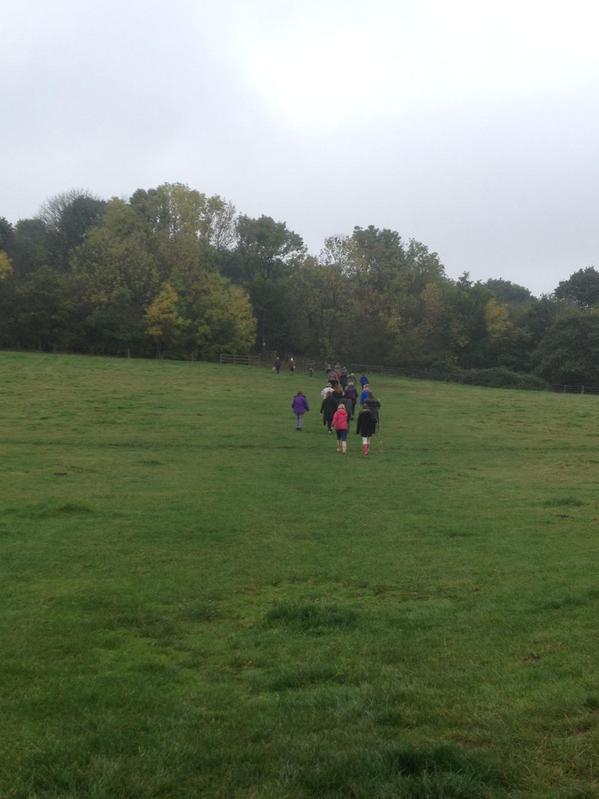
I reflected on this as I walked up for my preparatory visit to Cumnor Hurst along the path beyond the campus.  Here are things the students might pick up; here are things I must warn them about; these are the affordances; these are hazards. In some ways it’s not that different from checking the provision in the garden at the start of the nursery day.

However, it has another side to it if we move deeper into the world of educational metaphor. My rehearsal curriculum not only entails a revision of my (self-chosen) learning tasks, for also all those previous rounds of reflection on outdoor learning, the sessions that have gone well, and those that have not – and why. Serious reflection does allow for what Schwartz calls “disjuncture,” and this can be a challenge to the educator (and I remembered the time the students were unwilling to walk any more than 20 mins from campus). This is in line, of course, with the kind of activity I might think of as a spur to quality reflection – and indeed is a point for reflection/evidence is the HEA/Brookes OCSLD audit I’ve been looking at today which asks me to reflect on “Successful engagement in appropriate teaching practices” – because for me, successful engagement isn’t about being a Superteacher (I have been wary of these since my PGCE nearly thirty years ago), it’s about knowing what goes well, what went well, and how it can be improved.

So there’s my first marker on the path: engagement is about reflection, not just delivery. What do the students pick up? If it’s about engagement at HE level, surely the picking up is partly an independent thing: they pick up what might be afforded by the learning, not the things I list.  Their engagement starts from the pact we make in teaching and learning. We engage together, and my “writing” a syllabus/curriculum for outdoor learning begins from this principle.

U70124 arrive at Cumnor Hurst

But if academics see themselves not as creators of syllabi or curricula but as consumers (as Schwartz is suggesting), then the whole process of module design takes on a new dimension. “Module design” is never a creatio ex nihilo; it never springs from nowhere, but has some important elements in its formation:

  • Context in terms of the academic project on a macro level: why University?
  • Content in terms of the local context: why this course? Why this level?
  • Content in terms of restraints – social; resource-driven; interest-driven.

And if we see module design as an iterative process, all three of these come into play each time we open up the module to redesign – termly/by semester, weekly, session by session.

Why is what I have planned for Friday worth thinking about for a University course? Why, for example, do we really not need pond dipping in the module? How do I keep the content of the module current (recent research, the ever-shifting grounds of policy, the constantly changing needs of different student groups), and how do I present the course at an appropriate level?  How (and I began to ponder this in the summer, under Strawberries) do I keep it current without jumping on bandwagons? Has the team got the staff, the kit, the environment it needs? Will the students “get something out of” the class? Will I? For whom do we write the outdoors curriculum – and do I include myself in the plan to learn? Engagement takes into account constraints and context as well as some nebulous “what I want to teach.”

If I follow Schwartz’ argument, the fact that I am asking these questions indicates I see my curriculum (if I can call it that) as a “rehearsal curriculum:” the challenge moves onto how I know I am learning, enacting the things I’ve been reflecting on: how do I ensure (although I dread the word) impact?

On that note of challenge or self-doubt, I’ll leave it there for now: I have a class to prepare for tomorrow.

In my personal opinion, I feel

A particular bugbear stands at my shoulder, and I can’t do much more at this stage than warn the unwary. Here be dragons.

Consider this paragraph:

In my opinion, when children play outdoors they are getting a lot more out of it than just exercise. In fact, Louv (2006) goes so far as to state that this is a “nature-deficit disorder” (2006:8). I’m not sure I would call being outdoors “Nature’s Ritalin,” (2006:103) but it is really fantastic to see children allowed to be hyper outside and come in calm for work.

OK, it’s a compilation of three different (not very successful) essays which discuss Louv’s ideas.  The problems are highlighted (yes, really: but highlighted really means “marked with a highlight,” not just “stated”) here:

In my opinion, when children play outdoors they are getting a lot more out of it than just exercise. In fact, Louv (2006) goes so far as to state that this is a “nature-deficit disorder” (2006:8). I’m not sure I would call being outdoors “Nature’s Ritalin,” (2006:103) but it is really fantastic to see children allowed to be hyper outside and come in calm for work. So, when Vygotsky tells us “play is  the source of development,” (in Wild and Mitchell, 2007: 106), and Bruce (1991) talks about a high-level play that assists developing child, I think that play should be seen as the motivation that allows learning  &c., &c.

Let’s take them one-by-one:

“In my opinion” and “In fact” are simply not needed. They are colloquialisms that fill up the void when we talk but have no real place here.  “I’m not sure I would call being outdoors…” shows that the writer, having been allowed to use the first person, is allowing her/his own voice to dominate – see the final sentence. “Fantastic” is weak, but stems from the pervasive colloquial tone, as does “hyper,” which is fake-medical and inexact. The final sentence  shows that the writer has allowed her/himself to slip into the false thinking that this debate is happening entirely within their own frame of reference, that their judgement trumps a major theorist of the past and one of the present. Vygotsky is one voice, Bruce is another, “but I think….”

This requires us to take several steps back – to the start of preparing for the assignment, where reading, not opinion must take precedence.  I read an essay like this and think “If I were you, I wouldn’t start from here.”


Polonius

It is always a bit tricky to give people advice when they start a a new venture. It is parodied in Hamlet (Act 1 sc 3) like this:
And these few precepts in thy memory
Look thou character. Give thy thoughts no tongue,
Nor any unproportion’d thought his act.
Be thou familiar, but by no means vulgar:
Those friends thou hast, and their adoption tried,
Grapple them unto thy soul with hoops of steel;
But do not dull thy palm with entertainment
Of each new-hatch’d, unfledg’d comrade. Beware
Of entrance to a quarrel; but being in,
Bear’t that th’ opposed may beware of thee.
Give every man thine ear, but few thy voice;
Take each man’s censure, but reserve thy judgment.
Costly thy habit as thy purse can buy,
But not express’d in fancy; rich, not gaudy;
For the apparel oft proclaims the man,
And they in France of the best rank and station
Are most select and generous, chief in that.
Neither a borrower nor a lender be;
For loan oft loses both itself and friend,
And borrowing dulls the edge of husbandry.
This above all- to thine own self be true,
And it must follow, as the night the day,
Thou canst not then be false to any man.
Farewell. My blessing season this in thee!

and it would be possible to give similar advice today (I come close  to it in my previous post). How do you get on with other people as a young person in an unfamiliar environment? Polonius’ threadbare advice is to make and keep friends; dress well but not showily – and keep to your budget – and if you get into an argument make sure you win. Is this really the advice we’d want people to get as induction activities start at Brookes and elsewhere?

There’s an interesting look at this in Dave Aldridge’s blog which in turn cites this paper by Simon Edwards from Portsmouth. It might be about “academies” rather than “The Academy” (ie University), but has this interesting statement:

Relationships were viewed as a collaborative project where particular practices and attributes were valued as supporting the development and managing of relationships.

Relationships are collaborative. In University this is true, too: groups are set up and worked at by lecturers, and by students, too; but they are to be worked at (worked at by staff and students: this is not one of those “Ain’t this cohort dreadful?” posts). The writer goes on to suggest that

the task of everyday life in the school classroom for these young people was to bridge the gap between individuality, which was their fate and the practical and realistic capacity for self-assertion, which for them was located in collaborative relationships. Constant testing of relationships was critical to in order to orientate the self-project within relationships where there was no original self and no authentic representation of this original self. Therefore maintaining the flow of relationships and the narrative was more important than the space in which the young people occupied.

In looking (as we are this year) at the ways in which we can support well-being in the University (without losing sight of other critical parts of the task of academia), we need to look at the ways in which we demand academic probity, writing skills and effective relationships all at once from students – and how the successful student is very often the one who can manage the adult relationships (student-tutor as well as student-student) in such a way that there is an “authentic representation of this original self” – other words, as one Polonius-like figure told me before I went to University in the 70s, “Don’t be in a rush to become someone else.”

He had a point: relationships – positive ones – sustain and challenge. If we encourage effective working relationships between students and between students and staff, this has to be on a basis that we are all, to some extent, ready to “be ourselves.”

That’s a big ask for any of us.

Transcription

Today’s incident about Biscuits raised an interesting issue about transcription. It’s clear as you read it that I’ve clarified the diction – but what convention might I employ to be absolutely clear about what has been said: “G’an’pa” for “Grandpa,” or “in a post” for “in the post”? When I write “What in the parcel, Grandpa?” it’s not really what I heard – but might I have written “What‘s in the parcel” when there was no “s” and therefore no clear use of a verb? Where does interpreting stop and editing start?


I also feel I have to point out that this particular observation is simply posted because I have really no idea which mental gears were crunching for Ivy to get Biscuiteers and make (perfectly reasonable) sense of it as Biscuit Ears.

Plus it’s astonishingly cute.

Reimagining Spirituality

Sometimes blogging takes off. In this case, Lindsay Jordan, a fellow academic and doctoral student’s reflection on the philosophy of education – sometimes hers, sometimes more generally – produces some really worthwhile stuff.  Go and have a look: she makes a good case, for instance, here, around holistic views of higher education.

And this is why it was worth paying attention when Lindsay tweeted Jonathan Rowson’s report for the Royal Society for the encouragement of Arts, Manufactures and Commerce on spirituality. It is a really good report. It says to me that the spirituality component of our Masters’ module on Children’s Imaginative Worlds should be asked to read, mark and inwardly digest it as a matter of course, and that it is a really useful document for the Undergraduate work on Spirituality that I’ve discussed before, e.g. here and here, where I start from Rowson’s blog.

At a personal level, the passage in which Rowson discusses “the myriad addictions of apparently normal behaviour and [how] what passes for everyday consciousness begins to look like a low-level psychopathology” hits me almost with the force of a passage of Lectio Divina. Perhaps I have to follow the instruction with which the report ends, where Richard Rohr exhorts us  to “live ourselves into new ways of thinking.”

And this is where my own argument falters, and I have not yet worked out how to allow this holistic view of spirituality to develop my (sometimes uncomfortable) position as a member of a faith community teaching spirituality in a secular university. Perhaps, perhaps, it is time to move to a teaching of spirituality that is more open to (respectful) conflict and less eclectic, that allows, as one Muslim student remarked recently, “allows me to really re-evaluate what I believe – not so that I come to disbelieve it, but so that I know what I believe and I believe it stronger.” But does that mean that the academic demands are “best answered through practice rather than theory”? That the module looks at practising spirituality rather than examine it theoretically? Bonaventure, the great Franciscan theologian who recieved his doctorate at the same time as Thomas Aquinas is clear:

“…if you want to understand how this happens, ask it of grace, not of learning; ask it of desire, not of attentive reading; ask it of the betrothed, not of the teacher; ask it of God, not of humanity; ask it of darkness, not of radiance.”

Is this an anti-intellectual stance, or one that is simply demanding learning though practice? And what are its implications for the mixed community of a secular UK university?


Evaluation stumble

Last week I wrote a Moodle Book.

If you don’t know what that is, well, the way I used it, it’s a sequence of pages in a tool on the Brookes Virtual Learning Environment that has allowed me to set up a series of reading activities with videos and questions to ponder around curricular documents from England, Wales, NI and Scotland. Simpler than the bells and whistles of things like Adobe Connect, although I’m sure my version is basic even for the Moodle Book.

I am sort of proud of it, although Sue Cowley’s blog on making raised beds for her allotment was very apt when I read it on Friday. I got better over time.

And on Monday morning – tomorrow as I type – students will go and have a look, maybe dip into a page or two and say “meh,” I should imagine. They may persevere: it’s info needed for the assignment turned into a self-study tool from possibly the dullest class of the whole year.

My problem, really, is the Start-Stop-Carry On activity I gave them when we last met. High-tech stuff, this: a piece of A5 paper with the words Start, Stop and (you guessed it) Carry on, inviting students to say what they felt needed to be done about their module, by adding (‘Start’) or removing (‘Stop’) elements. An ad hoc evaluation.

And the the thing that came out loud and clear was “Stop Doing All This Online Stuff.”

Stop-Start-Carry On becomes Stop Nick in His Tracks.  I’ve done this new one for Monday because I’ve said I would, but the students were all-but unanimous in wanting face-to-face sessions where they could.   This could be because I suck at online learning environments; it could be because of the hidden conservatism of the students. Whatever the reason, I feel I have to ask:

What do we do with evaluation that goes against the grain?

Beyond the Motivational

This from Carl Hendrick is such a good blog post I have to point to it, even if my comments after it are lightweight.

“This type of stuff is obviously well intentioned but beyond symbolising a culture that privileges the media-soundbite over critical reflection, it does I think signify an increasing shift towards psychological interventions aimed at changing student self perception and represents a somewhat base and quite reductive approach to an extremely complex set of issues.”

I wonder how students would feel if instead of feedback such as “You must work on creating paragraphs with a tight and logical structure” we wrote “The first step to change is wanting to,” or “Life isn’t about finding yourself. Life is about creating yourself.”
[Read more here if you really want to.]


Thoughts on Leadership, Management and Ethos

A colleague of mine, an expert in how groups and professionals communicate, once asked me what I felt makes a good leader. I gave her a copy of the Rule of St Benedict.  Oxford Brookes, as I write, is searching for a new Vice-Chancellor; schools continue to face crises as they interview over and over for suitable candidates for headships; ‘my’ PGCE students are gathering their reflections of themselves as they prepare for the step into job applications, as they present themselves, even if only in an initial, local stage, as leaders in education. I still feel Benedict (and the tradition he gives impetus to) have a lot to offer in terms of insights on leadership.

Three things come together this week all (perhaps it’s unsurprising) from Catholic Christian tradition. The first is just part of the publicity, if you like, around Pope Francis’ latest visits. It’s not explicitly Benedictine, but does have a lot in common with the Benedictine rule. Francis is praised for his “Humanity, Humility and Humour,” a “bridge-builder (the first meaning of Pontifex),” a “shepherd who smells like his sheep.”

The second is today’s minor feast of St Placid, the boy monk who almost drowned, and his rescuer, St Maurus, whose obedience to St Benedict (according to St Gregory) effects a miracle. The miracle story might be seen as a message of how important unquestioning obedience is; it might also be seen as a parable of how a leader perceives need, delegates – and (at the end of the story) is unwilling to grab the glory for themselves.

The last was the feast of St Aelred on Monday, whose success in building up the community of Rievaulx was matched by his own penitence (life was not easy in the monastery for a Refusenik of the luxuria of the Scottish court) and his wish to be gentle, kind to his brothers. A short reflection from the ever-busy nuns of Holy Trinity can be found here; a Dominican reflection is here.

Leadership, in these cases, all seem summed up for me in St Aelred’s reflection on being an Abbot.  Aelred’s prayer, the Oratio Pastoralis, is poorly represented on the internet. Here is a taste of it, in my own very wobbly précis/translation.

Teach me, sweet Lord, to bring back trouble-makers, encourage the faint-hearted and support the weak. Let me adapt to the unique qualities of each person, to their character, their likes, their strengths, to their capacity to receive… and since (either because of my physical and spiritual limits or some deep-seated shortcoming) I cannot really help them develop through the example of  my late nights or my penitence, grant me by your mercy to be able to edify them by my humility, love, patience and mercy.

And again, the message comes out clearly, even if through the stained glass of the Middle Ages: humility, humanity… Humour, perhaps, springs from the previous two: if it is a human function, perhaps it could be seen as a prerequisite of a human manager.  There is an element of inclusivity here, a willingness to forgive, to develop people, to see them as individuals. How you might put all this in a job description for a leader, or to be specific an educational leader, I am not at all sure – but they are the essential qualities, I think.


Work in a Chill Month

There is the story that someone is admitted to Hell and is allowed their choice – one choice, and for ever – of punishment. It’s all very Hieronymous Bosch until the man finds a room in which everyone is sitting around drinking tea. The only drawback seems to be that the residents of this particular circle of the Inferno are knee deep in the worst floods of human waste. The stench is appalling but they are sitting about drinking tea.
“Well,” thinks this man, ” of all the punishments I have seen, this one seems the least horrendous.” And he opts for it.
“Are you sure?” he is asked. The man nods. He is ushered in, the door is shut, he is given a cup of tea to drink.
He takes only one sip, when a klaxon sounds, and a demonic voice calls out, “OK, everyone, back on your heads.”

And here we are, all back on our heads (if you like), back to it, with marking and staffing and curriculum design taking up all our time, and brain space being picked at by God-awful news from the wider world.  We know it’s the same with schools, where colleagues are beleaguered, over-worked, victims of the “can you just?” request (as in “can you just write the governors a paper on…” “could I ask you just to set up meetings with the parents?” &c., &c.). It is therefore something of a joy to come across Miss Smith’s clever and positive blog post: Teaching is Wonderful. Read it. Enjoy it. Warm up January.