For whom do we write the (outdoors) curriculum?

Morey Schwartz asked in 2006 (J. CURRICULUM STUDIES, 2006, VOL. 38, NO. 4, 449–457) “For whom do we write the curriculum?” and proposes an interesting model around the “rehearsal curriculum:”

“The teacher finds an exciting blueprint in the curriculum that enables her or him to teach from a new perspective—something that could not have been possible without studying the curriculum. In other words, our ‘curriculum-users’ have become the actual ‘curriculum-receivers’. While the curriculum may be designed for students, it is the way that it engages and educates teachers that constitutes the key to its success…

“A rehearsal curriculum is written in a way that prepares teachers for the teaching experience by prompting them to go through the same process of learning that will be used in the classroom.”(2006:454)

I reflected on this as I walked up for my preparatory visit to Cumnor Hurst along the path beyond the campus.  Here are things the students might pick up; here are things I must warn them about; these are the affordances; these are hazards. In some ways it’s not that different from checking the provision in the garden at the start of the nursery day.

However, it has another side to it if we move deeper into the world of educational metaphor. My rehearsal curriculum not only entails a revision of my (self-chosen) learning tasks, for also all those previous rounds of reflection on outdoor learning, the sessions that have gone well, and those that have not – and why. Serious reflection does allow for what Schwartz calls “disjuncture,” and this can be a challenge to the educator (and I remembered the time the students were unwilling to walk any more than 20 mins from campus). This is in line, of course, with the kind of activity I might think of as a spur to quality reflection – and indeed is a point for reflection/evidence is the HEA/Brookes OCSLD audit I’ve been looking at today which asks me to reflect on “Successful engagement in appropriate teaching practices” – because for me, successful engagement isn’t about being a Superteacher (I have been wary of these since my PGCE nearly thirty years ago), it’s about knowing what goes well, what went well, and how it can be improved.

So there’s my first marker on the path: engagement is about reflection, not just delivery. What do the students pick up? If it’s about engagement at HE level, surely the picking up is partly an independent thing: they pick up what might be afforded by the learning, not the things I list.  Their engagement starts from the pact we make in teaching and learning. We engage together, and my “writing” a syllabus/curriculum for outdoor learning begins from this principle.
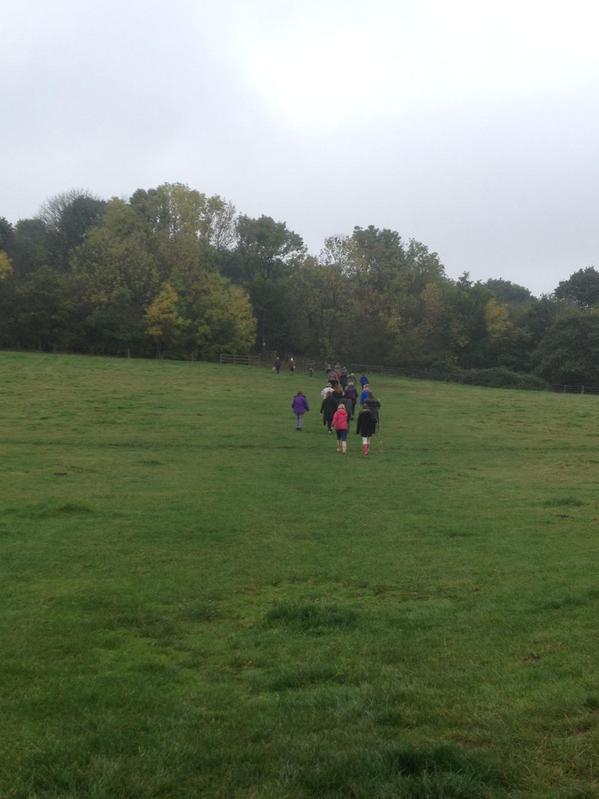
U70124 arrive at Cumnor Hurst

But if academics see themselves not as creators of syllabi or curricula but as consumers (as Schwartz is suggesting), then the whole process of module design takes on a new dimension. “Module design” is never a creatio ex nihilo; it never springs from nowhere, but has some important elements in its formation:

  • Context in terms of the academic project on a macro level: why University?
  • Content in terms of the local context: why this course? Why this level?
  • Content in terms of restraints – social; resource-driven; interest-driven.

And if we see module design as an iterative process, all three of these come into play each time we open up the module to redesign – termly/by semester, weekly, session by session.

Why is what I have planned for Friday worth thinking about for a University course? Why, for example, do we really not need pond dipping in the module? How do I keep the content of the module current (recent research, the ever-shifting grounds of policy, the constantly changing needs of different student groups), and how do I present the course at an appropriate level?  How (and I began to ponder this in the summer, under Strawberries) do I keep it current without jumping on bandwagons? Has the team got the staff, the kit, the environment it needs? Will the students “get something out of” the class? Will I? For whom do we write the outdoors curriculum – and do I include myself in the plan to learn? Engagement takes into account constraints and context as well as some nebulous “what I want to teach.”

If I follow Schwartz’ argument, the fact that I am asking these questions indicates I see my curriculum (if I can call it that) as a “rehearsal curriculum:” the challenge moves onto how I know I am learning, enacting the things I’ve been reflecting on: how do I ensure (although I dread the word) impact?

On that note of challenge or self-doubt, I’ll leave it there for now: I have a class to prepare for tomorrow.
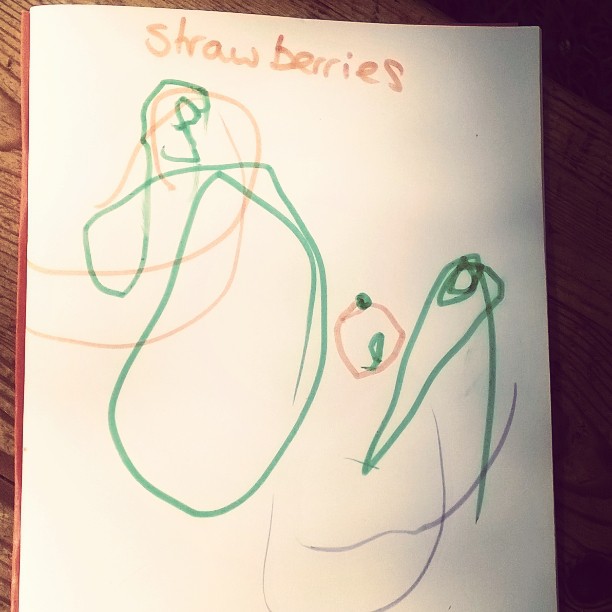
Strawberries

Critical incident:
5 yo picks strawberries, puts them in a bowl, takes them out one by one and either eats them or shares them with me. Some are left for a while, and then she requests a knife, which she uses to chop the rest up. They are left in the bowl, and eventually (when they are inedibly squashy), she returns to them and feeds them (at my suggestion) to the garden chickens.

Reflection

It is an idyllic scene in a garden in June. The child is engaged, her 2yo little sister too (see the drawing below), and there are plenty of opportunities for maths and science and language development  – a real “understanding of the world,” if we remove that term from the curriculum straight-jacket.  It would be very tempting to say that “every child should have the chance to pick strawberries.”

strawberries

That’s the phrase that needs unravelling: it brings with it assumptions about class, expectations, entitlement and the unattended questions about who decides on  a child’s experiences.

Class

This is all taking place in a lawned, private garden with chickens. We may not be talking an estate, but equally the incident is not one on a subsistence farm; we are talking, in current property terms, about a dwelling firmly in the middle classes. So the expectation itself that this is a valuable experience is already close to the idea of comfortable living. The “gaze about the multiplicity of who a child might be and how she might understand her world” (MacNaughton 2005:143) has been blinkered from the start by an unexplored attitude about the normalcy of middle class in the UK.

Entitlement

The “should” is itself therefore problematic. The work of Tina Miller on fathers (see previous blog post) suggests that just as fathering is part of/arises from  a set of views about “embodied selves and structural histories,”  (Miller 2010:38) so too do the practices of Northern-European childhoods. The “should” that may suggest fathers behave in certain ways also acts in a number of ways in the case of children. Proposals of “what children need” pepper Early Education books, and it is right that we have inspiration, leadership, direction – but the “should” is sometimes unexplored, and very often uncontested.  A child “should” be outside because of the tradition of children (particularly boys) being outside to play:

Let the amusements of a child be as much as possible out of doors; let him spend the greater part of every day in the open air; let him exert himself as much as he please, his feelings will tell him when to restand when to begin again; let him be what Nature intended him to be–a happy, laughing, joyous child. Do not let him be always poring over books (1878: 179)

This “nursery inheritance” (cf Brooker 2005: 117ff) brings with it a moral imperative that is likewise unchallenged.  When we talk about entitlement – and we should – what are we using as a yardstick? Do we see strawberry picking as valuable experiential learning about healthy eating? Or as another step in the induction into the middle class? Or an understanding of life processes? Or a replication of a dimly remembered rural past?

Who decides?

Let’s suppose this experience is viewed by someone – well-meaning and powerful – as a key experience for children. On what basis have they decided this? How do they implement it?

  • Is this the practitioner who sees a child enjoying strawberries and thinks about replicating this next year?
  • Is it the parent (or grandparent) who enjoys the time with a child and thinks “this is worth doing”?
  • What would it be like if the Secretary of State were to see the strawberry incident and say

“Every child should have the opportunity to pick and eat strawberries”?

This is not so far-fetched, even though the vision of government-regulated (and measured) strawberry-picking is a reductio ad absurdum.

How does a new project get off the ground? What criteria decide that this or that phonics scheme, or behaviour management approach “works” – and works for whom? This appears to be at the heart of a new book out of the IoE, which I look forward to reading.

To go back to the strawberries, we might ask (and in particular ask our students to enquire of their own experiences)

  • what makes this valuable?
  • what criteria do I use to give this value?
  • how do I communicate its value to the child, to the child’s parents, to managers and policy makers?

How am I an effective advocate for children, not just someone who sees a bandwagon and jumps on it?

References

Brooker, L (2005) “Learning to be a Child: cultural diversity and early years ideology”  in N Yelland (ed) Critical Issues in Early Childhood Education. Maidenhead, Open University Press.

Chavasse, P  (1878, 13th Ed) Advice to a Mother on the Management of her Children. Birmingham. available online http://www.gutenberg.org/cache/epub/6595/pg6595.html

Mac Naugton, G (2005) Doing Foucault in Early Childhood Studies. Abingdon:Routledge

Miller, T (2010) Making Sense of Fatherhood. Cambridge: Cambridge University Press

Wyse, D et al (2015) Exploring Education and Childhood: From current certainties to new visions. Abingdon:Routledge

Fattening a Pig

My father-in-law, Donald, was a Master Joiner who spent a lot of his working life on farms in the vale of York. He was (although this is by-the-way) witty, well read, but not a “success” at school; whatever that means, we are not talking about a father-in-law who was an educationalist. He was, however, a man much given to pithy comments, and when SATs first came in, he once said “You don’t fatten a pig by weighing it.” According to Don, testing, whatever other soundbites might suggest, does not automatically improve standards.

So here I am, on an unreasonably sunny morning, procrastinating about my Easter email backlog and pondering what might be said about tests. I see the opposition to baseline testing is back, from Early Education and others, and from the Unions – and I gather that Tristram Hunt has said he is always ready to “listen to professionals but…”

And today the proposal to re-test children who fail SATs at KS2 is interesting: the language alone is worth a re-read. Look first at the Telegraph‘s report:

Children who fail their primary school leaving exams in English and maths will be made to retake the tests in their first year of secondary school under Conservative plans to ensure there is “zero-tolerance of failure and mediocrity”

Is “failure” at the heart of SATs, then? And are KS2 SATs to be seen as “leaving exams”?

I think I am in favour of giving children a chance to have another go at an assessment task. It may even be (although I am less convinced about this) that a child might do better in a different environment. What is really quite disturbing in the language used by the Telegraph is the shorthand which makes SATs the ultimate arbiter of a child’s success – so much so that they will take them again if necessary.

Of course, this isn’t really what the proposal would be like: children would be allowed to have further teaching that would improve their skills in basic maths and English, and their NuSATs (my neologism) would test how well they were managing to catch up. The BBC have a different take on this:

The test resit plan from the Conservatives, which would be implemented next year, is aimed at making sure that pupils have not already fallen too far behind at the beginning of secondary school.

Pupils who did not get good grades in the Sats tests taken by 11-year-olds in primary school would have to retake a test during their first year after moving up to secondary school.

So let’s hear from the SoS herself:

“If they don’t achieve the required level when they leave Primary School, then in year 7, their first year at Secondary School, they would take slimmed-down tests in English and Maths. They could take these either in the spring term or the summer term.”

and I hope this link to her BBC interview remains stable, since her ipsissima verba are mostly reasonable, not strident, well worth listening to and pondering. It seems to me a wholesome ambition that young people should move from Primary schooling with a strategy in place for all the support they need to make a success of Secondary (I have been marking undergraduate year 1 assignments recently and might comment on English at entry to University at some point – but not today). I am not sure she has really explained here what will happen to make sure the children reach what she calls the “required levels,” and I worry that this may mean that Secondary schools are asked to use what she calls “catch-up money” to brumm children who are “behind” up to a standard that may not really be sustainable but which has got them through their NuSATs. There is a slight unease as I hear her move into what view OfSTED and the DfE might take as they look at “whether the school is letting those children down by not getting them to the required standard…there could be an intervention (NB the word is first used by the Beeb’s interviewer), it could be that other head teachers could come in or offer advice…”

And we are back at what has always seemed to me the main reason for SATs: to assess, not children, but the effectiveness of the school.

So if the pig being weighed is not the child, can we apply my father-in-law’s dictum to systems? Can we over evaluate schools? Is the over-testing of system likely to cause irreparable damage to the system? While I acknowledge they say little about school systems, to finish, here are some YouTube clips in which stretching and stress are used to test materials  from a webbing manufacturer, and from a Lab Test on Stainless Steel.

They are testing products to destruction.  Absit omen.


Evaluation stumble

Last week I wrote a Moodle Book.

If you don’t know what that is, well, the way I used it, it’s a sequence of pages in a tool on the Brookes Virtual Learning Environment that has allowed me to set up a series of reading activities with videos and questions to ponder around curricular documents from England, Wales, NI and Scotland. Simpler than the bells and whistles of things like Adobe Connect, although I’m sure my version is basic even for the Moodle Book.

I am sort of proud of it, although Sue Cowley’s blog on making raised beds for her allotment was very apt when I read it on Friday. I got better over time.

And on Monday morning – tomorrow as I type – students will go and have a look, maybe dip into a page or two and say “meh,” I should imagine. They may persevere: it’s info needed for the assignment turned into a self-study tool from possibly the dullest class of the whole year.

My problem, really, is the Start-Stop-Carry On activity I gave them when we last met. High-tech stuff, this: a piece of A5 paper with the words Start, Stop and (you guessed it) Carry on, inviting students to say what they felt needed to be done about their module, by adding (‘Start’) or removing (‘Stop’) elements. An ad hoc evaluation.

And the the thing that came out loud and clear was “Stop Doing All This Online Stuff.”

Stop-Start-Carry On becomes Stop Nick in His Tracks.  I’ve done this new one for Monday because I’ve said I would, but the students were all-but unanimous in wanting face-to-face sessions where they could.   This could be because I suck at online learning environments; it could be because of the hidden conservatism of the students. Whatever the reason, I feel I have to ask:

What do we do with evaluation that goes against the grain?

Visual Methodologies

Hmmmm.

I’m re-reading Gillian Rose on Visual Methodology, and she has given me a lot to think about.  I’d like to see if I can apply her ideas to some children’s work such as this:

climbing 001


So let’s look at this in more detail.

There are two figures, arms down by their sides, under or at least near a complex climbing frame. Writing explains that the child feels s/he is “very good at playing on the climbing frame.”

Now, I know who did this (I have obscured a name, although I do have the young artist’s permission to share this drawing) and the context, but if we apply Rose’s criteria to it, we need to ask:

  • What is being shown? What are the components of the image?
  • How are they arranged?
  • Is this a contradictory image?
  • What knowledges are being deployed?

At the basic level, what is shown is as I’ve said above, a climbing frame and two figures in proximity to it. There are two components as I read it: humans and climbing frame.   If part of the questioning we need to undertake is around what has been missed out, what is not there is interesting too, however. It might be that we can distinguish here a sort of intransitivity: the climbing frame is not being climbed, and the figures are not climbing it. In the picture there is no sky or grass, no distraction from other equipment. Does this argue for there being a lack of need from the adult for a ‘holding activity’? “Just [go away for five minutes and] colour in the sky”? Or does it argue for purpose or maybe even haste in the interaction between adult and child?

But we might also suggest a third component: the writing, both by the child and the adult. Image and text work together, and are part of the same tradition (of which child and adult are aware) as the picture story book.  The arrangement is one in which this convention is upheld.

Where it is skewed, where it has an element of contradiction,  is in the adult intervention. What is the purpose of this object? The title gives it away: this is a piece of school record keeping, very probably created at the request of an adult “to go in your file.” The child’s writing (and adult transcription) and title and date suggest that this is part of a record-keeping system that tells someone (see below) something (again: more to think of here) about how the child artist-writer sees themselves.

So what knowledges are being deployed? In brief, as a first go at this I propose that we can discern:

  • an understanding of how text and image can work together;
  • an understanding of how to represent the various elements of the climbing frame (including climbers);
  • some understanding of purpose and power in adult-child relationships.

So in looking at this power relationship, we come to the reason the work was created. I suspect, as I said, that this is at the request of the adult – and therefore, to some extent, the adult is the intended reader, the sponsor of the activity. Even in the context of physical play, the child is constrained, as is the adult, to use the event to spawn other events closer to the curricular needs, not of the child, but of the adult: play and the observation (or in this case the self-evaluation) makes it have a purpose the adult world might value.


Beyond the Motivational

This from Carl Hendrick is such a good blog post I have to point to it, even if my comments after it are lightweight.

“This type of stuff is obviously well intentioned but beyond symbolising a culture that privileges the media-soundbite over critical reflection, it does I think signify an increasing shift towards psychological interventions aimed at changing student self perception and represents a somewhat base and quite reductive approach to an extremely complex set of issues.”

I wonder how students would feel if instead of feedback such as “You must work on creating paragraphs with a tight and logical structure” we wrote “The first step to change is wanting to,” or “Life isn’t about finding yourself. Life is about creating yourself.”
[Read more here if you really want to.]


Attention sp

William Pooley raises some interesting questions here about attention span. Should we be “so willing to assume that every individual has a fixed ‘span’ (which can be stretched, or curtailed, perhaps, but still exists as a kind of objective measure)”?   The notion of us needing to maintain or enhance our focus is something Jason Elsom raised earlier this week in his tweet “How to focus in the age of…  SQUIRREL!!!” (@JasonElsom).  In both cases there are undertones of the now well-disseminated TED talk by Ken Robinson in which he claims too much of education is anaesthetising children.

I’d like, however, just to take an anecdotal sideways look at this.

Boys, we all know (because we are told we all know) have poor fine motor control, poor attention span., &c., &c. While William P is right that a serious study needs to be done on attention (I once found some interesting evidence of English monks in the Middle Ages muttering about long, rambling sermons, and attention during prayer has long been the focus of spiritual writers, but that’s even more of a digression), he is also right that this discourse of attention itself needs sustained enquiry. What follows is merely a snapshot.

Evan was having a good time – on and off – with the cars one week. Evan was four. One day he found that smashing trucks down a plank meant that the car crash was more spectacular than brumming them together. He built a ramp with planks and bricks to stop the trucks from falling off the sides. So far, an hour has passed. Group time, tidy-up time. Home time.

The next day he returns to the play, builds up the ramp, asks for some technical help about stopping the planks from sliding off the bricks (masking tape) and returns to his exploration of car crashes. He spends half and hour on this, goes to the loo, comes back – you can see where this is going. His key worker comes and sits with him from time to time, asking questions, finding masking tape, suggesting better cars – and by now fetching them from down the classroom where Evan is by now getting them to zip to. Two hours pass that day.

By the end of the third day, Evan has, in effect, devised an experiment to see whether how steep the ramp is affects how far the cars go. His key worker’s job on his Foundation Stage Profile is nearly done – if that’s a factor here.

My point is that the ‘discourse of attention span,’ when it hits the early years needs to take account of motivation: “Can concentrate on a self-chosen task” is a different thing (almost) entirely from “Can do as s/he is told for at least five minutes without wandering off.” Confusing the two risks misunderstanding the nature of self-motivated learning.


Thoughts on Leadership, Management and Ethos

A colleague of mine, an expert in how groups and professionals communicate, once asked me what I felt makes a good leader. I gave her a copy of the Rule of St Benedict.  Oxford Brookes, as I write, is searching for a new Vice-Chancellor; schools continue to face crises as they interview over and over for suitable candidates for headships; ‘my’ PGCE students are gathering their reflections of themselves as they prepare for the step into job applications, as they present themselves, even if only in an initial, local stage, as leaders in education. I still feel Benedict (and the tradition he gives impetus to) have a lot to offer in terms of insights on leadership.

Three things come together this week all (perhaps it’s unsurprising) from Catholic Christian tradition. The first is just part of the publicity, if you like, around Pope Francis’ latest visits. It’s not explicitly Benedictine, but does have a lot in common with the Benedictine rule. Francis is praised for his “Humanity, Humility and Humour,” a “bridge-builder (the first meaning of Pontifex),” a “shepherd who smells like his sheep.”

The second is today’s minor feast of St Placid, the boy monk who almost drowned, and his rescuer, St Maurus, whose obedience to St Benedict (according to St Gregory) effects a miracle. The miracle story might be seen as a message of how important unquestioning obedience is; it might also be seen as a parable of how a leader perceives need, delegates – and (at the end of the story) is unwilling to grab the glory for themselves.

The last was the feast of St Aelred on Monday, whose success in building up the community of Rievaulx was matched by his own penitence (life was not easy in the monastery for a Refusenik of the luxuria of the Scottish court) and his wish to be gentle, kind to his brothers. A short reflection from the ever-busy nuns of Holy Trinity can be found here; a Dominican reflection is here.

Leadership, in these cases, all seem summed up for me in St Aelred’s reflection on being an Abbot.  Aelred’s prayer, the Oratio Pastoralis, is poorly represented on the internet. Here is a taste of it, in my own very wobbly précis/translation.

Teach me, sweet Lord, to bring back trouble-makers, encourage the faint-hearted and support the weak. Let me adapt to the unique qualities of each person, to their character, their likes, their strengths, to their capacity to receive… and since (either because of my physical and spiritual limits or some deep-seated shortcoming) I cannot really help them develop through the example of  my late nights or my penitence, grant me by your mercy to be able to edify them by my humility, love, patience and mercy.

And again, the message comes out clearly, even if through the stained glass of the Middle Ages: humility, humanity… Humour, perhaps, springs from the previous two: if it is a human function, perhaps it could be seen as a prerequisite of a human manager.  There is an element of inclusivity here, a willingness to forgive, to develop people, to see them as individuals. How you might put all this in a job description for a leader, or to be specific an educational leader, I am not at all sure – but they are the essential qualities, I think.


Alethiometers for All?

Philip Pullman has written some terrific ideas into his “his Dark Materials” trilogy: dust, daemons, armoured bears. Today I was reminded of the Truth-reader, the Alethiometer, the Golden Compass which Lyra the protagonist uses to discern what is happening in various situations.

I was reminded of the compass image by this article on Tristram Hunt’s mission to give teachers an ennobled sense of their profession. http://www.bbc.co.uk/news/education-29482160 The “moral compass,” it would seem, is to be at the heart of Tristram Hunt’s vision of what teachers do: they hand it on.  In the ceremony ( if that’s what’s envisaged: see my posts on liturgy and graduation), newly professed teachers would be given a compass as a symbol that the role of a teacher is “to provide a sense of moral purpose and virtue to young people”.

“There is a teacher’s oath about continuing to learn and to pass on the love of learning.

“I’m very attracted by this notion of having almost a Hippocratic oath about the meaning and purpose of teaching,” he said.

“It’s bolstering the moment of qualification and the meaning of qualification – what it means to become a teacher.

“That seems to be an important idea that we want to explore.

“It can’t just be a gimmick – it has to be part of a commitment to professional development and career pathways.”

The commitment to year-on-year improvement is not to be sneezed at, especially if a new Labour government sees this as a commitment to support teachers’ access to high quality postgraduate study and really effective CPD. I worry that this vision of Hunt’s is a bit of conjuring to move the duty to teachers and away from hard-pressed school budgets.

I also worry quite what a “moral compass” is.  A real compass points to a True North. It smacks of an absolute moral right-or-wrong set of beliefs so that ,when we think about “truth” and “morality”,  teachers are being asked to reproduce a catechism of moral choices, rather than to encourage young people to enquire and challenge, to find standards and values to follow. An Alethiometer is much more of a meditation tool, a mechanised (and non-religious) I Ching that challenged Lyra to think, to reflect.  Pullman is too clever a writer to make this a simple set of instructions in machine form.  ‘”It tells you the truth,'” the Master of Jordan College tells her. ‘”As for how to read it, you’ll have to learn by yourself.”‘

Language, culture and education – a quick advert

Just to draw the eye of anyone who might read this to a series of lunchtime discussions at Harcourt Hill:
Oct. 8th 12.0 – 1.00 Dr. Andrie Yiakoumetti The World in the classroom Room AG/09

Why English? First and second language choices and policies
Which English? English as a lingua franca, English as an International Language and World Englishes
Should teachers of English be teachers of culture?

Oct. 22nd 12.0 – 1.00 Dr. Randall Holme The Language Learner: changing methods Room AG/09

What do language teachers need to know about language learners?: Appropriate methodology and learner contexts..
Why should second language acquisition research matter to the language teacher?

Nov. 5th 12.0 – 1.00 Dr. Paul Wickens The English language: changing methods Room AG/09

How is the corpus changing what we know about English? What does that mean for teaching English?
What should teachers know about language?