They

I had the privilege of working for a short time with Jane Lane, a tireless campaigner (forgive the cliche) against racist attitudes of all shapes and sizes in Early Years.   It is her thoughts I want to reflect on very briefly here.

We were sat one rainy evening in a café working through some documents I think Jane wanted some feedback on, and I can’t remember what sparked it, but Jane looked up from the papers we were reading and she gave us all a warning about words to do with water: floods, and influx were already words that warned of an uncontrollable situation, and therefore carried with them negative connotations. She then said “It’s like ‘They’ and ‘Them.” We looked at her, and she went on to say “If someone talks about immigrant children as “they” you know we’re facing a lot of trouble.”

It’s the lumping of people together that, to a greater or lesser extent depending on context, denies their personhood. That’s why when @elly_chapple today on Twitter described inclusion being about humanity, I was back in that rainy café. Inclusion is a problematic term, or at least one we have been asked to ponder at the start of Brookes ITT Inclusion week (#obuinc19), because it is multifaceted, moveable according to who we are talking to or about, evolving (we’d hope) as our capacities and reflective practice change. The head teacher who has staff wellbeing to think about; the teacher whose relationship with the parents hangs on That Tone of Voice when she meets them at the end of a day; the TA whose time is punctuated by demands for all sorts of expertise; the child herself.  And this is (so far) one child who needs to be included in the educational project of the school, or the county or whatever; inclusion also has to look at the system-drivers and system-users for Child A who has a hearing loss; for Child B who has foetal alcohol syndrome and is in the Looked-After system; for Child C on the Autistic spectrum… and the temptation is to reach for the They. “Yes we are proud of our inclusive ethos in the school,” says the head, beaming with good intentions. “They are well catered for.” And no doubt the needs are well met within the system.

But inclusion has to go beyond the system. It has to go beyond the number-crunching to the needs – and not just the shortcomings and deficiencies – of the children or their families. It has to embrace, as Elly says, their humanity. It’s therefore not about coping with (or solving) problems, but meeting the child and the family (and those they come into contact with) where they are.  Maybe it’s about a smile, a good word as well as a “Can I see you about…”  It’s certainly about seeing the child in focus as part of a wider set of societal expectations, but also seeing them as an individual, and definitely not as “one of Them.” Think how many of us might  have been excluded at one time or another by being part of “Them;” think how fragile the right not to be seen like that can seem to some sectors of society here or elsewhere.

To those who work with the complexities of atypical development, critical social need or physical or sensory challenge this is probably self-evident. I’m just not convinced that the children and families always hear this, always are aware that they are not They.

Compassion, Charity, Grace and a Hug

I have a big book on my lap. Well, it’s no Codex Amiatinus and actually claims to be concise. At 1840+  pages the Encyclopedia of Theology: a Concise Sacramentum Mundi might be full of “major articles on theology, biblical science and related topics from the (six volume) Sacramentum Mundi,” but concise it isn’t.

It’s also interesting to see what words it homes in on and what it does not. The apparent gaps and highlights show us, in part, how language changes and how with it (before it, after it) beliefs and attitudes. So I turn to the contents. A is for Afterlife, Agnosticism, Angels… M is for Magisterium, Man, Mariology… and it finishes with W: World and Worship. Compassion, I note, is missing, as is Love (if you’re wanting to know, Sex, Celibacy and Marriage all have sections). But Charity is there.  Reading Charity is interesting for what it says about language, as I mentioned (“Men feel bound to love others in proportion to their ‘social proximity'” reads as stickily old-fashioned) and its dryness is something of a challenge: “Love of the neighbour determines the basic structure of the moral act;” “The ‘transcendental depth’ of man in the encounter with the ‘other’ always points beyond itself, at least implicitly, to God…” It is clear the author (Waldemar Molinski) is talking about an active love of a real other person, but the vision seems to lack all sorts of attributes, not least everyday attention and  affection. There is no coffee here, there are no hugs: love with no humanity. In some ways that was, of course, the brief: this is an encyclopedia, after all.

Looking beyond Christian theology there are sources with more immediate appeal – even ones mentioned in this blog: vulnerability with Mike Armiger; Geoff Taggart’s compassionate pedagogy; and then Dennis Tirsch whom I quote in this blog post on sacredness:

A good relationship is a sacred space that can safely contain how we think and feel, along with our potentially painful histories + the whole of who we are.

In calling for a recognition of the sacredness of a good relationship we are actually closer (in thought if not in language) to the Charity article than it at first appears: recognising the reality of the other person is at the heart of Christian living. But Tirsch, I think, and my atheist and agnostic and Buddhist friends would not see Christian morality (when shaped like this) as having a sufficient language in itself. This is partly because Molinski is thinking in terms of individuals: this man [sic] and his neighbour, and their several relationships with God. Some of the appeal of Buddhist writing comes from its refusal to compartmentalise. Thich Nhat Hahn writes of working for peace in Vietnam during the War:

We were able to understand the suffering of both sides, the Communists and the anti-Communists. We tried to be open to both, to understand this side and to understand that side, to be one with them. That is why we did not take a side, even though the whole world took sides.

Being Peace

Thich Nhat Hahn sees us as trying to solve problems when things go wrong for a child, rather than blaming the child. This may be part of the issue (aka bitter arguments and name-calling)  around discourses of behaviour in schools: I don’t know. I do know that at home and at work it can be very hard and that I’m not very good at it in either place: I am too needy of other people’s approval and affection, too jealous of my own misplaced sense of equilibrium.

Perhaps in a search for Compassion in the Encyclopedia I should be looking more at Grace, the active giving “which divinizes the essence, powers and activity of man.”  A gift of freedom in the deepest sense.  As Thomas Merton warns:

…We only have as much as we give. But we are called upon to give as much as we have, and more; as much as we are. ..Love alone can teach us to penetrate the hidden goodness of the things we know.

No Man is an Island

Back, then, to sacredness, to self-giving and realising a huge Oneness, what Thich Nhat Hahn calls “the presence of the entire universe in ourselves.”  Back to meditation. Following the breath and hoping that this will free us from what Martin Laird calls “inner chatter,” from preconceptions and old pains.

***

Wonderful. But here I am blogging when I should be marking, wondering how useful it would be to mark an essay with the feedback “seeing and loving are one” (Thich Nhat Hahn again) or “We humble ourselves, crying for his mercy and grace” (Julian of Norwich). Of course it would not be what was needed: the compassionate act is to help the student understand what is working in their assignment , and where they might look next for ideas or for techniques to make their work better. Writing “Look at your sentence structure” becomes a more compassionate act than suggesting that “the rays of the sun and of the moon touch the earth, and yet the earth does not contaminate the light”  (St Augustine, if you’re interested).

This is a reductio ad absurdum, I know, but it does highlight a problem I struggled with as Programme Lead at Brookes and continue to struggle with as I talk to people who are still there: how to be compassionate in a system that is not compassionate. Not wicked, not prone to abuse, just that greyest of things: not compassionate: on Twitter tonight (17.12.18) I mentioned how

Lots of teams… can…find it easier to rely on a “just get on with it” culture where student needs are met by frontline staff but those staff are not themselves given regular help.

I am beginning to think that the uncaring or even the cruel system or the oppressive system might be easier to be compassionate in. I’m not advocating we should move to this, just that “compassionate as an act of defiance” is maybe easier to see or to see opportunities for than it is to see compassion or a need to exercise it in a system that talks about caring but actually cares very little: where the see-saw of the task and the group means that management-speak is about staff experience but where the systems leave little room for genuine compassion-focussed practice. This isn’t to say that Higher Education (or any educational project) should give itself over to the needs of the team  (though a hug is nice, sometimes) because teaching needs to happen, budgets need to be balanced, buildings tidied… – but that compassionate practice cannot be an add-on, and cannot be the hobby of a few.

However (and I’ll end here) this comes at a price, a real price that institutions, I think, have to step up to. The Twitter conversation this evening centred on a lovely animation from @KellyCanuckTO in which she asks, really, who looks after the people who do the looking after?  To provide this support in busy working lives takes time, takes people with time themselves, and skills and insight – and who are willing (because this is what Grace does) to risk being hurt, to risk that second asking of “Are you all right?” – and the time to sit and listen when there is an answer that needs an ear.

A Carol

…from John Masefield’s The Box of Delights. Presented here without comment – which perhaps is for a future post. – except that in Masefield the even lines are indented.

George took his lantern from the nail
And lit it at the fire-a;
He said, “The snow does so assail,
I’ll shut the cows in byre-a.”

Amid the snow, by byre door,
A man and woman lay-a
George pitied them, they were so poor,
And brought them to the hay-a.

At midnight, while the inn kept feasts,
And trump and whistle blew-a,
George heard a trouble in the beasts
And to the stable drew-a.

And there within the manger bars
A little child new born-a,
All bright below a cross of stars
And in his brow a thorn-a.

The oxen lowed to see their King,
The happy donkey brayed-a,
The cocks and hens on perch did sing,
And George knelt down and prayed-a.

And straight a knocking on the door,
And torches burning red-a,
The two great kings and Melchoir
With robes and wine and bread-a.

And all the night time rolled away
With angels dancing down-a;
Now praise we that dear Babe today
That bears the Cross and Crown-a.

Mr Gawain, NQT

Now the new year draws closer. Night passes. The day pushes out the dark – as the Lord bids.

Now neȝeȝ ƿe Nw Ȝere and ƿe nyȝt passeȝ
Ƿe day dryueȝ to ƿe derk, as Dryȝtyn biddeȝ…

The new year comes in for the young knight Gawain as he awaits his fate at the hands of the Green Knight: a cocky, good-looking, well-prepared young man, Gawain in the medieval poem had set out from Camelot to meet his nemesis the Green Knight with high hopes – but it was more ambiguous than he’d thought, and now it’s crunch time.

I won’t labour this analogy, but I am conscious that my corner of edutwitter has been pondering the Polonius-like advice for people starting the adventure of a PGCEs or work as NQTs for some weeks now. The time is upon us; that new year is here. Arthur, stirring in Camelot maybe, wonders how Gawain is getting on, just as I sit in my study and wonder how the students I met last year – the “graduands” from our PGCE whom I will meet again on Saturday – are facing what seem like crucial days of in-service training and meeting-and-greeting the team, and then the parents and children…

Does any[one] have any advice on what to do in first lesson…

What sort of lessons should my first lessons with a class be when school starts?

Any last minute advice ?

And the advice about not-smiling (or smiling) before Christmas piles in from

Teaching is 50% words and 50% numbers…but always 100% you

to

I understand the need for motivation yadayadayada but sometimes I read utter drivel that is solely tweeted for the purpose of likes/retweets and they mean nothing at all!

Right: so bearing that last outburst in mind, this isn’t advice as such, but self-reflection. My biggest changes in terms of work were probably: starting out as an undergraduate so long ago they would be findings for a History of Ed dissertation (as in fact they almost were a couple of years ago!), when I was caught in the headlights until Christmas; my first job in a Faculty library, where all of a sudden I was on the other side of the counter (and loved it); my first day on a PGCE teaching practice (and actually all of my final TP!); my first days in my first teaching job; my first day as Head Teacher – and then this summer, leaving my job in Higher Education to sit in the study here or in the Bodleian. They all have a theme running through them: that I had very little idea what I supposed to do. As a Head – on my own at the start of September – I sat at the desk and thought “Now you’ve done it.” That’s how it feels on my own again today, too. As a library assistant I had people telling me what to do until I got the hand of it; as an NQT, I tried to do the “fake it ’til you make it” thing. It didn’t work and I sat in my classroom wondering what I was there for…

I’m not going to be crass and suggest that training is useless or that only experience teaches – that’s all silly stuff from people with axes to grind. I will say, however, that when I came to education – or to education management, or to teaching in Higher Ed (not mentioned above) or out at other end, at 60-odd, into my eyrie here at home – the things I brought with me were insufficient. It was maybe an easier transition into working in Higher Education precisely because I knew what the initial tasks were, and I knew they would be fun and hard and complex. I would argue that that is the nature of things: the journey teaches, and while I would seriously urge the twin activities of scholarship and practice going hand-in-hand, there is an underlying attitude also needed: a willingness to learn.

Coming to a new classroom (as a teacher or a learner) with “I am all prepared” as your blazon is to lack a vital element. You are already well-liked on Twitter? It may be you have stuff to learn from actual colleagues. You are well-read and a critical reader? It may be you have stuff to learn from the children or your tutors and mentors. You have worked in schools for ages? It may be you have stuff to learn lurking in the library. Whatever it is, it may be you have stuff to learn. Bloody hell, as I exit to the other side and wonder what my new life looks like I can see I do: loads to learn, from how friendships look to how professional communication now works.

E7C55279-0993-4D7C-A0D1-C5D9609D5121So the advice has to be to recognise that starting out on one of the vital stages of professional formation (a BA, BEd, a PGCE, an NQT year) is just that: a starting out.

And at the start, we all need a friend, preferably a huggable, flesh-and-blood person we know, not just a smile on social media and a “U OK hun?” or people joining you in a moan who don’t know you or your school. Gawain (to return to my original image, with this picture of the Green Knight and Gawain reconciled) could have done with a mentor earlier in his quest to show him ways up the mountain, and Mr Gawain, the NQT (or the new starter on the PGCE, or new head or whoever)  could do with some genuine compassionate mentorship – and thinking of Up the Mountain (see the previous post) I might as well include this clip here of the marvellous picturebook about friendship and mentorship because – well, because picturebooks are always a good place to end.

Up the Mountain

Marianne Dubuc’s Up the Mountain is worth considering when anyone says that a picture book is simple. It does not have the visual fireworks of Gaiman and McKean’s Wolves in the Walls or the political complexity of Foreman’s A Child’s Garden but the straightforward story (outlined below) has a lot to offer.

I find it is sometimes challenging when reading educators’ social media about “Where would you have this book?” and ” What use could you make of this book?” to stop and think of a book as an object in itself: the visual aspects, the pace and language of the narrative…   That’s not to deny teachers for a moment a very exciting way to explore and widen their own understanding of “children’s books” – but just that sometimes a book calls me to step away from the pedagogy. Up the Mountain does that for me.  Yes, it fits with projects on Outdoors, it could be used to discuss age, and friendship, and exploring, maps and maths, wildlife, ability…

img_9968.jpg
But that’s why it is a really enticing book. “Very old” Mrs Badger, on her Sunday walk up the mountain meets the little cat Leo who overcomes his reticence and joins her in the walk – that Sunday and “for many a Sunday after that,” until Mrs Badger no longer has the strength and it is up to Leo to rediscover the mountain. It is a plain enough narrative, with an easy pace and lovely drawings, and as Leo makes the “splendid” mountain his own, it has a poignant and subtle message about growing up and passing on the things you have experienced  and grown to love – as Leo does at the end of the book. This is a story my 5yo granddaughter will love, but the unspoken affection, the relationships between character and landscape, the exploration of tradition and enthusiasm mean I can return to this over and again for my own pleasure.

So how do we step back from being pedagogues to being simple readers? Easy enough for me in semi-retirement, maybe, easier still with research partners to spur me on, but the following are just some rough-and-ready thoughts.

Reading widely helps: if you stick to the ones you know, you are missing out.  Not just because this book or that is perfect for this child or that, but because your own enjoyment is endangered, rendered threadbare. On social media recently, a new teacher asked about the book for this next term. My response was to suggest she read a book she will enjoy reading, and the best way to find those is to read widely. The commmuity of people reading and discussing “children’s books” (or fantasy or whatever) is rich, wide and very charitable. Look at Sarah or Dimitra for starters…

Re-visiting half-forgotten or set aside books or series: have you “done” the lovely Owl Babies a lot? What about On the Way Home?  Or if you set aside something (a besetting sin of mine) ask yourself why, and whether it’s worth returning to it. Finish the Stone Book Quartet. I bet there’s a Moomin story sitting unexplored – or what about Jansson’s adult books???  There’s a whole different thread…

Treating the books destined for the classroom just as you would your holiday reading: You don’t intend to put Margaret Atwood’s Hagseed in the classroom but how did you read it? Did you take its psychological messages about bereavement and revenge to heart, or did you read it as a comic exploration of a Shakespeare play? Did you read and re-read, or did you race through it? Did you share it with a friend or a partner? Or a book group? Or on Goodreads? What did you “get out of reading it”? I read seasonally: Moomins in the autumn, maybe, and Lucy Boston’s Children of Green Knowe in December…  How do you read? What do you enjoy?  Why do I like Up the Mountain so much? Is it that poignant subtext of Mrs Badger saying goodbye to her beloved Sunday walks? The gentle loyalty of Leo? A bit of self-reflection might let you think differently about the children’s books not as a resource but as a source of wonder and enjoyment.

Reading about authors – reading other people’s critiques of authors’ discussions and interviews (I have to link to Mat Tobin here, but check out Simon and Martin and others, too), author biographies, books by the author outside their usual genre. No, for some people that’s not the way they want to go, but for some those lavish books of Maurice Sendak’s artworks or the simple self-revelation of Alan Ahlberg’s The Bucket are just the thing to get you looking at the books children read in a different light.


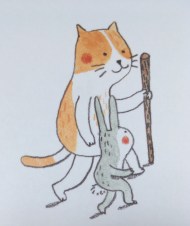
And then finally.  Once you have enjoyed the illustrations, seen the way prose and picture work together (or in opposition), enjoyed that way that little cat peers out at Mrs Badger and how the bunny later echoes the incident, finally figured out the relationship between Sally Gardner’s wolves and John Masefield’s – then start looking at the classroom, and again, Mat has the resources … Too late to do this for this summer, I know, but this is, after all, simply a reflection as the weather cools. Time for the Moomins for me, then… More mountains and small beasts.


Love

Love is a really difficult term, partly because it is over-used (“I love your hair!” “I love this blog!” “I love Santorini”), partly because it is so much more than this debased coinage: a risky, radical, affectionate, often sacrificial thing, it binds people together, may have an element of commitment and/or sexual attraction – all sorts may happen in the words “I love you.” It was therefore interesting to read this blog post which suggests that “we often substitute the word love with other safer words / phrases like unconditional positive regard, respect, care or compassion.” It draws on this document by a team in Sheffield and the research behind it. It is a fascinating piece of work, and makes me wish I were still teaching the module on Professional Roles or the other new values and practice modules in Oxford Brookes Early Childhood Studies. The interview findings pp12ff are enlightening in the EY practitioners’ discussion of physicality, affection, attention, “reading what is needed to make a child feel loved at any moment in time…” Enlightening is a weak word: this is amazingly honest, difficult, complex sometimes beautiful stuff.

As an early years practitioner (much, much less than I used to be, I know), I found it especially interesting how male practitioners felt drawn to the concept of Professional Love. It is worth noting that the fragile status I found when I first taught four-year-olds in the 80s is still there: the emotional, tactile and joyous stuff can still be pulled from us very quickly by suspicion and by the appalling behaviour of some people.  I remain cautious in my use of the word partly because of this, though I have used it about “loving my job” in a previous post.

However, I hope I’m not splitting hairs when I contest the earlier idea that unconditional positive regard, respect, care or compassion are safer words. I’m not sure at all about the first phrase, partly because it smacks of jargon. “What motivates you to work with young children, Nick?” ” The feelings of unconditional positive regard…” Just no; not for me.

I do think, however, that compassion is rather different from love. It is broader, for starters, maybe more analytical. It feels tougher, too: love as affection is breakable in too many ways, whereas compassion is a harder thing to break; love – this Professional Love – is reported as about touch, kissing,  whereas compassion goes to the child who is in pain and demonstrating that pain through difficult behaviour whatever their age. They are both valuable and the Jools Page report is ground-breaking in many ways – but perhaps they are dealing with different aspects of professional behaviour. I am always, for example, on edge when I read about relationships and pedagogy appropriate to a 15 yo being applied to a 5 yo (this summer’s Twitter has been depressingly full of this nonsensical secondary-based mansplaining) and maybe I am guilty of something just as woolly here too. Perhaps if we thought more about how we show care care and concern, if we thought about the love we show and the love children need, we would be better prepared for the onslaughts on our practice that come from people who are driven by a need to get children to learn stuff soon and quickly – so many Red Queens dragging children along…

Maybe I am confusing a broader concept of compassion with the behaviour of Professional Love in Early Years practice? Just in the same way the arguments against a therapeutic ethos in schools cannot be applied to children for whom attachment is a key element of their time in an institution (sorry if this is convoluted, but it isn’t just Early Years children), maybe I need to think further about the role of affection for all children. It certainly won’t be a hug and a kiss for a ten-year-old – but it might be time learning the recorder with him, or  lending a copy of a book that she might really like… and it might be time to recognise that the profession needs to reclaim terms such as “love” and “affection.” It is complex stuff, as Jools Page and team acknowledge – but it is about as radical a departure from targets and goals as we can get in framing our practice – and still allows us to be passionate about wellbeing, and the long-term aim of working with children and families.


Final thought.

I am nervous posting this; exploring “professional love” is an odd thing for a Catholic to write at this time, with the Pope (rightly) in impassioned pleas to recognise how the Church abandoned its children to abuse. However, reading the reports of what has happened, it does strike me that love was the single thing missing from the cases explored. I’m not linking into the reports – I find them deeply, deeply distressing – but it is clear that the things driving the cover-ups were fear and concern for reputation; the things driving the abuse were as far from the love we should be showing as professionals as can be.

Not Brookes Branded?

This is a brief (ish) reflection on the joys and trials of being a Principal Lecturer and Programme Lead as I come to the end of my service in the role. Trigger Warning: contains opera lyrics, I’m afraid.

Starting from First Principles, from Values, and while for me this is Oxford Brookes, the lovely and infuriating and supportive and dismissive organisation that has been my work home since I moved from being a Headteacher  in 2002, I don’t think I am alone in education in any phase or sector in the joys or the frustrations I’ve met with. As an aside, I’ve only just seen this piece in the local press: my comments on leaving Bartlemas bear a striking resemblance to what I am about to say here! This link, in any case, takes us to the Brooks strategy and vision of the University: https://www.brookes.ac.uk/about-brookes/strategy/strategy-2020/ and I’ll pick out some important ideas.

…committed to leading the intellectual, social and economic development of the communities it serves…
We will continue to enhance the value – and the perception of value – of our social as well as educational mission…
Oxford Brookes University will provide an exceptional, student-centred experience which is based on both internationally significant research and pedagogic best practice. We will build on a tradition of distinction in academic, professional and social engagement to enhance our reputation as a university which educates confident citizens characterised by their generosity of spirit.

This is fine stuff, but perhaps I would amend it to warn against the rise of what Paul Gilbert referred to recently as “non-compassionate processes.”  There has to be room – as Helena Mitchell and I are pointing out  in a forthcoming chapter – for compassion and self-reflection as a way of cutting through what one  writer calls the ‘semantic mess’ of educational values.

It would be easy to cite some of the less compassionate processes, and the UK is not alone in seeing managerial/administrative creep introduce these to the cost of staff and (very possibly) student experience. Say this to many public-sector (or quasi-public-sector) workers and a car parking debate will not be far behind. I will not dwell on the negatives, in case it looks like I am giving up the role out of pique, which is emphatically not the case. Instead I want to think about three phrases from my quotation above. Let me put the first two together as parts of the same idea:

Leading the intellectual, social and economic development of the communities it serves…our social as well as educational mission. 

The Programme Lead is really responsible for a rather odd set of  tasks that make up a bigger picture – not so much a mosaic as an anthill of duties of various sizes: performance development review; watching over quality returns of all sorts; chairing meetings, sitting in others; teaching and supervising; that knock in the door or the call that says “can you just…”; selling the programmes from first enquiry to beyond graduation…  It is sometimes  hard to see how the little tasks fit with the grand schemes, especially the aspirational stuff about leading social development and student-centredness.  Gregory the Great (d 604) complained of the tensions and the perils of the distracted (Pope or Programme Lead) have not lessened, as the Barber of Seville noted:

Tutto mi chiedono, tutti mi vogliono,
tutti mi chiedono, tutti mi vogliono,
Qua la parruca, presto la barba, presto il biglietto, ehi!

Figaro… Figaro… Figaro… Figaro...Figaro

Where does coffee fit? The chat on the bus? The head round the door to “just check…”? How do I find time to further the grand purpose when I have these minutes to review? Or how does tine management becomes so lacking in compassion?  Or how might I discern an ethical aspect to these procedural tasks?

Uno alla volta,
per carita!


A university which educates confident citizens characterised by their generosity of spirit.

It’s interesting to see the parallels between this statement from Oxford Brookes and Geoff Taggart whose vision for the Early Years is that “Compassionate pedagogy seeks to nurture children who are vocal, capable citizens as well as secure, well-adjusted people.” In the same way, at Brookes we educate [sc “people to be”] confident citizens in the midst of what some have described as a Mental Health epidemic. Is an academic a Canute, failing to hold back the tide? I would argue not, despite growing calls for better engagement from academic staff with the mental health of students, although I do think Paul Gilbert’s warning about processes that are “non-compassionate” is worth remembering: to redress the balance in what are potentially non-compassionate situations we need “intentionality and commitment:” vague notions are not enough.  What struck me most, in a personally significant, moving (and manic) few days in May, was the Compassionate Mind conference in which leaders in all sorts of sectors were united in a plea to return to first principles, to re-examine practices and attitudes that were toxic: overworking; rising levels of stress-related illness; the extra hour’s emails when you get home… Generosity of spirit can feel a bit like a drive to work harder and harder, from a position in which the individual is the slacker. If our first principles include generosity, we must consider emotional and physical wellbeing as key to that, and leaders (including Programme Leads)  have to see that generosity includes gentleness, and role-modelling concern. If “what will survive of us is love” (a line I cited earlier but with added poignancy as I start to pack up) then it starts now or more likely should’ve started years ago, before the packing boxes, or crisply worded email or the exasperated comment, or receiving these and storing them away (yes, Nick, that means you – and yes, St Benedict thought this all over in Ch 4 of the Rule  centuries ago…) or even the setting up of the shiny new system for this or that: its chrome plating does not guarantee its ethical worth. Gosh, that was a long sentence!  I think very often- and this year or two in particular- I have seen (like I have never seen before) where love and compassion are, and where they are not, in my own work life. Partly, where they are not are in the internal and external drivers that make me feel bad when I cannot deliver. Where they are, are among the trees on my lovely campus, green places, the student whose need or query I can meet, the quiet (or not-so-quiet) time with friends, the mind-stretching afternoon thinking through research. Wild Spaces, Wild Magic has to have a mention here – and brings me to my leaving.

While this song does go through my head from time, this

Notte e giorno faticar
per chi nulla sa gradir;
piova e vento sopportar,
mangiar male e mal dormir!
Voglio far il gentiluomo,
e non voglio più servir…

is not really me…  A gentleman – even of leisure- doesn’t seem to suit me, although the old designation of Gentleman Scholar would be fine.  I think I am sorted enough in my going that I will not be an Independent Scholar, at least, a phrase that reminds me of the Abbot in Brian Moore’s Catholics, adrift and alone, prelatus nullius, nobody’s prelate. As Julie Fisher has said “Independent Learning is not Abandoned Learning” – and I hope my plans for reserach and writing are the same. Not to see Thursbitch again would be painful.

But  since I’ve launched into one other language, and while the clouds lower over this blog, here is the gloomy Chorus from the end of Anouilh’s Antigone:

Et ceux qui vivent encore vont commencer tout doucement à les oublier et à confondre leurs noms.
Cest fini.

Finished.  This is the greatest fear, I guess, of humanity, and it does, in some way, strike me as I write this: the fear of being asked “Who are you?” when one expected to be recognised.  Will I continue to contribute or merely haunt? The revenant in stories usually has some name, whether (in my family) their vision is now reckoned as beatific (it’s his feast day as I write this section and I will confess I have always wanted the hat he wears) or something less rewarding.   The notion is that these spirit-presences at least are not forgotten…

Let’s not end there. Let’s search for another, livelier, image. More from Don Giovanni?

Finch’han dal vino
calda la testa,
una gran festa
fa preparar.

Or is that too out-of-context, too frenetic?  There is no “great feast” but maybe there are friends and people without whose love and support my world would be a greyer place… and maybe a beer or two. I’m back from the greyer thoughts of leaving to the much richer  remembering how lovely these last few years have been, genuinely connecting with people whose love and friendship sustain me. To move away from grand opera to Gershwin:

They can’t take that way from me.

I’ll end by reflecting on the title of the blog. I started from core beliefs and values, and nothing has exemplified how easy it is to lose that vision of “enhancing the value – and the perception of value – of our social as well as educational mission” than the criticism that a student-initiated  project on Mental Health was “not Brookes Branded” and “untidy.” I won’t rant, but since this has been so much about music, here is a piece of beautiful, lively, moving – and tidy – music. A bit of Bach never comes amiss. And here is something else – also moving, well-thought-out, heartfelt, beautiful, but much less tidy: Vaughan Williams in a piece I’d like to think of as the soundtrack to walking to Thursbitch.  Is tidiness per se part of the University mission (I don’t just mean Oxford Brookes)? Does corporate image drown out how we relate to the individuals? Does single spacing in  a Programme Handbook serve to advance or inhibit student satisfaction?

We might argue that tidiness allows for things and people to know where their best chance of flexibility lies, and that untidiness makes for reaction-led work, chasing around stables locking the doors. I think this has been my problem for some time, and I also think that reactionism is maybe where UK Higher Ed finds itself at the moment on student and staff mental health, but as we contemplate shaving down resources, focussing on core business, we must go back to the core ideals of “exceptional, student-centred experience.” And I have come to realise that student-centredness has to include the open ear, the compassionate stop in the cafeteria, the smile… and it starts with the people who work in Higher Education, just as it does in Early Years: it comes down to genuine interest in Nursery and Reception and it comes down to it in seminars and classes at Oxford Brookes, too.  Buzz-phrases to finish with then: I stand up for relational pedagogy and compassionate pedagogy wherever I may find them, hand-in-hand as they must be, and will continue to do so.


Codicil

Hard not to be mawkish today as I set down my burden, and I will confess more than a lump in my throat when I think of what I have done as an educator since I was that clumsy Reception teacher in 1988 – but really, what will survive of us is love, even if it is only a butterfly in a bigger turning world. So a final remark in this phase of the blog: individuals all have their songs on my YouTube Playlist, but this will do for everyone for now. No more time to stay and dream.

Or do QA paperwork.


Who Will Go Walk in the Woods?

I’m reading three books connected with trees and well-being at once at the moment: at Mat’s suggestion, Mythago Wood by Robert Holdstock; Max Adams’ The Wisdom of Trees and partly at Jon’s prompting Paul Gilbert’s Overcoming Depression. In the first, the Antiqua Silva asserts itself over a troubled house; in the second, there is appreciation of beauty, of effect, of the impact of the tree in Western culture; in the third I am exhorted to find/create an image of a safe space. Might I imagine a wood, full of green light? Woodland as therapeutic space: this blog returns to it again.

It appears that dasotherapy (or thasotherapy?) is not the neologism I’d thought: it occurs in a spa in Belarus. That’s not quite the use I’d hoped for, though, either. as I think about the Trees and Wellbeing conference that (almost) served as punctuation to an emotional rollercoaster of a fortnight – or month, or two months…

So when today I had some news I needed to turn over I’m my head, I went for a walk. A bit of time in the quiet green. Dasotherapy. Still not sure of the word.

I am immensely lucky I have the beautiful grounds of Harcourt campus as part of my work place. A muntjac was browsing, two magpies fighting or mating – bickering, whatever – in the canopy of weedy ash and sycamore.
It is not the canopy of Chiltern beechwood but in its way is beautiful. It may not be grand, but it is full of life and growth. I think of Roger Deakin’s accounts of walnuts in Ortok and ash in Suffolk; of Richard Mabey’s Unofficial Countryside and the marginalia of landscapes; and then of his Nature Cure.  Mabey speculates here at his lyrical best, describing his fens (but in truth praising any ecosystem):

…there is a general movement towards the development of woodland…but against this there is a corresponding, intrinsic drive towards variety, flexibility, subtle forms of symbiosis and partnership.

I feel like here I almost catch up with him. There seem to me to be all sorts of reactions to woods- places of awe, of menace, of folklore or inspiration to “high” culture, or an impetus to preserve, or to admire the invasive… but today in this scrubby green sanctuary, the volatility of woodland strikes me: young woodland, with trees competing for sunlight. Today I don’t need the ancient menace of Mythago to tell me how movable a wood is, or Ward’s Ancient Oak in Max Adams  to tell me how we grow old, how life is unstable and mutable. We operate on different timescales, but we too are seedlings, race for the light, and overreach ourselves and fade. Talis vita hominum- today, not to do with sparrows.

Take Off Your Shoes

A reflection on the sacredness of an “interior space” has to start (for me)

Lud

with a confrontational image of the sacred, something commanding awe and wonder.  Guess which I might choose?

However, I also have to admit that although this is one of those places I have encountered the huge and numinous, I kept my hiking boots firmly on. We are already into the language and symbol and metaphor. With Lud for me the enormity is an understandable link back in time to ponder what “sacred” might mean: is it just about respect, or something rather more complex?

What’s with the shoes?  The taking-off of real or metaphorical shoes is meant to signify vulnerability, maybe.  Certainly the practice is really ancient, and certainly is met with in a number of places in the Hebrew Bible (see this site for a compendium from a Christian counselling perspective, although some of its emphases I am not at liberty to explore here). I don’t have a good photo of my own for a Christian parallel, although this might suffice:

This link should take you to Monreale and this too, and perhaps best of all (but not the easiest to navigate) this –  to the luminous (and somehow ambiguous) face of Christ above the High Altar. It suggests to me a steady gaze at the penitent, the needy: it suggests compassion. The text Christ the Pantocrator holds is “I am the Light of the World” in Latin and Greek. Compassion illuminates.

And that brings me to the Tweet (21st April) from Dennis Tirch cited by Jon Reid:

A good relationship is a sacred space that can safely contain how we think and feel, along with our potentially painful histories + the whole of who we are.

Sacredness is an interesting concept there. We could take this as a metaphor, a bit as Steven Mithen uses Western Church architecture to explore mental structure. We might take a more sacramental view, and without wanting to baptise the temples of another set of beliefs, I want to explore this.

For me, the sacred is not so much forbidden but ungraspable,  attained only by grace.  As Bonaventure puts it:

Ask it of grace, not of learning; ask it of desire, not of understanding…

It is that thing that the earlier hymn-writer puts so beautifully and tentatively:

Expertus potest credere…
The one who has experience of it can believe…

In Tirsch’s soundbite, the sacred is not defined by how it might be attained but by how it is  boundaried by reverence. It is a place where one is liberated but contained. As Merton describes in his poem about deep religious experience  Freedom as Experience,

Our lives revolve about You as the planets swing upon the sun…
Imprisoned in the fortunes of Your adamant
We can no longer move, for we are free.

Is this the same as the relationship Tirsch is discussing? Maybe not, but it has some similarities: this friendship allows (to use Christian theological language) the outpouring of grace – of charity, forgiveness, acceptance – that is not a million miles from prayer. It also carries with it the sense of awesomeness, the sense that the unwary word, the nit-picking analysis could “break the spell.” Hemmerle in Rahner’s Encyclopedia of Theology rolls out a wonderful concept:

How is our understanding of being to to justice to the coming and summons of the holy? Not by counting the holy among the topics which it has comprehended, but by submitting itself to the holy.

A sense of the sacred is a sense of the intangible, the awesome: an “I can do this” disrespect takes away something vital. We need emptying,  kenosis, as Paul would call it, not harpagmon, a something to be grasped. When relating to another person we need more than simply respect: we need to set aside a tick-list mentality. It is as true of relationships as of liturgy.

Accounts in the first books of the Bible talk about various sanctuary places, the Burning Bush being one, the hilltop where Abraham prepares to sacrifice his son being another, there are others, too: Mamre, Shechem, threshing floors, High Places. In the therapeutic context that Tirsch proposes, perhaps Jacob’s encounters are the best: Bethel where the ladder of ascending and descending angels helps Jacob understand the renewal of the convenat, and Peniel, the wrestling place where Jacob cannot hope to leave unscathed but in which he seeks (in vain) to know the Name of God. We are called to deal, as Belden Lane writes (Backpacking with the Saints, ch 4), with our own disillusionment, accepting the courage to be imperfect. The sacred ground of the relationship is a special place because the other person teaches us

…that one’s worth isn’t rooted in one’s ability to excel. I can be what little I am, without incrimination. What I accomplish isn’t what allows me to be loved.

The heart of compassion.

Allegory Time. I think it is worth acknowledging that this set of concepts is much more easily represented in metaphor (as with Bonaventure) but that this leaves us to deal with the ambiguity this may bring. We are able to talk of space and landscape (see this post) only while we recognise this is an insufficient language.  A sacred space sounds like an apse, maybe a stone circle, but really it is a set of complex social interactions: from handshakes to hugs, from eye contact to taking to heart what is being left unspoken. We also, like Jacob, may not come away with a relationship sorted: we seek to know the name of the other person when really, as Tirsch points out, we might simply get to hold and contain them in their bleakest thoughts.

The sacred space of relationship requires three understandings, it seems to me:

  • That this relationship is a matter of attentive regard for the other person in a compassionate, non-judgmental way;
  • That we need to be aware of the joy – and sometimes disquiet – of going out beyond our normal boundaries;
  • That this requires respect: both (or all? Are these relationships always dyads?) participants have to regard this relationship as  potentially restorative and dynamic. and yet trespassable and fragile.

Hence the shoes: we have to tread lightly.


Addendum:

As I was inexpertly scribbling the above, Maria Popova’s Brain Pickings site posted this piece on Thich Nhat Hahn and Love. It says it rather better.

You Don’t Know Who You Are

A quick and mostly comic burst of pictures on Twitter show Edutwitter contributors in their adolescence(s) as a curious mix of Addams Family, aspiration  and rebellion. Who do we want to appear to be? Who did we want to appear to be? If it isn’t too convoluted, who did we want to appear to aspire to become?  It is enough to send me back to the self-reflection (or gnawing introspection, maybe) of my previous posts. I am still mulling over those things that marked my Lent and Holy Week and Easter Week around how I “know who I am.” Let’s ponder the outward appearance as discussed on Twitter, in the context of how we appear now and how we presented in a different time. Time is the crucial thing, fundamental to a fluidity of who we might have appeared, how we acted and the motives for our actions.  In the words of R S Thomas’ Eheu Fugaces,

…with our ear to history’s
curved shell we listen
to mixed sounds…

The curve of the shell changes the meaning; to change the metaphor, fundamentally change in time changes the lenses through which the past is viewed.

Here am I, and as a bit of a contrast (but in no way a real comparison) here’s my friend and colleague Jon, both of us 21-ish, but some 20 years apart. Old enough in our twenties to be recognisable, but in crucial ways different from how we are now. I think I can see the Jon I know now – a bit; I guess I can see me in that tweedy boy with the curly hair and wary eyes, but of course I was there, just south of the cloisters in Chichester with friends.  I also know Jon because the picture he has shared fits with the story he tells of himself. These things are easier when they are consistently represented. More detail might add to the story, make sense of the coronet of spiked hair and the straight-into-the-camera gaze, but as Thomas says, the message is already distorted by “history’s curved shell.” One thing I am wary of is the quick diagnostic.

At least I know how I appeared, and remember how I presented: a nice young man, a conformist, maybe a bit scared of the world. Who did I want to become? I’m not sure if I know “who I was,” then, although I can give myself some hasty headlines now, along the lines of “crazy mixed up kid,” although that’s a “quick diagnostic”too.  I know I was scared of being found out, of being known as a shallow imposter. That stays with me.  I know what I lacked toward myself – and probably others – was the word I keep coming back to: compassion.  More baldly, I don’t think then I knew who I was either. I think I wrote something about that time about being a mix of St Francis and the Big Bad Wolf. Dipsychos. Of the two of us, Jon looks to me the wolfier, but maybe that’s just my prejudices.

So here we are now. Something like convergent evolution appears to have taken place.

However, the outward appearances of a growing uniformity are only that: they might only be dress-code deep. Now there’s a phrase that just fell onto the screen!  Only by knowing ourselves and one another do we move beyond the shallow expectations. Jon and I may bring a bit of Country Living to a working relationship, but friendships are not made of tweed, a fragile, passing world, where moth and rust disfigure (Matt 6:20); they are made in knowing the other, and learning about ourselves in the process.

What constitutes “knowing who you are”? How we dress? What we say? What we do? What we read? Our Goodreads account, our Twitter presence? And when do we say it? This moment? That? A past year, a just-gone moment? This photo is of me in June 2018, in the same place as the first one of me. Is this “now” a real me? What about some moment still to come?  What will survive of us? Maybe the good we exhibit in our relationships?  We are in Larkin territory – coincidentally, in Chichester, where that boy with the curly hair had his photo taken. This is a good critical reading of Larkin’s poem An Arundel Tomb and here is my photo and then  here is the text of the poem itself.  Larkin’s cool eye looks at the memorial of a married couple and he comments

Time has transfigured them into
Untruth

To try and say who I am solely through how I used to look or how I wanted to present myself is misleading, dress-code deep in itself. Fun though this is on Twitter, it is in the growth, the people we grow with, the people we help to grow, that “who we really are” becomes shown; in friends like Jon, and Mat, and all the others at work; in Maggie, in my dad; in Stephen and Robert and all my friends I rarely see; and my kids who live here or visit and call. Larkin is as cynical as I am wary, but I sense he, like me, would like

to prove
Our almost-instinct almost true:
What will survive of us is love.