
Just a quick thought for the students on two of the three modules I’m teaching this semester, based on the relationship between the cat and the rabbit in the wonderful Up The Mountain. My comments here might be something to follow up, but are in no way important for what follows here. I hope this works for the three modules* but maybe in different ways: I have to say that from the outset I’m writing this really for the first years: for “my” Ed Studies students, and then for the first year Outdoor Learning people in Early Childhood.
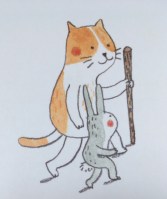 The model that the book Up The Mountain explores is one of friendship and apprenticeship. The author wrote it in memory of her grandmother “who loved nature and books” – and that pretty much sums up my attitude to this semester’s teaching: warmth, love of Nature, love of books.
However, if this were all, I think I would be wondering if this was worth a degree. Just as sometimes I look at CPD that people report as inspirational and think “that was a day’s worth?” I worry that coming out of the undergraduate process thinking that one or two tutors were nice people and that being outside is lovely is just too weak. Of course, in the CDP example and the undergraduate one, this précis is too wishy-washy to be a decent overview of what anyone has learn, but what do I want students to do when starting out in Higher Education? I find myself as old Mrs Badger, watching the little cat explore, and grow – and pass on his delight to the (even littler) rabbit who joins his journey. Perhaps the imagery doesn’t extend too far, a delight though the book is.
But to move away from metaphor, let’s take Doodles, the therapy dog whose work is described in Cheryl Drabble’s book and her blog. Why use a book like this in the Introduction to Education Studies? Well, because it describes and uses the disciplines of Education Studies in a compassionate and engaged context. Real children and young people, along with their educators, have encountered and appear to benefit from a different way of working. How do we know this works? Do we define curriculum in such a way that the experience of education has room for “cute, fluffy, handsome, pretty and furry”?**
We will, of course, read about the uses and abuses of cherrypicking educational practices and about the ways theory can and can’t be used – from Developmentally Appropriate Practice to looking at models of (dis)advantage – but Cheryl Drabbles’ dog allows us to ask big questions through a practical lens. For example:
- Should schools be therapeutic spaces – or should the task of learning itself be enough to raise self-esteem and motivate? How does “belonging” fit with one’s identity as a learner – or an educator (thanks, Jon, for the timely reminder on this last point as I prepare a class on the Sociology of Education)?
- If a dog is right for one school, should all schools get one? How might practice in a school where pupils have significant needs for physical and/or cognitive support be different from other schools? Should they be seen as different?
- What is the role of the professional as an autonomous worker? How do educational institutions work as teams – and (see above) how does belonging and having a voice in a team look in practice?
- What does the documentation of a National Curriculum have to say about what society might aspire for? Does this aspiration close doors or open them?
All this from a small dog?
We might, by moving beyond the text itself into exploring what we mean by distinguishing between research and news media, ask
- What makes an argument valid?
- Does “it works for us” clinch an argument, validate a practice?
- How does research work in a messy world of so many variables?
All this in twelve weeks?
No, and no. We (the students and I) are beginning to pose these questions, just as we are beginning to put together the skills the students will need for the next few years and beyond. And of course it’s not Doodles – or even Cheryl Drabble’s book about him and his impact on her school – that gives us these things. We are using the idea of a therapy dog, and what people have said about therapy dogs (and mutatis mutandis the experiences we are having outdoors in the other modules and what people write about being outdoors) as ways of starting to explore the Big Questions both in the abstract and the concrete. We are also starting to look at the conventions that Higher Education (sort of) seeks to impose on its neophytes. So – to end with practical questions – if we are using (as many students are) the e-version of the book, how are you going to reference a quotation from it? How might you summarise some of Drabble’s conclusions?

*The three modules are: the first year module Introduction to the Study of Education and the first and second/third year modules Young Children’s Outdoor Learning. Doodles makes his appearance especially in the first of these.
**Drabble, C (2019) Introducing a School Dog: a practical guide. London: Jessica Kingsley. Drabble (2019:98)
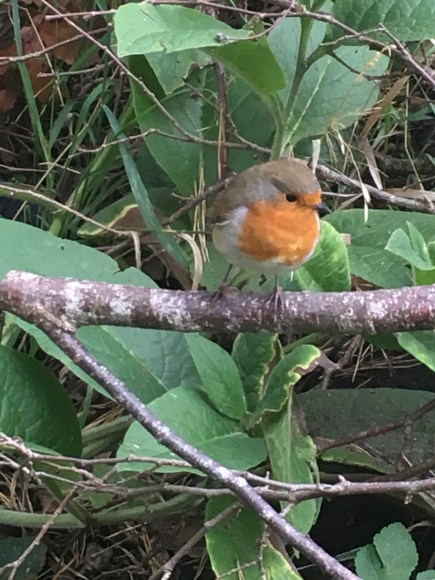 It is friendly enough to allow me to photograph it from close up. I love its jet-jewel eye and the way its chest moves as a bubbling song comes from somewhere in its tiny body. I love its daring proximity – it flies so close at one point, a wing brushes my leg.
 Not the silly vandalism of arson, harsh though that is, but the more calculated threatened developments that will alter precious run-off and the way light touches some areas, of potential pollution and game-play from developers, Councils and Trusts. How small conscience-easing grants alone will not in the end preserve such a small piece of wetland in the suburbs of a land-needy city. Change is of course inevitable in so many ways: my copy of W G Hoskins
  and talking about this have brought me is a closer look at landscape and the ways people interact with it. It has brought me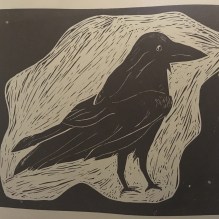
 stones; Cold Venus stones. She worked through all the ones we had collected, and, with the help of a “map” of the solar system, saw were we had been. She also checked them against pictures of rocks (see the photo), although not always with a great deal of success. All in all, the project took maybe 30 mins in the evening and 90 mins the next day. We had fun.
 not unlike DuBuc’s
 tattoed on my shoulder a few years ago, in my late fifties. I’m not hiding them; they are where I wanted them – occasionally on show, and something I can see and smile at. They are there rather than my forehead because I don’t think my forehead would look very nice with a circular tattoo. But of course this is where the trouble lies: what is “nice,” or “appropriate” or “professional”? Fashions change, attitudes to fashion change, how fashions mark professions or “class” (or lack of these) change. Maybe, too, the placing and reason for the tattoo matter: a wedding ring finger tattoo is approved of, where a heart and anchor and “Mother” might not be. But an arm tattoo is OK as long as you keep it covered? What about the educator with a usually covered tattoo who wears a short-sleeved shirt that reveals it? Dress codes are subtler than they first appear, and context is everything.
 nicktomjoe