Difficult Spiritual Experience and Landscape

One of the reasons I suspect beautiful waterfalls and so on are attractive when people (including me) talk about spirituality is that they exalt but do not challenge. The Great Bell Chant by Thich Nhat Hanh  is a wonderful example of a series of pictures and text that mostly show natural beauty –  “the beautiful child appears in the heart of the lotus flower.” [3’23”] – waterfalls from a great height, whales, then Masai leaping, monks walking. But pay attention to the children at around 5’15” and see where they are, what they are doing. Meditation is about truth.  Thick Nhat Hanh has worked with the war refugees from his homeland: Boat People who saw the same crippling suffering we see in the refugees from Syria, from Africa. In the same way, in the Great Bell Chant there are children gleaning from a rubbish tip. This is not comfortable living for people who want to Zen their home – however much I look enviously at their photos of libraries, sunrooms, bathrooms!

In the same way, the film that reduced me to tears last night has an ambiguity: when I sit in a comfortable cinema, watching expensive SFX and carefully coached acting and think about the anger of grief and loss, I spectate a deep – but hugely uncomfortable and potentially damaging –  spiritual experience.  So there’s my disclaimer.  In reading A Monster Calls and seeing the film many people will be challenged.  The critics were ambivalent.   Variety didn’t like it; their advert-heavy review linked here says “we’ve heard the same lesson countless times before in other movies” (I’d disagree, but it shows the tone of their review), others refer to a “cheap tear-jerker” but Rotten Tomatoes is at least somewhat warmer. So it is on the level of the protagonist’s experience rather than the success of the book or film that I want to ask these questions:

Can a spiritual experience be damaging? Can trauma be a spiritual experience?

There are a number of gnomic statements we might at least look at  here: “The best way  out is always through,” “We learn through suffering,” etc.,  and it is Philip Sheldrake in Spirituality and History who really pulls these to pieces for me in considering spirituality in a post-Holocaust era. Spirituality, when it is at its most genuine, confronts pain. The easy inspirational poster draws on the spirituality-laden themes of waves and whales, maybe, but can we tell Patrick Ness’ protagonist Conor these things, as he struggles with his nightmare, facing the ravaging decline of his mother? Will the poster help the war child?

The Monster Calls
The Monster Calls

This is where the earlier editions of A Monster Calls are so powerful: the illustrations (echoed in the film) show a menacing creature, full of earth and storm and history and danger, from the grasping hands of the half-title page and the stalking wildman of the cover. This is a Lud-like demigod, who shows no mercy at one level but in a deeper way is the psychopomp who leads Conor through the death he has to face. And the message this creature brings to suffering Conor is simple beyond a motivational poster’s reach: “If you speak the truth, you will be able to face whatever comes.”

Misappropriated, mishandled, a spiritual experience might well be damaging.  It is open to willful or stupid misinterpretation (as Teresa of Avila discovered); it is open to manipulation even (almost) to the point of murder as Katharina von Hohenzollern discovered; it is open to the demagogue, the cruel, the convincing psychopath.  In this sense, it can be damaging. There is another sense, too, in that someone who is misled might move to convince themselves – to allow themselves to be convinced by that cruel demagogue –  to hurt others, to despise them. And sometimes the urge is simply to give up on them. The Headmistress after Conor attacks his bully sums this last position up in her first words: “I don’t even know what to say.” They reminded me of my tutor’s comment on my weekly test at University when I came back from my mother’s funeral: Forgiven for this week.  He didn’t even know what to say – and maybe neither did I. How does anyone come back from something huge and have something to say? At best, perhaps, we can say that spiritual experience is like any experience: it has a yesterday and a tomorrow.

Or perhaps it has, rather, an inside and an outside: an enclosed and controllable aspect, and the wild, Ent-like, elemental rage Kathleen Raine (whom I quote more here) so vividly depicts in her Northumbrian sequence:

The storm beats on my window-pane,

Night stands at my bed-foot,

Let in the fear,

Let in the pain,

Let in the trees that toss and groan,

Let in the north tonight.

This spiritual experience (of loss, of choice, of change) is going to change the boy Conor forever. He is left (more or less) without a father and without this magic (is that the right word?) spiritual guide: the losses he sustains are huge. The reason this traumatic loss of so much is  – we guess – not going to damage him, is this lesson he learns at the end: “All you have to do is tell the truth.”

Light

I am intrigued by Oyvind Torseter’s The Hole, a charming but puzzling book by the same author as “My Father’s Arms are a Boat.”  The Hole gets a good exposition here on Brain Pickings from the prolific and insightful Maria Popova. “My Father’s Arms…” similarly gets  a write up here.

I wonder what the eponymous hole might signify? It could be all sorts of things: the hole could be a gap in the protagonist’s life, such as a separation; it could be a lost or unrequited love; it could be that this is a new symbol for depression. However, a hole is also an opportunity, where the light gets in.

“Beware of practising your piety to be seen,” Jesus warns, and whatever your idea of practice, this seems sensible. So this is a quick disclaimer: my mindfulness is not your mindfulness; this was nothing special except for me – but with a Friday mindfulness session coming back at Harcourt, I thought I’d record the way one night’s sitting session went.

Seven o’clock and on the evening I’m thinking of it’s time for the “unguided” sitting, where we sit and sit and at the end of forty minutes a bell is rung. Tonight there is a hint of a looming thunderstorm: the air is close, and it’s overcast. As we sit the light goes.

What is this metaphor? It goes? It fades? The dark increases? I watched it happen and am at a bit of a loss. The shine disappeared from the wooden floor. Colours muted (another metaphor) rather than deepened, it seemed to me. The gradual loss of light was itself so stunningly beautiful – but where does this come from? Why do I find it beautiful?

[Or maybe even asking these questions are unmindful. The light was what it was. I sat. I felt my breathing, the stiffness in my legs. The sitting was the sitting.]

And the hole? The Leonard Cohen line about the cracks being where the light gets in came to me as I pondered Torseter’s imagery last night. A hole can be a gap. A lack can be a desire to change. The gathering shadows in a mindfulness session can be beautiful. The ambiguity is (can I say it?) illuminating.

Manuscripts: a brief thought on autoethnography

I’ve been given Christopher de Hamel’s beauty of a book, Meetings with Remarkable Manuscripts for Christmas, and today I sat in bed listening to de Hamel and Andrew Marr enthusing about the more notable MSS de Hamel discusses.

The greater part of me is enthralled by the book, by the challenge of a not insignificant work, and by coming back to something I used to know well. Part of me, however, is a little wistful: I have had late medieval Books of Hours, chant books, portiforia in my hands, known or guessed their provenance, struggled with their handwriting.  It was a world I loved, playing M R James as I looked at the Bridgettines of Syon Abbey-  although I knew it a bit even at the time, I was without the obsessive commitment needed for the role. I describe myself as a “lapsed medievalist,” and I guess this will have to do.

So now, for the most part, I am the kid outside the sweet shop, looking at the barley sugars through the window…

…with the exception of the work on Gawain that’s come my way this year. I find that the past stuff on late medieval literature and spirituality is carrying me a long way into the sentient landscape project, picking up the crumbs that Alan Garner has dropped with a sharper eye than I would have done if I had not had those years of experience with the Syon MSS.

A final thought (for now) on making sense of my stumbling study: the way I looked at “my” manuscript (MS Rawl D 403) [when I finally packed away the reproduction I have and got on with training to be a teacher] was that I might come back to it. However, I wonder if that confuses scholarship in its widest sense with doctoral study, which is a a part of the scholarly project. Maybe the Liber Mortis et Vite never really left me; maybe I can dredge from those twenty-something enthusiasms skills and understanding I can still use. I used to dream in Syon; now I belong as much to the myths of quest and learning from my mistakes that are in Boneland, and Ludchurch. It feels all about synthesis of these different parts tonight.

Maybe a thought for my study in 2017…

Maybe

Return to…

A return to Garner country is demanded. I will confess here what Mat already knows: I dream of Ludchurch and spend a lot of sleep time in Thursbitch.

It is unfulfilled business, I guess, that takes me back. While these chaps seem to have done the things we might have I am left feeling that there is more to do, more to say. Is this because I am looking for a “safe” way of looking at the experiences we had, a tame Analytic Autoethnography (Anderson, Journal of Contemporary Ethnograph, 2006: thanks to Jon Reid for the source)? Am I just fighting shy of the overwhelmingly evocative? Would categories and Digimaps tame our experience? A lengthy quotation follows, although I would discourage this in a student essay:

Evocative autoethnographers have argued that  narrative fidelity to and compelling description of subjective emotional experiences create an emotional resonance with the reader that is the key goal of their scholarship. The genre of auto ethnographic writing that they have developed shared postmodern sensibilities—especially the skepticism toward representation of “the other” and misgivings regarding generalizing theoretical discourse. Evocative autoethnography requires considerable narrative and expressive skills..

and these are skills beyond me, or maybe the hugeness of the experience simply dwarfs my skills.

It is as if (clumsy extended metaphor alert) I foolishly took up a challenge and find the Big Thing (Garner’s translation of þurs)  bigger and more humbling than I had expected, and the Gawain quest provides a suitable framework.

Lud
Lud

In the comfort of Camelot the quest was achievable, but in Thursbitch I found something- a project, an attraction, a something that cannot be reduced to analysis. I note Garner talks about the bigness of the þurs…  So this brings me to the ambiguity of the relationship between Thursbitch and Gradbach. In Ludchurch we met up with the big, slow awesomeness of the Green Knight, but just because it is big, is this Thing the þurs? My instant reaction is to say that if Ludchurch is safe, Thursbitch is danger, the Valley of the Living Dread in Erica Wagner’s tricksy phrase,  and for me maybe Ludchurch is (as I’ve said before) masculine, and Thursbitch, feminine: Sarastro and the Queen of the Night.  Lost on the moor, in the fog, lost in the folklore, and in some hinterland of Jung and Freud… Two different big things – lots of different big things – in my mind. Continue reading “Return to…”

Contains Cannibalism and Barry Manilow

This was my “trigger warning” for our Becoming a Reader class this week in which we rounded off our work on traditional tales with a rendition of The Story of the Grandmother – and the meeting at the crossroads with Bzou, the werewolf –  and a look at how culture informs our reading of a text, for which we used Copacabana.

I rather like this session: “What’s a ‘showgirl’?” “What do we understand by a ‘dress cut down to there’?” and just who did shoot who[m]?  It allows me to present the work of Hilary Janks and Mary Roche not just as ways to look at children’s reading but also at us as adults becoming readers. I am fortunate to be able to explore this further with Mat in his Reading for Pleasure MA module tonight.

Janks makes a powerful point – or set of points – here:

“…decoding is often equated with reading and is associated with functional or basic literacy….The interrogation of texts, reading against the text, is tied to critical literacy and implies that readers recognise texts as selective versions of the world; they are not subjected to them and they can imagine how texts can be transformed to represent a different set of interests.”

and if I had one wish for our third year students, or maybe even just a wish arising from this module, it would be that their time at Brookes  has allowed them to develop just this critical literacy –  that policy, just like Garner or Shakespeare or the EPPE review, can only ever present selective versions of the world. I’m not asking for cynicism, or a world in which the principal graduate attribute is becoming a Radio 4 listener – but for an engagement with ideas which asks about viewpoint and opinion and world view in a critical way.

My Outdoor Learning

Last weekend (the final weekend in Oct 2016) I went outside.

Not to the allotment, and not to the Kalahari: a sort-of-adventurous outside for a 59-year-old academic who was a great hiker in his early teens but since then…

Well,  this is where we went.

thursbitch

And the “we” is Mat Tobin and I.

The notes of the work leading up to the trip and then the weekend’s notes are here:

It’s very obvious what we did well, and equally obvious what I didn’t prepare for properly.  Ah well, it was a first go. Others have also attempted it – cf Emily Morrison. There are even YouTube clips. As Garner and Langland say we “blostrede forth as bestes ouer baches and hulles,” and saw, and learned and came back.

What I want to think about here is how children’s experiences of “going out of their comfort zone” might parallel mine. I am struck by an impressive autoethnographic study by another colleague, Jon Reid, whose imaginative leaps have compared the metaphorical journey into doctoral study with physical travel.  It would be too cheeky – not to say intrusive –  to use his ideas verbatim, but let me just pull up one idea: that learning is very easily translated into journey imagery, and that the relationship is so intimate that “outdoor learning” might even seem a tautology.

It isn’t, of course: I’m not saying that no-one learns indoors, or that learning outside is automatic, or something so process-led that merely travelling is to arrive.  I simply can’t (yet?) get my head round the learning we did, since it was bound up in three elements:

  • Who I am and the past that brings me here, both positive and negative;
  • The experience of planning, doing, seeing;
  • Peak experiences.

“What did you go out into the wilderness to see? A reed shaken by the wind?” What did we go out to see? What do we ask children to do when we take them outside? There is a challenge, maybe even a hint of sarcasm in Jesus’ question to the comfortable bandwagonners in Matthew 11. What attracted me to the weekend? A love of being outside, a sense of challenge, a friendship. What did I go out to see? I went to find Thoon and found Lud.

The planning taught me a lot of skills, from Digimaps to revitalising my small skills with OS on the ground. The doing – the emailing for a taxi, sorting accommodation &c., &c. – was small beer compared with the journey up, the staying in Cheshire. I could have stayed for a week, repeated the visits we made, taken a lot more time over every aspect. I talk a lot to students about the value of first-hand experience, but here I was out doing stuff  myself: the verge by John Turner’s stone; the oddness of Jenkin Chapel; the wet underfoot past Gradbach and the sound of the water on the stones – the clonter. A series of little things making one big event of discovery.

And the huge experiences. The face in Ludchurch, the struggle to Thursbitch, the hardness of the journey from the valley to the Tor (and Mat’s driving us back to Oxford). I feel – as I suspect Garner intends us to – torn between the opinions of the scientist Sal whose mental state is allowing her the insights in Thursbitch that drive her story, and the hesitation of her devoted companion, the Jesuit medic Ian. Where they discuss “sentient landscape” encapsulates my own dilemma:

“Are you telling me, after all we’ve seen and done here, that this is just any old gritstone anticline?”

“I’d say that it’s a powerful and dramatic sub-Alpine environment. But what I accept as appearing to be strong atmosphere is no more than our projection of our own experience and emotion onto a circumscribed place.”

“How can a man with your job talk such crap?”

And this brings me to my pedagogic questions: do we take children out for peak experiences or something more subtle? When we talk about the “learning journey” where does this metaphor (here it comes again) lead us? Is there a spiritual dimension to the week-by-week going to Forest School – and does it need actively fostering or is it just there? What do we send children out to see? Reeds shaken in the wind or something bigger?


The landscape of the Dad

Patriarchs live in deserts. On what modern readers might see as the positive side, they produce water for the thirsty, food for the hungry, and field forty years’ worth of “Can we go back?” and “Are we nearly there?” The Patriarch Moses and God work together on this one: Dayenu.

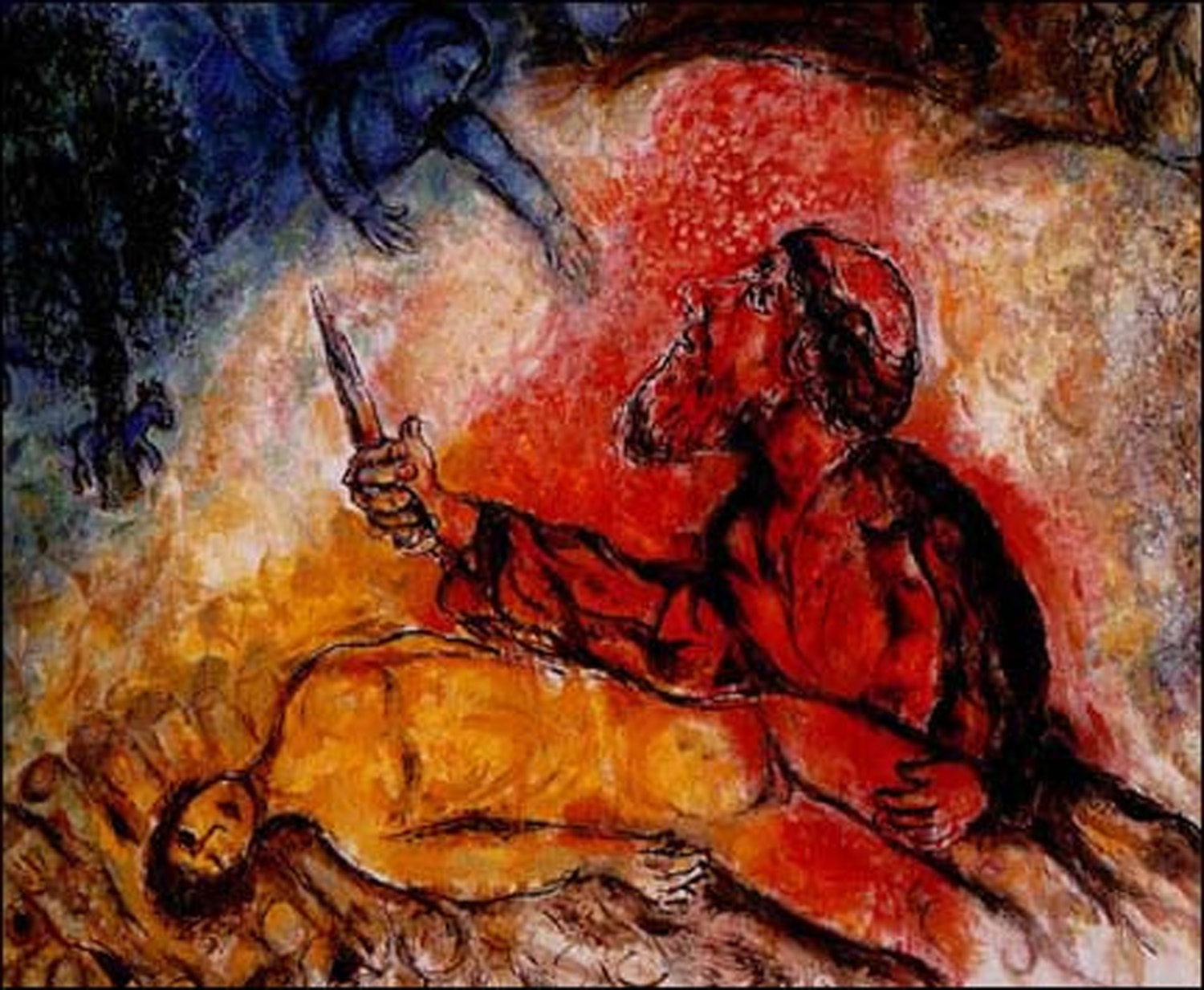
They also act in a (euphemism alert) risky way – Abraham’s attempted sacrifice of Isaac [an interesting blog post here] is not a model for parenthood easily adopted.

Chagall, Abraham ready to sacrifice his Son dv 1960-6

Dads live somewhere else. As Mat Tobin has recently explored with Keith Negley in response to his wonderful book Tough Guys (Have Feelings Too), they might live with a landscape that is a  “metaphor for frustration,” or in a cityscape that is created from block colours, but it seems to me that it is often rooted, in young children’s books, in a recognisable reality. It might not always be a positive thing to have your dad in the quotidianum  – think of the dad in Antony Browne’s Zoo, or Lauren’s Child’s Clarice Bean and her grumpy absentee  – but they are at least the common-or-garden dad. Even the fantastic, crazy world of classic Babar has Celesteville, and French family life is lived out in a gentle satire. It’s as if a dad cannot be a dad without reference to the everyday.

So the landscape of the Patriarch, even when geographically locatable, is in many ways the landscape of myth and legend (I have discussed legend-landscapes before), and the landscape of the dad is emotionally, socially (and geographically? I’m beginning to doubt this – see below) rooted in the recognisable. What might the exceptions be to this? A v quick list for me (as much as anyone) to think about:

  • Julia Donaldson’s Gruffalo’s Child, Cave Baby and Stick Man;
  • Tove Janson’s Moominpapa (passim);
  • The dads in the Ahlbergs’ Happy Families books;
  • Roald Dahl’s Fantastic Mr Fox.

What these all have in common is that the application of dadness to these fantastic contexts require an understanding of the everyday dad to interpret the fantastic –   “Interpretation calls upon the interpreter to render explicit a work’s meaning today. ” (Palmer, R (1969) Hermeneutics. Evanston: Northwest University Press. p 245).  We read these dads into their story party because of their relationship to the other dads we know.  Celesteville could be suburban France (or suburban European anywhere), the Gruffalo’s Child has an everyday dad-daughter relationship at its heart, and so on.

And so back to Keith Negley’s Tough Guys – and little more than to post anyone reading this to the significance of Keith Negley’s first response to Mat’s question about exploring masculinity: for Negley the project is in part for his own son (and iteratively for his own father?) and portraying in a positive way the emotional vulnerability the author-illustrator has “struggled with.” The last endpapers of Tough Guys – sampled by Mat here – show men in caring adult (dad or quasi-dad?) roles [the clever self-subversion being that it is the boys who are the superheroes: a real surprise to me]. The dads are Everyman dads, although they are unsited, depicted on a white background, they are doing the everyday stuff, playing with the boys. The interpreting reader brings to these vignettes the living room, the park, the garden.

The landscape of the dad, the everydayness of the relationships can therefore be aspirational – how a dad “ought” to be, or critical –  how a dad “ought not” to be; but in either sense there must be something in the relationship that shows we are in the world of the dad, not the desert of the Patriarch.


School Based Training: more dura et aspera

There is a myth about teacher training (well, tbh there are thousands: this is but one!) that somehow the completion of an ITT (ITE) programme from a BA/BEd, through a Masters-led PGCE or School-centred programme to “You have a degree, here’s six weeks on how to cope” means that at the end you are a teacher. Compliant and complex, informed and (to some extent) uniform, here is the student who was Rosie or Ryan and suddenly “Here is Miss Smith, here is Mr Jones, your new teacher.”

It’s September the whatever, and the job you applied for, schmoozed for (and perhaps when you got it felt smug about or trepidacious over) is yours, and you’ve met the team and put a mug in the cupboard in the staffroom and the headteacher introduces you to the class, and you shut the door and smile and you are the teacher.

You know you are a teacher because… Answers on a postcard.  The NUT guidance asks the question “I have QTS: What’s next?”  What indeed?

One of the key things that may keep you in the profession, it seems to me, is how you learn on School Based Training. I’ve written about the “hard and harsh” – what St Benedict calls the dura et aspera –  of parenting before and teaching is not dissimilar, with the important difference that your school-based training gives you a chance to see teaching for real in a way that many modern parents don’t get to see bringing up babies.  Seeing it without rose-tinted specs may be just what you need to keep you going in three years’ time. On a placement you get to (this list is a bit tongue-in-cheek):

  • iron;
  • smile at people you don’t like;
  • sing;
  • be someone special for children;
  • learn children’s limits of patience, attention, social skills – and how (and when) to stretch them;
  • learn your own limits of patience, attention, social skills – and how (and when) to stretch them;
  • learn your own language of teaching – do you like “stretching” and “pushing” as models of learning?
  • learn to treasure weekends – switching off is an important skill, if only so you are switched on on Mondays!

You also get to dress up for World Book Day. Something elaborate like the Very Hungry Caterpillar (“How the heck will I teach in this?”) or something less so (“George from George’s Marvellous Medicine? But I’ll just look like any boy!”)?  Something ambiguous (“Mrs Twit? Will they notice I dressed up?”) or something ambitious (“Aslan? I’ll roast in this costume!”).

So how do you learn on School Based Training?

Very Hungry Caterpillars aside, you learn by doing, by picking up (consciously and unconsciously) on how to use your teacher voice, your real smile, or how to identify the people to charm (and please remember the parents!!!) – and by making mistakes.

  • By not backing up your records before you dropped the laptop;
  • by dropping the paintings from the class while they were still not annotated;
  • by saying something so vastly comic you could hardly keep from laughing  out loud (“So while we are learning the /sh/ sound, what could we be shovelling?” [You meant ‘shiny things;’ that’s not what your TA thought]);
  • by forgetting the head’s name with her standing right next to you…

And by wishing you’d gone as Miss Trunchbull instead.

A Return to Green Knowe

I want to come back to a previous post, in which I reflected on adult perspectives on children’s literature by asking what certain adult characters might have made of their part in a child’s story. Here, I want to reflect as an older adult on the transformative character of the Great Grandmother in Lucy Boston’s Children of Green Knowe.

At the start of the Green Knowe sequence, Toseland – Tolly – is a rootless child, in need of a place to belong. I think that’s why I first liked him; I felt a connection. On the other hand, his great- grandmother, Linnet Oldknow has almost nothing but belonging, and it’s sometimes tempting to think that before Tolly’s arrival she has almost nothing but shadows. Occasional friends, some contact with her gardener and his family and then… then evenings in a big house full of history: whispers, half-heard singing, childhoods she can sort of remember, sort of touch. Evenings and evenings of silence.
As I grow older (and in welcoming my children’s children into our house I can see the pleasure she gets) I find myself wondering about what the incidents at the heart of The Children mean to her. She is challenged to allow Tolly into her life, and while she does so with exceptional good grace it requires her to share her history, good and bad with a boy passionate to share her sense of belonging, to share her shadows. Such, perhaps, is family.
What I share with my father and shared with his mother, was Lancastrian Catholicism, and the Laudian Anglicanism of the Oldknows both chimed with me and intrigued: like but unlike. I wasn’t much bothered about – and still don’t really know – how very minor seigneurial Catholics ended up in a terrace house in Blackburn (no Green Knowe for me!), but I was concerned with our family ghost, Lady Dorothy, and with our more-than-ghostly connection to a C17th past in Blessed John Southworth. My grandma went to Rome for his canonisation in 1970, much as, if she’d “been spared” (a phrase of hers) she might have come to her grandchildren’s graduations. Grandma shared stories of the Grey Lady at Salmesbury Hall, the stories of John Southworth, the stories of the Pendle Witches. I guess, to be crass, it’s called heritage, (and heritage was what Lucy Boston wanted (like Tolly), so she wrote herself into the history of her own house in the persona of the great-grandmother much like Kipling wrote himself into the valley where he lived). She -and my dad – changed our family into one full of possibility.

I am intrigued by how Mrs Oldknow reacts to Tolly in those first meetings: warm, but clear in her expectations, she leaves nothing to be unsettling and yet everything is unsettling – for both of them. Mrs Oldknow, as Lucy Boston writes her, brings out the stories she has lived with, in the ghosts and the artefacts of the ancient manor house and allows Tolly to be drawn into them with near-fatal consequences. At the climactic confrontation with the family’s curse she is almost powerless.

But it is her stories and her presence that brings all this to life: as they survive (and they do, through other books), her calmness, her understanding of the past transforms the manor into something truly wonderful. Story as represented by Linnet Oldknow (and my grandma) does not necessarily transform into a hubristic new-and-improved, but illuminates the past and therefore brings a greater understanding .

Dura et aspera


I hear, from time to time, echoes of other people’s jobs and lives with young children. It is usually a welcome insight into children’s lives that, because of its piecemeal nature, is unlikely to have the validity of a peer reviewed article surrounding it but which nevertheless seems to have an interesting point to make.

I might cite my colleague Dave’s anecdote about around the spelling competition in his boy’s class as an example, or the recounts of children’s insights around nativity plays.

However, this set of stories comes from something I’ve been pondering from the Rule of St Benedict (agane).

The hard and harsh things the new monk will meet are to be announced to him as part of his formation “Praedicentur ei omnia dura et aspera” (Rule of St Benedict LVIII).  No such provision really exists for parenthood. This is partly because we assume prospective parents meet other parents (their own, older siblings, &c) and learn something from them about what they are letting themselves in for. Penelope Leach and co don’t always cut it; childhood is not linear enough to be a railway timetable, parenting is too subtle to be paint-by-numbers – but I wonder: do the ambiguities of books for children which discuss tell the reader something important? At any rate here are some of the unexpected things gleaned from personal experience and anecdotes from friends and colleagues, arranged in a personal spectrum of what I would consider difficult.

  • Lack of sleep when child is ill.
  • School uniform.
  • Food fights over spinach baby food &c. with a one-year old.
  • Bad tempers in a toddler.
  • Trips to the doctor.
  • Clothes arguments with a pre-teen.
  • TV/Screen time with a child.
  • Lack of sleep when child is little.
  • Food fights over spinach &c. with a seven-year old.
  • Battles with school over homework.
  • TV/Screen time with teenager.
  • Battles with school over progress, attitude, &c.
  • Lack of sleep when child is no longer a child but is out on the town.
  • Battles with teenager over progress, attitude, &c.
  • Food fights  with a teenager.
  • Crying baby.
  • Battles with school over progress, attitude, &c. for child with additional need
  • Bad tempers in a teenager.
  • Anger in a teen or young adult.
  • Lack of sleep when child is worrying.
  • Lack of sleep when adolescent is worrying.
  • Lack of sleep when child is a baby and you have No Idea.

and to these, as unexpected as they are dreadful, might be added

  • all or most of the above (in varying guises) with young independent adult, e.g. undergraduate
  • stealing
  • bereavement
  • mental illness
  • and death.

The dura et aspera are not be be denied, and I think any prospective parent might attempt a similar list in the abstract, give or take a few. Where they are at their hardest is when reality bites: when it really is 2:00 am and you are still waiting for the front door to go; when you are listening to excuses from a teacher rather than solutions; when Christmas looks set to be ruined by a family shouting match. Some of these are first intimated in children’s literature: Mrs Lather’s Laundry tells in a comic way of the parent that just can’t cope any more; Piggybook is acid in the way it explores parental shortcomings; Outside Over There walks through the valley of the shadows of sibling jealousy and bereavement… I know I gained an awful lot from sharing the Ahlbergs’ Starting School with my Reception class all those years ago. The adult reader picks up the message, which is why Go The F*ck to Sleep was funny but also powerful.

It strikes me that this rather oblique plea for parenting help also means that parenting advice needs not be seen as a set of skills to be acquired, a compendium of answers like the Teacher’s Book in a Maths scheme, but rather (to return to St Benedict) a balance between warning and encouragement, delivered by a person who is “aptus ad lucrandas animas,” well set up to win over hearts and minds. There is no set way; only possible strategies that may or may not help you get through the day or the night. It may be that Moomins can help.