Sauron’s Mission Statement

O Felix Culpa, O happy fault. (Here at 6’14” in English and here at 5’49”  in the original Latin).  Lent is here, the Easter celebrations (from which this quotation comes) will soon be here. And I’m thinking about Evil, or more specifically what fantasy writers envisage their real big baddies are after. I don’t find it straightforward.

In one of the best recent meditations on good and evil – maybe the Best, and certainly the funniest – Good Omens,  Adam, the child who is supposed to be the AntiChrist is entertained with this rhyme:

Oh the grand old Duke of York
He had Ten Thousand Men
He Marched them Up to the Top of the Hill
And Crushed all the nations of the world and brought them under the rule of Satan our master.

This comedy underlies one of the principal themes of the book, in which the mundane and the transcendent meet in drily witty distjuncture and/or a poignant juxtaposition of ideas.

And there never was an apple, in Adam’s opinion, that wasn’t worth the trouble you got into for eating it.

O Felix Culpa.  This is a comic-book version – a satire, really – of the Bosch-like vision of Hell: at heart Pratchett and Gaiman are looking at an anthropology of good and evil, not a grand theodicy, and Adam, the boy at the centre of Armageddon escapes the wrath of God, the disapproval of his demonic progenitor and the very real discipline of his earthly father to and go and play, “half angel, half devil, all human…” with an apple or two he has scrumped on the way.

And in this satire of the Apocalypse, Hell is seen not only as painted in C16th horror, but as an antiquated and bullying bureaucracy; Heaven is imperious and out of touch, The downright nastiness of a Medieval Inferno is offset by an inability to manage modern technology; rank on rank the hosts of Heaven don’t really know what God plans are for Armageddon. These failures of evil occur elsewhere: the Big Bad  (were)Wolf in Grandma’s bed is fooled by Red Riding Hood needing a poo, and his descendants, such as Catherine Storr’s Stupid Wolf,  or Wile E Coyote  have similar problems.If we were to apply to other narratives the same comic mismatches, we might find Sauron losing his keys or Voldemort not managing a bus timetable.

Very often Bad does not triumph, it seems, because it is inefficient. This inefficiency  allows Good to triumph and Evil to defeat itself. Maybe the best look at the ineffectual evil sidekick for me are Pain and Panic, whose plain idiocy is a thorn in the flesh for Disney’s marvellously impatient Hades in Hercules.  However, although minor characters in Rowling’s battle for domination are allowed comic inefficiency, and the mean squabbles of orcs allows Tolkien a sideways swipe at something that falls short of Evil, a dull, malicious nastiness, there are in the big baddies of fantasy depictions of evil that go beyond the silly, the clumsy, the mean. What stirs in Earthsea, the intrusive Dark in Susan Cooper’s sequence: these are not to be discounted as minor threats.  It therefore becomes important to ask: what are they evil for? Why are these presences evil?

What these great Lords of Darkness are hoping to gain is not always clear. If we suppose Sauron gains the One Ring, and the new Age that is ushered in is his dominance, the destruction of all beauty, the enslaving of the free peoples, then what? And why?

Sauron is given a backstory in the Silmarillion in the Lucifer-like fall of his master Melkor, Morgoth, the dark Enemy of the World, so that

…he rose like a shadow of Morgoth and a ghost of his malice, and walked behind him on the same ruinous path down into the void.

but this is still insufficient. Malice might be at the heart of the dominating and destructive works of Sauron and Melkor, and a part of their destruction, but at the start we are not really sure what they intend but destruction.

At one level, they are evil the way they are evil in order to provide the foil the good guys need: that there is a personal element to Voldemort’s hatred of Harry Potter is one of the strengths of the series; the growing malaise in Earthsea likewise gives the books their unique flavour. At another level it can be argued that these evils reflect a societal understanding of what evil does, and in many cases there is either an explicit description of how that evil has come about in the story or in a further text (such as the Silmarrillion): a Fall, of sorts, and a touchstone for what the author/audience might see as evil.

But how do they make sense of their existence? What, to turn to my title, are their aims and mission? What is their spirituality? In a moment of clarity, does Sauron at some point think “today was a day well spent”? What are Sauron, or Voldemort, or Cooper’s Riders left with if they triumph? It seems to me they have (only) Milton’s vision of

Regions of sorrow, doleful shades, where peace
And rest can never dwell, hope never comes
That comes to all; but torture without end
Still urges, and a fiery Deluge, fed
With ever-burning Sulphur unconsum’d…

Perhaps that Nash-Tolkien  vision from the World War (think Menin Road or Wire as images of destruction, both linked here in the IWM) is simply of a grim, spreading, malicious destruction. The malice of the orcs, the cruel, sniping pettiness of Rowling’s OfSTED-like Dolores Umbrage are part of the bigger project as they pick apart anything good or beautiful.

The overall project, the destruction of human endeavours to be complete, at one, seeking peace and truth is what Sauron and Cooper’s Dark (and maybe Voldemort) are trying for.  To see this vision we might compare Nash’s Ypres Salient at Night with Tolkien’s account of the triumph of evil in the Fifth Battle:

Great was the triumph of Morgoth, and his design was accomplished in a manner after his own heart: for Men took the lives of Men and betrayed the Eldar, and fear and hatred were aroused among those that should have been united against him.

In other words, for Tolkien’s personification of evil, the engendering of destructive hatred is the end…

For Rowling? Apart from his vendetta against Harry Potter we only seem to have Voldemort’s desire for power: the struggle to frighten, to subjugate, to use those who admire and fear that power to bring more people under his rule. Is there a weakness in the narrative here – or is the threat of this fear, the menace that comes with his followers enough? Sauron  brings about strife and disunity; Voldemort seeks power and uses fear to recreate the world to his own ends. That leaves me with Cooper’s Dark and LeGuin’s failing powers. I think they are a subtler depiction of evil and will have to wait for another day.

Persisting Fairy Tales

Once (of course) upon a time, there lived three disciplines, and they lived in a cottage in the woods or possibly on separate parts of a campus. The Big one was called Anthropology, the Middle-sized one was called Folklore and the Teeny-tiny one was called Children’s Literature…

And one day Alan Garner and a whole load of other people threw open to all of them (rather more than three!)  the question

Where are your stories?

That question, which he asks in story-form as well as lectures, might be seen as being as disruptive as the breaking-and-entering “delinquent little tot” Goldilocks’ intrusion into the bears’ cottage. In Boneland – not Children’s Literature, I know – Garner asks his storytelling ancestor this massive question about the roles of story and culture. The Man says he “dreams in Ludcruck…the cave of the world” and in response to the question about stories, begins with an origin tale about Crane. The Man’s stories (which are, after all, Garner’s stories) continue to ring true for the human newcomers to what we now might call the Peak District, and so his dancing and singing are not in vain: the stories are handed on. Garner talks about this relationship of place and story passionately, eloquently. They become origin stories, spirit stories, and mix with concerns through the ages to give Garner his alfar and his Morrigan. This kind of reconstruction and continuity gives a lot of power to the way Garner (and Townsend and Rowling and Pullman and Lewis….) themselves tell stories, drawing some of their authority (if that’s the word) from storytelling of past times. If there is continuity here it is because folklore scholarship has enabled a sort of  continuity of sources. Leafield’s Cure-all Water, its Black Dog, all the Black Dogs maybe, and the standing stones at Rollright and elsewhere are examined by writers such as Katherine Briggs and Neil Phillip and often re-presented by Briggs, Lively, Rowling et al. One form of continuity.

We see another in the engaged and detailed work exploring landscape and language in Rob Macfarlane’s Landmarks which, as he writes of Richard Jeffries, is

fascinated by the strange braidings of the human and the natural.

Here, language is seen to contain elements of older land use, beliefs and practices. Sparrow-beaks explain fossilised sharks teeth and a tuft of grass looking like a bull’s forehead is bull-pated in Northamptonshire.

I have written before about folk tales that explain places, and how these “fairy” tales do provide a sort of continuity, although I think that possibly the syncretism of European story and British folk tales brings its own obscurity: Garner is on his own ground by Seven Firs and Goldenstone, but he is not suggesting that le Petit Chaperon Rouge lived in Congleton.

Where we get into trickier areas is when folklore is pulled into service elsewhere. Gargoyles and grotesques become evidence of a continuing belief in goblins; stories of boggarts become somehow real. I have looked behind me in darkening woods, been impatient to leave a lonely valley, and must acknowledge the pull of this argument, just as Garner steps (nimbly) between his own writing and rural practices and traditions in discussing the roots of his great novel Thursbitch. This talk is chilling, enlightening, inspirational – so that Big Bad Wolves, the Green Knight, Garner’s vision of story and space walking together pepper this blog:  turn but a stone and start a þurs. 

But can this is universalised?   I suppose my problem comes down to how much is understood but not spoken and certainly not (until recently) written. Can we see a Jack-in-The-Green and know for certainty this is the same as the carving on that roof boss, and that this is a continuing belief?  Can we really link Star Carr and Abbots Bromley? Did my great-grandma know quite who she might be warding off by crossing the fire-irons at night?

I would love to see those links clearly. We have tantalising hints, shadows, half-stories (Katherine Briggs’ doctoral work documenting the continuing traditions in literature in folklore across the Interregnum is fascinating) that might lead us in all sorts of directions, and Garner’s defence of place and story should not be overlooked. Rob Macfarlane’s “strange braidings” go between town and country but also between present and past, and how far back they link and join we can speculate  – but we cannot know. Briggs puts it well when she comments on the recurring concerns in Arthurian stories:

A remarkable thing about the Arthurian stories is the way in which primitive themes reappear amongst the most sophisticated embroideries. It seems as if the matter of Britain had a magnetic quality which attracted every type of myth towards it

This “magnetic quality,” it seems to me, is a good image of how Children’s Literature, especially when it explores themes that themselves arise from traditional tales, draws to itself fears and triumphs from former times. Piers Torday’s There May be A Castle is a good example, where quests and knights and woods and danger are explored: Abi Elphinstone, too, works magic here. Perhaps our best bet is to see that similar concerns – fears of the outside as well as celebrating its joys, the worrying menace of wolfish men, women placed outside the Christian context by their (sometimes useful) cunning, half-seen wanderers in a twilight wood –   continue to be represented in cult and place and story.

Apologies for the weak ending here: I think what it means for me is that, studying Children’s Literature I have to pay due attention to Anthropology and Folklore as fundamental to my understanding of so many works I want to study. You can see it clear as day in Garner’s Elidor or Weirdstone – but what about other books – younger children’s books, for example –  I am trying to look at, where the outdoors is a challenging place?


Wolf Moon

I missed the superbloodwolfmoon thing this week: cloud hid it in Oxford, although lots of amazing pictures emerged around the place. I tried, in compensation, to write a blog post linking back to my earlier explorations of Wolves and Red Riding Hood (my “Jack Zipes schitck” as someone described it) and the stuff I mull over a lot around outdoors and storytelling and wolves, and maybe (although this is where I stumbled and tripped) on the Black Dog of depression, nipping my heels nearly all this Christmas.

However, the death of Mary Oliver prompted me to buy a collection of her poems and comment on them. Social Media had all sorts going on – as is the way, some friendly and some not-so-friendly – but with today’s cold weather in England, I thought I would cite one of her bleaker pieces as apt for the weather and the moon:

Wolf Moon

Now in the season
of hungry mice,
cold rabbits
lean owls
hunkering with their lamp-eyes
in the leafless lanes
in the needled dark;
now is the season
when the kittle fox
comes to town
in the blue valley
or early morning;
now is the season
of iron rivers,
bloody crossings,
flaring winds,
birds frozen
in their tent of weeds,
their music spent
and blown like smoke
to the blue of the sky;
now is the season
of the hunter Death;
with his belt of knives,
his black snowshoes,
he means to cleanse
the earth of fat;
his gray shadows
are out and running – under
the moon, the pines,
down snow-filled trails they carry
the red whips of their music,
their footfalls quick as hammers,
from cabin to cabin,
from bed to bed,
from dreamer to dreamer.

Superb, and as bleak as the landscape and weather she is writing about.  It’s over ten years since I began to explore children’s literature as means to look at the outdoors, and literature continues to be a lens I use to look at how we react to landscape. My brother, I note (as I type), is in the snow at the Cat and Fiddle – close to Thursbitch in the snow. I think of Jack Turner, and the car off the road we saw in the fog by there:  worlds collide.

In Wolf Moon Oliver picks up the themes of Death and cold –  “his belt of knives,” “his gray shadows” –  in an almost Grendel (ettin or þurs)-like way; this is a Big Thing to terrify, with the wolves’ howling as the “red whips of their music” disturb the night. Because it is (perhaps) a simple point to make, but I feel it needs making: Mary Oliver is a good poet, not always writing comfortable nature poetry about childhood or inspirational lines about

I was thinking
so this is how you swim inward,
so this is how you flow outward,
so this is how you pray.

Five A.M. in the Pinewoods

and her sharp eye and the writing that comes from it is able to look at the aspects of nature that humanity finds inimical – and has, in some ways dedicated a lot of its evolutionary history to conquering.  She is able to write about the “roaring flamboyance” of the sea and the “hallowed lime” of owl pellets: the memento mori we can gain outdoors  that I mentioned in my earlier post.

The response of literature to the winter is itself interesting, and writers such as J R R Tolkien (think Caradhras the cruel) and Kenneth Grahame give vivid pictures of its dangers: although snow in The Wind in the Willows is softening, almost redemptive, the creepiness of Mole’s wintry experiences in the Wild Wood are very expressive “Then the faces began…Then the whistling began…Then the pattering began.” The winter wood; the dark wood; img_1355the wild wood as evening closes in. More modern writers have given us some great examples of snowy landscapes and confronting death: Philip Pullman works the theme extremely well in Northern Lights; Michelle Paver is terrifying in her adult book Dark Matter but also richly descrtiptive as Torak  battles the limits of human (and animal) endurance in the snow, and (again for adults – I wonder if this is significant) Garner deals with death and loss in the ice in Boneland, a death that stalks both strands of the book in different ways.
It seems to me that the immediate reaction is to see “outdoors” as somewhere positive, just in the same way as Mary Oliver is seen as uplifting – but we take on these broad judgments without thinking at our peril: literature does well to remind us that the outdoors is not always friendly, as sudden blizzards by Cat’s Tor can show.

Hope you’re OK, Mark.

“George took his lantern”

John Masefield ‘s The Box of Delights is a fantasy published in the 1930’s which draws on the hopes and fears of people after the first war, and set in the English landscape. We meet not only characters from the earlier work The Midnight Folk but the story deepens as the protagonist,  Kay, battles forces of witchcraft intent on destroying the traditional English Christmas by ruining  the thousandth midnight Christmas celebrations at the Cathedral.    The Box of Delights is a sequel that in many ways surpasses the nightmarish first book (pace Rob Maslen, who praises the Midnight Folk here) and its narrative strength means it has also made a radio play, a classic BBC TV adaptation and more recently a well received stage representation. All this is summed up very neatly here in the Guardian, and explored by Jake Hayes with his usual depth and perspicacity in his Tygertale blog for this Advent, and it is the language when we come to the denouement that I find striking  – I’m coming to this.

Throughout it is Kay’s relationship with Cole Hawlings that sustains the narrative. Cole is a travelling Punch and Judy Showman, but so much more than just an itinerant busker: like his successor, Susan Cooper’s Merriman Lyon, he is at the centre of a struggle against evil, represented (as in the previous book) by the murderously wicked Abner Brown. As with Merriman, we are allowed to see only snatches of the battles the adults are fighting; there are more than symbolic “wolves running,” allies we do not always recognise, dangers for the adults as well as for the children…  But there is an important set of differences: while Merriman/Merlin openly entrusts the Matter of a New Britain to the children in Cooper’s Silver on the Tree, Cole Hawlings, having helped Kay restore the rightful place of Midnight Mass in the embattled Cathedral, is still looking back: the nostalgia for Old England is strong in the final pages of The Box of Delights as, speeding towards the Cathedral, we hear the bells start up in all the little churches, and meet the monastic community of the Cathedral’s past. And while we are flying along in Herne the Hunter’s unicorn-pulled sleigh, to move the recently freed Bishop and Dean and choir (&c., &c.) from some kind of sub-Trollope or All-Gas-and-Gaiters imagery, we have a Christmas hymn in a folk idiom, which Masefield calls a carol: here is the text.  What surprised me on my first reading as a child, and still surprises me, is that Masefield gives the singing of it to the ambiguous dating-from-Pagan-times Cole Hawlings.

[Incidentally, the first time I heard this song, Móirín Na hEaglaise, sung by Nóirín Ní Riain, I thought of this carol, with the higher sections or answering melody being used in verses 4 and 7. I have tried it, although unsuccessfully: it may need something more robust, where maybe the last line of each verse is the “chorus after each stanza” Masefield notes].

The carol is a remarkable piece.  I’d like to look at a few details to see what they tell us about The Box of Delights:

Let’s start, like Masefield, with George. His very name seems to set the lyric in England, maybe even rural England, and it occurs in four of the verses. He is the figure of compassion, a carefulness that twice calls him to the byre (a beautifully localising word: again we are in rural England), where he first lets in a poor couple and then comes back because of the trouble and sees the Christ Child and then the kings.

Lantern, byre, hay, stable – even inn and snow – put the Nativity in the same landscape as The Box of Delights. The “-a” at the end of the shorter lines moves this further into the folk-song idiom, although what is and isn’t a folk song (a bit like what is and isn’t a carol) is disputable. Perhaps the most truly rural – or maybe best attempt – at a “country tone” is the line George heard a trouble in the beasts. It sounds like my Father in Law.   It is snowy and dark, George has a lantern to go to the stable/byre – and England receives its revelation.

And there within the manger bars
A little child new born-a,
All bright below a cross of stars
And in his brow a thorn-a.

The Mother, the Child, tenderness – but never too far from the cross and the Pieta: we are in Durer’s bleak theology, with those cross-like structures present in the nativity scene in his Madonna on a Grassy Bank.  George’s vision is mystical; we are with Durer, with Chesterton and Gill, in seeing a Gloria in Profundis, although what Masefield presents is a transcendent Child, a submarine vision of humanity divinised not “the height of the fall of God.”

What happens next is interesting from the point of view of a rural poem. The visitors are not shepherds but Kings. I am unsure whether to read anything into two great kings and Melchoir but will assume we needed Melchoir for scansion and rhyme. They bring Eucharistic gifts, too – and at a practical level welcome ones for the poor Family – bread and wine.  The ecclesiastical imagery is extended with the mention of robes. We have, by now, a crib scene – but where are the shepherds?

They – and we – are there in the person of George. The plain people of England (to misappropriate a phrase from Myles nagCopaleen) kneel down with the farm worker in homage of

that dear Babe today
That bears the Cross and Crown-a.

In looking back to a rural, more innocent time, we are at the heart of the nostalgia project that occupied so much thinking in the post-War period; we are also in that hankering for a countryside of freedom and adventure and risk that is at the heart of Masefield’s two books, and which informs Lewis, Garner and Cooper  — and… and …

And when Cole Hawlings – the theologian Ramon Lull – the pagan countryman and the lost medieval mystic – sings of this past time when George knelt down and prayed-a we are invited to a personal piety that is itself nostalgic, a recreation after The War to End Wars, of a pious peasantry, a dedicated episcopacy and (and here we are into a whole new set of thoughts about the villains in this story) the defeat of corrupt and self-serving greed. Not a bad wish for Christmas in the inter-war period; not a bad wish for this Christmas, either, but I am mindful of how Masefield’s vision played out in the following years: Masefield knows it is a “nice dream,” as Kay admits at the end of the book.

A Carol

…from John Masefield’s The Box of Delights. Presented here without comment – which perhaps is for a future post. – except that in Masefield the even lines are indented.

George took his lantern from the nail
And lit it at the fire-a;
He said, “The snow does so assail,
I’ll shut the cows in byre-a.”

Amid the snow, by byre door,
A man and woman lay-a
George pitied them, they were so poor,
And brought them to the hay-a.

At midnight, while the inn kept feasts,
And trump and whistle blew-a,
George heard a trouble in the beasts
And to the stable drew-a.

And there within the manger bars
A little child new born-a,
All bright below a cross of stars
And in his brow a thorn-a.

The oxen lowed to see their King,
The happy donkey brayed-a,
The cocks and hens on perch did sing,
And George knelt down and prayed-a.

And straight a knocking on the door,
And torches burning red-a,
The two great kings and Melchoir
With robes and wine and bread-a.

And all the night time rolled away
With angels dancing down-a;
Now praise we that dear Babe today
That bears the Cross and Crown-a.

Using Children’s Literature

I need to preface what I am going to write here by saying that I know that adults read for themselves or for children for a wide, wide range of reasons, and that the key reason why many of us are involved in children’s literature is at its heart pedagogic: we read because we want our students to appreciate our passion, whether they are three in nursery or thirteen in secondary school or training to be teachers or established teachers exploring at postgraduate level. I therefore do understand why teachers ask “Is this suitable for Y2s?” and “Could I use this with the Y7s?”  It’s just that this is not where this blog post is starting from.

If we think about literature at any level – let’s say a hard-but-marvellous book like Tristram Shandy, or the much-loved Rubaiyat of Omar Khayyam – we are confronted by questions like

  • Do I understand this?
  • Does it teach me anything?
  • Does it give me pleasure?

before (or alongside the moment where) we move into questions such as

  • What does this text tell us about the historical context of its composition?
  • How does the author use language to convey character?
  • Does the narrative structure (or lack of it) illuminate something about the writer’s ideas?

It is true, it seems to me, that the thoughtful reader moves beyond what Bachelard calls “sentimental resonances” produced by text or image.  It may be that what Chambers (and others, standing on the shoulders of giants) suggests about developing a community of readers is partly about moving beyond the simple pleasure to the more analytical or critical joys of exploring text and design and language and… and…  I find myself getting lost, or maybe I just get the feeling it would be good to come to something of a critical approach, the single, sharp insight on what Children’s Literature is and does, a spearhead.

When I look (as I often have done; as I am doing this evening) at Rob Pope’s English Studies Book, I wonder where Children’s Lit fits into the complexity of English Studies. Are we looking at close reading, with the text-centredness also taking into account the hand-in-hand nature of image and text in picturebooks where it might need to? Are we, as critics and consumers, reading a culture and doing so by consuming a cultural product/object? Do my gender/sexuality, ethnicity, culture come into play? Just as Pope suggests “No-one has a single, pure and fixed position.”

And here we are at the nub of the issue. Not only do we as critics not have a single apparatus to wheel in to view Children’s Literature, it may be that we cannot view Children’s Literature , in all its complexity, as a unified subject for discussion. Can we really look at The Secret Garden as part of the same phenomenon as Revolting Rhymes simply because they are both accessible to Primary-aged children? We might follow Tolkien though his themes such as Escape and Fantasy and see recurrent themes, but how much are these really uniting Elphinstone’s Sky Song with the Rosen/Oxenbury Bear Hunt or The Children of Green Knowe with My Father’s Arms are a Boat? Am I trying to make a unified subect because working with children by sharing books (or working with people who will work with children sharing books) is somehow more straightforward than facing complexity?

elidor6

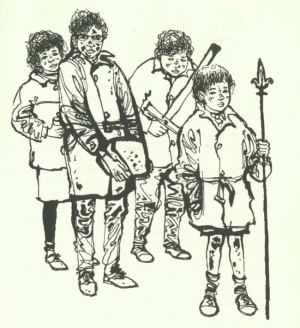
Let me come back to spearhead as an interesting image. It reminds me (for some reason) of the spear hefted by Roland, one of the children in Elidor (Jake Hayes’ blog is a beaut) – and that took me further, to Charles Keeping’s image of the weary children – and that took me in turn to the four gifts the children have entrusted to them: spear, sword, cauldron and stone.  While I’m not suggesting that Garner has consciously presented here an allegory of lit crit, it does strike me that these four treasures (in all their C20th grubbiness) can be asked to stand for the notion that we need more than one thing to preserve the magic, to allow for the critical-but-not-dismissive/destructive eye. The close reading of one reader; the eye to sources and history from another; the pedagogic “Can I use this for my science project?” or”we’re doing fairy tales, where should I start?” or “where is the vocab I need to teach?” of others.  Maybe we need them all, the field is so diverse.

Adults and children read for a wide, wide range of reasons; we enter not a single section of a bookshop, but a richly unfolding section upon section of fantasy, pathos, travel, speculation, high adventure and myth. We call it Children’s Literature when really it might at least have a  plural. “What are your researching, Nick?” “Oh, Children’s Literatures.”

And now I have lots more to think about.

*

Bachelard, G (1958, translation 1964) The Poetics of Space, trans Maria Jolas. New York: Penguin USA

(I am indebted to Nikki Gamble for discussing Bachelard on Twitter and moving me to explore his work)

Chambers, A (nd) Booktalk http://www.aidanchambers.co.uk/booktalk.htm and The Reading Environment http://www.aidanchambers.co.uk/readingenviro.htm accessed 29.10.18

Halford, D and Zaghini, E  (2004) Folk and Fairy Tales: a Book Guide. London: Booktrust

Lesnik-Oberstein, K (1994) Children’s Literature: Criticism and the Fictional Child. Oxford: OUP

Pope, R (1998) The English Studies Book. London: Routledge

Tolkien, J  (1964) Tree and Leaf. London: George Allen and Unwin


How Dead Are the Dead?

In the great story of Funnybones we are confronted with an unheimlich narrative. Three characters go for a walk, play on the swings and go home – but there’s a problem: they are dead. Or are they? They are skeletons, certainly, but they have emotions, thought, language, relationships and in any case we are told explicitly that

On a dark dark hill there are was a dark dark town…
and in the dark dark house there was a dark dark staircase
and down the dark dark staircase there was a dark dark cellar
and in the dark dark cellar …
some skeletons lived.

The nub of my argument when I talked in the Brookes Hallowe’en Seminar was that depiction of “real death” is sometimes avoided or underplayed, although this is changing.  The comic misunderstanding of the skeleton in the park requires however at least some knowledge of what a skeleton is.  It comes back to the time (maybe 1993) I read Funnybones in nursery, with animal X-rays darkening the windows,  and as I finished  (“…some skeletons lived….THEY STILL DO”) the X-rays with perfect timing slid from their places and we all jumped.  Death as comic – but also as unnerving.

In Funnybones the dead are hardly that unnerving. A big skeleton, a little skeleton and a dog skeleton are identifiable as a strange sort of being: nocturnal, with a clear mission to frighten people, but not dead, really, and if undead then hardly George Romero’s Night of the Living Dead.  But they have accidents, experience disappointment, and are warm towards one another. In the disjuncture the reader sees not only the scarily unfamiliar, but also the very famliar, a family unit out with the dog.  Their silliness reminds me always of the “gurning to camera” of the third skeleton in the C14th  De Lisle Psalter, Arundel MS 83, f. 127v, blogged about (with a great illustration of the grinning skeletons) by the British Library here. But while in “The Three Living and the Three Dead,” the skeletons meet the living princes to “admonish them to consider the transience of life,” in Funnybones we are with Gilbert and Sullivan finding that “we spectres are a jollier crew than you, perhaps, suppose.”

To understand what is going on here, we can refer to Gillian Rose’s visual methodology:

  • What is being shown? What are the components of the image? How are they arranged?
  • Is this a contradictory image?
  • What knowledges are being deployed?

This has come up before (it’s a shame that the new blog hasn’t preserved the images) and formed the backbone of the talk I gave a couple of years ago on the visual methodology of death. It is also pertinent in the run up to Hallowe’en: again something I have discussed before.   What is being shown is a family out for a walk – or three animate skeletons on a (rather unsuccessful) scaring spree.  In the same way there are complexities in the folk tale of the Teeny Tiny Woman who is compelled to give back the bone she finds in a graveyard. The sheeted figures who look on in horror as she pillages a bone for her supper (what on earth is that about?) require their bone back.   They are not, initially, menacing: they are being menaced by a cute little old lady. The comedy lies in the contradictory imagery, with the knowledges being deployed being rather complex.

The Teeny Tiny Woman, Funnybones; these will do for now. They draw on the flwing sheets of M R James and the earlier shrouded corpses. But of course children do know skeletons – museums have them; dinosaur fossils have them; we (and this is a bit of a shock: see this brief observation) have them. And in Funnybones we are invited to see with T S Eliot’s Webster  “the skull beneath the skin.”

There are other ways children see death, of course. Children’s Literature does well to represent a number of aspects:

  • In The Scar we deal, heartbreakingly, with real death – but the dead mother is unseen: her absence is the key act in the story.Dad said “She’s gone for ever.”I knew she hadn’t gone, she was dead and I would never see her again.’This story is not alone in looking, not at death, but at bereavement, just as the heart breaking Sad Book depicts the death of Michael Rosen’s son Eddie as a blank page, a gap in the history,  loss. He is drawn very much alive – and then not seen. A kinder view than the medieval skeletons? Or more shocking?
  • In Badger’s Parting Gifts, on a different tack we are invited to see the actual moment of Badger’s dying, going down into a long dark tunnel with no fear or pain.  Yet even here the dead Badger is not depicted.
  • In Death Duck and the Tulip (when I’ve talked about this the most divisive book choice), Duck recognises Death and they are friends – of a sort. Death here is close kin to the medieval Death the Reaper, or the three dead mentioned above, and maybe there is a message here of living life to the full and accepting our mortality that is not far from Arundel MS 83…

A conclusion to all this? No, there isn’t one.   Writing about death finds a number of ways to lighten the message – comedy; the sidestepping of the dead body (not always: Sydney Smith does so well (gently but clearly) in Footpath Flowers); using animals instead of humans – but increasingly these are not hard and fast conventions, and I predict we will see more imaginative ways to deal with letting in the dark and the dead into children’s literature.


Ahlberg A, Ahlberg J (2010) Funnybones (re-issue ed). London: Puffin

De Paola T (1985) Teeny Tiny. Oxford: Oxford University Press

Doonan, J (1993) Looking at Pictures in Picture Books. Stroud: Thimble

Erlbruch, W (2008) Duck, Death and the Tulip. Wellington: Gecko

Lawson, J and Smith S (2015) Footpath Flowers. London: Walker Books

Moundlic, C (2009) The Scar. London: Walker

Rose, G (2007) Visual Methodologies (2nd ed). London: Sage

Rosen, M (2004) The Sad Book. London: Walker Books

Varley S (1985) Badger’s Parting Gifts. London: Picture Lions


Place: literature as guide

This blog – or rather its predecessor – explored place rather a lot. This summer’s trip to Santorini was in part inspired by reading Clive King’s The 22 Letters; Gawain and Ludchurch (“Lud’s Church”) are all over it, too.  I have read about places and gone there; I have gone to places and read about them. I read The Canterbury Tales and Mydans’ novel about Thomas Becket and then went to Canterbury.   It set me thinking: what might I have made of Paris if I had read Vango first?  (After all, after I’d read Becket and its – erm – inspiration,  the novel by the great medievalist Helen Waddell, I was disappointed to find so little left of the Paris they describe. In fact, although there is more around Notre Dame than is immediately obvious, there is more tangible stuff left of Clive King’s Ancient Thera in the tablets of Linear B and the archaeological museums than there is of the ill-fated lodgings of the twelfth century canons of Paris.)  How do we, as adults, use the written word to tell children about the physical world? How might we (or do we) use story? How might this, in itself, change the visitor’s ideas?

And if Vango might have changed my view of Paris, what of Selznick’s Hugo Cabret? Or Kipling’s or Milne’s Sussex? I could go on…  and that’s before we start thinkng of places responding to their visitors – where Canterbury’s rebuild was prompted by its visitors, and Paris still holds the echoes of the Hemingways and Steins so wonderfully celebrated and parodied in the film Anastasia in Paris Holds the Key to Your Heart (of course Paris is particularly susceptible to this myth-making, as is Oxford, my city of aquatint and commuting).

But  then we come (of course) to Garner. The creation of the Alderley phenomenon, drawing on myth and legend, changes a bit of whimsical parkland with a few stories attached into a mythic landscape out of all proportion to the stories that we can find readily. It does so almost entirely because of the authochthonic outlook of Alan Garner. We find ourselves in this place or that seeking to see with his eyes, following his train of thought, his access to myth and legend. We are tempted to try and see his Alderley, his Thursbitch, his Ludcruck.  Gawain and Beowulf are in his sights; we peer into his horizons and try to see what he is pointing out.

But let’s broaden this out. As I have discussed before, there are clearly places that have myths or legends attached, where stories have been piled up. The Cheshire/Derbyshire border is one such; maybe Oxford is another, or Paris, or Tintagel. Part of the project I seem to be involved with is the uncovering of these story cairns – but there is another part: it is the job of the critic of children’s literature – or some of us – to look not only at what has been collected, but also at the effect of the stories on the visitors to the landscape.

What does the young visitor make (and here we are in the recent Twitter conversation that started my thinking) of Venice having read about the pig Olivia and her visit? And how might the adult draw on this in September to help the impressions of the visit stay vivid?

Up the Mountain

Marianne Dubuc’s Up the Mountain is worth considering when anyone says that a picture book is simple. It does not have the visual fireworks of Gaiman and McKean’s Wolves in the Walls or the political complexity of Foreman’s A Child’s Garden but the straightforward story (outlined below) has a lot to offer.

I find it is sometimes challenging when reading educators’ social media about “Where would you have this book?” and ” What use could you make of this book?” to stop and think of a book as an object in itself: the visual aspects, the pace and language of the narrative…   That’s not to deny teachers for a moment a very exciting way to explore and widen their own understanding of “children’s books” – but just that sometimes a book calls me to step away from the pedagogy. Up the Mountain does that for me.  Yes, it fits with projects on Outdoors, it could be used to discuss age, and friendship, and exploring, maps and maths, wildlife, ability…

img_9968.jpg
But that’s why it is a really enticing book. “Very old” Mrs Badger, on her Sunday walk up the mountain meets the little cat Leo who overcomes his reticence and joins her in the walk – that Sunday and “for many a Sunday after that,” until Mrs Badger no longer has the strength and it is up to Leo to rediscover the mountain. It is a plain enough narrative, with an easy pace and lovely drawings, and as Leo makes the “splendid” mountain his own, it has a poignant and subtle message about growing up and passing on the things you have experienced  and grown to love – as Leo does at the end of the book. This is a story my 5yo granddaughter will love, but the unspoken affection, the relationships between character and landscape, the exploration of tradition and enthusiasm mean I can return to this over and again for my own pleasure.

So how do we step back from being pedagogues to being simple readers? Easy enough for me in semi-retirement, maybe, easier still with research partners to spur me on, but the following are just some rough-and-ready thoughts.

Reading widely helps: if you stick to the ones you know, you are missing out.  Not just because this book or that is perfect for this child or that, but because your own enjoyment is endangered, rendered threadbare. On social media recently, a new teacher asked about the book for this next term. My response was to suggest she read a book she will enjoy reading, and the best way to find those is to read widely. The commmuity of people reading and discussing “children’s books” (or fantasy or whatever) is rich, wide and very charitable. Look at Sarah or Dimitra for starters…

Re-visiting half-forgotten or set aside books or series: have you “done” the lovely Owl Babies a lot? What about On the Way Home?  Or if you set aside something (a besetting sin of mine) ask yourself why, and whether it’s worth returning to it. Finish the Stone Book Quartet. I bet there’s a Moomin story sitting unexplored – or what about Jansson’s adult books???  There’s a whole different thread…

Treating the books destined for the classroom just as you would your holiday reading: You don’t intend to put Margaret Atwood’s Hagseed in the classroom but how did you read it? Did you take its psychological messages about bereavement and revenge to heart, or did you read it as a comic exploration of a Shakespeare play? Did you read and re-read, or did you race through it? Did you share it with a friend or a partner? Or a book group? Or on Goodreads? What did you “get out of reading it”? I read seasonally: Moomins in the autumn, maybe, and Lucy Boston’s Children of Green Knowe in December…  How do you read? What do you enjoy?  Why do I like Up the Mountain so much? Is it that poignant subtext of Mrs Badger saying goodbye to her beloved Sunday walks? The gentle loyalty of Leo? A bit of self-reflection might let you think differently about the children’s books not as a resource but as a source of wonder and enjoyment.

Reading about authors – reading other people’s critiques of authors’ discussions and interviews (I have to link to Mat Tobin here, but check out Simon and Martin and others, too), author biographies, books by the author outside their usual genre. No, for some people that’s not the way they want to go, but for some those lavish books of Maurice Sendak’s artworks or the simple self-revelation of Alan Ahlberg’s The Bucket are just the thing to get you looking at the books children read in a different light.


And then finally.  Once you have enjoyed the illustrations, seen the way prose and picture work together (or in opposition), enjoyed that way that little cat peers out at Mrs Badger and how the bunny later echoes the incident, finally figured out the relationship between Sally Gardner’s wolves and John Masefield’s – then start looking at the classroom, and again, Mat has the resources … Too late to do this for this summer, I know, but this is, after all, simply a reflection as the weather cools. Time for the Moomins for me, then… More mountains and small beasts.


Shelving

After years of accumulating homeliness, leaving my Brookes office was a dreadful thing to do; hasty, almost punitive. We left for Greece the day after my Brookes contract came to an end, with thoughts of Prospero set adrift echoing through my reading. My books of img_9972magic – of Wild Spaces Wild Magic – were set up, but the rest was just boxes of stuff.
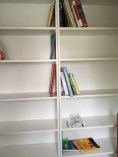
The boxes were sulking when I returned, but with a  bit of coaxing, they began to find ways into the study. Joe helped by taking me to Ikea and then helping with building the shelves. I did that job I had called “tonking”when I was a library assistant: setting the shelf heights by sorting out the supports or tonks. And after that it was shelving.

I decided to divide the books into “children’s literature” and “lecturer-type” books, with Wild Spaces Books on their own, starting with Molly Bang’s Picture This, through some (but not all) the Robert MacFarlanes, ending with Z is for Jack Zipes. There were boxes of liturgical and Biblical books – a very nice Liber Usualis, for example, and my battered Greek New Testament – too, but I set them to one side. I looked at the children’s literature and set to. They were in boxes roughly alphabetically, so that a pile of Anholts came out together, and more Mairi Hedderwick than I thought I had; but they weren’t in strict order, and there were gaps. This means that books that had not met for years suddenly were leaning against one another: Sheila Cassidy’s retelling of the Creation was up against Michael Foreman’s eco-committed texts on one side and David Almond’s Skellig on the other. More arrive and these congruences shift: Roald Dahl and Lauren Child budge in; Noel Langley’s Land of Green Ginger, with its rather dubious racial stereotypes, squeezes in with Virginia Kroll’s Masai and I. It’s a bit like rush hour, but they all do get  in.

Size is an issue, and while I create “Outsize” shelves, for a while it looks like MacFarlane and Morris’ The Lost Words has no home, until moving the Little Tollers downstairs makes space in Wild Spaces Wild Magic, between Landmarks and W G Hoskins The Making of the English Landscape. Some of these juxtapositions are just right.

Biblical and liturgical find a home like the sparrow in psalm 83.

img_0245

The grown-up books fill higher shelves, partly in case grandchildren want to browse the lower ones for books that are “for” them, but here it begins again: for a good while, Philip Pullman’s Daemon Voices snuggled next to Rob Pope’s English Studies, until Francis Pryor arrived with Steven Pinker and the Opies. Julie Fisher rested against Ralph Waldo Emerson for a while (or was Emerson the one doing the leaning?); Caspar Henderson and Geoffrey Grigson met briefly, as did Jackie Musgrave and T H White.

It’s all a lovely conceit, as if this crowded Tube train of office shelving means that Simon Schama and Chris Stringer will get chatting as their covers touch, or Katharine Briggs
will strike up a conversation with Jane Carroll as they squeeze together.   But of course they won’t. It may be that George Monbiot does talk to Sara Maitland, but they don’t do so on my shelves. Here, that’s my job. Because if this blog has point beyond a rather vain showing you (dear Reader) round some of a really quite small collection, it is this: books “talk” to each other only in the person who reads attentively and makes connections. We become passionate about this idea or that, but it is the reader who is in a position to connect playing outdoors as the Last Child in the Woods with the Hermits and the New Monasticism of the eleventh century (Louv and Leyser). Alcuin of York reminisces O quam dulcis vita fuit dum sedebamus in quieti … inter librorum copias, but I might respond O how sweet life is, Blessed Alcuin, where we sit and read in quiet and let the ideas inspire and jolt and fizz and mix…

We are where the debate takes place, where critical thinking emerges. Not reading alone, but thinking and speaking and mulling and writing – and maybe reshelving our ideas in a different order from time to time.