Statio

The year’s midnight. 

“Always winter and never Christmas.” C S Lewis’ ultimate baddie, the White Witch, keeps Narnia frozen in a time when the natural cycle of death and birth cannot continue. Will Stanton in Cooper’s The Dark is Rising has his midwinter birthday interrupted, threatened, brought into its rightful place by the crises in the book. Kay Harker’s dream (or not-a-dream) sees the Christmas of Merrie England restored when the dark powers of   sorcery threaten to destroy it. I feel I also have to note en passant the most terrifying version of this for me, Michelle Paver’s adult work Dark Matter, where the narrator faces months of night time and solitude – and something far worse out on the Arctic ice. The time in late December is reenacted in these stories as a time of crisis, and the subtext seems to me to be a worry that as the days darken, the sun will not return, no hope for love “At the next world, that is, at the next spring.” A fear that This is It.

As Catherine Butler in Four British Fantasists suggests of the interplay between magic and humanity in Cooper’s Dark is Rising sequence

The Light is opposed in turn by the Dark, and most of the activity of the other mythical and historical figures involved in the sequence is related in some way or another to their struggle. Given Cooper’s insistence (as in the description of Herne) on the wildness of some of these figures, this moral alignment of their magical power might be problematic.

Problematic indeed. The complexity of this vision is one of the things that Masefield is beginning to explore, and that Lewis more or less avoids, but which Cooper meets head-on in The Dark is Rising – and in more meditative and lyrical form in a poem she first published in 1974.

The publication of Susan Cooper and Carson Ellis’ The Shortest Day , which re-presents Cooper’s 1970s contribution to a larger work, has prompted renewed interest (it never really goes away) in the interplay between UK fantasy writers and the folklore they draw on. There are some lovely reviews already out (e.g. Kirkus, Brainpickings (who [of course] beat me to the Dillard reference, although that doesn’t often stop me) praising the text and artwork, and this is not a review but some thoughts at a tangent. Again, I am not alone in this tack: Calmgrove’s Christmas Delights (which already sounds like a box of candied fruits) has a wonderful post exploring a selection of writers from Nesbit to Masefield, and then Lewis, and so to Cooper herself. By celebrating Solstice (check out Solstice here)  she sets up not a Pagan in the sense of antiChristian but an unChristian, a preChristian festivity, gloriously underlined by the images Ellis gives us, as wanderers move through a land that they increasingly mark as their own.

Through all the frosty ages you can hear them

Echoing behind us – Listen!!

All the long echoes sing the same delight,

This shortest day…

In Ellis’s paintings we see the “precarious business” as the palaeoanthropologist Chris Stringer puts it, of early humanity’s existence in our inhospitable winter, and we see our efforts – the our, I think, underwires the charm and power of this book – at keeping the dangers and demons at bay across the centuries.  It is a similar nostalgia (thank you again, Chris Lovegrove, for this insight into Masefield ) to the gathering of the ancestral (ghostly) Oldknows in Tolly’s first Christmas in Lucy Boston’s Green Knowe, that we celebrated on our visit. All those long echoes in the stones of Hemingford Grey.

It sends me back to Ronald Hutton and his Stations of the Sun. In the opening chapters he carefully dissects Christmas customs with judiciously chosen details (I was intrigued by the mummers who menaced people having been “drinking, playing at cards and fiddling all day in disguised habits”) and drops in details that have resonances elsewhere, such as the apotropaic torch rituals in the Staffordshire moorlands town of Stanton.  It has to be remembered that Hutton, although with strong ties to various aspects of Paganism, is suitably cautious in his methodology:  Hutton looks at the Roman feasts of midwinter, Saturnalia and Kalendae, and then states

The new Christian feast of the Nativity extinguished or absorbed both of them, and a string of other holy days sprang up in its wake…

before going on to explain the rise of the Twelve days and the Epiphany/Theophany in the Western and Eastern Churches.

In most of northern and central Europe, where the cold and darkness were much greater…it would have run into local patterns of pre-Christian seasonal celebrations….

But Hutton warns us that

Literary sources do not tell us anything conclusive about the midwinter festival practices of the ancient British Isles…

He find the early English sources more enlightening than many others, and his trail leads him to the conflation (as he suggests) of a Modranicht, or Mother Night, a middum wintra, with the Nativity. The festivities may predate Christian Christmas or draw on earlier practices*… And then he turns his gaze on Yule (jol, jul, juul), the jolly time of Norse festivities.

Stations of the Sun is not a pagan handbook but a scholarly exploration, suggesting that seasonal rituals were fluid, open to change, to diminishing and reinterpretation. It is right, therefore, that in his conclusion some 400 pages and a ring-round year of celebrations later he writes:

It is one of the arguments of this book that the rhythms of the British year are timeless and impose certain perpetual patterns upon calendar customs: a yearning for light, greenery and warmth and joy in midwinter, a propensity to celebrate the spring with symbols of rebirth…

[However] What is also plain is that the last couple of centuries, in this as in every other aspect of British life, have produced a completely unprecedented amount of change… No amount of nostalgia or anxiety for a rapidly diminishing or deteriorating natural environment can alter the essential irrelevance which it now possesses for the daily lives and seasonal habits of most of the British; however, this very fact may cause it to play an ever greater part in religious symbolism.

And not only there, I think.  Children’s literature – the work written “for children” and the work written meditating on childhood – seems to me often drawn to these natural cycles, and most of all to the changes of dark and light, for which the stores of story and ritual and symbol stand ready for writers and artists to draw on. I do wonder about the place of folklore and a kind of vision of archaic beliefs in the writings of fantasy – and marvel at the power of this time of year to bring out our need to explore these themes…

IMG_7731

*

Oh, I see you haven’t spelled Station right – and what is that about anyway?

I have, and this is my final point. To return to another of Hutton’s delightful side-comments, he suggests that Yule is connected not only to the world “jolly”  but perhaps to the word we know as wheel;  I can’t help thinking of the Sun Cross, the sign of the Old Ones in Cooper’s The Dark is Rising, and the ‘ring with the longways cross” the Oak Lady wears in The Box of Delights, but the symbol of the sun as wheeling around might suggest that while we think of Solstice as when the sun stands still, another version might be that it is that tipping point before a wheel starts to turn again. Nature holds its breath, much as St Bernard suggests we all do when the Angel presents Mary with her choice at the Annunciation (Nota Bene: this impassioned, dramatic passage from Bernard is set in Roman Rite breviaries as the non-scriptural reading for 20th December).  The holding of our breath: can we get out of this darkest time? The site Spirituality and Practice has a brief extract on Statio as the sacred pause.  The moment, maybe, before the liturgy starts, where everyone is standing ready, not awkwardly waiting but attentive. Birdwatching for the moment of grace. This is not to say that the Solstice is now simply that for Christian practice or post-Christian jollity – but that the winter Solstice in particular invites us to pause, to listen as the new world turns and does it all again.


*Bede is his source here. Hutton is, in case you are wondering, suitably cautious when we get to Easter and its original. 


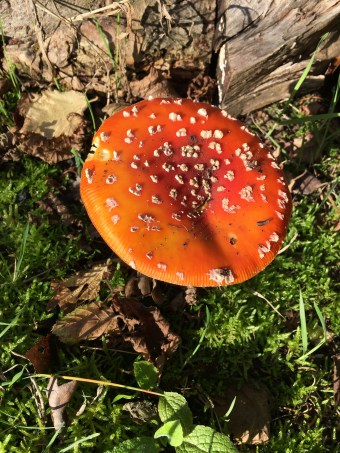
PS:  The photo, by the way, is not an Old Way or my own Old Road outside my front door, but unexpected snow before Christmas a few years ago, taken on the feast of St Lucy, the old “Shortest Day” that John Donne celebrates (and I cited at the start of this post) and the birthday (not the feast) of Bl Lucy of Narnia. Well, sort of.


Carnival chaos

To recap some of my thoughts about Hallowe’en. The use of such conquering fear of the dark activities seems to me pretty obvious:

winter nights enlarge/The number of their hours

and we can make the best of it by smiling at the dark. Thomas Campion‘s lyrics have it just right, and youthful revels have their place in the honey love of the closing-in evenings.

The pro and con tensions in part arise from the abuses these revels engender. “Psychos” and “Slutty Vampires” sit uncomfortably with my English folk-horror. Yet they’re not wholly American: Trick or Treat at least has an element of bargaining amid the demanding money with menaces, unlike much of its ancestor, Mischief Night, whose joys seem vengeful or gleefully malign. A door latch has a drawing pin attached to it with dog poo, so the unwary person who pricks his thumb goes at once to suck it… a sooty chicken is induced to cause havoc at a WI meeting…

Yes, these are both occurrences from North Yorkshire I’ve been told about.  They are the same Carnival as the Big Skeleton, the Little Skeleton and the Dog Skeleton go in for as they riot their way home in Funnybones, or the menacing pumpkin head that gets its comeuppance in the story of the hopping pumpkin  who meets an ignominious end with a goat (this is a link to a longer text than the one I tell).  But the Carnival is there because we are at a sort of seasonal fault-line, where summer’s lease is up and the dark is at the door.

There is a sense for me that this big change is the Autumn answer to May Day. The nights close in, the socialisation is indoors, defined, more visible, with the freedoms of warmer weather lost or at least traded for friends and firesides.  When C S Lewis envisages this in the hearts of his heroes in That Hideous Strength they think of

…stiff grass, hen-roosts, dark places in the middle of woods, graves. Then of the Sun’s dying, the Earth gripped, suffocated, in airless cold, the black sky lit only with stars.

No mischief or carnival here s we stare into the dark.  Mischief, however, is close friends with these shadows and darkness, of the almost-known, the footsteps partly recognised. It is the younger sibling of more menace, and this is partly why it is disquieting: does it licence the bully, the vandal? In looking into the shadows, does it, as Kathleen Raine so evocatively puts it:

Let in the dark,

Let in the dead…

(Northumbrian Sequence IV is cited in extenso here in my post about poetry and spirituality)?

It seems to me that this week or so – Hallowe’en to Remembrance/Martinmas – is a real blending of a gleeful naughtiness, the swede or pumpkin lantern and the restlessness of wind and dark, wet evenings, as the chaos of Carnival mimics and mocks – and presages – the chaos and pain of the storms of winter and death, “þis andwearde lif manna on eorðan” “Talis vita hominum praesens in terris…”

So when we smile at the shadows when we look at books for (and with) children, how do we approach death and disaster?  The too-brief nod recently to the BBC adaptation of Phillip Pullman’s His Dark Materials asks about the Beeb’s decisions to show it pre-watershed. We might similarly ask about Erlbruch’s Death, Duck and Tulip, that strange and lovely meditation on the role of death in our lives – or Thummler’s Sheets, or McCaughrean’s Where the World Ends, or Ness’ A Monster Calls…  In fact, although the list isn’t endless, there are plenty of books that offer wonderful and painful insights as they look at death and pain and loss.

The good writer who perceives a good story need not shy away from the issues; the reader who comes to these texts comes prepared for challenge, maybe for tears – but trusts the writer to deliver something that will bring them safely to shore. Raine puts it well when she suggests that in our innocence it is still within us to

bind in human form
A living power so great,
A living impulse great and wild

and (for me the subtlest line)

Have pity on the raven’s cry


Lewis, Merlin and Our Most Perilous Time

My mention of Jane and the Pendragon in my earlier post suggested to me that some of the good things about C S Lewis’ problematic text That Hideous Strength come from the interplay between the modern world and the enigmatic emergence of Merlin, meeting with his leader, Elwin Ransom, the Pendragon, a Cambridge academic who by chance or design now holds the fate of an embattled world in his hand. In a comfortable country house in England the two men are in discussion about how to save Britain – the Arthurian Logres – from the grasp of its power-hungry and immoral leaders:

Suddenly the magician. smote his hand upon his knee.
“Mehercule!” he cried.“Are we not going too fast? if you are the Pendragon, I am the High Council of Logres and I will counsel you. If the Powers must tear me in pieces to break our enemies, God’s will be done. But is it yet come to that? This Saxon king of yours who sits at Windsor, now. Is there no help in him?”
“He has no power in this matter.”
“Then is he not weak enough to be overthrown?”
“I have no wish to overthrow him. He is the king. He was crowned and anointed by the Archbishop. In the order of Logres. I may be Pendragon, but in the order of Britain I am the King’s man.”
“Is it then his great men — the counts and legates and bishops — who do the evil and he does not know. of it?”
“It is — though they are not exactly the sort of great men you have in mind.”
“And are we not big enough to meet them in plain battle?”
“We are four men, some women, and a bear.”
“I saw the time when Logres was only myself and one man and two boys, and one of those was a churl.Yet we conquered.”
“It could not be done now.They have an engine called the Press whereby the people are deceived.We should die without even being heard of.”
“But what of the true clerks? Is there no help in them? It cannot be that all your priests and bishops are corrupted.”
“The Faith itself is torn in pieces since your day and speaks with a divided voice. Even if it were made whole, the Christians are but a tenth part of the people.There is no help there.”
“Then let us seek help from over sea. Is there no Christian prince in Neustria or Ireland or Benwick who would come in and cleanse Britain if he were called?”
“There is no Christian prince left. These other countries are even as Britain, or else sunk deeper still in the disease.”
“Then we must go higher.We must go to him whose office it is to put down tyrants and give life to dying kingdoms.We must call on the Emperor.”
“There is no Emperor.”
“No Emperor…” began Merlin, and then his voice died away. He sat still for some minutes wrestling with a world which he had never envisaged.

No Emperor.  Lewis’ meditation on the collapse of morality and faith comes immediately after the Second World War, another episode in the devastation of Europe in the C20th.  It is a fantasy novel, of course, and has moments of comedy, insight – and a troubling theological sexism. It would make a wonderfully quirky film – with some very notable rewriting.  It is a harking-back to a golden age that Lewis tries explicitly in some of the Narnia books, and indeed the kings and queens and heroes who come to rescue Narnia are in some ways reimaginings of the Arthurian rescue: they do not sleep under a hill, but take another life in our mundane England.

It is this that Susan Cooper is answering in her charge when her Merlin tells the children that their task is to take up the Matter of Britain themselves, not as fantasy readers or antiquarian scholars but by engaging with the power that harms and grasps and mocks. Cooper’s Merlin is more worldly wise than Lewis’ when she has him say “ the evil that is inside men is at the last a matter for men to control.” I have discussed this hard lesson before – but it is a hard lesson. Arthur will not do it; no Archbishop or Monarch is going to save us: we have to do it. Lewis’ Merlin, under the guidance of his Pendragon, rises to the challenge, and the difference between Cooper and Lewis is that his Science Fiction does have rescuers, in the tutelary spirits of the solar system who endow Merlin with supernatural power. Lewis is playing with allegory here, and in the passage cited above shows how the disjunction can be an effective plot line. Cooper saves her message for the last pages of her sequence of books, and the message is clear: in times of crisis, of confrontation, a new post-War morality requires us to step up, to make choices and to act on them.

And the “Most perilous time”?  A line from a monk on the eve of the dissolution of his monastery, another period of question, of violence, manipulation and painful reemergence. Not always are these moments of crisis just the matter of fiction.

Emmett and Caleb and

The book Emmett and Caleb is a simple story about two friends, an exploration of friendship DE186CC4-0C87-4FD2-B161-7040A806FA69not unlike DuBuc’s Up the Mountain. Hottois and Renon give us a bear and a deer who live next door to each other, and we follow them through a year and through the ups and downs of their friendship. They live in a world where a deer can check the internet in bed, and where a bear can roast chestnuts.

Ian Eagleton has already laid bare much of the complexity around this relationship in his revealing interview with the author, which is linked here. Karen Hottois says so much in her responses I couldn’t better it. There is lots more, both in the book and the interview  – nature, landscape, the seasons, freedom: I’ve tagged this post “spirituality” precisely because of this richness and the interior life of the characters it reveals.

Sarah Ardizonne the translator has deliberately chosen to use the word “love” where the French original uses “aimer, ” as an indicator of the relationship between the two characters, and Karen Hottois is clear about her intention when she talks with Ian:

To me, Emmett and Caleb are friends but I did indeed deliberately write in such a way that they might be something else. First of all because I think that the contours of a relationship aren’t always clear-cut and because I wanted my readers (children and parents alike) to be able to interpret it as they want. Nothing gives me more pleasure than when I’m told that same-sex parents enjoy the book and can identify with it.

Let’s unpick that paragraph a moment. Hottois isn’t sidestepping the question about the relationship between the two animals at all; rather she is meeting a very big question about friendship head-on.  What language do we use for a strong male-male relationship?

To start with I want to return to this blog post from a while back. I based it on the illuminating messages of Dennis Tirsch, which I expanded to say that

The sacred is not defined by how it might be attained but by how it is  boundaried by reverence.

And this caution, this reverence, is what gives me great joy when reading Emmett and  Caleb – as much as when a friend calls me to meet.  It is there too in the physicality of relationships: hugs, the touch of a hand, whatever; and in the ways these physical expressions of friendship are like and unlike the ones that are part and parcel of being a dad, or even part and parcel of more involved romantic and intimate relationships. Except I’m not sure I like intimacy as a euphemism: Emmett and Caleb do not have a sexual relationship that we can see, but their relationship is certainly intimate. In a certain sense  whether their relationship is sexual doesn’t matter in the story: real intimacy is what is at the heart of the book.

Now, this sounds like a cop-out. “They don’t need to be gay like that, just really good friends” sounds like something from my parents, and that’s not what I think at all.  I do think that Love is a powerful word, and maybe it is scarily powerful for many men, but physical expressions of intimacy are not impossible. I take joy when I meet a friend in the Weston Cafe for coffee; likewise I have friends I can cry with, share poems with; friends I have taken a cup of tea in bed; friends I can dance with, borrow clothes off; friends I kiss when I haven’t got a cold; friends I have lent my dressing gown to (and readers of Emmett and Caleb will understand the references). With some friends I share really difficult stuff about my emotions, or about the pains of growing old, or the schlep of parenthood.  The Venn diagrams for all these would look like a kaleidoscope, and changes in culture change the patterns we discern, but it isn’t easy, because the word Love is not always accessible to men.

Sometimes that feels unfair: love is such a complex and involving thing, but it should be possible for men to use the term.  It’s there, but not nameable. It “dares not speak its name” because its meaning is so often seen as not complex, a simple dart of Cupid.  I cannot deny the two characters in this book that feeling, of course: books are interpretation places and anyone who comes to a book can approach it and savour it as they wish.   I can also see the tender and committed affection between bear and deer  at various points when they are tearful, or sharing the winter cold, or whatever – but it is as complicated for Emmett and Caleb as it is for us. I called this post Emmet and Caleb and because whatever the interpretation of their relationship, it stands for so many others.  They stand for me and my friends. When the deer and the bear struggle to express their feelings and they tussle about poems and messages, I am fully in agreement with Karen Hottois when she says that

the contours of a relationship aren’t always clear-cut.

This emerged last year in the context of professional use of the word Love, too, which I discussed and is increasingly present in children’s literature. In Keith Negley’s Tough Guys (Have Feelings Too) , which I have mentioned before, and which comes up in the work on masculinities and fatherhood Mat and to some extent I have been exploring, seriously characteristic, even caricature male figures – superheroes, wrestlers – are shown to have a similar relationship to their emotions. I am glad they are vulnerable – very glad this vulnerability is on show in a book for children.  Mat calls it an “optimistic and liberating story of starting down the road to a sense of emotional freedom for the modern man and father.“ Emmett and Caleb, too, live in a world where they enjoy the change of seasons, a last dance at the end of a party, thinking about each other’s birthdays… They do not live in a bloke culture where everything is painfully clear cut. And I am glad they don’t – and again, glad that this relationship is open to interpretation, to discussion, to ambiguity. My world is like that, too.

To concentrate on who Emmett and Caleb might be “in real life” or what that real life might consist of is to miss something important: the role of closeness in male friendship, a sustaining, honest closeness.

Emmett brought Caleb his dressing gown. They stayed there, keeping each other warm.

Together, like that, they could last the whole winter.

Yes, we read this and really believe they could.


Story

I love being outside, and from camping and hiking with the Woodcraft Folk on, I’ve loved storytelling outside too. I love warm summer days teaching, and this time earlier in July with Home Start was a joy in so many ways (I mentioned them in the previous two posts). 8325C7B0-0434-46B0-8C8C-F84C42D6F1E4Anna from Home Start has been kind enough to let me reuse the pictures she took, and I’m vain enough to have picked this photo. “You’ve got your gob open,” was the immediate family comment. Yes, I have: it is at once in the same tradition and a long way from all those MSS of the medieval Magister spouting in a lecture.  I was reminded sharply while I was working with their volunteers of the story in Kevin Crossley-Holland and Jill Paton Walsh’s Wordhoard in which the new teacher in the monastery school lets the boys out to read and learn in the orchard.
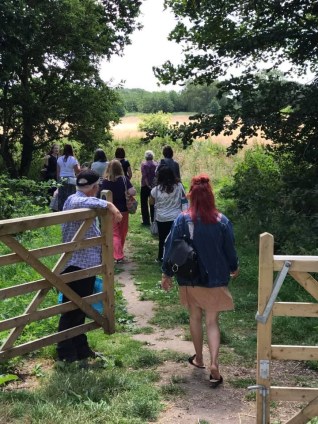
The perspicacious will also note that I’m not reading a story at this point, but discussing an article, down by my side – specifically Wyver et al (2010) The Ways to Restrict Children’s Freedom to Play: the problem of surplus safety, Contemporary Issues in Early Childhood Vol 11, no 3 – to explain something about safety and families. I love exploring that article; it is such a judicious mix of research synthesis and plain common sense.  But of course I did it with a story and it’s that pedagogic tool I first want to reflect on.

Teaching isn’t stand-up, I know, but there is always some room for a story in teaching, whether it’s through sharing a book (Anthony Browne this time; maybe Up The Mountain next time?), or a traditional tale told orally (next time I meet Home Start will be the autumn: I think hallowe’en pumpkins may get a look-in), or an anecdote to illustrate a point. This episode in our morning’s training was about giving parents permission – if such a thing is needed – to do a little bit of thinking ahead and then to let the children explore. The group picked up on the phrase surplus safety.  It’s not without risk, and the story I told was of a boy who fell while out of Forest School whose dad said to me “He never has an accident with me; he’s always in his pushchair.” The spin I put on it was that children need to be given opportunities. As Shirley Wyver and team point out:

They [sc children] will make postural adjustments to maximise stability and efficiency….

and they suggest that early protection from falling can limit the problem-solving a child needs to do on unfamiliar terrain. We discussed the section in Wyver’s article where she suggests it’s a mistake to think small children are not good walkers: children need to exercise (and so, often, do we). And walking brings us away from the adult as in charge, the story-teller/performer.

SDB7B4F32-2A3A-4B43-8D47-1D6FD937FACAtory is not all that happens outside. The very experience itself affords the chance to chat, to wander, to find a new way or a new place – and this is the problem with story as outdoor pedagogy: it is still too close to the teacher-as-Master. Again, this was something we discussed, and I confessed how hard I find it not to jump in and explain: this is called n…; that x is brilliant because it smells like…  While there is clearly a place for “the naming of parts,” for the acquisition of agreed names, there must also be time for independent discovery, for the friend who brings you an egg-shell they have found, for the ladybird on the hand, the sound of the wind in the grass, or even, simply – as one of the people I was with pointed out – that not all grass in green. Warneford Meadow lived up to my praise of it: the grasses were purple and tawny-gold.
Importance and Binary Opposites

The presentation on What Children Shouldn’t Read for the Reading Spree didn’t go too badly, and reflecting on what did (and didn’t) get heard has been interesting. A few messages went astray both from me and from other presenters, although the “reviews” to listen to are, of course, the people who were actually there, and caught nuances more than the powerpoint slides Twitterers want to argue with. Responses on social media have been thoughtful (and certainly less spittle-flecked) than they were following the first one, at least.  However, reading them does bring me back to Kieran Egan, whose Teaching as Storytelling was a key element of my 20 or so minute ramble. He asks

  • What is most important about the topic?
  • Why should it matter to children?
  • What is affectively engaging about it?

and then  follows this with the challenge to find binary opposites/pairs:

  • What powerful binary opposites best catch the importance of the topic?

Big questions when we look at storytelling and curriculum.   I suggest that they are different for teachers than they are for children. In What Not to Read I suggested we might ask “How do we look at books when we are educators?” and the same is true of how we look at the whole phenomenon of the outdoor curriculum and outdoor storytelling in particular – and in many ways, looking at curriculum is closer than using Egan’s probing questions as being essentially about storytelling.

There are tensions, binaries around ecocriticism and curriculum. Am I storytelling outdoors as a part of the Green Agenda?  How do I deal with a tension around book sharing and how we might orally present traditional tales – there are, for example, practical issues around books and outdoors (as we discovered in a session last year when it poured with rain)?  Teachers’ binaries will be concerned with these curricular issues; children-as-audience will be concerned with, as Egan puts it “the human adventure that began in magic and myth…” and they might be concerned with good and evil, danger and escape (Roald Dahl’s Goldilocks is a wonderful skewing of these concerns with his “delinquent little tot” and her fate at the hands of Baby Bear) or with destruction and redemption (I think at once of a beautiful and politically charged book I have discussed before: Michael Foreman’s A Child’s Garden).

So many binaries to disentangle, when the challenge from Egan is to find the  “binary opposites” that “best catch the importance of the topic” (my emphasis).   This is no small task when selecting books or stories for an outdoor audience; a huge task for teacher or school when considering why they might want to do storytelling and the practical considerations that arise from this plan. Why do we teach how we do?  What prevents us from running on the free rein of professional expertise and creativity?

*

To end with an esprit d’escalier thought about presentations and co-presenters at the Reading Spree, I will take a wide-angle lens view, and ask another of Egan’s questions:

  • What content most dramatically embodies the primary opposites?

This Saturday it was for me testimony from Simon from Whitby – of children in his school who had never been to the beach – and Nicki – a librarian on a TA’s salary, buying library stock from her own pocket.

I went the next day (Sunday) to a panel discussion hosted by members of the Blackfriars congregation about the impacts of poverty and austerity on the educational experiences of children in Oxford. The feelings of the three speakers (and including my Maggie), all in various roles in education, around the squeezed budgets of public services suggests to me the final and most obvious binary: funding and austerity. Life chances are enhanced by things like decent libraries and book provision (and excellent library provision and staffing such as evidenced here) in towns and schools: refusing to answer calls for better staffing and book stock is an ideological choice, to cut public funding and cut taxation.

Cut after cut and cut as politicians tear one another apart and us along with them. There’s a binary for starters.


What Not to Read

Kieran Egan in his book Teaching as Storytelling suggests that topics should be chosen according to a model that starts from Identifying Importance (he is using The Vikings as an example), and asks

  • What is most important about the topic?
  • Why should it matter to children?
  • What is affectively engaging about it?

He is asking the teacher to question how does the topic impinge on the child learner as “they begin to understand that the conflicts they see in their families and neighbourhoods and schools, and the conflicts they feel within themselves, are analogous to those that have shaped history,” and how “that values of tolerance, self-restraint and so on are essential for all of us to practice as prerequisites to civilized life.”  Although Egan does take this a lot further (of course), there’s more than a bit of “if I were you I wouldn’t start from here” in this approach to the Vikings – but if we think about this in terms of choices of books to buy for/share with children, it makes an interesting set of questions:

  • What is most important about the themes in this book?
  • Why should it matter to children?
  • What is affectively engaging about it?

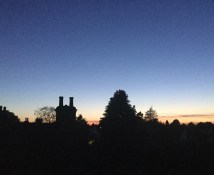
What books might I put in a pile that if I wouldn’t ban them I would sigh and think “Do I have to?” I wonder if this set of questions makes me think beyond my usual repertoire, so to test it I reach behind me (with a brief look at the lovely sunset 998976B0-CB3F-4424-BD5A-EE770D074DBBand a quick compulsive posting of the evening skyline) to find a book. The first to hand is the battered (and ergo much loved) family copy of the Tale of Squirrel Nutkin. Since I won’t be exploring this Potter in my Reading Spree talk on Saturday, it will do very well.  It is not my favourite Beatrix Potter but maybe that’s to the good as well.  Let me use these three questions on it, and see what emerges.

What is most important about the themes in this book?

Beatrix Potter’s iconoclastic red squirrel uses riddles to annoy the owl Old Brown when Nutkin should be polite. The tensions are around respect and the consequences of crossing boundaries of politeness. It seems to me that what is most important is rule breaking; tasks are not completed, authority is insulted, danger is courted.

Why should it matter to children?

Naughtiness and rebellion against authority are important themes in the literature of childhood. The Dionysian child brings Carnival and chaos to the adult world: in the Topsy-Turvy of Lewis Carroll, the child Alice is wondering but quite prosaic in the face of the Wonderland Carnival of the Hatter and the shower of cards that tries to overpower her; George brings chaos and murder by poison to his nasty, controlling Granny with his marvellous medicine. Squirrel Nutkin is a jester D4B73E98-8D7D-4D5E-A143-A529F50EDE2F.jpeg with “no nice manners” who takes his jesting too far.  These characters and situations matter to children as they explore the “what ifs” of denying respect, especially in a literary landscape where being good is rewarded.   With Squirrel Nutkin (and many of Beatrix Potter’s male anti-heroes) we are looking into the same, magically enticing world (although in reverse) as the unfortunate Bertha in Saki’s The Storyteller in that what matters is what happens on the disputed land between riot and being “horribly good.”

What is affectively engaging about it?

The uncertain territory allows for an ambiguous outcome, and thus a real sympathy emerges not for the much-put-upon Old Brown, but for his relentless tormentor. The storytellers who go down this path look for affective engagement with chaos and anti-heroes. No wonder the children in Saki are entranced; no wonder the reader delights in collapse of school authority in Matilda or the downfall of George’s grandma, or the disruptions in lives when the wind blew umbrellas inside out and whirled the postman’s letters up… In Beatrix Potter Carnival delights, but the trespassing Benjamin Bunny and the stoner Flopsy Bunnies learn their lesson. What seems to me to be engaging is the piling of misdemeanour on misdemeanour. How naughty can this get before order, tedious and safe, is restored? How naughty can I be before I get into trouble and the “mastering pressure of wearisome necessary things” (Saki again) returns?

***

So this use of Egan is part of my method for my talk at the Reading Spree. How do we look at books when we are educators?  What use is this book that I want to dismiss as anodyne, or creakily outdated? I want to explore ways we can look at children’s literature that allow a sideways glance – and particularly at stories and genres we may not like. This is not to say that any and every book is worth wasting precious story time in a pressured school day, but may be something of a recantation of my views on Blyton or Dahl or Walliams or Rowling, on the Rainbow Fairies and the Mister Men.

Or it may not. I have already Tweeted Joyce Grenfell’s devastating critique of the fake and formulaic Writer of Children’s Books who clearly has never been to Make-Believe Land, and I may have to rant. There is already a section marked NSFW.

Family

This is me:Me, study, Christmas


and my brother. 3378BABA-5EAA-47A0-939F-9BA534BA2A83


He is quite a bit older than me, and is, in fact, my older half-brother. This is the story:

Our mum has a baby, my brother Glenn, but her husband Jack is killed at sea in WWII. Eventually (in the 50s) she marries my dad, another sailor, Ray, and I come along. A series of miscarriages and my brother being abroad mean I am, more or less, an only child at this time.  Mum dies the year I go to University and my brother and I lose touch. We are eventually brought back together some ten years ago. I am, physically at least, quite like Glenn – to be honest, a shorter and -erm – less athletic version of my brother (and of his son, my half-nephew, Ben).

(I also have another half-brother and half-sister, Mark and Hannah, who are the children of my dad’s second marriage, to Val. Hannah is only about six months older than my oldest child, Joe, but for this post I want to mention Glenn and me).

Glenn is a fool and I am not. That is to say, his role in his local Morris side is that of a fool and I am in no way nimble enough to be a Morris Man. We share common interests in folklore, although mine tend to be bookish and his practical. We are both gardeners. We both have beards and white hair. I had quite a bit of contact with Glenn as I was growing up: I loved it when he came home, loved going on his motorbike from Blandford to Badbury Rings, loved going to visit him and his family – loved his garden, and walking on the wide beaches of the North East coast. In some ways he gave me experiences of outdoors, folklore and family that stay with me. Habitus. We aren’t twins separated at birth – but I am astonished by how strong I now perceive his influence on me to be. Was it really his dancing that led me to Wild Spaces, Wild Magic? How does his social circle of beardy beer drinkers influence my choice of appearance and choice of beverage? Was it our mum’s deep admiration of him that convinced me that here (in some respects) was what growing up was about? How, in the twenty or so years we didn’t meet, did those choices Glenn had made tell me about being who I am?

I am (as I have been before) reflecting on “history’s curved shell,” as R S Thomas says in his poem Eheu Fugaces, on how pasts come together in the present, on these strands of influence, and the more I think, the more I find the Nature/Nurture argument often too simplistic. There are physical differences as well as emotional ones, beliefs and life decisions we have made that are different, life circumstances (his losing his dad so young, for example) that are just not replicated…  Where do our choices come from, and how are they determined by people we meet, or see, or imagine? How do we look back at attitudes and choices?

*

To change tack: lots of things conspire to get me thinking about my family at the moment, but (for the purposes of this blog), I want to think about the struggle for identity so vividly described in Anthea Simmons’ Lightning Mary, a fictionalised account of the early life of Mary Anning.  In it, Mary is trying, with a “head full of pain and sorrow and anger” to establish what it means to be a scientist, coming from a poor background with numerous hardships; how does she identify as a woman without being seen as a potential wife and mother?

“Did I ask to be a woman? I did not… I hate babies and husbands and men and being poor and the sickness and the toil and the injustice. What have we done? Why are we to be punished so?”

Into Mary’s mouth are put the cries of impatience of generations.  Her mother responds,

“Whoever told you that life was fair, Mary? Not I. It is what it is.”

The injustices and hardships are depicted brilliantly in the book: her clashes with the landed gentry and “proper” scientists, her sustaining but troubled friendship with the precious young Henry de la Beche…  Mary becomes a real heroine, although as Simmons acknowledges in her afterword, her story is “profoundly sad,” and the novel ends, rightly, on a down-beat.

My brother’s and my story is not (so far!!!) sad, and neither of us, I think, is a frustrated genius, “born to blush unseen” but we (all) tread the difficult line between self-identity, the urge to be Henry de la Beche’s “friend and scientist” and Anning’s mother’s line that “life is what it is.” But our similarities and differences do highlight the ambiguities and tensions of upbringing and choice, of lack of freedom in various generations, of societal expectations. For us it is just ordinary life, in so many ways, but for Anning it was painful and frustrating.

“There were days, dark days, when I felt as if I had lined up for a race and then been told to take two steps back because I was poor, and then two steps back because Father had been a Dissenter, and then ten steps back because I was not a man…”

Anning in the novel is prickly and wilful, but also determined, resourceful – and ultimately doomed (the passive voce is important, I think) to be by-passed by the scientific revolutionaries with whom she deals. The book is a rallying- cry for young woman thinking about science as a career. It is also a plea for educators to remember how complex the stepping stones of privilege and the nets of disadvantage can be.


Understanding

Does an author (and I will use the term to mean authors and illustrators and author-illustrators; see below) always write with the intention of perfect clarity?

No.

Next question.

I’m thinking of a number of authors of books  children read whose writing has caused me to stop and puzzle. Lots of authors do it, and part of my problem with the Goodreads/Amazon way of presenting books (“What did you use the product for?”) is that too often this leads to a “Didn’t like it? Next!” reaction, the kind of literary equivalent of the whistle stop tour; this approach can (I’m not saying it must) mean we read to write the review and move on, just as we visit this palace to take that picture. “Rushing past… No more time to stay and dream…” as Dowland has it (look, for example, at this version from Les Canards Chantants) .  We actually need time to stay and dream, and puzzling over a book’s ambiguity provides some of that.

Let me very briefly take a few examples: Le Petit Prince; The Rabbit and the Shadow; My Brother’s Book.  I could go on, of course, but these are especially ambiguous in lots of ways. I may be displaying my ignorance here, and to others the answers may be very obvious indeed but

  • Is the little Prince in the novella a hallucination?
  • In The Rabbit and the Shadow,  how many characters have an independent existence? Are they all in a child’s play? Is the soldier, because of their humanity, the one playing?
  • When Guy dives into the maw of the bear in My Brother’s Book, is he already dead?

Notice I haven’t asked these first of all in terms of the author’s intention. I think it’s a different thing to ask “Who does Saint-Exupéry want us to think of when we see the little Prince?” “Does Mélanie Rutten intend us to see this as in some way a “real” adventure, or is it all in the child’s mind?” “Sendak plays with Jack and Guy in other work, and with the notion of death in Outside Over There. Is the Bear the same as the goblins?” These are not so different from exam questions that could be

  • Explore the role of the angelic in Le Petit Prince and Mary Poppins
  • In what ways might the Stag-Rabbit relationship in The Rabbit and the Shadow be a parent-child model and what does this tell us about contemporary models of family?
  • Discuss (with reference to both texts), how death is represented symbolically in the Winters Tale and My Brother’s Book (NB: use of the online game in Winterson’s The Gap in Time will gain extra credit).

None of these nine are, at heart, bad questions, and maybe my query could simply come down to something like “Is it always an author’s task to clarify – or might their work also challenge us to think more , to do some digging?”  We expect it, of course, in some authors (it is central to the work in the Wild Spaces Wild Magic project) and for example in Garner’s “adult” texts, Boneland and Thursbitch (parallels between these two and Le Petit Prince, The Rabbit and the Shadow and in particular My Brother’s Book have not escaped me). We expect it, too, in the Brontës, Sterne, Heaney (hence the digging)… we expect, maybe work for these connections, keen eyes peeled for antecedents, symbols. It seems to me the author makes a choice to be ambiguous: think about the mystery and half-told stories in Jane Eyre until the blunt (and beautifully timed) “Reader, I married him.”  Does a “children’s author” make the same choices?

I don’t think all do – but I do think they can do. I look at Mat’s exposition (again the digging metaphor) of Town is By the Sea or his discussion of the book with the artist here on his blog, and see that there is a real chance for children and adults to think critically and deeply about the books they read.   I also don’t think this always needs to mean that we can work through a line-by-line exegesis or pinpoint exactly where an illustrator is standing when they sketch, but that thinking deeply might mean living with and savouring rather than codifying and commenting on the subtleties of a text or picture. Barring the odd editorial mistake, we must trust the author to have intended a lack of clarity, an image half explained (Simon and the giraffe in Hilary McKay’s The Skylark’s War springs to mind), because life is not neat, every dilemma does not resolve like a Restoration Comedy – and as Saint-Exupéry (half) explains

On ne voit bien qu’avec le cœur


Back into Storyland

Let’s start with the lyrics:

When a knight won his spurs in the stories of old
He was gentle and brave he was gallant and bold
With a shield on his arm and a lance in his hand
For God and for valor he rode through the land

No charger have I, and no sword by my side
Yet still to adventure and battle I ride
Though back into storyland giants have fled
And the knights are no more and the dragons are dead

Let faith be my shield and let joy be my steed
Against the dragons of anger the ogres of greed
And let me set free with the sword of my youth
From the castle of darkness the power of the truth.


I loved this song as a child: perfect Junior School Assembly stuff. I sang it in college with my friend Robert, too: a shared memory of school even though we hadn’t known each other. It colours, also, my understanding of fantasy literature: the wistfulness is something of a challenge and full of the pull of nostalgia, and for me (some way from assembly in Harlow), this folksy version by Martin Simpson of it really rings a chord.

I’m not swapping from wolves to dragons as an interest, but just to record, for National Storytelling Day, the wonderful variety of dragons. Here are some of my favourites, drawn, I ought to say, from the European tradition. The song I’ve cited above always reminds me these days of Tomie de Paola’s The Knight and the Dragon, where the luckless knight and dragon come to terms with each other, make peace and live happily. But there is also Eustace in  C S Lewis whose encounter with – and transformation into – a dragon are an allegory of sin and redemption; there is Rosemary Manning’s urbane and charming R Dragon, standing for the whole of Cornwall, wistful for the time of Arthur; the urbane and vain dragon defeated by The Paper Bag Princess… And there is Smaug the Stupendous.

It seems to me that dragons are (like wolves) personifications of a certain type of aggression, and that the fire they are often surrounded by is its potent symbol. Michael Martchenko‘s wonderful fire in the Paper Bag Princess has it all: all-consuming but ultimately exhausting. And at an uncertain hour, when anger is rife, maybe storytelling can remind us of this: those dragons of fear and anger (and criticism and self-doubt) are in the end going to burn themselves out.