Confusions

To reflect on the moving Corey’s Rock by Sita Brahmachari and Jane Ray has required a number of shifts in my thinking. I’ve had to screen out some of the praise for the book as well as the discomfort I feel at a personal level for a subject that – in part at least – touches my own life. There are already confusions here, and what I want to do is to return to the questions of ambiguity I’ve looked at before (in fact just over a year ago in my post Understanding).

Corey’s Rock tells an uncomfortable story. Isla, the young first -person narrator, has returned to the island where her mother’s family have roots. In the aftermath of the death of Corey, Isla’s younger brother, the family of four – Mum, Dad, girl and dog – are a family seeking, in Auden’s words, locality and peace. The narrative at its simplest is about the weeks in which Isla begins to settle into her new life while mourning her brother.

But I see that I have already strayed away from the simple into the complex, and in referring to Auden I have returned to my own confusions, and a post in which I look at the

the cramped frustration of attempting

the jigsaw with pieces missing

And if the posts from that time are about a lost me, this book is a story of a lost family.

So I think there are three sets of confusions to be addressed here: the ambiguities of the text and illustrations; the complexity and detail of narrative and art work; the twinges and uncertainties of the reader.

They are not all things we should fight shy of: life is confused; endings are uncertain. If the current crises in health, society and the economy (insofar as they can be disentangled) can teach us, we are an uncertain bunch: too reflective to suffer dumbly, but unable to make much sense of sudden changes, sudden downturns in our fortune. This is not always to the advantage of the writer, who has to contend with issues of clarity. Jenny Nimmo writes a piecemeal and sometimes unclear narrative when she looks to set out the relationship between the magic world and our world in The Snow Spider; Sita Brahmachari does the same with a similar brief: how to look at a child’s grief through myth and landscape. The issue, it seems to me, is connected with the genuine confusions in the minds of Isla and Gwyn – and the pain of their adults. Ivor, Gwyn’s father, is the more confused of the two dads, lost in his anger as much as Bethan was lost on the mountain; Isla’s father (and some cost to himself, I think), sighs as he tells his daughter “You know Corey can’t come back, don’t you?”
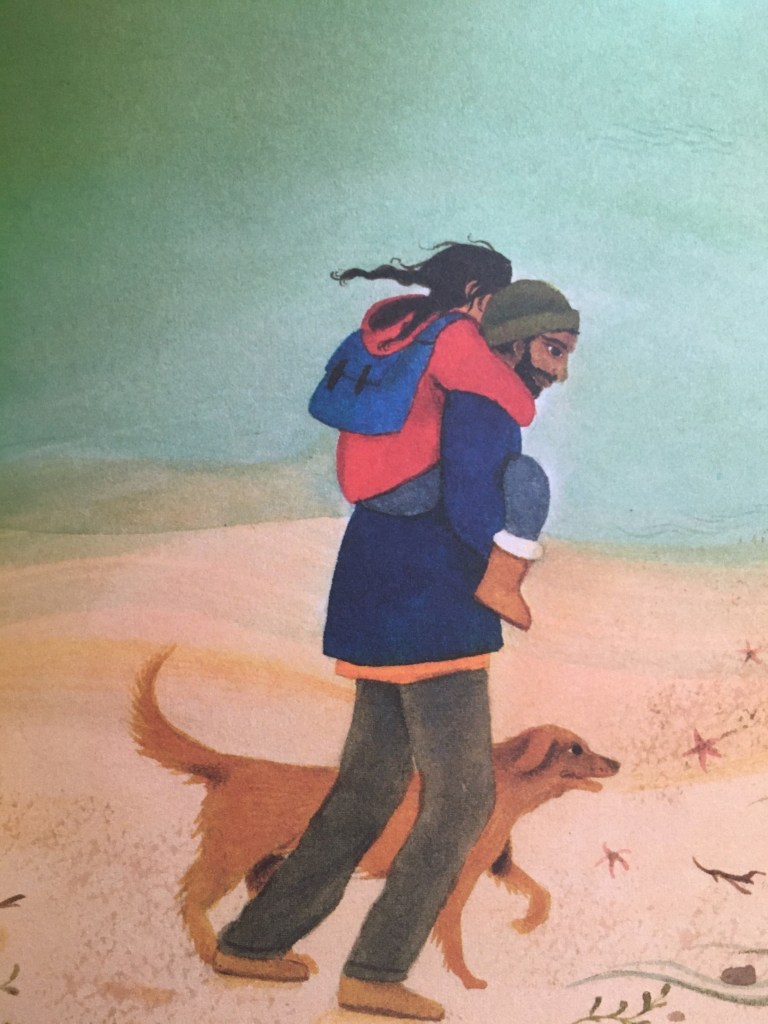
The truth does not make him any less beautiful or eloquent: Jane Ray’s luminous artwork gives him soulful eyes and a deep connection to his children and Sita Brahmachari gives him the best lines:

“How deep does the colour go?” I ask Dad.

How deep is the sea,” he answers.

He is an archaeologist with the soul of a poet. Kathleen Jamie, meeting him on a beach in the bleak north of Scotland, would have found a friend.

Back to my three confusions: I suppose I am trying to distinguish in my own mind between what seems the author’s deliberate blurring of edges (which is as much at the heart of this as it is David Thomson’s classic People of the Sea and the film Song of the Sea) and the fact that I am not (or not yet) at ease with the rich complexity of the story Brahmachari is telling. Shapes shift, roles move, tragedy and freedom walk hand in hand, and in this story we trace other themes, too, besides myth and landscape: race, disability, belonging, refugee children washed up on the shores of Europe; the roles of incomers in an island community; a mother coping with grief and a father’s efforts to keep his family whole; and the big question of little Isla:

Do you think this island will make us happy again?

Have the author and artist been over ambitious, or is it, perhaps, that I don’t feel able to embrace this complexity? I struggled with this on my first two readings, but then was struck by the Celtic knotwork on one of the double-page spreads, and thought of those complex interweavings that are part of so many pre-conquest crosses, ornaments (like this from a Viking grave in Orkney) and tombs and manuscripts – and I honestly think this was my misreading. This is an ambitious book, but look at Sendak (link here to the haunting and complex My Brother’s Book, again a richly illustrated and complex text about death); Foreman; look, even at the stories of Katie Morag and her own island life. I know picture books and richly illustrated texts aren’t always easy. Of course I know that.

So what was my problem here? My third confusion. It is possible for a story to be poorly written, badly drawn: in my teaching on a module called Becoming a Reader we would look at texts with ideologies long dead, books with clumsy pictures or inconsequential, often derivative stories. Corey’s Rock is not one of those, although the threads of detail take some following. The third confusion is where the reader looks but does not see how those threads might go.

Because in the end there are more and more threads to follow: where author and artist brings their research, their pasts (including their past work: the dad in Corey’s Island recalls – although not exactly – the beautiful, caring father in A Balloon for Grandad)… or where a reader’s own reading past or visits to a place or similar sadnesses lead off in the wrong direction.

So to end, not in any way to try and trump the painful story at the heart of Corey’s Rock, but maybe to explain part of my confusion as I read and re-read it, joining in the sea song of all those times Isla’s family walk along the beach or look out for the bobbing head of a seal, is one of my twenty-year old poems for our son Theo.

Recalling you is a daily conjuration.  In solitude

I know my sadness, know your face, but you appear

where least expected: at the corners of sleep;

at the bruise of unkindness; in a flower

unlooked-for, by a cliff’s edge.

Today I called you,

throwing a stone

into the receding tide,

trying to write your name in the wet sand;

but as I made the first stroke, crossbar of your T,

the wave returned,

unbidden, sudden –

And the mark my writing didn’t leave was you.

Landscape and Community

Chris Lovegrove and I have been trying to explore aspects of Jenny Nimmo’s The Snow Spider together: this blog post forms part of the concluding dialogue between me and Chris. In this week’s blogs we are answering the same questions, but doing so, to some extnent “blind:’ we have agreed our two questions and then we are posting our blogs on the same day.

Here’s the first, posed by Chris:

1. The Snow Spider is very much set in the Welsh landscape, not just by the language and the myths but also by the descriptions — the hills and the sheep farming, for example, and the apparent proximity of the sea (which Gwyn is able to smell after a short tramp through over the hills). Does it matter for our engagement with the story that it’s bedded in a realistic setting or does it work equally well in a mythic setting (as it has to for those unfamiliar with The Snow Spider’s cultural matrix)? 

My response: I’ve been to Wales four times: once to Conwy and Betws-y-Coed on a coach trip with a pile of nuns when I was nineteen;  once, in 2000, to the Brecon Beacons to get soaking wet while training as a Forest School Leader in the pouring rain; once to stay in a cottage at the foot of the Sugar Loaf near Abergavenny. My  last visit, rather later in my life, was to help at a Quality Assurance event in Carmarthen. My understanding of Wales is therefore built on brief and specific visits – and at no time have a stayed in a claustrophobic valley like in The Owl Service, nor really had any dealings with Welsh hill farmers beyond being told a footpath was no longer in use. So what, therefore, is my response to the landscape in The Snow Spider? How realistic do I need it to be?

It was not a high mountain, nor a dangerous one. Some might even call it a hill. It was wide and grassy, a series of gentle slops that rose, one after another, patterned with drystone walls and windblown bushes. The plateau at the top was a lonely place, however. From here only the empty fields and surrounding mountains could be seen and, far out to the west, the distant grey line of the sea.

This is Nimmo’s early setting the scene. Gwyn ascends the mountain to practise his powers, but here we are being told simply what the upland looks like. There is a lot, of course, that a reader (particularly, perhaps a reader of Gwyn’s age) might want to disentangle in the language and topology: How can a hill be a mountain? What’s a plateau? As we sort out the vocabulary of place in a possibly unfamiliar place at the start of the narrative, we are on the cusp of a deeper understanding, almost a curtain-raiser for the mythic and developmental battles young Gwyn is beginning to engage in.

But in order to come close to Chris’ enquiry I feel I need to distinguish between the everyday depiction and the descriptions that that move the story along. Michael Bonnett and certainly Michael Farrelly seem to suggest that “human-environmental interrelationships” are aided by powerful storytelling. We have that here, in Jenny Nimmo’s three Magician Trilogy novels. In the Snow Spider it seems to me that the author chooses weather as a way of inviting her readers into the hill farms, rather than more explicit topography. Here, for example, in Chapter Eight the young magician is poised to fight in the face of a snowstorm:

There was a sudden stillness and the mountain held its breath. Clouds of snow began to gather on the summit; they intensified and rolled downwards in a vast, ever-thickening ice-cold wave.

It is atmospheric writing of a high order. Nimmo has brought us to this point by vivid and intensifying descriptions of weather in a hill country. From much earlier in the story, this is the arrival of a November gale, the first major encounter with wind as an elemental, magical force:

Then, one Sunday, the wind came; so quietly at first that you hardly noticed it. By the time the midday roast had been consumed, however, twigs were flying, the barn door banging, and the howling in the chimney loud enough to drive the dog away from the stove.

The storm, a dominant motif – and an important factor when anyone is up in a mountainous region – will come to provide the wintry arena for a final conflict . Even Gwyn’s prosaic father Ivor has to admit it is “a damn peculiar kind of wind” ; by doing so we come to understand that this is a hard life, and see quite how the tragedy of Gwyn’s older sister being lost on the mountain might have occurred. In these earlier sections, however, Nimmo is also careful to give us little domestic details: the barn door, the dog, the stove… So I come (finally) to Chris’ question: Does it matter for our engagement with the story that it’s bedded in a realistic setting?

I think it does. Part of the power of the depiction of Gwyn’s father (see below) is that he is ordinary; the ambiguities of learning to be a wizard are all the more painful for Gwyn than the flamoyant Owls from Hogwarts and cartoon familial abuse are for Harry Potter because in Gwyn’s story they are depicted as taking places in a believable world. Nimmo leads her readers through the fields with open gates, cows that need milking, the circle of trees where the septic tank lies… and into a world of magic spiders and a past full of ancient tales. It’s a clever way of convincing the reader of the reality of the Gwyn’s challenge as he grows – but for a little more of this, see below.

The second is posed by me:

2: The tight-knit community of The Snow Spider allows for powerful reactions between a limited range of characters: Gwyn’s family, his friends, the neighbours. In a more widely connected world – mobile ‘phones, internet & c (shown in the new TV version) the world is a wider place. Does this date the plot unduly? And if not, why not?

I started by wanting to consider the Hui Clos of Pendewi, the village in the Snow Spider, but of course the most famous line from Sartre’s play is L’enfer c’est les autres, and the more I ponder the community the less sure I am of this. There are family tensions here, and the neighbourly relationships of a small village, but these are not people trapped in Hell together, but a Pobol y Cwm, a people of the valley. When Alun, Gwyn’s friend, is lost in the storm, the ‘grapevine” works fast to rustle up a search party. When Bryn and Gladys Davis confront Gwyn’s family about Gwyn injuring their son Dewi it is uncomfortable – but not on an epic scale. Gwyn is like many a child who needs to make sense of his family as he grows: what does his family history tie him to? Does he like being with them? As with landscape (above), it is the ordinariness that provides the power to the scene and to the magic that interrupts it.

The new TV version gives some nod to the passing of time since the original publication of the Nimmo books, starting in 1986, in that there is some mention of the internet, and the watch Gwyn gets as a birthday present in the book has become a tablet (with remarkably good connection). This in turn allows some further plot exposition, some idea of the past which Gwyn is inheriting. It also serves to underline that very odd nature of the old Welsh manuscript the young magician reads. As a reflection on the updates in the series it works well.

Does this make the actual text creak at all in retrospect? I didn’t think so. The IPad/tablet would have been no further use in the story than the rewrite has allowed it. (In pondering updates I did think of Baz Luhrmann’s Romeo + Juliet where for the tragic failures of communication to take their toll, the modern audience needs not to think how simple a quick couple of texts or emails could have sorted everything). Gwyn’s father’s quad bike was a nice touch, too: this was a family more like Emmerdale (or God’s Own Country) than Cold Comfort.

But what of magic in the modern world? Where might the Tylwyth Teg live now? For Alice Thomas Ellis the uncomfortable magic of the Welsh tradition in Fairy Tale suggests they live where they have always lived: in edgelands, woods, odd meadows and lanes with a strange feel to them, very much alive in the affairs of humans. In Pendewi, the stories live on by being reenacted (more explicitly in the later books in the trilogy), and the parallels with Garner’s The Owl Service are many, from common roots in the Mabinogi to the recurrence of tensions dating back into myth and legend. Where is the magic? In both books (“all the books,” if we count the Ellis, the Garner, all three by Nimmo and Susan Cooper [who will come into my next post]) it is frighteningly close: it exhibits in the fallible humans who cross its path. (Just as it would be amusing to think up how M R James’ stories could be updated effectively, it would also be a challenge to think quite where his ghosts might reside now: in mobile numbers that link to conspiracy theories long dead, catalogues whose URL summon destruction, internet stalkers whose only real presence is to hunt the curious through the pdfs of manuscripts…) But Nimmo’s Gwyn, it seems to me does not needs this. It is his ordinariness that saves him. Tensions between generations, Ivor Griffiths’ incoherent anger at his family’s loss, the petty rivalries of the playground: these are universal enough to contain the introduction of the internet, while a small village up in the hills (Chris may take a different view) may not be able to rely on mobile signal quite as much as I do for sustaining its relationships.

Chris and I are planning to post our blogs on 4th May, having not seen one another’s responses. Do please visit https://calmgrove.wordpress.com to see what Chris has made of these two questions.

At Sea

When Moominpapa leads his little tribe away from Moominvalley he is trying to negotiate a new way of being the Father. In Moominpappa at Sea he has left his study and gone back to his childhood wanderings as depicted in his memoirs – except that this time he has family to deal with, and instead of hilarious annoyances like the Hemulen Aunt and Edward the Booble, settles on an island and is concerned with keys to the lighthouse, protecting his family, and the fact that – as we maybe all discover in some ways – that our shadows follow us when we make changes to our lives. Change in purpose, in attitude, in relationship (to one another, to the landscape we inhabit, to our selves) is at the heart of the story.

Following them in her inexorable, inexplicable, icy rage is the worst Nemesis in any book for children: the Groke. Symbol of crushing depression, she kills everything in any place she sits. This is perhaps the most terrifying illustration of the creature in all of Jansson‘s depictions (I am even fond of the darkening paper of my soon-to-fall-apart copy). She frightens me like the revenant in the final sections of Michelle Paver‘s terrifying Dark Matter.

The Moomin family have been described as “surprisingly complex and plausible.” Part of me wants to jump up and down at that “suprisingly,” but it does reflect something of my own disquiet when I first read this book – and I read it as an adult. In fact I did remark to one of my children that “I didn’t think it was a book for children.” I think my opinions about “for children” have changed now – but it reflects some of the themes Tove Jansson presents. These are characters with depth, full of love, sadness, frustration, loneliness: capable of wrong decisions, reconciliation, fear and delight – and because they are Jansson’s characters, able to worry too about the lack of paraffin and to enjoy a birthday tea.

Reviews on Goodreads go from a five-star “poignant and empathetic” to “a deeply distasteful story of toxic masculinity.” It is worth remembering this is a book from 1965, of course, but in the way that Moominpappa is trying to restart his life, and the ways Moomintroll is trying to make sense of the haunting chill of the Groke that has pursued him and the beauty of the seahorses he encounters, we are looking at an exploration of growing that goes way beyond the anachronism of “toxic masculinity.” If anything, these two male characters are asking for ways to make sense of their place in family and society: how can I be a “family man” when so much is beyond my control? asks the father. How do I tame the depression that seems to negate my inner need for beauty and transcendence? asks the son. Or perhaps I read the two characters like this because in some way those are my own questions… Let’s return to the text. (NB: It would take a lot longer than a blog post to bring in here a discussion of Little My, or Moominmamma or the sea horses – they need looking at in their own right. This post will have to be about Moomintroll and Moominpappa, and revisists/revises some of my thinking from an earlier post.)

The way Moomintroll and his father interact in Moominpappa at Sea appears to me to be an indicator of both characters growing. With his comfortable self-assurance, Moominpappa in Ch 4 (“The North-Easter”) starts off in control when he and his son go to bring in a haul of fish: Now you can see I know something about the sea, he says, but he is panicky, unable to direct Moomintroll effectively, and the nets are full of seaweed rather than fish. All the father’s expertise temporarily ebbs away – and their boat capsizes. Tove Jansson knows her boats, and takes us through this disaster assuredly – but even though father and son come through the crisis, here, in this brief interchange, her characters show they are less sure of themselves:

“Well, we managed that all right,” said Moomintroll, looking cautiously at his father.

“Do you think so?” said Moominpappa doubtfully.

It is a revealing little scene: the self-assured, bungling dad loses face with his growing son, and when Moomintroll looks cautiously for reassurance, it is at this point that Moominpappa expresses his doubt. Simply told, but in an effective few words.

The chaos of the botched fishing trip is a metaphor for frustration (as Keith Negley describes his pirate in an interview with Mat Tobin), and is followed by the usually imperturbable Moominmamma’s sighs as Moomintroll’s obsession with the lantern (and the demands of the Groke) interrupt her plans. It is as if in this landscape of frustration, nothing can come right.

Moominpappa is contending with his island, his family, his worries. Instead of a study where the family interrupt him, he has a crag on which to sit: this life change has not been the success he had expected.

The ending is ambiguous, Moomin Valley is (maybe) lost, the characters (certainly) challenged, and if their issue around the custodianship of the lighthouse are resolved, I still feel a chill when reading

The thought of the Groke crossed Moomintroll’s mind. But he didn’t feel that he must think about her. He would see her later as usual, but he didn’t have to.

It now reminds me (with important distinctions, of course) of the final of Dark Matter. The narrator, Jack, having been menaced and haunted (“It can open doors“) in Gruhuken in the blackness of an arctic winter where his friend has drowned, now lives in balmy Jamaica, and once a year visits the sea:

When I’ve mustered my courage, I can just bring myself to crouch at the water’s edge and di[ in my hand, and hold it there while I talk to Gus. It’s a kind of communion. But it’s a dangerous one, for I know that I’m also communing with Gruhuken, and with what walks there in the dark…

The worst is not knowing if you’re still there.

What has Moomintroll’s repeated encounters in the dark with the Groke, this vengeful granddaughter of Nordic Frost Giants, brought him? An appreciation of his father’s ennui? There is a significant change in understanding between Moomintroll and the Groke so that she

…started to sing. Her skirts fluttered as she swayed to and fro, stamping on the sand and doing her best to show him that she was pleased to see him…

and I would – maybe even ought to be – happy with that, but what is the Groke’s new relationship with the Moomins? Is she in some way healed? Changed? She appears to me a figure of terror, but gradually Jansson introduces other ideas: her sadness; loneliness the coldest thing that ever was… Why do I come back to her as something to be scared of negotium perambulans in tenebris, Scaduhelma…wan under wolcnum? Is it, maybe, that these frustrated monsters are for me like the thursen of our research – and that what I am looking for is the very opportunity to grow? Moomintroll himself has grown, it seems – but what of Moominpappa?

The title in English gives us the “at sea” of this blog post: lost, aimless, adrift. The title in Swedish translates as “Moominpappa and the Sea,” reminiscent of Hemingway. Moominpappa has uprooted his family, tried to rewrite their relationships, and come adrift from the way his family works. Who lives in the lighthouse – who controls this important part of the environment? Most crucially: whose job is it to do these things? Who is using all the paraffin (it is his son’s night time meetings with the Groke herself). In the dialogue with the raging sea – which parallels his son’s gradual reconciliation with the Groke – Moominpappa rebukes the sea which in turn gives him a sign that the family should stay. It is not the task Moominpappa envisaged, but it is a mission nonetheless, to settle down there and enjoy themsleves, although they were surrounded by a vast, never-changing horizon closing in on them. Settle into this new life, and accept what is offered: re-invent this landscape not as one of frustration but as one of change. Just as it is not Moomintroll’s job to tame the Groke, but to live with her, to accept her, it is not for Moominpappa to control his environment, but to live with its ambiguities. The crucial symbolic action for Pappa is therefore much closer to home (for him and me? – and do I wear a hat so much because he does?):

[The lighthouse keeper] completed the puzzle. It was a picture of birds flying round a lighthouse. He turned round and looked at Moominpappa.

“Now I remember,” he said.”We’re both wearing the wrong hat.”

He took off the hat he was wearing and offered it to Moominpappa. They exchanged hats without saying a word.”

The lighthouse keeper, the lost Ben Gunn-like fisherman, gets his old hat back, along with his role as lighthouse keeper – and Moominpappa, who had said he didn’t need his top hat any more, has his iconic hat returned to him.

The blurb at the start of the Puffin edition (1974) tells me it is “for readers of eight and over,” and describes it as a “haunting, moving, beautiful book…perhaps the most satisfying of all the Moomin stories.” But just as I take issue with the word “surprising” from the Guardian, I wonder quite what “satisfying” really means here. So many unanswered questions remain – not least whether they will stay in the end – and for me, the psychodrama of Moomin and the Groke, and his father’s loss of faith in his role, pound at my reading like the breakers on the rocks.

Need Called Knowledge Out

This blog post forms part of the dialogue between me and Chris Lovegrove on aspects of Jenny Nimmo’s The Snow Spider. This was my post on anger; this was his exploring the Myths and the Gifts that Gwyn receives, and this is Chris on Loss, which I will cite below.

Many stories take off at the point where a protagonist realises something about their place in the narrative. The variations are worth a quick look. The title of this post comes from the complex beginnings of A Wizard of Earthsea, where Ged discovers, little by little, the power of magic, and it is this particular sequence from LeGuin that for me embodies the best of these understandings of who these young heroes are – or might become. Will Stanton has a more dramatic set of encounters in the Dark is Rising; the growing menace that threatens Martha and the other children of a quiet Oxfordshire village in The Whispering Knights shows another way of introducing the dilemma at the heart of fantasy. Caspian, Eustace and Polly in various of the Narnia stories have similar vocational events; the children in Elidor fall into their task by accident and are all, in various ways, unwilling heroes. The two most famous (at the moment) are where Harry Potter is told that he’s a wizard and where Frodo takes up the task of destroying the Ring. Here, as a shortcut, is the film version of the Harry Potter interchange; likewise here is Frodo at the Council of Elrond. It is debatable whether this is the moment at which Frodo decides, of course, and there could be various readings of this. It would make an interesting task to take these narratives of self-realisation and tabulate them: gender (What happens when Lyra is given the alethiometer? Is this her “vocational event”? Is Lucy in The Lion the Witch and the Wardrobe the same in terms of “vocation” and belief [a theme repeated in Prince Caspian] as her brothers here? What about Susan?); does it come about by self-discovery or an external message; how does use of past histories explain the state the hero is entering (what does Miss Hepplewhite’s back story do to help the children along?); age of the young hero (nine? ten? thirteen?); pace of discovery, point of self-realisation…

Ah yes: the point at which the hero accepts the quest makes for an interesting point*. In Harry Potter, this is a surprise, almost comic, as the boy discovers (by being told) something about who he “really is” in the teeth of opposition from his oppressive family; in Lord of the Rings this is an unwelcome realisation on the part of Frodo Baggins – that his part in the story is not over, a culmination of a whole load of plot development, near-death adventure and background in-fill: while Harry is described as unhappy, abused and lost, with his inchoate powers hinting at him that there is more to come, Frodo (not a magician any more than his Sam) has learned of the peril of the Ring, the need to get it secretly away from the terrors that are seeking it, and has experienced its addictive and destructive power. Such is the pace of Rowling and Tolkien in a nutshell: Tolkien is creating his world, while Rowling throws us in medias res. In a story written with children in mind the choice for a sudden exposition is also connected to a desire to get on with the plot – so that when Gwyn is given the news he is (or may be) a magician in The Snow Spider it is abrupt like the news Hagrid gives Harry:

“‘Time to find out if you are a magician, Gwydion Gwyn!’ said Nain.

‘A magician?’ Gwyn inquired.

‘Time to remember your ancestors: Math, Lord of Gwynedd, Gwydion and Gilfaethwy!’

‘Who?’ ‘

The magicians, boy!”

and just in the same way as Harry Potter and Ged will take time to find their place in the world they are entering – one might argue that Ged struggles all his life, after his early (literally schoolboy) errors – Gwyn takes all three books of The Snow Spider to realise his power, his place in Nimmo’s grand continuum of myth and location.

Vocational Event: self-realisation. When a story takes off like this, somewhere along the line there is a task to take up, a burden to shoulder.

Frodo becomes the hero (and maybe even more so, Sam) by his involvement in the story, whereas Harry’s status goes before him. Gwyn, Ged and Will are an uncomfortable mixture of the two, which makes these stories have an undertow of Bildungsroman to them: their growth into their magic is what makes them interesting protagonists. While Will is looking for his place among the Old Ones as their mission reaches its conclusion, Ged is literally (and figuratively) at sea, looking, as the books progress, at the encircling gloom he has, in part, released. Gwyn, however, is a new creation of the mythic past – less an inheritor than (as I said before) “growing into an adult sensitivity, into understanding his family, into his power as a magician.” The demons he encounters are therefore not just the spirit of Efnisien but what Chris Lovegrove calls “the multiple human tragedies that always happen, now as ever -” the thousand natural shocks.

The need that calls out his knowledge is not just the immediate – to find Bethan his lost sister – but to stand in the breach of his family’s pain. As Chris explains it “Gwyn has to learn how to control his innate gifts as a magician in order to make good as many of the losses as he can.” He needs to contain, to hold, to heal. The symbolism of the gate not shut is subtle – but insistent throughout the first book of the trilogy, and the clumsiness of Gwyn’s attempts at healing recurs in the third.

Gwyn (or young reader of The Snow Spider), please note: no-one – apart, perhaps, from your imperfect parents – expects you to be perfect, and if Nain looks like she wants to rest the whole weight of the history of early medieval Wales on your shoulder, she, too, is over ambitious.

This is where the reader’s identification with a questing protagonist is key. We ride alongside Gringolet to earn, with Gawain, the true value of knighthood; we learn to deal with adults with Harry Potter, with belief and faith in Narnia: we negotiate family dynamics in a time of transitions with Roland in Elidor and in a time of pain and loss with Gwyn in The Snow Spider… Growing up in not without pain, struggle –

And as Will concludes in the final words of the Dark is Rising books “I think it’s time we were starting out…We’ve got a long way to go.”

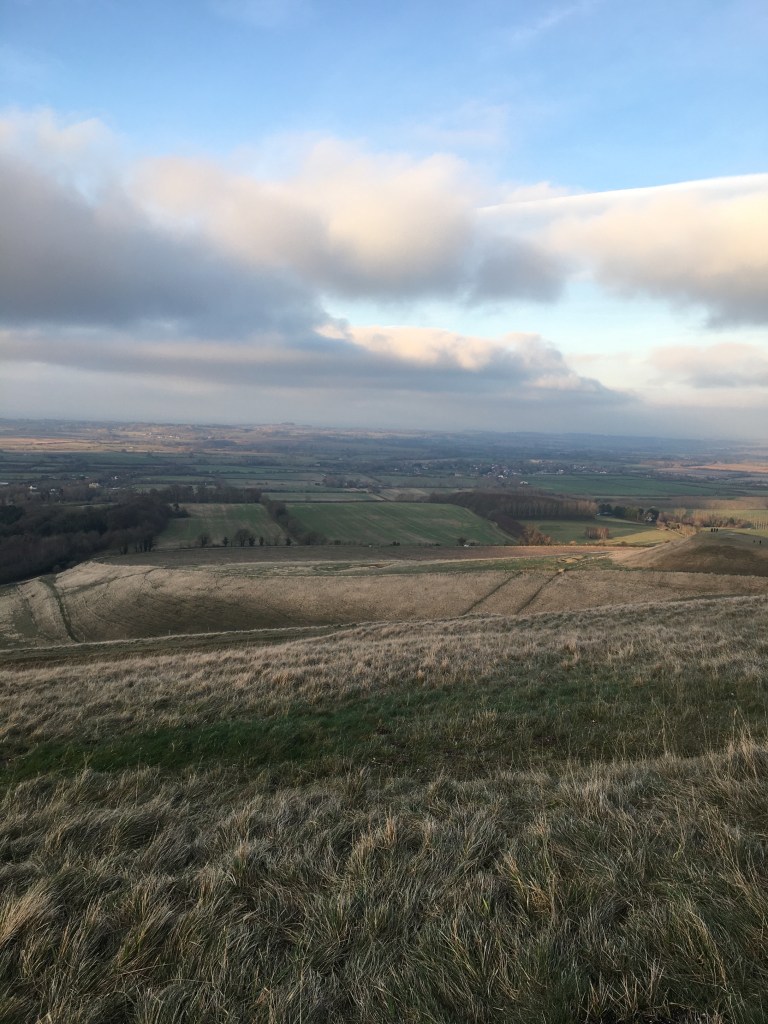
*There are parallels here with many Biblical (and non-Biblical) narratives: the call of Abram/Abraham; the vocational encounter of Moses; the desert experience and Baptism of Jesus – the questioning about suffering of Siddhārtha Gautama, the call of St Francis, the Sword in the Stone… I might then want to explore the lines between the sacrificial journey of Abraham and Isaac, the journey to Calvary, and the sacrifice of Lubrin Dhu in Sun Horse Moon Horse… There isn’t really space in this post to do any exploration of these justice. But at least that thought gives me an excuse to finish with the view from Uffington.

Escape, extent and serendipity

There was a time long ago – say, last Sunday afternoon – when nipping off for a run seemed easy and natural. And on Monday, when Jeff and I went for a walk – well, it seemed a normal thing. Bloke. Dog. Biscuits. Sunshine. The political clouds of isolation and the warning that people had to be more responsible were looming, but dogs gotta walk, and man’s gotta be sensible about “social isolation.” That seemed about it.

Jeff the dog and I went to South Park and Warneford Meadow. We got muddy, he more than I, we looked at the various corvids and the people playing basketball, he ate dog biscuits and I didn’t, and we were sensible about keeping ourselves to ourselves. We didn’t do the reckless “last weekend before we have to be indoors” congregating, but yes, it seemed that keeping to guidelines was easy. A new politeness was emerging around how far apart we needed to be from people we passed, it’s true, but in any case they weren’t people either of us knew, not even nodding acquaintances. A quick chat with the basketballers a good 4m away and then we moved on. We got closer to magpies, to be honest. Three for a girl, if I remember rightly.

Only with yesterday evening’s pronouncements did that mood really change, and I think in retrospect we pushed it a bit. Maybe it was my day’s exercise. It will have to stand as such.

Wind back a week and I am with Mat high on the Downs, and you could not wish for a lovelier day. Sunny again, breezy, a sharp-eyed, sharp-minded kestrel of a good friend, everything bright and fair. As I discussed here, human relation to place is, for Robert Mcfarlane, grounded in language; but language is itself grounded in relationship. I’m coming back to this.

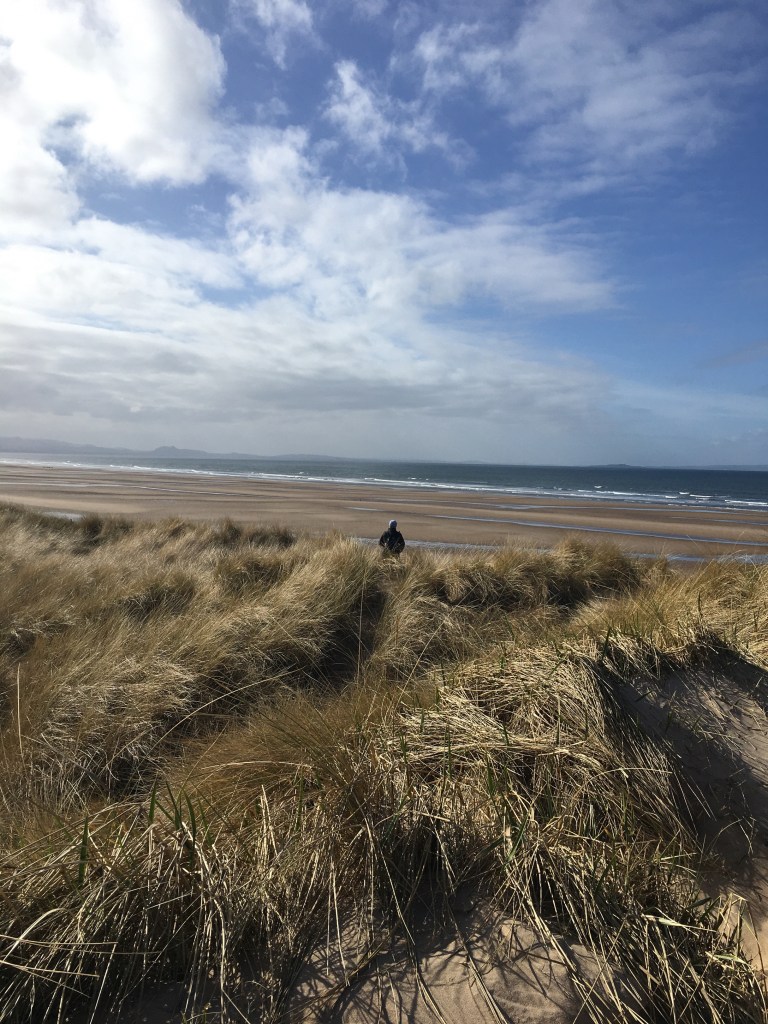
Back to the Friday before and Lizzie, Maggie and I walk through the Aberlady nature reserve and across the beach to Gullane. A bright sun, a brisk wind. Family enjoying one another’s company.

But these are not excuses to show snapshots. What is it that gave these trips significance? Why feel better after them? They both lacked the challenge of Rob Macfarlane’s exploration of the treacherous Broomway or even the experience of our face-to-face encounter at Ludchurch. What is it that some trips into the outdoors bring? and how do we represent that in time and place without it being, like these photos, just a grown-up version of What I did on My Holidays?

The absolutely seminal book on the psychology of the outdoors for me is the 1989 book The Experience of Nature, by Rachel and Stephen Kaplan. In it, they explore dimensions that may provide a framework for how “nature” helps and supports psychological wellbeing. Extent; fascination; action and compatibility. Because their work looks to the “wilderness” they address the nation of escape as well, which they view with some caution because it has in it “an absence of some aspect of life that is ordinarily present and presumably not always preferred.” I can see their point, but given that it is early work (thirty years ago) and has been superseded in many ways (partly by the new nature writing itself), I want to raise the question of escape with someone. Here, further off on the Aberlady sand dune, is Maggie; Mat not only drove the two of us to Uffington, his insights enriched our visit. We are “political animals” – not because we are forever tuned into the depressing power games (or, if you like, selfless and inspirational leadership) that cram our news until we cannot see what’s actually happening – but because we are defined by how we live in the company of others. I go out on my own but with me come meetings to have, people I want to see (or don’t), ideas to bounce off others. I bring the city with me. And similarly I contend that a visit to Uffington means I am “with” (metaphorically) Rosemary Sutcliff, or that to go to Ludchurch “with” Alan Garner is not to travel alone. In some ways, the accompanying author or characters provide what the Kaplans call action and compatibility, and of course are the spur to action via the notion of fascination. We go “Backpacking with the Saints” according to Belden Lane (article here; link to the [excellent] book is here. Name the saints that come with you.

Lane, a “scholar in recovery” takes with him insights from the Desert Monastics and “a few lines of Rumi” and is wedded to the silence that wilderness can bring. Not as far into my recovery I have taken Gawain, most recently Sun Horse Moon Horse and the Land of the White Horse. Somewhere in my mental backpack are lines and vistas from writers such as Robert Macfarlane, C S Lewis, Oliver Rackham…. This isn’t a boast: I sometimes wonder whether I could leave them in the car. Would this then be more of an escape, or given the liberating nature of some of this writing, less of one? And what about extent? Do we need the wide open wilderness of the Ozarks are we OK with the view from the White Horse down into the farmlands of Oxfordshire and Wiltshire? I think of Aberlady, where I have no literary baggage to bring: an escape, as the Kaplans would see it from particular content, “a rest from pursuing certain purposes.” I wonder if writing about his wilderness hikes took the edge off the experience from Beldin Lane…

But for the trips that fall under the Wild Spaces Wild Magic umbrella I really have to take the authors firmly in my hand and my mind: last week for example I was reading the episode of Lubrin Dhu’s planning of the White Horse from Rosemary Sutcliff and looking for where she might have sited the Wych Elm. She comes with me and by extension the characters she calls into being; David Miles comes with me – my copy of his book has a smudge of Uffington soil on the page of his site plan (p101, if you’re interested); Mat of course comes with me. Identifying where this Wych Elm might have been, we find some wild apple trees by chance and wonder: are these the inspiration for the sacred apple trees in Sun Horse Moon Horse?

Social aspects of serendipity (see for example Morrissey’s “An autoethnographic inquiry into the role of serendipity in becoming a teacher educator/researcher,” International Journal of Qualitative Studies in Education, 2014) seem to me to work alongside the changeability of being outside. Less is in the enquirers’ control, expectations have to change. Two pairs of eyes are able (sometimes) to be more alert to these changes: sagacity (Morrissey again) enhances serendipity but are two heads better than one? If we are aware of the dangers of shoring up each other’s ideas, might collaboration, like identifying mistakes (Morrissey) “also uncover for the researcher… fears, preconceptions or beliefs …of which he/she had hitherto been unaware”?

And if we are accompanied by the cloud of witnesses from literature – such as nature writers and their places, fiction writers and their characters – then we might address two notions (or one single notion with two aspects? I’m not sure as I write) of psychogeography and autoethnography. How much, in other words, does setting (in its broadest sense) and personal history of setting enhance or detract from personal reading of landscape? I am conscious of the dilemmas where Dyson writes “In recognising that I was a subject and an object of the research I realised that at the same time I was and could be both an insider and an outsider within the culture that I was investigating.” (From his article My Story in a Profession of Stories: Auto Ethnography – an Empowering Methodology for Educators, https://ro.ecu.edu.au/ajte/ 2007). I rejoice in being on the Downs with Mat; I am very glad we have purpose in a book I love; I am exhilarated in the chill breeze and bright sun. To change from his journey metaphor to one of wind or water, being the reader and a colleague in an investigating team involves recognising how all sorts of things flow over one another: the reader and her/his history; the researcher and her/his concerns and limitations; the authors under investigation, their sources, their motives, their depiction of place and character; and being a research partner multiplies these complexities. For me this links with Rob Macfarlane’s lines from his introduction to The Living Mountain:

…the world itself is therefore not the unchanging object…but instead endlessly relational. It is made manifest only by only by presenting itself to a variety of views, and our perception of it is made possible by our bodies and their sensory-motor functions… We have come increasingly to forget that our minds are shaped by the bodily experience of being in the world – its spaces, textures, sounds, smells and habits…

We are human, language-loving and people-loving; we are also placed: physically located on a windy ridge above a deserted farmhouse in the Peak district, or searching for a tree that may never have been at the foot of the Downs.

To conclude with Belden Lane, who may be close to an answer here (I know I’m not): The Spanish philosopher Ortega y Gasset once said, Tell me the place where you live, and I’ll tell you who you are. I think he also could have said, Tell me the place to which you are drawn, and I’ll tell you who you are becoming. 

Sword-grey sky, daffodil light

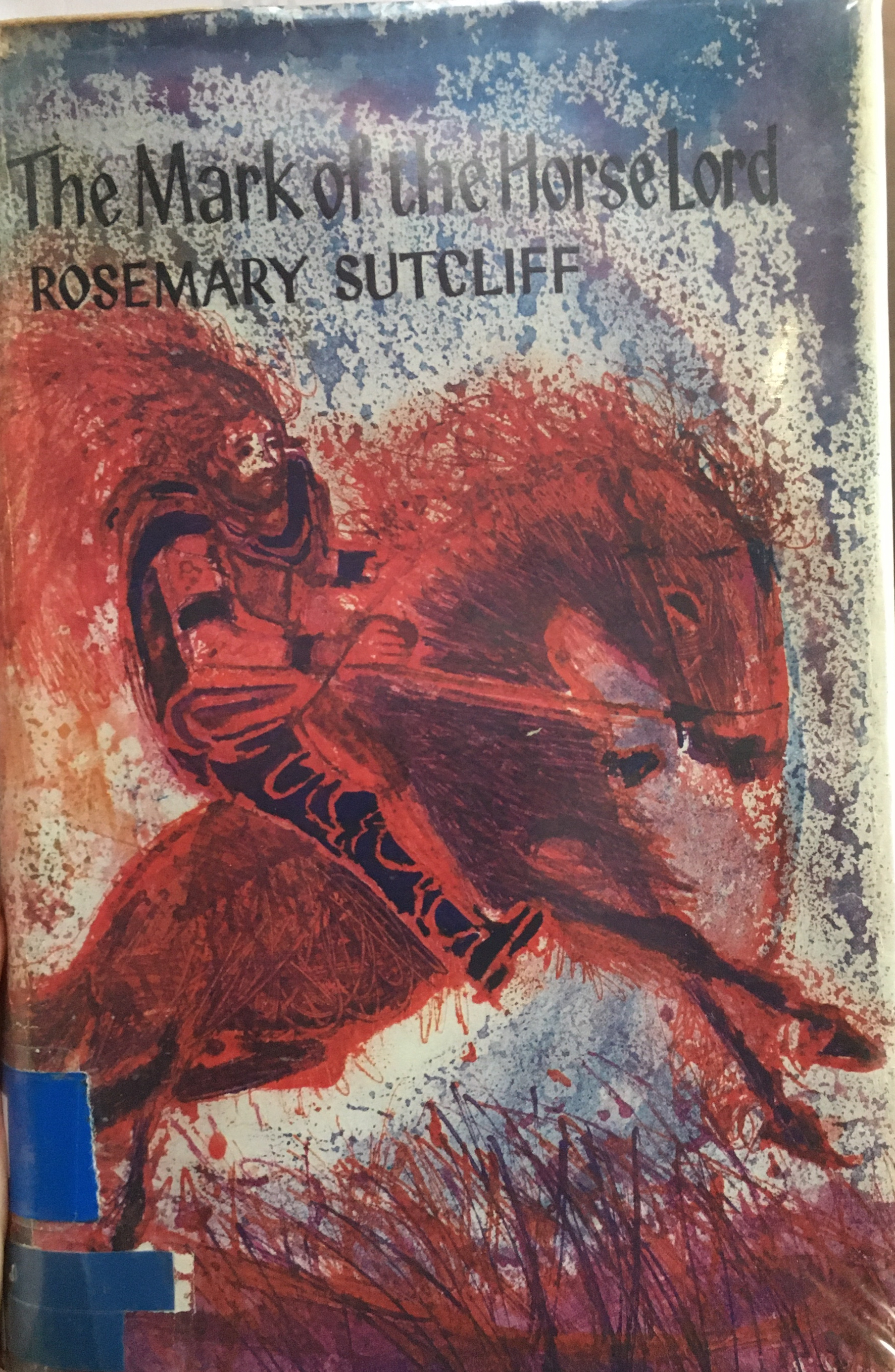
To do no more this morning than record this astonishing section from Rosemary Sutcliff’s Mark of the Horse Lord. The protagonist, newly made king of the peoples of what we might describe as Western Scotland, Red Phaedrus, img_2217
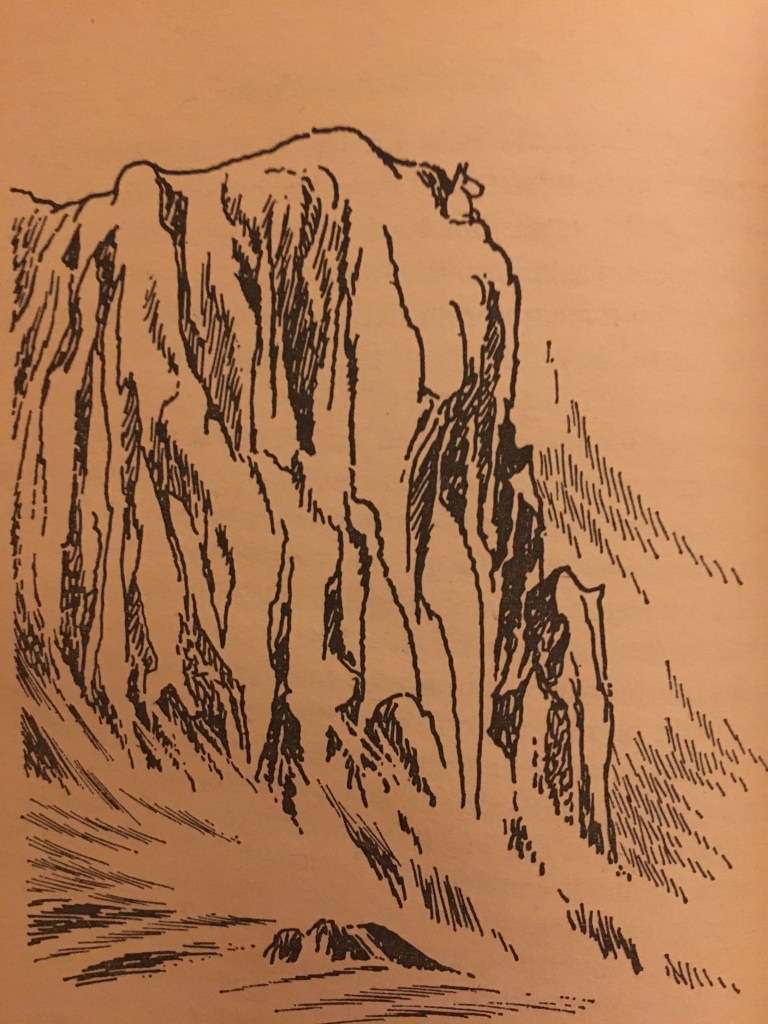
is out to catch the woman appointed as his wife. These are horse-people, as the book’s title suggests, and this rough “courtship” (here as in the Lantern Bearers Sutcliff does not shy away from the nature of marriage and being given in marriage and its impact on woman) is the bridgegroom’s chase after his bride. They are both mounted, and she has a head start as the groom’s party pursue her through the country of the Dál Riata.  Just look at this amazing use of colour and shade, and how Sutcliff anchors this in the landscape features – the whirlpool of the Old Woman, the mountain of Cruachan she has already introduced us to in map and in narrative.

The track was pulling up now, out of the great flats of Mhoin Mhor, and the quarry, striking away from it, was making north-eastward for the hills around Loch Abha head. And the wild hunt swept after her, hooves drumming through the blackened heather, skirting little tarns that reflected the sword-grey sky, startling the green plover from the pasture clearings. Far over to the west the clouds were breaking as they came up into the hills, and a bar of sodden daffodil light was broadening beyond the Island, casting an oily gleam over the wicked swirling water of the Old Woman, while away and northward, the high snows of Cruachan caught the westering beams and shone out sour-white against the storm-clouds dark behind.

Think Human and Think Literature

In among teaching, marking, and research, Mat Tobin has convened a really exciting evening panel conference (with me as whipper-in) and really to advertise this event as part of the Think Human festival at Oxford Brookes, I thought I’d post a brief reflection – and if you aren’t already aware of how to book in, or what the details are, this is the link to the details on Eventbrite.childrens literature conference (1)-1

The award-winning panel we will meet at the event – Daniel Hahn, with discussants Catherine Johnson, Beverley Naidoo and S F Said – will of course have their own things to say, and Jon Appleton will reflect on Jan Mark as well, to start us off. I may get a chance to reflect by blog on the issues they raise later. I won’t subvert the discussion by starting it now. Well, not much.

I wanted to take a step back and think – as this blog title puts it – about how Think Human seems to me just has to be something to do with story. Over Christmas Chris Lovegrove followed closely the Twitter conversation about Masefield’s Box of Delights and in his summing up on his blog suggested that there is “fictionalising of autobiographical elements” in Masefield. Do we – or if I’m not going to overgeneralise, do I – do the reverse when I read? Did I need in some sense to become Kay Harker, the orphaned hero, when I first read The Midnight Folk and its sequel with my mum and dad comfortably having a Middle Class cup of tea downstairs? Do I autobiographise (that’s a terrible word; I promise not to use it again) elements of fiction as I read?

In the MA module I participate in, I ask the students to look at a chapter (15, if you’re interested)  of Alasdair MacIntyre’s After Virtue in which he writes

Narrative history of a certain kind turns out to be the basic and essential genre for the characterization of human actions.

(I must admit one reason for including this chapter in their discussion is MacIntyre’s example of the young man at the bus stop and the duck – but that’s by the way).

In life, MacIntyre suggests

We enter upon a stage which we did not design and we find ourselves part of an action that was not of our making.

It would seem natural that, if we live this metaphor, we would try to discover patterns in our own narrative by looking at other people’s – fictional or actual. Empathy and even compassion are part of our participation in a story. It is interesting that MacIntyre’s own example includes this identification between storyteller and audience specifically in a drama/story context:

Each of us being a main character in his own drama … In my drama, perhaps,I am Hamlet or Iago or at least the swineherd who may yet become a prince…

I think it is fundamental to the conversation of drama, novel, even the everyday “You’ll never guess who I saw in town today…”  and perhaps it always has been. The hunter returns to the fire and tells us of the kill she or he has made, and we try and empathise ourselves into their account. Or they return and tell us of the deer that leapt past them into the undergrowth and how it lives and we think what it must be like to live like that, the choices it might make (and maybe how we might catch it) – and all of a sudden I am at one with Rob Cowan’s magnificent empathetic account of the deer in Common Ground. 4000 BCE or today.  The act of storytelling may have become more complex over millennia, but has an element of identification between telling and hearing: what one of the characters in Alan Garner’ Boneland pronounces as a ‘True Story,” a story in which we understand something more of ourselves, a story that makes us “think Human.”

But this is just my take: does everybody – writers, translators, readers – see it this way?  One of the main ideas of getting such major voices together was to urge people who come to Boxes of Delight to try and see what links there might be between how writers communicate. Are there common themes on how they approach their task? What is the importance of the values they communicate? Do they write for the child they once were; do they write with a specific audience in mind? 

See you on 11th Feb.?


Which Moomin Character?

A lot can be said – and has been said – about Tove Jansson’s relationships within the books and cartoon strips, and she does indeed present a child’s Hogarth of a world, where foibles and strengths are all on show, from Sniff’s immaturity to a similar self-centredness in the Muskrat, hiding in his mauvaise foi in a dismissive attitude. And all this in a landscape that (for me when I first read the books in Harlow [as it then was] “New Town”) enticing and alien: mountain streams with crocodiles, and observatories and impromptu woodland dances…  Part of me wondered if this was how Scandinavia really was, and maybe it took reading the Summer Book at Brookes for me to see how clever Jansson was about these ways marrying of reality and fantasy. Part of me wondered if those weird and engaging people were real too, whether I had some part of me in those stories.

Turn but a tweet and start a blog, to paraphrase Francis Thompson.  A discussion today on Twitter prompted me to offer reading about the Fillyjonk as an example of the joy of private, quiet reading.  Why, when discussing reading, did I suggest a Fillyjonk as the person I want to meet in my private reading? I was thinking of Tales from Moominvalley, I suppose, and she was the first person I could think of, a minor character rather than Moomin (see below) or from his immediate friends or family.  Showing off, I suppose, like Sniff…   A Fillyjonk is essentially an anxious person “dutiful to the point of tedium – not a character I immediately  identify with, although I can see what I was getting at, I suppose: a catastophizer who meets with a real disaster.   So who would I like to be?

  • I am too much of a home body to join the Hattifateners – whom I loved because I could draw them.
  • Bingummy and Thob taught me so much about language play – but I was an only child, in effect: that wasn’t the bizarre little twins.
  • The ghost in the Exploits, with a gentle side and a macabre turn of phrase?
  • The Hemulen Aunt? There have been times when, as an Early Years teacher, I have heard her voice come out from my mouth. And Edward the Booble’s grumpy tones. 
  • The Groke? Well, she was my avatar for our Virtual Learning Environment for quite some time. I wonder whether she sloped off when I changed it, leaving a trail of frost across the internet.

This isn’t the quiz that you can do.  I haven’t done it. Really, even when I first read Finn Family Moomintroll (and heard it on Jackanory in the mid-60s), I think I had it worked out, albeit dimly: Moomintroll pining after Snufkin. And so often I could characterise my relationships – certainly the ones that had me roaming morosely around as an undergraduate – as ones in which my inner Moomin longed and longed to be the adventurous and carefree Bohemian. Jansson may not be Maimonides, but the Moomins were a family when I was so perplexed I felt I had none, and “which Moomin character are you?” would have had only one answer.  And there were quite a lot of candidates for Snufkin…

But of course the joy and the cleverness of Jansson’s characters is that you can be more than one. Dutiful to the point of tedium like Mrs Fillyjonk; self-centred Sniff; fussy and obsessive like a Hemulen, full of unrealistic hopes like the little dog who wished he was a wolf  – and now? Well, Maggie is making cakes in the kitchen, and I am in my study pondering my youth.

Down in Yon Forest

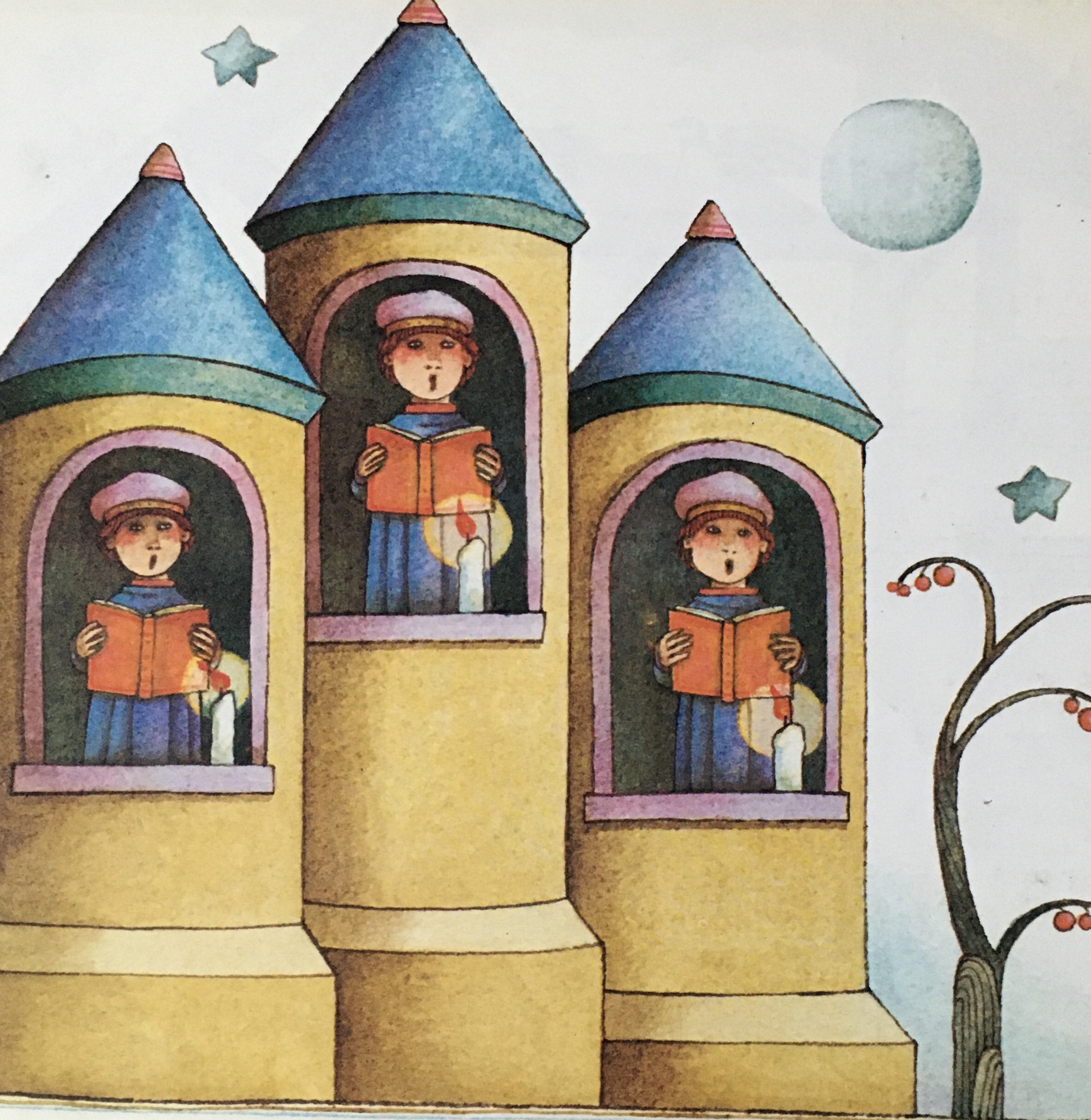
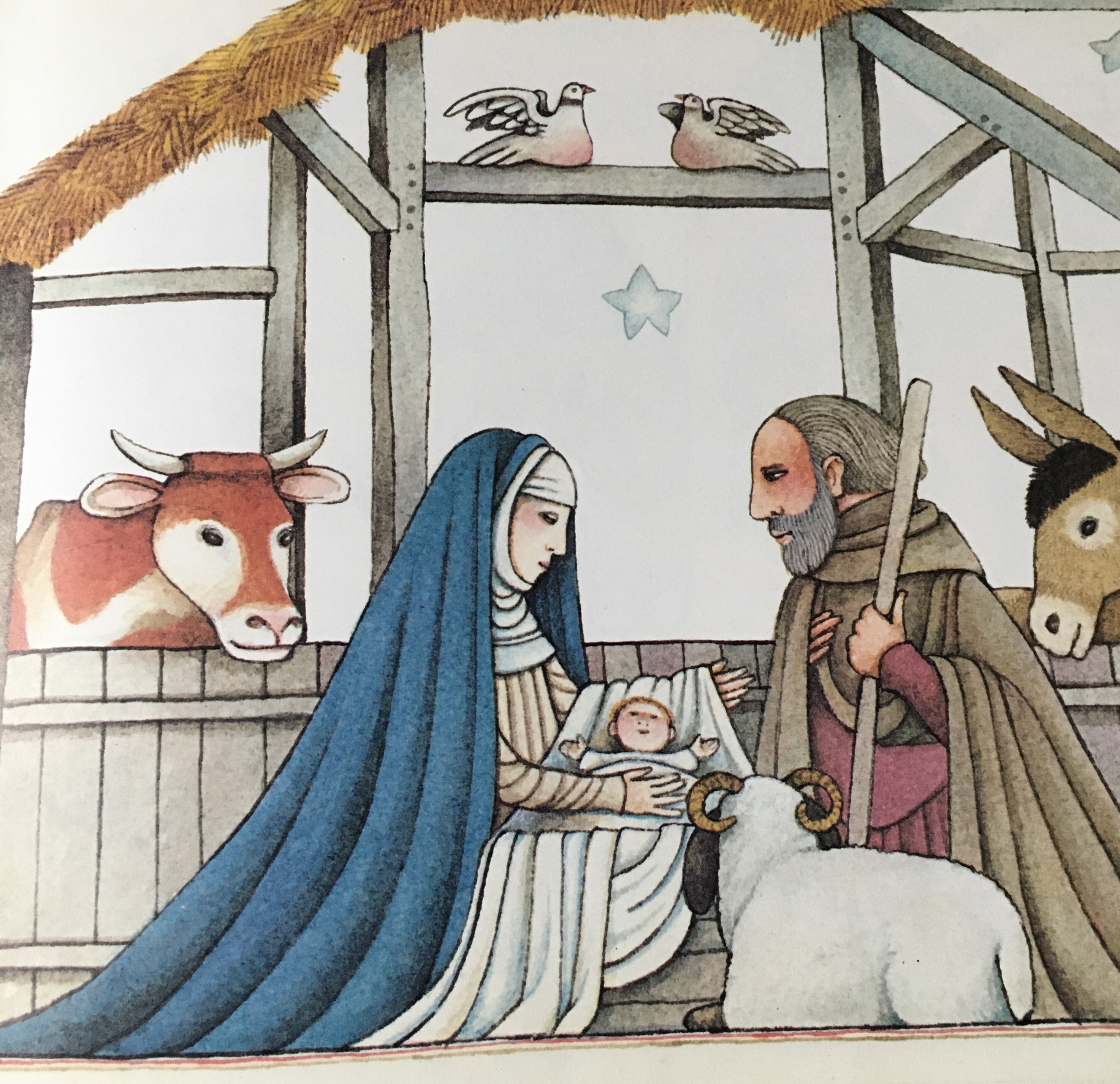
This is a bit of a mish-mash, with all sorts of sources bunged together. I’d like to think of it as an enquiry into why Christmas a time of nostalgia but suspect it is a pile of stuff under a Christmas tree with no labels: sort through the pile and see what you can find. But why do we look back at Christmas? img_1806-1Why does the glorious The Friendly Beasts by Tomie de Paola have choristers and candles to sign/sing us to the stable? It is as if the validity of Christmas in some ways springs from this appeal to the past. Is it because Christianity has created a feast in which “history” is one of the most important guests?  I’m not sure. De Paola often has this sense of tradition, such as his retelling of Italian folk tales, the beautiful Clown of God, and representations of Bible stories – and the Night Before Christmas, which is our family’s standard version of the poem (follow this link to Jake Hayes who has some lovely photos of this version). There is some of that, certainly, right from St Luke’s dating of events and the genealogies he and St Matthew produce. Perhaps it is also because, in the partial extirpation of a pagan Yule, one of the things that remains is an echo that says “remember how it used to be…” – and could this be an attempt to return to a (mythical) Christmas of our own childhoods?  And then maybe in England that nostalgia includes a sorrowing for some good old days, a golden age around  1500 CE or maybe 1600, or 1800…  There is more than one ghost of Christmas past, I suspect, and maybe as well as our personal ones we carry ones for our society too, whether we acknowledge them or not.

It is not only Dickens that feels the weight of past Christmasses. Cole Hawlings who “does date from pagan times” in The Box of Delights sings the rescued Cathedral staff back to their Midnight Mass  where they are greeted by the monks from years past

…for on such a Christmas Eve what one of them would keep away?

and Tolly’s dream-like experience of Midnight Mass moves between his own twentieth century and the past of his family in the seventeenth. As I have just cited recently, Susan Cooper celebrates this looking back when celebrating the Solstice:

All the long echoes sing the same delight,
This shortest day…

What is the attraction of the past for this festival?

In the run-up to this Christmas I come back (again) to poets Thomas Merton and R S Thomas. Here are two poems that seem to me typical of their approach to Christmas. Merton first of all, surrounded by the traditions of his faith and practice like Duccio’s Maesta or Martini’s: All those hopes and fears of all the years gathered around the Virgin and Child:

Flocks feed by darkness with a noise whispers,
In the dry grass of pastures,
and lull the solemn night with their weak bells.

The little towns upon the rocky hills
Look down as meek as children:
Because they have seen come this holy time.

God’s glory, now, is kindled gentler than low candlelight
Under the rafters of a barn:
Eternal Peace is sleeping in the hay,
And Wisdom is born in secret in a straw-roofed stable.

And O! Make holy music in the stars, you happy angels.
You shepherds, gather on the hill.
Look up, you timid flocks, where the three kings
Are coming through the wintry trees;

While we unnumbered children of the wicked centuries
Come after with our penances and prayers,
And lay them down in the sweet smelling hay
Beside the wise men’s golden jars.

Merton: Carol

and Thomas, well, Thomas is aware of the biting wind of doubt and silence in the Nada Nada Nada, Y En El Monte Nada of St John of the Cross. Here he captures a Christmas purity that I think is hard to beat:

The moon is born
and a child is born,
lying among white clothes
as the moon among clouds.

They both shine, but
the light from the one
is abroad in the universe
as among broken glass.

Thomas: Nativity

RST is like this: grounded but bleak, with a now rather than a history in his poem. This is often his way, I think (although not always): a doubting impatience in the spiritual –

Will you continue to torment us?
If you are ubiquitous, why
not be here when we say : Now?

Thomas: Could Be

I have been a student of your love

and have not graduated. Setting
my own questions, I bungled
the examination…

Thomas: Incarnation

Merton,  however, pours out his love not only for the God he seeks in monastic profession but also in places for the life itself:

The sun that plays in the amazing church
Melts all the rigor of those cowls as grey as stone – Or in the evening gloom that clouds them through those tintless panes,
The choirs fall down in tidal waves
And thunder on the darkened forms in a white surf of Glorias.

Merton: St Ailred

I’m not sure I can answer my own question, to be honest: Christmas is a time of looking back, looking forward – and inwards too. For me, the tensions between the very grounded (and dark) spirituality of R S Thomas and the almost ecstatic exuberance of Thomas Merton is resolved in a medieval lyric:

This is the text:

Lully, lullay, lully, lullay,
The fawcon hath born my mak away.

He bare him up, he bare him down,
He bare him into an orchard brown.

In that orchard ther was an hall
That was hangid with purpill and pall.

And in that hall ther was a bede;
Hit was hangid with gold so rede.

And yn that bed ther lythe a knyght,
His woundes bledyng day and nyght.

By that bedes side ther kneleth a may,
And she wepeth both nyght and day.

And by that bedes side ther stondith a ston :
Corpus Christi wretyn thereon.

It is known as a Christmas carol in a slightly altered version, where the moon shines bright on a saviour… born this night, but the earliest version seems to me to be a visit to the Sacrament where the Passion is clearly discerned.  Benjamin Britten’s version is here, but the version of Britten’s setting I know best and love is Jeff Buckley’s anguished countertenor.

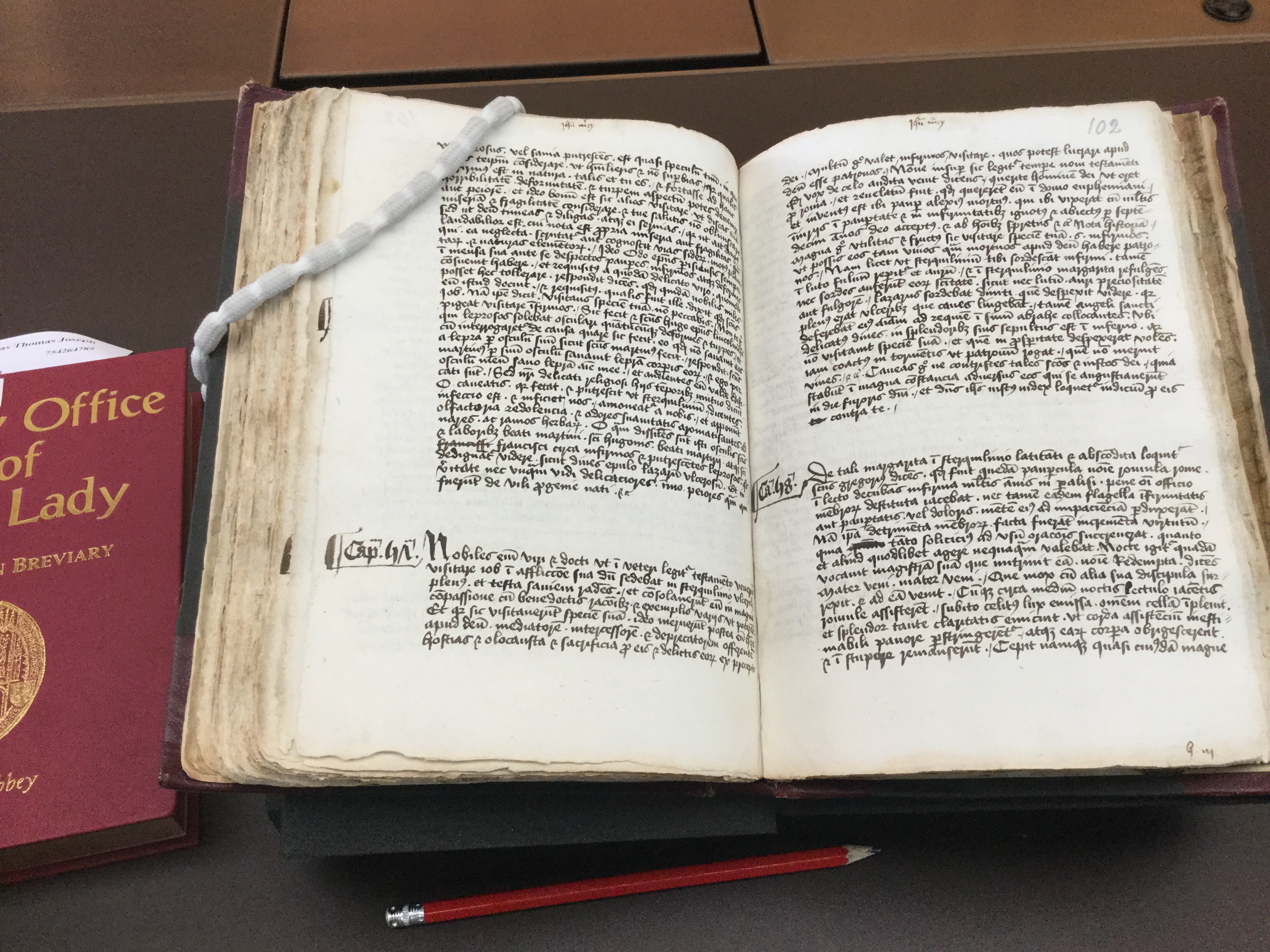
But let’s go back a bit. Here I am, in the mid-70s, eighteen or nineteen years old, and opening my new Breviary for the first time, exploring what it has in it. It has an appendix of poems as well as hymns and in coming for the first time to the Corpus Christi carol I remember myself (a year or so before) back to a little gothic church in the hills above Guildford.

Lully lulley; lully lulley.

The fawcon hath born my mak away.

So why the falcon? And why the lullaby refrain? The idea of being suddenly snatched now makes me think of a sparrowhawk or peregrine, but I will let my C16th predecessor (who doubtless was more at home with such things as this MS/blog from the British Library suggest) have her/his way. In a near-sleep, dreamlike state, a soul is snatched away to a hall –

He bare hym up, he bare hym down;

He bare hym into an orchard brown.

…and in the hall in a wood (or Eden after the Fall, its trees bare), sees the truth of the link between Passion and Eucharist.

The trees surrounding the Franciscan Friary church (now Chilworth Abbey) could well be leafless in winter, and at any rate the “truth” of this matters less than what the image said to me in my late teens: a religious experience that was sudden and rooted in mediaeval imagery brought me (I am unsure who “my mak” is otherwise) to an altar, to the reserved sacrament on its bed. We might well be beyond the limits of medieval orthodoxy here, in the realm of the eternally bleeding Fisher King perhaps, as we look at the knight in bed and his attending virgin. The song remains sited for me in a small monastic/friary choir, all gothic and quiet. What strikes me some forty-odd years later is how powerful the medieval imagery is.

This seems to me to be important for a number of reasons, and at the moment, prominent in these for me is that whatever we make of this kind of medievalism it remains a touchstone of Christian – or perhaps Catholic Christian – piety. It allows us back into a time (or a mythology) where there was space for a rich visual and linguistic expression of religious practice. I might contest this, sometimes – a sort of liturgical Sealed Knot where historical re-enactment is what it’s all about – but I cannot deny its power. It allows me to read The Cloud of Unknowing, or Bl Julian of Norwich with a sense of continuity that draws on aesthetics as much as reason or ipsissima verba. It opens a door, as it were, to the MSS I love to read.

I sometimes wonder whether, somewhere along the line, I learned (probably wrongly) that this allowed me to say “I belonged;” I belonged to something big and beatific. Seeing it at Chilworth was therefore a step towards the belonging I felt for a time at Magdalen and then Ampleforth and then Blackfriars. And therefore for me Christmas might be some kind of looking backwards to see what Christmas means; to some extent, looking at might-have-beens.

Puddleglum

Above Dr Slop and Mr Slope And Mrs Proudie and all the Blooms, Flashmans [sic], Golightlies and Trunchballs (and Honeys) and other characters with significant names – even Agnes Nutter – one character in fiction stands out for me as having not so much a name as a character description:

Puddleglum the Marsh Wiggle in C S Lewis’ The Silver Chair.

The Narnian ancestor of Fungus the Bogeyman, Puddleglum is never one to look on the bright side of life. His fenny existence is as dull and damp and depressing as his expectations are low. When Eustace and Jill and Puddleglum reach the giants’ gastle, he very typically says “We’ve done the silliest thing in the world by coming at all: but now
that we are here, we’d best put a bold face on it.” I might have wished him voiced by one of the more lugubrious characters created by Les Dawson or some maungy character from Last of the Summer Wine.  Today, 13.12.19, maybe I could voice it myself.

And the genius of Lewis’s depicting such a gloomy character is that The Silver Chair is enlivened by the warmth with which Puddleglum is presented: a comic character ” as doleful as a funeral,” a caricature of an adult whose task seems to be to depress the enthusiasm of the child protagonists. But then comes this, his best speech, and the heart of Lewis’ contra mundum (or at least contra Senior Common Room) beliefs: fighting the lulling enchantments of the Witch who wants to entrap the heroes in her Underland, he stamps on her fire and returns to her:
“One word, Ma’am,” he said, coming back from the fire; limping, because of the pain. “One word. All you’ve been saying is quite right, I shouldn’t wonder. I’m a chap who always liked to know the worst and then put the best face I can on it. So I won’t deny any of what you said. But there’s one thing more to be said, even so. Suppose we have only dreamed, or made up, all those things — trees and grass and sun and moon and stars and Aslan himself. Suppose we have. Then all I can say is that, in that case, the made-up things seem a good deal more important than the real ones. Suppose this black pit of a kingdom of yours is the only world. Well, it strikes me as a pretty poor one. And that’s a funny thing, when you come to think of it. We’re just babies making up a game, if you’re right. But four babies playing a game can make a play-world which licks your real world hollow. That’s why I’m going to stand by the play-world. I’m on Aslan’s side even if there isn’t any Aslan to lead it. I’m going to live as like a Narnian as I can even if there isn’t any Narnia. So, thanking you kindly for our supper, if these two gentlemen and the young lady are ready, we’re leaving your court at once and setting out in the dark to spend our lives looking for Overland. Not that our lives will be very long, I should think; but that’s small loss if the world’s as dull a place as you say.”
The Silver Chair (and I have to admit it is my favourite of the Narnian chronicles) deals with enslavement to enchantment as the allegory of sin with such vivid detail – the eponymous silver chair being the beautiful instrument that holds Prince Rilian in thrall to the Witch – that it makes me wonder whether Lewis is doing something autobiographical here. One of the beauties of the storytelling is that it works at all sorts of levels, religious and non-religious spirituality: sin and redemption; exile and homecoming. And what are we in thrall to? And who liberates whom?
And if we are on a quest to find a way to be free, what is the role of Puddleglum in our lives?
There is a danger in seeing a superficial mindfulness as the touchstone of happiness, “I have been mindful today” being the spiritual equivalent of “I must, I must improve my bust.” What Puddleglum does is remind us that jollity is not happiness, that it is not always necessary to look forward to a glorious dawn in order to be righteous or holy or whatever. And today I think of the cruelty of the death of St Lucy, the plight of many in a false dawn for a brand new (= same old, same old) Britain, and I wonder if, with so little cause for carolings, I can be glum for a while, and alongside Puddleglum can “take a serious view of life” – and still be prepared to stamp out, when needed, the seductive sweetness of a sorcerer‘s fire.