Fighting talk

Perhaps it’s fighting season. Michael Gove has set up one target – school playing fields -the disquiet around which could be a topic for some of my Outdoor Learning module this coming semester, but it’s various postings from Michael Rosen that drew my attention today, and which are linked here without comment.

This first one is a reposting of his, from the blog of a childminder reflecting on phonics. The second is from Michael himself addressing Jim Rose, replying to Rose’s letter in the Guardian which is itself a reply to Michael Rosen and others…

Learning poems

I will leave it to two voices more eloquent than mine to explore in two very different ways the notion of children “as young as five” (why always that cliche?) learning to recite poems. They express in different voices a counterpoint of the disquiet we have all, I think, felt at pronouncements on the the content of the new National Curriculum, esp in its looking at English in the first years of Primary.

Michael Rosen, whose poems really do inspire young children – and by that I mean everything from getting them to make rhymes themselves (In one nursery I worked in we had “Don’t put Teresa in the freezer/Don’t put Nick in the sick” as a response to Michael’s Mustard in the Custard poem, on Youtube here) to falling about on the floor laughing – is as eloquent and wrathful as ever, an Amos Starkadder kind of rage aimed at the current decisions, when he critiques the new curriculum proposals. Here, in story form, he mocks everything he can lay his hands on about the idea of reciting poetry in the Gove model.

If Michael Rosen is Amos Starkadder, perhaps Mary Beard is Flora Poste: determined to bring a sense of order to the seeming chaos (I note, however, that she and I have different views on Cold Comfort Farm).  Mary is, however, no fan of the Gove model either. Here, in her Times Blog (linked in my Blogroll, as you’ll see) she too expresses her doubts.

So why don’t I like what Gove is suggesting? Because it’s bound to be one size fits all kind of learning and so completely uninspiring.

I fear she is right, that this could be the beginning of a canon of a great works way of looking at literature that will be dull and unresponsive to children’s interests and needs. And this will be the challenge: making this work, cutting through the political rhetoric on any side to see that at the heart of it is not the creation of children and schools from Ladybird Reading Scheme books of years gone by, nor yet dismissing this because Michael Gove has come to be disliked and mistrusted, but saying calmly and passionately to parents, trainee teachers, Governors, Inspectors, “This is what we have always done, and done well. The children in this school delight in spoken and written English, from Early Years (where they learn to recite and love and parody and store up for later those rhymes we call, well, nursery rhymes) to the riches of Heaney, Clare, Causley, Marvell – yes, and Rosen too, and, in time, Vergil.  This is what we do, this (if you’ll let us explain) is how we do it. We are not disempowered idiots, or people jumping on and off bandwagons when we are urged to do so: we are a profession; we have beliefs we profess.

And I was going to leave it to Michael and Mary. Maybe I should have.

Maurice Sendak

“Still are thy pleasant voices, thy nightingales, awake” as one poet-translator put it, after Callimachus. In the midst of saying goodbye to some really good students, and “doing” the marking, and sorting staffing and timetables and the other stuff, I am suddenly saddened by the news of your death.

I remember my parents being asked whether they would let me read Where the Wild Things Are (I was 10!); I recall my delight at sharing it, and Little Bear, and Chicken Soup with Rice with my children; news of your coming out at 80 reached me a day or so before I was to present a paper on Outside Over There, my first external academic paper! I feel I have had your books as part of the scenery of my intellectual life for so long.  I hope you wouldn’t have found that metaphor unwieldy; you were so much of a dramatist, both directly involved in theatre and in creating alarming and joyful explorations of dreams, both terrors and pleasures.

Ah enough. Better obituaries than mine have said more, and your own work is the best tribute to your genius. The best epitaph that I’ve seen was a quotation from you in the Guardian:

You cannot write for children. They’re much too complicated. You can only write books that are of interest to them.


Ulysses

An interesting workshop tomorrow at the Ashmolean gives me pause for thought: what Illustrating Ulysses brings to my mind (apart from Attic vases) is the challenge of looking at the relationship between text and illustration. In the work I’ve being doing this is very much hand-in-hand, and very often precedes publication but this blog brings the practice into (very) adult literature. If, as this writer suggests “some great stories come in daunting packages” what then does the illustrator make of them? What does Bloom look like – or for that matter, any central figure, no matter how detailed the author’s work in describing them?

And of course we might then consider the iconography of children’s literary figures, from Alice (much disputed) or Frodo (trumped by the films? This site asks  a curious question) to Red Riding Hood, who, despite growing into her costume (and her age, curiously!) as Jack Zipes outlines, carries as much baggage with her as any character from more complex texts.

So, since this is a brief pause in the day for me, I just want to finish by asking (myself as much as anyone) where does  a collaborative project of writing and illustrating differ from illustrating a classic?

Back to the Dark

Hallowe’en is coming, and with it the difficulties schools – perhaps UK culture, if we can talk in this way – face with the Americanised rituals. We could be wary of these things for the sake of children worried by them, we could take a mono-cultural stance, we could take a wider view that this is an opportunity not for worship of some dark force or bowing to Coca-Cola culture but for an opportunity to let children explore fear of the dark.

And in a dark, dark town… some skeletons lived.

Those last three words from the introductory page of Janet and Allan Ahlberg’s Funnybones set the oxymoronic tone of the whole riotous book (and its successors).

Body Horror

This is the link to posters for the forum in which I will explore some of these ideas next week: how can they be skeletons and live?

Nostalgia, Comfort and Risk in Young Children’s Literature

It would be over-ambitious to try and encapsulate a history of landscape or picturesque landscape painting into this short paper – even the origins of the term landscape have been queried – but following Cosgrove, it is “way of seeing the world,” with “an aspect of meaning that lies beyond science, the understanding of which cannot be reduced to formal processes.” In terms of landscape painting, this ca be seen as an attempt to grasp a “deeper meaning” or to imbue a scene with meaning – so that in Gainsborough’s Mr and Mrs Andrews we are presented with land as managed and ownable. Landscape painting emerges most powerfully in traditional Western Art, Cosgrove asserts, precisely at the point where the political change and tensions of the C18th require it. Prince is bolder: “One appeal of picturesque art was precisely its escape from the stresses and disturbances caused by Agrarian changes” and thus conversation-pieces like Mr and Mrs Andrews or even the considered landscape of Constable’s Golding Constable’s Kitchen Garden (NB this link  is to a pencil sketch in the V&A) present visual evidence of human intervention into a natural world.

That there is a further element of the fantastic in the three images I want to discuss does not remove them from this painterly tradition – in fact, there is an interplay between this tradition and the intentions of the Ahlbergs and author and illustrator that I suggest is deliberate. There are, for example, visual borrowings – meandering rivers, church spires seen at a distance, that act as signifiers of location but also as a subtle joke. This is a fantasy land, but this is recognisable England. The same sort of visual reference is made in the illustrations Tolkein made, where the Shire, for all its round doors and houses in hillsides, quotes from a view of rural Englishness that has been recognisable since Gainsborough. To misquote Peter Porter, “this is not Athens, but it may be the woods of Warwickhire.” It is interesting to note, of course , as a sideline, that this is the same device by which Shakespeare’s own rural England becomes fantasy world, and that it is the very same region of Arden that encompasses Tolkein’s childhood. This nostalgia for the rural has an ancient lineage itself: the first-century Roman poet Horace (whose poetry constitutes part of the Classical tradition in English education) discusses his desire to return to his farm and its clear spring water , and the poem continues to have influences in the work of writers such as Wordsworth, Hopkins and Joyce

Here we come close to something like my main argument: in using English landscape, Janet Ahlberg is not only “collecting” – which was the modus operandi behind so much of the detail in her work – landscapes, and English ones were the most accessible but consciously drawing on the conventions –the “easy tricks” as Gombrich calls them of English landscape painting which are themselves echoed in books Janet relished as a child such as Rupert Bear . In the Jolly Postman we have wooden signposts, hills with small fields, the church spire on the horizon; the same landscape appears in the two other books I am considering. I should perhaps mention that I have excluded from my discussion the urban landscapes of any of Cops and Robbers and Burglar Bill, and that in any case this use of landscape is not unique to Janet Ahlberg – we might not only cite Tolkein, but poignantly closer in genre, Allan Ahlberg’s later collaborator, Andre Amstutz.

Siting the Ahlbergs within this tradition is one thing; in seeking to explore the three themes promised by my title, we need to move from this basic stance to look at the issue of why children’s book authors and illustrators set children’s books in the past, exploring why they do so and when that past might be located. I feel that the answer lies in the rise of landscape painting itself. If Prince is right that there is an escapist element to landscape painting, it might be possible to see an element of escapism in the nostalgic representations in the three works under consideration.

In a brief overview of ecocritcism Gifford’s Recent Critiques of Ecocriticism two contrasting models of criticism are put forward, in a context which the author freely admits is rather difficult to define: what has been called the “praise-song school,” in which the individual writers from Thoreau to Mabey are celebrated for their insights can be contrasted with a ‘second wave’ which, to give the briefest of overviews is more aware of its own cultural and political engagement. It is with this interpretative model in mind that we look at Nostalgia and Comfort.

One theory might be that the deliberate nostalgia of the characters in the three books draws on a continuing tradition of setting traditional tales in the past: in Each Peach Pear Plum, for example, the costumes seem to draw on C18th domestic clothing (Mother Hubbard in the cellar, Jack and Jill in the ditch) , and Edwardian hunting clothes of the three bears, with a nod to the mediaeval attire of Robin Hood. The appeal of the C18th and Edwardian periods for these characters/setting could be precisely because they represent possible Golden Ages, the “Good Old Days” to which the dinosaur refers in Jeremiah in the Dark Woods, or at least the eve of radical changes to society, the changes of from rural to urban life experiences in C19th, the societal changes brought about by the war(s) of the C20th. . The appeal of this desire for a return to a golden age in childhood might be, as Coe suggests, that “…it is not so much that the child itself, now an adult, has forever outgrown the splendors [sic] of the past, but rather than civilization and “progress” have annihilated, perhaps totally and irretrievably, an ancient way of life and replaced it with something crude, rootless and modern.” Certainly the use of a dinosaur to express the desire for “the good old days, them good old days as is gone forever” underlines the annihilation of the past.

Another way of seeing these is in terms of the comfort, the reassurance historical continuity can provide. This, again, is not isolated to the Ahlbergs, or to younger children’s literature, and is attested in other children’s writers, for example Rudyard Kipling and Lucy Boston. The latter is very clear:
“Readers of The Children of Green Knowe might suppose Green Knowe was my family home. This is not so. It came to me by accident… My passionate desire that it should have a future made me provide it in the books with such a firm lineage.”

Her description of finding an historical artefact – a beaver’s tooth – is very similar to that of Kipling’s workmen finding Roman remains when digging a new well at Bateman’s, where he claims the genius loci of the valley inspired his seeing key episodes of British history played out on the local scale: Kipling’s comments on his search for “roots” in writing Puck of Pook’s Hill:
I…began to ‘hatch’ in which state I was ‘a brother to dragons and a companion to owls’…The Old Things of our valley glided into every aspect of our outdoor works. Earth, Air, Water and People had been – I saw it at last – in full conspiracy to give me ten times as much as I could compass.

Both authors point to a need to connect with a past for sureness – and it is perhaps significant, to return to an earlier point, that they both have these experiences overshadowed within a few years by war.
“To all children, and particularly to small children, a love of the past is natural. It is the soil at their roots. They have but recently emerged from the stuff of it. It gives them comfort, security and a pattern”

Her use of land imagery is to be noted; Kipling and Boston share a sense of what Boston calls “racial memory” and represent it in their books. It is possible to see the nostalgic representations in the Ahlbergs in a similar vein – but this is a conjecture; so far the evidence is lacking.

Note that the text prepared for the conference paper was referenced.  Sources and further reading would include

Ahlberg, A. (1996). Janet’s Last Book, Printed for private circulation by the author.

Coe, R. (1984). When the Grass was Taller: Autobiography and the Experience of Childhood. New Haven, Yale University Press.

Cosgrove, D. (1982). Social formation and symbolic landscape. Madison, University of Wisconsin Press.

Gifford, T (2008).  Recent Critiques of Ecocritcism, New Formations Spring 2006: 64: 15-24

Kipling, R (Library Ed., 1951) Something of Myself. London, MacMillan.

Mabey, R (2006). Nature Cure. London: Pimlico Books.

Prince, H. (1988). Art and Agrarian Change 1710-1815 In Denis Cosgrove, Stephen Daniels. The iconography of landscape. Cambridge, Cambridge University Press: 98-118.

Rosendale, S. ed (2002). The Greening of Literary Scholarship: literature, theory and the environment. Iowa, University of Iowa Press.

Michael Morpurgo on why I come to work

There must be more than just this briefest post at some point, but here  is the current link (how long will an I-player link work?)  to Michael Morpurgo’s inspirational Dimbleby lecture and here is the link to Morpurgo’s own website and text.

I notice that the harder-lined chatterers are already out with comments like “He is a well intentioned, but clueless person. He has a big old fashioned left wing heart, good at bleating, but short on analysis.”  I disagree: we are not dealing here with “wrong but romantic versus right but replusive”  but with a whole set of practices and assumptions that ultimately defeat the work educators try and do.  I write this  because the points he brought in – the power of books to transform understanding, school starting age, the complexities of discussing oppression, life-chances and school experiences – all made rather a clever argument for the right of children to be able to access  a well-thought-out and effective educational experience.

And if there was the occasional bleat, I’m afraid I prefer it to to a snarl.

Alice

Some thoughts on Alice in Wonderland for the class Monday 16th August.

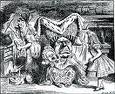
Tenniel Alice

Key to my reading – and it is only my reading – of Alice is the theme that runs through a lot of my thinking: exploring the models of childhood in literature.

Looking at Chris Jenks’  dichotomy:

“The Apollonian child, the heir to sunshine and light, the espouser of poetry and beauty…angelic, innocent and untainted…”(Jenks 1996:73)

“The child is Dionysian in as much as it loves pleasure, it celebrates self-gratification….”  (Jenks 1996:63)
Jenks C (1996) Childhood: Abingdon: Routledge

is Alice the barely reined-in Dionysian child, who, let loose in her dreams, finds her way home (to “dull reality”) by negotiating both models – in finding how to respond to the demands around her and stay sane – in other words, to grow up? Are we looking at some kind of spiritual quest for self-realisation?  We might object that Carroll did not intend this – but again perhaps looking at what an author intended in a  story made up just to while away an afternoon’s rowing is too fraught with difficulties. In any case, when Carroll is being didactic towards children – as in his Easter Letter – we know about it.

Of course the all-important commentary is the wonderful

Gardner M (ed)  (2000) The annotated Alice: the definitive edition. London: Penguin

There are  loads of other books, looking at Alice and Carroll biographically, from the point of view of psychoanalysts, logicians, mathematicians…  An interesting way of looking at Alice might be to consider her not in the context of Victorian literature (and Alice abounds with cross-references here) but to the folk-tale inheritance and to her influence in later children’s literature: there is something of Red Riding Hood in Alice, but her literary ‘daughters’ (in Oxford terms at least) include Lucy from the Narnian chronicles and (perhaps by extension) Lyra from Pullman’s His Dark Materials.   Is she also re-presented in the precocious Cordelia in Brideshead – or is the ‘secret door’ from Alice completely different for Sebastian and Charles?

For scholarship’s sake, I suppose I ought also to attempt a filmography, since my presentation makes mention of the Disney and Burton versions, but I haven’t time, since there are lots of others, too – a silent one from 1903 which I linked to here from YouTube being the earliest I can find.

And here, for what it’s worth, is the powerpoint:

Alice Worcester summer school


Please note that since writing the Disney and Burton clips have been removed from YouTube for copyright reasons. 

Gardeners

Isabel Colegate’s book A Pelican in the Wilderness has some interesting stories and she tells them well. I am particularly grateful for the information towards the end about Holly Hill, a place that I will always remember fondly and in some ways aspire to.
The narrative that I found especially useful, however, was the connections she made between the eremitical tradition, the Romantic Movement and garden design. And it made me think: is the mature garden envisioned by Capability Brown and Inigo Jones really the garden of the Romantic?

And is this idealized perfect landscape also the world in miniature, or the wild wood tamed – and hence is it Outside in children’s literature?