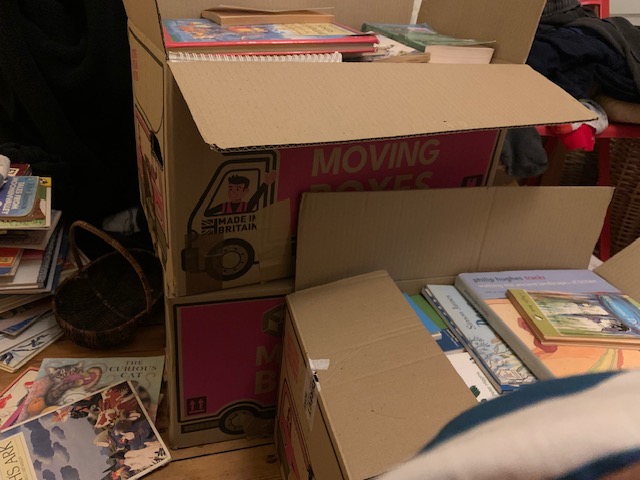
In making “my” study accessible, some of the books, a lot of my books, are having to go. How to choose?
Lots more tidying is required, and with it a commensurate saying goodbye. This isn’t some magic decluttering nor yet an account of my following tidying “gurus” such as Marie Kondo. Far from it: there is no sparkling joy https://youtu.be/x4Nrd68bhH0?si=3LoZa2ghKZtp7oY0 and while part of that is that I won’t be buying into the hype, part of it is that the getting rid aspect has a number of other themes attached to it.
Harry’s Numbers by Jill Waterman is going to the charity shop: so many memories of reading and re-reading at the children’s grandma’s house: and there’s Bonne Nuit, a board book for bedtime given me by a priest to whom I was teaching English, to read to the children. Read out loud in French, read too in my clumsy translation in English, I remember most my trying to read it with a child under each arm. What to look for in Summer: ah yes, all those Ladybirds dug out on trips back to Yorkshire or bought at jumble sales. The seasonal idylls were only eclipsed by the description of the Farm, and again a discussion of how the farm next door to Grandad’s wasn’t like that… Thomas the Tank Engine; Norse Myths; The Velveteen Rabbit…
And with each of these the abiding memory is a child or two or three snuggled with me at bedtime, and of me (and sometimes them) falling asleep while we read together.
At work as well as at home, there were John Burningham’s Would You Rather – hot debates with wriggly children in Reception about having your house surrounded by jungle and Eric Carle’s Brown Bear, Brown Bear What Do You See which so often became a chanted Nursery spell with its own increasing momentum. So many more.
Do I keep books that I shared at school (and as a University tutor) because I feel I was good at reading them? Is it that shallow? Or do I take a breath and collapse all the memories into the boxes along with (so far) well over a hundred books?
Most of them are going, and if Alligators All Around stays, that too has a sense of sadness to it: will a keen-eyed adult never read this to a group of laughing five-year-olds again?
Oh, enough of the melancholy.
But what is that title all about? It’s a line from a poem in the book of the prophet Isaiah, where the King laments that he will leave his life half-spent, his life “taken away, rolled up like a shepherd’s tent.” The Latin text is sonorous:
Generatio mea ablata est et convoluta est a me quasi tabernaculum pastorum. Praecisa est velut a texente vita mea. Is. 38:11
And what Hezekiah feels, that all his meaning, his capacity for life have been tidied away, rolled up as something temporary and no longer needed.
This is where the knife digs deep. I think I mourn the passing of these books because it signifies the passing of a self-image that was powerful and affirming. All self-image seems to me to be in part myth. It is a powerful and long standing myth, and giving more of it up requires me to wrench the image of the scholar in his [sic: such is the myth, although not the reality] study from how I view myself and any future work.
So it’s book 5 of Heartstopper, and Nick and Charlie, after a painfully long time for the readers (although less for the characters) are prepared, have motive and opportunity… and from coy first kisses way back in book 1 are going to have …
Well, what are they going to have, and what do the readers have to read into text and image?
Conversations around sex and young adult literature seem to me to centre around two questions: Do the characters have to have sex? and How appropriate is the depiction of what they do? Since Alice Oseman’s style allows the (pretty inescapable) sex to take place, she is caught needing to decide on what to show. And it is “pretty inescapable,” in that the kissing that takes up the physical side of Nick and Charlie’s relationship from Ch 3 of Book 1 only starts to build much later – but build it does.
This has attracted a number of critical responses, summed up (and to a large extent demolished) in vlogs like this from Obviously Queer and elsewhere. [Heartstopper] “is unapologetically showing queer love being wholesome innocent and slow.” If this is not the case in other teen product or even in real life, the slowness of the developing relationship is charming, and leaves emotional room for the and finally of Book 5. This is a key scene, taking place some days before the excerpt below, and note that the reader is left to fill in at least some of the blanks.
It is clear from the conversations between characters that the blanks are to do with penetrative sex, and that after a very long period of awkward relationship development (the line “Why are we like this?” is a refrain in a number of scenes), we are seeing-yet-not-seeing something incredibly intimate, decorated with giggles and whispers, with trainers and trousers discarded, so with the condoms and lube Nick has bought in Oxford being brought out from his suitcase we have little room to doubt what’s going to happen. “Okay, let’s go” may sound more like the start of a rollercoaster ride than a key point in their relationship, but Oseman is entitled to depict these two star-crossed lovers as having fun.
Heartstopper Book 5, Ch 7, 1563
And this might be where the reader gets a shock: is it acceptable to see this as fun?
Of course it is. They may have taken what seems to me to be a very long time getting there, and Nick and Charlie, one of the satellite texts in the Heartstopper canon, suggests it was a bit nerve-wracking for the young characters to start, but maybe when we think of what is acceptable to be shown, we see Oseman’s skill at changing narratives. This is not about the mechanics (or geography, if you prefer the metaphor) of sex, or the metaphysics of love and sex, but simply about fun.
Is it right to depict sex as fun instead of guilt ridden (or even a liberation from guilt)? How does the adult gatekeeper react to this sidestepping of traditional attitudes and narratives? The argument about Lyra and Will in Pullman’s The Amber Spyglass (no time to talk about the do-they-or-don’t-they? or the Bowdlerisation of the US edition) suggests to me a deeply concerning attitide from adult readers: brought up on the post- D H Lawrence bonk fest, it is almost as if adults need to see the sex and then disapprove of it. Oseman is telling is This is Not Our World, even if once it was.
… begins “Dear Nicholas,” which is maybe as it should, but is also quite wrong; nobody calls me that. The last person to do so as a normal thing, my brother Glenn, died a couple of years ago. It is a signifier of the database form of address and alerted me to the formal tone of what was to come. Do I mean “formal”?
The contents of the first letter were mostly plain statements of facts: a list of symptoms and who had referred me to whom, test results, and a brief note on what the writer of the letter had found.
Childe Rowland to the dark tower came…
Nothing surprising. Factual, and the obvious word, clinical. Colourless, in contrast to my Technicolor emotions.
What was surprising were the omissions. The monster is not named; timescales for tests are shakey; the Big Timescales of prognosis are not mentioned. This is clinical, and those in charge for now of my health are also in charge of what can be expressed. The formal language if anything highlights what is not being said.
Henry Marsh has insights into this formality. He suggests that “faced by piles of paperwork and test results (now largely online) it is difficult to keep in mind that each result has an anxious patient attached to it” and that “much of what goes on in hospitals – the regimentation, the uniforms, the notices everywhere – is about emphasising the gap between staff and patients, and helping the staff overcome their natural empathy.”
“Patients want certainty but doctors can only deal in uncertainty.” This is something I shall have to hold on to.
***
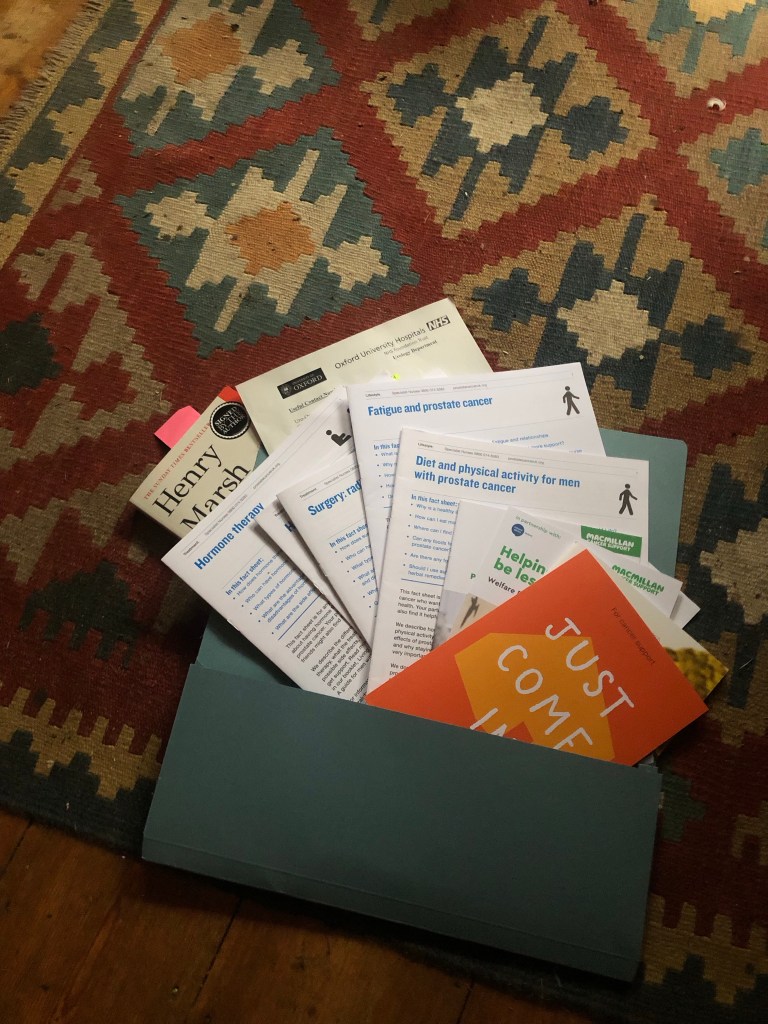
Or not: a watershed crossed in late November and (to muddle my imagery) the dam bursts with info.
Information Pack
But even in the information flood there is uncertainty, and I look at all these guides like a first year undergraduate looks at a course handbook: so much to take in; how much of this is relevant?
***
So the latest letter is clearer, and today (11.12.23) is the day this word becomes flesh (why yes, this is all coloured in by the purples, reds and greens of Advent) with a F2F meeting. There is the scribble of results that is no more enlightening than the old-fashioned, mythic doctors’ bad handwriting, and then the veil is parted:
Unfortunately.
The job not got, the offer withdrawn, the bad news word. The heart races, sinks, I don’t know: rereading the text in the rush that follows I am struck by the name Gleason which takes me to the bull that tramples through Puck of Pooks Hill – thence my mind hears the yammering at my elbow of all those crazy, violent, vivid dreams that keep my sleep broken. Now Stop! Max said. And the wild things are stopped as by a lion-tamer’s whip and chair, stopped by another word:
However.
Watersheds and floods; dark towers and brave rescues; lion taming and þursen and the wild rumpus. Good, picaresque nonsense, jumbled fairytales to give shape, colour and texture to the bare outlines of grey corridors and professional friendliness and the heart-crunching worry of boring my friends.
Which is maybe what I’m doing here. Not a wild rumpus, not even an Ariadne thread, just a confusing set of encounters with images given a high fantasy gilding.
Time to stop and get ready for my consultation? Just one more thing, another letter:
A letter from the Blood Donor Service, in response to my having to withdraw from donation. It talks of ambassadors like you encouraging others to give blood…I hope you’ll continue spreading the word.
Having written about Blyton this month I started Peter Fiennes’ excellent book Footnotes, the opening chapter of which takes us to Dorset with its pleasant pastures and the clouded hills, and I feel I need to have a rethink. Hisstaunch defence – amid a no-holds-barred exploration of her life – makes me at least want to add on some of his ideas about the ways in which Blyton writes. Although he is aware of her shortcomings, Fiennes likes Blyton, and puts her in context: immensely popular, a great manager of her own “brand,” with a love of nature and adventure that meant she was influential and lasting. With the prejudices of her time (a polite circumlocution for her attitudes to race and class), ambiguously portrayed or even attacked by her children, she nevertheless conjured her stories and teased at our childish longings. I have tried, since reading this chapter in Footnotes, to like her. I still can’t – but I can understand something more of her.
I chose the title for this blog because Fiennes gleefully points out how Blyton uses the adjective so much in what he calls her lumpen prose. However, rather then simply criticising her, he has this brilliant insight:
The simple fact is that Enid writes in archetypes; another word would be cliches. She had no interest in writing with the evocative precision about specific places. It is certainly hard to pin them down in her writings… Enid preferred to write her books and live her life on the surface. And to keep things vague. But even if it is hard to locate specific places, here in the Isle of Purbeck, the truth is that everything inside an Enid Blyton book is instantly recognizable. She takes the world and makes it less confusing, kneading her ingredients into something manageable, safe, tidy and above all familiar.
Peter Fiennes Footnotes, Ch 1.
This is, of course why comparison with Garner doesn’t work. His interest is all to do with evocative precision about specific places; that’s what Garner does. In Arboreal, for example, his essay on the Alder Bog (note: the boggy woodland will re-emerge in Treacle Walker), is much more than a history: it is biography, autoethnography, where ‘he,’ the protagonist, has renewed the tamed wild. Garner has cleared the mess of derelict woodland, and from it has brought a poetic insight reminiscent of Hopkins, an historical sense of place like that of Kipling’s Tree Song, but earthier, deeper, more powerful. There is a love of the land and the language here that is worth more than repeating: it is worth celebrating:
Archaeologists came and trowelled one of the Bronze Age barrows near the house. With burnt bone they found the turves that built the burial mound and in them the pollen of the plants that lived then: willow, hazel, ivy, ash; alder, lime, elm, pine and oak; moss, fern, bracken, heather, sedge, and gorse; meadowsweet, vetch, daisy, buttercup; spelt, grass, corn spurrey, wheat; dandelion, chickweed and fat hen. Four thousand years ago the wild was cleared and gone. All was fields, farms, crops, cattle, order; rule: an open world.
The dead men in the ground had worked the same land.
Someone on Twitter once sort of challenged me – or I provoked myself – to write as if Enid Blyton had strayed into Garner Country, or if Alan Garner had tried to write in the style of La Blyton. “Wot larx,” I thought – and although parody is not really something I can do very easily, I thought a quick go would be OK. After all, the Weirdstone begins with two children going on holiday, doesn’t it? How hard can this be?
Actually, it’s really difficult. Blyton, although occasionally mocked and frequently criticised – Joyce Grenfell is merciless – was hugely popular and does attempt a child’s-eye drama, but she has such a different point of view from what we see of Alan Garner, from use of language to views of landscape, that I am reminded of Wittgenstein’s often quoted ‘If a lion could speak, we could not understand him’ – see, for example this blog post. Would an Alan Garner world be comprehensible to Enid Blyton?
And yet, poorly little Joe in Treacle Walker might (possibly with a sigh) tear himself away from his Knockout comic to read some escape with spies and danger if such a thing seemed exciting, and The Mountain of Adventure might have gone in a more Aikenesque or Garnerish direction. Garner’s Mossocks might stand for Blyton’s Evans, and we are, after all, in a misty, hilly landscape…
I am being cheeky here.
Where the task becomes impossible is evident from my subtitle. Imagine the tragedy, the earthiness, the spirituality of Thursbitch being reduced to a tale of spies and scientists up in the hills… or (more fairly) to keep to Garner’s earlier work, aimed more at a young readership, Selina Place in Weirdstone or Gomrath being tamed into simply an unpleasant figure with a big house on the Cheshire plain? It is where this taming would be necessary that the parody becomes worthless.
Witness:
Brambles were waiting for them on the other side, but they tore themselves free and ran as best they could through the scrub and matted fringe of the wood.
Garner: Weirdstone Ch 16: The Wood of Radnor
which might have come from either author, whereas
In [Roland’s] narrow angle of vision there was nothing but mountains; peaks, crags, ice and black rock stabbed upwards. The porch seemed to be at the top of a cliff, or a knife-backed ridge. Roland had the sensation of a sheer drop behind him in tge room.
Garner: Elidor Ch 14: The High Places
That sheer drop is astonishing landscape painting, the view through the letterbox that seeps into the everyday, and the image, a little further on, of the lance-carrying men “with the beauty of steel,” riding stags in the shadow-light completes this, a short but utterly brilliant fantasy scene. There is little place in Blyton’s mystery novels even for “Athens in the woods of Warwickshire,” and there is a lack of nuance and transcendence in her more magical writing that sets her apart from Garner. I cannot escape the idea of “lack,” but at its simplest, these are worlds and words far, far from each other. We might as well begin a Blyton adventure in Llareggub, with Dylan Thomas.
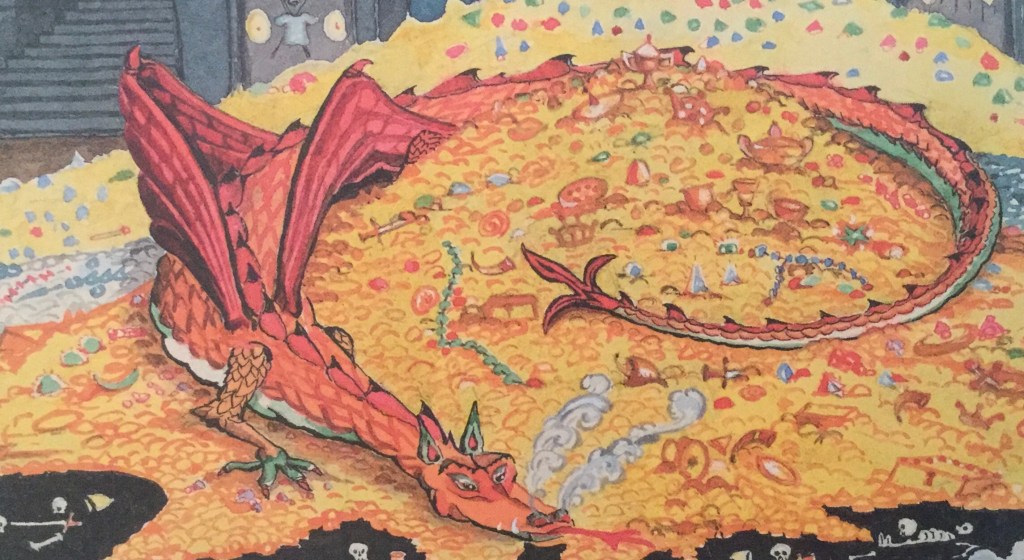
I’m starting – and won’t finish – this on St George’s Day. But while I’ve written about dragons before here, and on St George’s Day, too. And as is often the case, I’m spurred into action by a remark elsewhere – in this case Martin Flatman’s comment on Twitter that suggested we should have a St George to fight bots. A clever thought: some internet warrior whose job is to deal with the time and emotion devouring interjections into our e-life. But what are our foes? How do we counter them? Let’s look at some dragons.
“A giant lizard…like a hideous dragon guarding its beautiful treasure.”
Notice that it isn’t a dragon. As Tolkien suggests of a wider range of literature, dragons, real dragons, essential both to the machinery and the ideas of a poem or tale, are actually rare…There are massive brontosaurus-like creatures (the magnificently irascible Edward the Booble), and this lizard like a dragon, but of all the fantasies Tove Jansson conjures up, traditional creatures such as dragons hardly figure. We may have plants eyeing up Snork Maidens, and knitting ghosts, and the howling fire of the Comet’s nuclear blast – but no dragons.
“No dragons” makes me think of Thor Nogson, whose failure to confront his fear makes him so much a figure I recognise.
Thor Nogson in “Noggin and the Dragon.” The Dragon?
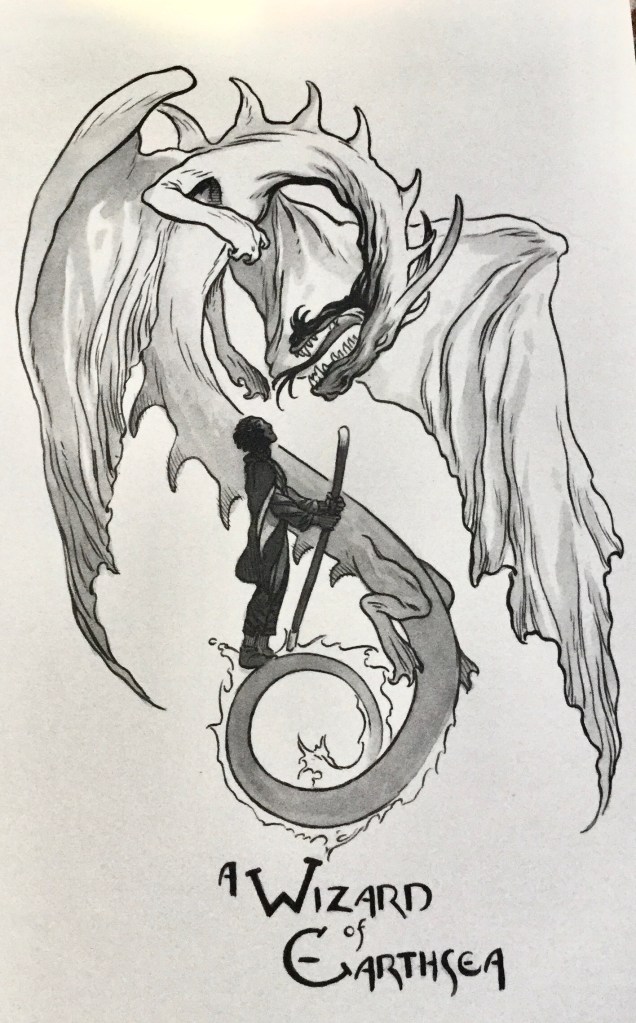
Then there is the sorry figure of the dying dragon whose form luckless, soulless Eustace inhabits/inherits much to his regret in Voyage of the Dawn Treader, that uncomfortable fantasy of redemption and repentance at the heart of the Pilgrimage of Perfection (or the earlier Pilgrimage of the Life of Man or maybe Pilgrim’s Progress?), and the awesome (in the earlier sense of the world) dragons in Earthsea [Cue at least one fantastic, menacing, serpentine LeGuin dragon from the artwork of Charles Vess: compare and contrast with poor Eustace].
Pauline Baynes: Eustace as a Dragon bewails his fate
Charles Vass’s sinuous dragon at the start of The Books of Earthsea.
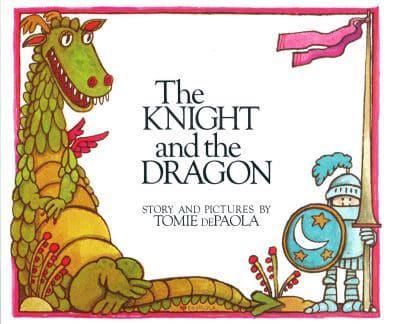
And nearer to my heart are the Knight and the Dragon, trying so hard to live up to the myth of who they are meant to be in Tomie de Paola’s parable of reconciliation and self-realisation, and the very modern, urban and urbane Franklin, in Jen Campbell and Katie Hartnett’s Franklin’s Flying Bookshop. Dragons have changed, been tamed (or come closer at any rate to us). Franklin seems a long way from Orm Embar.
“Luna and Franklin feel like they are made out of stories.”
Few of these – and I know they are self-selected (where, for example, would I put the greedy and self-centred dragon from The Paper Bag Princess?) – are the dragons we would fight. These last two in particular play with the terror, the aggression and turn it on its head.
So far, so predictable, perhaps. Beyond those texts, behind my understanding of what a dragon might be, is this song that I loved so much in school assembly. Martin Simpson performed a gentle, thoughtful version of When a Knight Won His Spurs, linked here.
“Let faith be my shield and let joy be my steed Against the dragons of anger, the ogres of greed,” the song goes. These monsters that attack us, that with the current war in Ukraine seem closer than ever – and, it is noticeable, the war is fought most fiercely in the ruins of cities – but is also fought with anger and misinformation on the web. And not only this war, but the miry lies of governments, our own self-deception. I no longer wield a “sword of youth” but I still fight to set free the power of truth in myself. It’s never an easy task.
So with this simple song from my childhood we might be back to where we might need to fight dragons. Maybe this is the place.
So dragons from the past in Western literature stand as images of aggression, greed especially, and are a species apart. They are (often) merciless, or with their own way of thinking: symbols of our inability to think ourselves into the minds of others. The battle here is with an enemy we don’t understand – maybe one that is set not to understand us.
This is where Martin Flatman’s remark becomes clearer and cleverer: how do we stand against the slow acid attack on our ideas or our spaces in the maze of the Internet or in real life: intrusive, poisoning, interrupting. How would a St George deal with them? Perhaps it s not the clumnsy sword-weilding that deals with them; you wouldn’t use a sword to bash away flies after all. Simply saying “don’t” to bots (and their fleshier imps, the trolls) is like saying “Thou shalt not,” as Pullman suggests in his surprising praise of Jesus as storyteller: Thou shalt and thou shalt not are easily ignored and soon forgotten; but Once upon a time lasts forever. We need stories of hope, stories that laugh at the invading, venomous half-truth. I am holding out, not so much for a hero, but for a Teller of Tales.
A bit of a tortuous introduction to a simple theme. I was looking for a Name Day for Jono, our daughter’s partner, and was a bit stuck for a Saint Jonathan. It turns out – with a bit of a wobble – that Jonathan, the son of King Saul and confidant of the man who will become King David, is commemorated on 1st March. I rather suspect that Jonathan, son of Saul is commemorated here in a confusion with Saint David, the fierce and energetic patron saint of Wales, but the story of David and Jonathan refers to the early kingship struggles in Israel, and to the mutual friendship between the two. I also see that Jonathan is commemorated as one of the patron saints of friendship in some Churches.
Emmett and Caleb
So today is today. The feast of St David of Wales and (very much in its shadow), a commemoration of Saint (?) Jonathan, and although John the Beloved Disciple and a choir of others might join him, it strikes me as a day one might celebrate friendship. We are a long day from the International Day of Friendship, the world looks awful, I am coughing and coughing: we need our friends… So here is a quick roll-call, not much more, of some Significant Male Friendships in (mostly) young people’s literature.
In High Fantasy the obvious Tolkien friends might be Frodo and Sam – but what about Legolas and Gimli? Sparrowhawk in A Wizard of Earthsea has Vetch; their true names are Ged and Estarriol, which I cannot omit because of how the latter name rolls around in the mind, echoing the stars, or Tolkien’s Estel.
Historical fiction takes me to Dara and Lubhrin the Heart-Brothers in Rosemary Sutcliff’s Sun Horse, Moon Horse, and to Vortrix and Drem, to Artos and Bedwyr, to the tragic story of Randall and Bevis (I have discussed close male friendships in Sutcliff before) – but to other friendships, too – maybe to Thomas Becket and King Henry, for example. Not all friendships go well. Perhaps I unfairly stretch out of “children’s literature” with Sword at Sunset and with Mydans‘ Thomas anyway
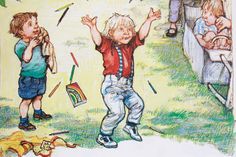
Picture Books? Well, if I exclude Nen and the Lonely Fisherman it’s only because the significance of this male friendship seems to me to be much more romantic than many encounters, although almost its contemporary, Emmett and Caleb, provides a poignant example of ambiguity. The ambiguity of text is a thread for a labyrinth of half-meanings and unstated feelings going back to the story of Jonathan and David after all, and maybe its time to acknowledge the subtleties of such tales. But back to those passionate, wild child younger friends: how about Bernard and Alfie? How many Bernards did my children meet up with, or for how many of their friends were my children the Bernard? Rambunctious, up for a laugh, just on the edge of “naughtiness.” Whose house were they in when all the children took mattresses off the beds and used them to toboggan down the stairs? Who encouraged a young visitor to write her name on our bookcase?
Bernard throws the crayons
In fiction as in real life we meet friends on the edge of tragedy, comrades in arms and united in more gentle fellowship. We meet friends whose devotion to each other is deep and sustaining; comic; brotherly; on the cusp of romantic (and sometimes a coded version of this), so many invitations to adventure, to joy, to wholeness. Happy feast day, friends.
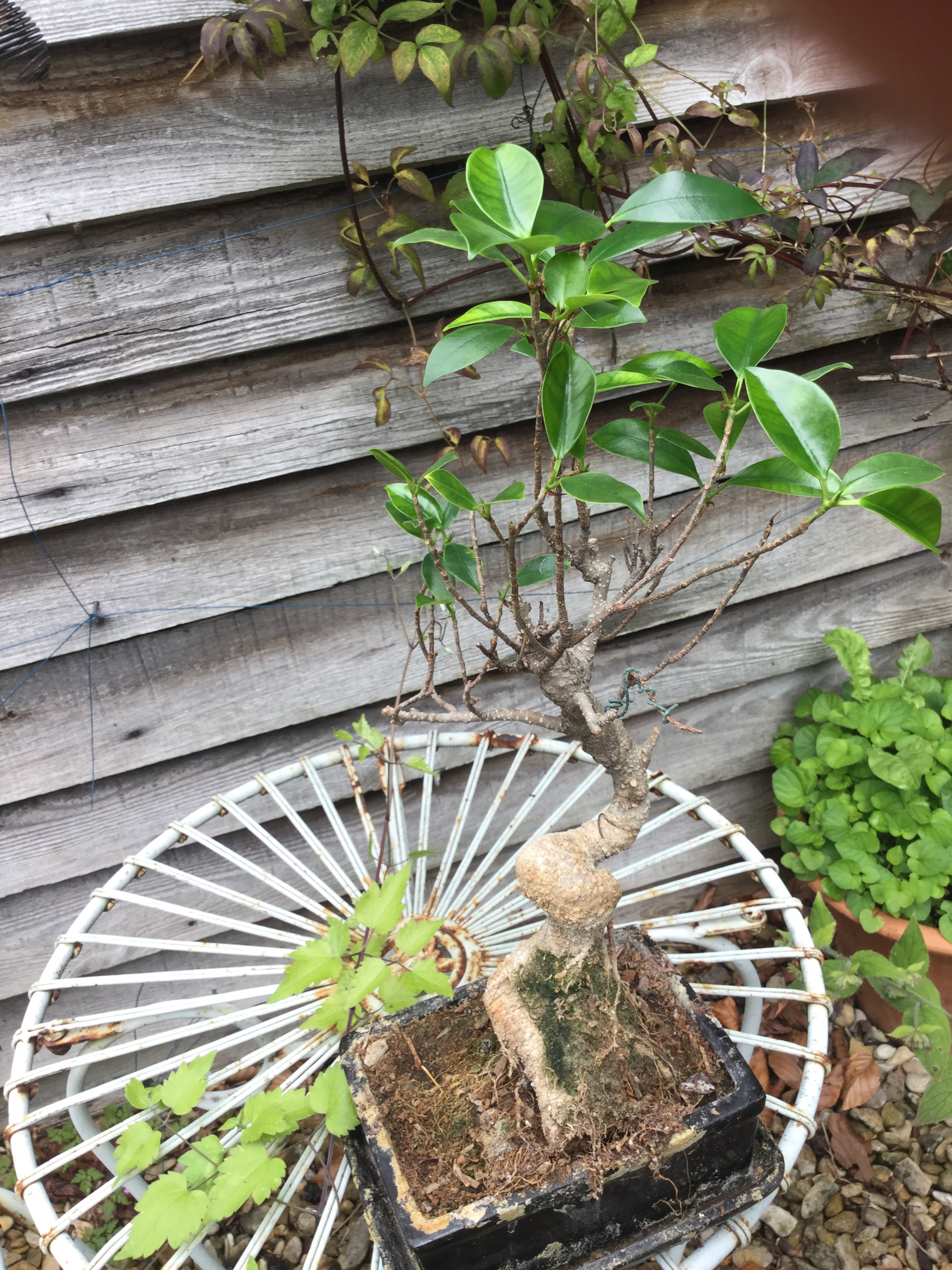
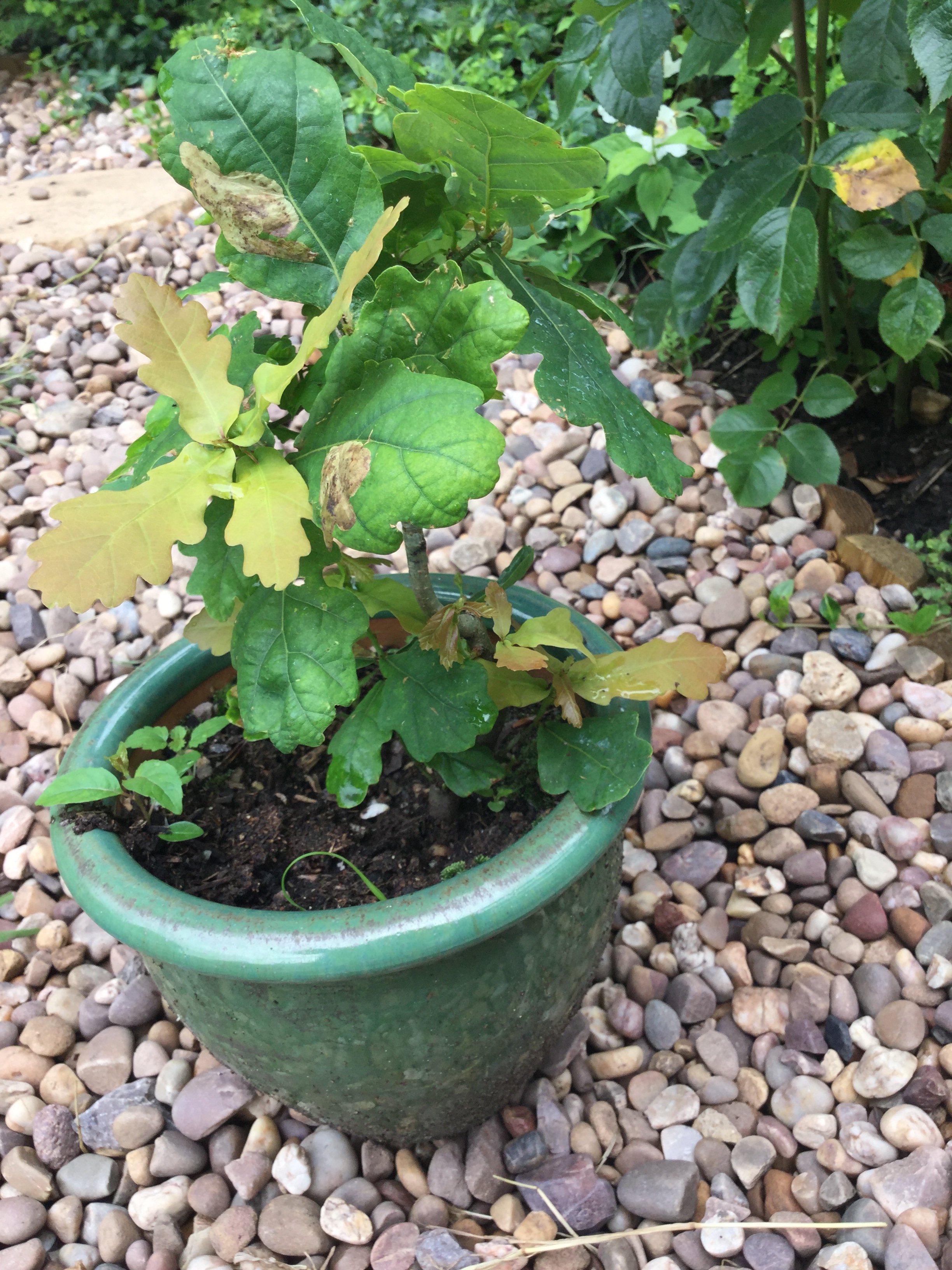
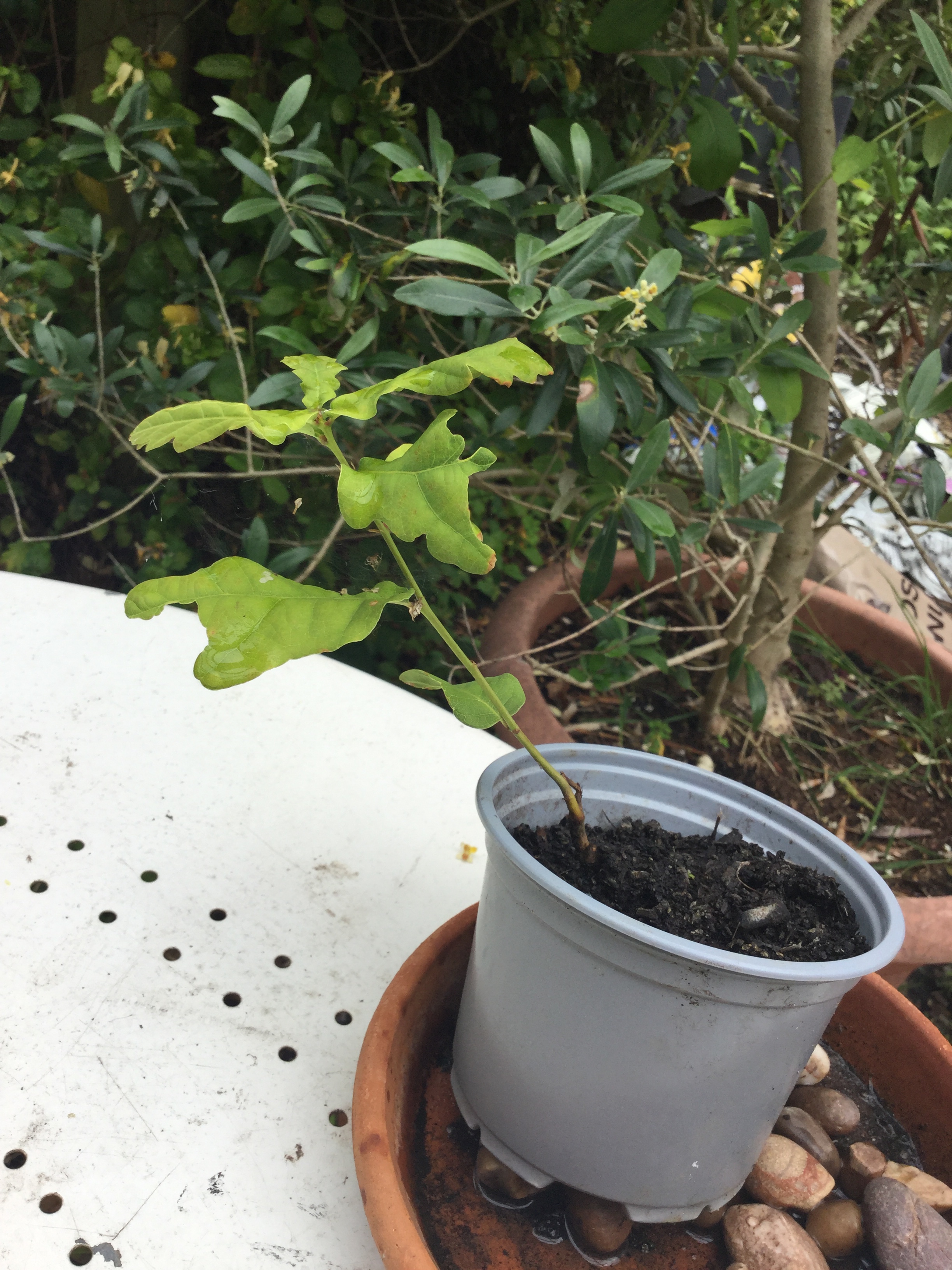
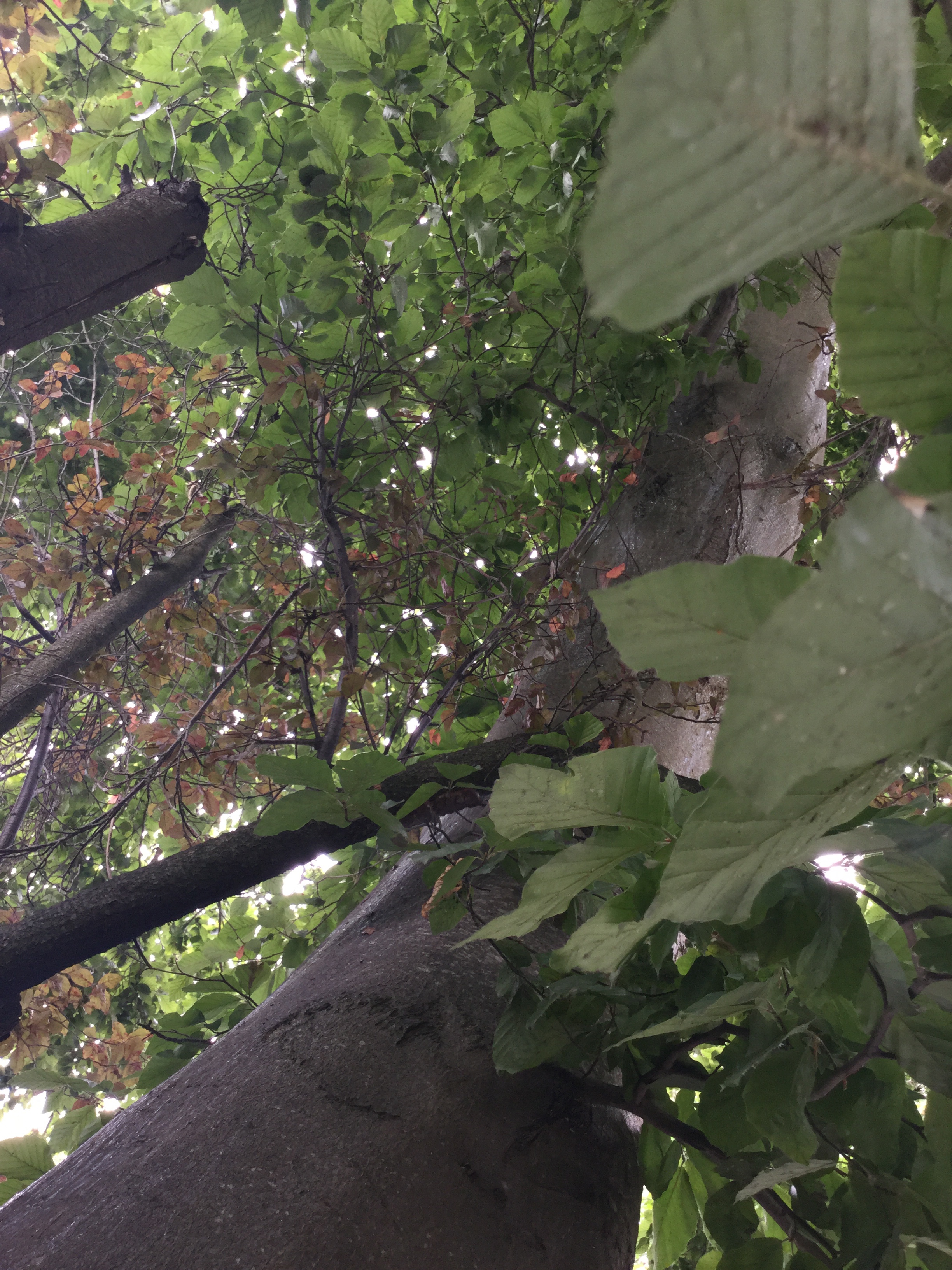
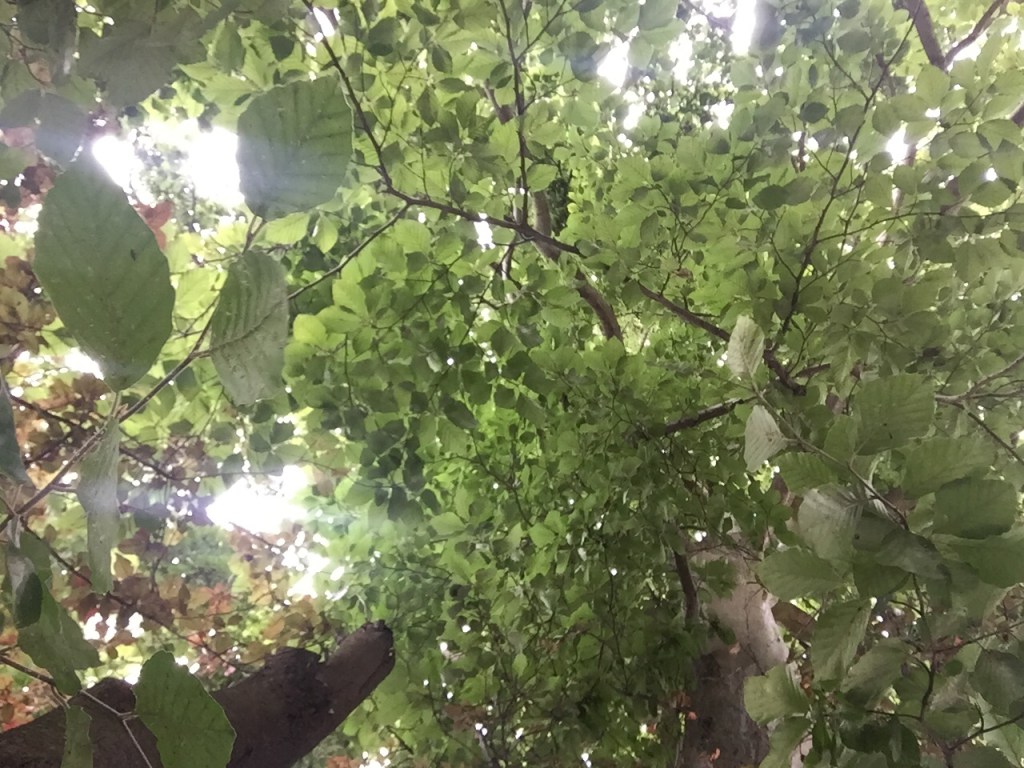
I often think about the big beech tree (bottom right and below) by our front gate: its looming presence in wet weather; the leaves in the autumn; the squirrels, pigeons, whitefly… I worry about it in the high winds, and glory in it in the spring. I am also aware of the smaller trees that have come to be part of my life, and am always grateful for the life chances that allow me to go to the allotment and pick apples and damsons (fewer this year, after a surprise, cruel, late frost). And then there are my smallest trees: a bonsai ficus (top left) I bought at a student market and am nursing back to health, the little oak (centre) I have trimmed and wired for a few years, the seedling red oak (bottom left) I found on the allotment this year and didn’t have the heart to hoe up but replanted and brought home.
It’s as if my desire to feel trees as a healing presence is played out in large scale and small.
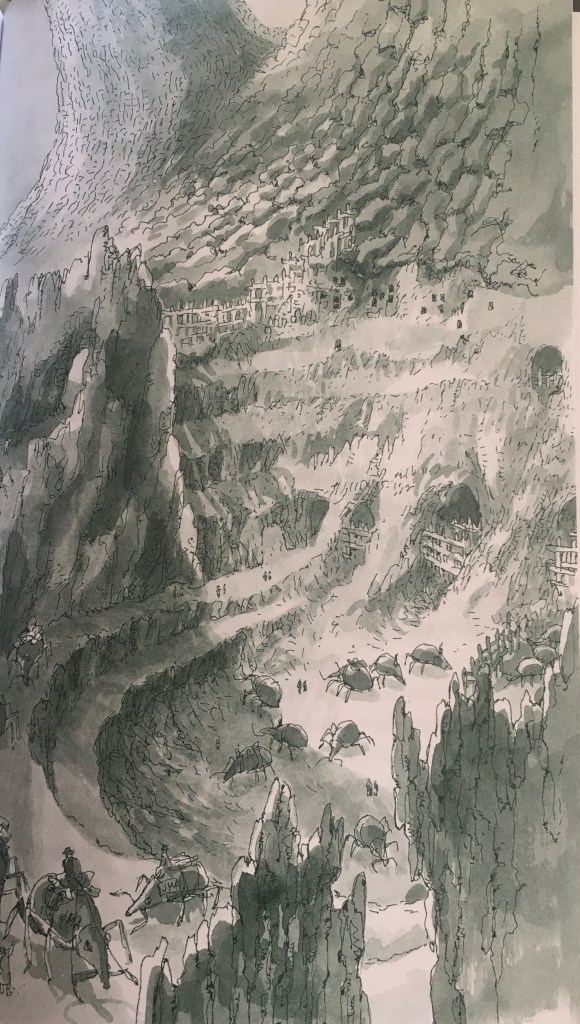
And then a pair of books come up for me to read, the first simply a chance find in a charity shop from a To Be Read list. Timothée de Fombelle’s Toby Alone and its “sequel” (really part 2), Toby and the Secrets of the Tree. Toby is one and half millimetres tall and his world, at least at the start, is a tree from topmost leaves to where it sinks into the soil. Small people – from Lilliput to Borrowers, from Hobberdy Dick to Hobbits – are nothing new, but de Fombelle is daring in making his characters so small. Daring, too, in then taking the ecosystem of the tree they live in and describing it in terms of landscape.
At the bottom of the Tree, before it comes into contact with the earth, the wood from the Trunk rises up to form high mountain ridges.
Needle rocks, bottomless precipices…the surface of the bark is crumbled, like rippling curtain folds. Moss forests cling to the peaks, trapping snowflakes in winter. the valley passes are blocked by ivy creepers. It makes for a dangerous, impassable terrain.
Timothée de Fombelle: Toby and the Secrets of the Tree Ch 3: Someone Returns
The Crater from Toby Alone, illus François Place
It is the scale that boggles the mind. The Tree is at once a massive entity and a vulnerable one, a stage on which the cleverly Dickensian drama of lost children and choices based on mistakes, and a body around which a drama unfolds like a hospital soap opera. The smallness of Toby and the rest of the Tree and Grass people allows this to be played out wonderfully clearly. The technology of living a (sort of) human life at the scale de Fombelle describes is passed over in many places, made much of elsewhere: the terrifying soldier ants and destructive weevils underline the issue of scale; cigarettes, prison door keys, carts, boots are accepted parts of this society. The author works hard to make these transitions unobtrusive. Essentially this is a meditation on power and corruption and ecocide and resistance: a competent political thriller and romance but very much in miniscule. So is the setting on a tree merely a backdrop?
Toby’s tree is a presence as much as a setting, and its fate is the matter of both books. Ruthless, populist entrepreneur Mitch digs sordid housing projects at the cost of the Tree’s health – and therefore at the cost of the society he is claiming to protect. Toby’s father is a marginalised and then persecuted scientist intent on protecting his world by exposing what’s going on (I am reminded of the HS2 project as I read Toby’s adventures, but then think that Toby’s Tree is just one; we have seen woodland after woodland, thousands of trees cut down – the emotive word is wilfully, and tonight it seems right). Friendship, loyalty, rivalry and love – these may be the strands which move the story along, but the politics of violence are violence not only to the people who live on and at the foot of the Tree but also to the Tree itself: ecocide as a sort of suicide.
I am therefore reminded of the protestors’ occupation of the massive tree in Powers’ The Overstory:
He has seen monster trees for weeks, but never one like this. Mimas: wider across than his great-great-great-grandfather’s old farmhouse. Here, as sundown blankets them, the feel is primeval, darshan, a face-to-face intro to divinity. The tree runs straight up like a chimney butte and neglects to stop. From underneath, it could be Yggdrasil, the World Tree, with its roots in the underworld and crown in the world above.
Richard Powers: The Overstory: Trunk
And there is the connection: The World Tree. The Tree that Toby inhabits in the de Fombelle books is a world, to start with, just the one tree. Ravaged Mimas, the doomed chestnuts, the rewilded back yard with its pine tree,the Brazilian forest where all is fringe and braid and pleat, scales and spines are diverse but more interconnected in The Overstory, although it takes tree-years for the humans to grasp this, and then only some of them, and even then only imperfectly.
With that connection comes an answer to the riddle of scale: De Fombelle’s millimetre-high hero is related to his environment in much the same scale as the humans in The Overstory are related to the forests, the priestly tulip trees, the baobabs and quiver trees they inhabit or protest over or study. Toby is tiny to us, even tinier to the Tree, in the same way as we are tiny to the ancient forests of the human world – and what De Fombelle allows us to see is one tree in its fragility and complexity and then look up and ask: if that is one tree, what then is a forest? What mission might we be on, if Toby’s adventure is to save his Tree? Looking into Toby’s world is like contemplating the sudden shift in focus with a camera: new ideas come into view, new oportunities to see our place in the world. As Toby’s father Sim claims, Nature is a magician; as my perspective shifts from Toby to the trees in The Overstory and back again, I wonder how often I overlook the magic, that face-to-face intro to divinity.
Have you ever tried to enter the long black branches of other lives…
Do you think this world is only an entertainment for you?
Mary Oliver, Have you ever tried to enter the long black branches of other lives
The beech (I don’t feel I can call it “my” beech), like Mary Oliver’s Black Walnut
swings through another year
of sun and leaping winds,
of leaves and bounding fruit
and I am all of a sudden, looking at it entirely differently.
Almost a microblog, this – a notification that my friend Chris Lovegrove (with whom I collaborated on a read-though of the Snow Spider stories: see this example from Chris, and this from me) is giving notice of a read-through, in publication order, of the Chronicles of Narnia, starting in November, under the title Narniathon21. He is incredibly well read and thoughtful: it will be a wonder.
I come back to C S Lewis on my blog fairly often, but not always to Narnia, although the present scambling and unquiet time sends me back to Puddleglum more often than not if I catch the news. Perhaps I need to ponder why I have not come back to Narnia more often or in more depth.
Whatever the answer, I am looking forward to Chris’ look, book by book, at everyone from Lucy to Tirian, from Jadis to Shift, from Calormen to Stable Hill. And maybe confronting my discomfort.
GOE, and catche a falling starre…Teach me to heare Mermen singing
I think that the first mer-character I really remember was a mer-boy who either rescues Rupert the Bear or who is rescued by the smartly-dressed ursine adventurer. Looking at various stories in which the merboy figures, I can’t say for certain which it was – I remember the putto-like character, the rocky shore, a sea-serpent…. All rather untamed, compared with the donkeys-and-pier seaside I knew in Cleethorpes, but somewhat like bits of Dorset. For me at the time, seaside was not a place of uncanny encounters, but I did recognise that such meetings, on a chilly shore, make for a great read. Katharine Briggs has some good stories of Merrows and seal-people scattered through her books but she does warn that
The mermaids are perhaps of the most ambivalent character. The very sight of them at sea is death to sailors, and it is their habit to decoy people under water, but at times they are benevolent …
K M Briggs: “Forgotten gods and Nature Spirits” in The Fairies in Tradition and Literature.
Human fear of drowning and perhaps a fear of the disruption to a society of a sort of seductive sexuality make the mermaid seem a dangerous creature. Note, however, that Briggs refers here to maids, to dangerous aquatic females – but she is aware, too, of male people of the sea.
While thinking of Mermen, it is worth turning to Walter Map, whose work De Nugis Curialium contains the story of Nicholas Pipe, described as
A true man with no hint of the inhuman in any of his limbs and with no defect in any of his five senses, he had been given, beyond his humanity, the aptitudes of a fish.
Illusions and Resurrections selected from Walter Map’s De nugis curialium translated and adapted by M. T. Anderson
but tellingly also less than a human and united with the fishes. (see this edition for all sorts of name-dropping, snarky comments and so on from Walter Map – and occasional folktales and horror stories). It strikes me that what Pipe is, is a creature, like many supernatural creatures, able to move between the accepted world and the unknown. In the book People of the Sea a seal inland worries islanders that it might be something more than a seal. That ambiguity is the stuff of the uncanny.
People of the Sea requires a bit of explanation. I’d seen merpeople in Narnia, read the Little Mermaid with its chilling message about hopeless love, and then was bought David Thomson’s rich and bleak The People of the Sea one Christmas in the early 80s. Here Thomson recounts the classic Selchie Tale of the seal-woman who raises a land family (in this case under duress) before returning to the sea. It’s a haunting tale that gets a beautiful modern retelling in the film Song of the Sea (Trailer here), and a different exploration around sibling bereavement in Brahmachari and Ray’s Corey’s Rock. (NB, I have explored Corey’s Rock before: link here). There are versions of Selchie tales of all sorts, told in almost orientalised contexts in David Thomson’s book, attesting to the power of these ambiguous creatures, and relationships between land people and magic sea people – and earthly seals too, hunted with respect but not sentimentality.
And the latest voices and images to attest to that power belong to Ian Eagleton and James Mayhew. Again drowning is a key dramatic element, and the story draws on Hans Christian Andersen’s Little Mermaid – or perhaps the Disney version*. No Prince to be rescued here, but a scruffy-but-nice Fisherman called Ernest; no manipulative Sea-Witch, but a jealous ruler, Pelagios, Nen’s father, a gloriously imperious, almost gilded merman straight from an eighteenth-century fireplace.
The characters are “between worlds” (a phrase I picked up from the BBC series on the influence of Irish music and this piece by Michael O’Suilleabhain), like the unicorn Findhorn in Alan Garner’s magnificent and threatening fantasy Elidor (a great blog report here). Findhorn walks in high places and yet meets his end in the lap of a virgin not in a glorious, flowery tapestry but on a demolition site in 60s Manchester. Nen, in sharp contrast, lives in deep places, but finds fulfilment in the gaze of a lonely fisherman on a coast of rocks and cottages, and his father begins to wonder whether the two worlds are as different as he had thought.
Just as I like the way James Mayhew depicts the anguished hauteur of Pelagios – and while I promised not to think of Disney, it does match, if not exceed, the wrath of Triton in The Little Mermaid – the eye contact between the merman Nen and his lonely fisherman Ernest is also charmingly warm. The images stand in opposition to each other. The sighing ocean and the violent waves, are calmed by the merman’s song tender and brimming with courage – and Pelagios’ doubts over the human world abate like the storm, so that Nen and his (a little word but worth noting) fisherman are on a rock laughing and dreaming about the future.
It is here that the despair of Andersen is passed over, and the subtexts of abuse and grief from the Selchie stories of the Gaelic islands are rewritten. More tales could be told – maybe should be told – about Nen and Ernest as they grow and share their lives. We are not in the world of the uncanny – or with John Donne in the world of fantastic improbability as in the headquote – but in a world of acceptance.
*[And as an aside, I have to say that, tempting though it might be to read this (and write about Ian and James’ book) as a queering of Disney, I’m largely going to leave Uncle Walt to others.]










 nicktomjoe