Strawberries

Critical incident:
5 yo picks strawberries, puts them in a bowl, takes them out one by one and either eats them or shares them with me. Some are left for a while, and then she requests a knife, which she uses to chop the rest up. They are left in the bowl, and eventually (when they are inedibly squashy), she returns to them and feeds them (at my suggestion) to the garden chickens.

Reflection

It is an idyllic scene in a garden in June. The child is engaged, her 2yo little sister too (see the drawing below), and there are plenty of opportunities for maths and science and language development  – a real “understanding of the world,” if we remove that term from the curriculum straight-jacket.  It would be very tempting to say that “every child should have the chance to pick strawberries.”
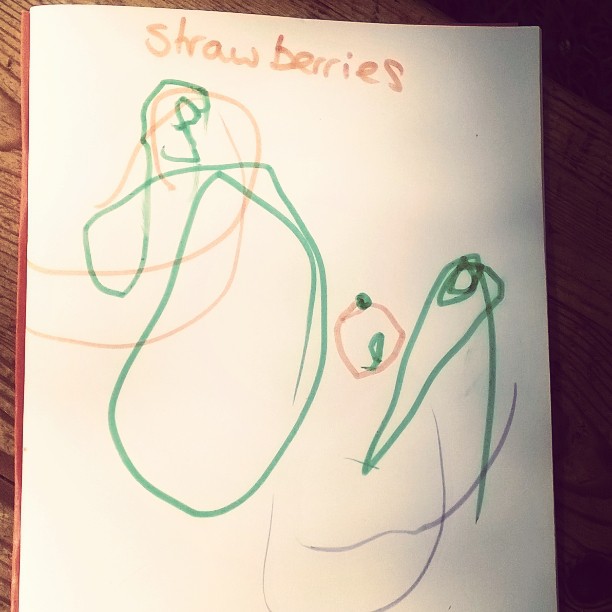
strawberries

That’s the phrase that needs unravelling: it brings with it assumptions about class, expectations, entitlement and the unattended questions about who decides on  a child’s experiences.

Class

This is all taking place in a lawned, private garden with chickens. We may not be talking an estate, but equally the incident is not one on a subsistence farm; we are talking, in current property terms, about a dwelling firmly in the middle classes. So the expectation itself that this is a valuable experience is already close to the idea of comfortable living. The “gaze about the multiplicity of who a child might be and how she might understand her world” (MacNaughton 2005:143) has been blinkered from the start by an unexplored attitude about the normalcy of middle class in the UK.

Entitlement

The “should” is itself therefore problematic. The work of Tina Miller on fathers (see previous blog post) suggests that just as fathering is part of/arises from  a set of views about “embodied selves and structural histories,”  (Miller 2010:38) so too do the practices of Northern-European childhoods. The “should” that may suggest fathers behave in certain ways also acts in a number of ways in the case of children. Proposals of “what children need” pepper Early Education books, and it is right that we have inspiration, leadership, direction – but the “should” is sometimes unexplored, and very often uncontested.  A child “should” be outside because of the tradition of children (particularly boys) being outside to play:

Let the amusements of a child be as much as possible out of doors; let him spend the greater part of every day in the open air; let him exert himself as much as he please, his feelings will tell him when to restand when to begin again; let him be what Nature intended him to be–a happy, laughing, joyous child. Do not let him be always poring over books (1878: 179)

This “nursery inheritance” (cf Brooker 2005: 117ff) brings with it a moral imperative that is likewise unchallenged.  When we talk about entitlement – and we should – what are we using as a yardstick? Do we see strawberry picking as valuable experiential learning about healthy eating? Or as another step in the induction into the middle class? Or an understanding of life processes? Or a replication of a dimly remembered rural past?

Who decides?

Let’s suppose this experience is viewed by someone – well-meaning and powerful – as a key experience for children. On what basis have they decided this? How do they implement it?

  • Is this the practitioner who sees a child enjoying strawberries and thinks about replicating this next year?
  • Is it the parent (or grandparent) who enjoys the time with a child and thinks “this is worth doing”?
  • What would it be like if the Secretary of State were to see the strawberry incident and say

“Every child should have the opportunity to pick and eat strawberries”?

This is not so far-fetched, even though the vision of government-regulated (and measured) strawberry-picking is a reductio ad absurdum.

How does a new project get off the ground? What criteria decide that this or that phonics scheme, or behaviour management approach “works” – and works for whom? This appears to be at the heart of a new book out of the IoE, which I look forward to reading.

To go back to the strawberries, we might ask (and in particular ask our students to enquire of their own experiences)

  • what makes this valuable?
  • what criteria do I use to give this value?
  • how do I communicate its value to the child, to the child’s parents, to managers and policy makers?

How am I an effective advocate for children, not just someone who sees a bandwagon and jumps on it?

References

Brooker, L (2005) “Learning to be a Child: cultural diversity and early years ideology”  in N Yelland (ed) Critical Issues in Early Childhood Education. Maidenhead, Open University Press.

Chavasse, P  (1878, 13th Ed) Advice to a Mother on the Management of her Children. Birmingham. available online http://www.gutenberg.org/cache/epub/6595/pg6595.html

Mac Naugton, G (2005) Doing Foucault in Early Childhood Studies. Abingdon:Routledge

Miller, T (2010) Making Sense of Fatherhood. Cambridge: Cambridge University Press

Wyse, D et al (2015) Exploring Education and Childhood: From current certainties to new visions. Abingdon:Routledge
Fatherhood I

One of the joys of the team here at the moment is the real energy there is towards research. and looking outwards to more fluid forms of communication such as blogging.
Mat Tobin, for example, has recently blogged on why picturebooks matter, and it’s our shared interest here that has made us gravitate to each other on a shared project around fatherhood and children’s picturebooks.

Very often in books in which children have adventures, the parents are absent, and in some the very absence of the parent exacerbates the crisis (I’m thinking of Sendak’s Outside Over There, particularly, but there’s the gentler story of Joe’s Cafe – and  for older children we might consider the death of Torak’s father, and in YA fiction Patrick Ness’ A Monster Calls or the complexities of Dacid Almond’s Billy Dean).

So just to kick me off on this (next stop looking in detail at Tina Miller on Fatherhood and exploring her ideas of the masculinisation of the home !), I’m posing three questions:

  • Why do parents have to be absent for a “good” story?
  • Are weak parents a substitute for absent parents?
  • What about the unlikeable parent – the buffoon, the bully?


Using visual methodology to look at childhood.

“Childhood,” that fluid concept that may (or may not) include infancy and may (or may not) embrace young people up to 18, gets looked at using all sorts of research tools which may (or may not – I’ll stop doing this now) provide valid data. Aries’ own use of visual material has been criticised for its subjectivity in selection and judgment, and I’m sure the four pictures I used in my research presentation could likewise be pulled apart.

What I attempted to do at our Faculty Research Conference was to try to think in terms of methodology to look at a similar event – children playing outdoors – through different media: a four year old’s drawing; an historical photograph; children’s book illustration.

The child’s drawing I have already discussed.

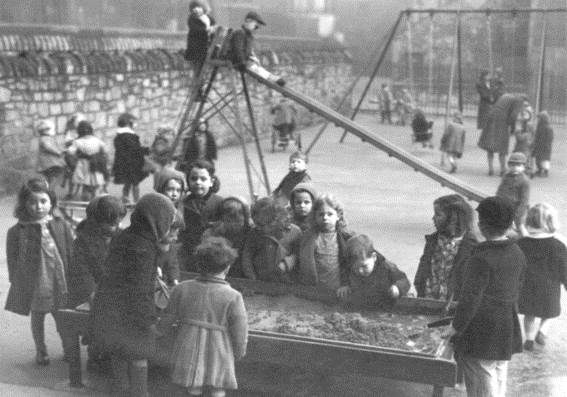
This was the photograph I chose

Cowgate Nursery
Cowgate Nursery

– a substitute for the one I really wanted, from Margaret MacMillan’s passionate plea for Early Childhood provision from 1923, for which I couldn’t get a clear enough reproduction. My only real points here were about how we are unaware, by and large of how “participatory and collaborative” (Pink, 2001:58-9)  this is, and if there might be here (Burke, 2001: 117) a “possibility of idealisation” – positive or negative? Is this an ideal – an example of what schools often label “Best Practice”? Or maybe a plea for more of these institutions? Or part of a study of the urban poor – and in contrast to what?

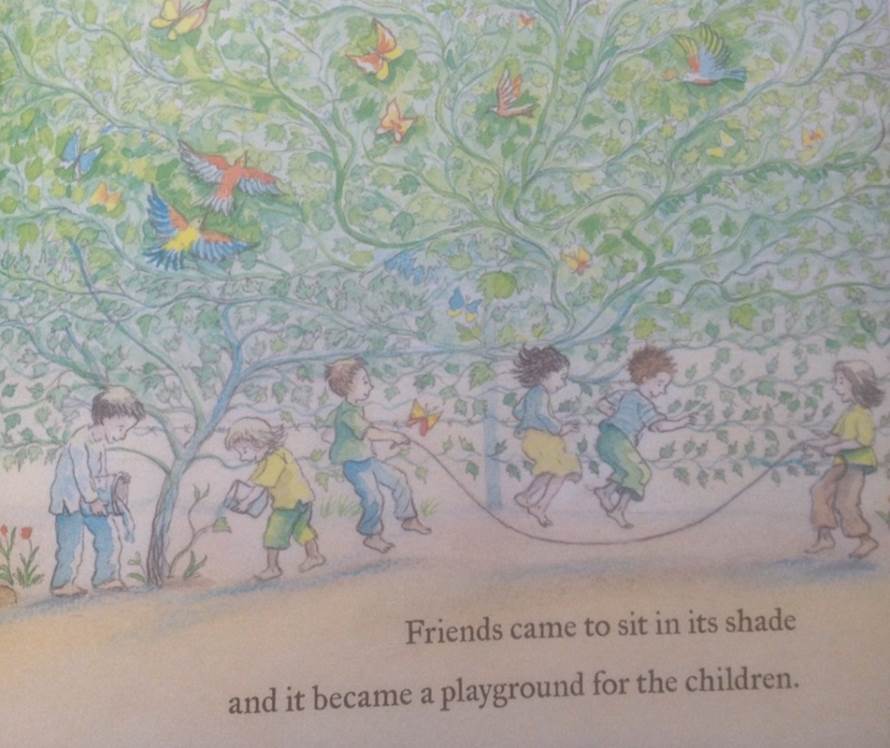
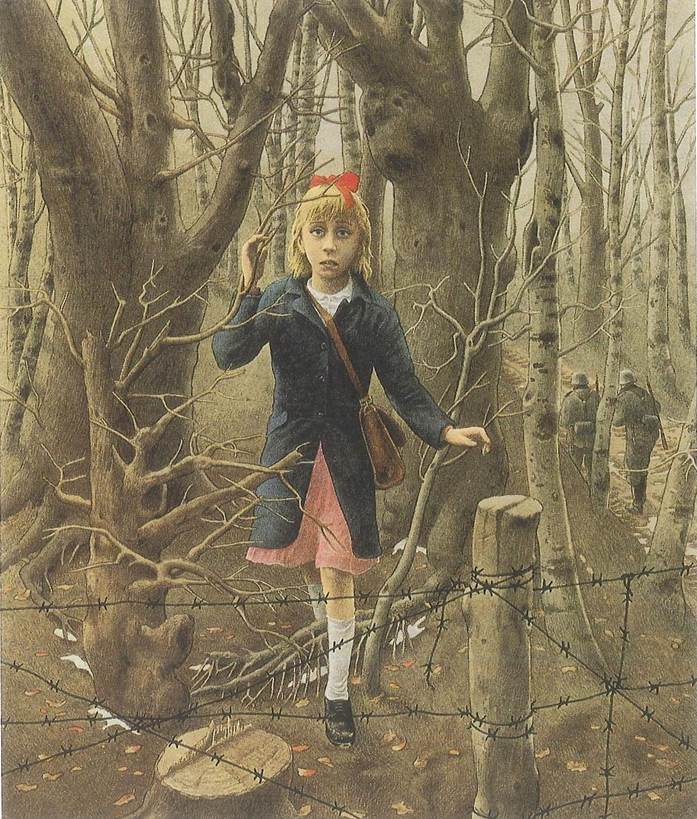
The heart of what I presented was around Michael Foreman’s reflection on his time in Gaza

The first children play in the shadow of the vine
A Child’s Garden


and Roberto Innocenti’s moving and ambiguous story of a young German child’s encounter with the Holocaust.

The girl discovers the camp
Rose Blanche


I looked at composition to some extent (what is Innocenti’s girl staring at in horror?), and at the symbolism both illustrators managed to use (e.g. the notion of the vine as the symbol of a flourishing Israel at peace), but all I was really able to do in 15 mins was to suggest that for all three sets of images context is important, and that for the illustrations all this becomes much more complex; in an analysis of illustrations in children’s literature context includes, it seems to me:

  • Narrative (what comes before and after the single image)
  • Intertextuality (reference in word and image to other works)
  • Multiple readership and multiple views

I think I crammed a lot more into 15 mins than this precis suggests – and here are the articles and  books I used to help me on my way.

Anning, A and Ring, K (2004) Making Sense of Children’s Drawings. Maidenhead: Open University Press.

Burke, P (2001) Eyewitnessing: the use of images as historical evidence. London: Reaktion Books

Foreman, M (2009) A Child’s Garden. London: Walker Books

Foreman, M (2009) Picture Books and the Environment: a lifelong concern in J Harding et al (eds) Deep into Nature: Ecology, Environment and Children’s Literature. IBBY/NCRCL Papers 15. Lichfield: Pied Piper Publishing

Innocenti, R and McEwan, I (1985) Rose Blanche. London: Red Fox

Pink, S (2001) Doing Visual Ethnography. London: Sage

Pink, S (2008) “Analysing Visual Experience” in M Pickering (ed) Research Methods for Cultural Studies. Edinburgh, Edinburgh University Press.

Rose, G (2001) Visual Methodologies. London: Sage

Rose, G (2014) On the relation between ‘visual research methods’ and contemporary visual culture. The Sociological Review, Vol. 62, 24–46

Sipe, L. (1998). “How Picture Books Work: A Semiotically Framed Theory of Text-Picture Relationships.” Children’s Literature in Education 29(2): 97-108.

Styles, M. and Salisbury., M.  (2012). Children’s Picturebooks: the art of visual storytelling London, Laurence King.

Are we lacking in stories about real kids?

Abigail makes a good point in Like a Real Life where she asks “why are children’s picture books hardly ever about children?” She raises the issue of anthropomorphism in a slightly different way: are real children really “soooo thirty years ago”?

I suspect I have an answer of some sorts, but before we go that way, I’d like to echo the idea that Like a Real Life explores: there are good books with animals standing in for humans, and there may well be some decline in humans as main characters – although I think a really effective bit of time-sampling would be needed to make this claim securely (just to play Devil’s Advocate, for example, I  might cite Charlie and Lola, and the great Bear Hunt itself).

But no: alongside Charlie and Lola, as Like a Real Life suggests, are the Julia Donaldson brigade, great stories, massively well marketed and brilliantly produced, with frogs, and mice.

Where I think the animal stories succeed is in blurring limitations of time, space and culture.  That’s not to say they are bad because of this, but that Room on the Broom, for example, may be “about” sibling rivalry or how people learn to get along but is not boundaried by portrayals of a period of time, class, ethnicity &c., as (perhaps) the work of Mary Hoffman or Shirkey Hughes might be. This might, the cynic in me argues, come  down to marketing, although you could argue (see my post on Diversity) that this is a weakness: that a frog cannot ever really stand  in for  a marginsalised child, for example. If this comes down to identification then we have to develop a much more acute sense of what is being signified by this mouse, that badger, good and bad wolves, so that we can “leave in the magic, leave in the bizarre and the adventure” and still let the children be in on the game.

Maintained Nursery Schools

Killing any birds with any number of stones is not easy in election time. This blog post, short though it is, maybe is over-ambitious.

This information is intended largely for the enlightenment of my own students (do I own students?) as their write their assignments for Early Years in the UK Context – but since it is of wider significance, and came to me as a personal communication from my MP, I thought it could go here for more public perusal.

Letter from SOS to Rt Hon A Smith

These are politically senstive times, so I will present it without commentary, except to say that the letter in response to my own letter to Andrew Smith, who took up the matter with Nicky Morgan: the date is explained in other correspondence by the letter from the Secretary of State for Education Nicky Morgan in Sept not reaching Andrew Smith until this month.

Do use the reply facility if you wish.


Fattening a Pig

My father-in-law, Donald, was a Master Joiner who spent a lot of his working life on farms in the vale of York. He was (although this is by-the-way) witty, well read, but not a “success” at school; whatever that means, we are not talking about a father-in-law who was an educationalist. He was, however, a man much given to pithy comments, and when SATs first came in, he once said “You don’t fatten a pig by weighing it.” According to Don, testing, whatever other soundbites might suggest, does not automatically improve standards.

So here I am, on an unreasonably sunny morning, procrastinating about my Easter email backlog and pondering what might be said about tests. I see the opposition to baseline testing is back, from Early Education and others, and from the Unions – and I gather that Tristram Hunt has said he is always ready to “listen to professionals but…”

And today the proposal to re-test children who fail SATs at KS2 is interesting: the language alone is worth a re-read. Look first at the Telegraph‘s report:

Children who fail their primary school leaving exams in English and maths will be made to retake the tests in their first year of secondary school under Conservative plans to ensure there is “zero-tolerance of failure and mediocrity”

Is “failure” at the heart of SATs, then? And are KS2 SATs to be seen as “leaving exams”?

I think I am in favour of giving children a chance to have another go at an assessment task. It may even be (although I am less convinced about this) that a child might do better in a different environment. What is really quite disturbing in the language used by the Telegraph is the shorthand which makes SATs the ultimate arbiter of a child’s success – so much so that they will take them again if necessary.

Of course, this isn’t really what the proposal would be like: children would be allowed to have further teaching that would improve their skills in basic maths and English, and their NuSATs (my neologism) would test how well they were managing to catch up. The BBC have a different take on this:

The test resit plan from the Conservatives, which would be implemented next year, is aimed at making sure that pupils have not already fallen too far behind at the beginning of secondary school.

Pupils who did not get good grades in the Sats tests taken by 11-year-olds in primary school would have to retake a test during their first year after moving up to secondary school.

So let’s hear from the SoS herself:

“If they don’t achieve the required level when they leave Primary School, then in year 7, their first year at Secondary School, they would take slimmed-down tests in English and Maths. They could take these either in the spring term or the summer term.”

and I hope this link to her BBC interview remains stable, since her ipsissima verba are mostly reasonable, not strident, well worth listening to and pondering. It seems to me a wholesome ambition that young people should move from Primary schooling with a strategy in place for all the support they need to make a success of Secondary (I have been marking undergraduate year 1 assignments recently and might comment on English at entry to University at some point – but not today). I am not sure she has really explained here what will happen to make sure the children reach what she calls the “required levels,” and I worry that this may mean that Secondary schools are asked to use what she calls “catch-up money” to brumm children who are “behind” up to a standard that may not really be sustainable but which has got them through their NuSATs. There is a slight unease as I hear her move into what view OfSTED and the DfE might take as they look at “whether the school is letting those children down by not getting them to the required standard…there could be an intervention (NB the word is first used by the Beeb’s interviewer), it could be that other head teachers could come in or offer advice…”

And we are back at what has always seemed to me the main reason for SATs: to assess, not children, but the effectiveness of the school.

So if the pig being weighed is not the child, can we apply my father-in-law’s dictum to systems? Can we over evaluate schools? Is the over-testing of system likely to cause irreparable damage to the system? While I acknowledge they say little about school systems, to finish, here are some YouTube clips in which stretching and stress are used to test materials  from a webbing manufacturer, and from a Lab Test on Stainless Steel.

They are testing products to destruction.  Absit omen.


Visual Methodologies

Hmmmm.

I’m re-reading Gillian Rose on Visual Methodology, and she has given me a lot to think about.  I’d like to see if I can apply her ideas to some children’s work such as this:

climbing 001


So let’s look at this in more detail.

There are two figures, arms down by their sides, under or at least near a complex climbing frame. Writing explains that the child feels s/he is “very good at playing on the climbing frame.”

Now, I know who did this (I have obscured a name, although I do have the young artist’s permission to share this drawing) and the context, but if we apply Rose’s criteria to it, we need to ask:

  • What is being shown? What are the components of the image?
  • How are they arranged?
  • Is this a contradictory image?
  • What knowledges are being deployed?

At the basic level, what is shown is as I’ve said above, a climbing frame and two figures in proximity to it. There are two components as I read it: humans and climbing frame.   If part of the questioning we need to undertake is around what has been missed out, what is not there is interesting too, however. It might be that we can distinguish here a sort of intransitivity: the climbing frame is not being climbed, and the figures are not climbing it. In the picture there is no sky or grass, no distraction from other equipment. Does this argue for there being a lack of need from the adult for a ‘holding activity’? “Just [go away for five minutes and] colour in the sky”? Or does it argue for purpose or maybe even haste in the interaction between adult and child?

But we might also suggest a third component: the writing, both by the child and the adult. Image and text work together, and are part of the same tradition (of which child and adult are aware) as the picture story book.  The arrangement is one in which this convention is upheld.

Where it is skewed, where it has an element of contradiction,  is in the adult intervention. What is the purpose of this object? The title gives it away: this is a piece of school record keeping, very probably created at the request of an adult “to go in your file.” The child’s writing (and adult transcription) and title and date suggest that this is part of a record-keeping system that tells someone (see below) something (again: more to think of here) about how the child artist-writer sees themselves.

So what knowledges are being deployed? In brief, as a first go at this I propose that we can discern:

  • an understanding of how text and image can work together;
  • an understanding of how to represent the various elements of the climbing frame (including climbers);
  • some understanding of purpose and power in adult-child relationships.

So in looking at this power relationship, we come to the reason the work was created. I suspect, as I said, that this is at the request of the adult – and therefore, to some extent, the adult is the intended reader, the sponsor of the activity. Even in the context of physical play, the child is constrained, as is the adult, to use the event to spawn other events closer to the curricular needs, not of the child, but of the adult: play and the observation (or in this case the self-evaluation) makes it have a purpose the adult world might value.


Lost Words

A lot was made recently of the decision by the Oxford Dictionaries to take out some words from one dictionary and put in others.   The choices that were especially criticised were the ones where “nature” words were lost in favour of computing words.  I’m not sure where I stand on this; it is the task of the lexicographer, and especially one working with a word-limit to make such decisions.  What words do children use? What do they need?

The excellent Landreader project makes some really good points in this blog post, not least the suggestion that the list of words to be taken from the Junior Dictionary  can be seen as a  “prose-poetry supplement to be administered like a multivitamin as a defense against lexical malnutrition” – a neat turn of phrase.  It’s neat because of the word “need.” What words do children need, and why?

They need words to talk about things – ivy, a starling, catkins. They might need a dictionary to help them understand something on the edge of their current world – the stream that gives its name to  Boundary Brook Road,  the kingfisher in Kingfisher School. They might also want – and this is where a dictionary helps immensely – to inform when a reader meets something new and unexpected – minnow, newt, porpoise.

This has limits, of course: the Landreader project has a glossary which introduces the visitor to words beyond usual use: sleech,  or drumble, or twitten. Intriguing though they are, they are not really for the Junior Dictionary. But are we really to think that heron and poppy are becoming part of the same world? That the comic  linguistic vagaries of Rambling Syd Rumpo might also now include conker and stoat?

Attention sp

William Pooley raises some interesting questions here about attention span. Should we be “so willing to assume that every individual has a fixed ‘span’ (which can be stretched, or curtailed, perhaps, but still exists as a kind of objective measure)”?   The notion of us needing to maintain or enhance our focus is something Jason Elsom raised earlier this week in his tweet “How to focus in the age of…  SQUIRREL!!!” (@JasonElsom).  In both cases there are undertones of the now well-disseminated TED talk by Ken Robinson in which he claims too much of education is anaesthetising children.

I’d like, however, just to take an anecdotal sideways look at this.

Boys, we all know (because we are told we all know) have poor fine motor control, poor attention span., &c., &c. While William P is right that a serious study needs to be done on attention (I once found some interesting evidence of English monks in the Middle Ages muttering about long, rambling sermons, and attention during prayer has long been the focus of spiritual writers, but that’s even more of a digression), he is also right that this discourse of attention itself needs sustained enquiry. What follows is merely a snapshot.

Evan was having a good time – on and off – with the cars one week. Evan was four. One day he found that smashing trucks down a plank meant that the car crash was more spectacular than brumming them together. He built a ramp with planks and bricks to stop the trucks from falling off the sides. So far, an hour has passed. Group time, tidy-up time. Home time.

The next day he returns to the play, builds up the ramp, asks for some technical help about stopping the planks from sliding off the bricks (masking tape) and returns to his exploration of car crashes. He spends half and hour on this, goes to the loo, comes back – you can see where this is going. His key worker comes and sits with him from time to time, asking questions, finding masking tape, suggesting better cars – and by now fetching them from down the classroom where Evan is by now getting them to zip to. Two hours pass that day.

By the end of the third day, Evan has, in effect, devised an experiment to see whether how steep the ramp is affects how far the cars go. His key worker’s job on his Foundation Stage Profile is nearly done – if that’s a factor here.

My point is that the ‘discourse of attention span,’ when it hits the early years needs to take account of motivation: “Can concentrate on a self-chosen task” is a different thing (almost) entirely from “Can do as s/he is told for at least five minutes without wandering off.” Confusing the two risks misunderstanding the nature of self-motivated learning.


Innocence and Childhood – thoughts for St Agnes’ Day

Some random thoughts here. Not sure I can bring them all together but here goes.

The monk, peace activist and writer Thomas Merton wrote a couple of poems on the child-martyr Agnes. The one here is in some ways the less accessible, with its interplay between English and Latin, and the references to liturgical practice, but does nonetheless have some things I want to explore.
St. Agnes: A Responsory

Cujus pulchritudinem
Sol et luna mirantur. . .
Hear with joy this child of God
Plays in the perfect garden of her martyrdom,
Ipsi soli servo fidem.

Spending the silver of her little life
To bring her Bridegroom these bright flowers
Of which her arms are full.

Cujus pulchritudinem. . .
With what white smiles
She buys the Popes their palliums,
And lavishes upon our souls the lambs of her confession!
Sol et luna mirantur,
Ipsi soli servo fidem.

Her virtues, with their simple strings,
Play to the Lover hidden in the universe,
Cujus pulchritudinem. . .
Who smiles into the sun His looking-glass,
And fills it with his glorious face:
Who utters the round moon’s recurring O
And drowns our dusks in peace.
Ipsi soli servo fidem!

The Roman captain’s work is done:
Now he may tear his temples down—
Her charity has flown to four horizons, like the swiftest doves,

Where all towns sing like springtime, with their newborn bells
Pouring her golden name out of their crucibles.

Two themes here, then: the martyrdom of eleven-year old Agnes moved the early Church partly because a child – and a girl-child at that – demonstrated her free acceptance of the consequences of her beliefs, in a way that ran contrary to the established views of childhood, in which subordinacy, docility perhaps, is key.  Agnes is independent,  willing to go to her death, and unafraid. It is a poignant picture, whatever you make of her decision. It is also touched by the tradition of the virgin martyrs (Cecilia, Anastasia – there is a list [in itself an odd document, if you don’t consider the context] on this site) many of whom chose Christian martyrdom rather than the “easy escape” of being married off. You might say that a child-virgin-martyr ticks a great number of boxes for Catholic Christianity, certainly in the early days.

Thus, Thomas Merton plays with the image of “the silver of her little life,” in the “garden of her martyrdom” (echoed in the penultimate line with “springtime” and “newborn bells”) to emphasise her childhood, but also depicts her briefly as playing a stringed instrument to her “Lover hidden in the universe.” Merton addresses a contradiction – as he does in his other, much darker poem on the subject.

The feast of St Agnes (21st January) challenges me to think about innocence and independence as I watch my granddaughters grow – but it also reminds me (as I prepare for the module on Children’s Spirituality this semester) of how important childhood is (or at least can be) in the formulation of Christian spirituality. Hans Urs von Baltasar (a theologian more or less contemporary with Merton) puts it like this:

The backward glance to lost childhood – as cultivated by Christian poets – is no longer just a romantic dream, but a longing for a lost innocence and intimacy with God that Jesus and Mary never lost… (Die Ganze im Fragment, cited in John Saward’s The Way of the Lamb).

I’d suggest that the early reflections on St Agnes are much the same kind of longing for innocence and intimacy, and that these are present in Merton’s poem. Both Baltasar and Merton, of course, might had had much to say about the scandals of abuse that now indelibly scar that vision.

Christian spirituality has had to grapple in various ways with the childhood and maturity of a God made flesh, and in orthodox Christian theology (East and West), the child fed by his mother is key. However, whether that child is a “mere” baby, or something more, visual and poetic depictions have often found hard to some to terms with: this is a child, but more than a child; a “silly tender babe” and “Immensity cloistered in thy dear womb.”

And perhaps this tension is itself creative, propelling Christianity to think about children as people – innocent but independent, people of many possibilities,  and resilient. This is a vision that should, to my mind fly “to four horizons like the swiftest doves.”