More Nonsense in a Minute

Dave Aldridge has released an interesting blog post  I want to respond to or at least use as a springboard for a personal rant.  Where Dave asks “What, then, will become of the proposed LEA chains?” I guess he is dealing with that uncomfortable truth that the big businesses behind academies  will – or may – not want to take on smaller schools, rural areas, some of the seemingly insoluble issues that lead to “poor quality pupils.” [NB: the website of the original report seems to have been taken down]   That the state provides the “safety net” (I’m not sure of this shorthand metaphor) seems eminently reasonable; if the government has decided not to be the major player in what was a national initiative, well, we, the electorate, voted them in, sort of. Today it seems “we, the people” voted for a string of idiocies.

I join Dave Aldridge in his disquiet. However, I would be more sanguine about this if it weren’t for the dreadful other things we are seeing from this government at the moment: high-handed bullying around dodgy dealings on the NHS; rich people making decisions about their taxes that takes money from public services – and then covering it up; the opposition of the current government to taking in refugee children under the “Dubs Amendment.” This Kindertransport moment (the PM says it isn’t) is where I give up. If, as the Secretary of State for Education has said, this is a “broadly Christian country” (a phrase I believe she used to justify her position at the time in opposing equality in marriage, presumably based in part on a reading of Leviticus 20:13 or Romans 1:27), then where is our broadly Christian Government going to stand on Deuteronomy 10:18, 19, where God “takes no bribe…and executes justice for the fatherless and loves the stranger,” or the vilifications of the prophet Amos (e.g. Ch 8) against those who trample on the needy, eager to resume their unfair trading?  And if the mention of Amos makes anyone think this is all a bit Amos Starkadder, then 2 Corinthians 8 is a more human take. Be kind: it seems that kindness – the recognition that we are all the same kind, all human, all with needs and talents and joys and disasters – is exactly what is being written out of our lives systematically.

So this is my Catiline question (I know I am not alone in using it) : Quousque tandem abutere, Catilina, patientia nostra? How long will you abuse our patience? If “accuracy is for snake-oil pussies,” if High Street tycoons can make a packet and then walk away, it is as if the last election entitles only to attend feeding time at a pool of crocodiles.


Yes, it goes without saying that these views do not necessarily represent an official position by my employers.

And yes, I know Cicero would not necessarily approve of my use of his phrase in this argument.

Dirty

This is a really neat overview on YouTube of my favourite module, “my” Outdoor Learning module. It can serve as a version of the fictionalised examples I have picked up over the years that I present below. As I burble on in the video, I raise the question about where does the passion and interest lie in being outdoors.  We whet the appetite in Year 1 in the module Introduction to the Study of Education, pick it up in Year 2 with this module, and some will go on to a final year placement in Forest Schools or maybe do a dissertation around the outdoors. I’m never sure quite what to make of the student evaluation questions about “challenge,” however: U70124 is a popular module, whatever that means, and the eager student will doubtless go beyond the procedural, the basic literature (however valuable) – but we sit, perhaps ambiguously, between the placement modules and the theoretical. What do we mean by challenge, then? Is there a difference between academic challenge and physical challenge? Between physical challenge and overcoming resistance?

Here’s one student: she joins the module with a (largely unacknowledged) antipathy towards sustained reading. She is not alone in finding essay writing an awkward mixture of thinking out her opinions based on class input and “finding the right quotes” for the essay.

And here’s another: she is a solid practitioner who finds the academic stuff hard, but equally finds the alternative perspectives she meets uncomfortable. There are real points in the outdoor learning module where she finds herself thinking “I would never do that with my children.” At heart she is here to make her setting better.

And in the rule of three, here is the last: a good student, an experienced EY worker, she is nonetheless convinced by voices from her past that a stick on the floor is dirty, that sitting in the floor is unpleasant. Even being in the little wood here is several steps into an unknown.

Are their challenges the same? Are engaging with effective reading, linking theory to practice, overcoming tactile defensive systems all fundamentally about overcoming some resistance? And what does their tutor do – what do I do – to help them face their challenges, to see the threshold idea as something to be welcomed ?

U70124 2009

I confess I find myself hampered by my big question from the YouTube video, around where the “passion and interest lie.” So often we talk about passion, about well-being, or (worse) “allowing children to be children.” These ideas – sometimes surrounded by metaphor or given authority simply the power of the slogan – may well have power in the advocacy that student 2 may need, but are well-nigh fatal to the thinking and engagement required by student 1.  And while this is familiar territory to me as an academic, where does this leave student 3? How do I look at student well-being and challenge on all three levels? It’s as if I need a set of resources or an approach that will

  • encourage engaged reading
  • improve practice
  • support challenge without acting as Mother-Hen.

Oh, wait: that’s probably my job: to develop a package  (a class, a module) that enables as well as challenges; where reading is expected, opinions are welcomed, and even den-building in a muddy wood has its place. Maybe that “place” (metaphorically) also has to make the discomfort of changing minds acceptable to students. A tall order: the students aren’t the only people who have a challenge in the module on Outdoor Learning.


The landscape of the Dad

Patriarchs live in deserts. On what modern readers might see as the positive side, they produce water for the thirsty, food for the hungry, and field forty years’ worth of “Can we go back?” and “Are we nearly there?” The Patriarch Moses and God work together on this one: Dayenu.

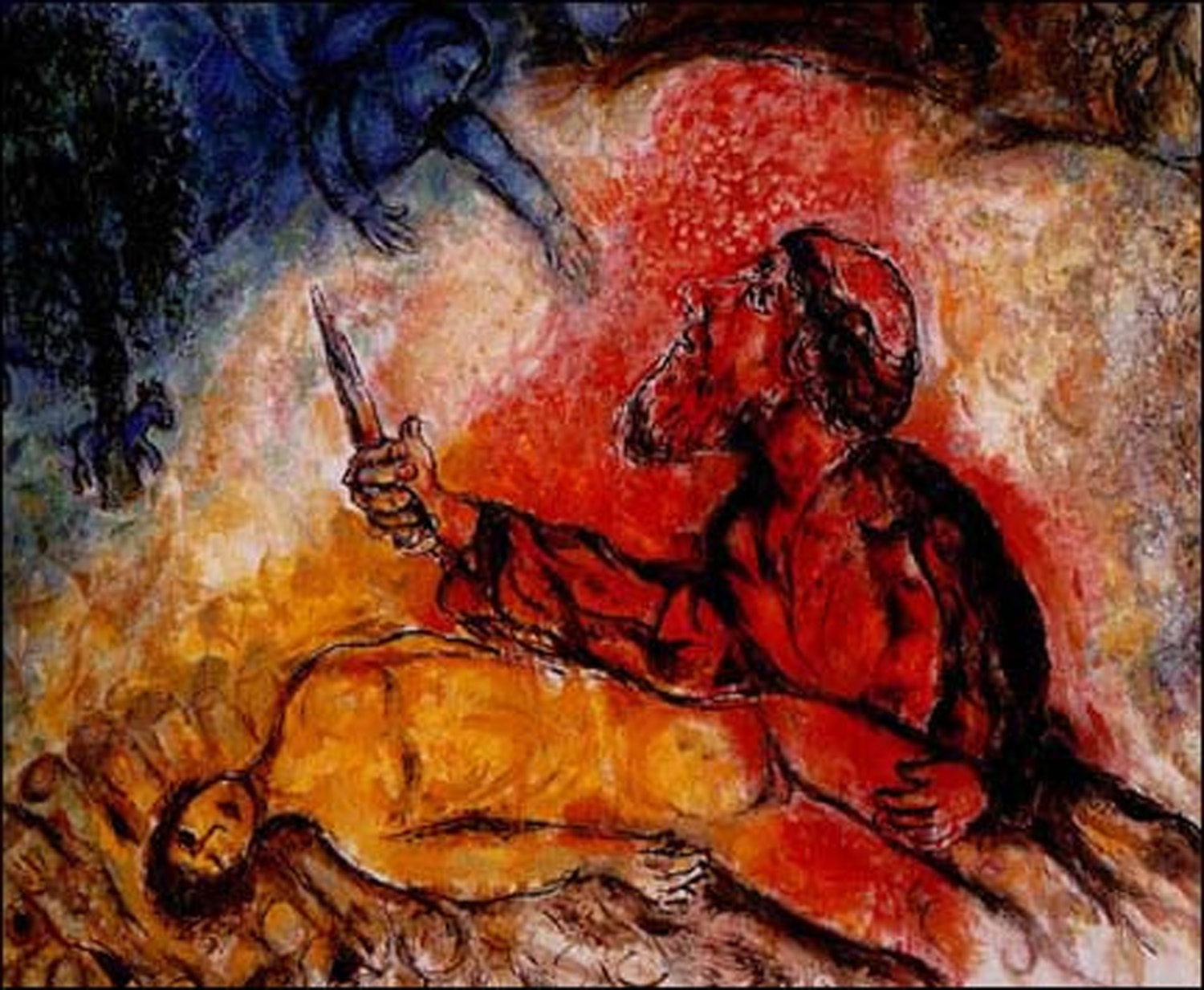
They also act in a (euphemism alert) risky way – Abraham’s attempted sacrifice of Isaac [an interesting blog post here] is not a model for parenthood easily adopted.

Chagall, Abraham ready to sacrifice his Son dv 1960-6

Dads live somewhere else. As Mat Tobin has recently explored with Keith Negley in response to his wonderful book Tough Guys (Have Feelings Too), they might live with a landscape that is a  “metaphor for frustration,” or in a cityscape that is created from block colours, but it seems to me that it is often rooted, in young children’s books, in a recognisable reality. It might not always be a positive thing to have your dad in the quotidianum  – think of the dad in Antony Browne’s Zoo, or Lauren’s Child’s Clarice Bean and her grumpy absentee  – but they are at least the common-or-garden dad. Even the fantastic, crazy world of classic Babar has Celesteville, and French family life is lived out in a gentle satire. It’s as if a dad cannot be a dad without reference to the everyday.

So the landscape of the Patriarch, even when geographically locatable, is in many ways the landscape of myth and legend (I have discussed legend-landscapes before), and the landscape of the dad is emotionally, socially (and geographically? I’m beginning to doubt this – see below) rooted in the recognisable. What might the exceptions be to this? A v quick list for me (as much as anyone) to think about:

  • Julia Donaldson’s Gruffalo’s Child, Cave Baby and Stick Man;
  • Tove Janson’s Moominpapa (passim);
  • The dads in the Ahlbergs’ Happy Families books;
  • Roald Dahl’s Fantastic Mr Fox.

What these all have in common is that the application of dadness to these fantastic contexts require an understanding of the everyday dad to interpret the fantastic –   “Interpretation calls upon the interpreter to render explicit a work’s meaning today. ” (Palmer, R (1969) Hermeneutics. Evanston: Northwest University Press. p 245).  We read these dads into their story party because of their relationship to the other dads we know.  Celesteville could be suburban France (or suburban European anywhere), the Gruffalo’s Child has an everyday dad-daughter relationship at its heart, and so on.

And so back to Keith Negley’s Tough Guys – and little more than to post anyone reading this to the significance of Keith Negley’s first response to Mat’s question about exploring masculinity: for Negley the project is in part for his own son (and iteratively for his own father?) and portraying in a positive way the emotional vulnerability the author-illustrator has “struggled with.” The last endpapers of Tough Guys – sampled by Mat here – show men in caring adult (dad or quasi-dad?) roles [the clever self-subversion being that it is the boys who are the superheroes: a real surprise to me]. The dads are Everyman dads, although they are unsited, depicted on a white background, they are doing the everyday stuff, playing with the boys. The interpreting reader brings to these vignettes the living room, the park, the garden.

The landscape of the dad, the everydayness of the relationships can therefore be aspirational – how a dad “ought” to be, or critical –  how a dad “ought not” to be; but in either sense there must be something in the relationship that shows we are in the world of the dad, not the desert of the Patriarch.


A Return to Green Knowe

I want to come back to a previous post, in which I reflected on adult perspectives on children’s literature by asking what certain adult characters might have made of their part in a child’s story. Here, I want to reflect as an older adult on the transformative character of the Great Grandmother in Lucy Boston’s Children of Green Knowe.

At the start of the Green Knowe sequence, Toseland – Tolly – is a rootless child, in need of a place to belong. I think that’s why I first liked him; I felt a connection. On the other hand, his great- grandmother, Linnet Oldknow has almost nothing but belonging, and it’s sometimes tempting to think that before Tolly’s arrival she has almost nothing but shadows. Occasional friends, some contact with her gardener and his family and then… then evenings in a big house full of history: whispers, half-heard singing, childhoods she can sort of remember, sort of touch. Evenings and evenings of silence.
As I grow older (and in welcoming my children’s children into our house I can see the pleasure she gets) I find myself wondering about what the incidents at the heart of The Children mean to her. She is challenged to allow Tolly into her life, and while she does so with exceptional good grace it requires her to share her history, good and bad with a boy passionate to share her sense of belonging, to share her shadows. Such, perhaps, is family.
What I share with my father and shared with his mother, was Lancastrian Catholicism, and the Laudian Anglicanism of the Oldknows both chimed with me and intrigued: like but unlike. I wasn’t much bothered about – and still don’t really know – how very minor seigneurial Catholics ended up in a terrace house in Blackburn (no Green Knowe for me!), but I was concerned with our family ghost, Lady Dorothy, and with our more-than-ghostly connection to a C17th past in Blessed John Southworth. My grandma went to Rome for his canonisation in 1970, much as, if she’d “been spared” (a phrase of hers) she might have come to her grandchildren’s graduations. Grandma shared stories of the Grey Lady at Salmesbury Hall, the stories of John Southworth, the stories of the Pendle Witches. I guess, to be crass, it’s called heritage, (and heritage was what Lucy Boston wanted (like Tolly), so she wrote herself into the history of her own house in the persona of the great-grandmother much like Kipling wrote himself into the valley where he lived). She -and my dad – changed our family into one full of possibility.

I am intrigued by how Mrs Oldknow reacts to Tolly in those first meetings: warm, but clear in her expectations, she leaves nothing to be unsettling and yet everything is unsettling – for both of them. Mrs Oldknow, as Lucy Boston writes her, brings out the stories she has lived with, in the ghosts and the artefacts of the ancient manor house and allows Tolly to be drawn into them with near-fatal consequences. At the climactic confrontation with the family’s curse she is almost powerless.

But it is her stories and her presence that brings all this to life: as they survive (and they do, through other books), her calmness, her understanding of the past transforms the manor into something truly wonderful. Story as represented by Linnet Oldknow (and my grandma) does not necessarily transform into a hubristic new-and-improved, but illuminates the past and therefore brings a greater understanding .

Nature writing

image


“We went on a worck to the medow and we called for an owl. the owl calld back.”

We went out into the dark to Warneford Meadow – daughter, son-in-law, two grandchildren, with my new Tawny Owl call, a little flute-type thing that you can make “to-whoooo.” We used the owl call, and in the distance (how far, I don’t know) we heard an owl call.

And on the way home, Maisy, making that unreproducible high-pitched squeak young children can do (and which I associate with our pre-language ape-troupe ancestors, with no evidence, really), got a call-back from a barn owl in the trees by the hospital.

Magic. Such magic I am putting it here without further comment.

Dura et aspera


I hear, from time to time, echoes of other people’s jobs and lives with young children. It is usually a welcome insight into children’s lives that, because of its piecemeal nature, is unlikely to have the validity of a peer reviewed article surrounding it but which nevertheless seems to have an interesting point to make.

I might cite my colleague Dave’s anecdote about around the spelling competition in his boy’s class as an example, or the recounts of children’s insights around nativity plays.

However, this set of stories comes from something I’ve been pondering from the Rule of St Benedict (agane).

The hard and harsh things the new monk will meet are to be announced to him as part of his formation “Praedicentur ei omnia dura et aspera” (Rule of St Benedict LVIII).  No such provision really exists for parenthood. This is partly because we assume prospective parents meet other parents (their own, older siblings, &c) and learn something from them about what they are letting themselves in for. Penelope Leach and co don’t always cut it; childhood is not linear enough to be a railway timetable, parenting is too subtle to be paint-by-numbers – but I wonder: do the ambiguities of books for children which discuss tell the reader something important? At any rate here are some of the unexpected things gleaned from personal experience and anecdotes from friends and colleagues, arranged in a personal spectrum of what I would consider difficult.

  • Lack of sleep when child is ill.
  • School uniform.
  • Food fights over spinach baby food &c. with a one-year old.
  • Bad tempers in a toddler.
  • Trips to the doctor.
  • Clothes arguments with a pre-teen.
  • TV/Screen time with a child.
  • Lack of sleep when child is little.
  • Food fights over spinach &c. with a seven-year old.
  • Battles with school over homework.
  • TV/Screen time with teenager.
  • Battles with school over progress, attitude, &c.
  • Lack of sleep when child is no longer a child but is out on the town.
  • Battles with teenager over progress, attitude, &c.
  • Food fights  with a teenager.
  • Crying baby.
  • Battles with school over progress, attitude, &c. for child with additional need
  • Bad tempers in a teenager.
  • Anger in a teen or young adult.
  • Lack of sleep when child is worrying.
  • Lack of sleep when adolescent is worrying.
  • Lack of sleep when child is a baby and you have No Idea.

and to these, as unexpected as they are dreadful, might be added

  • all or most of the above (in varying guises) with young independent adult, e.g. undergraduate
  • stealing
  • bereavement
  • mental illness
  • and death.

The dura et aspera are not be be denied, and I think any prospective parent might attempt a similar list in the abstract, give or take a few. Where they are at their hardest is when reality bites: when it really is 2:00 am and you are still waiting for the front door to go; when you are listening to excuses from a teacher rather than solutions; when Christmas looks set to be ruined by a family shouting match. Some of these are first intimated in children’s literature: Mrs Lather’s Laundry tells in a comic way of the parent that just can’t cope any more; Piggybook is acid in the way it explores parental shortcomings; Outside Over There walks through the valley of the shadows of sibling jealousy and bereavement… I know I gained an awful lot from sharing the Ahlbergs’ Starting School with my Reception class all those years ago. The adult reader picks up the message, which is why Go The F*ck to Sleep was funny but also powerful.

It strikes me that this rather oblique plea for parenting help also means that parenting advice needs not be seen as a set of skills to be acquired, a compendium of answers like the Teacher’s Book in a Maths scheme, but rather (to return to St Benedict) a balance between warning and encouragement, delivered by a person who is “aptus ad lucrandas animas,” well set up to win over hearts and minds. There is no set way; only possible strategies that may or may not help you get through the day or the night. It may be that Moomins can help.


EPPSE and beyond

October’s report on pre-school and early home learning effects on A-level outcomes (DFE-RR472A) has some heartening things to say for us who are struggling as Children’s Centres are closing, reshaping or simply looking gloomily at their money being taken away. Lasting impact to AS level; lasting impact beyond that for young people whose background is more problematic.

I’m going to put up part of the executive summary, partly for my students (yes, you: now look up the full text, linked above), but also because it never hurts to keep saying these things:

Pre-school
• There are continuing effects of pre-school at age 17. EPPSE students who had attended any pre-school were more likely to enter AS-level exams (mostly taken at age 17) than those who had not. In addition, if they attended a high quality pre-school they were twice as likely as those who hadn’t attended pre-school to take AS-levels.
• However, for most students the pre-school effect had disappeared by the time they took A-levels (generally at age 18) as there were no continuing effects of pre-school at entry to A-level exams or on the grades students achieved in them.
• Separate analysis for the Sutton Trust (Sammons, Toth and Sylva, 2015) showed that there is lasting impact of pre-school for the specific sub-group of disadvantaged young people who were classed as ‘high achievers’ at the end of primary school.
Home learning environment
• The quality of the home learning environment EPPSE students experienced before they attended school does have a continuing effect at ages 17 and 18. EPPSE students who experienced a good early HLE were more likely to enter AS-levels, A-levels, and have higher attainment in terms of KS5 point scores.

And beyond? Well, the implications for how we and the Higher Education students with whom we engage see the role of Early Childhood is a start: coming into the sector “to make a difference” really does seem to work.

Pas Devant Les Enfants

A spat of sorts came and went in the Guardian and places where they tweet last week over A Song for Ella Grey, and Lynne Reid Banks’ reaction to its marketing – or placing it among “children’s books:”

In the first five pages there is lesbian love, swearing, drinking, and enough other indications that, once again, this is not a book for children. Children are people up to the age of 12. They are not grownups of 17. The books are going straight back to Waterstones.

Woe to us who really do write for children! No prizes for us. Publishing is not a children’s world any more.

I can sympathise with her to some extent, in that I feel that better categories and prizes associated with them might actually lead to a celebration of quality that is more discernible.  I am less sure about the tone she adopts, which has an acerbic tone of distaste reminiscent of  Joyce Grenfell‘s “George! Don’t do that!

I have to ask myself if there are stories or parts of stories that I would avoid reading with children. I do find Roald Dahl’s casual racism hard to get round – unacceptable even in the dates of publication, something  that I have always edited out. Even this isn’t perhaps a reason for editing them out of children’s experience completely. C S Lewis is not immune from this either, and his views on how young women grow up strikes a sour note at the end of The Last Battle to say the least. But then we have the Junk shouting match from the 1990s, and a pious Christian asking me if I would “let” my teenager at much the same time read His Dark Materials. There is debate here about childhood, agency and censorship.

However, what it raised for me, in discussion with my colleague Mat Tobin today was something about the transferability of children’s narratives. Is one of the marks of whether a story “holds water” as to whether it might be told to adults or from the adult perspective?

Two brief examples:

  • What might The Children of Green Knowe be like if written for adults and from the perspective of Mrs Oldknow? Mrs Oldknow’s comfortable magical realism is disrupted by the (welcome) intrusion of her great grandson, whose curiosity forces her to come to terms with a series of horrific deaths. I think this could work.
  • Or what of the Chronicles of Ancient Darkness? Torak’s path through adolescence (which takes, in its physical form, a few weeks and is described in the present books in terms of a change in his smell) and his struggle with evil might become precisely the kind of literature Lynne Reid Banks would take back to Waterstones.

I wonder whether the complexities of narrative – and particularly the complexities of the unspoken in “children’s books” – are what make good children’s narratives effective. Is it the every coyness that makes for the complexity? And in which case what would we want to have that makes that coyness work for the intelligent, critical reader, whatever age they are? How explicit does the tension between characters have to be? How explicit the violence, the sex, the drinking?

I’m not mocking here, but wanting to point out that these would both be valid stories. So my first thoughts are around whether this is true of all good stories initially envisaged for children – and if that is (or even might be) the case, then what about stories that perhaps are not?  On whose authority do we age-band stories? And what are the markers that show narrative A to be on one side and narrative B to be on the other?

At any rate, the translation of children’s narrative into adult perspective can provide a bit of a parlour game. Anyone for the Moomins from The Groke’s point of view? Or Where the Wild Things Are in the voice of Max’s mother?

Transcription

Today’s incident about Biscuits raised an interesting issue about transcription. It’s clear as you read it that I’ve clarified the diction – but what convention might I employ to be absolutely clear about what has been said: “G’an’pa” for “Grandpa,” or “in a post” for “in the post”? When I write “What in the parcel, Grandpa?” it’s not really what I heard – but might I have written “What‘s in the parcel” when there was no “s” and therefore no clear use of a verb? Where does interpreting stop and editing start?


I also feel I have to point out that this particular observation is simply posted because I have really no idea which mental gears were crunching for Ivy to get Biscuiteers and make (perfectly reasonable) sense of it as Biscuit Ears.

Plus it’s astonishingly cute.

Bike riding

Just to record the way in which parental (and grandparental) roles shift when teaching someone to ride a bike. “Liberty Hall at Granny’s House” is sometimes (not always) the order of the day, but the relationship shifts when a definite and complex set of tasks are to be undertaken, as in helping Maisy to get to grips with her bike. The need to keep her on task and not downhearted (and preferably relatively uninjured) is compounded by the need to help her succeed – in itself part of keeping her buoyant. Given how learning to ride a bike has a number of components that need to be mastered (balance, steering, pedalling – and to that I might add holding on, using the brakes), it is hard to make some small, achievable steps that are real and build to a sub-set of the skills of successful bike-riding.

Her progress is steady, she is doing well – but it is not easy. Falls are hard, and the effort from all of us is tiring. Lunch and Shaun the Sheep were an important punctuation.

And then this link reminds me of how many children have already had the Time Out of Time Outs in being excluded, as indicated by this DfE report. I just wonder how many of these exclusions had, somewhere along the line, a failure from a practitioner to recognise the complexity of a task, or how tired the day was making child or grown-up? This isn’t to join some line of people blaming the adults, or to suggest that everything must always go at the pace a child thinks is appropriate, but just perhaps

when we think about a piece of learning, should we ask

  • does it need breaking down any further?
  • what implications are there for adults’ time and energy?
  • how can a  break in the learning look like a success, not a retreat?