
I use the Grandparental Reflections pages for occasional observations about my grandchildren. Maybe they are “incidents” rather than “ reflections;” Sleeping in the Bin and other such incidents are often funny and illustrate (a bit) the quirkinesses of children’s language. What follows is a reflection that came out of playing with my 6yo granddaughter, but is more a reflection than those short transcripts. There isn’t a whole load of geology in here, or indeed the solar system – but they are part of the starting point.
6yo, staying with us, built a spaceship out of a box, wrote and drew all sorts of aliens on it, then in due course went to bed. The next morning, she and I went for walk though the local scrubby woods and out onto a disused car park. She was in her spaceship. We collected stones from the gravel, noted the Alien Squirrel, the Alien Magpies, &c., &c, then came back to my house. What happened then was interesting, in that, with no prompting, 6yo asked for pens and paper “to make a book,” which turned out to be a catalogue of the stones and where we had found them: Hot Venus stones; Cold Jupiter stones; Cold Venus stones. She worked through all the ones we had collected, and, with the help of a “map” of the solar system, saw were we had been. She also checked them against pictures of rocks (see the photo), although not always with a great deal of success. All in all, the project took maybe 30 mins in the evening and 90 mins the next day. We had fun.
It reminded me very strongly of the kind of work I was lucky to do with children not so much younger when I worked in nursery, in the dear days when children could stay until they were five: enough time, and space and adult interest to follow a project through for a number of sessions, with purposeful writing and reading, and bags of talk from both adult and child, and curiosity and mathematical language and perseverance at a self-chosen task.
I’m not going to be so crass as to ask that every child gets these opportunities in school, because I know schools do provide children with all sorts of ways to learn and to practise what they have learned (although If I Ruled The World I would bring back 5yo into a nursery environment). But I was struck by how easily we (me included) look to Learning Goals rather than what makes for effective learning, in other words what we want rather than how children learn. I remember when the first Foundation Stage curriculum guidance came out we had something of a battle to move it away from simple goals to paths towards those goals. It is heartening that some years later the current EYFS (para 1.9 in the Statutory Framework) suggests that effective learning can be thought of like this:
Playing and Exploring
Active Learning
Creating and Thinking Critically.
I don’t like the phrase Active Learning, but at least it can stand for the complex mix (muddle????) of hands-on activities, persistence, learning from mistakes… but do note that “Shhhh and listen” is not part of it, any more than it was in 2002 when REPEY stated that
every effective form of pedagogy must be instructive in some way
but that
learning is an interactive event, where the child actively constructs his/her own understandings within a social and physical environment.
Wouldn’t it be good to hear more EY practitioners – and I’d include KS1 teachers – using this language? What might a parent-teacher meeting be like if, in the kind of meeting that might happen, say, in the spring of Y1, a teacher reported primarily on how Child A or Child X approached their learning? If, in other words, we looked at how children learn with a greater seriousness, and if the formative experiences of early Primary School were described to parents and carers not by what the children have (and then by implication have not) achieved but by what has excited their learning? Would this allow us to look again at discovery as being more than “look at what I want you to see,” as a teacher suggested to me recently?
This comes back to the heart of the current debates about the models of childhood we use, and the difficult questions they bring to the surface. Should adults so set up Early Childhood education as to prepare children for the responsibilities of later study, or work? Is relationship simply a tool to make instruction easier? A red herring when our true role is instruction to make children able to overcome barriers of social exclusion? Or are children going to be allowed to rule in some innocent-but-not-innocent kingdom where their wills are supreme? How might adults boundary their time, their energy? What is the role of parent well-being in the healthy family? Do children have to be the key agents of their learning, their behaviour, their relationships?
The title of this blog post was deliberately misleading: my granddaughter did not intend to learn about rock formation or the planets any more than I intended to teach her. What we intended was some nice time together, a rare occasion for just the two of us in a home environment, and specifically in outdoor and indoor play.
What come from it for me is reflection on the nature of the adult-child relationship, and not just at home, but in the educational processes outside the home too. What is the child in the family? What is the child in the family in the school community? We are at the heart of the argument Ruth Swailes and others have tried to engage Channel 4 in this week about a programme they plan to air tomorrow. In her blog, Ruth argues (and I agree with her) that co-regulation is the effective way for children to learn how to make appropriate responses – but the reason a programme about training your child using dog-training techniques is even considered is that questions such as the above are not seriously open to scrutiny. There is still room for discussion in lots of these areas – but TV sensationalism will not help us.
I know that with the ways we are swinging and falling and dividing among ourselves there is little or no energy for this debate right now – but when might we get the time? Because the dog clickers are ready, and TV companies want the viewers, and will court all sorts of insanities to get them: the discussions will not wait.
 not unlike DuBuc’s
  and a quick compulsive posting of the evening skyline) to find a book. The first to hand is the battered (and ergo much loved) family copy of the Tale of Squirrel Nutkin. Since I won’t be exploring this Potter in my
  with “no nice manners” who takes his jesting too far. These characters and situations matter to children as they explore the “what ifs” of denying respect, especially in a literary landscape where being good is rewarded. With Squirrel Nutkin (and many of Beatrix Potter’s male anti-heroes) we are looking into the same, magically enticing world (although in reverse) as the unfortunate Bertha in
 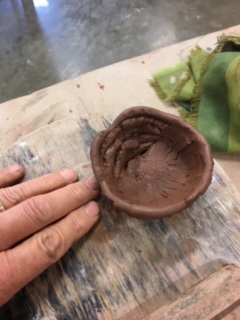 Dismal. In trying to make something small, I had something fiddly, and the techniques I hoped to use needed to be applied more delicately and with a more practised hand. A small pot became a pile of used clay and my ambition took a bash.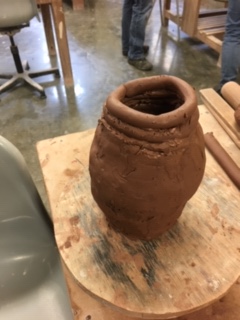
 watching our students or being observed by our leaders, and that is that we are less free to persuade ourselves “the children really love it” (or “won’t notice” in the case of baseline assessment) or “the students lap it up.” We are certainly much less able to disentangle ourselves from the learner’s impatience, or the sense of a desire to build the perfect pot (the photos show I didn’t quite manage this) – even the sense of envy or discouragement at the gorgeous things other people produce. And in Higher Education we might look again at our modes of assessment: writing at the same time as our students are on the essay treadmill we put them on is a revelation!

 I love the idea of children being outside; I am unhappy when schools are elbowed into making sure children do this, that or the other outside the school day. We are told – and it already seems a bit defensive to highlight this in
 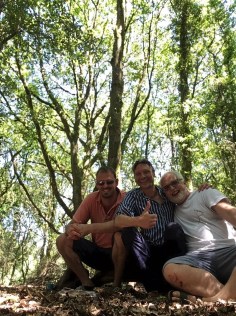 have sat in a local copse with a couple of mates and a beer… And this is all without mentioning my passion for exploring children’s literature and how it can represent the
  nicktomjoe