Alice

Some thoughts on Alice in Wonderland for the class Monday 16th August.
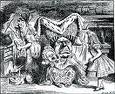
Tenniel Alice

Key to my reading – and it is only my reading – of Alice is the theme that runs through a lot of my thinking: exploring the models of childhood in literature.

Looking at Chris Jenks’  dichotomy:

“The Apollonian child, the heir to sunshine and light, the espouser of poetry and beauty…angelic, innocent and untainted…”(Jenks 1996:73)

“The child is Dionysian in as much as it loves pleasure, it celebrates self-gratification….”  (Jenks 1996:63)
Jenks C (1996) Childhood: Abingdon: Routledge

is Alice the barely reined-in Dionysian child, who, let loose in her dreams, finds her way home (to “dull reality”) by negotiating both models – in finding how to respond to the demands around her and stay sane – in other words, to grow up? Are we looking at some kind of spiritual quest for self-realisation?  We might object that Carroll did not intend this – but again perhaps looking at what an author intended in a  story made up just to while away an afternoon’s rowing is too fraught with difficulties. In any case, when Carroll is being didactic towards children – as in his Easter Letter – we know about it.

Of course the all-important commentary is the wonderful

Gardner M (ed)  (2000) The annotated Alice: the definitive edition. London: Penguin

There are  loads of other books, looking at Alice and Carroll biographically, from the point of view of psychoanalysts, logicians, mathematicians…  An interesting way of looking at Alice might be to consider her not in the context of Victorian literature (and Alice abounds with cross-references here) but to the folk-tale inheritance and to her influence in later children’s literature: there is something of Red Riding Hood in Alice, but her literary ‘daughters’ (in Oxford terms at least) include Lucy from the Narnian chronicles and (perhaps by extension) Lyra from Pullman’s His Dark Materials.   Is she also re-presented in the precocious Cordelia in Brideshead – or is the ‘secret door’ from Alice completely different for Sebastian and Charles?

For scholarship’s sake, I suppose I ought also to attempt a filmography, since my presentation makes mention of the Disney and Burton versions, but I haven’t time, since there are lots of others, too – a silent one from 1903 which I linked to here from YouTube being the earliest I can find.

And here, for what it’s worth, is the powerpoint:

Alice Worcester summer school


Please note that since writing the Disney and Burton clips have been removed from YouTube for copyright reasons. 

Kindergarten Graduation

The end of the year approaches, the first degree ceremonies are over in UK Universities – although here at Oxford Brookes the major push for such things is in Early September – and in a cycle that has something to do with saints’ days, something to do with harvest time and now a lot to do with holidays for students and staff, people move on academically. September sees professorships awarded, (with professors being given chairs, installed or just plain appointed ), and small children move from home to early education and daycare, from early years into Big School, and then in a very few years’ time from Key Stage 2 to 3, and so on.

It is interesting to observe that business is growing in the US and worldwide around graduating young children from their earliest educational experiences. One site  with the catchy but curious name of Rhyme University sells whole packages for gradation at affordable prices. The company’s website states that “we’ve been able to successfully grow from 121 customers in 1954 to over 20,000 schools worldwide.”

The “About Us” section has a telling story to set the tone about a child’s pride in a scrappy diploma, and notes that
“If early learning provided the keys to greater success later in life, then the transition from preschool and/or kindergarten should be marked with no less importance.”
Rhyme University’s deluxe package ($23.95) comprises a cap with tassel, a gown, a sash, a ring and a diploma.

While this site – Kindergarten lessons – seeks to minimize the ritual elements, this site is more specific about what graduation might mean and might entail:  suggesting that “[E] ach year of graduating from one grade to the next deserves a special celebration” and that this is “a time to honor their achievements, let them know they’ve done great work and have accomplished the goals of moving on to the next stage of life.”

And this leads me to the thought for the day: at what point is progression the same as graduation?

“Deep understanding is more important than superficial coverage.”

In one short sentence, the authors of this report on EYFS sum up so much.   Here I am, in a cold study with the snow pelting down and the light fading,  struggling with what to say about Early Years and Health, and they give me the answer.

Let them say it themselves, then – although the emphases and editing are entirely mine.

Enhancing children’s development is skilful work, and practitioners need training and professional support to do it well, including making decisions about children’s individual needs and the ways to ‘personalise’ their learning.

Talking about feelings has beneficial effects. Although this has been a self-evident truth for decades, new research on ‘Social and emotional aspects of learning’ for children shows how it benefits learners of all ages, even children under four.

Formative assessment will lie at the heart of providing a supporting and stimulating environment for every child. This may require professional development for practitioners and liaison with individuals and agencies outside the setting.

The art of early years practice is getting the balance right between guided and self initiated learning, either in homes or in settings.

Skillful work. Art. Balance.

The excitement of helping a child melt a handprint into frost.

Knowing when to swap the sand for cooked spaghetti, or to put a plastic penguin in a tub of water in the freezer for tomorrow.

And from the point of view of ‘health promotiong activities?’

Is the In Depth section for EYFS Health and Well Being really sufficient?

Profiles

There’s a mini learning journey for practitioners here.

We start off on the EYFS home page and click on profile. Hidden (far too well, really, as we come to expect live hyperlinks to look obvious) on this page is a link to the NAA work on the Early Years Foundation Stage Profile:  and in case they move it, here is the link as it appears at present: http://www.naa.org.uk/naa_17850.aspx

And here we meet Ellis and friends. This link takes us to Ellis and Ashton’s exploration of plans to build a spaceship, with windows, teleport (or lift; there is a professional disagreement between the two designers here) and a jumping device.

Their learning journey is made clear for us by the possible scale points which is downloadable, but it also made me think of the remarks of Margaret Edgington in The Foundation Stage Teacher in Action (2004, p158):

However intensive their study of children during initial teacher training, teachers still have a great deal to learn. Early years teaching is quite simply about studying and learning about children. There are two related parts to this study. First, teachers need to understand about children in general – ideally from birth until at least 7 or 8… They need to understand environmental, sociological and psychological theories in order that their view of society is broadened, and is taken beyond their own limited life experience.  They also need to know that individual children develop uniquely… Throughout their careers, teachers need to develop further their general view of children through the study of individuals. [my emphasis]

Hmmm.  Did I say a mini learning journey? It might be just part of the practitioners’ job, but I wouldn’t want to underestimate the task.

Coram Boy

Having listened to the BBC R4 dramatisation of the novel (not available for download) , I was intrigued to get the book for Christmas – after some very heavy hints, of course!

And this link will take any readers to Jamila Gavin’s own website and her thoughts on risk, creativity and education.  She is at risk of being accused of elititism when she writes

“I’m asking that we are more selective with what we give our children in school. We should recognize that, for a vast majority, it may be the only opportunity to give them contact with the finest achievements of many civilizations. I think a fear of “elitism” has meant that generations of children aren’t hearing the finest music, reading the finest literature, or being given access to the best of human achievement.”

But she does have a point, and  I feel Coram Boy is a work that in its bravery and clarity gives her the authority to talk about ‘the finest literature.’

Rose Review: Interim Report (first thoughts)

Better late than never, the interim report of the Independent Review of the Primary Curriculum is finally out. This link goes to the BBC’s reporting; this link to the page from which (until or unless DCFS move the URL)  the ipsissima verba of Jim Rose can be downloaded.
Provisional Recommendations 10 and 11 are the ones I was looking for most eagerly, especially after this morning’s reportage about key subjects &c &c. They are
Recommendation 10:
(i) Entry into reception class in the September immediately following a child’s fourth birthday should become the norm. The Review will explore how this might be achieved without unduly restricting parental choice, for example by allowing parents to choose a period of part-time attendance.
(ii) The DCSF should provide information for parents and local authorities about the optimum conditions and the benefits to children of entering reception class in the September immediately after their fourth birthday.
Recommendation 11: The Review will consider how best to support teachers and practitioners to provide effective play-based learning.

Hmmm. This seems to suggest that children will be in school – not nursery, where the quality may be seen to lie, but in Reception classes – when they are four and a bit. Le Roy le veult. So far, my mouth turns down.  However, unpacking recommendation 11 – “how..to support…effective play-based learning” is more encouraging. Into school with you, little child, and if your parents don’t like it, you don’t have to go all day, but there you will find play-based learning, as outlined by the best research.
I remain cynical about the will – and mostly the budgets –  of schools and the expertise of YR teachers  to implement this.  This isn’t to do down the commitment of teachers of young children, but to note that they continue to be faced with a continuing dynamic that looks to SATS looming (despite what the report has to say) and the demands for early, noticeable acquisition of secretarial and calculation skills, which simply raises the questions – deeply related – of funding, vision and qualifications…
And the question for us in ITT has to be: how do we train new entrants to the profession to bring this change about?  How do we help create EYFS teachers, rather than very early Primary teachers?

Two news items

Two stories arrive on my BBC news ticker tape this morning. Both would be worth a comment; together they are a perfect exemplar of how, as Carol Aubrey says, “children are at the nexus of power relations, policy concerns and value investments of home and school.”

The first item is a simple and depressingly familiar tale of how Church is seen – can be seen – as a showcase, in which children may be cute and decorative, “mild, obedient, good as He,” but shouldn’t be disruptive of adult business. Church is for grown-ups, and the power discourse suggests that either the minister (or celebrant, or president, or whatever) is doing something so special, so magic, that s/he cannot lose concentration, or that the Bride and Groom are so caught up in some soupy myth about weddings couldn’t possibly want to start their married life with the sounds of – horror of horrors! – children. Of course, these are extremes, and it’s possible neither of them remotely reflect what happened in this case. I want to think about this in the context of childhood, of course – but it’s also worth linking the story with another from the same local news site. Inclusion is a hotter topic all of a sudden – not just becasue of the gay/women Bishops debate in the Cof E, but also because the debate on how we include children and other disruptive elements seems to be cropping up elsewhere. How does the Church – how does anyone – value These People? Perhaps it is about marginalised groups struggling to find a voice after all.

The second story grabs headlines but I feel more ambiguous about it, if only because the clumsy reportage doesn’t do justice to the idea. This link goes to the actual report, at least. It looks at children not so much older, still in the Early Years community (if we can talk about such a thing) being given Shakespeare to read. Nothing wrong, really, except the overcrowding of the EY curriculum, until we read that a spokesperson for National Association for the Teaching of English is reported as saying, “the earlier children are introduced to Shakespeare the better.”

Hmmm. And I thought educationalists were growing out of that argument.