For whom do we write the (outdoors) curriculum?

Morey Schwartz asked in 2006 (J. CURRICULUM STUDIES, 2006, VOL. 38, NO. 4, 449–457) “For whom do we write the curriculum?” and proposes an interesting model around the “rehearsal curriculum:”

“The teacher finds an exciting blueprint in the curriculum that enables her or him to teach from a new perspective—something that could not have been possible without studying the curriculum. In other words, our ‘curriculum-users’ have become the actual ‘curriculum-receivers’. While the curriculum may be designed for students, it is the way that it engages and educates teachers that constitutes the key to its success…

“A rehearsal curriculum is written in a way that prepares teachers for the teaching experience by prompting them to go through the same process of learning that will be used in the classroom.”(2006:454)

I reflected on this as I walked up for my preparatory visit to Cumnor Hurst along the path beyond the campus.  Here are things the students might pick up; here are things I must warn them about; these are the affordances; these are hazards. In some ways it’s not that different from checking the provision in the garden at the start of the nursery day.

However, it has another side to it if we move deeper into the world of educational metaphor. My rehearsal curriculum not only entails a revision of my (self-chosen) learning tasks, for also all those previous rounds of reflection on outdoor learning, the sessions that have gone well, and those that have not – and why. Serious reflection does allow for what Schwartz calls “disjuncture,” and this can be a challenge to the educator (and I remembered the time the students were unwilling to walk any more than 20 mins from campus). This is in line, of course, with the kind of activity I might think of as a spur to quality reflection – and indeed is a point for reflection/evidence is the HEA/Brookes OCSLD audit I’ve been looking at today which asks me to reflect on “Successful engagement in appropriate teaching practices” – because for me, successful engagement isn’t about being a Superteacher (I have been wary of these since my PGCE nearly thirty years ago), it’s about knowing what goes well, what went well, and how it can be improved.

So there’s my first marker on the path: engagement is about reflection, not just delivery. What do the students pick up? If it’s about engagement at HE level, surely the picking up is partly an independent thing: they pick up what might be afforded by the learning, not the things I list.  Their engagement starts from the pact we make in teaching and learning. We engage together, and my “writing” a syllabus/curriculum for outdoor learning begins from this principle.
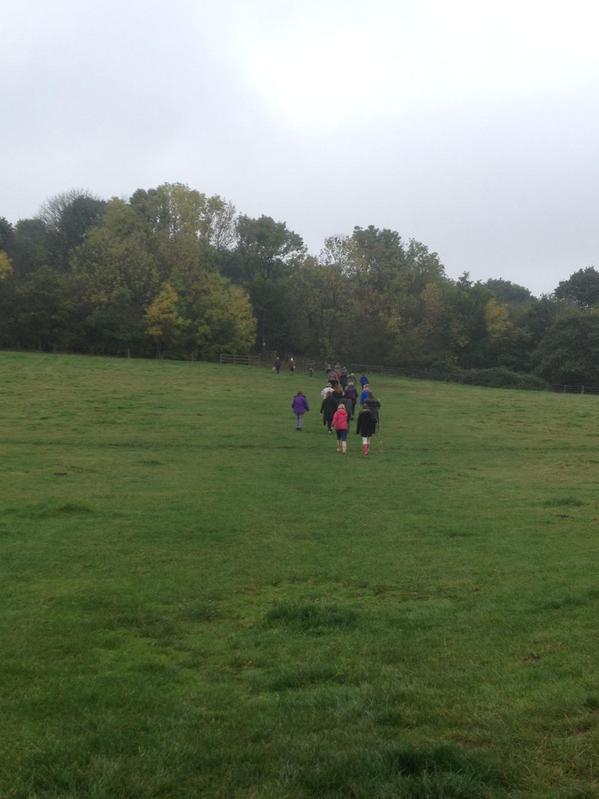
U70124 arrive at Cumnor Hurst

But if academics see themselves not as creators of syllabi or curricula but as consumers (as Schwartz is suggesting), then the whole process of module design takes on a new dimension. “Module design” is never a creatio ex nihilo; it never springs from nowhere, but has some important elements in its formation:

  • Context in terms of the academic project on a macro level: why University?
  • Content in terms of the local context: why this course? Why this level?
  • Content in terms of restraints – social; resource-driven; interest-driven.

And if we see module design as an iterative process, all three of these come into play each time we open up the module to redesign – termly/by semester, weekly, session by session.

Why is what I have planned for Friday worth thinking about for a University course? Why, for example, do we really not need pond dipping in the module? How do I keep the content of the module current (recent research, the ever-shifting grounds of policy, the constantly changing needs of different student groups), and how do I present the course at an appropriate level?  How (and I began to ponder this in the summer, under Strawberries) do I keep it current without jumping on bandwagons? Has the team got the staff, the kit, the environment it needs? Will the students “get something out of” the class? Will I? For whom do we write the outdoors curriculum – and do I include myself in the plan to learn? Engagement takes into account constraints and context as well as some nebulous “what I want to teach.”

If I follow Schwartz’ argument, the fact that I am asking these questions indicates I see my curriculum (if I can call it that) as a “rehearsal curriculum:” the challenge moves onto how I know I am learning, enacting the things I’ve been reflecting on: how do I ensure (although I dread the word) impact?

On that note of challenge or self-doubt, I’ll leave it there for now: I have a class to prepare for tomorrow.

PGCE Placement – a guest blog

Jen Day (who is to be found here) sent her PGCE students this message at the midweek for their first placement in School Based Training. Without saying much more than I love it, it is reproduced here without comment:

Dear PGCEs,

It’s Wednesday and, as I did last week, I thought I’d send you a few musings and well wishes. Today is 21/10/2015. For those of you who don’t know, this is the day that Marty McFly went ‘Back to the Future’ in the popular 80’s sci-fi film. As a result, I thought I’d take you back in time and tell you a story.

I would like to share with you my own first week on SBT1. I, like you, trained to teach at Oxford Brookes. I lived in the older Harcourt Hill halls (J block, my name is still graffiti’d under the stairs!)

I didn’t have a car, so for my first placement I got a lift with the lovely lady that I was paired with for placement. Let us call her Ethel for the purposes of this email. To me, Ethel seemed like a being from another planet. We had no common ground at all, or so it seemed.

Each morning Ethel would be waiting to pick me up in her car at 6.45am. On the first morning I overslept because I had been up late the night before panicking. This was not a good start. Ethel patiently sat outside peeping the horn of her ancient Volvo until I emerged from my student hovel, looking frazzled and dazed. Ethel liked to listen to Radio 4. She didn’t take kindly when I offered up my mixed tape of Spice Girls and Take That tunes (I did say we were going back in time!). The 45 minute journey seemed to take forever. I am embarrassed to say that I took a nap to avoid any small talk.

The first day went reasonably well. We met the staff, the children, the parents. There were so many new names that I felt like I had forgotten all of them, including my own. I was taught how to use the photocopier, where the art cupboard was and what time break started. I instantly forgot all of that too.

Ethel, on the other hand, forgot nothing. It transpired that she had worked as a Teaching Assistant before. She befriended the staff with ease, she knew tricks on the photocopier that even the school secretary didn’t know, and she took lots of notes in a little official looking notebook to help her remember things. On meeting the headteacher, I glanced at Ethel and thought that he may as well offer her a job on the spot.

By Wednesday my confidence was in tatters. I still couldn’t remember more than three of the children’s names (the good, the bad and the ugly.) I had forgotten to bring my teaching file in. I’d been observing the class teacher and thinking that I’d never be able to control the class like she did, or inspire them to do their best work. I’d been pouring over real lesson plans for the very first time, petrified by their length and detail.

The teacher called us over at the end of the day. “Tomorrow I think that you should both teach part of a lesson.” Ethel beamed. This was the opportunity she had been waiting for. “Ethel can lead a 15 minute maths warm up game, and Jen can lead 15 minutes at the start of literacy. We’re doing multiplication and fairy tales. Good luck!”

On the way home Ethel managed to come up with what seemed like 500 outstanding potential maths activities. “It’ll just be so hard to pick one” she trilled. I had nothing. Not a single idea. I got to my room, I phoned my Mum, I had a little cry. One of the other girls I lived with walked past my door and asked what was wrong. I told her. “Get over yourself, it’s only 15 minutes!”, came her comforting response, “Just do some hot seating. A little drama or something.”

And so I did. Hot seating with Red Riding Hood and the Big, Bad Wolf. I found some props out of the Halloween outfits belonging to my flatmates. I practiced my Big, Bad Wolf voice in the mirror. I wrote a hugely detailed lesson plan. On reflection it was way more detailed than you really need for 15 minutes, but I wanted to do it right.

The next day my lesson starter went down well. The children behaved. They listened. They laughed. I was elated. I could do it! What’s more, I really enjoyed those moments talking to the children and finding out what they knew. This teaching lark was quite addictive.

In the car on the way home I was absolutely thrilled. I couldn’t wait to teach a whole literacy lesson the following week. The teacher and I were to plan it together the next day based on some of her plans from the previous year.

Ethel parked the Volvo up by my halls and I was taking off my seat belt when suddenly she burst into tears.

“I don’t think I can do this!” she sobbed.

I was aghast. But Ethel, you’re amazing at this already and it’s only day four.

“The children didn’t laugh in my maths activity like they did in yours.”

But, Ethel, in your lesson they actually learnt something new! I’m not sure they learnt anything in mine, for all that they enjoyed it.

“The children like you better because you’re younger than me and you understand what they’re into.”

But, Ethel, I am absolutely terrified of the parents and the other teachers. It doesn’t really matter that I know what music the kids are into.

“You never have to take notes like I do, you just seem to remember everything!”

But, Ethel, I haven’t remembered a thing! I just keep asking questions of the three kids whose name I know. Half of the time I’m acting confident because I’m scared that someone will spot that I’m not good enough.

“When we met the headteacher I’m certain that he was thinking that he’d give you a job in the future.”

But, Ethel, I was thinking exactly the same about you.

We had a hug. We resolved that we were in this experience together. We acknowledged our different strengths. We promised to support one another in our weaknesses.

It turned out that me and Ethel did have things in common all along. We were both anxious about passing the placement. We both wanted the teacher to be impressed and for the children to like us. We both wanted to get a job at the end of the course.

We both loved teaching, we just had different styles. And that was ok.
So let’s go ‘Back to the Future’…

Ethel is a Head Teacher now, and she’s amazing.

You’re going to be amazing too.

Your experiences won’t be exactly the same as mine, it is likely they will be very different. But please remember this. Comparing yourself to what you think another person is like by watching them, comparing your day to a snapshot of someone else’s day on Facebook or Twitter, comparing yourself to someone with different life experiences will only make you glum. There is only one you. As Oscar Wilde said ‘be yourself, everyone else is taken.’

My Brother Esau

Over a first coffee, I was challenged this morning (this is why I love my job) about whether I would accord some kind of race-memory to the notion of the wild man. I am not at all sure we can go – at least, I am not sure I can go – too far down the Jungian byways here.  Forth, in Images of the Wildman which I discussed yesterday (and where I first encountered the word glabrous used of a human rather than a plant), argues that wild man images obscure our own visual methodology of early modern humans and non-European peoples. What we can be sure of is that earliest writings that still have (or, until recently, had) currency in defining such things are clear about body hair (see below). There is, in addition, already a body of archaeological evidence on how hairy first peoples in Europe were, elegantly and delicately described by Chris Stringer, in  Ch 6 of Origin of Our Species, and of whose deeper research work I am not a competent judge (although the relevant paper he cites by Reed et al has such a great title I had to include it: see below).

Sneaky-Is-Best leader (up there with many-scheming Odysseus) is the patriarch Jacob, who in Genesis 27 cheats his hairy brother out of a blessing. He is a smooth operator in many senses of the word, and hairy, stupid, red-faced Esau is invariably the loser in the aetiological stories of the sibling rivalry. While it would be nice to claim that this myth has about it the bones of a story about Homo Sapiens out-competing other hominins, we can’t do it: too long a time frame between history and the development of myth must exist, tempting though it might seem with Stringer’s account of the archaeology of the Middle East, and to suggest that the Wild Man stories give us Sasquatches and Big Bad Wolves takes it from improbable to impossible.

So we must look for a simpler explanation of the lure of hair and wildness.  All I think I’d really be prepared to do is to blame puberty and the individual differentiation that it brings. “We” (and there’s a whole argument to be looked at about who “we” are, from when to where) look at one another, recognise one another by all sorts of things and facial hair (and/or maybe body hair?) is part of this. And then we look at other animals – ones we eat or live with or compete with – and ask “why is Esau growing to look like a goat, a wolf or (in modern, maybe more positive parlance) an otter or a bear?” And there it is: we don’t need hairy Neanderthals loping inexpertly through the woods, or massive Australopithecene Yeti to make a link between the hairy human and the animal, although we might, as a sort of back-fill of an argument suggest that connection.

But I still want to know: never mind the body hair, why does our head hair grown and grow? Oh dear, RRH has started looking like Rapunzel.


Forth, G (2007) Images of the Wildman Inside and Outside. Folklore Vol 118 (December 2007): 261–281

Reed, D et al. (2007) Pair of Lice Lost or Parasite Regained: the Evolutionary History of Anthropoid Primate Lice, BioMedCentral Biology, vol 7.

Stringer, C (2011) The Origin of Our Species. London: Allen Lane

What to do with a Big Bad Wolf 12:00-13:00

Apparently the talk didn’t go too badly – it certainly was well attended by many admired colleagues from admin and teaching/research teams as well as some amazing visitors.
Here are the principal ideas, anyway:

There are multiple versions of the story of Red Riding Hood, from the “original” (which isn’t original at all), complete with Woodcutter and everyone (sometimes even the Wolf) living happily ever after. This story is very effectively explored in Jack Zipes’ The Trials and Tribulations of Little Red Riding Hood.
What if she isn’t little?
What if the wolf isn’t a wolf?
And why does this story have such an appeal?
I cited Zipes (2012:21) “A simple, imaginative oral tale containing magical and miraculous elements…related to the belief systems, values, rites and experiences of pagan peoples,” and suggested that the story has a strong, if obscured, ritual element to it, and maybe this has links to the kind of woodland initiation rituals in W Africa: it could be the story of a rite.
Red Riding Hood can therefore be read as a risk story with ritual elements way beyond the immediate, with a population of marginalised and dangerous characters.
In the tangled roots of this forest (“Stumble trip, stumble trip”) there are wolfshead-men, witches, the only half-forgotten memories of sacrifice, and the never-to-be-forgotten lesson that
SNEAKY IS BEST

I hope this makes sense. The “Jack Zipes’ schtick” is appropriately acknowledged (see reading, below) but I wish I could have said more about:

  • The wargus and the homo sacer
  • Liminality and the medieval settlement
  • Paganism and the Wild Man.

Too many ideas to cram into a lightweight lunchtime.

Cosgrove, D. (1982). Social formation and symbolic landscape. Madison, University of Wisconsin Press.
Forth, G (2007) Images of the Wildman Inside and Outside. Folklore Vol 118 (December 2007): 261–281
Jarvis, P (2009) Play, narrative and learning in education: A biocultural perspective. Educational & Child Psychology Vol. 26 No. 2: 66-76
Rosendale, S. (2002). The Greening of Literary Scholarship: literature, theory and the environment. Iowa, University of Iowa Press.
Zipes, J. (2012) The irresistible fairy tale: the cultural and social history of a genre. Princeton, N.J.: Princeton University Press
Zipes, J. (1983) The trials and tribulations of Little Red Riding Hood: versions of the tale in sociocultural context. London: Heinemann

In my personal opinion, I feel

A particular bugbear stands at my shoulder, and I can’t do much more at this stage than warn the unwary. Here be dragons.

Consider this paragraph:

In my opinion, when children play outdoors they are getting a lot more out of it than just exercise. In fact, Louv (2006) goes so far as to state that this is a “nature-deficit disorder” (2006:8). I’m not sure I would call being outdoors “Nature’s Ritalin,” (2006:103) but it is really fantastic to see children allowed to be hyper outside and come in calm for work.

OK, it’s a compilation of three different (not very successful) essays which discuss Louv’s ideas.  The problems are highlighted (yes, really: but highlighted really means “marked with a highlight,” not just “stated”) here:

In my opinion, when children play outdoors they are getting a lot more out of it than just exercise. In fact, Louv (2006) goes so far as to state that this is a “nature-deficit disorder” (2006:8). I’m not sure I would call being outdoors “Nature’s Ritalin,” (2006:103) but it is really fantastic to see children allowed to be hyper outside and come in calm for work. So, when Vygotsky tells us “play is  the source of development,” (in Wild and Mitchell, 2007: 106), and Bruce (1991) talks about a high-level play that assists developing child, I think that play should be seen as the motivation that allows learning  &c., &c.

Let’s take them one-by-one:

“In my opinion” and “In fact” are simply not needed. They are colloquialisms that fill up the void when we talk but have no real place here.  “I’m not sure I would call being outdoors…” shows that the writer, having been allowed to use the first person, is allowing her/his own voice to dominate – see the final sentence. “Fantastic” is weak, but stems from the pervasive colloquial tone, as does “hyper,” which is fake-medical and inexact. The final sentence  shows that the writer has allowed her/himself to slip into the false thinking that this debate is happening entirely within their own frame of reference, that their judgement trumps a major theorist of the past and one of the present. Vygotsky is one voice, Bruce is another, “but I think….”

This requires us to take several steps back – to the start of preparing for the assignment, where reading, not opinion must take precedence.  I read an essay like this and think “If I were you, I wouldn’t start from here.”


Red Riding Hood’s Reality Check

I’m due to give a talk next week, and someone – not unkindly – asked if it would be my “Jack Zipes Shitck.” And actually I’m rather hoping not. What I will be doing is looking at

  • Werewolves – and why children are still scared of wolves in England
  • Red Riding Hoods – and why authors and illustrators love them
  • The Great Wood – and why it exists in our minds (hearts?) if not for Ordnance Survey

So, Jack Zipes (see his work here) and Perry Nodelman (here’s his enviable staff page) will hang over this as my tutelary spirits, but I hope, even in something fairly light, to go deep into the dark wood.

And out.

In an hour.

National Poetry Day – one of mine

The Bodleian: Do vobis potestatem legendi
for Rick

No sacred space this:
Theologies of the unspeakable are the subject of catalogues.

Reverence gives way to reference, here
factories of readers assemble intricacies,
spirals of exposition, circuits of illumination,
gardeners sweat composting arguments
lay slabs of authors,
the architects of bibliography
balance cantilevers of dispute,
and in the dim carrels of dark wood
wide lands are scouted by hunters shading their eyes,
stalking prey across the savannahs of paragraphs.

Polonius

It is always a bit tricky to give people advice when they start a a new venture. It is parodied in Hamlet (Act 1 sc 3) like this:
And these few precepts in thy memory
Look thou character. Give thy thoughts no tongue,
Nor any unproportion’d thought his act.
Be thou familiar, but by no means vulgar:
Those friends thou hast, and their adoption tried,
Grapple them unto thy soul with hoops of steel;
But do not dull thy palm with entertainment
Of each new-hatch’d, unfledg’d comrade. Beware
Of entrance to a quarrel; but being in,
Bear’t that th’ opposed may beware of thee.
Give every man thine ear, but few thy voice;
Take each man’s censure, but reserve thy judgment.
Costly thy habit as thy purse can buy,
But not express’d in fancy; rich, not gaudy;
For the apparel oft proclaims the man,
And they in France of the best rank and station
Are most select and generous, chief in that.
Neither a borrower nor a lender be;
For loan oft loses both itself and friend,
And borrowing dulls the edge of husbandry.
This above all- to thine own self be true,
And it must follow, as the night the day,
Thou canst not then be false to any man.
Farewell. My blessing season this in thee!

and it would be possible to give similar advice today (I come close  to it in my previous post). How do you get on with other people as a young person in an unfamiliar environment? Polonius’ threadbare advice is to make and keep friends; dress well but not showily – and keep to your budget – and if you get into an argument make sure you win. Is this really the advice we’d want people to get as induction activities start at Brookes and elsewhere?

There’s an interesting look at this in Dave Aldridge’s blog which in turn cites this paper by Simon Edwards from Portsmouth. It might be about “academies” rather than “The Academy” (ie University), but has this interesting statement:

Relationships were viewed as a collaborative project where particular practices and attributes were valued as supporting the development and managing of relationships.

Relationships are collaborative. In University this is true, too: groups are set up and worked at by lecturers, and by students, too; but they are to be worked at (worked at by staff and students: this is not one of those “Ain’t this cohort dreadful?” posts). The writer goes on to suggest that

the task of everyday life in the school classroom for these young people was to bridge the gap between individuality, which was their fate and the practical and realistic capacity for self-assertion, which for them was located in collaborative relationships. Constant testing of relationships was critical to in order to orientate the self-project within relationships where there was no original self and no authentic representation of this original self. Therefore maintaining the flow of relationships and the narrative was more important than the space in which the young people occupied.

In looking (as we are this year) at the ways in which we can support well-being in the University (without losing sight of other critical parts of the task of academia), we need to look at the ways in which we demand academic probity, writing skills and effective relationships all at once from students – and how the successful student is very often the one who can manage the adult relationships (student-tutor as well as student-student) in such a way that there is an “authentic representation of this original self” – other words, as one Polonius-like figure told me before I went to University in the 70s, “Don’t be in a rush to become someone else.”

He had a point: relationships – positive ones – sustain and challenge. If we encourage effective working relationships between students and between students and staff, this has to be on a basis that we are all, to some extent, ready to “be ourselves.”

That’s a big ask for any of us.

First Year, First Semester

The start of the new year in a new institution is always, frankly, scary for some people. Here are some thoughts – and a possible timetable for Early Childhood Studies students at Oxford Brookes.

Practicalities are sorted here  for the most part. For ECS here is your main page.

Accommodation: this is worth a look if you were not allocated Halls this semester.

Bigger Questions: the “Will I fit in?” “Can I study at this level?” questions are harder to deal with.

Will I fit in? I almost want to say “no” – at least, not at first. The day you arrive you will probably not feel or look like a confident human being – and those who do may be putting a brave face on it. Because that is what we all do: we breathe deeply, we smile and we say “Hi, my name is….” Go for it. Fitting in follows. 

Can I study at this level? Hmmmm. Unpacking this question might take you until the day of your graduation. All I can say is that we wouldn’t have accepted you if we didn’t believe you could, if we didn’t think you’d be fine, and if we didn’t think the course could cope with you. There are all sorts of ways this first semester will challenge you, and the step up from your previous study is undoubtedly one of the biggest. 

  • Talk to tutors: that’s what we’re paid for. Early Childhood students have the opportunity to meet most of the tutorial team in modules in the first semester and if the answer isn’t obvious in your course or module handbooks, try the tutors!
  • Use the library: reading – and the thinking that goes with it –  is not a hobby, but integral to getting it right. But don’t be afraid to learn news skills: better note-taking, selecting the books to read. The library is a helpful place.
  • Use the University support systems: they aren’t add-ons, but part of your entitlement, from the SU to UpGrade. And above all don’t forget your Student Support Coordinator.
  • And of course talk to each other, to your course reps, to second and third years.

I could fill up page after page of things to do and not to do, but you will get it right (and sometimes wrong) and it will all be OK, so I won’t go on. Instead (back to practicalities) here is an indication of the modules ECS students will study up until Christmas.

*Mon 9:00: U70103 Families, Culture and Context

*Tues 1:00U 70110 Studying Early Childhood (double: Semesters 1 and 2)

 *Thurs 1:00 U71703 Introduction to the Study of Education

You might also choose U71701 Constructions of Childhood (Weds 1:00)  and  U71705 Education and Childhood through Film and Literature (Thurs 9:00) – but of course there are lots of other choices too. The compulsory ones I’ve marked with an asterisk * and we can (and will) discuss the choices you make. The only caveat I’d add is that attendance at classes isn’t all there is to do to be successful; out-of-class private study is key. As I said a bit earlier; your reading (and thinking) is key, and should take in far more than just getting the quotations as you  struggle to complete an essay. 

We are genuinely looking forward to seeing you: enjoy the start of  September, and we will meet up very soon.

Transcription

Today’s incident about Biscuits raised an interesting issue about transcription. It’s clear as you read it that I’ve clarified the diction – but what convention might I employ to be absolutely clear about what has been said: “G’an’pa” for “Grandpa,” or “in a post” for “in the post”? When I write “What in the parcel, Grandpa?” it’s not really what I heard – but might I have written “What‘s in the parcel” when there was no “s” and therefore no clear use of a verb? Where does interpreting stop and editing start?


I also feel I have to point out that this particular observation is simply posted because I have really no idea which mental gears were crunching for Ivy to get Biscuiteers and make (perfectly reasonable) sense of it as Biscuit Ears.

Plus it’s astonishingly cute.