Using Children’s Literature

I need to preface what I am going to write here by saying that I know that adults read for themselves or for children for a wide, wide range of reasons, and that the key reason why many of us are involved in children’s literature is at its heart pedagogic: we read because we want our students to appreciate our passion, whether they are three in nursery or thirteen in secondary school or training to be teachers or established teachers exploring at postgraduate level. I therefore do understand why teachers ask “Is this suitable for Y2s?” and “Could I use this with the Y7s?”  It’s just that this is not where this blog post is starting from.

If we think about literature at any level – let’s say a hard-but-marvellous book like Tristram Shandy, or the much-loved Rubaiyat of Omar Khayyam – we are confronted by questions like

  • Do I understand this?
  • Does it teach me anything?
  • Does it give me pleasure?

before (or alongside the moment where) we move into questions such as

  • What does this text tell us about the historical context of its composition?
  • How does the author use language to convey character?
  • Does the narrative structure (or lack of it) illuminate something about the writer’s ideas?

It is true, it seems to me, that the thoughtful reader moves beyond what Bachelard calls “sentimental resonances” produced by text or image.  It may be that what Chambers (and others, standing on the shoulders of giants) suggests about developing a community of readers is partly about moving beyond the simple pleasure to the more analytical or critical joys of exploring text and design and language and… and…  I find myself getting lost, or maybe I just get the feeling it would be good to come to something of a critical approach, the single, sharp insight on what Children’s Literature is and does, a spearhead.

When I look (as I often have done; as I am doing this evening) at Rob Pope’s English Studies Book, I wonder where Children’s Lit fits into the complexity of English Studies. Are we looking at close reading, with the text-centredness also taking into account the hand-in-hand nature of image and text in picturebooks where it might need to? Are we, as critics and consumers, reading a culture and doing so by consuming a cultural product/object? Do my gender/sexuality, ethnicity, culture come into play? Just as Pope suggests “No-one has a single, pure and fixed position.”

And here we are at the nub of the issue. Not only do we as critics not have a single apparatus to wheel in to view Children’s Literature, it may be that we cannot view Children’s Literature , in all its complexity, as a unified subject for discussion. Can we really look at The Secret Garden as part of the same phenomenon as Revolting Rhymes simply because they are both accessible to Primary-aged children? We might follow Tolkien though his themes such as Escape and Fantasy and see recurrent themes, but how much are these really uniting Elphinstone’s Sky Song with the Rosen/Oxenbury Bear Hunt or The Children of Green Knowe with My Father’s Arms are a Boat? Am I trying to make a unified subect because working with children by sharing books (or working with people who will work with children sharing books) is somehow more straightforward than facing complexity?
elidor6

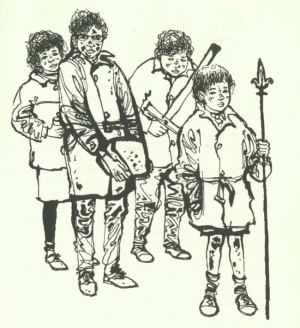
Let me come back to spearhead as an interesting image. It reminds me (for some reason) of the spear hefted by Roland, one of the children in Elidor (Jake Hayes’ blog is a beaut) – and that took me further, to Charles Keeping’s image of the weary children – and that took me in turn to the four gifts the children have entrusted to them: spear, sword, cauldron and stone.  While I’m not suggesting that Garner has consciously presented here an allegory of lit crit, it does strike me that these four treasures (in all their C20th grubbiness) can be asked to stand for the notion that we need more than one thing to preserve the magic, to allow for the critical-but-not-dismissive/destructive eye. The close reading of one reader; the eye to sources and history from another; the pedagogic “Can I use this for my science project?” or”we’re doing fairy tales, where should I start?” or “where is the vocab I need to teach?” of others.  Maybe we need them all, the field is so diverse.

Adults and children read for a wide, wide range of reasons; we enter not a single section of a bookshop, but a richly unfolding section upon section of fantasy, pathos, travel, speculation, high adventure and myth. We call it Children’s Literature when really it might at least have a  plural. “What are your researching, Nick?” “Oh, Children’s Literatures.”

And now I have lots more to think about.

*

Bachelard, G (1958, translation 1964) The Poetics of Space, trans Maria Jolas. New York: Penguin USA

(I am indebted to Nikki Gamble for discussing Bachelard on Twitter and moving me to explore his work)

Chambers, A (nd) Booktalk http://www.aidanchambers.co.uk/booktalk.htm and The Reading Environment http://www.aidanchambers.co.uk/readingenviro.htm accessed 29.10.18

Halford, D and Zaghini, E  (2004) Folk and Fairy Tales: a Book Guide. London: Booktrust

Lesnik-Oberstein, K (1994) Children’s Literature: Criticism and the Fictional Child. Oxford: OUP

Pope, R (1998) The English Studies Book. London: Routledge

Tolkien, J  (1964) Tree and Leaf. London: George Allen and Unwin
 

How Dead Are the Dead?

In the great story of Funnybones we are confronted with an unheimlich narrative. Three characters go for a walk, play on the swings and go home – but there’s a problem: they are dead. Or are they? They are skeletons, certainly, but they have emotions, thought, language, relationships and in any case we are told explicitly that

On a dark dark hill there are was a dark dark town…
and in the dark dark house there was a dark dark staircase
and down the dark dark staircase there was a dark dark cellar
and in the dark dark cellar …
some skeletons lived.

The nub of my argument when I talked in the Brookes Hallowe’en Seminar was that depiction of “real death” is sometimes avoided or underplayed, although this is changing.  The comic misunderstanding of the skeleton in the park requires however at least some knowledge of what a skeleton is.  It comes back to the time (maybe 1993) I read Funnybones in nursery, with animal X-rays darkening the windows,  and as I finished  (“…some skeletons lived….THEY STILL DO”) the X-rays with perfect timing slid from their places and we all jumped.  Death as comic – but also as unnerving.

In Funnybones the dead are hardly that unnerving. A big skeleton, a little skeleton and a dog skeleton are identifiable as a strange sort of being: nocturnal, with a clear mission to frighten people, but not dead, really, and if undead then hardly George Romero’s Night of the Living Dead.  But they have accidents, experience disappointment, and are warm towards one another. In the disjuncture the reader sees not only the scarily unfamiliar, but also the very famliar, a family unit out with the dog.  Their silliness reminds me always of the “gurning to camera” of the third skeleton in the C14th  De Lisle Psalter, Arundel MS 83, f. 127v, blogged about (with a great illustration of the grinning skeletons) by the British Library here. But while in “The Three Living and the Three Dead,” the skeletons meet the living princes to “admonish them to consider the transience of life,” in Funnybones we are with Gilbert and Sullivan finding that “we spectres are a jollier crew than you, perhaps, suppose.”

To understand what is going on here, we can refer to Gillian Rose’s visual methodology:

  • What is being shown? What are the components of the image? How are they arranged?
  • Is this a contradictory image?
  • What knowledges are being deployed?

This has come up before (it’s a shame that the new blog hasn’t preserved the images) and formed the backbone of the talk I gave a couple of years ago on the visual methodology of death. It is also pertinent in the run up to Hallowe’en: again something I have discussed before.   What is being shown is a family out for a walk – or three animate skeletons on a (rather unsuccessful) scaring spree.  In the same way there are complexities in the folk tale of the Teeny Tiny Woman who is compelled to give back the bone she finds in a graveyard. The sheeted figures who look on in horror as she pillages a bone for her supper (what on earth is that about?) require their bone back.   They are not, initially, menacing: they are being menaced by a cute little old lady. The comedy lies in the contradictory imagery, with the knowledges being deployed being rather complex.

The Teeny Tiny Woman, Funnybones; these will do for now. They draw on the flwing sheets of M R James and the earlier shrouded corpses. But of course children do know skeletons – museums have them; dinosaur fossils have them; we (and this is a bit of a shock: see this brief observation) have them. And in Funnybones we are invited to see with T S Eliot’s Webster  “the skull beneath the skin.”

There are other ways children see death, of course. Children’s Literature does well to represent a number of aspects:

  • In The Scar we deal, heartbreakingly, with real death – but the dead mother is unseen: her absence is the key act in the story.Dad said “She’s gone for ever.”I knew she hadn’t gone, she was dead and I would never see her again.’This story is not alone in looking, not at death, but at bereavement, just as the heart breaking Sad Book depicts the death of Michael Rosen’s son Eddie as a blank page, a gap in the history,  loss. He is drawn very much alive – and then not seen. A kinder view than the medieval skeletons? Or more shocking?
  • In Badger’s Parting Gifts, on a different tack we are invited to see the actual moment of Badger’s dying, going down into a long dark tunnel with no fear or pain.  Yet even here the dead Badger is not depicted.
  • In Death Duck and the Tulip (when I’ve talked about this the most divisive book choice), Duck recognises Death and they are friends – of a sort. Death here is close kin to the medieval Death the Reaper, or the three dead mentioned above, and maybe there is a message here of living life to the full and accepting our mortality that is not far from Arundel MS 83…

A conclusion to all this? No, there isn’t one.   Writing about death finds a number of ways to lighten the message – comedy; the sidestepping of the dead body (not always: Sydney Smith does so well (gently but clearly) in Footpath Flowers); using animals instead of humans – but increasingly these are not hard and fast conventions, and I predict we will see more imaginative ways to deal with letting in the dark and the dead into children’s literature.


Ahlberg A, Ahlberg J (2010) Funnybones (re-issue ed). London: Puffin

De Paola T (1985) Teeny Tiny. Oxford: Oxford University Press

Doonan, J (1993) Looking at Pictures in Picture Books. Stroud: Thimble

Erlbruch, W (2008) Duck, Death and the Tulip. Wellington: Gecko

Lawson, J and Smith S (2015) Footpath Flowers. London: Walker Books

Moundlic, C (2009) The Scar. London: Walker

Rose, G (2007) Visual Methodologies (2nd ed). London: Sage

Rosen, M (2004) The Sad Book. London: Walker Books

Varley S (1985) Badger’s Parting Gifts. London: Picture Lions


Students as Advocates

I warn my Outdoor Learning students that the assignment is not

  • Ain’t nature a hoot?
  • Why I agree with Nick
  • Children are precious because

and faced with articles such as the ones they have been reading (at my suggestion) they have a bit of an uphill struggle. They look at Helen Little, Sara Knight, Kathryn Solly and see researchers and advocates whose view is already (often but not always) that outdoors is a good place to be. I have a problem here, when I teach: I think so too.  This is in some ways the tightrope all educationalists walk: how to create a class where debate is encouraged but where passion is also allowed? Do we reward passion? Do we reward advocacy? Can we distinguish academic argument from a passion which sustains practice?

I am currently in the cycle with both my Y1 students and my mixed group of Y2s and Y3s where we are outside. Tomorrow morning the Y1s are in the woods with me, as I’ve done before; we may light a fire.  We are fortunate this year that the weather has so far been  glorious, and that walks and sand play and mud play have been embraced (again, so far) wholeheartedly. Years ago I took the view that I would not assess the play of the students, but that they would create a short written piece on their outdoor experiences. With this I step back from being someone coplaying or directing their play or commenting on the homes they have made for the cuddly toys or how challenging it’s been for them to get their hands dirty: I will read their reflections on what worked and didn’t work, and how that links to or contradicts what they have read at a later time. Some will say they “had a great time” – and I may be chilly enough to suggest they step away from the colloquial; some will say they felt it was a waste of time – and I will look and see whether they have made a good enough case to support this. What I hope they will avoid is telling us things such as “It was brilliant” or “boring” without thinking about why, and without exploring the feeling (or the argument) from all sorts of sides.

One of my favourite Grademark markers is one I created called “Not sure if I agree but…” and says “Not sure if I agree but it’s an interesting point. A good essay isn’t about finding ways to agree with your marker anyway.”  So what is a good essay? The dullest answer is to pull apart the kind of generic criteria Brookes and other Universities might use: Knowledge/Understanding; Reading; Synthesis and Evaluation; Standard  of Written English.   And with that ind of scaffolding we can stay safe with our QA guidelines and say this module or that is assessed against something tutors have written as a breakdown of general expectations  to something more subject specific. What does an Outdoor Learning essay look like if it shows good understanding of the subject? How much reading is enough? What the heck is synthesis? This is what we spend a lot of time on as the semester progresses.

So it is possible to read something from a student where they ask if risk is a good thing or not – and provided they make a good case for their argument, I will go along with it.

However, there is another side to all of this. The temptation in Higher Education is sometimes to assume that undergraduate work is the same as postgraduate work and that is the same as doctoral or postdoctoral study or publishing. In this model, the Y1 historian (or linguist, or educationalist) is up for creating something that in 20 years time they will look back on and say “Did I really think this? My recent paper suggests I have moved some way….”  but certainly for the educationalist or an undergraduate in a practice-facing module there is a much more urgent set of questions:

  • How useful is this?
  • Will what my tutor says carry weight in the classroom?
  • How do I make a case for doing this or that?

in other words

How is this course making me a better practitioner? 

img_0641

I would argue that fire making, or sitting quiet in the woods (or whatever) has a potential to be transformational – and at the worst has the potential of breaking up a course of book-based and class-based study with something that is a different sort of challenge. The tutor writes the curriculum (here is an earlier reflection) precisely so that we can…

…sit, perhaps ambiguously, between the placement modules and the theoretical. What do we mean by challenge, then? Is there a difference between academic challenge and physical challenge? Between physical challenge and overcoming resistance?

(As I’ve suggested before in discussion of the challenge in an academic course in Outdoor Learning)…

Because the challenge is complex.  I am asking the students to do stuff practically that they may take into a setting; I am also asking them to inform themselves, coolly and reflectively, so that when the time comes for them to be advocates they are informed and well as skilful, sharp-eyed for silly arguments as well as practical in the application of their ideas. They cannot be consistently good advocates without a criticality that lets them avoid arguments with holes in.

Enthusiasms will only take them so far; to be advocates for young children learning in the outdoors, they will need to being up arguments from research that checks the methodology; few of them will become academics, but any of them in educational practice (and maybe the fragile world of Early Years especially?) will need to read widely and keep current; they will need (as I hope we will all experience in the morning in the Harcourt woods) to draw breath and look at the sun in the pine trees, or listen to the peeling cry of the Red Kite. They need all these things together for the grey day when no colleague wants to go outside, or a child’s desires for a particular way of pretending have been hard to understand, or a parent doesn’t want their child “wasting their time playing.”

Yes, the challenge is complex. Maybe my task is to ask them to walk the tightrope.

A World We Feel at Home In

It seems odd – maybe contrary to some netiquette that forbids self-publicity – to repost a blog, but with Dave Aldridge‘s appearance to discuss remembrance in Cambridge (and in general) still very current, I want to return to the noxious growlings of Gove against “Blackadder history” and how I looked at this in a blog post earlier. Here it is, with its warning that “it is not only ancient history that makes myths.” This isn’t really about Gove, or the trenches, or the youths who will dress up and march in streets and square next month, but about how we seek to mythologise bloody episodes as part of our story of belonging. Glorious victory at Rochester, Brunanburh, Hastings, the “famous victory” at Blenheim,  Prestonpans, Amiens and the Somme , the Baltic? Which is the most relevant now?  How do we use these stories? Is Hastings an awful warning about the dreadful continentals or a defining moment in land ownership and language? Is the Somme a warning never to trust politicians’ manipulation of the people or a blow for the freedom of Europe?

Yesterday was the 84th birthday of the great Alan Garner, and as I look at his work, and mindful of my blog post on fiction, memory and Roman Britain, the work of Rosemary Sutcliff, and then think of the Battle of Hastings, remembered last week, and the battles of more recent times we celebrate (is that the word?) in the Remembrance season I think I want just to add some of his thoughts on memory and landscape from The Voice That Thunders. In the first section, from the essay “Inner Time” Garner looks bleakly at the American myth, contrasted with his vision of Europe where myth is richly layered:

Man is an animal that tests boundaries. He is a ‘mearcstapa,” “boundary strider,” and the nature of myth is to help him understand boundaries, to cross them and to comprehend the new; so that, whenever Man reaches out , it is myth that supports him with a truth that is constant, although names and shapes may change… The Biblical, the Epic, the Romantic, the Gothic are all merestones, boundary markers, of their day and the pointers of ours. Three hundred years ago, the mystery was in the greenwood; last century, the nearest grave; now the nearest galaxy…

And then in his essay on Strandloper, he returns to his task in celebrating the autochthonic ideals of language and people and history in the First Peoples in Australia and in his native Cheshire:

[I have been trying] to celebrate the land and tongue of a culture that has been marginalised by a metropolitan intellectualism, that churns out canonical writers…who draw on the library, ignorant of the land; on the head, bereft of the heart. For true reading is creativity: the willingness to look into the open hand of the writer and to see what may, or may not, be there…

Garner has the energy, skill and creativity to be the offerer, the writer who presents us with ideas and wisdom and myth and legend.  Perhaps I was wrong in my earlier blog to have thrown all of this into a store room full of the “chill of secrets;” maybe the fiction writer – and the Remembrance marchers and the people protesting – is looking for the defining myth still. Just as the people recovering from the 1914-18 conflict rediscovered land and landscape – returning to a mixture of visions of pastoral and homes fit for heroes  – maybe the scambling and unquiet time we are in demands of us a new view of what we mean by “home” and a world we feel at home in.

The trouble is that myths are always shifting: flora changes on the Cheshire hills of Garner and the borders of Sutcliff; we need to read our landscape as closely as the text an author proposes –

The pity is that idiots have driven a chariot of the gods through the great wonders and the true mystery.

Honesty, dialogue, cooperation – and cheating

Referencing is a chore.  Software does help, and guidance from tutors can sometimes support the student, but actually getting the info all in the right order and the right stye is a bloody pain. Especially if the threat of being “done for plagiarism” hangs over the writer. I’m not talking here about the parasitic cnuts who will write an essay for money, or the weak mate who will lend you their essay; I’m thinking about how we stay honest about our ideas and where they come from.

We can make plagiarism one more stumbling block to academic success, a “why should I?” task which lurks on the shoulder of the harassed student – but let’s just think about that harassment: when any of us are writing (or as lecturers preparing a class) we are full of ideas, and behind us are the shadows of people with better ideas or with slicker sentences. I don’t mean the obvious ones, like the lovely, quirky, dated language of Margaret McMillan:

Just as a child loves to run fast, loves to jump off a high stump, loves to throw a stone far, just as he loves these things and for the same reason he loves to marshal all his memories, to use them and feel his life quicken in so doing.

I mean writers who have just hit the nail on the head, and so while I’m looking at theories of learning in the Early Years I find this:

The world clearly presents children with sufficient stimulation to keep their inquisitive juces flowing and offers sufficient answers and solutions to the questions children pose about their world to maintain their interest in being active and interactive learners.

Now that’s very good. I like that. It might be a bit long to put the whole quotation in, or I might be a bit busy to type it all out, and really the bit I need is that last bit to maintain their interest in being active and interactive learners. Yes, that will do. A bit later I’ll come back and find the page reference. But life intervenes, and in a Google doc or on a notepad is a phrase: active and interactive learners.  And now it’s essay time.  What book was that from? Or was it my own idea? I’ve read five articles, skimmed twelve books, read two carefully. I am harassed by the shortness of time I have left to do this work – the deadline was years away two weeks ago – or I am harassed purely and simply by the fact that that phrase now seems inescapably the one I want for my piece of writing.

In fact after typing it I did shut the book and am now cursing that I’ll have to spend time finding it.  I also know that if the book had gone back to the library, I’d be even more lost. As it is, it’s my own copy of Julie Fisher’s Starting from the Child.  It’s still on my desk. I rifle through and find the right passage. It is a good quotation, and it says what Margaret McMillan was saying in neat, authentic, up-to-date prose. Fisher J (2013) Starting from the Child, 4th edn. Maidenhead: Open University Press.   In the text this is supposed to have the page number too for a direct quotation: Fisher (2013:97).

So why does it matter really? It matters because if you expect to profit from someone else’s ideas it is courteous to acknowledge them and dishonest to pass their ideas off as your own. It’s about ethics.  Bluntly, this notion of “profit” seems to me it comes down to three things: the profit might be marks for a student, or kudos for a presenter or money in book sales for a writer. The latter is silly: I got, I think, 43p last year. Or was that the year before? But the kudos thing is interesting. Academia gets jumpy about this stuff partly because in some cases (beyond the student essay) jobs and reputations, funding and publications rest on getting this honest reporting right. And this is just a big-world version of what happens when a student tries to pass any idea off as their own: “Look at clever old me! I thought this up!” No, you didn’t: that pithy phrase you couldn’t trace is by Julie Fisher. We do need experts after all.

But before I lose it completely, let’s go back to that harassed student. That phrase, active and interactive learners, is a neat one. I can’t really think how to put it better. So: put it in (keep the quotation short so as not to eat into your word count) and play the game, do the styling. &c., &c.

*

But there’s another side to this: the student has been learning. Not just ingesting in order to regurgitate, but debating, thinking, playing with ideas, reading on, reading again.  We learn from one another; we are social animals, not much different from the troupes (or troops) and shrewdnesses of other apes. I learn explicitly and in practically every book shared, conversation had, or walk taken with Mat Tobin; I learn more subtly but still with considerable influence from the thinking Jon Reid is doing on compassion and inclusion. Conversations with him are buried deep in the ideas on compassionate leadership I have been writing about. Roger Dalrymple makes me wish I had taken another path entirely: he informs me with patience and passion about the Middle English literature I only really leafed through. So in my own examples I acknowledge I learn from interactions with these people, and with all those who worked so hard on the book on Professional Dialogues in the Early Years the School of Education has out, colleagues such as Catharine Gilson, Elise Alexander, Mary Wild, Mary Briggs, Gillian Lake… It is about dialogue, after all: that time-consuming dance of ideas that enriches both (or all) sides.  Perhaps for the book I have learned most from discussion my friend and co-worker, Helena Mitchell, who wrote our chapter on values with me and picked up the threads of the little I had done when I was unable to make sense of them. I am also grateful for her teaching me Higher Ed: the time she showed me how to moderate, demonstrated how to supervise a dissertation – these things are hidden in my part of the chapter somewhere, in my understanding of mentoring, of the disciplines of Early Childhood.

Here’s the problem: for the student, or for any of us, where does acknowledging our sources begin and where do we call a halt before it becomes an Oscars’ acceptance speech?  

My take, then: we acknowledge a source when it’s explicit – a real book we are referring to, for instance, or a presentation slide; we acknowledge it when it’s distinct – a chunk of thinking, an idea that comes from a person or a group; we acknowledge it when not doing so is somehow to our benefit, when it makes us look better than we are.

Place: literature as guide

This blog – or rather its predecessor – explored place rather a lot. This summer’s trip to Santorini was in part inspired by reading Clive King’s The 22 Letters; Gawain and Ludchurch (“Lud’s Church”) are all over it, too.  I have read about places and gone there; I have gone to places and read about them. I read The Canterbury Tales and Mydans’ novel about Thomas Becket and then went to Canterbury.   It set me thinking: what might I have made of Paris if I had read Vango first?  (After all, after I’d read Becket and its – erm – inspiration,  the novel by the great medievalist Helen Waddell, I was disappointed to find so little left of the Paris they describe. In fact, although there is more around Notre Dame than is immediately obvious, there is more tangible stuff left of Clive King’s Ancient Thera in the tablets of Linear B and the archaeological museums than there is of the ill-fated lodgings of the twelfth century canons of Paris.)  How do we, as adults, use the written word to tell children about the physical world? How might we (or do we) use story? How might this, in itself, change the visitor’s ideas?

And if Vango might have changed my view of Paris, what of Selznick’s Hugo Cabret? Or Kipling’s or Milne’s Sussex? I could go on…  and that’s before we start thinkng of places responding to their visitors – where Canterbury’s rebuild was prompted by its visitors, and Paris still holds the echoes of the Hemingways and Steins so wonderfully celebrated and parodied in the film Anastasia in Paris Holds the Key to Your Heart (of course Paris is particularly susceptible to this myth-making, as is Oxford, my city of aquatint and commuting).

But  then we come (of course) to Garner. The creation of the Alderley phenomenon, drawing on myth and legend, changes a bit of whimsical parkland with a few stories attached into a mythic landscape out of all proportion to the stories that we can find readily. It does so almost entirely because of the authochthonic outlook of Alan Garner. We find ourselves in this place or that seeking to see with his eyes, following his train of thought, his access to myth and legend. We are tempted to try and see his Alderley, his Thursbitch, his Ludcruck.  Gawain and Beowulf are in his sights; we peer into his horizons and try to see what he is pointing out.

But let’s broaden this out. As I have discussed before, there are clearly places that have myths or legends attached, where stories have been piled up. The Cheshire/Derbyshire border is one such; maybe Oxford is another, or Paris, or Tintagel. Part of the project I seem to be involved with is the uncovering of these story cairns – but there is another part: it is the job of the critic of children’s literature – or some of us – to look not only at what has been collected, but also at the effect of the stories on the visitors to the landscape.

What does the young visitor make (and here we are in the recent Twitter conversation that started my thinking) of Venice having read about the pig Olivia and her visit? And how might the adult draw on this in September to help the impressions of the visit stay vivid?

Hurt

Mike Armiger has written on Twitter very powerfully today about how our practice “can plunge us into a pool of vulnerability” and how his own vulnerability is shown often around grief and bereavement. Go onto Twitter and find his thread for 21.09.2018; I won’t jump on his bandwagon (much) here: Mike’s voice is more powerful than mine. His thread – or his own part of it, since it has touched a number of people as well as me – ends with these astounding words:

Embracing the vulnerability has been worth it. And the best part? It no longer scares me.

But it continues to scare me, I must admit. The vulnerabilities around bereavement especially, are, as the etymology shows, about the vulnera, the wounds, that are capable of being opened up when I think I have gone wrong in some way. The wound of my mum dying when I was 18; the wounds of loves botched (I’m thinking of the down-to-earth melancholy of Spender’s poem  I quote below, remembering loves and poems lost) or loves rejected; the wound of our son dying… They are as tangible as the knee I injured when I was nine that still has a scar, and still aches sometimes.  Such regrets and hurts are not smoothed away by time, nor, I think, do they make me, in some muscular way, a Better Person. What they do do – or can do, or maybe I am fortunate or blessed that they have done for me – is suggest to me that this very vulnerability makes us approachable for others.  The vulnera, the wounds, make us vulnerable, woundable, and can, maybe, create something of a unity with a person we encounter who is also hurting. It is more than simple memory, but something bigger, as Spender suggests:

Such pasts

Are not diminished distances, perspective

Vanishing points, but doors

Burst open suddenly by gusts

That seek to blow the heart out.

Stephen Spender, One More New Botched Beginning


Standards and Social Media

When we talk about social media and teaching with young or trainee teachers it’s often about privacy, so that the young teacher can set boundaries and not have her or his pupil mock them for the indiscreet picture of that party from last year.  I want to propose that it’s more than that. This is going to sound some warning notes about professionalism and social media, so it is ironic that I am starting from Tim O’Brien, whose work I really know from Twitter.  Here is Tim at IOE and on Twitter he is @doctorob. I’m starting from Tim’s report for the Chartered College Listening to Teacher Voice  and in it he states that the concept of professionalism is viewed by teachers

as enabling them to be respected as a highly qualified community of practitioners who have expert and specialised knowledge and skills

and it’s this that I want to take apart a bit.


I’ll set aside the “highly qualified” with the assertion that I have known

  • Teachers with oodles of paper who struggled in the classroom and staffroom
  • Teachers with oodles of paper who were brilliant in the classroom and staffroom
  • Teachers with the bare minimum of qualification who shone
  • Teachers with the bare minimum of qualification who sank

in favour of reading the next bit about expert and specialised knowledge and skills. A PGCE does not make you a teacher and years of experience don’t make you brilliant. But “expertise” comes from experience as much as reading and further study – indeed it really is about “having experienced” something. “Specialised knowledge” is different again, and while I would not dream of telling a secondary teacher or Education Prof outside my area how to put across their chosen subject, the respect is not always mutual. Early Years suffers – has always suffered – from the reverse. Very kindly, once, a dad at my Nursery School offered to come and teach and when I tried to say his expertise and qualifications were other than in Early Years he did remind me, huffily, that he was a prof at Oxford…

So here is a tricolor flag to shoot at:

  • Specialised knowledge needs to be respected: experience, reflection and scholarship in the Early Years really do mean that the Cowleys and Fishers and Moyletts and Allinghams and DuBiels of this world should be listened to;
  • Specialised skills mean that people who write about compassion in education or about behaviour aren’t softy do-gooders with no idea, but people, very often, who work or who have worked with difficult children many of us wouldn’t know how to start to relate to;
  • Early Years and SEND are not areas that “everybody knows” about. Just because your child liked Roald Dahl doesn’t mean literature hasn’t moved on; just because you didn’t like the way the nursery worker was playing when you dropped your neighbour’s child off doesn’t mean you know about adult-child interactions; just because the child in your class wears the proper socks doesn’t mean you understand the lives of the families outside the school.

So far so good. Sort of.

A bit further into Listening to Teacher Voice, there is quite a stark warning:

Many teachers in this study use social media to share ideas and information for personal and professional development but there was concern that online communities could sometimes generate hostile exchanges.

Yes, sometimes. There are clearly people who have ridden the social media wave and have the ear of the Great and the Good and position themselves to rubbish other teachers, call children stupid, disparage parents…  And this is where the rant turns to something more serious.

The window into the arguments about education afforded by social media tends to make us (to continue the metaphor) seem like we are shouting down into a square from our isolated ideological window with no consequences for others. It isn’t true, of course and hasn’t been since TES’ innovative on-line message boards way back when. The remark can be heartfelt – but can also be harsh, and hard to hear. People reading our one-liners  may have had hard days themselves, or be pushed into having a hard evening by a thoughtless comment. The rhetoric can be targeted and pithy, but it’s called – or in some cases can be called – bullying. Just as teachers in the Standards are required to

establish a safe and stimulating environment for pupils, rooted in mutual respect

so they should model it. The requirement to

develop effective professional relationships with colleagues

might be seen as something we do on line as well as over the horrid INSET coffee or in the staff meeting. It might include

respect for the rights of others

and be underpinned by

mutual respect, and tolerance.


Yes,  these last bits are from parts of the standards that are to do with all sorts of things, but I do wonder whether we neglect – maybe I neglect – to see social e-communication as part of the professional dialogue. Too easy to dismiss this Czar or that Guru because they are not part of my tribe? Too easy to contribute to a lack of compassion in the profession by the 250-character put-down?

If the profession (from Higher Ed to Early Years) is facing ideological struggle, funding crises, more battles than we have fought before – loss of staff, burnout, depression – the maybe we should guard against how we present ourselves in blogs and Twitter? Maybe together, rather than in a melee, we will be able to work on how we

enable pupils to be taught effectively…have a secure understanding of how a range of factors can inhibit pupils’ ability to learn…treat pupils with dignity…

All there in the standards – but to return to the Chartered College report to end with:

A Chartered Teacher is a specialist teacher who cares about their practice and their profession.

They care about what they do on a day to day basis, and they care about their colleagues.  Inside the College and out of it, this care and respect surely should be a professional aim.


Mr Gawain, NQT

Now the new year draws closer. Night passes. The day pushes out the dark – as the Lord bids.

Now neȝeȝ ƿe Nw Ȝere and ƿe nyȝt passeȝ
Ƿe day dryueȝ to ƿe derk, as Dryȝtyn biddeȝ…

The new year comes in for the young knight Gawain as he awaits his fate at the hands of the Green Knight: a cocky, good-looking, well-prepared young man, Gawain in the medieval poem had set out from Camelot to meet his nemesis the Green Knight with high hopes – but it was more ambiguous than he’d thought, and now it’s crunch time.

I won’t labour this analogy, but I am conscious that my corner of edutwitter has been pondering the Polonius-like advice for people starting the adventure of a PGCEs or work as NQTs for some weeks now. The time is upon us; that new year is here. Arthur, stirring in Camelot maybe, wonders how Gawain is getting on, just as I sit in my study and wonder how the students I met last year – the “graduands” from our PGCE whom I will meet again on Saturday – are facing what seem like crucial days of in-service training and meeting-and-greeting the team, and then the parents and children…

Does any[one] have any advice on what to do in first lesson…

What sort of lessons should my first lessons with a class be when school starts?

Any last minute advice ?

And the advice about not-smiling (or smiling) before Christmas piles in from

Teaching is 50% words and 50% numbers…but always 100% you

to

I understand the need for motivation yadayadayada but sometimes I read utter drivel that is solely tweeted for the purpose of likes/retweets and they mean nothing at all!

Right: so bearing that last outburst in mind, this isn’t advice as such, but self-reflection. My biggest changes in terms of work were probably: starting out as an undergraduate so long ago they would be findings for a History of Ed dissertation (as in fact they almost were a couple of years ago!), when I was caught in the headlights until Christmas; my first job in a Faculty library, where all of a sudden I was on the other side of the counter (and loved it); my first day on a PGCE teaching practice (and actually all of my final TP!); my first days in my first teaching job; my first day as Head Teacher – and then this summer, leaving my job in Higher Education to sit in the study here or in the Bodleian. They all have a theme running through them: that I had very little idea what I supposed to do. As a Head – on my own at the start of September – I sat at the desk and thought “Now you’ve done it.” That’s how it feels on my own again today, too. As a library assistant I had people telling me what to do until I got the hand of it; as an NQT, I tried to do the “fake it ’til you make it” thing. It didn’t work and I sat in my classroom wondering what I was there for…

I’m not going to be crass and suggest that training is useless or that only experience teaches – that’s all silly stuff from people with axes to grind. I will say, however, that when I came to education – or to education management, or to teaching in Higher Ed (not mentioned above) or out at other end, at 60-odd, into my eyrie here at home – the things I brought with me were insufficient. It was maybe an easier transition into working in Higher Education precisely because I knew what the initial tasks were, and I knew they would be fun and hard and complex. I would argue that that is the nature of things: the journey teaches, and while I would seriously urge the twin activities of scholarship and practice going hand-in-hand, there is an underlying attitude also needed: a willingness to learn.

Coming to a new classroom (as a teacher or a learner) with “I am all prepared” as your blazon is to lack a vital element. You are already well-liked on Twitter? It may be you have stuff to learn from actual colleagues. You are well-read and a critical reader? It may be you have stuff to learn from the children or your tutors and mentors. You have worked in schools for ages? It may be you have stuff to learn lurking in the library. Whatever it is, it may be you have stuff to learn. Bloody hell, as I exit to the other side and wonder what my new life looks like I can see I do: loads to learn, from how friendships look to how professional communication now works.

E7C55279-0993-4D7C-A0D1-C5D9609D5121So the advice has to be to recognise that starting out on one of the vital stages of professional formation (a BA, BEd, a PGCE, an NQT year) is just that: a starting out.
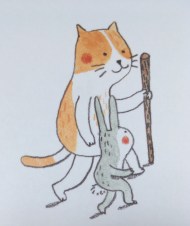
And at the start, we all need a friend, preferably a huggable, flesh-and-blood person we know, not just a smile on social media and a “U OK hun?” or people joining you in a moan who don’t know you or your school. Gawain (to return to my original image, with this picture of the Green Knight and Gawain reconciled) could have done with a mentor earlier in his quest to show him ways up the mountain, and Mr Gawain, the NQT (or the new starter on the PGCE, or new head or whoever)  could do with some genuine compassionate mentorship – and thinking of Up the Mountain (see the previous post) I might as well include this clip here of the marvellous picturebook about friendship and mentorship because – well, because picturebooks are always a good place to end.

Up the Mountain

Marianne Dubuc’s Up the Mountain is worth considering when anyone says that a picture book is simple. It does not have the visual fireworks of Gaiman and McKean’s Wolves in the Walls or the political complexity of Foreman’s A Child’s Garden but the straightforward story (outlined below) has a lot to offer.

I find it is sometimes challenging when reading educators’ social media about “Where would you have this book?” and ” What use could you make of this book?” to stop and think of a book as an object in itself: the visual aspects, the pace and language of the narrative…   That’s not to deny teachers for a moment a very exciting way to explore and widen their own understanding of “children’s books” – but just that sometimes a book calls me to step away from the pedagogy. Up the Mountain does that for me.  Yes, it fits with projects on Outdoors, it could be used to discuss age, and friendship, and exploring, maps and maths, wildlife, ability…

img_9968.jpg
But that’s why it is a really enticing book. “Very old” Mrs Badger, on her Sunday walk up the mountain meets the little cat Leo who overcomes his reticence and joins her in the walk – that Sunday and “for many a Sunday after that,” until Mrs Badger no longer has the strength and it is up to Leo to rediscover the mountain. It is a plain enough narrative, with an easy pace and lovely drawings, and as Leo makes the “splendid” mountain his own, it has a poignant and subtle message about growing up and passing on the things you have experienced  and grown to love – as Leo does at the end of the book. This is a story my 5yo granddaughter will love, but the unspoken affection, the relationships between character and landscape, the exploration of tradition and enthusiasm mean I can return to this over and again for my own pleasure.

So how do we step back from being pedagogues to being simple readers? Easy enough for me in semi-retirement, maybe, easier still with research partners to spur me on, but the following are just some rough-and-ready thoughts.

Reading widely helps: if you stick to the ones you know, you are missing out.  Not just because this book or that is perfect for this child or that, but because your own enjoyment is endangered, rendered threadbare. On social media recently, a new teacher asked about the book for this next term. My response was to suggest she read a book she will enjoy reading, and the best way to find those is to read widely. The commmuity of people reading and discussing “children’s books” (or fantasy or whatever) is rich, wide and very charitable. Look at Sarah or Dimitra for starters…

Re-visiting half-forgotten or set aside books or series: have you “done” the lovely Owl Babies a lot? What about On the Way Home?  Or if you set aside something (a besetting sin of mine) ask yourself why, and whether it’s worth returning to it. Finish the Stone Book Quartet. I bet there’s a Moomin story sitting unexplored – or what about Jansson’s adult books???  There’s a whole different thread…

Treating the books destined for the classroom just as you would your holiday reading: You don’t intend to put Margaret Atwood’s Hagseed in the classroom but how did you read it? Did you take its psychological messages about bereavement and revenge to heart, or did you read it as a comic exploration of a Shakespeare play? Did you read and re-read, or did you race through it? Did you share it with a friend or a partner? Or a book group? Or on Goodreads? What did you “get out of reading it”? I read seasonally: Moomins in the autumn, maybe, and Lucy Boston’s Children of Green Knowe in December…  How do you read? What do you enjoy?  Why do I like Up the Mountain so much? Is it that poignant subtext of Mrs Badger saying goodbye to her beloved Sunday walks? The gentle loyalty of Leo? A bit of self-reflection might let you think differently about the children’s books not as a resource but as a source of wonder and enjoyment.

Reading about authors – reading other people’s critiques of authors’ discussions and interviews (I have to link to Mat Tobin here, but check out Simon and Martin and others, too), author biographies, books by the author outside their usual genre. No, for some people that’s not the way they want to go, but for some those lavish books of Maurice Sendak’s artworks or the simple self-revelation of Alan Ahlberg’s The Bucket are just the thing to get you looking at the books children read in a different light.


And then finally.  Once you have enjoyed the illustrations, seen the way prose and picture work together (or in opposition), enjoyed that way that little cat peers out at Mrs Badger and how the bunny later echoes the incident, finally figured out the relationship between Sally Gardner’s wolves and John Masefield’s – then start looking at the classroom, and again, Mat has the resources … Too late to do this for this summer, I know, but this is, after all, simply a reflection as the weather cools. Time for the Moomins for me, then… More mountains and small beasts.