Mary Oliver

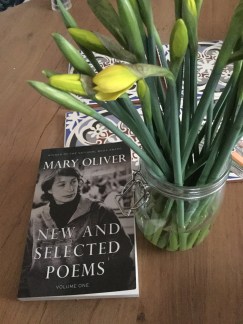
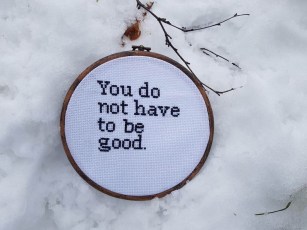
The death of Mary Oliver, a poet who addresses the carpe diem of Nature and the looming, warning memento mori, has prompted me to buy a copy of her poems. BFB3044E-AE72-4BEB-BB95-3AA59BC92067.jpeg I know lots of people (such as the wonderful Maria Popova) are ahead of me in knowing her work and loving it, and knowing her (which I will never do), so this is really an exploration of a first reading her poems. I had seen some of her work before. I knew The Black Walnut Tree with its “whip-crack of the mortgage” and Starfish (“learning little by little to love our only world”) and met Wild Geese yesterday, although I had been given a photo containing the phrase “You do not have to be good” by Jon in the Spring.
The poem itself is astonishing, all the more so when Popova provides us with a sound recording of Mary Oliver reading it:

You do not have to be good.
You do not have to walk on your knees
For a hundred miles through the desert, repenting.
You only have to let the soft animal of your body
love what it loves.

I find it astonishing that she manages here a division of mind and body (“the soft animal of your body”) without violence or separation. Maybe I can love that soft animal, I think…  and then the challenge to move beyond comfort:

Whoever you are, no matter how lonely,
the world offers itself to your imagination,
calls to you like the wild geese, harsh and exciting…

I will not beat about the bush: this sounds like a call to a new dawn, a new day in this chill, grey New Year for me. She joins Nina Simone

I wish I could live like I’m longing to live
I wish I could do all the things that I can do
And though I’m way over due
I’d be startin’ anew….

in giving me a kick in the depressive pants.

And this is the first thing I want to say in praise of Mary Oliver: she has, in among the imagery of the “floor of darkness”  under tall trees and the stories of sadness and loss, a great hope, “Blades from the fields of Spring.”
db492fd4-9945-4d5a-9c61-335cc0307f36

She is also a great writer of the poetic punchline.   Again, I want to refer to another writer. Just as her hope, her persistent “happy tongue” reminds me of another voice, so her form makes me think of R S Thomas, and

…the bent
knee, waiting, as at the end

of a hard winter
for one flower to open
on the mind’s tree of thorns.

She doesn’t always do it, of course, any more than R S Thomas. Neither  of them are cheesy hacks with a simple trick to end a poem. Her ending couplet to The Summer Day might end up as her most quoted line

Tell me, what is it you plan to do
with your one wild and precious life?

– but I rather hope it doesn’t, even though it is as clear as a silver trumpet, since to be known just for these punchlines would be to lose the clear call of the Wild Geese, “high in the clear blue air,” or the “shower of white fire” of the egrets, unruffled in a pond.

So what have I gained today, exploring this selection of poems? Why the urge to link them to things already known?
Lud’s Church

I think it’s because, when faced with a new author, I feel the need for landmarks. With Garner’s writing for adults, these turned out to be physical; Anne and I going to Alderley, then Mat and I going there on our first trip and then on to Ludchurch and Thursbitch. With Cooper, although there was familiarity with the Chilterns, it was much more knowing where she sat in a rich tradition of myth, and especially of myth revisited as C S Lewis attempted in so many of his books.   And with Le Guin? More of a challenge, but I think it has to do with the way I saw not so much a precursor to Harry Potter (it seems a real nefas to describe Ged in those terms!) as a fictional representation of the work of Alan Watts.

But this is beginning to look a bit silly. I think many of us do this in our own way, and I won’t labour the point.

So what I have “got from Mary Oliver” this afternoon? That she is as inspirational as Nina Simone and as masterful as R S Thomas? That would be one set of things, but if that’s all it was, it would be a pretty poor pay back for the book I just bought. Reading someone for the first time – maybe reading someone whose work feels like it chimes with your own psyche or whose skill you can admire – also brings delights in other ways, and for me today it has been the richness of language and natural imagery. Perhaps it is best exemplified in The Night Traveler, a poem so chock-full of wonderful images (“a doctor/On his way to a worried house;” “…bits of wilderness;” “It will nuzzle your face, cold-nosed,/Like a small white wolf”) and puzzles around symbol and metaphor that it really deserves a slow read, and without any more melling on from me:

Passing by, he could be anybody:
A thief, a tradesman, a doctor
On his way to a worried house.
But when he stops at your gate,
Under the room where you lie half-asleep,
You know it is not just anyone —
It is the Night Traveler.
You lean your arms on the sill
And stare down. But all you can see
Are bits of wilderness attached to him —
Twigs, loam and leaves,
Vines and blossoms. Among those
You feel his eyes, and his hands
Lifting something in the air.
He has a gift for you, but it has no name.
It is windy and woolly.
He holds it in the moonlight, and it sings
Like a newborn beast,
Like a child at Christmas,
Like your own heart as it tumbles
In love’s green bed.
You take it, and he is gone.
All night — and all your life, if you are willing —
It will nuzzle your face, cold-nosed,
Like a small white wolf;
It will curl in your palm
Like a hard blue stone;
It will liquefy into a cold pool
Which, when you dive into it,
Will hold you like a mossy jaw.
A bath of light. An answer.

They

I had the privilege of working for a short time with Jane Lane, a tireless campaigner (forgive the cliche) against racist attitudes of all shapes and sizes in Early Years.   It is her thoughts I want to reflect on very briefly here.

We were sat one rainy evening in a café working through some documents I think Jane wanted some feedback on, and I can’t remember what sparked it, but Jane looked up from the papers we were reading and she gave us all a warning about words to do with water: floods, and influx were already words that warned of an uncontrollable situation, and therefore carried with them negative connotations. She then said “It’s like ‘They’ and ‘Them.” We looked at her, and she went on to say “If someone talks about immigrant children as “they” you know we’re facing a lot of trouble.”

It’s the lumping of people together that, to a greater or lesser extent depending on context, denies their personhood. That’s why when @elly_chapple today on Twitter described inclusion being about humanity, I was back in that rainy café. Inclusion is a problematic term, or at least one we have been asked to ponder at the start of Brookes ITT Inclusion week (#obuinc19), because it is multifaceted, moveable according to who we are talking to or about, evolving (we’d hope) as our capacities and reflective practice change. The head teacher who has staff wellbeing to think about; the teacher whose relationship with the parents hangs on That Tone of Voice when she meets them at the end of a day; the TA whose time is punctuated by demands for all sorts of expertise; the child herself.  And this is (so far) one child who needs to be included in the educational project of the school, or the county or whatever; inclusion also has to look at the system-drivers and system-users for Child A who has a hearing loss; for Child B who has foetal alcohol syndrome and is in the Looked-After system; for Child C on the Autistic spectrum… and the temptation is to reach for the They. “Yes we are proud of our inclusive ethos in the school,” says the head, beaming with good intentions. “They are well catered for.” And no doubt the needs are well met within the system.

But inclusion has to go beyond the system. It has to go beyond the number-crunching to the needs – and not just the shortcomings and deficiencies – of the children or their families. It has to embrace, as Elly says, their humanity. It’s therefore not about coping with (or solving) problems, but meeting the child and the family (and those they come into contact with) where they are.  Maybe it’s about a smile, a good word as well as a “Can I see you about…”  It’s certainly about seeing the child in focus as part of a wider set of societal expectations, but also seeing them as an individual, and definitely not as “one of Them.” Think how many of us might  have been excluded at one time or another by being part of “Them;” think how fragile the right not to be seen like that can seem to some sectors of society here or elsewhere.

To those who work with the complexities of atypical development, critical social need or physical or sensory challenge this is probably self-evident. I’m just not convinced that the children and families always hear this, always are aware that they are not They.

Passport to a Rant

I find myself really torn by the recent DfE initiative around enriching children’s childhoods. img_0772I love the idea of children being outside; I am unhappy when schools are elbowed into making sure children do this, that or the other outside the school day. We are told – and it already seems a bit defensive to highlight this in the web page that launches it  – that the initiative is “backed by the Scouts, Girlguiding and National Trust.” This is part of the introduction from the webpage:
The list of activities is intended to support parents and schools in introducing children to a wide variety of experiences and fulfilling activities like flying a kite, learning something new about the local area or putting on a performance.

The list of activities was inspired by the Education Secretary’s visit to St Werburgh’s Primary School, in Bristol, where every child is encouraged to take part in a list of tasks and experiences, with key achievements for each school year to tick off. The list will be sent to schools in January for teachers to adapt to meet the needs of their pupils and local communities, helping young people to build their personal skills and qualities during the school day and at home.

And here is the draft passport, downloadable and by and large unobjectionable as a set of things to do. Already some of my impatience at yet another thing for schools to do is partly mitigated: this is to “support parents and schools,” not just to be a tick list for schools, and it is adaptable, so that (to some extent – see below) issues of physical or economic challenge can be got round (I am choosing that awful phrase on purpose). Ah but look carefully at that last sentence.

The list will be sent to schools in January for teachers to adapt to meet the needs of their pupils and local communities, helping young people to build their personal skills and qualities during the school day and at home.

It will be for teachers to do this: schools are (yet again) seen as the managers of the deficit home life or at best the recorders and by extension legislators of parental attitudes and activities. The organisation Every Child Should (that title raises my hackles, but let that pass) take the line that “particularly with the demise of universal youth work provision and Surestart” schools are now the “only remaining point of universal access.” In other words because of all the cuts, teachers: work harder! Schools stump up the funds! This is where my – and their – disquiet is worth hearing:

Great to introduce a bucket list for 11 year old but is this just another thing for schools to be held to account for? Austerity. Little extras. And yep – these are all significant issues and to pretend a passport can fix these challenges is at best foolish and at worse insulting.

While they then do suggest a passport is an effective model, they do so with a set of very worthwhile pro viso warnings about affordability, inclusivity and partnership. Let me propose a couple of scenarios here to illustrate where the passport model might not be a good way forward:

In case one mum is a teacher and dad is an office worker. They have two primary age children. Hard working (remember the “hard-working families” guff from a few years back?) but if they feel to some extent time poor they are not at a critical point. They build snowpeople [sic] when they can, read books, play on IPads, go camping.

In case two, again a “hard-working family” with two primary age children, and with dad on nights, mum works in a local supermarket: they box-and-cox childcare as best they can. This is much more like real time poverty, but there is still time for a kick-about in the park, and swimming club on Wednesdays, most weeks: and sometimes a bit of belt-tightenng to afford it.

Family one are already doing this stuff, and the school are being asked to do what? Manage these things? Supervise them? Require parents to record them? I recall the Oxford Reading Spree conversation about teachers keeping children in to “do reading” if the Home-School Reading Record was not showing reading at home: are we now looking at compulsory After-School Guiding if the record is not kept up to date? Family two likewise might be able to take on suggestions about starry nights or planning a meal, but really do not need school breathing down their necks any more: there is already enough pressure around finding the approved shoes for school, doing the increasingly involved homework (“make an Egyptian irrigation system”), find the money for trips… My point here really is to ask what does this passport have to do with them?

When the NCB endorses the passport their Chief Executive writes

We welcome this effort to immerse children and young people in activities that can build their confidence, develop their curiosity and support their growth beyond academic attainment…

But none of the endorsements seem to see the relevance of this element of control on the lives of these families. Let’s face it: as proposed by the National Trust (whose suggestions for “Things to do” form the basis of the Passport) these activities are interesting, free from immediate curriculum constraints (until we get to writing about it in class: note the SoS for Education seeing the “relevance to the curriculum”), and might encourage a bit more engagement with world beyond the immediate, technology dominated life of today. They are a bit culturally biased, a bit lacking in context, a bit wistful for a childhood past (I love the adventure into Ladybird Land with “post a letter” – although “play in the garden while Daddy reads the paper” was strangely absent), but we are reminded this is adaptable. The parasites are already creating forms for you to use. When Action for Children suggest more face-to-face time in their Build Sound Minds campaign (and God knows we need to think about families’ mental health), I worry the resource creators are already licking their lips at some kind of target-driven initiative that makes quality parent-child time into a Couch to FiveK plan. Yes, that’ll work, I’m sure.

And now let me suggest case three: mum is full-time at home, not out of choice but because the needs of their child suggest she may be called upon when these additional needs are felt to be beyond the capabilities of the school; the out-of-school activities they need, as she once explained to me, to include “our own parking place at the local hospital.” This passport better be adaptable – and not just in terms of “work arounds” for this family, but in ways that are genuinely inclusive. Or is this child’s teacher actually going to have to say “We’ll let you off the tree climbing, of course…”

It would be easy to go along a scale in terms of severity of need and still not stray from families I have worked with: the child looked after all week by Granny; a family for whom the mother being outside the home was culturally a challenge (a challenge they were meeting); the single parent for whom a lie-in felt like a necessity and who didn’t know how to cook (one of the TAs taught her to save money by mashing potatoes rather than buy microwavable stuff)… and we aren’t yet in the serious crisis cases.

I am all in favour of schools – and families – going beyond academic attainment. I spent a large amount of time on my two modules on Outdoor Learning last semester talking about how the curriculum  is much more than a syllabus; learning is more than being filled with facts… We sat outside in the autumn sun; we lit a fire, found a badger sett…  And out of work – well, after work, and along the road from the Harcourt Hill campus, at least –  I IMG_9750-1have sat in a local copse with a couple of mates and a beer…  And this is all without mentioning my passion for exploring children’s literature and how it can represent the magic of being outdoors.

I am not (as Margaret Hodge once described me and some colleagues when we asked for developmental elements in the Foundation Stage documents) a “joyless do-gooder” who wants to deprive working class children of the opportunities I gave my own children. But I am not convinced – yet – of the passport as proposed from on high as not just another bit of target creep: codification and a plea for schools to work harder.

In the end, I guess, my rant comes down to one thing:

How joyless to see the stars at night so you can tick them off!

Whilst

Up to my (shall we say?) knees with marking and just want to consider one little word. Actually it’s a word that stands for a whole set of assumptions about academic writing. Whilst.

It reminds me of the Grandma who once, in the springtime of the world, came to pick up her grandchild from Nursery. The unfortunate dialogue went something like this:

Granny: Hurry up, Mikey, we need to go.
[Mikey continues to play]
Granny: If you don’t come soon your headteacher will smack you for being naughty.
[I don’t normally intervene and certainly not to contradict a carer but I wade in]
Me: I’m sorry, Mrs S, but we don’t ever smack children; please don’t give Mikey the idea that we do.
Granny: But I’m giving you permission to smack him. Insofar as you are in charge in this establishment I am permitting you to exercise your rights in loco parentis.

Now, this isn’t about smacking or school-based discipline or home-school relationships, but voice. I can see what I did wrong there – but I still think Mikey needed to know I wasn’t going to hit him – but listen to Granny. She didn’t normally talk like this, but she changes gear massively with that Insofar. The awful phrase in loco parentis just adds to the sense that this person is claiming some kind of authority by sounding, well, as if they have some. My dreaded signal while (sorry: whilst) marking does the same. What it too often introduces – like Granny’s insofar – is a sort of strangled over-writing (I still feel much the same about the new(ish) translation of the Roman rite liturgy, if I’m honest, with its sub-Cranmerian verbosity but that is by-the-by).

When I see whilst I have to acknowledge that sometimes it does sounds better.   I suppose I could write “don’t use this:” after all, I do have a button in Grademark that just says “Avoid,” but whilst has so much hanging on it I feel I need to explain myself.  No-one (in my modules at least) will get marked down for just using whilst, or even (usually) for the occasional “you” or an odd lapse in references. My hunter instincts may be roused, but I will not routinely chase the hare. Does that metaphor work?

I could have called this blog post “please consider keeping your sentences shorter and more straightforward: you will be able to “lead your reader” more effectively if you make less use of phrases such as ‘through this research journal article  it has been discovered…'” but I don’t think it’s as catchy, even though I use that phrase (or similar) often enough when I give written feedback. What whilst says to me is “I’m drowning here: how the fuck do I make myself sound like the kind of people I’ve been reading?”

And that is a challenge that assignment feedback can hardly start on. How do we give the complex and sometimes mixed messages about how to join the writers’ club? What about the comment “missing apostrophe” or “italics not needed in Harvard”? How is a student to know where to start with all of this? Or, to make this personal, how do I take my chatty, ranty blog posts and change the voice to get an article from this idea or that?

Students, young writers be aware at least of this:

You are not joining us in an exercise of perfection, but in a struggle for clarity.

Compassion, Charity, Grace and a Hug

I have a big book on my lap. Well, it’s no Codex Amiatinus and actually claims to be concise. At 1840+  pages the Encyclopedia of Theology: a Concise Sacramentum Mundi might be full of “major articles on theology, biblical science and related topics from the (six volume) Sacramentum Mundi,” but concise it isn’t.

It’s also interesting to see what words it homes in on and what it does not. The apparent gaps and highlights show us, in part, how language changes and how with it (before it, after it) beliefs and attitudes. So I turn to the contents. A is for Afterlife, Agnosticism, Angels… M is for Magisterium, Man, Mariology… and it finishes with W: World and Worship. Compassion, I note, is missing, as is Love (if you’re wanting to know, Sex, Celibacy and Marriage all have sections). But Charity is there.  Reading Charity is interesting for what it says about language, as I mentioned (“Men feel bound to love others in proportion to their ‘social proximity'” reads as stickily old-fashioned) and its dryness is something of a challenge: “Love of the neighbour determines the basic structure of the moral act;” “The ‘transcendental depth’ of man in the encounter with the ‘other’ always points beyond itself, at least implicitly, to God…” It is clear the author (Waldemar Molinski) is talking about an active love of a real other person, but the vision seems to lack all sorts of attributes, not least everyday attention and  affection. There is no coffee here, there are no hugs: love with no humanity. In some ways that was, of course, the brief: this is an encyclopedia, after all.

Looking beyond Christian theology there are sources with more immediate appeal – even ones mentioned in this blog: vulnerability with Mike Armiger; Geoff Taggart’s compassionate pedagogy; and then Dennis Tirsch whom I quote in this blog post on sacredness:

A good relationship is a sacred space that can safely contain how we think and feel, along with our potentially painful histories + the whole of who we are.

In calling for a recognition of the sacredness of a good relationship we are actually closer (in thought if not in language) to the Charity article than it at first appears: recognising the reality of the other person is at the heart of Christian living. But Tirsch, I think, and my atheist and agnostic and Buddhist friends would not see Christian morality (when shaped like this) as having a sufficient language in itself. This is partly because Molinski is thinking in terms of individuals: this man [sic] and his neighbour, and their several relationships with God. Some of the appeal of Buddhist writing comes from its refusal to compartmentalise. Thich Nhat Hahn writes of working for peace in Vietnam during the War:

We were able to understand the suffering of both sides, the Communists and the anti-Communists. We tried to be open to both, to understand this side and to understand that side, to be one with them. That is why we did not take a side, even though the whole world took sides.

Being Peace

Thich Nhat Hahn sees us as trying to solve problems when things go wrong for a child, rather than blaming the child. This may be part of the issue (aka bitter arguments and name-calling)  around discourses of behaviour in schools: I don’t know. I do know that at home and at work it can be very hard and that I’m not very good at it in either place: I am too needy of other people’s approval and affection, too jealous of my own misplaced sense of equilibrium.

Perhaps in a search for Compassion in the Encyclopedia I should be looking more at Grace, the active giving “which divinizes the essence, powers and activity of man.”  A gift of freedom in the deepest sense.  As Thomas Merton warns:

…We only have as much as we give. But we are called upon to give as much as we have, and more; as much as we are. ..Love alone can teach us to penetrate the hidden goodness of the things we know.

No Man is an Island

Back, then, to sacredness, to self-giving and realising a huge Oneness, what Thich Nhat Hahn calls “the presence of the entire universe in ourselves.”  Back to meditation. Following the breath and hoping that this will free us from what Martin Laird calls “inner chatter,” from preconceptions and old pains.

***

Wonderful. But here I am blogging when I should be marking, wondering how useful it would be to mark an essay with the feedback “seeing and loving are one” (Thich Nhat Hahn again) or “We humble ourselves, crying for his mercy and grace” (Julian of Norwich). Of course it would not be what was needed: the compassionate act is to help the student understand what is working in their assignment , and where they might look next for ideas or for techniques to make their work better. Writing “Look at your sentence structure” becomes a more compassionate act than suggesting that “the rays of the sun and of the moon touch the earth, and yet the earth does not contaminate the light”  (St Augustine, if you’re interested).

This is a reductio ad absurdum, I know, but it does highlight a problem I struggled with as Programme Lead at Brookes and continue to struggle with as I talk to people who are still there: how to be compassionate in a system that is not compassionate. Not wicked, not prone to abuse, just that greyest of things: not compassionate: on Twitter tonight (17.12.18) I mentioned how

Lots of teams… can…find it easier to rely on a “just get on with it” culture where student needs are met by frontline staff but those staff are not themselves given regular help.

I am beginning to think that the uncaring or even the cruel system or the oppressive system might be easier to be compassionate in. I’m not advocating we should move to this, just that “compassionate as an act of defiance” is maybe easier to see or to see opportunities for than it is to see compassion or a need to exercise it in a system that talks about caring but actually cares very little: where the see-saw of the task and the group means that management-speak is about staff experience but where the systems leave little room for genuine compassion-focussed practice. This isn’t to say that Higher Education (or any educational project) should give itself over to the needs of the team  (though a hug is nice, sometimes) because teaching needs to happen, budgets need to be balanced, buildings tidied… – but that compassionate practice cannot be an add-on, and cannot be the hobby of a few.

However (and I’ll end here) this comes at a price, a real price that institutions, I think, have to step up to. The Twitter conversation this evening centred on a lovely animation from @KellyCanuckTO in which she asks, really, who looks after the people who do the looking after?  To provide this support in busy working lives takes time, takes people with time themselves, and skills and insight – and who are willing (because this is what Grace does) to risk being hurt, to risk that second asking of “Are you all right?” – and the time to sit and listen when there is an answer that needs an ear.

“George took his lantern”

John Masefield ‘s The Box of Delights is a fantasy published in the 1930’s which draws on the hopes and fears of people after the first war, and set in the English landscape. We meet not only characters from the earlier work The Midnight Folk but the story deepens as the protagonist,  Kay, battles forces of witchcraft intent on destroying the traditional English Christmas by ruining  the thousandth midnight Christmas celebrations at the Cathedral.    The Box of Delights is a sequel that in many ways surpasses the nightmarish first book (pace Rob Maslen, who praises the Midnight Folk here) and its narrative strength means it has also made a radio play, a classic BBC TV adaptation and more recently a well received stage representation. All this is summed up very neatly here in the Guardian, and explored by Jake Hayes with his usual depth and perspicacity in his Tygertale blog for this Advent, and it is the language when we come to the denouement that I find striking  – I’m coming to this.

Throughout it is Kay’s relationship with Cole Hawlings that sustains the narrative. Cole is a travelling Punch and Judy Showman, but so much more than just an itinerant busker: like his successor, Susan Cooper’s Merriman Lyon, he is at the centre of a struggle against evil, represented (as in the previous book) by the murderously wicked Abner Brown. As with Merriman, we are allowed to see only snatches of the battles the adults are fighting; there are more than symbolic “wolves running,” allies we do not always recognise, dangers for the adults as well as for the children…  But there is an important set of differences: while Merriman/Merlin openly entrusts the Matter of a New Britain to the children in Cooper’s Silver on the Tree, Cole Hawlings, having helped Kay restore the rightful place of Midnight Mass in the embattled Cathedral, is still looking back: the nostalgia for Old England is strong in the final pages of The Box of Delights as, speeding towards the Cathedral, we hear the bells start up in all the little churches, and meet the monastic community of the Cathedral’s past. And while we are flying along in Herne the Hunter’s unicorn-pulled sleigh, to move the recently freed Bishop and Dean and choir (&c., &c.) from some kind of sub-Trollope or All-Gas-and-Gaiters imagery, we have a Christmas hymn in a folk idiom, which Masefield calls a carol: here is the text.  What surprised me on my first reading as a child, and still surprises me, is that Masefield gives the singing of it to the ambiguous dating-from-Pagan-times Cole Hawlings.

[Incidentally, the first time I heard this song, Móirín Na hEaglaise, sung by Nóirín Ní Riain, I thought of this carol, with the higher sections or answering melody being used in verses 4 and 7. I have tried it, although unsuccessfully: it may need something more robust, where maybe the last line of each verse is the “chorus after each stanza” Masefield notes].

The carol is a remarkable piece.  I’d like to look at a few details to see what they tell us about The Box of Delights:

Let’s start, like Masefield, with George. His very name seems to set the lyric in England, maybe even rural England, and it occurs in four of the verses. He is the figure of compassion, a carefulness that twice calls him to the byre (a beautifully localising word: again we are in rural England), where he first lets in a poor couple and then comes back because of the trouble and sees the Christ Child and then the kings.

Lantern, byre, hay, stable – even inn and snow – put the Nativity in the same landscape as The Box of Delights. The “-a” at the end of the shorter lines moves this further into the folk-song idiom, although what is and isn’t a folk song (a bit like what is and isn’t a carol) is disputable. Perhaps the most truly rural – or maybe best attempt – at a “country tone” is the line George heard a trouble in the beasts. It sounds like my Father in Law.   It is snowy and dark, George has a lantern to go to the stable/byre – and England receives its revelation.

And there within the manger bars
A little child new born-a,
All bright below a cross of stars
And in his brow a thorn-a.

The Mother, the Child, tenderness – but never too far from the cross and the Pieta: we are in Durer’s bleak theology, with those cross-like structures present in the nativity scene in his Madonna on a Grassy Bank.  George’s vision is mystical; we are with Durer, with Chesterton and Gill, in seeing a Gloria in Profundis, although what Masefield presents is a transcendent Child, a submarine vision of humanity divinised not “the height of the fall of God.”

What happens next is interesting from the point of view of a rural poem. The visitors are not shepherds but Kings. I am unsure whether to read anything into two great kings and Melchoir but will assume we needed Melchoir for scansion and rhyme. They bring Eucharistic gifts, too – and at a practical level welcome ones for the poor Family – bread and wine.  The ecclesiastical imagery is extended with the mention of robes. We have, by now, a crib scene – but where are the shepherds?

They – and we – are there in the person of George. The plain people of England (to misappropriate a phrase from Myles nagCopaleen) kneel down with the farm worker in homage of

that dear Babe today
That bears the Cross and Crown-a.

In looking back to a rural, more innocent time, we are at the heart of the nostalgia project that occupied so much thinking in the post-War period; we are also in that hankering for a countryside of freedom and adventure and risk that is at the heart of Masefield’s two books, and which informs Lewis, Garner and Cooper  — and… and …

And when Cole Hawlings – the theologian Ramon Lull – the pagan countryman and the lost medieval mystic – sings of this past time when George knelt down and prayed-a we are invited to a personal piety that is itself nostalgic, a recreation after The War to End Wars, of a pious peasantry, a dedicated episcopacy and (and here we are into a whole new set of thoughts about the villains in this story) the defeat of corrupt and self-serving greed. Not a bad wish for Christmas in the inter-war period; not a bad wish for this Christmas, either, but I am mindful of how Masefield’s vision played out in the following years: Masefield knows it is a “nice dream,” as Kay admits at the end of the book.

A Carol

…from John Masefield’s The Box of Delights. Presented here without comment – which perhaps is for a future post. – except that in Masefield the even lines are indented.

George took his lantern from the nail
And lit it at the fire-a;
He said, “The snow does so assail,
I’ll shut the cows in byre-a.”

Amid the snow, by byre door,
A man and woman lay-a
George pitied them, they were so poor,
And brought them to the hay-a.

At midnight, while the inn kept feasts,
And trump and whistle blew-a,
George heard a trouble in the beasts
And to the stable drew-a.

And there within the manger bars
A little child new born-a,
All bright below a cross of stars
And in his brow a thorn-a.

The oxen lowed to see their King,
The happy donkey brayed-a,
The cocks and hens on perch did sing,
And George knelt down and prayed-a.

And straight a knocking on the door,
And torches burning red-a,
The two great kings and Melchoir
With robes and wine and bread-a.

And all the night time rolled away
With angels dancing down-a;
Now praise we that dear Babe today
That bears the Cross and Crown-a.

Amid piles of books

The great Alcuin once praised a time (in his past) when he sat with a friend,  quiet inter librorum copias – amid piles of books. I have had the privilege of doing the same, and if I didn’t get a PhD out of it, well, more fool me – but I did spend time with chant books, books of hours, office books, the I’m-sure-this-is-interesting-but-it’s-page-after-page-of-crabbed-writing-with-the-occasional-red-capital books…  So I wasn’t a complete novice when Lizzie and I went to the British Library for

Anglo-Saxon Kingdoms: Art, Word, War

…even if my “own period” was six or more centuries later, the late C15th and early C16th MSS. The printing press; the rise and fall of Norman-French; complex harmony; Wycliffe; America…  In coming to this eagerly awaited event exploring the piety and power of the kingdoms of what is now called England, I thought I knew what I was getting into – naive of me: this is so much richer than a timeline of MSS.

It is simplistic to say so, but six hundred years is a long time for any scholar, committed professional or amateur, and the thousand years between Cnut the King and us seems more than that by a huge stretch. These are works that never were designed to come together – they span five hundred years themselves – but together they make the most wondrous kaleidoscope of a culture – or of a string of shifting cultures. The BL has skillfully collected material that is not only of monumental importance but also illustrates very well what a different world the peoples of the Anglo-Saxon Kingdoms inhabited. The lady Wynflaed who left her nun’s veil in her will, as well as naming her slaves that were to be freed; the warning illustration in a bilingual psalter against deceit, showing Cupid firing arrows at a cuddling couple; the elegant copy of Alcuin’s letters; Aelfric’s Grammar… The exhibition is designed to lead the visitor roughly through the first peoples we might think of as “The Anglo-Saxons” (book after book is available on this shorthand; suffice it here to say that, while explaining the rise of Germanic kingship in Southern Britain, the curators steer mercifully away from Our Island Story) through to one of the final cases, The Domesday Book.  And for similarities we have not only a growing and changing view of power and relationship with the rest of Europe (and Africa: it was lovely to hear the astonishment of two visitors reading about the African Abbot Hadrian of Canterbury), but the growth of ‘our’ language from the grey, tatty wonder that is Beowulf through to Bishop Wulstan’s poem in praise of…. well, himself. There is enough here to challenge and to enlighten what it is to be English – or even English-speaking – in the uncertain times we live in, partly because we are shown a story – uncertain, faltering, violent, pious – of the growth of English identity.

I’m thinking about the books, principally: they were what I wanted to see. I have mentioned my love of manuscripts before in the blog and although I love them, I know there are crowds of people with more enthusiasm and expertise: my passing note (twice, I think) of Christopher de Hamel’s wonderful Meetings with Remarkable Manuscripts just points to who I have read and learned from. (And in such a list I can’t miss out Tolkien (the model for the Dwarves Chronicle in Moria is in this exhibition) or Lewis (and Pauline Baynes, who must, I think, have seen the Utrecht or Harley Psalter) or indeed M R James, whose works I used in paleography tutorials in the 80s.)   His book, especially, and Daniel Wakelin’s Designing English book and exhibition were in my head as I  looked forward to – and then looked round – the British Library exhibition.

Just sometimes hyperbole around amazement and treasure is justified. It wasn’t just the size of the great Codex Amiatinus that astonishes, but its story: how it got to Italy with Abbot Ceolfrith and why it never got to Rome; what happened to its equally massive sisters; what it shows in illustration and skill. It is open at a wonderful interpretation of a scholar (Ezra, the exilic historian) at the task of writing , a common enough image (not wishing to damn Lindisfarne’s spare and lovely images  with faint praise!), but here with his library open, a book on the floor, his ink-mixing stuff to hand… It sums up to me so much of what I love about scholarship both as an activity and as an object of study. Ezra is inter librorum copias, and so I am here, not changing the world by restoring Jerusalem, or making a bid to be made Archbishop like Ceolfrith, but just a tourist into this world of manuscripts, inspired by their beauty and fragility, intrigued by their world(s), glimpsed, like a friend’s face in a crowd.

This is a majestic and vitally important exhibition. It is improbable that I will get to see many of these treasures in another, and it may be that conservation practices will mean they will never come together again.   Once in a lifetime? Once in a thousand years.


Experts

Apparently the dominant idea of this Age that someone on Twitter called the twatocene (pithy or what?) is that we have had enough of experts. Beautifully encapsulated by the “ I prop up the bar and you can’t tell me what’s right” school of philosophy, the dismissal of experts I think was originally from Michael Gove – a man who, allegedly, reads and thinks and has brought that reading and thinking to his work.  An expert telling us we have no need of experts? He was joined in the twatosphere by the “ Leeds born and bred” Shadow Justice Secretary this weekend, and signalled, for me, an ungainly collapse of any remaining hope of intelligent debate from politicians.

Therefore, in wanting to propose some resources (see below), I find I need to say that I think we do need experts. We need people we want to listen to – and people we don’t. The ITT student who gathered a whole crowd of Tweety onlookers telling her she was right to walk out when she disagreed with a lecturer, the minister or shadow minister who thinks that this  “no experts” line will allow her or him to sidestep a question when someone with some knowledge objects to their line of argument (and then, smooth-faced, to return to their think-tanks of  – erm – apparent experts), or the crabby old academic who might have Twitter and a blog at his disposal but really is just mumbling “things ain’t what they were in my day” – we all need challenging. The expert – the person who has tried it out, the person with the reading and thinking and doing to give them authority – has to be heard (and courteously).  This is not, by the way, a plea for some bizarre civility to allow numb-nut racists  or Climate-Change deniers access to any part of the social media they choose, or to bleat at people about balance when they don’t get it – and the ad absurdum arguments there are beyond me to tackle.

So when I see the SoS for Education advocating lots of outdoor experience I might (and did) sigh deeply at how this really mustn’t become number-crunching target fodder – but I agree with his overall intent and I let it pass. I might debate his sources, or the implications of his plan, but don’t dismiss the National Trust as “experts I don’t need.” Easy one, because by and large I am in sympathy.

When I see the Schools Minister and friends advocate for more content (what they seem to want to call a knowledge-based curriculum) in Early Years, again I might (and did) sigh deeply and since I am not at all sure about the overall argument or the detail of delivery, I will think about it and debate it – and maybe get frustrated at weasel words or underhand dealing – but I don’t dismiss the participants as “experts I don’t need.” Less easy – in fact quite tricky. But it has to be done.

Dismissing the epidemic of young people’s mental health as a snowflake phenomenon would be destructive dismissal of experts. Dismissing advice on children’s activity as just impracticable in today’s curriculum is also plain idiotic. Neither of them make for easy reading – as a parent, an educator, a rather inactive older bloke – but at least they have not been subject to dismissal. The 20-odd-page government-commissioned report on austerity was, however, dismissed loftily by one minister with the words “I don’t know who this UN man is”  and the Work and Pensions Secretary condemned it as “political.” And here I come to the end:

These documents are all political, and they all come from experts in one way or another.

  • Climbing trees not only has ability/disability written into its aspirations it has issues of access, local funding, government spending….
  • A knowledge-rich curriculum has all sorts of issues about who gets to say what and what is not acceptable as cultural capital, or where libraries and sited and funded;
  • Why so many people (young and old) are sick at heart, and what we can do about it is tied up with everything from student loans to mobile phones – and the biggest question is at what pin-point entry-level intervention beleaguered and distracted politicians want to aim their funding;
  • Where in the curriculum we design vigorous exercise – and how its expert teachers are supported and training (and – again – funded) are big questions; these are not freebies, if done properly;
  • And finally, how has it come to be that  “the country’s most respected charitable groups, its leading think tanks, its parliamentary committees, independent authorities like the National Audit Office, and many others, have all drawn attention to the dramatic decline in the fortunes of the least well off in this country”?

“Expert” is being redefined by pundits of all shapes, sizes and political parties as “people who know more than I do and with whom I disagree.” Yes, I stand by the fact that we are seeing an ungainly collapse in any sense of real debate. Come on, please: you’re not playing for points at a college debating society, nor are we paying politicians to put their fingers in their ears when an expert disagrees with them.


Oldtales

Reading Peter Dickinson’s The Kin is intriguing. I am not yet finished, but want to take a bit of time to think about stories of origin and how he creates and presents them in between the narrative chapters, the things he calls the Oldtales. Origin stories are interesting in Dickinson because they illuminate the actual tale of the children of the Moonhawk Kin, and their relationship to the places through which their Kin travel.

However, preparing a blog on them I thought I would go back to source books that in turn illuminate “our” own origins (the “our” is in doubt, of course, because of the ways in which increasingly we view our origins: Chris Stringer and Adam Rutherford, for example,  give us lively accounts of a trail of humanity that does not include Adam and Eve).  I went back to Mircea Eliade to read of the ‘African High Gods,’ of Ngai, of Ndjambi Karunga, and to read the beautiful Hymn to Shamash from Mesopotamia and prayers of a !Kung hunter – and I thought of the stories in Genesis that explain Mamre and Moriah, Beersheba and Bethel. The connections to Peter Dickinson (whose books tell us he was, as a long-term project, often to be found exploring myth and religion in his writings) are really interesting, but didn’t illuminate what I was looking for. How does these stories resonate with the reader?  Joseph Campbell’s Hero with a Thousand Faces brings me, tantalisingly, to the Bacchae and thence to Thursbitch (“O Bonny Bull”), but again and again I find myself looking at the first stories in Genesis.

They are worth a read in an attempt to see quite what they have to say about earlier views of where we come from, but as Robert Alter in his Art of Biblical Narrative suggests, we need

…some detailed awareness of the grid of conventions upon which, and against which, the individual work operates… am elaborate set of tacit agreements between artist and audience about the ordering of the art work…

and he warns that when we look at biblical narrative

we have lost most of the keys to the conventions out of which it was shaped.

This gives Dickinson a free hand in creating the stories that illuminate the main narrative, of course, and the creation of the Good Places, the multiplication of the sons of An and Ammu – so that these “folk tales” are all distinct, sort of working with the main narrative, sometimes not (yet) – but the opposite is true when we look at our own old tales. We are encouraged, I think, to see them as part of a single book, The Bible, when it might be better to see the biblical texts as a collection – and Genesis itself to be a collection within the collection. All of a sudden I am back in my Old Testament tutorials as an undergraduate, reading Gerhard von Rad.

Von Rad proposes a number of narrative sources, “woven together more or less skillfully by a redactor.”  This, in part, explains the two creation stories at the start of the Genesis collection “In the beginning God created the heaven and the earth” and then “These are the generations of the heavens and of the earth when they were created, in the day that the Lord God made the earth and the heavens” which leads to the next story beginning “Now the serpent was more subtil than any beast of the field which the Lord God had made.”  The gods (in the plural form Elohim: we are already into controversy here, but remember that “God said, Let us make man in our image, after our likeness” not to mention the “sons of God” in chapter 6) make choices about the world: reading these stories out of their stained-glass attitudes we have a different sort of world, closer to the movements of Dickinson’s Black Antelope, where the text of Genesis is “de-Biblified,” taken as origin-text rather than sacred story.

Except, maybe, all origin-tales, to sound “right” to us, have an element of sacred story about them?  I think I have a lot more to think about.


Codicil: 

The amazing Neil Philip, on Twitter, has helpfully informed me and Mat:

The Genesis Rabba, a Jewish commentary of c.400 CE, says that while G-d created Adam in his own image, this likeness to G-d only lasted until Enosh, son of Adam’s 3rd son Seth, after which humanity degraded and acquired faces like apes. Also says humans had tails like animals.

Loads and loads more to think about then!