Doing the Tudors

It was interesting to talk to some teachers about the work I’ve been preparing around traditional tales for Outdoor Classroom Day, and something of a challenge to find a set of stories that linked with “Doing the Tudors” and “Doing the Romans” to then tell the children. Given the school I was working in, the Romans proved easier than I’d thought: with Akeman Street on the doorstep of Combe village, we pondered what Roman life was like off the roads, away from the imposed civilisation of the invaders. Yes, there were wolves.
For the Tudors, I went for a story that had a version known in the time of Elizabeth I: The Three Heads of the Well. I started from this version, and cut and reshaped and simplified. It helped that the school had a real well…and the three heads that provided me with their magic (‘weirded me” as the language of one version goes) through the day were maybe Katharine Briggs, Terry Jones and Alastair Daniel.  Actually there were more: Adrienne Duggan, the ever-at-my shoulder Mat, the inspirational Neil Phillip… and more – see below…

But back to Doing the Tudors, the point of this post. The “Doing” of topics is always an uneasy business, with that sense of finality, of completion, a dusting of hands and a walking away. I fell into this language myself (I don’t  think I noticed the children or staff using it), and was conscious of how it brought with it another meaning: finished but maybe superficially, as in “We did Oxford yesterday; is this Stonehenge?” Layers of detail and meaning lost.  Having just gone back to my first postgrad research in Tudor history through reading Diarmaid MacCulloch’s Thomas Cromwell, I was well aware of the complexities of “doing” and “finishing off” the Tudors. I know Year 6 had not been discussing the gaps in extant correspondence in this archive or that, of course, but if I thought my “doing” laid bare a “been there, done that” assumption, I need not have worried.

I had chickened out of telling the story with the death of the Queen at the end of The Three Heads, and softened the part about the King’s bribe to the cobbler to take the horrid step-sister away. Some of this was about brevity and tellability, and some of my choices, I reckoned, were about taste.  The children were not to be fooled, and although they enjoyed the story, I was soon in a discussion about what a “real Tudor” would make of the way it concluded. They wanted – in their words – a (they said “the“) “cruel ending.” Beheadings or divorce would have been in order. They appreciated the cruel (step)sister going off with the cobbler – but didn’t see that there was a bad ending somehow in her having to work for a living. Such is the power of storytelling and literature in the curriculum – but note to self: a Roald Dahl ending with blood and shame would have been truer to the earlier versions and maybe pleased my young audience more. Those children had Done the Tudors well.

Alongside what help I and my tutelary spirits could be for “doing the Tudors” or whatever, there were two other magic presences in this day’s work: Jackie Morris and Rob Macfarlane, artist and wordsmith of the great The Lost Words, whose work I shared with every group. It was wonderful to read the short acrostic for Ivy, (“the real high flyer… you call me ground-cover; I say sky wire”) and see the Reception class lap it up, and the “top Juniors” appreciate their understanding of an acrostic. Best of all, as the younger children went back to their room, one of them pointed to the ivy on the school wall, and another said “I say sky wire.” That really surpassed all the messages I could hope to give about links between language and literature and environment. We couldn’t have said we’d “done” language and the environment any more than I have “done” the Tudors, but that five year old knew a nature metaphor when he saw it.
Importance and Binary Opposites

The presentation on What Children Shouldn’t Read for the Reading Spree didn’t go too badly, and reflecting on what did (and didn’t) get heard has been interesting. A few messages went astray both from me and from other presenters, although the “reviews” to listen to are, of course, the people who were actually there, and caught nuances more than the powerpoint slides Twitterers want to argue with. Responses on social media have been thoughtful (and certainly less spittle-flecked) than they were following the first one, at least.  However, reading them does bring me back to Kieran Egan, whose Teaching as Storytelling was a key element of my 20 or so minute ramble. He asks

  • What is most important about the topic?
  • Why should it matter to children?
  • What is affectively engaging about it?

and then  follows this with the challenge to find binary opposites/pairs:

  • What powerful binary opposites best catch the importance of the topic?

Big questions when we look at storytelling and curriculum.   I suggest that they are different for teachers than they are for children. In What Not to Read I suggested we might ask “How do we look at books when we are educators?” and the same is true of how we look at the whole phenomenon of the outdoor curriculum and outdoor storytelling in particular – and in many ways, looking at curriculum is closer than using Egan’s probing questions as being essentially about storytelling.

There are tensions, binaries around ecocriticism and curriculum. Am I storytelling outdoors as a part of the Green Agenda?  How do I deal with a tension around book sharing and how we might orally present traditional tales – there are, for example, practical issues around books and outdoors (as we discovered in a session last year when it poured with rain)?  Teachers’ binaries will be concerned with these curricular issues; children-as-audience will be concerned with, as Egan puts it “the human adventure that began in magic and myth…” and they might be concerned with good and evil, danger and escape (Roald Dahl’s Goldilocks is a wonderful skewing of these concerns with his “delinquent little tot” and her fate at the hands of Baby Bear) or with destruction and redemption (I think at once of a beautiful and politically charged book I have discussed before: Michael Foreman’s A Child’s Garden).

So many binaries to disentangle, when the challenge from Egan is to find the  “binary opposites” that “best catch the importance of the topic” (my emphasis).   This is no small task when selecting books or stories for an outdoor audience; a huge task for teacher or school when considering why they might want to do storytelling and the practical considerations that arise from this plan. Why do we teach how we do?  What prevents us from running on the free rein of professional expertise and creativity?

*

To end with an esprit d’escalier thought about presentations and co-presenters at the Reading Spree, I will take a wide-angle lens view, and ask another of Egan’s questions:

  • What content most dramatically embodies the primary opposites?

This Saturday it was for me testimony from Simon from Whitby – of children in his school who had never been to the beach – and Nicki – a librarian on a TA’s salary, buying library stock from her own pocket.

I went the next day (Sunday) to a panel discussion hosted by members of the Blackfriars congregation about the impacts of poverty and austerity on the educational experiences of children in Oxford. The feelings of the three speakers (and including my Maggie), all in various roles in education, around the squeezed budgets of public services suggests to me the final and most obvious binary: funding and austerity. Life chances are enhanced by things like decent libraries and book provision (and excellent library provision and staffing such as evidenced here) in towns and schools: refusing to answer calls for better staffing and book stock is an ideological choice, to cut public funding and cut taxation.

Cut after cut and cut as politicians tear one another apart and us along with them. There’s a binary for starters.


What Not to Read

Kieran Egan in his book Teaching as Storytelling suggests that topics should be chosen according to a model that starts from Identifying Importance (he is using The Vikings as an example), and asks

  • What is most important about the topic?
  • Why should it matter to children?
  • What is affectively engaging about it?

He is asking the teacher to question how does the topic impinge on the child learner as “they begin to understand that the conflicts they see in their families and neighbourhoods and schools, and the conflicts they feel within themselves, are analogous to those that have shaped history,” and how “that values of tolerance, self-restraint and so on are essential for all of us to practice as prerequisites to civilized life.”  Although Egan does take this a lot further (of course), there’s more than a bit of “if I were you I wouldn’t start from here” in this approach to the Vikings – but if we think about this in terms of choices of books to buy for/share with children, it makes an interesting set of questions:

  • What is most important about the themes in this book?
  • Why should it matter to children?
  • What is affectively engaging about it?

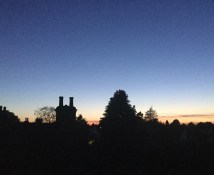
What books might I put in a pile that if I wouldn’t ban them I would sigh and think “Do I have to?” I wonder if this set of questions makes me think beyond my usual repertoire, so to test it I reach behind me (with a brief look at the lovely sunset 998976B0-CB3F-4424-BD5A-EE770D074DBBand a quick compulsive posting of the evening skyline) to find a book. The first to hand is the battered (and ergo much loved) family copy of the Tale of Squirrel Nutkin. Since I won’t be exploring this Potter in my Reading Spree talk on Saturday, it will do very well.  It is not my favourite Beatrix Potter but maybe that’s to the good as well.  Let me use these three questions on it, and see what emerges.

What is most important about the themes in this book?

Beatrix Potter’s iconoclastic red squirrel uses riddles to annoy the owl Old Brown when Nutkin should be polite. The tensions are around respect and the consequences of crossing boundaries of politeness. It seems to me that what is most important is rule breaking; tasks are not completed, authority is insulted, danger is courted.

Why should it matter to children?

Naughtiness and rebellion against authority are important themes in the literature of childhood. The Dionysian child brings Carnival and chaos to the adult world: in the Topsy-Turvy of Lewis Carroll, the child Alice is wondering but quite prosaic in the face of the Wonderland Carnival of the Hatter and the shower of cards that tries to overpower her; George brings chaos and murder by poison to his nasty, controlling Granny with his marvellous medicine. Squirrel Nutkin is a jester D4B73E98-8D7D-4D5E-A143-A529F50EDE2F.jpeg with “no nice manners” who takes his jesting too far.  These characters and situations matter to children as they explore the “what ifs” of denying respect, especially in a literary landscape where being good is rewarded.   With Squirrel Nutkin (and many of Beatrix Potter’s male anti-heroes) we are looking into the same, magically enticing world (although in reverse) as the unfortunate Bertha in Saki’s The Storyteller in that what matters is what happens on the disputed land between riot and being “horribly good.”
What is affectively engaging about it?

The uncertain territory allows for an ambiguous outcome, and thus a real sympathy emerges not for the much-put-upon Old Brown, but for his relentless tormentor. The storytellers who go down this path look for affective engagement with chaos and anti-heroes. No wonder the children in Saki are entranced; no wonder the reader delights in collapse of school authority in Matilda or the downfall of George’s grandma, or the disruptions in lives when the wind blew umbrellas inside out and whirled the postman’s letters up… In Beatrix Potter Carnival delights, but the trespassing Benjamin Bunny and the stoner Flopsy Bunnies learn their lesson. What seems to me to be engaging is the piling of misdemeanour on misdemeanour. How naughty can this get before order, tedious and safe, is restored? How naughty can I be before I get into trouble and the “mastering pressure of wearisome necessary things” (Saki again) returns?

***

So this use of Egan is part of my method for my talk at the Reading Spree. How do we look at books when we are educators?  What use is this book that I want to dismiss as anodyne, or creakily outdated? I want to explore ways we can look at children’s literature that allow a sideways glance – and particularly at stories and genres we may not like. This is not to say that any and every book is worth wasting precious story time in a pressured school day, but may be something of a recantation of my views on Blyton or Dahl or Walliams or Rowling, on the Rainbow Fairies and the Mister Men.

Or it may not. I have already Tweeted Joyce Grenfell’s devastating critique of the fake and formulaic Writer of Children’s Books who clearly has never been to Make-Believe Land, and I may have to rant. There is already a section marked NSFW.

More Dragons: St George’s Day

Ignoring the debates about how much the Church has baptized pagan celebrations, part of me wants to ask people to back off the appropriation of Christian festivals for secular ends, from the feast of All Uncomfortable Family Obligations (25th December) to Chocolate Bunny Day (which this year fell earlier this month).    It is perverse of me, I expect, to push the fact that today is celebrated by many/most Western Christian Churches as St George’s Day, the solemnity that remembers the martyrdom of a saint from the Middle East whose cultus spread during the crusades as a sort of military demi-god. The feast has moved because the week (“octave”) after Easter is deemed to be so special it clears the calendar of other celebrations. I shall not comment on the crusader link, and for now I’ll skirt round those other ways in which tales of George and his emblems and cross have supported or excused violence against the enemies of England or Western Christendom.  It is my fervent hope that, as I said earlier this year, those dragons are in the end going to burn themselves out, but today I find myself in some doubt.59610823_10161841658920341_2877297955658792960_n

Just briefly, however, to reflect on whose saint George is. Not in terms of whose patron saint he might be, if that means who he might support in a battle or a football match, or whatever (all of which seem pretty empty to me, although I recognise the power of Shakespeare both at the time of his writing Henry V and of Laurence Olivier’s stirring speech in his film version), but in terms of tradition.   Tradition is  powerful thing, of course, and the St George tradition renews itself through the institutions of English monarchy, flags on church buildings – and more recently by appropriation of a mythic, medieval past by right-wingers that reminds me uncomfortably of Romanita in Mussolini’s celebration of Vergil. Mind you, Vergil’s own plea to a mythic past is also open to exploration…

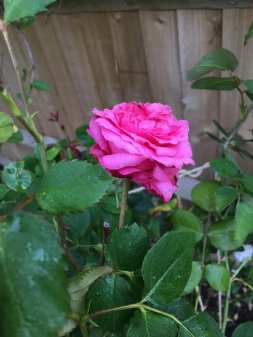
What are we left with?  Lots of English images of churches, flags, the rolling countryside of the story of a land fit for heroes that has given rise, indirectly, to the powerful love of landscape and nature that might yet save our environment? Shall I wind up the gramophone and start the Vaughan Williams or Holst … and go on a search for a Land of Hope and Glory of 1220, 1420 or 1950 that never really existed?  It is not to be denied that imagery, music, tradition are key to understanding identity, and these myths are important. Above is a nod, in some form, to the traditional iconography in the red(ish) rose in my back garden this morning, out early, out in time for St George’s day (the white Yorkshire rose is hanging back, I note). So when is St George’s Day? Does the tradition of 23rd April stand, and if we get a new national holiday, that will be it? Or is it something for Christians, with our own calendars, celebrating a saint from such uncertain past histories we are unsure who we are celebrating, or for people looking for an identity?  Do Christians cede St George to people in search of a mascot, a symbol of a (xenophobic, possibly violent and unthinking) nationalism? What did I celebrate when I opened my breviary today?

I have to wonder if what I celebrated was not St George, and certainly not Englishness, but a curmudgeon’s hankering after a faith identity that separates itself – or has been separated – from a nationalist identity, and this is born, in part, from the Reformation script that meant Catholics were seen as in some way foreign. Here we are at the us-and-them of identity: we are us because we are not them. Perhaps this is why a combative dragon-slayer fits so well.  Perhaps we are all looking at mythic pasts for identity guides.  Uncomfortable thoughts on a fine spring morning.

Pottery

Some twenty years ago I used to “do pottery” at the local FE college. Two hours on a Monday evening and a kebab on the way home.  Today, courtesy of a birthday present (thank you, Lizzie), I was back – same room, probably some of the same tools, same mistakes of misplaced omnipotence and self-criticism.  Different tutor, still good: thank you Activate Learning, and thank you, Graham, for your skills as a tutor.

Tutor intro.  Tour, health and safety. “No running with scissors” was not mentioned – but beware the dangerous chemicals and the clay dust.   And then into the task. A demo which showed how very easy it was.

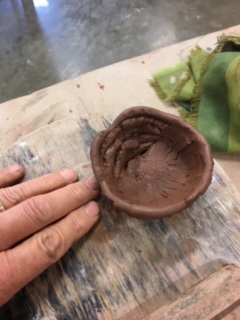
First attempt. IMG_0084 Dismal. In trying to make something small, I had something fiddly, and the techniques I hoped to use needed to be applied more delicately and with a more practised hand. A small pot became a pile of used clay and my ambition took a bash. Been here before.
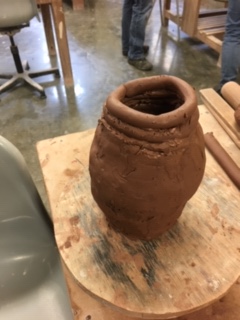
Second go:  The longer attempt and really (with a lunch break) the work of the day, 11:00-3:30, went a little better.   A larger piece, but it still took a long time and I had to unguess shortcuts, to keep the pace, to refine and design. I watched smooth surfaces appear for other people when my effort looked like something the Beaker People would have looked at and said whatever their language had for “Meh.”

The work later in the afternoon was not without challenge but did allow a certain amount of “distract and redirect” as I used slip to decorate the misshapen vase. Plans and designs revised, the learner supported and encouraged – and forgiven, if that’s the right word – for assumptions and wrong turns.

What went right. Well, it wasn’t perfect, and I hesitate to think how I would have felt if it were being marked, and certainly on such an initial piece of learning and creation. Would I have tried harder?   Paid more attention?  Worried more? I am reminded of Margaret Donaldson’s warning (in Children’s Minds) that

” …if an activity is rewarded by an external prize or token…it is less likely to be enjoyed.”

and the next point might be (for me and the pottery) that I might have decided, given the freely chosen nature of activity, not to participate. Not everyone is the same: for some, the medal for Salsa or the position in the running club league is an important factor: but this is not universal. I am brought to consider pedagogy and curriculum because of my engagement as a learner.

IMG_0085

I wonder if every teacher/educationalist should be asked to go back to something and try to think about their learning.   The “There is Only Knowledge” team might find that no amount of knowledge organisers substitute for the feeling of clay, or the knack of smoothing a wet joint into place, and the “Experience is Everything” crew might find something too, about where clay comes from, how its history has been so close to human development, how art and colour and chemistry work together. We might find common ground; we might learn something important. So too might the pigeon-fancying behaviourists (particularly watching themselves when things go wrong) and the “It’s All About Self-regulation” group, watching how as adults we motivate and self-regulate (and help others to regulate) with breaks for a drink, chatting, swearing….  And my contention would be that when we observe our own learning we are acutely aware of the humanity of the learner. This isn’t a suggestion that everyone should take up dancing or running, or pottery, but perhaps that we might have a richer professional development experience if all CPD – or a large part of it – were directed to reflection on how we learn, and then ask how we might apply those insights to our own pedagogy.  We would have to be bold and committed for this to work as trainers or learners: genuine reflection is hard.

Observing ourselves as learners is not easy – but it has an important advantage over 4D8ACABD-AE50-4B68-BF32-406F01ED4ABCwatching our students or being observed by our leaders, and that is that we are less free to persuade ourselves “the children really love it” (or “won’t notice” in the case of baseline assessment) or “the students lap it up.”  We are certainly much less able to disentangle ourselves from the learner’s impatience, or the sense of a desire to build the perfect pot (the photos show I didn’t quite manage this) – even the sense of envy or discouragement at the gorgeous things other people produce.  And in Higher Education we might look again at our modes of assessment: writing at the same time as our students are on the essay treadmill we put them on is a revelation!

I want to conclude with praise for the kinds of tutors who work as my tutor did today: a judicious mix of direct “do-it-like-this” instruction, demonstration, leaving us to try, and advice. It seems to me the best way to respond to the humanity of the learner is by listening, responding but never letting go of the role of instructor where it is necessary. There are times when each of these is needed, and it is the professional educator (not the politician, I would contend, but that is by-the-by) who is best placed to find the way to teach. Top tips too easily become high horses (if that turn of phrase works) and teachers are better than that. As Donaldson concludes (and I will too), we have to keep trying

to help our children meet the demands we impose on them

and to do that, a deficit model of the child  learner is simply not enough:

…we must not call them stupid. We must rather call ourselves indifferent or afraid.


Family

This is me:Me, study, Christmas


and my brother. 3378BABA-5EAA-47A0-939F-9BA534BA2A83


He is quite a bit older than me, and is, in fact, my older half-brother. This is the story:

Our mum has a baby, my brother Glenn, but her husband Jack is killed at sea in WWII. Eventually (in the 50s) she marries my dad, another sailor, Ray, and I come along. A series of miscarriages and my brother being abroad mean I am, more or less, an only child at this time.  Mum dies the year I go to University and my brother and I lose touch. We are eventually brought back together some ten years ago. I am, physically at least, quite like Glenn – to be honest, a shorter and -erm – less athletic version of my brother (and of his son, my half-nephew, Ben).

(I also have another half-brother and half-sister, Mark and Hannah, who are the children of my dad’s second marriage, to Val. Hannah is only about six months older than my oldest child, Joe, but for this post I want to mention Glenn and me).

Glenn is a fool and I am not. That is to say, his role in his local Morris side is that of a fool and I am in no way nimble enough to be a Morris Man. We share common interests in folklore, although mine tend to be bookish and his practical. We are both gardeners. We both have beards and white hair. I had quite a bit of contact with Glenn as I was growing up: I loved it when he came home, loved going on his motorbike from Blandford to Badbury Rings, loved going to visit him and his family – loved his garden, and walking on the wide beaches of the North East coast. In some ways he gave me experiences of outdoors, folklore and family that stay with me. Habitus. We aren’t twins separated at birth – but I am astonished by how strong I now perceive his influence on me to be. Was it really his dancing that led me to Wild Spaces, Wild Magic? How does his social circle of beardy beer drinkers influence my choice of appearance and choice of beverage? Was it our mum’s deep admiration of him that convinced me that here (in some respects) was what growing up was about? How, in the twenty or so years we didn’t meet, did those choices Glenn had made tell me about being who I am?

I am (as I have been before) reflecting on “history’s curved shell,” as R S Thomas says in his poem Eheu Fugaces, on how pasts come together in the present, on these strands of influence, and the more I think, the more I find the Nature/Nurture argument often too simplistic. There are physical differences as well as emotional ones, beliefs and life decisions we have made that are different, life circumstances (his losing his dad so young, for example) that are just not replicated…  Where do our choices come from, and how are they determined by people we meet, or see, or imagine? How do we look back at attitudes and choices?

*

To change tack: lots of things conspire to get me thinking about my family at the moment, but (for the purposes of this blog), I want to think about the struggle for identity so vividly described in Anthea Simmons’ Lightning Mary, a fictionalised account of the early life of Mary Anning.  In it, Mary is trying, with a “head full of pain and sorrow and anger” to establish what it means to be a scientist, coming from a poor background with numerous hardships; how does she identify as a woman without being seen as a potential wife and mother?

“Did I ask to be a woman? I did not… I hate babies and husbands and men and being poor and the sickness and the toil and the injustice. What have we done? Why are we to be punished so?”

Into Mary’s mouth are put the cries of impatience of generations.  Her mother responds,

“Whoever told you that life was fair, Mary? Not I. It is what it is.”

The injustices and hardships are depicted brilliantly in the book: her clashes with the landed gentry and “proper” scientists, her sustaining but troubled friendship with the precious young Henry de la Beche…  Mary becomes a real heroine, although as Simmons acknowledges in her afterword, her story is “profoundly sad,” and the novel ends, rightly, on a down-beat.

My brother’s and my story is not (so far!!!) sad, and neither of us, I think, is a frustrated genius, “born to blush unseen” but we (all) tread the difficult line between self-identity, the urge to be Henry de la Beche’s “friend and scientist” and Anning’s mother’s line that “life is what it is.” But our similarities and differences do highlight the ambiguities and tensions of upbringing and choice, of lack of freedom in various generations, of societal expectations. For us it is just ordinary life, in so many ways, but for Anning it was painful and frustrating.

“There were days, dark days, when I felt as if I had lined up for a race and then been told to take two steps back because I was poor, and then two steps back because Father had been a Dissenter, and then ten steps back because I was not a man…”

Anning in the novel is prickly and wilful, but also determined, resourceful – and ultimately doomed (the passive voce is important, I think) to be by-passed by the scientific revolutionaries with whom she deals. The book is a rallying- cry for young woman thinking about science as a career. It is also a plea for educators to remember how complex the stepping stones of privilege and the nets of disadvantage can be.


Understanding

Does an author (and I will use the term to mean authors and illustrators and author-illustrators; see below) always write with the intention of perfect clarity?

No.

Next question.

I’m thinking of a number of authors of books  children read whose writing has caused me to stop and puzzle. Lots of authors do it, and part of my problem with the Goodreads/Amazon way of presenting books (“What did you use the product for?”) is that too often this leads to a “Didn’t like it? Next!” reaction, the kind of literary equivalent of the whistle stop tour; this approach can (I’m not saying it must) mean we read to write the review and move on, just as we visit this palace to take that picture. “Rushing past… No more time to stay and dream…” as Dowland has it (look, for example, at this version from Les Canards Chantants) .  We actually need time to stay and dream, and puzzling over a book’s ambiguity provides some of that.

Let me very briefly take a few examples: Le Petit Prince; The Rabbit and the Shadow; My Brother’s Book.  I could go on, of course, but these are especially ambiguous in lots of ways. I may be displaying my ignorance here, and to others the answers may be very obvious indeed but

  • Is the little Prince in the novella a hallucination?
  • In The Rabbit and the Shadow,  how many characters have an independent existence? Are they all in a child’s play? Is the soldier, because of their humanity, the one playing?
  • When Guy dives into the maw of the bear in My Brother’s Book, is he already dead?

Notice I haven’t asked these first of all in terms of the author’s intention. I think it’s a different thing to ask “Who does Saint-Exupéry want us to think of when we see the little Prince?” “Does Mélanie Rutten intend us to see this as in some way a “real” adventure, or is it all in the child’s mind?” “Sendak plays with Jack and Guy in other work, and with the notion of death in Outside Over There. Is the Bear the same as the goblins?” These are not so different from exam questions that could be

  • Explore the role of the angelic in Le Petit Prince and Mary Poppins
  • In what ways might the Stag-Rabbit relationship in The Rabbit and the Shadow be a parent-child model and what does this tell us about contemporary models of family?
  • Discuss (with reference to both texts), how death is represented symbolically in the Winters Tale and My Brother’s Book (NB: use of the online game in Winterson’s The Gap in Time will gain extra credit).

None of these nine are, at heart, bad questions, and maybe my query could simply come down to something like “Is it always an author’s task to clarify – or might their work also challenge us to think more , to do some digging?”  We expect it, of course, in some authors (it is central to the work in the Wild Spaces Wild Magic project) and for example in Garner’s “adult” texts, Boneland and Thursbitch (parallels between these two and Le Petit Prince, The Rabbit and the Shadow and in particular My Brother’s Book have not escaped me). We expect it, too, in the Brontës, Sterne, Heaney (hence the digging)… we expect, maybe work for these connections, keen eyes peeled for antecedents, symbols. It seems to me the author makes a choice to be ambiguous: think about the mystery and half-told stories in Jane Eyre until the blunt (and beautifully timed) “Reader, I married him.”  Does a “children’s author” make the same choices?

I don’t think all do – but I do think they can do. I look at Mat’s exposition (again the digging metaphor) of Town is By the Sea or his discussion of the book with the artist here on his blog, and see that there is a real chance for children and adults to think critically and deeply about the books they read.   I also don’t think this always needs to mean that we can work through a line-by-line exegesis or pinpoint exactly where an illustrator is standing when they sketch, but that thinking deeply might mean living with and savouring rather than codifying and commenting on the subtleties of a text or picture. Barring the odd editorial mistake, we must trust the author to have intended a lack of clarity, an image half explained (Simon and the giraffe in Hilary McKay’s The Skylark’s War springs to mind), because life is not neat, every dilemma does not resolve like a Restoration Comedy – and as Saint-Exupéry (half) explains

On ne voit bien qu’avec le cœur


Omens

It’s a spring day as March comes to its “out like a lamb” ending. The sun is shining and I’m out on Warneford Meadow, treading through tufty grass, and along paths worn by commuters. It is our local Green and a valuable space, with a rich and (I suspect) growing biodiversity.   I am one of a number of visitors, human and non-human – and as I trot down one of the paths I see a bunch of magpies. The Opies record the rhyme as:

One for sorrow
Two for mirth
Three for a wedding
Four for a death.

Lots of other versions are on record, testimony to the respect  people (maybe) had for these striking birds as messengers.  The Boke of Saint Albans has, in its lists of the Compaynys of beestys and fowlys has a tiding of [mag]pies (but beware: I’m not sure I trust a list with  Superfluyte of Nonnys or Noonpacience of Wyves)…

One for sorrow,
Two for joy,
Three for a girl,
Four for a boy,
Five for silver,
Six for gold,
Seven for a secret,
Never to be told.
Eight for a wish
Nine for a kiss
Ten a surprise you must not to miss.

(It received a boost by being the theme tune for the Thames TV production of Magpie, ITV’s Blue Peter Rival, when perhaps other customs and rhymes have fallen by the wayside – but that began when  I was the key audience: a long time ago, now.)

Back to Warneford Meadow as I slog over a possible Roman settlement and try not to think about the Quis Est Iste Qui Venit of such a run.   Nine magpies, then as I approach it’s four then seven and then just one. What do we make of portents whose mobility makes the I Ching look solid?  Well, of course, we don’t, in general; it’s a bit of mind play while I run.

I remember that as I qualified as a teacher, the National Curriculum was just coming in, and the course leader was ending his goodbye speech to the PGCE with “May you live in interesting times.”  He did not foresee where we might be today: if we were only contending with conflicting views about curriculum that would be enough, but we have Schoolsweek announcing scandal upon scandal, Unionist bands and racists openly on the streets in London vying for publicity (and no, they don’t get links) with crowds and crowds of people with more politeness and less threatened violence, a Parliamentary struggle the likes of which I have never seen before… These are interesting times, but not in a good way. There are no signs or portents to match all of this rubbish.

And while I trundle my sixty-something way and wonder about what the list of magpie numbers might portend (I really did get the one above the other week), part of my mind is wondering: instead of nines and sevens am I just seeing magpie after magpie after magpie? Sorrow and sorrow and sorrow?  I don’t think I have ever felt gloomier about the state of my country and my profession.

So instead of corvid fortune telling, I will end with part of my play list for running:

Nina Simone whose version of Billy Taylor’s anthem to Freedom has been a lifesaver this winter.

And while we’re at it, her singing of Randy Newman’s great hymn to compassion.

Sod the magpies, stuff the omens: this is what we need.

Unwary Travelling – References

Or Unofficial (and Sweary) Views about Referencing

This is an odd piece to write because some of the students whose discussions prompt it graduate this summer. Too late, maybe, is the “well, I think” nature of this personal rant. Sorry.

I am also not able – or in fact willing even if it were in my power – to bring the whole edifice of referencing down, and I am not speaking for anyone but me – and probaby not me as a marker, when I am, apparently, harsh. I’m writing as an unwary fellow traveller myself, someone who continues to forget where a quotation comes from, and who, when I actually do publish something, dreads the Guides for Authors which tell me my own style won’t work for the Journal of Grindylow Studies when it was perfectly OK for Nelly Long-Arms Quarterly. So this is just my view, and you can’t hold me to it when I mark you down for something.

And with that disclaimer has to go the advert for the Brookes UpGrade (or Upgrade) service, who will help Brookes students get it right. The Upgrade web pages are a study handbook in themselves for referencing, note-taking, how to make a powerpoint… and include my favourite resource, Manchester University’s Academic Phrasebank. Yes, I use it when I get stuck, if you’re wondering.

Why Referencing?

The official view – and I wouldn’t depart from it – is that academic integrity demands it, and that anyone who writes should be able, as it were to show their workings. Nicely put here, it comes down to: No Fudging, No Half-quoting, and No Nicking ideas off other people. But with this there is another subscript, if you like: students reference because courses from Foundation Degrees and BAs on are in some bizarre way part of the apprenticeship for what every student really wants to be, and that’s an academic.  And academics’ jobs hang on the notion that their work is their own, their writing and teaching are trustworthy – so you, dear students, must buy into this most basic membership of the academic club.

Why Referencing like This?

or that? Why footnotes or endnotes or Harvard or whatever?

Really only because for the first bit to work, the reader/marker has to know what you’re trying to get at and where your ideas are coming from. Death by buzzword makes for an essay with little substance, and “everybody knows” is not a watertight argument.

Here we go with the kind of ranty thing I can’t really do much of in a class.

So I am bowling along in my writing and there’s this article, and I want to cite it. It’s Elizabeth Bucar’s The Ethics of Visual Culture, and it’s in the Journal of Religious Ethics, March 2016, Vol. 44 Issue 1, p7-16. That still won’t do us, even though I copied it faithfully from the article itself. Since the references list is alphabetical by surname, it has at least to be Bucar, E – and since we also used the date when citing inside the essay, that makes sense to be next. Bucar, E (2016). The rest falls into place as Article title, Journal title and then more precise details. 

Bucar, E (2016) The Ethics of Visual Culture. Journal of Religious Ethics. 44:1, pp7-16.

Or something like that. And that’s where people start to panic.

What was all that stuff about Grindylows?

A Grindylow is “a Yorkshire water-demon who lurks in deep stagnant pools to drag down children who come too near to the water” (Briggs 1976: 206. See also Jenny Greenteeth, Nelly Long-Arms and Peg Powler) and I used the fictitious journals earlier because referencing is itself a bit of a Grindylow in that if you’re not careful it can drag you under if not, as the song has it, by “the fancy tie round your wicked throat.”  Let’s not panic – but I’ll admit that a couple of weeks ago it dragged me under, chasing references because I thought I had lost the notes I was working from – so

Rule 1: Take Notes and Keep Them. Full notes too – not just “Bucar” (as above) but the title and the year of the journal at the very least.

And it can drag you down in other ways too. Tutors are not always very helpful here, and my experience is that we think we are consistent but often we slip or we have different expectations. This isn’t a Brookes thing: I’ve done enough work as an External Examiner, looking at coursework from other Universities, to know that one tutor will find

Bucar, E (2016) The Ethics of Visual Culture, Journal of Religious Ethics. 44:1, pp7-16.

acceptable and one will want

Bucar, E. (2016) The Ethics of Visual Culture. Journal of Religious Ethics. 44:1: 7-16.

But in most cases, marking tutors are less worried about this than you might think.

What all tutors find hard is when key information is missing (e.g. the whole reference – and that happens a lot!) or if it turns up in the text and not in the end list, or it some of it, but not all is in the end list, like these:

Bucar (2016) The Ethics of Visual Culture. Journal of Religious Ethics. 44:1, pp7-16. (Sigh: where’s the initial?)

Elizabeth Bucar, (2016) The Ethics of Visual Culture. Journal of Religious Ethics. 44:1, pp7-16. (Ah crap: now not in alphabetical order.)

The Ethics of Visual Culture. Journal of Religious Ethics. 44:1, pp7-16. Bucar, E (2016)  (What the fuck?)

Bucar, E (2016) Journal of Religious Ethics. 44:1: 7-16. (What the actual fuck?)

Bucar, E. (2016) The Ethics of Visual Culture. Journal of Religious Ethics. Page 14 (Where’s the rest of it?)

And yes I’ve seen all of these. They aren’t the be-all-and-end-all but they sometimes indicate a lack of respect for the sources used. So to be safe:

Rule 2: Make sure all the details are there and in the right order. Styling is helpful. 

We tend not to mind if you have a convention of pp rather than : to introduce page range; we don’t always notice if the author’s initial has a . after it (and some styling argues against it); consistency will help, and if you use things like Cite Them Right (the library at Brookes recommends it) you will rarely stumble too much.

And the third way references can drag you down is the really complex one: why you are quoting in the first place, and what you need those actual words for. Maybe you don’t.  Look back at the guidance from Upgrade about why we reference anyway.

  • to enable other people to identify and trace your sources quickly and easily
  • to support facts and claims you have made in your text
  • to show that you have read widely and use a variety of sources

So it starts from how you access and use your sources. That means

Rule 3: Propping up the Easy-to-Grab Sources as you write and bunging in  quotes that sound good won’t help you make your argument.

Reading, thinking and talking about your ideas will help your argument: quotation for the sake of it is just a bit desperate.

And that reading and discussing will also be the best “entry into the academic club,” in which as a graduate you will be able (and at liberty) to define Higher Education in terms of inclusivity, raising aspirations, employability or plain BS Spotting. Not fancy words, not even, actually, neat referencing – but reading and digesting other people’s ideas and making coherent and engaged arguments that challenge you, challenge the writers you have read and the practices you have seen. Get the references right and then forget them: what you really need, and what your markers are looking for is usually much more about ideas than whether you have put bullet points on all the entries in your references list.

***

PS: Don’t put bullet points on the entries in your references list. It really pisses me off. 


Back into Storyland

Let’s start with the lyrics:

When a knight won his spurs in the stories of old
He was gentle and brave he was gallant and bold
With a shield on his arm and a lance in his hand
For God and for valor he rode through the land

No charger have I, and no sword by my side
Yet still to adventure and battle I ride
Though back into storyland giants have fled
And the knights are no more and the dragons are dead

Let faith be my shield and let joy be my steed
Against the dragons of anger the ogres of greed
And let me set free with the sword of my youth
From the castle of darkness the power of the truth.


I loved this song as a child: perfect Junior School Assembly stuff. I sang it in college with my friend Robert, too: a shared memory of school even though we hadn’t known each other. It colours, also, my understanding of fantasy literature: the wistfulness is something of a challenge and full of the pull of nostalgia, and for me (some way from assembly in Harlow), this folksy version by Martin Simpson of it really rings a chord.

I’m not swapping from wolves to dragons as an interest, but just to record, for National Storytelling Day, the wonderful variety of dragons. Here are some of my favourites, drawn, I ought to say, from the European tradition. The song I’ve cited above always reminds me these days of Tomie de Paola’s The Knight and the Dragon, where the luckless knight and dragon come to terms with each other, make peace and live happily. But there is also Eustace in  C S Lewis whose encounter with – and transformation into – a dragon are an allegory of sin and redemption; there is Rosemary Manning’s urbane and charming R Dragon, standing for the whole of Cornwall, wistful for the time of Arthur; the urbane and vain dragon defeated by The Paper Bag Princess… And there is Smaug the Stupendous.

It seems to me that dragons are (like wolves) personifications of a certain type of aggression, and that the fire they are often surrounded by is its potent symbol. Michael Martchenko‘s wonderful fire in the Paper Bag Princess has it all: all-consuming but ultimately exhausting. And at an uncertain hour, when anger is rife, maybe storytelling can remind us of this: those dragons of fear and anger (and criticism and self-doubt) are in the end going to burn themselves out.