Robin

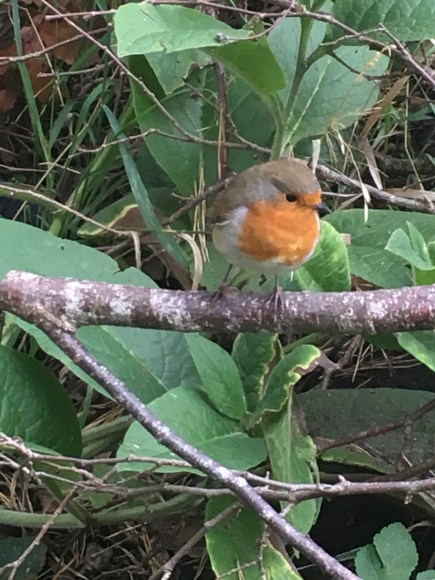
It’s National Poetry Day and I’m clearing old woody clippings from an allotment that is, thanks to Rosa, coming back to life like something in Frances Hodgson Burnett. As with yesterday’s digging, I am accompanied by a robin. It is friendly enough to allow me to photograph it from close up. I love its jet-jewel eye and the way its chest moves as a bubbling song comes from somewhere in its tiny body. I love its daring proximity – it flies so close at one point, a wing brushes my leg.

Its closeness and seeming trust mean I am able to photograph it – but miss the Mafiosi magpies who swoop and bicker close by, and am nowhere near fast enough for the dive of a sparrowhawk as it twists into the trees, after some luckless songbird. After the robin? My little friend?

The theme of this poetry day is truth, and I do wonder how truth exhibits itself – or is exhibited in Nature Writing. There are the monumental and disturbing images from Underland, and the small but detailed work of taxonomy and the science of magnifiers; there is the work from Peter Fiennes on woodland, and the research from Mat about language and landscape – and then there is this robin, and the magpies and the hawk. Guardian nature writing; CaedmonGilbert White; Edgelands and the Shell Country Alphabet: they all bring something to the kaleidoscape that seeks to explore and explain and act as advocate. There is a cloud of witnesses here.

But to think about truth in Nature Writing (why those upper case letters?) and a short poem I was brought back – by that killer robin, terror of the worms I was turning over, and by the sparrowhawk that set the wrens in ear-achingly shrill panic – to the ambiguity of our gaze. The robin as my friend – or as belligerent defender of her/his turf? Sparrowhawk as dangerous thief – or as a beautiful trajectory on an autumn day?

And that gave me the poem for today, a marvel in concise, painterly imagery from Anne Stevenson, and a sharp reminder of the way our truth, our human truth is only ours, not universal:

Gannets Diving

The sea is dark
by virtue of its white lips;
the gannets, white,
by virtue of their dark wings.

Gannet into sea.

Cross the white bolt
with the dark bride.

Act of your name, Lord,
though it does not appear so
to you in the speared fish.


The sparrowhawk didn’t get the robin, by the way.

Sing me…

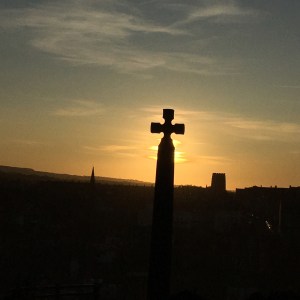
Bede’s telling of the story of Cædmon’s miracle has a freshness in Old English that is as sharp on the mind as the iodine of seaweed is on the tongue and in the nose here in Whitby. We meet in this untutored farm worker a confrontation between lack of self confidence and grace, between establishment and creativity – and the birth of vernacular English poetry. Whatever the truth of this story, when even its location is in doubt, I just want to record my gratitude to this moment when the stress of politics and belief found some release in a moment of creativity.

In the well worn story, the unmusical, unpoetic Cædmon who has skulked off to avoid singing, is commanded to sing by the miraculous dream-visitor:

Eft he cwæð, se ðe wið hine sprecende wæs: ‘Hwæðre þu meaht singan.’ Þa cwæð he: ‘Hwæt sceal ic singan?’ Cwæð he: ‘Sing me frumsceaft.’ 

Sing to me of the beginning-making.

Sing of creation, sing of Nature: sing into English the glorious hymnody, the great Nature poets: sing John Clare, Rob MacFarlane, Wendell Berry, Ralph Emerson, sing Maya Angelou and Alice Oswald and Keats and Hopkins and Thomas and…

… and here I am in Whitby and conscious of all the ambiguity in this story, but nevertheless wanting to say thank you for the burgeoning of beauty that gave us the tale of the night-watchman who changed us for ever.

A Good Story

I commented on Richard Powers’ book when I was part-way through, making connections between Robert Macfarlane’s magisterial (for me almost scriptural) Underland and Powers’ rich and mind-expanding The Overstory. For what it’s worth, the link is here. This is just a codicil, really, trying to make sense of what I think eco-literature might be.

Powers’  narratives are rich and engrossing, and while I see Patricia Westerford as having the key storyline – another character towards the end of the book hearing one of her lectures suggests this might be the author’s intention – others will follow this disparate fellowship of artists and activists, cowards and heroes in different ways. It is Westerford, the lost-then-found scientist of forest and human interbeing, who has the message from an ecological perspective:

“A fluid changing web of purposeful lives dependent on each other”

and

“Our brains evolved to solve the forest…to see green is to grasp the Earth’s intentions.”

However, there is more than just sermonising here. The deliberately rhizomatic storylines, in which characters reach out, connect, have meaning gives the novel a keep-your-wits-about-you edge: challenging  and yet engrossing. The endings for the human dramatis personae are ambigous at least. Dodging round the spoilers I can just say that one character, facing a Hellish future, nonetheless finds purpose in his life past and to come, gains the one crumb of comfort possible to him: that he knows what his purpose has been, and is: to give the moral purpose of his ecological insights the story they need.

I was very conscious of this impetus – perhaps it is what has driven my reading of these final sections of The Overstory – when I was in the Lye Valley at the weekend. Lye Valley is a short walk from where I live, a SSSI, a small, very rare piece of fenland, only, really, kept up by strenuous conservation. I was impressed by the Friends of Lye Valley‘s efforts as much as I was concerned by the encroachment. IMG_0719Not the silly vandalism of arson, harsh though that is, but the more calculated threatened developments that will alter precious run-off and the way light touches some areas, of potential pollution and game-play from developers, Councils and Trusts. How small conscience-easing grants alone will not in the end preserve such a small piece of wetland in the suburbs of a land-needy city. Change is of course inevitable in so many ways: my copy of W G Hoskins Making of the English Landscape opens, I see, at the 1795 map of Middle Barton, and his comments about village development; my mind turns to the assarts of Leafield and the encroachments on and enclosures of the great forest.

I loved the Grass of Parnassus in among the wet grasses of the Lye Valley, and how its mention in a low countries herbal in the C16th might come from a visit to this very site; I loved the lousewort, the service tree  – but these are not enough to make a story, even in tiny England, let alone in a world of Amazonian fires, and in any case, what would our whingeing be to an aspiring farmer in the C18th or a family looking for land in the C14th? When as Jack Zipes says

To have a fairy tale published is like a symbolic public announcement, an intercession on behalf of oneself, of children, of civilization

I wonder if this also applies to a book as big as The Overstory or Underland?  An intercession (not a sermon) on behalf of civilization?  So is this really the purpose of ecoliterature? Not to persuade in itself – The Overstory doesn’t do that – but to give a story on which imagination and theory can come together?

[…]

I am – seriously – interrupted as I type by a blue tit fluttering and tapping the window frame, looking (I suspect) for spiders to eat. Spiders that are maybe here because of the little evening flies that I attract by having my light on.  Another little story.  I lose the thread, and have other work to do but will post this anyway, ending with half a parable. Maybe that’s all we have at the moment: collections of half-parables.


Lewis, Merlin and Our Most Perilous Time

My mention of Jane and the Pendragon in my earlier post suggested to me that some of the good things about C S Lewis’ problematic text That Hideous Strength come from the interplay between the modern world and the enigmatic emergence of Merlin, meeting with his leader, Elwin Ransom, the Pendragon, a Cambridge academic who by chance or design now holds the fate of an embattled world in his hand. In a comfortable country house in England the two men are in discussion about how to save Britain – the Arthurian Logres – from the grasp of its power-hungry and immoral leaders:

Suddenly the magician. smote his hand upon his knee.
“Mehercule!” he cried.“Are we not going too fast? if you are the Pendragon, I am the High Council of Logres and I will counsel you. If the Powers must tear me in pieces to break our enemies, God’s will be done. But is it yet come to that? This Saxon king of yours who sits at Windsor, now. Is there no help in him?”
“He has no power in this matter.”
“Then is he not weak enough to be overthrown?”
“I have no wish to overthrow him. He is the king. He was crowned and anointed by the Archbishop. In the order of Logres. I may be Pendragon, but in the order of Britain I am the King’s man.”
“Is it then his great men — the counts and legates and bishops — who do the evil and he does not know. of it?”
“It is — though they are not exactly the sort of great men you have in mind.”
“And are we not big enough to meet them in plain battle?”
“We are four men, some women, and a bear.”
“I saw the time when Logres was only myself and one man and two boys, and one of those was a churl.Yet we conquered.”
“It could not be done now.They have an engine called the Press whereby the people are deceived.We should die without even being heard of.”
“But what of the true clerks? Is there no help in them? It cannot be that all your priests and bishops are corrupted.”
“The Faith itself is torn in pieces since your day and speaks with a divided voice. Even if it were made whole, the Christians are but a tenth part of the people.There is no help there.”
“Then let us seek help from over sea. Is there no Christian prince in Neustria or Ireland or Benwick who would come in and cleanse Britain if he were called?”
“There is no Christian prince left. These other countries are even as Britain, or else sunk deeper still in the disease.”
“Then we must go higher.We must go to him whose office it is to put down tyrants and give life to dying kingdoms.We must call on the Emperor.”
“There is no Emperor.”
“No Emperor…” began Merlin, and then his voice died away. He sat still for some minutes wrestling with a world which he had never envisaged.

No Emperor.  Lewis’ meditation on the collapse of morality and faith comes immediately after the Second World War, another episode in the devastation of Europe in the C20th.  It is a fantasy novel, of course, and has moments of comedy, insight – and a troubling theological sexism. It would make a wonderfully quirky film – with some very notable rewriting.  It is a harking-back to a golden age that Lewis tries explicitly in some of the Narnia books, and indeed the kings and queens and heroes who come to rescue Narnia are in some ways reimaginings of the Arthurian rescue: they do not sleep under a hill, but take another life in our mundane England.

It is this that Susan Cooper is answering in her charge when her Merlin tells the children that their task is to take up the Matter of Britain themselves, not as fantasy readers or antiquarian scholars but by engaging with the power that harms and grasps and mocks. Cooper’s Merlin is more worldly wise than Lewis’ when she has him say “ the evil that is inside men is at the last a matter for men to control.” I have discussed this hard lesson before – but it is a hard lesson. Arthur will not do it; no Archbishop or Monarch is going to save us: we have to do it. Lewis’ Merlin, under the guidance of his Pendragon, rises to the challenge, and the difference between Cooper and Lewis is that his Science Fiction does have rescuers, in the tutelary spirits of the solar system who endow Merlin with supernatural power. Lewis is playing with allegory here, and in the passage cited above shows how the disjunction can be an effective plot line. Cooper saves her message for the last pages of her sequence of books, and the message is clear: in times of crisis, of confrontation, a new post-War morality requires us to step up, to make choices and to act on them.

And the “Most perilous time”?  A line from a monk on the eve of the dissolution of his monastery, another period of question, of violence, manipulation and painful reemergence. Not always are these moments of crisis just the matter of fiction.

Corvid, my Corvid

So I was standing in a large auditorium reading the names of people who were being awarded doctorates. There were more than I expected – in fact more and more seem to appear on the sheaf of papers I was reading from. I dropped the papers, and picked them up in any order. The hall kept getting bigger, I kept seeing more people, and the titles of their theses were, over and over, relevant or interesting to me. I mugged my way through the ceremony, trying to make some sense of the papers in front of me. All those people with doctorates and I couldn’t manage to read their names clearly enough.

And then I woke up, woke up with a sense of failure – and remembered that last night I had agreed to sign my withdrawal form from my own doctoral/MPhil experience. I signed it this morning, and the should’ve, could’ve, might’ve shadows make my tasks today – reading more of Hawkes’ A Land in the Bodleian and setting up teaching for the next semester – seem at first glance empty of significance.

But – like all but one of the psalms – I cannot leave it there. The title of my research still holds good: A critical investigation of themes in the depiction of the outdoors environment in young children’s picture books and one of the things reading and reading and thinking Ludchurch duskand talking about this have brought me is a closer look at landscape and the ways people interact with it. It has brought me all sorts of authors and ideas: Macfarlane, Garner, Gawain, Ludchurch;  it continues to allow me to work with and learn from Mat and Roger, to read with joy and understanding, to think  about the pressing issues of our ecological failures, to take pleasure (as well as feel concern) as I look at the world I walk in.

So here is Mary Oliver (of course) in her poem

Landscape

Isn’t it plain the sheets of moss, except that
they have no tongues, could lecture
all day if they wanted about

spiritual patience? Isn’t it clear
the black oaks along the path are standing
as though they were the most fragile of flowers?

Every morning I walk like this around
the pond, thinking: if the doors of my heart
ever close, I am as good as dead.

Every morning, so far, I’m alive. And now
the crows break off from the rest of the darkness
and burst up into the sky – as though

all night they had thought of what they would like
their lives to be, and imagined
their strong, thick wings.

cropped-img_6934

Spiritual patience, and the ambition of crows.


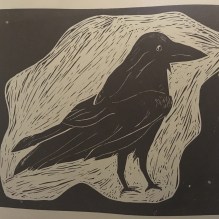
And thank you, Annie, for the raven linocut I’m finishing with. I might want to fly with the wings of eagles, but a keen eyed scavenger with a rude clarion cronk (thanks, Chris!) will do me just fine –

– and is probably just right. 

Geology and the Solar System

I use the Grandparental Reflections pages for occasional observations about my grandchildren. Maybe they are “incidents” rather than “ reflections;” Sleeping in the Bin and other such incidents are often funny and illustrate (a bit) the quirkinesses of children’s language. What follows is a reflection that came out of playing with my 6yo granddaughter, but is more a reflection than those short transcripts.  There isn’t a whole load of geology in here, or indeed the solar system – but they are part of the starting point.

6yo, staying with us, built a spaceship out of a box, wrote and drew all sorts of aliens on it, then in due course went to bed. The next morning, she and I went for walk though the local scrubby woods and out onto a disused car park. She was in her spaceship. We collected stones from the gravel, noted the Alien Squirrel, the Alien Magpies, &c., &c, then came back to my house.  What happened then was interesting, in that, with no prompting, 6yo asked for pens and paper “to make a book,” which turned out to be a catalogue of the stones and where we had found them: Hot Venus stones; Cold JupiterE9A68576-5A5E-42A6-AD82-BE280C2CBA9A stones; Cold Venus stones. She worked through all the ones we had collected, and, with the help of a “map” of the solar system, saw were we had been. She also checked them against pictures of rocks (see the photo), although not always with a great deal of success. All in all, the project took maybe 30 mins in the evening and 90 mins the next day. We had fun.

It reminded me very strongly of the kind of work I was lucky to do with children not so much younger when I worked in nursery, in the dear days when children could stay until they were five: enough time, and space and adult interest to follow a project through for a number of sessions, with purposeful writing and reading, and bags of talk from both adult and child, and curiosity and mathematical language and perseverance at a self-chosen task.

I’m not going to be so crass as to ask that every child gets these opportunities in school, because I know schools do provide children with all sorts of ways to learn and to practise what they have learned (although If I Ruled The World I would bring back 5yo into a nursery environment). But I was struck by how easily we (me included) look to Learning Goals rather than what makes for effective learning, in other words what we want rather than how children learn.  I remember when the first Foundation Stage curriculum guidance came out we had something of a battle to move it away from simple goals to paths towards those goals. It is heartening that some years later the current EYFS (para 1.9 in the Statutory Framework) suggests that effective learning can be thought of like this:

Playing and Exploring
Active Learning
Creating and Thinking Critically.

I don’t like the phrase Active Learning, but at least it can stand for the complex mix (muddle????) of hands-on activities, persistence, learning from mistakes… but do note that “Shhhh and listen” is not part of it, any more than it was in 2002 when REPEY stated that

every effective form of pedagogy must be instructive in some way

but that

learning is an interactive event, where the child actively constructs his/her own understandings within a social and physical environment.

Wouldn’t it be good to hear more EY practitioners – and I’d include KS1 teachers – using this language? What might a parent-teacher meeting be like if, in the kind of meeting that might happen, say, in the spring of Y1, a teacher reported primarily on how Child A or Child X approached their learning? If, in other words, we looked at how children learn with a greater seriousness, and if the formative experiences of early Primary School were described to parents and carers not by what the children have (and then by implication have not) achieved but by what has excited their learning?  Would this allow us to look again at discovery as being more than “look at what I want you to see,” as a teacher suggested to me recently?

This comes back to the heart of the current debates about the models of childhood we use, and the difficult questions they bring to the surface. Should adults so set up Early Childhood education as to prepare children for the responsibilities of later study, or work?  Is relationship simply a tool to make instruction easier? A red herring when our true role is instruction to make children able to overcome barriers of social exclusion? Or are children going to be allowed to rule in some innocent-but-not-innocent kingdom where their wills are supreme? How might adults boundary their time, their energy?  What is the role of parent well-being in the healthy family? Do children have to be the key agents of their learning, their behaviour, their relationships?

The title of this blog post was deliberately misleading: my granddaughter did not intend to learn about rock formation or the planets any more than I intended to teach her. What we intended was some nice time together, a rare occasion for just the two of us in a home environment, and specifically in outdoor and indoor play.

What come from it for me is reflection on the nature of the adult-child relationship, and not just at home, but in the educational processes outside the home too.  What is the child in the family? What is the child in the family in the school community?  We are at the heart of the argument Ruth Swailes and others have tried to engage Channel 4 in this week about a programme they plan to air tomorrow. In her blog, Ruth argues (and I agree with her) that co-regulation is the effective way for children to learn how to make appropriate responses – but the reason a programme about training your child using dog-training techniques is even considered is that questions such as the above are not seriously open to scrutiny.  There is still room for discussion in lots of these areas – but TV sensationalism will not help us.

I know that with the ways we are swinging and falling and dividing among ourselves there is little or no energy for this debate right now – but when might we get the time?  Because the dog clickers are ready, and TV companies want the viewers, and will court all sorts of insanities to get them: the discussions will not wait.


Emmett and Caleb and

The book Emmett and Caleb is a simple story about two friends, an exploration of friendship DE186CC4-0C87-4FD2-B161-7040A806FA69not unlike DuBuc’s Up the Mountain. Hottois and Renon give us a bear and a deer who live next door to each other, and we follow them through a year and through the ups and downs of their friendship. They live in a world where a deer can check the internet in bed, and where a bear can roast chestnuts.

Ian Eagleton has already laid bare much of the complexity around this relationship in his revealing interview with the author, which is linked here. Karen Hottois says so much in her responses I couldn’t better it. There is lots more, both in the book and the interview  – nature, landscape, the seasons, freedom: I’ve tagged this post “spirituality” precisely because of this richness and the interior life of the characters it reveals.

Sarah Ardizonne the translator has deliberately chosen to use the word “love” where the French original uses “aimer, ” as an indicator of the relationship between the two characters, and Karen Hottois is clear about her intention when she talks with Ian:

To me, Emmett and Caleb are friends but I did indeed deliberately write in such a way that they might be something else. First of all because I think that the contours of a relationship aren’t always clear-cut and because I wanted my readers (children and parents alike) to be able to interpret it as they want. Nothing gives me more pleasure than when I’m told that same-sex parents enjoy the book and can identify with it.

Let’s unpick that paragraph a moment. Hottois isn’t sidestepping the question about the relationship between the two animals at all; rather she is meeting a very big question about friendship head-on.  What language do we use for a strong male-male relationship?

To start with I want to return to this blog post from a while back. I based it on the illuminating messages of Dennis Tirsch, which I expanded to say that

The sacred is not defined by how it might be attained but by how it is  boundaried by reverence.

And this caution, this reverence, is what gives me great joy when reading Emmett and  Caleb – as much as when a friend calls me to meet.  It is there too in the physicality of relationships: hugs, the touch of a hand, whatever; and in the ways these physical expressions of friendship are like and unlike the ones that are part and parcel of being a dad, or even part and parcel of more involved romantic and intimate relationships. Except I’m not sure I like intimacy as a euphemism: Emmett and Caleb do not have a sexual relationship that we can see, but their relationship is certainly intimate. In a certain sense  whether their relationship is sexual doesn’t matter in the story: real intimacy is what is at the heart of the book.

Now, this sounds like a cop-out. “They don’t need to be gay like that, just really good friends” sounds like something from my parents, and that’s not what I think at all.  I do think that Love is a powerful word, and maybe it is scarily powerful for many men, but physical expressions of intimacy are not impossible. I take joy when I meet a friend in the Weston Cafe for coffee; likewise I have friends I can cry with, share poems with; friends I have taken a cup of tea in bed; friends I can dance with, borrow clothes off; friends I kiss when I haven’t got a cold; friends I have lent my dressing gown to (and readers of Emmett and Caleb will understand the references). With some friends I share really difficult stuff about my emotions, or about the pains of growing old, or the schlep of parenthood.  The Venn diagrams for all these would look like a kaleidoscope, and changes in culture change the patterns we discern, but it isn’t easy, because the word Love is not always accessible to men.

Sometimes that feels unfair: love is such a complex and involving thing, but it should be possible for men to use the term.  It’s there, but not nameable. It “dares not speak its name” because its meaning is so often seen as not complex, a simple dart of Cupid.  I cannot deny the two characters in this book that feeling, of course: books are interpretation places and anyone who comes to a book can approach it and savour it as they wish.   I can also see the tender and committed affection between bear and deer  at various points when they are tearful, or sharing the winter cold, or whatever – but it is as complicated for Emmett and Caleb as it is for us. I called this post Emmet and Caleb and because whatever the interpretation of their relationship, it stands for so many others.  They stand for me and my friends. When the deer and the bear struggle to express their feelings and they tussle about poems and messages, I am fully in agreement with Karen Hottois when she says that

the contours of a relationship aren’t always clear-cut.

This emerged last year in the context of professional use of the word Love, too, which I discussed and is increasingly present in children’s literature. In Keith Negley’s Tough Guys (Have Feelings Too) , which I have mentioned before, and which comes up in the work on masculinities and fatherhood Mat and to some extent I have been exploring, seriously characteristic, even caricature male figures – superheroes, wrestlers – are shown to have a similar relationship to their emotions. I am glad they are vulnerable – very glad this vulnerability is on show in a book for children.  Mat calls it an “optimistic and liberating story of starting down the road to a sense of emotional freedom for the modern man and father.“ Emmett and Caleb, too, live in a world where they enjoy the change of seasons, a last dance at the end of a party, thinking about each other’s birthdays… They do not live in a bloke culture where everything is painfully clear cut. And I am glad they don’t – and again, glad that this relationship is open to interpretation, to discussion, to ambiguity. My world is like that, too.

To concentrate on who Emmett and Caleb might be “in real life” or what that real life might consist of is to miss something important: the role of closeness in male friendship, a sustaining, honest closeness.

Emmett brought Caleb his dressing gown. They stayed there, keeping each other warm.

Together, like that, they could last the whole winter.

Yes, we read this and really believe they could.


Once a king or queen

What happens at the end of the Narnia stories puzzles lots of people. At least I’m not alone: this is a really interesting example.  The End of All Things, Narnia’s apocalyptic destruction is a complicated and vivid run-through much of Lewis’ vision for his world, and the growing deceit and corruption are brought to a close by the parousia – not of the Son of Man on the clouds of heaven but by a headteacherly “Enough is enough” from Aslan.

The Last Battle (the title of the book is itself worth pondering) is the defeat of goodness at the very doorway that leads to judgement. In the depths of early Christian persecution, the writer of the Book of Revelation may have felt much the same. There is a problem throughout Lewis with the vaguely Persian/Indian Calormenes in that, with a few exceptions, they are The Baddies, and their covertly invading of Narnia is already problematic in its racism; here they team up with the power-hungry and deceitful to wreck the rural idyll of Narnia. Am I the only Catholic child to have read in the ape Shift pushing himself as spokesman for Aslan a cruel criticism of my own beliefs? Perhaps this is one of my problems with the book; from an early read I saw this as Lewis knocking down pet hates one by one…  (I think now I was wrong: Shift is a warning to a lot of people – but the initial doubts do stay with me.)

But when after the crisis and the End of All Things the narrative moves into the new Narnia, Aslan’s heaven, Lewis keeps going. Susan, one of the great Queens of the first story, The Lion, The Witch and the Wardrobe, is not in the curtain call of great heroes that wraps up the narrative:

‘Sir,’ said Tirian, when he had greeted all of these. ‘If I have read the Chronicles aright there should be another.  Has not your Majesty two sisters?  Where is Queen Susan?’

‘My sister Susan,’ answered Peter shortly and gravely,  ‘is no longer a friend of Narnia.’

She has grown up and away from the world that promised her she would always be a Queen.  It is the problem of adolescent catechesis, the theological issue of the perseverance of the saints.  “Once a King or Queen in Narnia,” Aslan has promised, “always a King or Queen”  – unless growing up has presented the Elect with other choices they have not refused. In Susan’s case it seems drastic and maybe final:

 ‘Oh Susan!’ said Jill. ‘She’s interested in nothing nowadays except nylons and lipstick and invitations. She always was a jolly site too keen on being grown-up.’

‘Grown-up indeed!’ said the Lady Polly, ‘I wish she would grow up…’

When Alan Garner returns to his Weirdstone stories he too addresses the issue of how a child in a story grows up. In ways reminiscent of Atonement, he acknowledges that such growing up requires a sacrifice – for Garner it is mental well-being; for McEwan it seems to me to be self-honesty: where Colin in Boneland is lost and wounded, Bryony’s mauvaise foi allows her to deceive her readers and herself.

Susan has neither luxury; she is written out as frivolous and sexual: no longer a friend. We have met adult, marriageable Queen Susan already, trying to avoid marrying the (of course) odious prince of the Calormenes in The Horse and His Boy. (In fact, we met all four of the children-grown-to-be adults at the end of The Lion, The Witch and the Wardrobe. I first read their retransformation when I was nine or ten; a re-read of the books at thirteen or so made me think “Poor Peter: to have to go through this twice.”)

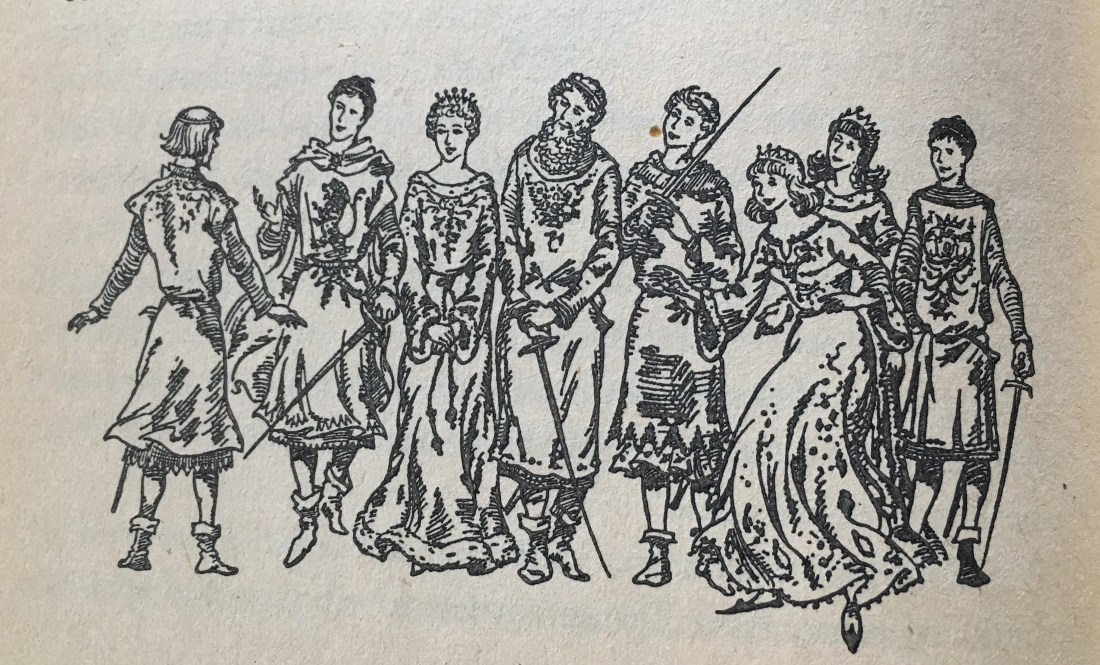
But what of Susan? She is avoiding her family, and thus avoids the train disaster that kills them. When we see the heroes, they are in a form we will consider (haltingly) below: Here is the line-up of the heroes of Narnia’s history, younge, freshe folkes, he or she, turned from worldly vanity –  and the iconography is worth considering:
D7B0F758-C623-4ED0-A220-4A072DC75341

The only bearded hero is the older man, Digory; the others are young knights in the first flush of manhood.  Susan is not with them, although the other “daughters of Eve,” Polly (with a perm to indicate her seniority) and Lucy and Jill are there.

The excellent and thoughtful collection Women and C S Lewis has a number of chances to address Susan’s absence, with Elmore and Brown’s essays perhaps being the most pertinent. Brown‘s essay Are the Chronicles of Narna Sexist? is a defence, in some ways, of the portrayal of women in the Chronicles, and while I’m not sure I can sign up wholeheartedly to this approach, there are some points worth pondering here. Of particular note is that while her exclusion may seem final, time is continuing in “our” world: the train accident that has brought three of the great monarchs of Narnian history to Aslan’s Country with their friends and mother and father leaves socialite Susan Pevensie (who has been asked repeatedly to reminisce about Narnia and refuses, excluding herself from much of her siblings’ gatherings) with a terrifyingly huge amount of  grief, multiple regrets, and a huge amount of legal and financial clearing-up to do.  Do we imagine Aslan, the Christ-figure, will leave her to do this? Can Peter’s “No longer a friend” cancel out Aslan’s “once a Queen. always a Queen”?

A reading of The Great Divorce suggests to me there is at least some hope that in the Hell she finds herself in after this devastating tragedy, there is further opportunity for salvation: “There is no soul in Hell to whom He did not preach.”  Like the characters in the Great Divorce, she may not take it. She may, in all these (I suspect rather smug: Peter was ever pompous) invitations back to meet up with their friends, have seen what is on offer and refused it irrevocably. Tempting to write the fanfic: Lewis tries very hard with an uncomfortable question, but the text itself seems unforgiving. He will come to write later (see below) of “A door slammed in your face, and a sound of bolting and double bolting on the inside. After that, silence.”

However, the issue of children growing up adds all sorts of complexity.  People change as they grow, and Lewis knows this and represents it in so much of his writing it is pointless in a short piece to try an overview. Representation of age, and specifically of youth, recurs several times in Lewis’s fantasy; in worlds where time is changeable – Narnia or Perelandra – the issue of ageing and salvation is an interesting line to follow.  Compare these passages: apologies for the sketchy intros to the characters.

In this first, Caspian, the young, eponymous Prince has become King, and by the end of The Silver Chair has grown up and old and has died: the earthly children are standing by his corpse in Aslan’s Country:

And the dead King began to be changed. His white beard turned to grey, and from grey to yellow, and got shorter and vanished altogether; and his sunken cheeks grew round and fresh, and the wrinkles were smoothed, and his eyes opened, and his eyes and lips both laughed, and suddenly he leaped up and stood before them — a very young man, or a boy. (But Jill couldn’t say which, because of people having no particular ages in Aslan’s country. Even in this world, of course, it is the stupidest children who are most childish and the stupidest grown-ups who are most grown-up.) And he rushed to Aslan and flung his arms as far as they would go round the huge neck; and he gave Aslan the strong kisses of a King, and Aslan gave him the wild kisses of a Lion.
At last Caspian turned to the others. He gave a great laugh of astonished joy.

People have no particular ages in Aslan’s Country, in a state of grace or not in the Country.  Stupidity is the model Lewis uses for those for whom grace is in some way not sufficient, but note that being at the end of adolescence is somehow the desirable age for heaven, or for the bodily resurrection.  If Susan were to return to the faith of her youth, Lewis would grant her, perhaps, the crown, the vitality and maybe the physical appearance of her young adulthood.  Why? Herbert McCabe, in his collection of sermons God Christ and Us, makes a telling point about the resurrection of Jesus:

…the Hebrews saw sickness and death or hell as much the same thing…

So, when you died young, as Jesus did, your spirit or ghost was excluded from the joys of life. So the ghost was the sign of death. ..

This is what filled the disciples with alarm and fright. At first they saw Jesus as a manifestation of death. They have to learn that he is a manifestation of life.

After his ideas in the 40s and 50s (represented in the Space Trilogy, in Mere Christianity and in Narnia), there comes his blistering and raw dissection of love and death in A Grief Observed.  A longer piece might look at this uncomfortable text…  But for now it is worth seeing resurrection much as McCabe suggests: a re-inclusion in the joys of life, for which, maybe, early adulthood is a satisfactory metaphor. But Susan’s materialism is about to be given a shock when she sees the newspaper and connects who was on the train – and then her telephone rings….  The author of A Grief Observed would not, I think, countenance the after-story he sets up in his earlier book: the grief that “felt so like fear…” “All sorts of pleasures and activities…simply written off”  “A door slammed in your face.”  Unless, of course, he would recognise the possibility of a painful repentance and the Leap of Faith in The Pilgrim’s Regress.

*

Let’s leave the healthy “very young man,” enjoying the beatific vision, and Susan (in my speculation) offered the same, and turn to Lewis’ adult novel, That Hideous Strength – link here, and a good critique of its complicated plot here. In this passage Jane, the female protagonist, meets Ransom, the wounded Pendragon who has travelled in the heavens, now called (significantly) Mr Fisher-King, the Director of the resistance to the evils of post-War Britain who lives in a large house called St Anne’s.

Of course he was not a boy – how could she have thought so? The fresh skin on his forehead and cheeks and above all on his hands had suggested the idea. But no boy could have so full of beard. And no boy could be so strong. She had expected to see an invalid. Now it was manifest that the grip of those hands would be inescapable and imagination suggested that those arms and shoulders could support the whole house.

It seems to me the same vision, and it is worth pondering why.

I want to see the boyishness of the resurrected Caspian and the returned Ransom as an attempt by Lewis to depict the resurrection. It is always worth remembering that Lewis was by trade a medievalist and therefore we might look at sources such as the art and literature of the Middle Ages for his inspiration.  We might look at the images of death I have explored before: the Funnybones school of portraying life after death. Giotto, for example (apologies for the link, but the best-looking source is full of adverts) give us resurrection scenes where age is valued but in heaven has not withered its ancients; Fra Angelico’s dance of the saved and the angels at the Last Judgement (very apt for the Last Battle and beyond!) is even more vivid in its fresh-faced angelic and human dancers.  If the youth renewed like the eagle’s (the important Biblical link: Ps 103) is Lewis’ way of inviting his readers into the theology of salvation and resurrection, it does two important things: it gets round the issues of growing old and heaven and the resurrection of the body; it also avoids the uncomfortable feeling that resurrection might (as one one my Theology tutors once jibed) mean my having a reanimated corpse.  Resurrection is therefore a renewal; for Caspian and the heroes of the Last Battle, all is light, refreshment and peace (and hearty adventure: no chance of boredom in Aslan’s Country!); for Ransom the wounded Pendragon, it means he brings his wounds from his great struggle with evil with him, as does Christ in the Gospel narratives.

And Susan growing up? Well, in avoiding the train crash she has more living to do, more time to think. She grew away from Narnia as she put away childish things, but maybe she will know God better in the human world, with time.  As Timothy Radcliffe suggests in Seven Last Words, “It takes time to fertilise human language with the Word of God.” Perhaps as Susan does the growing up Lewis thinks she needs, there is hope for her in Lewis’ vision of the divine economy.

Perhaps.


Imperium

Three conversations today – much on Social Media, but some actually (yes!) with Real People – bring me back to where I was last week for Joe and Asiye’s wedding.

Aachen. The astonishing Carolingian Cathedral.  Pause here for the UNESCO entry and  here for the Wikipedia entry and for some holiday snaps.


It is an architectural jewel, and the Treasury stores artworks that are beautiful and priceless.  I reflected on the human cost of such a glorification of empire – the taxing, the fights, the cajoling, the bullying – while caught in admiration of the artefacts and in wonder at the Cathedral building.  Easy to fall in love with this art; easy, maybe, to fall for the propaganda of who is actually in charge. So here is a brief thought from a Christian perspective. Clearly, only from a Christian perspective: even in writing this,  Pullman’s Magisterium looms from the shadows.

I often like to test out how chant would sound in places connected with that piece of music. This version of the Laudes Regiae, the Royal Praises may not be quite as I would wish (because I’m picky) but gives a sense of what is going on in this lengthy chant to welcome emperors, popes and others. Christus vincit, Christus regnat, Christus imperat.  I should have liked to sing it in Aachen – but wouldn’t dare, if I’m honest: a chicken clucking in a convocation of eagles.

But how do I translate that refrain? Or more particularly how would I want to translate it in these turbulent times, when a President is proclaimed in the US in salvific terms, and when Catholics in the UK Cabinet seem oblivious to so much Catholic teaching?

The first translation might be

Christ conquers, Christ reigns, Christ is the Emperor.

But I wonder. Too easy to feel buoyed up by this, seduced rather, into thinking it is Christ who has put the King, the Pope, the Emperor, the President in control. The intrigue, the backstabbing, the battles, the bribes: it is Christ who has done this. Time, I think, in a world where we know our “rulers” better than that, to turn it on its head.

It is Christ who is the conqueror, Christ, the King, Christ, the Emperor.

After all the Laudes continue:

Ipsi soli imperium, laus et iubilatio
per immortalia saecula saeculorum.

To him alone (sc Christ) is the imperium, the praise of the jubilation, for the undying ages of ages.

Not someone who thinks they are important when an election falls their way; not someone who rises to power because of support for this colleague or that…  The Royal Praises are another Sic Transit Gloria Mundi – or more: our leaders, or rulers, or ministers or whatever are too easily portrayed as executors of the will of God when they are (or can be) no more than Shift, the ape who is gulling the Narnian people in C S Lewis’ The Last Battle.

Christian liturgy and theology is rather better than a wa y of glorifying people on power – or can be…

Underland and Overstory

He still binges on old-school reading. At night he pores over mind-bending epics that reveal the true scandals of time and matter. Sweeping tales of generational spaceship arks…There’s a story he’s waiting for, long before he comes across it.

Richard Powers, The Overstory, Neelay Mehta

I read.  I read fast, slow, recite, note, on line, in paper books, out loud, in silence.  I’m not unusual in this, even in the binge-reading of some of the books that have come my way recently.  I do find it tiring, sometimes, even, oddly unnerving to see a TBR (To Be Read) pile mounting – but still compulsive. Like Patricia in The Overstory:

Then the reading, her nightly thousand-mile walk to the gulf. When her eyes won’t stay open any longer, she finishes with verse…

The walk for me includes all those classics unread, new books set to educate and delight, those well-loved books from the past that I have loved long since and lost awhile; re-reading is about depth but is also about limit and comfort, too (I finish with M R James more often: verse just makes me want to write)… The urge to read is maybe one reason why I go back to well-loved favourites ( for example, I have just got my third copy of C S Lewis’ That Hideous Strength*), even when tired at the end of a day.

Just sometimes, however, a pile of books present themselves that are of such quality that any sense of “one sodding thing after another” (to reuse the judgement on history from one of Alan Bennett’s  History Boys) is completely lost. As the title of this post suggests, they are Rob Macfarlane’s magisterial Underland and Richard Powers’ The Overstory.  In this case it’s two books: not really a pile.

“Reading,” Margaret Meek suggests, “demands explanations beyond the information given about the surface features of language, important as that undoubtedly is.”  It is with this in mind that I reached nearly half-way through Overstory and found this line, the culmination (or at least first-act closer) of the story of a botanist who discovers that forests are themselves ecological systems with their own means of communication:

There are a hundred thousand species of love, separately invented, each more ingenious than the last, and every one of them keeps making things.

The echoes with Underland and the wonderfully named Merlin Sheldrake do not need repeating. Woodlands are not there to be judged as needing tidying.   – except that the human users want things a certain way. On the way I often run, for example, there is a young dead badger: already a bit bloated, with flies on its fur and the sweet smell starting. Do I look at it as part of a massive pattern, a fractal maybe, which at my level is discernible as flies and fungus and young trees and older ones, soil that was the badger’s life – or do I impose my need, even the drive of my spirituality (misplaced, I think) to show it respect?  In reading Underland and then The Overstory, I know how illiterate I am, like Powers’ prisoner, here:

If he could read, if he could translate…If he were only a slightly different creature, then he might learn all about how the sun shone and the rain fell and which way the wind blew against this trunk for how hard and long. He might decode the vast projects that the soil organised, the murderous freezes, the suffering and the struggle, shortfalls and surpluses, the attacks repelled, the years of luxury, the storms outlived, the sum of all the threats and chances that came from every direction in every season this tree has ever lived.

Leave the badger by the path in the wood, move it, bury it?  Clear it up, and the pattern shifts: do we intrude by trying to make sense or enter the dance? Write about the history of Warneford Meadow in an effort to explain these scrubby trees to one side in what is grandly called a wildlife corridor? Look (as Paul Kingsnorth does in his essay on Burnham Beeches in Arboreal) at the networks of mycelial threads even here?  Maybe seeing it is our part in the pattern?  I confess that, in reading these books, I have been feeling elated and dismayed, disepmowered and propelled to try and and understand. And if we don’t try, then, bleakly as one character finds 

All that’s left to sell up here is nostalgia.

All we have left is commodification, where even story is no longer an invitation to greater understanding but simply the cheap tricks of landscape depiction, a collection of backdrops and no more.

Arboreal, Common Ground, Underland, The Overstory and so much magnificent writing all stand as a challenge.

Turn but a stone and start a wing

or miss the many-splendoured thing?

IMG_0245


_____________

*As a diversion: To me Lewis’ That Hideous Strength is a book at once of its time and horrifyingly prescient in its vision of popularist seizing of media and power that is accompanied by radical and appalling dehumanisation. I admire some bits (the almost-not-there Institute Director who roams the corridors: every academic has known him), I love others (the discussion between Merlin and the C20th academic who has to bring him up to date), and have to say I wince at others – not least the final paragraphs). Of its time is a periphrasis or maybe euphemism for the fact that it is all terribly clubbable, Oxbridgy stuff with a deep theology of sexism thrown in…  So why the re-read?