Merlyn

I am reading T H White’s The Book of Merlyn again after a long break.

The paper trail is not edifying so maybe it needs acknowledging – at least, the messiness needs some acknowledging. It is a mess of the biographies of two men: William Mayne and T H White. There remain all sorts of issues about how we celebrate the creativity of people whose personal lives did not measure up to the standards we would wish. That is at least some acknowledgement…  

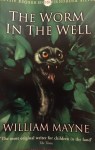
I came back to the Sword in the Stone again having read William Mayne’s The Worm in the Well, which echoes it. I asked when I’d read it if Mayne’s flaws deafen me to his message of reconciliation and renewal; I find myself asking over and over the same with T H White – something I was alerted to in Helen Macdonald’s H is for Hawk. But for the purposes of this blog post (which will largely be quotation from the Book of Merlyn) I am going to set aside the author and look at the text.

I know I’ve written about the magic patriarch before, when Merlin, Merriman et al have come up from my reading (here, for example, where I mention White explicitly, and then here, for the “humanist rabbit pulled from a transcendental hat,” and most recently here) but Merlyn – note the spelling – is here at the moment because of T H White’s lost-and-found masterpiece and its subject. Setting aside the moving first sections, the re-encounter of Merlyn with his former pupil (now beaten and old and depressed) the substance of the story brings us to Badger’s sett, to, in effect, an Oxbridge Senior Common Room in the grand old style, the Combination Room, where Arthur is tasked by Merlyn and the animal committee to make sense  of the human condition, in the last night before Arthur’s final battle.

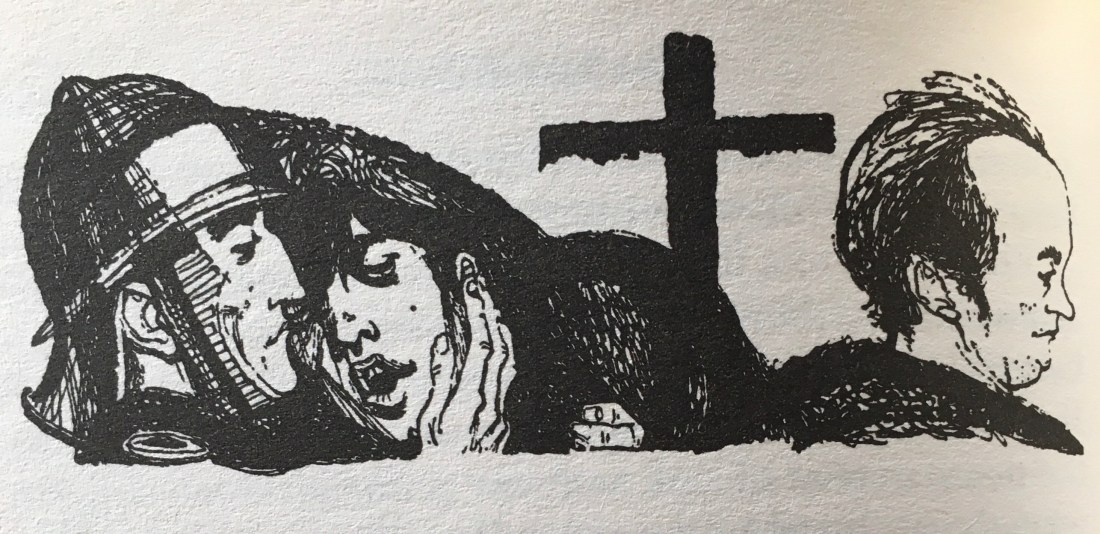
White’s construction of Merlyn’s prophetic powers is that he is living his life in the opposite direction to the rest of us. Merlyn has known the insanities of C20th totalitarian regimes (White wrote the book as part of his struggle about whether he should maintain his pacifism), refers affectionately (but not without criticism) to his friend Karl Marx, and gets muddled in trying to explain to Arthur that the whole story they are in is on a book – the book I am holding. img_1629The gentle, bookish comedy aside, this allows Merlyn the painful knowldege that Arthur is to die in battle the next day, and for White/Merlyn to comment on fascism and communism, and for King Arthur, lost and tired,  to ponder his path, as (with the the magician’s assistance) he visits ants, geese and takes advice from the donnish Badger and the Plain People of England in the shape of the Hedgehog… What makes Arthur Arthur? What makes a Human Homo Ferox rather than Homo Sapiens? Facing defeat of everything he thought he stood for, yet surrounded by his animal advisers and under the magic of the querulous Merlyn (beautifully depicted by Trevor Stubley), Arthur, the aged king, is exhausted:
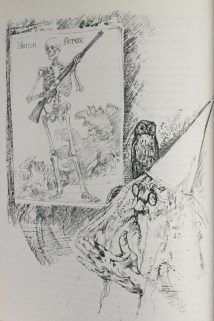
There was a thing which he had been wanting to think about. His face, with the hooded eyes, ceased to be like the boy’s of long ago. He looked tired, and was the king: which made the others watch him seriously, with fear and sorrow.

They were good and kind he knew. They were people whose respect he valued. But their problem was not the human one…It was true indeed that man was ferocious, as the animals had said. They could say it abstractly, even with a certain didactic glee, but for him it was the concrete: it was for him to live among yahoos in flesh and blood. He was one of them himself, cruel and silly like them, and bound to them by the strange continuum of human consciousness…

One of them himself. Politics, ethics, where to belong and whether to resist: these are not abstractions for White (in exile in Ireland in 1942 as he writes), or for Arthur – or for us. As he writes, Tolkien’s Fellowship are paused at Balin’s tomb in Moria, Lewis’ protagonist in The Great Divorce is sent back to everyday life in Oxford rather than face the terrible sunrise of the parousia: it is a decade of loss and darkness and doubt. Life should have been sorted in the War to End Wars that ended in 1919 – and hadn’t been. Arthur continues to ponder:

…he had been working all his life. He knew he was not a clever man.… Just when he had given up, just when he had been weeping and defeated, just when the old ox had dropped in the traces, they had come again to prick him to his feet. They had come to teach a further lesson, And to send him on.

But he had never had a happiness of his own, never had him self: never since he was a little boy in the Forest Sauvage.… He wanted to have some life; to lie upon the Earth, and smell it: to look up into the sky like anthropos, and to lose himself in clouds. He knew suddenly that nobody, living upon the remotest, most barren crag in the ocean, could complain of a dull landscape so long as he would lift up his eyes.

And I know how he feels: to have some life seems to me to be a core desire – certainly for Arthur, whose life has, throughout the books, been so rarely his own.
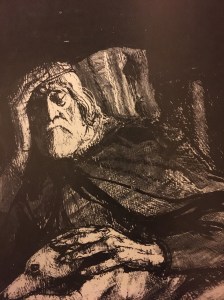
Is this last part of this post a spoilier? I find it hard to say: the book has a moving ending, the various endings to the legends providing their own kind of speculative fiction.  The sleeping king of so many folktales? Avalon? Edinburgh? and White has to make his own move about his position on war and resistance. But before he does, he finds space for his own legend of Arthur Rex quondam et futurus:

I am inclined to believe that my beloved Arthur of the future is sitting at this very moment among his learned friends, in the Combination Room of the College of Life, and that they are thinking away in there for all they are worth, about the best means   to help our curious species: and I for one hope that some day, when not only England but the World has need of them, and when it is ready to listen to reason, if it ever is, they will issue from their rath in joy and power: and then, perhaps, they will give us happiness in the world once more and chivalry, and the old medieval blessing of certain simple people – who tried, at any rate, in their own way, to still the ancient brutal dream…

But defeating the barbarities of Attila or Sauron or Mordred remains only a hope, an aspiration, and I return (as ever) to Susan Cooper’s bleak but rousing Merriman:

You may not lie idly expecting the second coming of anybody now, because the world is yours and it is up to you.

A different , maybe more grounded Merlin and a different hope to the poor hope of the exiled White.
After Noise

I suppose partly in response to my last post and the idea that goes with it that I am wholly at home with the Whisper of running streams and the immense depth I want to record some of the things I observed in my “quiet time” today:

  • An earworm of the Queen of the Night’s aria, left over from a detective drama I watched;
  • An urge to get up and feed the chickens;
  • The need to revisit my marking;
  • Where I can get peppers for roasting for tea tonight;
  • How Maggie’s meeting is going and whether she will bring home any Pfeffernüsse;
  • How I would respond to a tweet about ad orientem Eucharists;
  • Why I should take a photocopy of Sunday’s Introit and see if my voice can carry it after my sore throat;
  • How Ro’s throat is today, and how my children and my mates are getting on;
  • Whether my bus pass has run out;
  • How nice the silence is;
  • Whether I could make a blog post out of my distractions.
  • Yes, that last one is where I am now: distracted and writing about distractions.
  • But it does strike me that, while admitting these contrails of thoughts as an antidote to the last bit of piety, it is worth recording more fully that penultimate one: in the midst of too much online presence, silence is like clear, fresh water. So before signing off – and recognising the online marking I have to do this week – here’s something I wrote a few years back.
  • After noise, silence that you can drink;
    the clock resumes its syllable,
    light is once again important,
    and thoughts scatter in their errands
    leaving the house less cluttered .
    Silence runs to reach a level,
    a still dark pool beyond the day’s rapid.

    Stillness, dancing and sunlight

    A quick anthology (an extract and four short poems) to exemplify one of the aspects of “dancing above the hollow place,” that complex and simple phrase of Ursula Le Guin’s in The Farthest Shore that I first explored a couple of years ago.

    First, T S Eliot, striving to express the apophatic in East Coker:

    I said to my soul, be still, and wait without hope

    For hope would be hope for the wrong thing; wait without love,

    For love would be love of the wrong thing; there is yet faith

    But the faith and the love and the hope are all in the waiting.

    Wait without thought, for you are not ready for thought:

    So the darkness shall be the light, and the stillness the dancing.

    Whisper of running streams, and winter lightning.

    And then his younger contemporary, Thomas Merton:

    When in the soul of the serene disciple

    With no more Fathers to imitate

    Poverty is a success,

    It is a small thing to say the roof is gone:

    He has not even a home.

    Stars, as well as friends,

    Are angry with the noble ruin.

    Saints depart in several directions.

    Be still:

    There is no longer any need of comment.

    It was a lucky wind

    That blew away his halo with his cares,

    A lucky sea that drowned his reputation.

    Here you will find

    Neither a proverb nor a memorandum.

    There are no ways,

    No methods to admire

    Where poverty is no achievement.

    His God lives in his emptiness like an affliction.

    What choice remains?

    Well, to be ordinary is not a choice:

    It is the usual freedom

    Of men without visions.

    Then the great and painful Elizabeth Jennings, whose poem Teresa of Avila for me has the saint and her experiences just right:

    Spain. The wild dust, the whipped corn, earth easy for footsteps, shallow to starving seeds. High sky at night like walls. Silences surrounding Avila.

    She, teased by questions, aching for reassurance. Calm in confession before incredulous priests. Then back – to the pure illumination, the profound personal prayer, the four waters.

    Water from the well first, drawn up painfully. Clinking of pails. Dry lips at the well-head. Parched grass bending. And the dry heart too – waiting for prayer.

    Then the water wheel, turning smoothly. Somebody helping unseen. A keen hand put out, gently sliding the wheel. Then water under the aghast spirit refreshed and quenched.

    Not this only. Other waters also, clear from a spring or a pool. Pouring from a Fountain like child’s play- but the child is everywhere. And she, kneeling, cooling her spirit at the water, comes nearer, nearer.

    Then the entire cleansing, utterly from nowhere. No wind ruffled it, no shadows slid across it. Her mind met it, her will approved. And all beyonds, backwaters, dry words of old prayers were lost in it. The water was only itself.

    And she knelt there, waited for the shadows to cross the light which the water made, waited for familiar childhood illuminations (the lamp by the bed, the candle in church, sun beckoned by horizons) – but this light was none of these, was only how the water looked, how the will turned and was still. Even though the image of light itself withdrew, and the dry dust on the winds of Spain outside her halted. Moments spread not into hours but stood still. No dove brought the tokens of peace. She was the peace that her prayers had promised. And the silences suffered no shadows.

    And lastly, although I can’t replicate his indents in the text, R S Thomas’ Waiting, the final stanza of which is also in my breviary:

    Face to face? Ah, no

    God: such language falsifies

    the relation. Nor side by side

    nor near you, nor anywhere

    in time and space.

    . Say you were,

    when I came, your name

    vouching for you, ubiquitous

    in its explanations. The

    earth bore and they reaped:

    God, they said, looking

    in your direction. The wind

    changed: over the drowned

    body it was you

    they spat at.

    . Young

    I pronounced you. Older

    I still do, but seldomer

    now, leaning far out

    over an immense depth, letting

    your name go and waiting,

    somewhere between faith and doubt,

    for the echoes of its arrival.

    All this from a small dog?

    Doodles the therapy dog whom Cherryl Drabble has introduced to her school and written about has been much in my thoughts, and was the subject of a blog post at the start of this academic year, when I asked this strings of questions:

    • Should schools be therapeutic spaces – or should the task of learning itself be enough to raise self-esteem and motivate? How does “belonging” fit with one’s identity as a learner – or an educator (thanks, Jon, for the timely reminder on this last point as I prepare a class on the Sociology of Education)?
    • If a dog is right for one school, should all schools get one? How might  practice in a school where pupils have significant needs for physical and/or cognitive support be different from other schools? Should they be seen as different?
    • What is the role of the professional as an autonomous worker? How do educational institutions work as teams – and (see above) how does belonging and having a voice in a team look in practice?
    • What does the documentation of a National Curriculum have to say about what society might aspire for? Does this aspiration close doors or open them?
    • What makes an argument valid?
    • Does “it works for us” clinch an argument, validate a practice?
    • How does research work in a messy world of so many variables?

    That’s a lot of questions to lay at the door of one writer and her dog, and maybe a lot to ask of first year undergraduates, too. What I suppose I’m getting at – and thinking about as I gear up for the marking of their essays – is the stuff at the heart of this document, Be More Critical from Oxford Brookes’ Upgrade service.

    As a student in higher education, you need to weigh up the strengths and limitations, the values or merits of what you read, see and hear. You can then justify your own conclusions.

    Much of your learning at university is designed to enable you to develop the skills you need for life and work. A questioning, ‘critical’ approach is fundamental to everything. You are not simply a ‘sponge’, soaking up information, and repeating it in your assignments to prove you ‘know’ it. Your course is designed to help you develop a critical approach to evidence so you can apply it in your future practice…

    And so here we are, faced with a multi-headed task around choosing an essay that is

    • going to exercise and develop a student’s critical skills
    • going to be big enough to be interesting and yet feasible in about four weeks
    • going to have an accessible amount of relevant sources.

    Let’s look at Doodles.

    Cherryl Drabble’s book is friendly, chatty and anecdotal. It allows a school to ponder some of the pros and cons of getting, training, managing and, well, using a dog in therapy.  I think it has come as a surprise to some of the students that policy and practice can be presented and discussed in this voice -but of course this is the voice of education as it is spoken in staff rooms.  Is it, maybe, the voice of the educator as opposed to the educationalist? In some ways, perhaps: but here is  another critical question, and one that trails around education very often (this clip provides a nice metaphor): how does someone who thinks and writes about education differ from someone who works with learners on a daily basis? What should the new consumer (and replicator?) if academic style make of Drabble’s warm reportage?

    When Levi, a boy with ADHD (p100) readies himself for learning by playing with Doodles, and perhaps more particularly by taking charge of the dog, a number of things are in play.

    We as readers are aware of Drabble’s astonishment at this turn of events; she is showing a key (but sometimes overlooked) element in reflective practice in that she reports on her emotional responses.

    We are also aware of how her report is couched in conversational language: a student-critic will notice the turns of phrase that are suited to spoken language (“No, that wasn’t his intention at all.”) and reflect on the way in which academic language, while useful when it makes meaning clear, can also distance the reader… What are the choices for the young writer?

    It’s actually quite complex – and the deeper we go, the more there is to see:

    Why is Levi “running off some energy?” and what is the role of a TA with a child who has needs similar to Levi? What role does conformity play in a learner’s experience? What might boundaries do – impair Levi’s learning or give him a structure? How does the student in Higher Education explore the big questions around educational “therapeutic spaces”?

    And then I might ask the student reader to look again at Levi, to see how these “sensory breaks” allow him to succeed in class. Might Levi’s teacher really be looking at good practice for any learner – and how does learning at University take into account ideas of what makes an enabling learning environment? Or does it simply replicate historical precedents with a liberal (or “customer-first” neoliberal?) veneer of conversation, group tasks and chatty tutors? Should we have sensory breaks? How do we make a case – weighing up evidence, seeing arguments in context? If pace is self-chosen for Levi, if compassion and belonging underpin his learning experience, what about in Higher Ed?

    From Levi and Cherryl on the playground we are on task in “developing students’ critical skills” as well as looking at the questions this post started from.

    Wow. Yes, all this from a small dog.  


    Hope

    At the end of Rosemary Sutcliff’s The Lantern Bearers, the aging physician Eugenus reflects on the ways in which the lives of British and Romano-British peoples stand at the close of an era. The protagonist, Aquila, is looking into the night, wondering whether the victory over the encroaching Saxons will hold. Aquila is right: we know, with the author, that the Romano-British way of life is doomed. It is a story set no more than fifty or a hundred years, say, before the start of Wordhoard, with that painful first story of grubby accommodation and oppression.

    Eugenus’ lines are therefore a vaticinium ex eventu: Sutcliff can see – as Aquila and Eugenus cannot – the Osrics and Edwins, the Augustines and Bedes as well as the Great Heathen Army, the Normans, and the wars in Europe of C20th…

    “It may be that the night will close over us in the end, but I believe that morning will come again.

    Morning always grows again out of the darkness that maybe not for the people who saw the sun go down. We are the Lantern Bearers, my friend; for us to keep something burning to carry what light we can forward into the darkness and the wind.”

    She is writing in a world that has seen appalling hardship; Eugenus is speaking words of comfort but knowing that the peace will likely not last.

    But they are words of comfort and hope beyond the trite “tomorrow is another day;” Aquila and Ambrosius and Ness and Artos, the future King Arthur, are looking for a time ahead of peace and stability, knowing it may not be theirs to see: like Moses gazing into a promised land he will not set foot in.

    In the difficult incident where Aquila chooses to help an injured Saxon (skirting spoilers here) we see the first glimmer of a new Britain made of Roman, Briton, Saxon, Pict – and people whose ties to Britain were only half conceived when Sutcliff wrote. She sees a possibility of unity, of a loyalty bigger than tribalism. Hers is not the magical transcendence of Lewis but more like the charge of Cooper’s Merlin that after the grim times of the two World Wars “the world is yours and it is up to you.”

    We are at a similar point now – a time upon us, maybe, or looming, where resentments are revived, nationalism is violently imposed – but Eugenus (a name suggesting “Good People”) reminds Sutcliff’s first readers – and us – of the importance of the basic relationships: Ninnias, the pottering herbalist monk, and Eugenus, the Roman doctor, are no magic patriarch Merlin, but advisers alone. It is worth noting that Sutcliff does not give us Merlin to contemplate, and that Ninnias has a gentle and largely unheroic gospel to proclaim: hope comes from humanity for post-war Sutcliff and for the last remnant of Roman Britain.

    Up to us, then, to remember aright, to read the signs well, to act as best we can. It is not the apocalyptic Son of Man we conjure (who could? Jesus himself warns us to be guard against times and seasons) or a Merlin to stride in to save us, but peace and compassion that we need to work for ourselves.

    A thought for Armistice Day and Martinmas?

    Worm in the Well

    William Mayne again, and some thoughts on my latest reading.

    I’ve just read Mayne’s retelling of the worm legend that has a vivid version in the singalong the Lambton Worm.

    To get the Lambton song out of the way, here it is in all its glory with Bryan Ferry sounding to my mind like an escapee from a Steeleye Span tribute band and here are the lyrics. Perhaps the hectic version by Alan Price catches the C19th popular tone best… I don’t know. It was a staple song in the Co Durham school where I taught in the late 80s. My own best memory of the song was reading the lyrics to one of my reception children at the Gateshead Garden Festival (see the clip here: the worm appears at about 7′ 30″) and having to show him the word “hoy,” when he said “Is that a real word, like? That you can write down?”

    It’s not the Lambtons, however, and certainly not the song, that I want to think about, but Mayne’s retelling and my reaction. I’ve already recorded how my understanding of the relationships in his Earthfasts was changed by knowing Mayne’s story, and how alert I was to ambiguities in those relationships in my adult reading that I was unaware of as a younger reader.  I was, therefore, alert for the worm story to be, in Mayne’s hands, a sort of sub-Freudian exploration of the denial of the phallic leading to confrontation and resolution.

    I was wrong.

    In The Worm in the Well, Mayne takes the worm in a different direction.  Two boys struggle to find justice in their place as young heirs to unequal fortunes in Feudal England, and the bitterness of their rivalry spills into the next generation and changes even the metaphysics of their world. People are sewn away into tapestries; swords and loves are lost and found; the constant commentary of the nurse (precursor to Blackadder’s Nursie, successor to C S Lewis’ Batta in Till We Have Faces and the Giant Nurse in The Silver Chair – yes, Patsy Byrne again in the BBC version) and the knowing and notknowing presence of the witch Granny Shaftoe thread through and dominate everything.

    The book has some wonderful ideas: the Worm that grows more monstrous and rapacious with each rejection; the recurring tragedy of wrong choices presented like a folk tale; the brilliant depiction of a world view where magic is possible and monsters stare like heraldic beasts. Mayne has a stunningly good turn of language to describe the natural world too: “The waters of the pool went down clear into deep darkness;” “The trees scraped at the greying sky;” or “Overhead the clouds rolled together; below, the greenwood filled with darkness, blacker than nature.” There is a menace in his psychogeography throughout.

    Mayne has, of course (and thanks to Nick Campbell for this lead) looked at the awful worm elsewhere. Nick C shares, in his blog post on Mayne’s other worm tale, A Game of Dark, my reticence to deal with the biography and in A Game of Dark we have another medieval worm: a stinking menace the protagonist needs to kill (although the echoes for me are with A Monster Calls). I suppose what I want to do is set to rest my disquiet at how his personal story might affect his themes, and to praise his bold, vivid glorying in the countryside.

    When Alan, the inheritor of a manor and of the negative emotional history of his father, comes back from the Crusades, he finds his fief hushed, unloved and out of kilter, “insulated from the clamour of heaven.” His cry is a summons, an anthem of rewilding:

    “This is my land and I order it to become noisy like the real countryside. The wind must blow, and of the river rage; the sheep must shout and the meadows rave; wild beasts must run, and the clouds must rive; men must ride and children riot.”

    If I can get that biography out of my head, I hear a powerful voice telling important stories of reconciliation and renewal. Do Mayne’s flaws deafen me to his message?

    Donkeys

    No, not the satirical resistance of Led by Donkeys who have worked so hard to expose the bizarre corners of Brexit – nor yet Puzzle, the duped innocent whose impersonation of Aslan in The Last Battle is key to the destruction of Narnia. No, this is just to record how depressing it is on a wet Saturday in November to see a sequel to the Wonky Donkey book, in which his daughter is cute and has long eyelashes.

    Just to record it? Perhaps not: perhaps it is more accurate to say that this brief post is a plosive against both books. The Wonky Donkey book (I’m not linking to it) is a series of word plays about an animal where “shortcomings” in mobility, eyesight &c are hilariously (allegedly) explored. Pity the child who walks with an aid and whose teacher reads this. The sequel does try, in that the daughter of the Wonky Donkey does at least stray into smelling as bad as her father – but why the long eyelashes and the cuteness? I want to say to the author (again, no link) “Did you have to?”

    I am not always a great fan of the new wave of woke lit for children, which, it seems to me, is patchy in quality and often a bit sermonising – but can’t we do better than these dreadful donkeys? And if the defence is that they are “meant to be funny,” doesn’t that allow for a whole tranche of ableist or sexist humour to be legitimised?

    Or is it that I am cold and wet, and fail to see the humour in the absurdity of these stories?

    Carnival chaos

    To recap some of my thoughts about Hallowe’en. The use of such conquering fear of the dark activities seems to me pretty obvious:

    winter nights enlarge/The number of their hours

    and we can make the best of it by smiling at the dark. Thomas Campion‘s lyrics have it just right, and youthful revels have their place in the honey love of the closing-in evenings.

    The pro and con tensions in part arise from the abuses these revels engender. “Psychos” and “Slutty Vampires” sit uncomfortably with my English folk-horror. Yet they’re not wholly American: Trick or Treat at least has an element of bargaining amid the demanding money with menaces, unlike much of its ancestor, Mischief Night, whose joys seem vengeful or gleefully malign. A door latch has a drawing pin attached to it with dog poo, so the unwary person who pricks his thumb goes at once to suck it… a sooty chicken is induced to cause havoc at a WI meeting…

    Yes, these are both occurrences from North Yorkshire I’ve been told about.  They are the same Carnival as the Big Skeleton, the Little Skeleton and the Dog Skeleton go in for as they riot their way home in Funnybones, or the menacing pumpkin head that gets its comeuppance in the story of the hopping pumpkin  who meets an ignominious end with a goat (this is a link to a longer text than the one I tell).  But the Carnival is there because we are at a sort of seasonal fault-line, where summer’s lease is up and the dark is at the door.

    There is a sense for me that this big change is the Autumn answer to May Day. The nights close in, the socialisation is indoors, defined, more visible, with the freedoms of warmer weather lost or at least traded for friends and firesides.  When C S Lewis envisages this in the hearts of his heroes in That Hideous Strength they think of
    …stiff grass, hen-roosts, dark places in the middle of woods, graves. Then of the Sun’s dying, the Earth gripped, suffocated, in airless cold, the black sky lit only with stars.

    No mischief or carnival here s we stare into the dark.  Mischief, however, is close friends with these shadows and darkness, of the almost-known, the footsteps partly recognised. It is the younger sibling of more menace, and this is partly why it is disquieting: does it licence the bully, the vandal? In looking into the shadows, does it, as Kathleen Raine so evocatively puts it:

    Let in the dark,

    Let in the dead…

    (Northumbrian Sequence IV is cited in extenso here in my post about poetry and spirituality)?

    It seems to me that this week or so – Hallowe’en to Remembrance/Martinmas – is a real blending of a gleeful naughtiness, the swede or pumpkin lantern and the restlessness of wind and dark, wet evenings, as the chaos of Carnival mimics and mocks – and presages – the chaos and pain of the storms of winter and death, “þis andwearde lif manna on eorðan” “Talis vita hominum praesens in terris…”

    So when we smile at the shadows when we look at books for (and with) children, how do we approach death and disaster?  The too-brief nod recently to the BBC adaptation of Phillip Pullman’s His Dark Materials asks about the Beeb’s decisions to show it pre-watershed. We might similarly ask about Erlbruch’s Death, Duck and Tulip, that strange and lovely meditation on the role of death in our lives – or Thummler’s Sheets, or McCaughrean’s Where the World Ends, or Ness’ A Monster Calls…  In fact, although the list isn’t endless, there are plenty of books that offer wonderful and painful insights as they look at death and pain and loss.

    The good writer who perceives a good story need not shy away from the issues; the reader who comes to these texts comes prepared for challenge, maybe for tears – but trusts the writer to deliver something that will bring them safely to shore. Raine puts it well when she suggests that in our innocence it is still within us to

    bind in human form
    A living power so great,
    A living impulse great and wild

    and (for me the subtlest line)

    Have pity on the raven’s cry


    Forest School or Outdoor Learning

    A local school recently tweeted that at Forest School the children had “learnt about bioaccumulation through a game with foxes and mice.” Similarly today the Brookes undergraduates in Early Childhood and Education Studies learned how to make a standing-up giant, paint on trees, and how to pace a storytelling session and what to do when the sun is in your eyes.

    I don’t begrudge anyone their learning, obviously – here, or in the woods around a school, or on a walk in the Botanic Garden or (as we did a year ago) on a trip with our MA students around local parks, looking at design and purpose. Bioaccumulation is a good thing to know about; linking the wind in the trees with the listening skills vital for acquisition of skills in phonics is good, too; the practical skills of painting with mud, the health and safety aspects of transporting large logs, the content and context of telling a story about a Hallowe’en pumpkin – these are useful in their place. They will all be even more useful when applied, reflected on, maybe even when they supply material for assessed work.

    IMG_1086.JPG


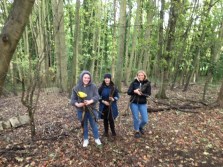
    But a purist voice in my ear asks are these Forest School?  What makes Outdoor learning – even learning in a wood – Forest School?   For me the tension is around how I “teach about Forest School,” when I find that the easiest thing to do is show activities that might occur in Forest School, which tends to mean we do adult (i.e. me) led activities, when some of the best times I’ve had with children in Forest School have been tree-climbing, den-making : things that children have chosen and devised. Should I be making opportunities for my (mostly young) adult learners just to sit, or climb, or muck about? Is mucking about a part of the curriculum?

    Perhaps rather than trying for a false dichotomy here, we might look at curriculum as something richer than frameworks for learning, or even intent,  implementation, and impact.  What might curriculum be, if the Forest is not an extra-curricular activity?  If we look at the Oxfordshire local outdoor centre, Hill End, and their statement on Forest School there is much to ponder. This seems to me to be at the heart of their thinking:

    Forest School sessions are practical and primarily child led. The emphasis is on the development of self-esteem, communication and social skills, personal responsibility and citizenship. These skills feedback positively into other areas of work in schools and settings. When embedded in the setting’s curriculum Forest School enriches and links to all areas of development and learning.

    and to move from the windswept smiles of the undergraduates this morning and this afternoon to look at this in a bit of detail, two phrases stick out for me: practical and primarily child led and [t]hese skills feedback positively into other areas of work in schools and settings. In other words one of the markers of Forest School is the child-initiated activity, and another is that skills, rather than primarily content are what feed back into school.

    Does this invalidate the experience in which the educator follows the learners’ interests? No, but what has given me pause for thought was the first year student whose commentsIMG_1091.JPG this morning  showed her perspicacity. In distinguishing (as she did) between “fun” and “engagement” she laid bare one of the most important issues facing outdoor education that follows something of the Forest School ideal. Primarily child-led, but a powerful element in enriching school-based learning. Not every student can do this so early in their course; not every teacher or pedagogic critic can do it either.

    Curriculum is not a simple set of stepping stones of skills or a navigable maze of knowledge, although knowledge and skills are certainly there, but a complex mix of both – and more: it is only really understood where context is also explicitly planned for and understood.

    And this is where the mistakes of some of my students emerge: they confuse engagement with fun, and both with notions of child-led exploration. Too easy to think about “getting children” to build a den, rather than letting them do it. Getting rather than letting, as if value comes with adult input.

    And maybe I get confused too: in trying to sell Forest School, do I go for fun over engagement, my planning over student enthusiasm, and in the words of Francis Thompson, “miss the many-splendoured thing”?

    Starting out

    Just a quick thought for the students on two of the three modules I’m teaching this semester, based on the relationship between the cat and the rabbit in the wonderful Up The Mountain. My comments here might be something to follow up, but are in no way important for what follows here. I hope this works for the three modules* but maybe in different ways: I have to say that from the outset I’m writing this really for the first years: for “my” Ed Studies students, and then for the first year Outdoor Learning people in Early Childhood.

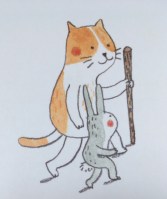
    img_9968The model that the book Up The Mountain explores is one of friendship and apprenticeship. The author wrote it in memory of her grandmother “who loved nature and books” – and that pretty much sums up my attitude to this semester’s teaching: warmth, love of Nature, love of books. 

    However, if this were all, I think I would be wondering if this was worth a degree. Just as sometimes I look at CPD that people report as inspirational and think “that was a day’s worth?” I worry that coming out of the undergraduate process thinking that one or two tutors were nice people and that being outside is lovely is just too weak. Of course, in the CDP example and the undergraduate one, this précis is too wishy-washy to be a decent overview of what anyone has learn, but what do I want students to do when starting out in  Higher Education?  I find myself as old Mrs Badger, watching the little cat explore, and grow – and pass on his delight to the (even littler) rabbit who joins his journey.  Perhaps the imagery doesn’t extend too far, a delight though the book is.

    But to move away from metaphor, let’s take Doodles, the therapy dog whose work is described in Cheryl Drabble’s book and her blog. Why use a book like this in the Introduction to Education Studies? Well, because it describes and uses the disciplines of Education Studies in a compassionate and engaged context. Real children and young people, along with their educators, have encountered and appear to benefit from a different way of working. How do we know this works?  Do we define curriculum in such a way that the experience of education has room for “cute, fluffy, handsome, pretty and furry”?**

    We will, of course, read about the uses and abuses of cherrypicking educational practices and about the ways theory can and can’t be used – from Developmentally Appropriate Practice to looking at models of (dis)advantage – but Cheryl Drabbles’ dog allows us to ask big questions through a practical lens.  For example:

    • Should schools be therapeutic spaces – or should the task of learning itself be enough to raise self-esteem and motivate? How does “belonging” fit with one’s identity as a learner – or an educator (thanks, Jon, for the timely reminder on this last point as I prepare a class on the Sociology of Education)?
    • If a dog is right for one school, should all schools get one? How might  practice in a school where pupils have significant needs for physical and/or cognitive support be different from other schools? Should they be seen as different?
    • What is the role of the professional as an autonomous worker? How do educational institutions work as teams – and (see above) how does belonging and having a voice in a team look in practice?
    • What does the documentation of a National Curriculum have to say about what society might aspire for? Does this aspiration close doors or open them?

    All this from a small dog?

    We might, by moving beyond the text itself into exploring what we mean by distinguishing between research and news media, ask

    • What makes an argument valid?
    • Does “it works for us” clinch an argument, validate a practice?
    • How does research work in a messy world of so many variables?

    All this in twelve weeks?

    No, and no. We (the students and I) are beginning to pose these questions, just as we are beginning to put together the skills the students will need for the next few years and beyond.  And of course it’s not Doodles – or even Cheryl Drabble’s book about him and his impact on her school – that gives us these things. We are using the idea of a therapy dog, and what people have said about therapy dogs (and mutatis mutandis the experiences we are having outdoors in the other modules and what people write about being outdoors) as ways of starting to explore the Big Questions both in the abstract and the concrete. We are also starting to look at the conventions that Higher Education (sort of) seeks to impose on its neophytes.  So – to end with practical questions – if we are using (as many students are) the e-version of the book, how are you going to reference a quotation from it? How might you summarise some of Drabble’s conclusions?

    41taXukT7rL._SX316_BO1,204,203,200_.jpg

    *The three modules are: the first year module Introduction to the Study of Education and the first and second/third year modules Young Children’s Outdoor Learning. Doodles makes his appearance especially in the first of these.

    **Drabble, C (2019) Introducing a School Dog: a practical guide. London: Jessica Kingsley.  Drabble (2019:98)