Sword-grey sky, daffodil light

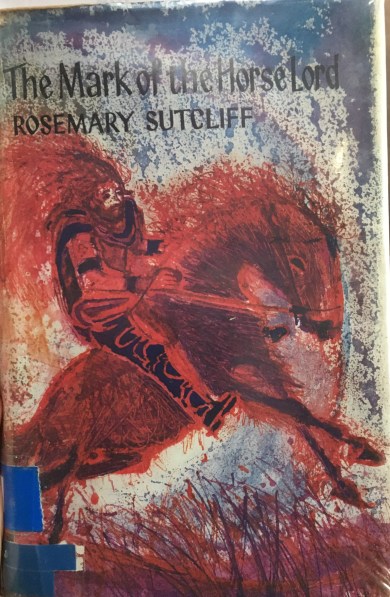
To do no more this morning than record this astonishing section from Rosemary Sutcliff’s Mark of the Horse Lord. The protagonist, newly made king of the peoples of what we might describe as Western Scotland, Red Phaedrus, img_2217
is out to catch the woman appointed as his wife. These are horse-people, as the book’s title suggests, and this rough “courtship” (here as in the Lantern Bearers Sutcliff does not shy away from the nature of marriage and being given in marriage and its impact on woman) is the bridgegroom’s chase after his bride. They are both mounted, and she has a head start as the groom’s party pursue her through the country of the Dál Riata.  Just look at this amazing use of colour and shade, and how Sutcliff anchors this in the landscape features – the whirlpool of the Old Woman, the mountain of Cruachan she has already introduced us to in map and in narrative.

The track was pulling up now, out of the great flats of Mhoin Mhor, and the quarry, striking away from it, was making north-eastward for the hills around Loch Abha head. And the wild hunt swept after her, hooves drumming through the blackened heather, skirting little tarns that reflected the sword-grey sky, startling the green plover from the pasture clearings. Far over to the west the clouds were breaking as they came up into the hills, and a bar of sodden daffodil light was broadening beyond the Island, casting an oily gleam over the wicked swirling water of the Old Woman, while away and northward, the high snows of Cruachan caught the westering beams and shone out sour-white against the storm-clouds dark behind.

Think Human and Think Literature

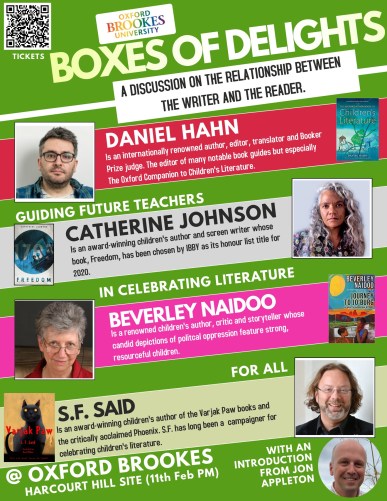
In among teaching, marking, and research, Mat Tobin has convened a really exciting evening panel conference (with me as whipper-in) and really to advertise this event as part of the Think Human festival at Oxford Brookes, I thought I’d post a brief reflection – and if you aren’t already aware of how to book in, or what the details are, this is the link to the details on Eventbrite.childrens literature conference (1)-1

The award-winning panel we will meet at the event – Daniel Hahn, with discussants Catherine Johnson, Beverley Naidoo and S F Said – will of course have their own things to say, and Jon Appleton will reflect on Jan Mark as well, to start us off. I may get a chance to reflect by blog on the issues they raise later. I won’t subvert the discussion by starting it now. Well, not much.

I wanted to take a step back and think – as this blog title puts it – about how Think Human seems to me just has to be something to do with story. Over Christmas Chris Lovegrove followed closely the Twitter conversation about Masefield’s Box of Delights and in his summing up on his blog suggested that there is “fictionalising of autobiographical elements” in Masefield. Do we – or if I’m not going to overgeneralise, do I – do the reverse when I read? Did I need in some sense to become Kay Harker, the orphaned hero, when I first read The Midnight Folk and its sequel with my mum and dad comfortably having a Middle Class cup of tea downstairs? Do I autobiographise (that’s a terrible word; I promise not to use it again) elements of fiction as I read?

In the MA module I participate in, I ask the students to look at a chapter (15, if you’re interested)  of Alasdair MacIntyre’s After Virtue in which he writes

Narrative history of a certain kind turns out to be the basic and essential genre for the characterization of human actions.

(I must admit one reason for including this chapter in their discussion is MacIntyre’s example of the young man at the bus stop and the duck – but that’s by the way).

In life, MacIntyre suggests

We enter upon a stage which we did not design and we find ourselves part of an action that was not of our making.

It would seem natural that, if we live this metaphor, we would try to discover patterns in our own narrative by looking at other people’s – fictional or actual. Empathy and even compassion are part of our participation in a story. It is interesting that MacIntyre’s own example includes this identification between storyteller and audience specifically in a drama/story context:

Each of us being a main character in his own drama … In my drama, perhaps,I am Hamlet or Iago or at least the swineherd who may yet become a prince…

I think it is fundamental to the conversation of drama, novel, even the everyday “You’ll never guess who I saw in town today…”  and perhaps it always has been. The hunter returns to the fire and tells us of the kill she or he has made, and we try and empathise ourselves into their account. Or they return and tell us of the deer that leapt past them into the undergrowth and how it lives and we think what it must be like to live like that, the choices it might make (and maybe how we might catch it) – and all of a sudden I am at one with Rob Cowan’s magnificent empathetic account of the deer in Common Ground. 4000 BCE or today.  The act of storytelling may have become more complex over millennia, but has an element of identification between telling and hearing: what one of the characters in Alan Garner’ Boneland pronounces as a ‘True Story,” a story in which we understand something more of ourselves, a story that makes us “think Human.”

But this is just my take: does everybody – writers, translators, readers – see it this way?  One of the main ideas of getting such major voices together was to urge people who come to Boxes of Delight to try and see what links there might be between how writers communicate. Are there common themes on how they approach their task? What is the importance of the values they communicate? Do they write for the child they once were; do they write with a specific audience in mind? 

See you on 11th Feb.?


Gifts Reserved for Age?

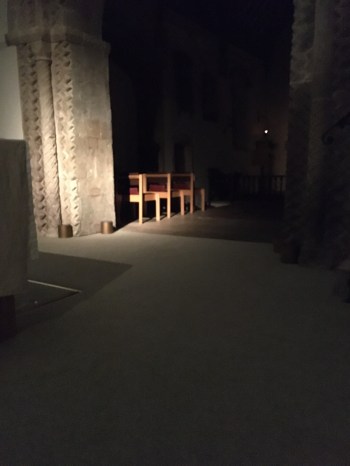
A storm was gathering yesterday that has hit us good and proper today. I had been for a walk and a coffee and came out from the pub to see the lights on in St Andrews across the way. Evening Prayer time in a warm, quiet, dark church.

And when I got home I looked up the words from T S Eliot because, I wanted, I suppose, some more of that sense of contemplation that Eliot tries for:

So, while the light fails
On a winter’s afternoon, in a secluded chapel,
History is now and England…

The aesthetic pathway of spirituality may be cultural, maybe victim to changing fashions or simply growing up, but it is not to be forgotten: it creates the thin places, or sharpens the senses to see those places where prayer has been valid, where the other and the now meet. Thin places. In the church the silent near-dark was stunning, and all those poems from all those Thomases,   Thomas Merton and R S Thomas and T S Eliot (not to mention Dylan Thomas’ “close and holy darkness”) were somehow at my elbow. And maybe the incense smudge of a memory of the church when I was a child, after Compline and Benediction, or the quiet of Magdalen after Night Prayer…

But tonight it is different, and the blustery grey has been superseded by a Wild Hunt of a storm. Time then to go back in my mind to another thin place, to the little, basic cottage on the North York moors where this poem from Kathleen Raine was posted up by a previous inhabitant, and said so much about a keener, wilder, maybe more dangerous spirituality. I have cited it before.

Let in the wind,
Let in the rain,
Let in the moors tonight,
The storm beats on my window-pane,
Night stands at my bed-foot,
Let in the fear,
Let in the pain,
Let in the trees that toss and groan,
Let in the north tonight.

Let in the nameless formless power
That beats upon my door,
Let in the ice, let in the snow,
The banshee howling on the moor,
The bracken-bush on the bleak hillside,
Let in the dead tonight.

The whistling ghost behind the dyke,
The dead that rot in the mire,
Let in the thronging ancestors,
The unfilled desire,
Let in the wraith of the dead earl,
Let in the dead tonight.

Let in the cold,
Let in the wet,
Let in the loneliness,
Let in the quick,
Let in the dead,
Let in the unpeopled skies.

Oh how can virgin fingers weave
A covering for the void,
How can my fearful heart conceive
Gigantic solitude?
How can a house so small contain
A company so great?
Let in the dark,
Let in the dead,
Let in your love tonight.
Let in the snow that numbs the grave,
Let in the acorn-tree,
The mountain stream and mountain stone,
Let in the bitter sea.

Fearful is my virgin heart
And frail my virgin form,
And must I then take pity on
The raging of the storm
That rose up from the great abyss
Before the earth was made,
That pours the stars in cataracts
And shakes this violent world?

Let in the fire,
Let in the power,
Let in the invading might.

Gentle must my fingers be
And pitiful my heart
Since I must bind in human form
A living power so great,
A living impulse great and wild
That cries about my house
With all the violence of desire
Desiring this my peace.

Which Moomin Character?

A lot can be said – and has been said – about Tove Jansson’s relationships within the books and cartoon strips, and she does indeed present a child’s Hogarth of a world, where foibles and strengths are all on show, from Sniff’s immaturity to a similar self-centredness in the Muskrat, hiding in his mauvaise foi in a dismissive attitude. And all this in a landscape that (for me when I first read the books in Harlow [as it then was] “New Town”) enticing and alien: mountain streams with crocodiles, and observatories and impromptu woodland dances…  Part of me wondered if this was how Scandinavia really was, and maybe it took reading the Summer Book at Brookes for me to see how clever Jansson was about these ways marrying of reality and fantasy. Part of me wondered if those weird and engaging people were real too, whether I had some part of me in those stories.

Turn but a tweet and start a blog, to paraphrase Francis Thompson.  A discussion today on Twitter prompted me to offer reading about the Fillyjonk as an example of the joy of private, quiet reading.  Why, when discussing reading, did I suggest a Fillyjonk as the person I want to meet in my private reading? I was thinking of Tales from Moominvalley, I suppose, and she was the first person I could think of, a minor character rather than Moomin (see below) or from his immediate friends or family.  Showing off, I suppose, like Sniff…   A Fillyjonk is essentially an anxious person “dutiful to the point of tedium – not a character I immediately  identify with, although I can see what I was getting at, I suppose: a catastophizer who meets with a real disaster.   So who would I like to be?

  • I am too much of a home body to join the Hattifateners – whom I loved because I could draw them.
  • Bingummy and Thob taught me so much about language play – but I was an only child, in effect: that wasn’t the bizarre little twins.
  • The ghost in the Exploits, with a gentle side and a macabre turn of phrase?
  • The Hemulen Aunt? There have been times when, as an Early Years teacher, I have heard her voice come out from my mouth. And Edward the Booble’s grumpy tones. 
  • The Groke? Well, she was my avatar for our Virtual Learning Environment for quite some time. I wonder whether she sloped off when I changed it, leaving a trail of frost across the internet.

This isn’t the quiz that you can do.  I haven’t done it. Really, even when I first read Finn Family Moomintroll (and heard it on Jackanory in the mid-60s), I think I had it worked out, albeit dimly: Moomintroll pining after Snufkin. And so often I could characterise my relationships – certainly the ones that had me roaming morosely around as an undergraduate – as ones in which my inner Moomin longed and longed to be the adventurous and carefree Bohemian. Jansson may not be Maimonides, but the Moomins were a family when I was so perplexed I felt I had none, and “which Moomin character are you?” would have had only one answer.  And there were quite a lot of candidates for Snufkin…

But of course the joy and the cleverness of Jansson’s characters is that you can be more than one. Dutiful to the point of tedium like Mrs Fillyjonk; self-centred Sniff; fussy and obsessive like a Hemulen, full of unrealistic hopes like the little dog who wished he was a wolf  – and now? Well, Maggie is making cakes in the kitchen, and I am in my study pondering my youth.

Inosculation

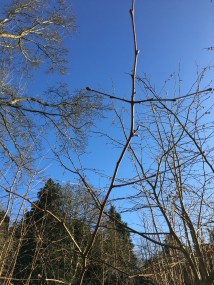
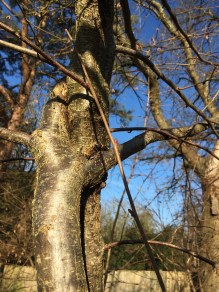
Just sometimes a day in January makes me want to believe in spring.  A chilly day down the allotment – should have been the morning but we pressed on – and my task was to finish some hazel coppicing. img_1988Well, actually my task was to tidy the absolute dog’s breakfast I had made of the hazel I had undertaken to coppice on some communal land to one side of the plots. Hacking with a billhook like William Ager had been immensely satisfying but really untidy; a mixture of billhook, bowsaw and ordinary handsaw meant I managed better. At least occupied with coppicing there was was no diggin’ to be done in the claggy soil.

Two rods stand tall on one hazel stool, and turn round each other. At one point they meet, touch and begin a process of fusing together known as inosculation, a joining together: the term has its root in the Latin word for kissing. I am, because of how my mind works, really quite moved by the metaphor – but recognise that I need to get to work. The two rods have, I guess, been working at this for years, but now I need to get cutting. I sort of hope that I can cut the fusion out as a whole piece (but in the end I can’t)… but the time the hazel has taken and the time it takes my saw to undo the fusion seem out of all proportion.

Old man on an allotment hazel stand: hardly great forestry or John Seymour-like land management. Forest School is not survival training; allotmenting is not farming. But once in a while, what we potter about at is something that is in the shadows of a bigger husbandry and a longer history: the stone axe; the horse, the enclosures.  And the kissing metaphor makes me think of so many nature writers’ respect and tenderness for the landscapes they represent. So when I come home, thinking of how this work is explored, I look at various texts. Edward Parnell’s exploring of the ghostlands of literature and his own biography; Thomas Merton’s monks whose “saws sing holy sonnets;” the changing and unchanging downs of the White Horse in David Miles’ book… and then into other writers on my shelves, where I am struck by this:

What a bare desert of a place the world would be without its woods and trees. How long would man live once he had broken the balance.

Ian Niall, in Fresh Woods and Pastures New (Little Toller did one with lovely illustrations by Barbara Greg) is keen eyed and dreadfully prescient about deforestation.

When he cuts down the planting, the copse, the old oak wood, it takes him a little while to see that the drainage is different, that the soil washing into the hollow, and new crops of rock are in his field. The lumbermen come and haul away the timber and every yard of the fields on either side changes in nature, new weeds, new grasses, more sun, less humus, water-logged drains in wet weather, overflowing ditches. A year or two, and the man sees what he has done, but how long must he wait to see it as it once was?

Believing in spring feels easy on a chill, bright January day: believing in a world where we can find ways to harvest from the earth when it looks like the Anthropocene crisis is upon us in the Amazon, Jakarta and Australia feels a lot harder. “Man sees what he has done:” but can we step back from it, somehow? Can we realise our need to reconnect, to re-fuse with the world we live in?

Gaudete II

A brief addendum to my thoughts on joy and nostalgia in Advent, at the Solstice, and at Christmas, now nearly upon us. What follows is not my thought but from the best book I have read this year; Robert McFarlane’s Underland, a book so magisterial ( I know I use this word a lot) I keep returning to the idea of it as a new way of looking at spirituality and landscape.  This quotation  must therefore stand as a codicil to the posts on his book (such as this one) and to the post on the Solstice.

In this section Rob is visiting the most northerly cave paintings we know, in Norway. After a mammoth struggle to arrive at the caves he discerns the outlines of dancers:

And when I open my eyes and look again, there is – yes, there, there in the flicker of a line that is not only of the rock’s making… And there is another, and another, here, a dozen or more of them, spectral but still present now, leaping and dancing on the rock, arms outstretched and legs wide, forms shifting and tensing as I blink.…

These figures are ghosts all dancing together, and I am a ghost too, and there is a conviviality to them, to us, to the thousands of years for which they have been dancing here together.

Dancing together. In fiction, Cole and Merriman, Will and Tolly; in history people we can name, people whose names we guess, people whose names (and beliefs) we can never know dance together:

Listen!

All the long echoes sing the same delight.

So thank you to the nature writers, nature activists, ecologists, historians, manuscript scholars, poets, fantasy writers who help us dance.  And thank you to the ghosts that dance with us this chill Christmas.

Down in Yon Forest

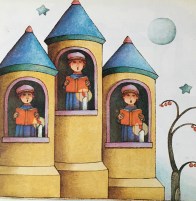
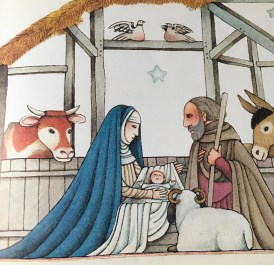
This is a bit of a mish-mash, with all sorts of sources bunged together. I’d like to think of it as an enquiry into why Christmas a time of nostalgia but suspect it is a pile of stuff under a Christmas tree with no labels: sort through the pile and see what you can find. But why do we look back at Christmas? img_1806-1Why does the glorious The Friendly Beasts by Tomie de Paola have choristers and candles to sign/sing us to the stable? It is as if the validity of Christmas in some ways springs from this appeal to the past. Is it because Christianity has created a feast in which “history” is one of the most important guests?  I’m not sure. De Paola often has this sense of tradition, such as his retelling of Italian folk tales, the beautiful Clown of God, and representations of Bible stories – and the Night Before Christmas, which is our family’s standard version of the poem (follow this link to Jake Hayes who has some lovely photos of this version). There is some of that, certainly, right from St Luke’s dating of events and the genealogies he and St Matthew produce. Perhaps it is also because, in the partial extirpation of a pagan Yule, one of the things that remains is an echo that says “remember how it used to be…” – and could this be an attempt to return to a (mythical) Christmas of our own childhoods?  And then maybe in England that nostalgia includes a sorrowing for some good old days, a golden age around  1500 CE or maybe 1600, or 1800…  There is more than one ghost of Christmas past, I suspect, and maybe as well as our personal ones we carry ones for our society too, whether we acknowledge them or not.
It is not only Dickens that feels the weight of past Christmasses. Cole Hawlings who “does date from pagan times” in The Box of Delights sings the rescued Cathedral staff back to their Midnight Mass  where they are greeted by the monks from years past

…for on such a Christmas Eve what one of them would keep away?

and Tolly’s dream-like experience of Midnight Mass moves between his own twentieth century and the past of his family in the seventeenth. As I have just cited recently, Susan Cooper celebrates this looking back when celebrating the Solstice:

All the long echoes sing the same delight,
This shortest day…

What is the attraction of the past for this festival?

In the run-up to this Christmas I come back (again) to poets Thomas Merton and R S Thomas. Here are two poems that seem to me typical of their approach to Christmas. Merton first of all, surrounded by the traditions of his faith and practice like Duccio’s Maesta or Martini’s: All those hopes and fears of all the years gathered around the Virgin and Child:

Flocks feed by darkness with a noise whispers,
In the dry grass of pastures,
and lull the solemn night with their weak bells.

The little towns upon the rocky hills
Look down as meek as children:
Because they have seen come this holy time.

God’s glory, now, is kindled gentler than low candlelight
Under the rafters of a barn:
Eternal Peace is sleeping in the hay,
And Wisdom is born in secret in a straw-roofed stable.

And O! Make holy music in the stars, you happy angels.
You shepherds, gather on the hill.
Look up, you timid flocks, where the three kings
Are coming through the wintry trees;

While we unnumbered children of the wicked centuries
Come after with our penances and prayers,
And lay them down in the sweet smelling hay
Beside the wise men’s golden jars.

Merton: Carol

and Thomas, well, Thomas is aware of the biting wind of doubt and silence in the Nada Nada Nada, Y En El Monte Nada of St John of the Cross. Here he captures a Christmas purity that I think is hard to beat:

The moon is born
and a child is born,
lying among white clothes
as the moon among clouds.

They both shine, but
the light from the one
is abroad in the universe
as among broken glass.

Thomas: Nativity

RST is like this: grounded but bleak, with a now rather than a history in his poem. This is often his way, I think (although not always): a doubting impatience in the spiritual –

Will you continue to torment us?
If you are ubiquitous, why
not be here when we say : Now?

Thomas: Could Be

I have been a student of your love

and have not graduated. Setting
my own questions, I bungled
the examination…

Thomas: Incarnation

Merton,  however, pours out his love not only for the God he seeks in monastic profession but also in places for the life itself:

The sun that plays in the amazing church
Melts all the rigor of those cowls as grey as stone – Or in the evening gloom that clouds them through those tintless panes,
The choirs fall down in tidal waves
And thunder on the darkened forms in a white surf of Glorias.

Merton: St Ailred

I’m not sure I can answer my own question, to be honest: Christmas is a time of looking back, looking forward – and inwards too. For me, the tensions between the very grounded (and dark) spirituality of R S Thomas and the almost ecstatic exuberance of Thomas Merton is resolved in a medieval lyric:

This is the text:

Lully, lullay, lully, lullay,
The fawcon hath born my mak away.

He bare him up, he bare him down,
He bare him into an orchard brown.

In that orchard ther was an hall
That was hangid with purpill and pall.

And in that hall ther was a bede;
Hit was hangid with gold so rede.

And yn that bed ther lythe a knyght,
His woundes bledyng day and nyght.

By that bedes side ther kneleth a may,
And she wepeth both nyght and day.

And by that bedes side ther stondith a ston :
Corpus Christi wretyn thereon.

It is known as a Christmas carol in a slightly altered version, where the moon shines bright on a saviour… born this night, but the earliest version seems to me to be a visit to the Sacrament where the Passion is clearly discerned.  Benjamin Britten’s version is here, but the version of Britten’s setting I know best and love is Jeff Buckley’s anguished countertenor.

But let’s go back a bit. Here I am, in the mid-70s, eighteen or nineteen years old, and opening my new Breviary for the first time, exploring what it has in it. It has an appendix of poems as well as hymns and in coming for the first time to the Corpus Christi carol I remember myself (a year or so before) back to a little gothic church in the hills above Guildford.

Lully lulley; lully lulley.

The fawcon hath born my mak away.

So why the falcon? And why the lullaby refrain? The idea of being suddenly snatched now makes me think of a sparrowhawk or peregrine, but I will let my C16th predecessor (who doubtless was more at home with such things as this MS/blog from the British Library suggest) have her/his way. In a near-sleep, dreamlike state, a soul is snatched away to a hall –

He bare hym up, he bare hym down;

He bare hym into an orchard brown.

…and in the hall in a wood (or Eden after the Fall, its trees bare), sees the truth of the link between Passion and Eucharist.

The trees surrounding the Franciscan Friary church (now Chilworth Abbey) could well be leafless in winter, and at any rate the “truth” of this matters less than what the image said to me in my late teens: a religious experience that was sudden and rooted in mediaeval imagery brought me (I am unsure who “my mak” is otherwise) to an altar, to the reserved sacrament on its bed. We might well be beyond the limits of medieval orthodoxy here, in the realm of the eternally bleeding Fisher King perhaps, as we look at the knight in bed and his attending virgin. The song remains sited for me in a small monastic/friary choir, all gothic and quiet. What strikes me some forty-odd years later is how powerful the medieval imagery is.

This seems to me to be important for a number of reasons, and at the moment, prominent in these for me is that whatever we make of this kind of medievalism it remains a touchstone of Christian – or perhaps Catholic Christian – piety. It allows us back into a time (or a mythology) where there was space for a rich visual and linguistic expression of religious practice. I might contest this, sometimes – a sort of liturgical Sealed Knot where historical re-enactment is what it’s all about – but I cannot deny its power. It allows me to read The Cloud of Unknowing, or Bl Julian of Norwich with a sense of continuity that draws on aesthetics as much as reason or ipsissima verba. It opens a door, as it were, to the MSS I love to read.
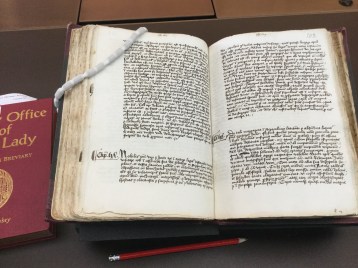
I sometimes wonder whether, somewhere along the line, I learned (probably wrongly) that this allowed me to say “I belonged;” I belonged to something big and beatific. Seeing it at Chilworth was therefore a step towards the belonging I felt for a time at Magdalen and then Ampleforth and then Blackfriars. And therefore for me Christmas might be some kind of looking backwards to see what Christmas means; to some extent, looking at might-have-beens.
Gaudete

Rejoice.

img_1787

This blog post has turned into a bit of a sermon on the place of joy. I hope it has a wider audience but let’s start Churchy: apologies if anyone can see the formatting glitches further down.

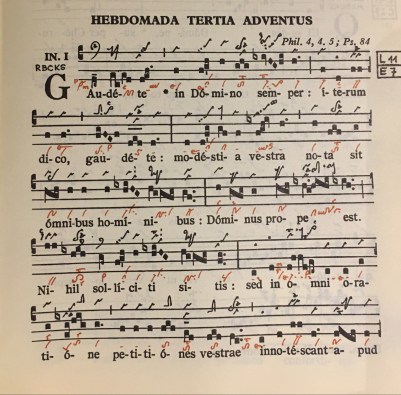
Today in the Roman Rite, the priest and deacon wear a colour that only comes out twice a year, a light, bright pink called rose . It indicates, to gloss over much of its symbolism and history, a day “off” from the penitential season of Advent. The opening song of the Mass begins “Rejoice,” as the comparable Sunday in Lent begins “Be glad.” The chant, or part of it, is in the photo, and this link takes you to it being sung. Note: it isn’t the carol popularised by Steeleye Span, but a song of waiting.

But what if you don’t feel like rejoicing?

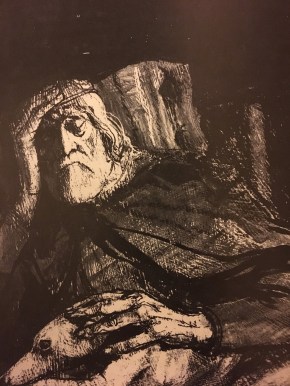
The next image is of the defeated and dispirited Arthur in the Book of Merlyn. img_1751He has, it seems, nothing left, although the book and Arthur’s lessons about what it is to be human have some way to go. The unrequited desire, the longing for fulfilment, for liberation: exhausting.

The text of the chant is one of the most famous lines of the apostle Paul in the letter to the Christians in Philippi. The exhortation to rejoice is one “in the Lord,” in expectation of the end of days: “The Lord is at hand… Take no care for anything…” but it is not a smug grin that the Philippians are to put on. We are not at a happy-clappy bus stop to heaven. Puddleglum is right.

I also wonder whether this is “life coaching” in difficult times for a whole load of people, whether in the Christian community or not. It’s about acceptance, about not being dragged down, not being lost in despair. God knows, I find the enforced jollity of Christmas hard, and this year is threatening to be as hard as the last in some ways.

So I want to jump ahead a few verses to advice from St Paul perhaps we could all listen to:

Finally… whatever is true, whatever is noble, whatever is right, whatever is pure, whatever is lovely, whatever is admirable–if anything is excellent or praiseworthy–think about such things.


Puddleglum

Above Dr Slop and Mr Slope And Mrs Proudie and all the Blooms, Flashmans [sic], Golightlies and Trunchballs (and Honeys) and other characters with significant names – even Agnes Nutter – one character in fiction stands out for me as having not so much a name as a character description:

Puddleglum the Marsh Wiggle in C S Lewis’ The Silver Chair.

The Narnian ancestor of Fungus the Bogeyman, Puddleglum is never one to look on the bright side of life. His fenny existence is as dull and damp and depressing as his expectations are low. When Eustace and Jill and Puddleglum reach the giants’ gastle, he very typically says “We’ve done the silliest thing in the world by coming at all: but now
that we are here, we’d best put a bold face on it.” I might have wished him voiced by one of the more lugubrious characters created by Les Dawson or some maungy character from Last of the Summer Wine.  Today, 13.12.19, maybe I could voice it myself.

And the genius of Lewis’s depicting such a gloomy character is that The Silver Chair is enlivened by the warmth with which Puddleglum is presented: a comic character ” as doleful as a funeral,” a caricature of an adult whose task seems to be to depress the enthusiasm of the child protagonists. But then comes this, his best speech, and the heart of Lewis’ contra mundum (or at least contra Senior Common Room) beliefs: fighting the lulling enchantments of the Witch who wants to entrap the heroes in her Underland, he stamps on her fire and returns to her:
“One word, Ma’am,” he said, coming back from the fire; limping, because of the pain. “One word. All you’ve been saying is quite right, I shouldn’t wonder. I’m a chap who always liked to know the worst and then put the best face I can on it. So I won’t deny any of what you said. But there’s one thing more to be said, even so. Suppose we have only dreamed, or made up, all those things — trees and grass and sun and moon and stars and Aslan himself. Suppose we have. Then all I can say is that, in that case, the made-up things seem a good deal more important than the real ones. Suppose this black pit of a kingdom of yours is the only world. Well, it strikes me as a pretty poor one. And that’s a funny thing, when you come to think of it. We’re just babies making up a game, if you’re right. But four babies playing a game can make a play-world which licks your real world hollow. That’s why I’m going to stand by the play-world. I’m on Aslan’s side even if there isn’t any Aslan to lead it. I’m going to live as like a Narnian as I can even if there isn’t any Narnia. So, thanking you kindly for our supper, if these two gentlemen and the young lady are ready, we’re leaving your court at once and setting out in the dark to spend our lives looking for Overland. Not that our lives will be very long, I should think; but that’s small loss if the world’s as dull a place as you say.”
The Silver Chair (and I have to admit it is my favourite of the Narnian chronicles) deals with enslavement to enchantment as the allegory of sin with such vivid detail – the eponymous silver chair being the beautiful instrument that holds Prince Rilian in thrall to the Witch – that it makes me wonder whether Lewis is doing something autobiographical here. One of the beauties of the storytelling is that it works at all sorts of levels, religious and non-religious spirituality: sin and redemption; exile and homecoming. And what are we in thrall to? And who liberates whom?
And if we are on a quest to find a way to be free, what is the role of Puddleglum in our lives?
There is a danger in seeing a superficial mindfulness as the touchstone of happiness, “I have been mindful today” being the spiritual equivalent of “I must, I must improve my bust.” What Puddleglum does is remind us that jollity is not happiness, that it is not always necessary to look forward to a glorious dawn in order to be righteous or holy or whatever. And today I think of the cruelty of the death of St Lucy, the plight of many in a false dawn for a brand new (= same old, same old) Britain, and I wonder if, with so little cause for carolings, I can be glum for a while, and alongside Puddleglum can “take a serious view of life” – and still be prepared to stamp out, when needed, the seductive sweetness of a sorcerer‘s fire.

Statio

The year’s midnight. 

“Always winter and never Christmas.” C S Lewis’ ultimate baddie, the White Witch, keeps Narnia frozen in a time when the natural cycle of death and birth cannot continue. Will Stanton in Cooper’s The Dark is Rising has his midwinter birthday interrupted, threatened, brought into its rightful place by the crises in the book. Kay Harker’s dream (or not-a-dream) sees the Christmas of Merrie England restored when the dark powers of   sorcery threaten to destroy it. I feel I also have to note en passant the most terrifying version of this for me, Michelle Paver’s adult work Dark Matter, where the narrator faces months of night time and solitude – and something far worse out on the Arctic ice. The time in late December is reenacted in these stories as a time of crisis, and the subtext seems to me to be a worry that as the days darken, the sun will not return, no hope for love “At the next world, that is, at the next spring.” A fear that This is It.

As Catherine Butler in Four British Fantasists suggests of the interplay between magic and humanity in Cooper’s Dark is Rising sequence

The Light is opposed in turn by the Dark, and most of the activity of the other mythical and historical figures involved in the sequence is related in some way or another to their struggle. Given Cooper’s insistence (as in the description of Herne) on the wildness of some of these figures, this moral alignment of their magical power might be problematic.

Problematic indeed. The complexity of this vision is one of the things that Masefield is beginning to explore, and that Lewis more or less avoids, but which Cooper meets head-on in The Dark is Rising – and in more meditative and lyrical form in a poem she first published in 1974.

The publication of Susan Cooper and Carson Ellis’ The Shortest Day , which re-presents Cooper’s 1970s contribution to a larger work, has prompted renewed interest (it never really goes away) in the interplay between UK fantasy writers and the folklore they draw on. There are some lovely reviews already out (e.g. Kirkus, Brainpickings (who [of course] beat me to the Dillard reference, although that doesn’t often stop me) praising the text and artwork, and this is not a review but some thoughts at a tangent. Again, I am not alone in this tack: Calmgrove’s Christmas Delights (which already sounds like a box of candied fruits) has a wonderful post exploring a selection of writers from Nesbit to Masefield, and then Lewis, and so to Cooper herself. By celebrating Solstice (check out Solstice here)  she sets up not a Pagan in the sense of antiChristian but an unChristian, a preChristian festivity, gloriously underlined by the images Ellis gives us, as wanderers move through a land that they increasingly mark as their own.

Through all the frosty ages you can hear them

Echoing behind us – Listen!!

All the long echoes sing the same delight,

This shortest day…

In Ellis’s paintings we see the “precarious business” as the palaeoanthropologist Chris Stringer puts it, of early humanity’s existence in our inhospitable winter, and we see our efforts – the our, I think, underwires the charm and power of this book – at keeping the dangers and demons at bay across the centuries.  It is a similar nostalgia (thank you again, Chris Lovegrove, for this insight into Masefield ) to the gathering of the ancestral (ghostly) Oldknows in Tolly’s first Christmas in Lucy Boston’s Green Knowe, that we celebrated on our visit. All those long echoes in the stones of Hemingford Grey.

It sends me back to Ronald Hutton and his Stations of the Sun. In the opening chapters he carefully dissects Christmas customs with judiciously chosen details (I was intrigued by the mummers who menaced people having been “drinking, playing at cards and fiddling all day in disguised habits”) and drops in details that have resonances elsewhere, such as the apotropaic torch rituals in the Staffordshire moorlands town of Stanton.  It has to be remembered that Hutton, although with strong ties to various aspects of Paganism, is suitably cautious in his methodology:  Hutton looks at the Roman feasts of midwinter, Saturnalia and Kalendae, and then states

The new Christian feast of the Nativity extinguished or absorbed both of them, and a string of other holy days sprang up in its wake…

before going on to explain the rise of the Twelve days and the Epiphany/Theophany in the Western and Eastern Churches.

In most of northern and central Europe, where the cold and darkness were much greater…it would have run into local patterns of pre-Christian seasonal celebrations….

But Hutton warns us that

Literary sources do not tell us anything conclusive about the midwinter festival practices of the ancient British Isles…

He find the early English sources more enlightening than many others, and his trail leads him to the conflation (as he suggests) of a Modranicht, or Mother Night, a middum wintra, with the Nativity. The festivities may predate Christian Christmas or draw on earlier practices*… And then he turns his gaze on Yule (jol, jul, juul), the jolly time of Norse festivities.

Stations of the Sun is not a pagan handbook but a scholarly exploration, suggesting that seasonal rituals were fluid, open to change, to diminishing and reinterpretation. It is right, therefore, that in his conclusion some 400 pages and a ring-round year of celebrations later he writes:

It is one of the arguments of this book that the rhythms of the British year are timeless and impose certain perpetual patterns upon calendar customs: a yearning for light, greenery and warmth and joy in midwinter, a propensity to celebrate the spring with symbols of rebirth…

[However] What is also plain is that the last couple of centuries, in this as in every other aspect of British life, have produced a completely unprecedented amount of change… No amount of nostalgia or anxiety for a rapidly diminishing or deteriorating natural environment can alter the essential irrelevance which it now possesses for the daily lives and seasonal habits of most of the British; however, this very fact may cause it to play an ever greater part in religious symbolism.

And not only there, I think.  Children’s literature – the work written “for children” and the work written meditating on childhood – seems to me often drawn to these natural cycles, and most of all to the changes of dark and light, for which the stores of story and ritual and symbol stand ready for writers and artists to draw on. I do wonder about the place of folklore and a kind of vision of archaic beliefs in the writings of fantasy – and marvel at the power of this time of year to bring out our need to explore these themes…

IMG_7731

*

Oh, I see you haven’t spelled Station right – and what is that about anyway?

I have, and this is my final point. To return to another of Hutton’s delightful side-comments, he suggests that Yule is connected not only to the world “jolly”  but perhaps to the word we know as wheel;  I can’t help thinking of the Sun Cross, the sign of the Old Ones in Cooper’s The Dark is Rising, and the ‘ring with the longways cross” the Oak Lady wears in The Box of Delights, but the symbol of the sun as wheeling around might suggest that while we think of Solstice as when the sun stands still, another version might be that it is that tipping point before a wheel starts to turn again. Nature holds its breath, much as St Bernard suggests we all do when the Angel presents Mary with her choice at the Annunciation (Nota Bene: this impassioned, dramatic passage from Bernard is set in Roman Rite breviaries as the non-scriptural reading for 20th December).  The holding of our breath: can we get out of this darkest time? The site Spirituality and Practice has a brief extract on Statio as the sacred pause.  The moment, maybe, before the liturgy starts, where everyone is standing ready, not awkwardly waiting but attentive. Birdwatching for the moment of grace. This is not to say that the Solstice is now simply that for Christian practice or post-Christian jollity – but that the winter Solstice in particular invites us to pause, to listen as the new world turns and does it all again.


*Bede is his source here. Hutton is, in case you are wondering, suitably cautious when we get to Easter and its original. 


PS:  The photo, by the way, is not an Old Way or my own Old Road outside my front door, but unexpected snow before Christmas a few years ago, taken on the feast of St Lucy, the old “Shortest Day” that John Donne celebrates (and I cited at the start of this post) and the birthday (not the feast) of Bl Lucy of Narnia. Well, sort of.