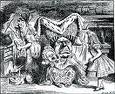
A Dialogue between Caliban and Ariel

The title is taken, of course, from the poem by John Fuller – which is worth reading in it own right: lines like “bells call out the music of the sea”  are just beautiful.

What has haunted me, however, since I first read it, is the line in Caliban’s villanelle “A language learnt but nothing understood.”   By emphasising decoding over enjoyment and comprehension,  the notion of learning to read/reading to learn, a purely instrumental view of reading, is this not what we risk? And in “slimming down” the National Curriculum, do we not risk a dulling-down (as opposed to a dumbing-down) of what is taught in schools?  Classics and dull learning (not that Latin need be dull, of course) come back under the banner that says we must not deny any child a right to succeed. But succeed at what? Succeed in a system that creaked and groaned when I was at school? Some might, from a paternalistic model of education, see the teacher’s role as setting language on the tongues of Cailbans, but is their profit on’t to reproduce or at least be compliant in outmoded ways of learning?

I return again to the animated (in both senses) Ken Robinson.

Happy New Year?

Well, now.

This blog makes for some interesting (if sometimes

Frosty at Harcourt Hill

chilling) reading for the new year but this link from earlier last year from the department sets more of an encouraging tone.  Although, frustratingly, I cannot find the dictum on qualifications in the EarlyYears,at least this from Gove himself perhaps, makes a more personal impression.

But do we now assume that local government, or school governing bodies, can make their own minds  up about who to employ in the Early Years?

Has the heating gone off, or is that a chill wind I feel?

Perhaps this link from Al Aynsley Green on the RSA site will be a little warming.

Aesthetic and anaesthetic education?

Some interesting stuff here – an RSA Animation again from Ken Robinson, whose fascinating insights I have cited before.  Thanks to my colleague Helen for the link, by the way.

The link between the growth of routine medication for possible ADHD and routine testing makes for a thought-provoking “moment” and (such is Robinson’s way) a good gag about the way different states in the US provide for what he calls a “fictitious epidemic” – but he has some important things to say about  “aesthetic and anaesthetic education” and the  link between patterns of industrial and educational organisation. And what do we make of the decline in divergent thinking throughout schooling? It reminded me powerfully of a poem Jack Zipes cites in his wonderful Relentless Progress, “…Because the houses of Quiet Restraint/had so few gifts in them…”

Spend just over 11 minutes on this and rethink (some) ideas on what education is about.

Wet play times

“My” PGCE students are out on their first day of what we term their first school experience, and the rain has tipped down, and the winds are high. It reminds me of my very first play time that I had to supervise and it was announced (perhaps somewhat gleefully by an older teacher) as Wet Play Time.

It was a bear garden, if by that term we can conjure up a hundred bears and probably about 75 crayons and the longest piece of paper – from one end of the hall to the other – and twenty minutes of frenzied drawing.

Did I mind it? Well, it was an eye-opener as to how much these rather daunting and serious-minded children could throw themselves into a rather ad hoc activity. No, it was fine, except perhaps for gathering them all together at the end. What gave me pause for thought was what counts as unsuitable weather.  Rain is out, for starters, apparently.

Then, after a stretch of some four years, I found myself in the pouring rain with a bunch of four year olds, watching water pour down the leaky gutter onto the pumpkin they had grown. We all got wet and cold, and took about an hour to invent ways of collecting water, harvest pumpkins, and so on. I thought I was very brave, smugly. I can see now I was learning.

Move forward to this morning, and my thoughts turning to the baptism by fire that might, in some schools, be Wet Play Time for the PGCE students. I find, with a bit of help, two starkly contrasting visions of outdoor play: this from Norway and this from the UK .  The emphasis on risk and protection from the v enthusiastic advocates in UK is entirely valid, but the conversations (and in some ways the actitivities) are dominated by the notion of staying safe.

Both sets of practitioners  would  claim that “Being happy, being outside and getting fresh air is clearly important for today’s children” as Heidi, the Norwegian school leader states. This is close to the four dimensions of outdoors mentioned by the Kaplans that I have discussed before: Being Away; Extent; Fascination; Compatibility. What is most striking is the degree to which they do this, the degree of Extent to use Kaplan’s phrase – one setting being next to a (doubtless quite cold) lake, where the staff meeting (in a tepee) discusses (at 12 mins 50 in the clip) being able to see the children after the winter sun disappears, and the other in a UK garden where an island is manufactured with a tarpaulin sheet (6 mins 20) and you have to pretend it’s deep water. Look at the Norway clip around 10 mins in, and see the match incident, to see real instruction, real involvement. It’s there in the UK, of course – as in the box play (4 mins 50) – but contrast that to the mountain walk in Norway (16 mins 20).

There are huge issues of confidence here – adults’ trust in the resilience of children, parents’ trust in the staff (and we can note the difference in the videos between advocating the outdoors to parents in the UK, and the parents’ voices in Norway) the staff’s trust in their understanding of the children: a mutual upbuilding of a project, arising from respect and common ideals. Is that what we’re lacking in the UK context?


Old Road

To return to Rachel Kaplan’s argument I began to explore a while back – really to revisit my walk (not really very adventurous)  up Old Rd in Headington to the Hollow Way down into Wheatley.

The Kaplans (Kaplan and Kaplan 1989 p182) suggest four key elements to the outdoors as as restorative experience:  Being Away; Extent; Fascination; Compatibility. And I saw the first two today, most powerfully evidenced in the diminution of background noise. It isn’t just that urban rumble itself disturbs, surely? This article suggests it is, and I present the link without comment. It just makes me think that “Away” is possibly away from the urban stressors of background noise, this allowing greater fascination, itself requiring extent and compatibility.

Are they all so mutually interdependent for everyone- or is it just that in the quiet on Shotover I became so much more aware of my internal chatter and my need to still it? It was just a personal thing I’m sure,  how I felt stilled on the other side of the hill, looking out at the smudge of trees in the rain, and the red kites wheeling over a ploughed field.

Merlin, Arthur, Bath

No, not some odd piece of fan fiction: this weekend’s visit to Bath raised further questions about ‘real’ landscapes and traditional tales. It is certainly something of a tourist pull – I admit I felt it myself. Had the ‘real’ Arthur – or Merlin – sat where I sat on those steps? Might they have  avoided the place as sordid, or unholy – or just plain ruined?

More thoughts here, anyway – or at any rate a long quotation from the Vita Merlini.

Play and playfulness

Perhaps I have been too allusive in recent posts on EYFS, and perhaps this is a symptom of being away from the classroom  too long – too far away from the stories shared with chidlren, the time we found a mouse’s nest, the cafe where the food was made of sand from the sand pit.  When I included here a quotation from Evangelou et al to the effect that “the art of early years practice is getting the balance right between guided and self initiated learning, either in homes or in settings” I ought to have gone further, and maybe nailed my colours to the mast.  Here, then are some more quotations to think about.
In Sue Rogers’ chapter on “Powerful Pedagogies” (in Liz Brooker and Sue Edwards’ Engaging Play) she suggests, for example that

The coupling of play with pedagogy is in many ways a deeply problematic enterprise for at least three reasons [I’m quoting just the first two here]: first, because traditionally, the concept of play has been positioned in marked opposition to its apparently more worthwhile counterpart, work. This divuision is marked not simply by the ways in which play is often relegated to specific times and places but also in the ways inn which it is regarded in practice as a marginal and recreational activity removed from the real business of the early childhood classroom. Second the pedagogization of play (pedagogy of play) has meant that play has increasingly become an instrument for learning adult competencies.

And Deborah Albon’s chapter on Playing for Real (in Janet Moyles’ Thinking about Play) starts to draw to a conclusion with these remarks:

…I do not believe there are easy answers; indeed I am suspicious of ‘easy answers’ to complex areas of practice. But I do believe the questions are important to reflect on and constantly revisit as team. This points to a need for reflective classroom discussions about play in early childhood settings that go way beyond planning meetings merely listing the resources that might be added to an area in order to organize and encourage children’s play or that discuss observations of children’s play without reflecting on the role practitioners could play in extending or, indeed, inhibiting that play.

So here’s me not being allusive:
The richest times I have seen children have in school have rarely been in the gift of the adult, except indirectly. That’s not to say that there wasn’t learning there – my observations at the time suggested the opposite – or that learning didn’t take place in opportunities I created, but simply that those times which I remember best from working with young children are those in which children seem motivated and involved in a project that has only incidentally been about their learning something I have chosen. They have been afternoons with time machines, days with dens, improvised pulleys and rope swings, funerals for dolls, and the time that mouse came out from under a paving slab.

Alice

Some thoughts on Alice in Wonderland for the class Monday 16th August.

Tenniel Alice

Key to my reading – and it is only my reading – of Alice is the theme that runs through a lot of my thinking: exploring the models of childhood in literature.

Looking at Chris Jenks’  dichotomy:

“The Apollonian child, the heir to sunshine and light, the espouser of poetry and beauty…angelic, innocent and untainted…”(Jenks 1996:73)

“The child is Dionysian in as much as it loves pleasure, it celebrates self-gratification….”  (Jenks 1996:63)
Jenks C (1996) Childhood: Abingdon: Routledge

is Alice the barely reined-in Dionysian child, who, let loose in her dreams, finds her way home (to “dull reality”) by negotiating both models – in finding how to respond to the demands around her and stay sane – in other words, to grow up? Are we looking at some kind of spiritual quest for self-realisation?  We might object that Carroll did not intend this – but again perhaps looking at what an author intended in a  story made up just to while away an afternoon’s rowing is too fraught with difficulties. In any case, when Carroll is being didactic towards children – as in his Easter Letter – we know about it.

Of course the all-important commentary is the wonderful

Gardner M (ed)  (2000) The annotated Alice: the definitive edition. London: Penguin

There are  loads of other books, looking at Alice and Carroll biographically, from the point of view of psychoanalysts, logicians, mathematicians…  An interesting way of looking at Alice might be to consider her not in the context of Victorian literature (and Alice abounds with cross-references here) but to the folk-tale inheritance and to her influence in later children’s literature: there is something of Red Riding Hood in Alice, but her literary ‘daughters’ (in Oxford terms at least) include Lucy from the Narnian chronicles and (perhaps by extension) Lyra from Pullman’s His Dark Materials.   Is she also re-presented in the precocious Cordelia in Brideshead – or is the ‘secret door’ from Alice completely different for Sebastian and Charles?

For scholarship’s sake, I suppose I ought also to attempt a filmography, since my presentation makes mention of the Disney and Burton versions, but I haven’t time, since there are lots of others, too – a silent one from 1903 which I linked to here from YouTube being the earliest I can find.

And here, for what it’s worth, is the powerpoint:

Alice Worcester summer school


Please note that since writing the Disney and Burton clips have been removed from YouTube for copyright reasons. 

Kindergarten Graduation

The end of the year approaches, the first degree ceremonies are over in UK Universities – although here at Oxford Brookes the major push for such things is in Early September – and in a cycle that has something to do with saints’ days, something to do with harvest time and now a lot to do with holidays for students and staff, people move on academically. September sees professorships awarded, (with professors being given chairs, installed or just plain appointed ), and small children move from home to early education and daycare, from early years into Big School, and then in a very few years’ time from Key Stage 2 to 3, and so on.

It is interesting to observe that business is growing in the US and worldwide around graduating young children from their earliest educational experiences. One site  with the catchy but curious name of Rhyme University sells whole packages for gradation at affordable prices. The company’s website states that “we’ve been able to successfully grow from 121 customers in 1954 to over 20,000 schools worldwide.”

The “About Us” section has a telling story to set the tone about a child’s pride in a scrappy diploma, and notes that
“If early learning provided the keys to greater success later in life, then the transition from preschool and/or kindergarten should be marked with no less importance.”
Rhyme University’s deluxe package ($23.95) comprises a cap with tassel, a gown, a sash, a ring and a diploma.

While this site – Kindergarten lessons – seeks to minimize the ritual elements, this site is more specific about what graduation might mean and might entail:  suggesting that “[E] ach year of graduating from one grade to the next deserves a special celebration” and that this is “a time to honor their achievements, let them know they’ve done great work and have accomplished the goals of moving on to the next stage of life.”

And this leads me to the thought for the day: at what point is progression the same as graduation?