A Shepherd’s Tent

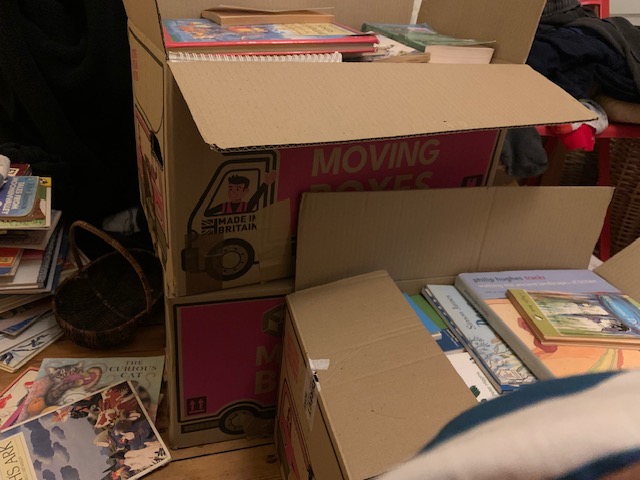
In making “my” study accessible, some of the books, a lot of my books, are having to go. How to choose? 

Lots more tidying is required, and with it a commensurate saying goodbye. This isn’t some magic decluttering nor yet an account of my following tidying “gurus” such as Marie Kondo. Far from it: there is no sparkling joy https://youtu.be/x4Nrd68bhH0?si=3LoZa2ghKZtp7oY0 and while part of that is that I won’t be buying into the hype, part of it is that the getting rid aspect has a number of other themes attached to it.

Harry’s Numbers by Jill Waterman is going to the charity shop: so many memories of reading and re-reading at the children’s grandma’s house: and there’s Bonne Nuit, a board book for bedtime given me by a priest to whom I was teaching English, to read to the children. Read out loud in French, read too in my clumsy translation in English, I remember most my trying to read it with a child under each arm.  What to look for in Summer: ah yes, all those Ladybirds dug out on trips back to Yorkshire or bought at jumble sales. The seasonal idylls were only eclipsed by the description of the Farm, and again a discussion of how the farm next door to Grandad’s wasn’t like that… Thomas the Tank Engine; Norse Myths; The Velveteen Rabbit…

And with each of these the abiding memory is a child or two or three snuggled with me at bedtime, and of me (and sometimes them) falling asleep while we read together. 

At work as well as at home, there were John Burningham’s Would You Rather – hot debates with wriggly children in Reception about having your house surrounded by jungle and Eric Carle’s Brown Bear, Brown Bear What Do You See which so often became a chanted Nursery spell with its own increasing momentum. So many more.

Do I keep books that I shared at school (and as a University tutor) because I feel I was good at reading them? Is it that shallow?  Or do I take a breath and collapse all the memories into the boxes along with (so far) well over a hundred books? 

Most of them are going, and if Alligators All Around stays, that too has a sense of sadness to it: will a keen-eyed adult never read this to a group of laughing five-year-olds again?

Oh, enough of the melancholy. 

But what is that title all about? It’s a line from a poem in the book of the prophet Isaiah, where the King laments that he will leave his life half-spent, his life “taken away, rolled up like a shepherd’s tent.” The Latin text is sonorous:

Generatio mea ablata est et convoluta est a me quasi tabernaculum pastorum. Praecisa est velut a texente vita mea. Is. 38:11

And what Hezekiah feels, that all his meaning, his capacity for life have been tidied away, rolled up as something temporary and no longer needed.

This is where the knife digs deep. I think I mourn the passing of these books because it signifies the passing of a self-image that was powerful and affirming. All self-image seems to me to be in part myth. It is a powerful and long standing myth, and giving more of it up requires me to wrench the image of the scholar in his [sic: such is the myth, although not the reality] study from how I view myself and any future work.

Starting

Who makes learning desirable?

It is a sunny day, probably in 1997 or so. Despite a visit from my Early Years adviser – at least, I hope it was “despite” rather than “In a desperate attempt to show said adviser that a teaching Head could work effectively in the nursery outdoor environment” – I was out in the garden, watching, supporting, intervening and choosing not to intervene. I remember it involved a lot of transfer of water from the outside tap, while those not playing in the sand and water were climbing trees, running a shop…  Hesitant children were being given literally a helping hand to overcome their fear of mud; more confident Wild Things were being guided towards a way of playing that was more inclusive;  a small group were playing a game we had developed together called “1 – 2 – 3 – 4 – SMASH,” in which some children were waiting until five sandcastles had been built before they could jump up and down on them. All of these were, of course, of limited success: no single activity is likely to produce a piece of learning, perfectly formed and squeaky clean. Learning takes time, repetition, commitment from adult as well as child.

At the time – maybe as now – there was some debate about curriculum content, aims, approaches. We were moving (this is a truncated version of the development) from the Desirable Learning Outcomes through the Curriculum Guidance, until we came to the revision of the Early Years curriculum under the forbidding title of the Statutory Framework for the Early Years Foundation Stage, revision of which has brought us to where we are now, with all its supporting guidance. Maybe this fluctuation of emphasis and debate is how it should always be – provided it doesn’t slide into a power struggle like some kind of Tudor court politics, where which faction has the ear of the powerful is the indicator of what is “right” or “wrong.” At the time, in the late 90s, however, Early Years education felt embattled more than challenged, and I remember asking Julie – yes, the adviser was Julie Fisher, sharp-eyed and thoughtful as ever – whether she thought the “classic” state nursery education model had had its day, if we were looking at a model that was something of a creature on its way to extinction. “Not a dinosaur,” she replied, “but maybe an endangered butterfly.”

And part of me wondered how long we had.

Last week, however, Julie was kind enough to give Maggie and me a copy of the fifth edition of the book for which I think she will be remembered: Starting from the Child? She continues to write with the passion of a conservationist, but goes much further than simply wishing to preserve a fading set of practices.

Each edition has been worthwhile, but the new, fifth edition has some really interesting things to say. I don’t intend to make a line-by-line textual analysis of Prof Julie Fisher’s fourth and fifth editions of Starting from the Child, except to notice  that the question mark has come and gone across the editions and through the years. The question mark notes the approach taken in the latest edition: Julie is clear from the preface on:

I believe that recent policies and expectations pertaining to early childhood education now make it a challenge to always keep the child at the heart of best practice. SFTC?5, p xvi

The quiet(ish) shift away from what we might have thought of as child-initiated learning came more vividly to my attention when Prof Kathy Sylva was presenting findings that were part of the EPPE project, and a transcript of a (pretty dire) group time in which the adult kept peppering her attempts to keep the children on task with “I need to you know…I want you to know.” It was a far cry from the beautifully descriptive blog post in which Julian Grenier played with the ideas of a child enrgrossed in the spider he had seen at the tricky moment of transition:

“He had held onto something that was fascinating him, despite his upset, and he had wanted to share it with [his key person] once he felt calm enough.”

http://juliangrenier.blogspot.com/2012/12/magical.html?m=1

The little boy’s insistence on retuning to the spider meant that the teacher felt overcome by a child’s sense of wonder. It’s a lovely piece of writing, made all the more so by the fact that so many of us, alert to a key interest or moment in a child’s day, have seen similar incidents. Even back as far as Margaret McMillan herself (and in her particular style) the children experience the garden with wonder:

Gold and green, purple and white, rose and blue, meet us at every step : and the children look at this newborn wealth of colour with wonder. It is surely the moment to fix these glorious tints and shades in their memories and make of them living memories.

Margaret MacMillan The Nursery School (1919) p139

In more modern parlance, this is an important part of what Annica Lofdahl describes as

the teachers’ efforts to develop a pedagogical environment that creates positive opportunities for learning and development.

Annica Lofdahl, “Who gets to play?” in Brooker and Edwards Engaging Play (2010, p123)

Time and again the pedagogical decisions of the adults are about creating positive opportunities for children to greet their environment and their important people (children and adults) with questions about how the world works. Julie puts it clearly:

Curiosity is  provoked by a high quality environment in which children pose their own questions

SFTC?5 p27

We set up an environment in which the children can move from attachment to home people to adults and children they can trust, in an enviornment that allows curiosity to flourish. Not just busyness, note: a place where questions are at home, where adults build on what they already know of a child. This is how we “start from the child.” It is not a step-by-step “now you learn this;” equally it is not a vague wandering round a nursery with a key worker trying to entertain or distract the child. No: Julie is looking for a patient building on interests known from home, an understanding of how children learn and how sequences of learning and development work.

It is in the opening pages of Starting From the Child? Ed 5 (SFTC?5) that Julie talks about this in terms of the child being intrigued and curious. Likening young children’s learning to a traditional jigsaw, Julie – ever the one to choose an engaging image – points out how a child turns the piece round, examines it with patience. The adult is watching, maybe commenting or questioning, but fully grasping that this is learning prompted by the child’s own curiosity. Where then is the adult?

It is the skill of the educator to be aware of the pieces of the jigsaw that the individual child already has in place and whether or not they have fitted the pieces together correctly. If they have not, then supporting the child to review the construction of their cognitive jigsaw is as delicate and difficult an operation as persuading the child to remove a piece of misplaced wooden puzzle… The inappropriate imposition of connections can lead to the learner becoming confused and disaffected…The effort to make connections is all the more likely and all the more successful when a child is motivated to do so.

SFTC?5 p28

This seems to me to at the heart of what Julie Fisher is getting at, with the title of her book. It is by no means a worn-out phrase, but one that needs regular reappraisal and challenge. Starting from the Child might mean simply

What do I want this child/these children to learn and how will they best learn it?

SFTC?5 p67

Have I reduced this to such simplicity that this looks like a book of obvious assertions? It certainly isn’t that. When Julie explores fundamental differences between the adult and the child curriculum she is clear that

…it should never be assumed that learning [sc for every child] will be equally sequential. Each child’s sequence will be highly idiosyncratic according to the knowledge and understanding they already have and that they bring with them to the learning situation.

SFTC?5 p114

And this underlines what she has written earlier:

As educators we join the child some considerable way along their learning journey.

STFC?Ed 5 p11

And this previous experience – which can be positive or negative – has to be seen as fundamental to the learning attitudes and processes the child brings. Observation – and effective communication with parents and previous settings a child might have engaged with – allows us to hone in on what a child is motivated by. The chapter called Whose curriculum matters? has sections and examples on how context allows children to revisit and apply new knowledge and understandings. (SFTC?5 p116)

Yet – and this is where I have to finish – Julie would not want the reader to think this is something wholly in the hands of the child or children any more than it is in the hands of the adults in an Early Years setting, but often takes places in the negotiated space of a rich and curiosity-provoking environment. I love the section (SFTC?5 pp128ff) in which she exemplifies adult-led learning being used in child-led activity, and vice versa, child-led activity being picked up and extended in an adult-led context.

We are back in my nursery school in the nineties: how we move water with buckets and guttering was important to the children and the language was – thanks to the adults (not just me – but teamwork and shared adult expactations makes a whole different blog post) – extended and enriched by modelling, deep questioning, shared attention and excitement. The same was true with the sandcastles, the shop and the chasing games.

Having different purposes and different outcomes does not preclude adults and children from learning from each other’s plans and outcomes. Each must be given time to flourish and to conclude…

What must be achieved is a balance – a balance ensuring what children are to learn influences how they learn. But primarily, all that is known about the child as a unique individual is the starting point for planning the curriculum – whoever leads and whoever follows.

SFTC?5 pp129, 130

Okay, Let’s Go

So it’s book 5 of Heartstopper, and Nick and Charlie, after a painfully long time for the readers (although less for the characters) are prepared, have motive and opportunity… and from coy first kisses way back in book 1 are going to have …

Well, what are they going to have, and what do the readers have to read into text and image?

Conversations around sex and young adult literature seem to me to centre around two questions: Do the characters have to have sex? and How appropriate is the depiction of what they do? Since Alice Oseman’s style allows the (pretty inescapable) sex to take place, she is caught needing to decide on what to show. And it is “pretty inescapable,” in that the kissing that takes up the physical side of Nick and Charlie’s relationship from Ch 3 of Book 1 only starts to build much later – but build it does.

This has attracted a number of critical responses, summed up (and to a large extent demolished) in vlogs like this from Obviously Queer and elsewhere. [Heartstopper] “is unapologetically showing queer love being wholesome innocent and slow.” If this is not the case in other teen product or even in real life, the slowness of the developing relationship is charming, and leaves emotional room for the and finally of Book 5. This is a key scene, taking place some days before the excerpt below, and note that the reader is left to fill in at least some of the blanks.

It is clear from the conversations between characters that the blanks are to do with penetrative sex, and that after a very long period of awkward relationship development (the line “Why are we like this?” is a refrain in a number of scenes), we are seeing-yet-not-seeing something incredibly intimate, decorated with giggles and whispers, with trainers and trousers discarded, so with the condoms and lube Nick has bought in Oxford being brought out from his suitcase we have little room to doubt what’s going to happen. “Okay, let’s go” may sound more like the start of a rollercoaster ride than a key point in their relationship, but Oseman is entitled to depict these two star-crossed lovers as having fun.

Heartstopper Book 5, Ch 7, 1563

And this might be where the reader gets a shock: is it acceptable to see this as fun?

Of course it is. They may have taken what seems to me to be a very long time getting there, and Nick and Charlie, one of the satellite texts in the Heartstopper canon, suggests it was a bit nerve-wracking for the young characters to start, but maybe when we think of what is acceptable to be shown, we see Oseman’s skill at changing narratives. This is not about the mechanics (or geography, if you prefer the metaphor) of sex, or the metaphysics of love and sex, but simply about fun.

Is it right to depict sex as fun instead of guilt ridden (or even a liberation from guilt)? How does the adult gatekeeper react to this sidestepping of traditional attitudes and narratives? The argument about Lyra and Will in Pullman’s The Amber Spyglass (no time to talk about the do-they-or-don’t-they? or the Bowdlerisation of the US edition) suggests to me a deeply concerning attitide from adult readers: brought up on the post- D H Lawrence bonk fest, it is almost as if adults need to see the sex and then disapprove of it. Oseman is telling is This is Not Our World, even if once it was.

Where is Prince Hamlet When the Curtain’s Down?

Happy Ever After?

For some time I have been intrigued by the stories not told in books written with children in mind (I’ll use the shorthand “children’s literature” from now on): the author (and sometimes the reader) consider what happens before a story starts, what happens alongside and afterwards. In some books these “beyond the text” narratives are hardly dealt with at all, and characters emerge like Athene from the brow of Zeus, fully formed. It can work well: the child reader particularly perhaps invests in a child they might assume to be like themselves. Often the characters are introduced and then bits and pieces of their lives are dropped in. This too works well (if done sensibly), fleshing out details of the character as needed. Rarely, however, do we see this detail in the minor characters, and we are often left at the end of a book with “that’s all right then:” justice is served, wrongs put to rights and “all manner thing shall be well.”

Folktales, because the characterisation operates on a very different level, can sometimes have a sudden ending that is unsatisfactory in terms of modern structure: characters are set up, have an adventure or resolve a crisis and go away, go home, marry a prince or princess and live happily ever after. It seems to me that these stories have broadly the themes of return and resolution (often retribution). This kind of traditional tale may raise eyebrows as we read them today, but the point is that the curtain falls on a happy scene.

But what about afterwards? How long is “happy ever after” anyway? Ever strikes me as the problem here: per omnia saecula saeculorum is not how mortals live.

Sometimes, when picking up the “afterwards,” stories end with a challenge: The Lantern Bearers by Rosemary Sutcliff ends with the responsibility laid on the protagonist (and by implication the reader) that it is “for us to keep something burning to carry what light we can forward into the darkness and the wind. (I have blogged about it here); similarly Susan Cooper’s sequence The Dark is Rising ends with the charge “you may not lie idly expecting the second coming of anybody now, because the world is yours and it is up to you.” So it is ip to survivors and their descendents to make sense of it all, to take on the lessons learned. Peter Dickinson’s stories of the development of the first humans in Africa, The Kin, ends with a similar message – but of course the “for ever” includes us as readers, knowing the “hopes and fears of all the years” of humanity.

C S Lewis has it right, I think (and hence the title of this blog) in his sharp-eyed if rather wordy poem from The Pilgrim’s Regress:

Whom Thy great Exit banishes, no after age Of epilogue leads back upon the lighted stage.
Where is Prince Hamlet when the curtain’s down?
Where fled Dreams at the dawn, or colours when the light is sped?
We are thy colours, fugitive, never restored,
Never repeated again. Thou only art the Lord…

Although fiction of a very different kind, there is something of a parallel with A A Milne: at the end of The House at Pooh Corner, Pooh’s world does come to an end: Christopher Robin has the burden of knowing that he is growing up and away from his nursery companions (the “Lords of the Nursery” in the poignant Milne poem Forgotten) “looking out over the world and wishing it wouldn’t stop” (NB: this was an uncomfortable issue for Christpher as he grew up, as he records). Yet here, too, the author steps back from complete loss: Pooh Bear becomes the icon for a childhood largely lost, yet retained in a parallel world of memory, so that “in that enchanted place on top of the Forest a little boy and his Bear will always be playing.” It may be a fond wish of the author that his imagination will continue to colour his child’s life or a plea from the author to adult and child readers to retain something of the imagination and innocence of the Hundred Acre Wood – but whichever it is, in Milne’s world destruction is never that total.

While death is present in challenging, even nihilistic ways (compare Ehrlbruch’s meditative Death Duck and Tulip and Brooks’ brutal  Bunker Diary), it is rare for a book to deal with the end of all things explicitly. One book, Hiawyn Oram’s  Angry Arthur does so – or at least uses the imagery of destruction to describe a child whose emotions are raging: at the end, he is in bed, alone on a fragment of earth floating in space, his violent emotions subsiding, but unable to remember what caused his tantrum. Parents gone, world shattered. While it might be read as comic hyperbole, this has always struck me as an imperfect way to look at children’s uncomfortable emotions: almost completely destructive, with no way back. It does, however, raise the question of what will the end of my family look like? What will the end of the world be like – and what comes after it?  The issue is addressed in school and in popular science, but the probable absence of a human audience makes it an unlikely topic. 

In the book that first let me encounter the idea of total destruction, Comet In Moominland, the whole world is threatened with a fiery comet that will hit the earth on the seventh of October. “Mamma will know what to do,” Moomin comforts himself, although it is plain that a comet’s impact will be cataclysmic in a way that no Mamma will be able to lessen. In the finale, the cast of characters are gathered and are kept safe in a cave as the comet passes close by but does not hit Moominvalley. The threat of the comet (which may stand in the Moomin world for the Bomb?) passes away, and the horror of its near-destruction of the world is replaced by a restoration: a world back in the order it should have, an invitation to explore it. Mamma did indeed know what to do, although there is a concerted effort by everyone to bring them to safety. It is not the animals that keep themselves safe but a natural disaster that does not come about. The story therefore ends with an opening of a new view: “I think everything is still there… Come with me and have a look.” The new view takes Moomin, his family and friends into new adventures: total destruction has not come about, and the world is full of possibility.

The Letter

… begins “Dear Nicholas,” which is maybe as it should, but is also quite wrong; nobody calls me that. The last person to do so as a normal thing, my brother Glenn, died a couple of years ago. It is a signifier of the database form of address and alerted me to the formal tone of what was to come. Do I mean “formal”?

The contents of the first letter were mostly plain statements of facts: a list of symptoms and who had referred me to whom, test results, and a brief note on what the writer of the letter had found.

Childe Rowland to the dark tower came…

Nothing surprising. Factual, and the obvious word, clinical. Colourless, in contrast to my Technicolor emotions.

What was surprising were the omissions. The monster is not named; timescales for tests are shakey; the Big Timescales of prognosis are not mentioned. This is clinical, and those in charge for now of my health are also in charge of what can be expressed. The formal language if anything highlights what is not being said.

Henry Marsh has insights into this formality. He suggests that “faced by piles of paperwork and test results (now largely online) it is difficult to keep in mind that each result has an anxious patient attached to it” and that “much of what goes on in hospitals – the regimentation, the uniforms, the notices everywhere – is about emphasising the gap between staff and patients, and helping the staff overcome their natural empathy.”

“Patients want certainty but doctors can only deal in uncertainty.” This is something I shall have to hold on to.

***

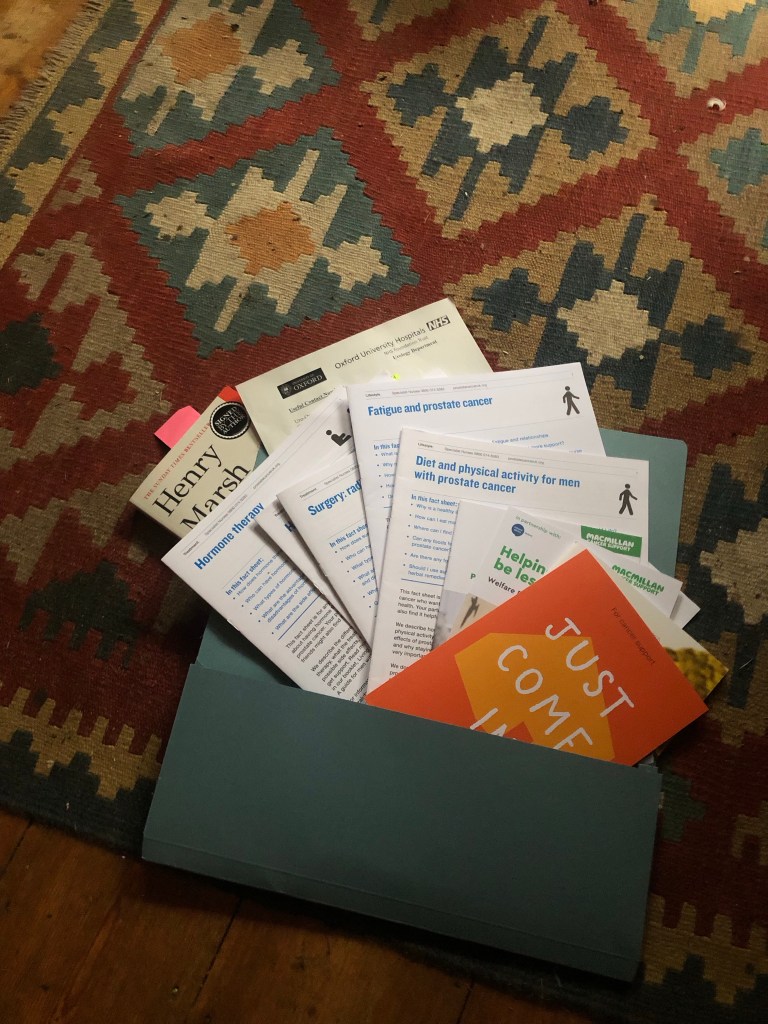
Or not: a watershed crossed in late November and (to muddle my imagery) the dam bursts with info.

Information Pack

But even in the information flood there is uncertainty, and I look at all these guides like a first year undergraduate looks at a course handbook: so much to take in; how much of this is relevant?

***

So the latest letter is clearer, and today (11.12.23) is the day this word becomes flesh (why yes, this is all coloured in by the purples, reds and greens of Advent) with a F2F meeting. There is the scribble of results that is no more enlightening than the old-fashioned, mythic doctors’ bad handwriting, and then the veil is parted:

Unfortunately.

The job not got, the offer withdrawn, the bad news word. The heart races, sinks, I don’t know: rereading the text in the rush that follows I am struck by the name Gleason which takes me to the bull that tramples through Puck of Pooks Hill – thence my mind hears the yammering at my elbow of all those crazy, violent, vivid dreams that keep my sleep broken. Now Stop! Max said. And the wild things are stopped as by a lion-tamer’s whip and chair, stopped by another word:

However.

Watersheds and floods; dark towers and brave rescues; lion taming and þursen and the wild rumpus. Good, picaresque nonsense, jumbled fairytales to give shape, colour and texture to the bare outlines of grey corridors and professional friendliness and the heart-crunching worry of boring my friends.

Which is maybe what I’m doing here. Not a wild rumpus, not even an Ariadne thread, just a confusing set of encounters with images given a high fantasy gilding.

Time to stop and get ready for my consultation? Just one more thing, another letter:

A letter from the Blood Donor Service, in response to my having to withdraw from donation. It talks of ambassadors like you encouraging others to give blood…I hope you’ll continue spreading the word.

Give blood: https://www.blood.co.uk

And chaps: get your prostates checked https://prostatecanceruk.org/risk-checker?gad_source=1&gbraid=0AAAAAC_DJ7RCCrftQ3BTC63oIqJ-4wrw3&gclid=EAIaIQobChMI3qXct4iHgwMVrIpQBh1wXAqDEAAYAiAAEgJ2BvD_BwE&gclsrc=aw.ds

A Book Cull

[T]here is a difference between liking books and needing them. I needed books. They weren’t a luxury good during that time in my life. They were a Class A addictive substance. I’d have gladly got into serious debt to read (indeed, I did). I think I read more books in those six months than I had done during five years of university education, and I’d certainly fallen deeper into the worlds conjured on the page. There is this idea that you either read to escape or you read to find yourself. I don’t really see the difference.”

“Reasons to Stay Alive” by Matt Haig

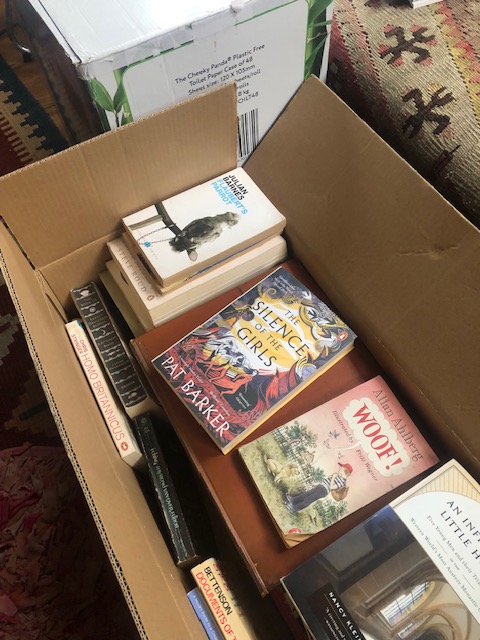
Time to thin out the books I can’t see I’ll ever need again. Some I liked but feel I have finshed with; some I didn’t like; some I genuinely feel I want to share. There are some treasures in the boxes in the front room, and I hope someone will enjoy reading them. Ecclesiastical history rubs shoulders with comedy books; the quirky and delightful end of nature writing sits next to the I Ching.

My thoughts the other week on the new translations of the psalms, which have ended up way back in this blog, raised all sorts of questions for me about how texts are presented. Will the new Breviary be something I buy and learn to love? And then following that, what do I treasure about books, and is the aesthetic please of turning the pages of a book itself something I wouldn’t want to surrender? What am I giving up as I surrender these books to a charity shop?

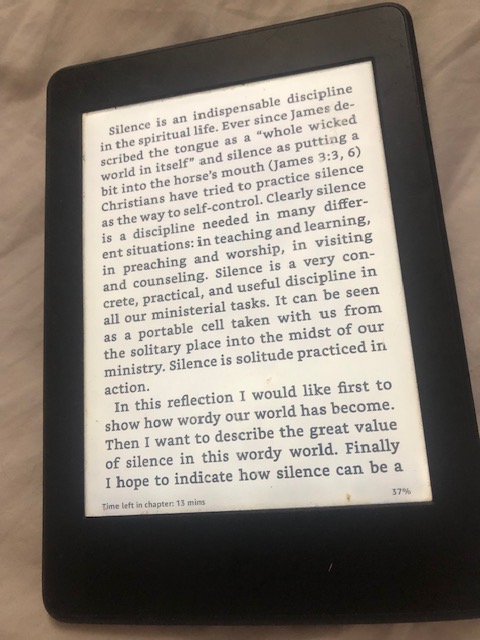
Here are two examples of text. One, very plain, has a lot of e-technology behind it, and, perhaps inescapably, overt links to the buying of books: Kindle is so designed that ownership is private, and lending a friend a book is a different thing than the owning of a book like the family Winnie the Pooh.

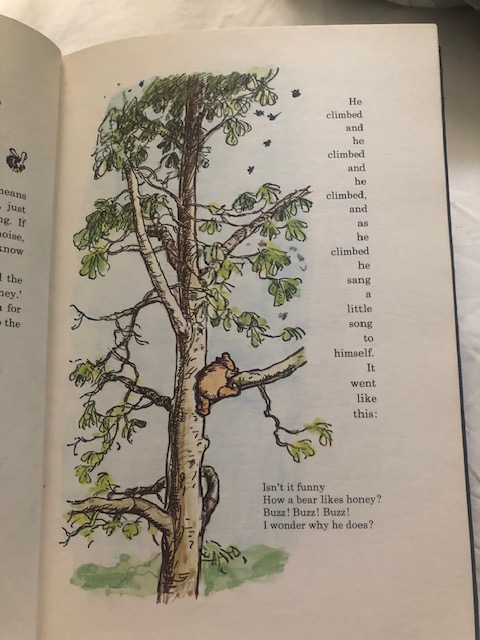
They both have a place, I think: the private and portable versus the aesthetic and sociable. I can read Van Nouwen on the bus and slip umpteen volumes in my pocket when approaching my stop, or I can share the heavy pages and hard cover of A A Milne with a small person heading over the crest of the day to sleep.,

X

X

X

X

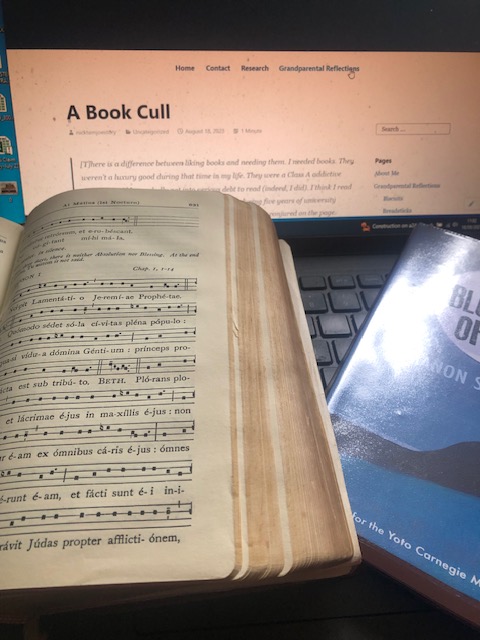
So let me finish with one more image from today: this blog being written, the Liber Usualis (gold edge, red leather cover) from this morning; the paperback (library outer) on Manon Steffan Ros’s The Blue Book of Nebo, which is my post-work read at the moment. All texts; all products of technologies – and (what made me change direction in writing this post) all texts on the fragility of things. My Book Cull is not a big thing in the History of the Book, or even in my reading history; The Blue Book of Nebo is (so far) an uncomortable meditation on how close humanity is to a sad and hard end; the Liber Usualis fell open at the Lamentation of Jeremiah, Oh how she sits alone, the city that was full of people….

More Merlins

There comes a time when light entertainment on an evening’s telly is like a massive trifle: you know that there would be a time when you would enjoy it, but equally you know this is not that time.

That was a few nights ago.

So rather than sit with half an eye on Wimbledon and the rest of my attention on my ‘phone, I went out. Threatening rain, and not many cars on the roads: it was quiet. Some day birds still around – I could see and hear a Wood Pigeon and some Blackbirds, and up in a very tall willow, a Kestrel. And under that I heard a running set of tunes from littler birds.

I was able, by activating my new App, to map what was where. It was damp, getting dark, so I had a couple of Blue Tits, the Kestrel once, Great Tit and as I spotted, the Pigeons and the Blackbird. Low trees and bushes for the small birds, still zipping about, the Blackbird and Thrush in the lower branches of big trees and the Wood Pigeons ungainly in the top branches.

Warneford Meadow, early July.

Yesterday morning in the quiet garden the App gave a lot more: Goldcrest, a Robin, Magpies, and this evening a Blackcap. However, it gave me pause for thought, the same disquiet I have had when out with Mat: how much do I sacrifice of an holistic appreciation of place in order to name this plant, that village in the distance, that bird? I recall my comment that my experience of being outdoors “is enriched but also boundaried by names.”

This is where Merlin, the Cornell University App, comes in. As its introductory story suggests

Merlin is designed to be a birding coach for bird watchers at every level. Merlin asks you the same questions that an expert birder would ask to help solve a mystery bird sighting…It takes years of experience in the field to know what species are expected at a given location and date. 

https://merlin.allaboutbirds.org/the-story/

Years of indwelling, of spotting quietly and without sensationalism that bird you expected or didn’t expect. The same would be true of the hemlock by the path, the fallow deer by the car park, the otter footprint on the sandy bank. Parsing the landscape (a phrase used of Alan Garner, but this blog post has some interesting thoughts, too) must include the flora and fauna, and we have to then admit something not so much about our vision of the landscape but what we exclude. The dry stone wall or hedge is more than just a division; it is a provider of microclimates and refuges, shade or a safe place to pass unseen.

In the angle a narrow opening runs through between the two banks, whihc do not quite meet: it is so overgrown with bramble and fern, convulvulus and thorn, that unless the bushes were parted to look in no one would suspect the existence of this green tunnel, which on the other side opens on the ash copse, where a shallow furrow (dry) joins it. This tunnel is the favourite way of the rabbits from the copse out into the tempting pasturage of the meadow; through it, too, now and then, a fox creeps quietly…

Richard Jefferies, Wild Life in a Southern Country, Ch 11: The Homefield.

It is an added joy (for some) to know we are spotting Conicum maculatum, or Dama dama, or Lutra lutra, but for most of us, this doesn’t add to the experience of the environment. Just as E B Ford scathingly reports that

There has been a tendency for mathematicians to sit at home and deduce how evolution ought to work rather than base their analyses upon the results of observation in the field.

E. B. Ford (1979) Ecological Genetics

so the naming of the content of a hillside or a dune goes some way but does not – cannot – give a full picture on its own. This is why reducing Richard Jefferies (above) to the list (below) is a reduction almost ad absurdum:

and is why Roger Deakin’s Wildwood is as much a sociology of plants and humans as it is a travelogue* or Jefferies’ writing is an “intuitive ecology” (to borrow Mabey’s phrase from his introduction to the Little Toller edition of Jefferies’ masterpiece), with an “insistence on the connectivity of the natural world.” And it is these connections that help me pose questions: why no wrens in my back garden? What do those song thrushes do when they call out those maddeningly different snatches of tune?

The Merlin App, to give it its due, is not simply an amateur’s way of finding what chirrupped like that, what irascible song bird scribble came from that bush like that, but a massively ambitious attempt to bring together all the naming of parts from around the world – and I love it, and what it teaches me. But the great writers on nature are able to move from observation in the field to exploring the rich and precious connectivity of the landscape, while bringing an understanding of the individual elements: a genuine reading of all the elements that make up a story, a close reading and a parsing, for which my naming this plant or animal is (to continue the metaphor) just me “barking at text.”

_________

*Wildwood continues to be a delightful book: the story of the apple trees and their transit through Europe, for example, remains a beautiful piece of writing as well as an illuminating account of a major, if too little known, story of ethnobotany.

Dads and Art: some emotional landscape painting

or

And When Did You Last See Your Father?

Fictional child is called upon to display courage, loyalty and maybe moral leadership as a Puritan Government official questions him about his father, whom Cromwell’s officers are pursuing. Family watch anxiously from the left of the picture, while on right, the table, the gentlemen facing back into the room, the wall behind them all put a stop to the narrative continuing. The young boy is at the extreme of the crisis, facing stern authority without his dad. The tearful big sister is going to be next, and the hand of the soldier on her back suggests she is being pushed forward: all rests on the boy.

And yet the father is present, in a way: the firm gaze of the boy confronting his inquisitor, his hands behind his back. He has learned what it is to stand firm.

The awkward irony of this post is that the dads I will be discussing are very much in evidence, and the children are not the immaculately turned-out boy in pale sky blue (or indeed the tearful girl who we might assume to be his [?older] sister), but the children at the heart of the swirling emotions of books by Anthony Browne and Ian Eagleton/Jessica Knight. And they are not firm of purpose, but children in flux. I contend that both families are labile, and face challenges just as the wrong-but-romantic Cavalier family I started with. But while the when-did-you-last-see-your-father brigade propose an image of weak and tearful females as opposed to the firm chin and still form of the boy, the boys and men I want to discuss are survivors becaue of their openness to change.

There is a tangible absence in Ian Eagleton and Jessica Knight’s story of little Rory; his dad has moved out (or mum has moved out), and Rory, his lookalike son, lives with mum and mum’s new boyfriend, Tony. Rory misses his dad, although they meet up for an archetypical Saturdads time together in the park. In Rory’s Room of Rectangles Tony, nervous of the responsibility, takes Rory to an art gallery. They don’t see And When Did You Last See Your Father? or Käthe Kollwitz‘s unbending, grieving Father (I’m rather glad to say) but rooms of art which nevertheless challenge and move the little boy. They find nightmarish pictures, shimmering shapes and bright, loud, fierce art before coming to Tony’s favourite room. Tony is clearly not just joining in with Rory’s delight in painting: he gives something of himself in the room full of vibrant blues. This self-disclosure is key to the narrative: Tony is giving up something here. This is a risky day for all of them.

There is an unwelcome presence (as I see it) in Anthony Browne’s story where the dad – who uncomfortably dominated his family’s trip to the Zoo – similarly tries to assert himself in the hallowed halls of a London art gallery. In The Shape Game, his being there does not make for an easy read. Boorish, ill-at-ease when he is not the centre of attention, Browne seems to me to have created a figure of whom every dad reading the book would ask, anxiously, “Is this me?”

In Rory’s case he does find something new about his dad (does he, in a sense, rediscover his father?) and Tony’s sensitivity hints at a healthy relationship beginning here. What transformations of a father do we see in Anthony Browne’s Dad figure in The Shapes Game?

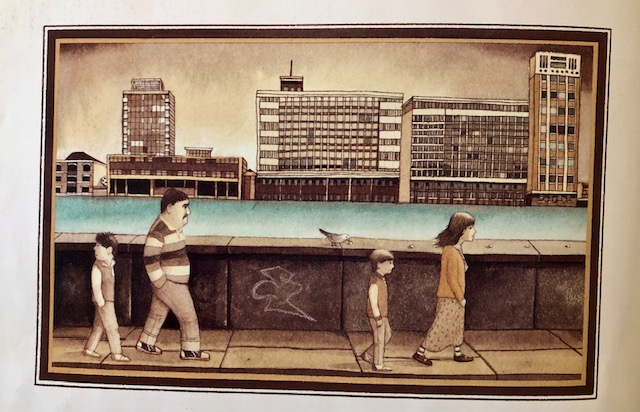
Here they are at the start of the book: dull tones, and a heavy border indicate a sense of entrapment. Maybe even Mum, leading the way for her birthday treat, senses it, with her three males slouching behind her.

This is not the footie match Dad and older brother are missing: there is little sense that today will be even mildly pleasant, let alone transformative.

Someone is going to have to give something up if today is going to be worth anything.

If he is confronted with motives to change, it is the art he encounters which forces Dad to become more open.

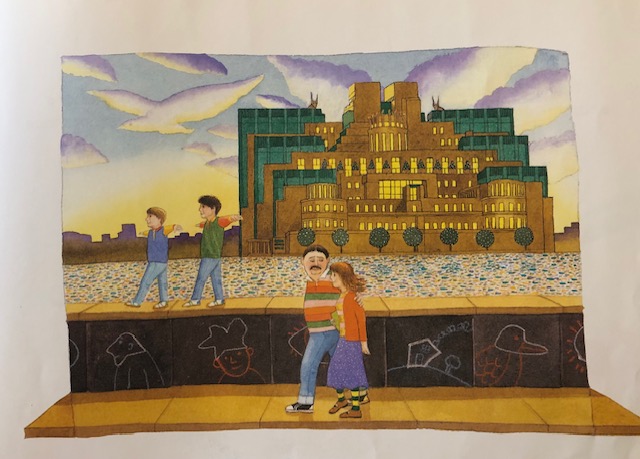
So here they are at the end of their visit. There is no frame to suggest they are trapped; the architecture across the river is transformed; the sky has a cloud-dove (a dove of peace?); Mum and Dad are walking together and the graffiti hints at the eponymous Shape Game the boys will play on the way home. The experience of the gallery has changed them all – and the autobiographical note at the beginning suggests it was this trip to the art gallery “that changed my life forever.” Mum had wanted to go “somewhere different,” and this has a deeper significance than simply a different physical location: the family are moving into a different place, and even home will be different.

Rory, in the Eagleton/Knight story experiences a transformation. But, like the family in Browne’s trip to the art gallery, is it only the little boy? Under Tony’s guidance Rory moves from room to room in the gallery, seeking something in all these forms of art to help him make sense, but outside is were he meets his father again. We get a hint that maybe he is on his mum’s boyfriend’s territory – or at least their common ground – with art, but the adult reader will maybe supply the conversations about how the three adults – mum, mum’s boyfriend, and dad – see Rory’s problems and propose a solution. In other words (to make the comparison between the two books), Dad and the boys in The Shape Game change by exposure to the art they encounter, whereas Rory comes to terms with his emotions in the gallery, while his three parenting figures have transformed their relationship “off-stage.”

What has changed?

Rory’s loyalty to his dad remains unshaken: he is, in this, like the boy who begins this blog post for us. But he has undergone something in the art gallery – and in the rage before it, and the reconciliation that follows it.As two American authors have put it* they – the males in both stories – are seen “developing and reclaiming their own fundamental human capacities.” It was in all four characters confronting their discomfort that they, like Anthony Browne’s family, move to “somewhere different.”

*Di Bianca, M. and Mahalik, J.R. (2022) ‘A relational-cultural framework for promoting healthy masculinities’, American Psychologist, 77(3), pp. 321–332

Badgers, Wildcats and Tulips

Some thoughts on picturebooks about death.

In my Twitter bio I often have some mention of my interest in picturebooks along the lines of looking for answers to big questions in small books. The review of Yumoto and Sakai’s The Bear and the Wildcat that I did recently for Just Imagine raised more questions about maybe the biggest of big questions, or at least the biggest in terms of what can be depicted in picturebooks: how do we deal with death?

For me, at any rate, The Bear and the Wildcat stands as one of the greats. Plain text, subdued artwork, and just enough raw emotion to take the reader somewhere uncomfotable. Why is the discomfort important?

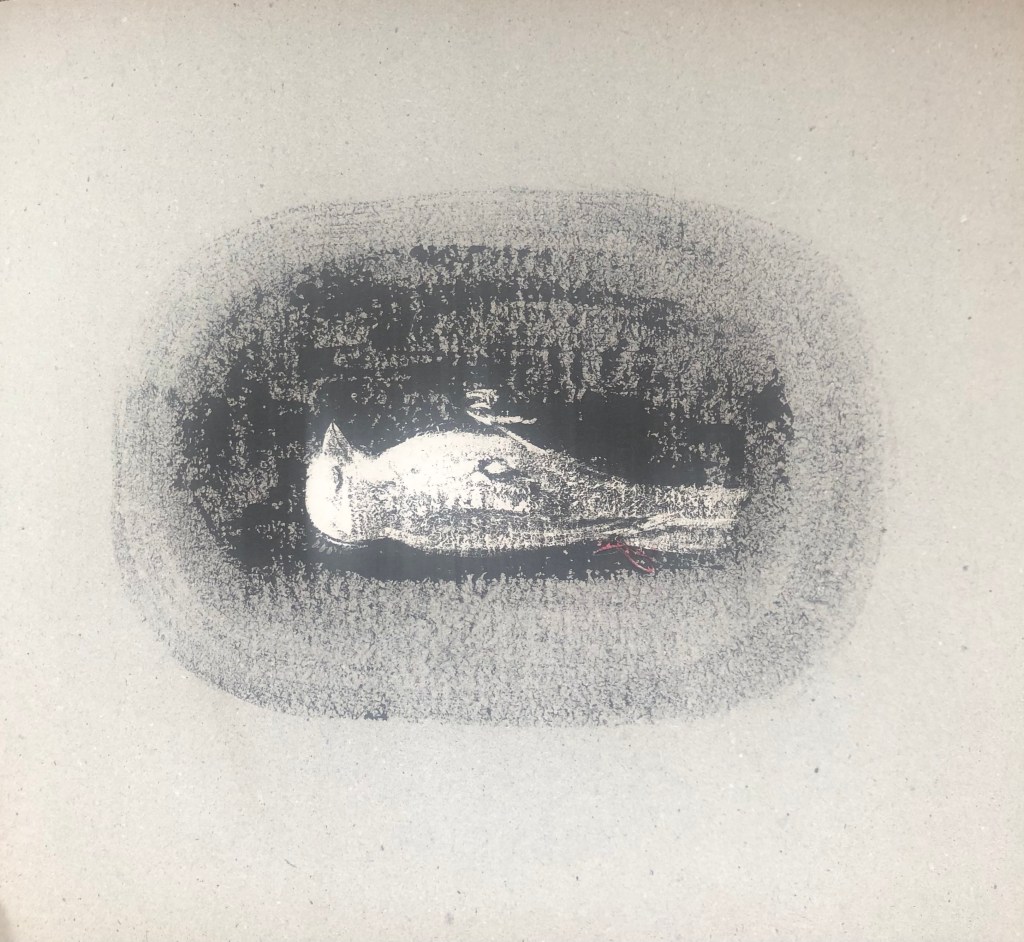
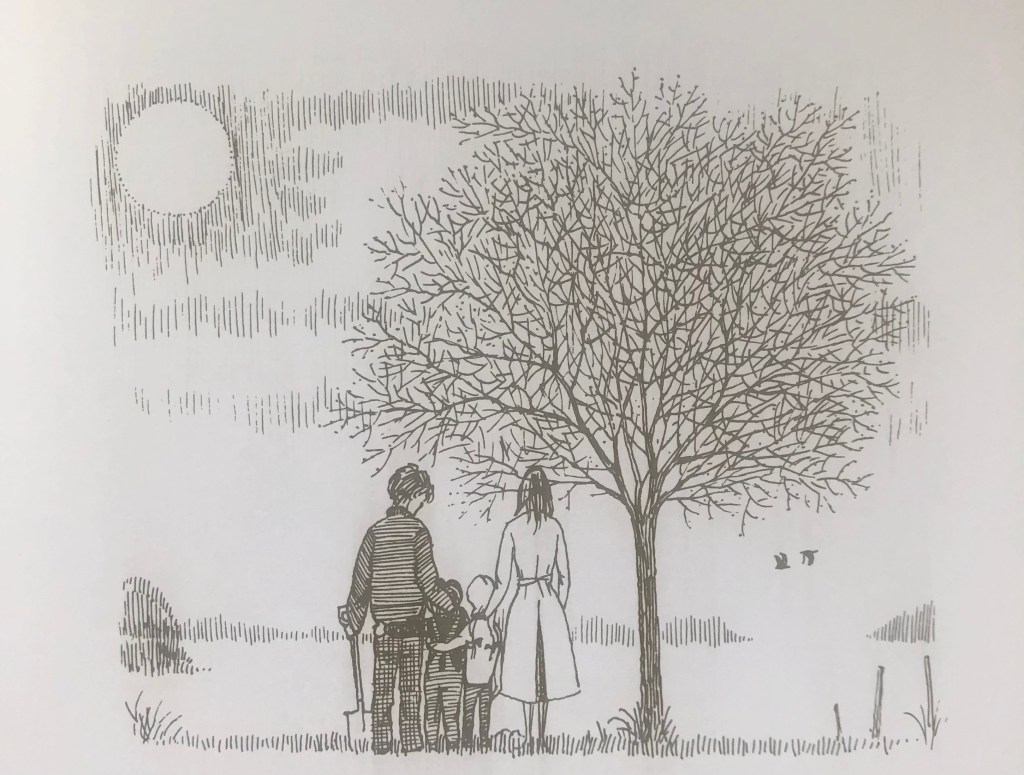
Compare the two images here: the little bird from The Bear and the Wildcat and the family saying goodbye to their cat in Viorst and Blegvad’s The Tenth Good Thing About Barney. Both sparse in their own way, but the impact of the image in Barney is more muted because of the lack of the cat. Because Barney is really about the burial and what happens afterwards, Erik Blegvad focuses on the family (and the argument about heaven and decomposition). This is not an easy text, but it is the ideas in the dialogue that stand out for me.

A number of writers discuss death in picturebooks. Kelly Swain, for example, in the Lancet Child and Adolescent Health writes of her neice asking rather literally whether Great-Grandma Nancy had gone up to heaven or into the ground. The same question occurs in Barney. In the debtae about whether the cat is in heaven there is real impatience and ambiguity. Not so for the little bird in The Bear and the Wildcat, whose dead body is shown starkly but without sensation: the focus here is grief.

We meet bereavment in Varley’s classic (and in its time quite daring) Badger’s Parting Gifts, and we have also a desctription of death from Badger’s point of view: a “strange yet wonderful dream” yet going down a tunnel (a sort of good place for a Badger to go, and actually not unlike the behaviour of some Badgers).

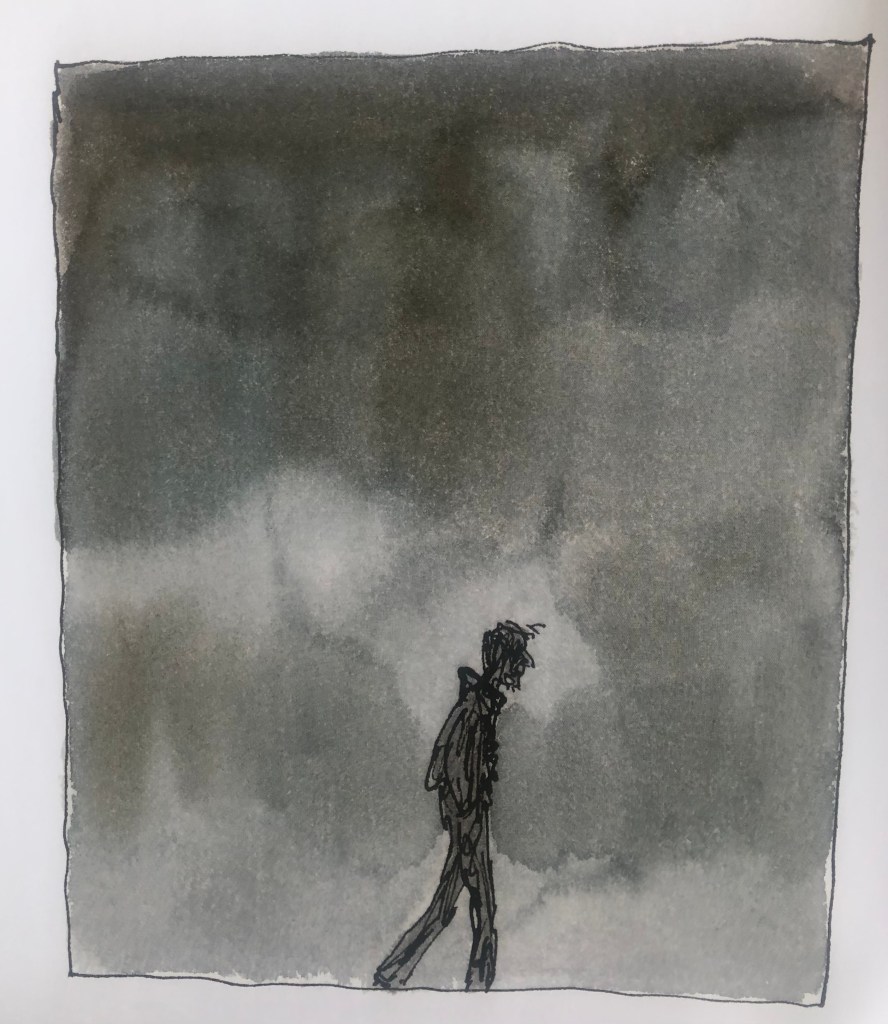
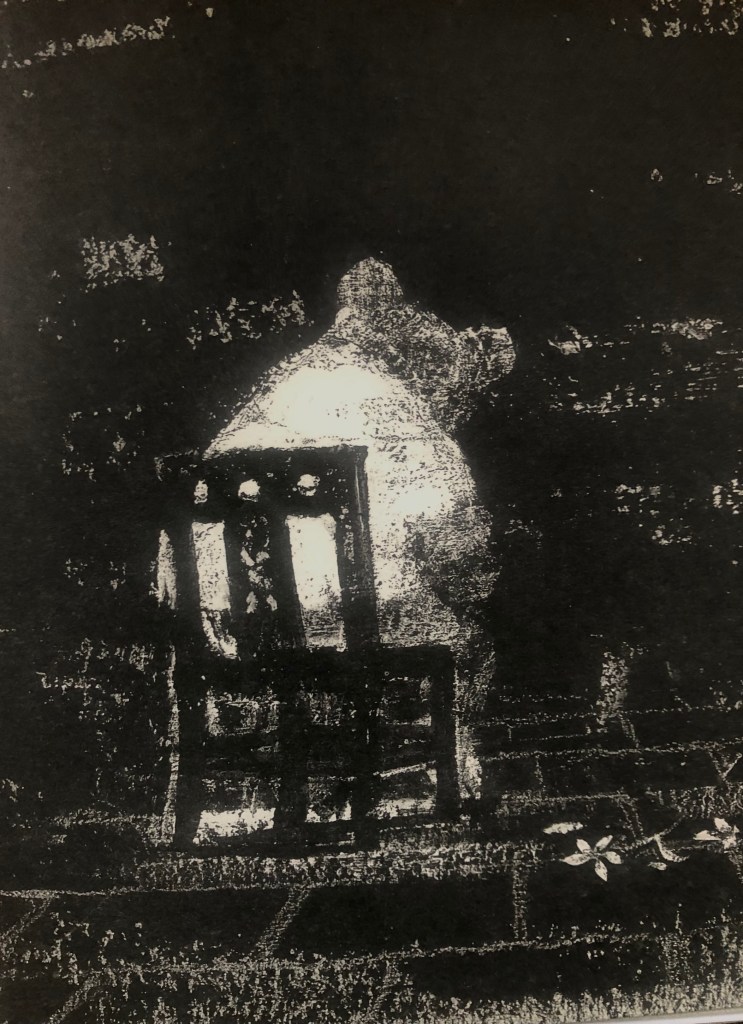
The book that still feels to me raw and angry as well as deeply felt is the great book by Michael Rosen, his Sad Book, where Quentin Blake’s artwork walks hand-in-hand with Rosen’s pain.The lone figure in the evening rain, hands in pockets; the single candle of a painful solitude. In many ways the turning-point picture in The Bear and the Wildcat seems to me to be much the same: despairing loneliness, and the overarching bleak dark. Painful to read, but beautifully told, and certainly chimes with my own experience. In discussing the Sad Book Maria Popova in the gobsmacking Marginalian blog puts it so well:

What emerges is a breathtaking bow before the central paradox of the human experience — the awareness that the heart’s enormous capacity for love is matched with an equal capacity for pain, and yet we love anyway and somehow find fragments of that love even amid the ruins of loss.

Michael Rosen’s Sad Book: A Beautiful Anatomy of Loss, Illustrated by Quentin Blake https://www.themarginalian.org/2015/08/25/michael-rosens-sad-book-quentin-blake/

Other stories are possible, too. In Maia and What Matters we have a true-to-life complicated story of a grandmother losing her words and mobility, a grandfather dying, and little Maia, caught by all sorts of adult pressures being the one who knows what matters. True-to-life text here stands in tension with dreamy artwork where symbol and tone show Maia growing and loving and getting angry and taking charge in page after page of real days and might-have-beens until we are at the final denouement of grandma beside her husband’s coffin, stroking his hair. (As an aside I decided only to show the cover, because the large format of the book would be given no recognition by a small picture or excerpt of a larger spread)…

I have mentioned the companionship of death in Duck, Death and the Tulip – like The Bear and the Wildcat, another triumph from Gecko Press – and the picture here shows tenderness – and comedy? The incongruity of their friendship [until a cool wind ruffles Duck’s feathers] does allow for a wry smile:

Actually he was nice (if you forgot for a moment who he was). Really quite nice.

Wolf Ehrbruch, Duck, Death and the Tulip.

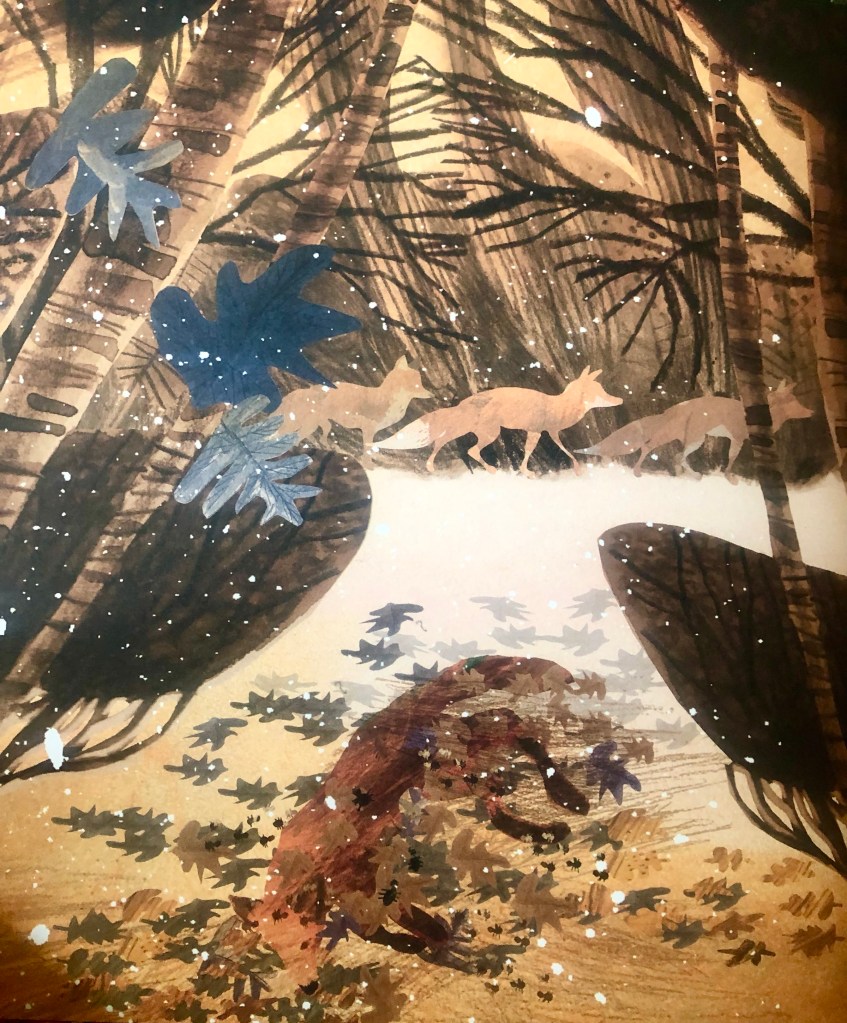
In The Bear and the Wildcat we look hard at grief; but in Thomas and Egneus’s Fox: a Circle of Life Story it is remarkable in its absence. The vixen is hit by a car, the cubs watch and then go their way. The fox is part of the autmnal decay –

“Tiny creatures get to work and fox begins to fade away.”

Back to earth, to plants, to air flow the tiny particles that were once a fox.

Isabel Thomas, Daniel Egneus Fox: A Circle of Life Story

And so we come to a couple of books that do not look at grief, or at the possibility of an afterlife, but at a stark reality – only to find that in neither book is it particulartly harsh. The fox dies (quickly: no agony; no hunting horn) and in this last text, Lifetimes by Bryan Mellone and Robert Ingpen,

Nothing that is alive goes on living for ever… Sometimes, living things become ill or they get hurt. Mostly, of course, they get better again but there are times when they are so badly hurt or they are so ill that they die because they can no longer stay alive.

https://www.penguinrandomhouse.com/books/113067/lifetimes-by-bryan-mellonie/

I might raise an eyebrow at the over-comfortable “Mostly,” but the book is clear about what will happen, and that this is part of they way things live “and that is their lifetime.”

So there seem to me to be ideas here worth disentangling. I have had to cut out for brevity Oliver Jeffers’ wonder The Heart and the Bottle in which grief is the key driver of the narrative – or, if not grief, then the love that engenders sorrow – and Glenn Ringtved’s Cry, Heart, But Never Break where again a personification of death imparts some wisdom, and so many more. But these stories deal with two principal themes: bereavement, and inevitablity/natural cycles. Maybe the “inevitability” books are ones that any child will be intrigued by; the bereavement books may have a particular audience. And this was where I stumbled in my review for Just Imagine. When asked “Who is this book (in this case, The Bear and the Wildcat) for?” it is often hard to pick an age range or educational context. Does this mean, however, that we must restrict children’s reading? Not for me: but it does mean that it is incumbent on educators (including the wonder that is a good school librarian) and parents to approach books with respect and something like humility. There are books for children and among them ones that will move adults to tears as well, and sometimes, even in the heart of their own sad time, the grown up needs to see which book a child might like, be interested in, be comforted by. It’s not easy.

I have met educators and parents who have said, of Duck, Death and the Tulip, that they would “never let a child have that book.” It clearly stirs something in us of a desire to protect children from the ultimate monster under the bed; yet there is even in that book a sense of hope. Death is not something to fear. And in the book that sparked this blog post, the sensitive and beautiful story of a bear who has lost his best friend, there is hope. Not some great afterlife hope – even though we are in Easter Week as I write – but simply that friendship helps, and that life goes on. |It can be painful and crazy as in Sad Book, and it can look like the comfort is illusory as in the discussions around Barney the cat, but there is this: compassion and friendship.

“All around us, and everywhere, beginnings and endings are going on all the time.”

Points of needles, edges of swords, blades of axes

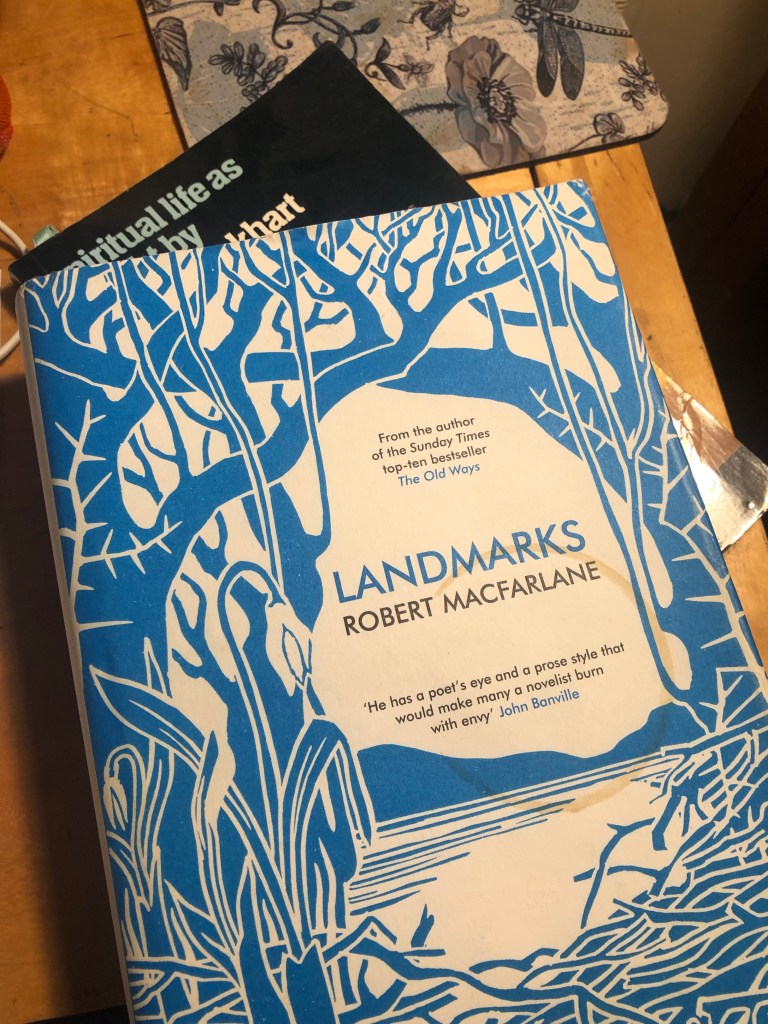
I started this post in February on what I described as “an odd day,” where I had been looking for material on meditation and spirituality, mostly because I was fretting about a postgraduate class on Early Childlhood spirituality that I was due to teach. One book leads to another like something out of The Name of the Rose, so for entirely different reasons than I’ve ended up with, I was looking at Rob Macfarlane’s great book Landmarks. I came across his account of the Kalevala (Landmarks, Ch6, by the way) and Vainamoinen Finds the Lost-Words:

Robert Macfarlane: Landmarks cover

Its hero, Vainamoinen, is trying to build an enchanted ship of oak wood in which he will be able to sail to safety ‘over the rough sea-billows.” But he is unable to conclude his shipbuilding for want of three magic words…

And along with various other things I’ve been reading, here was the image I was looking for – not for my class on spirituality, but actually for an entirely different class on Play. To Macfarlane, the finding of the lost words is the key or maybe even the origin-text, it seems to me, to his – and Jackie Morris’ – beautiful collaboration The Lost Words and the works that have come from it. For me it provides an entry into the search that Vainamoinen undertakes, and with it a search a lot of educationalists are seduced into undertaking: a set of spells from the past that will give us just a few magic words that will enable us to create the way we want to go across the rough seas of educational theory. To get there we have to look all over the place – see Rob Macfarlane’s account where Vainamoinen searches through improbabilities of swallow’s brains, swan’s heads and the like – until we face a place of conflict: in the Kalevala this is a journey over the points of needles, the edges of swords and the blades of axes.

And it struck me that far, far too often, educators spent their time looking for the three magic words that will solve their problems, and that they will seek those words out despite the cost.

Pinning one’s hopes to a single answer – and in the story just cited, a simple formula – is hopeless when critically exploring something as complex as pedagogy. the Education Endowment Foundation (summary review) gets round this by assuming that everyone can sign up to the statement:

Learning requires information to be committed to long-term memory

Acquiring language, developmental considerations would seem to be set aside, alternative provisions and pedagogies forgotten or (as the salivating Twitterati are wont to do) denigrated and mocked, were it not for the statemant that

Our review is founded on the view that translation of evidence from basic science is neither simple nor unproblematic.

EEF Review p6

So while I had thought of a (deliberately) controversial title for this post:

Why CogSci is Rubbish

To be quickly followed by

Why Forest School is Rubbish

I really have to avoid the cheap tricks and hark back to the word I slipped in earlier in this post

Critically

And it has a lot of work to do, that little word. Who gets to be critical about the work teachers do? Are teachers meant to be professionals? Do they critique their work reflectively? Most topically, given this week’s unhappy occurrences, are we to see teachers as direct agents of Government, QUA[N]GOs like OFSTED, individual ministers and their inner circle, &c., in a trend of disempowerment and control that was certainly well under way by the late Eighties? Or are they reflective workers, whose tasks are quality assured, both internally and through independent scrutiny?

And this is where we come to the points of needles. When the Early Years practitioner comes to articles such as Brain Development and the Role of Experience in the Early Years (Tierney and Nelson, 2009) we read that

 ….experience shapes the structure of the brain…for healthy development of brain circuits, the individual needs to have healthy experiences

and we might be tempted to take this to mean that this vital role of experience is all. This, however, denies the assertion that

Applying the principles of cognitive science is harder than knowing the principles and one does not necessarily follow from the other. Principles do not determine specific teaching and learning strategies or approaches to implementation.

In the same way, the unreflective CogSci advocate might be tempted to retort “Ah, but this isn’t what I mean by the word ‘learning.’ We are in the Humpty Dumpty world where this exchange is enviaged by Lewis Carroll:

“When I use a word,” Humpty Dumpty said, in a rather scornful tone, “it means just what I choose it to mean – neither more nor less.” “The question is,” said Alice, “whether you can make words mean so many different things.”

The word is either insufficient for the observant practitioner or for the theoretician mindful of where their words will go. The same is true of the unreflective use of ideas such as “freedom” (freedom to be a child) or even “nature:” which brings me back to where I started last month.

It is easy for me to hone in on pedagogy whether underpinned by applied cognitive neuroscience or whittled hazel sticks – but we (I) need to be aware of our own three magic words, those words we try to somehow make their own unspoken axioms. And what would my three magic words be?

When I came back to this post last week I started with the idea of an axiom and, of course, started a Google search. The second question in the list that came up was

Does axiom mean truth?

Do I just assume that spirituality is a thing? Is play not merely a slippery concept but a clumsy agglomeration of phenomena? And what about outdoors – my garden? The Lye Valley? Is my looking at Margaret McMillan a search through ancient lore for The Answer?

Lye Valley tree