After years of accumulating homeliness, leaving my Brookes office was a dreadful thing to do; hasty, almost punitive. We left for Greece the day after my Brookes contract came to an end, with thoughts of Prospero set adrift echoing through my reading. My books of 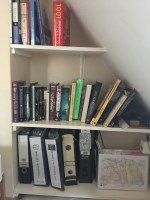 magic – of Wild Spaces Wild Magic – were set up, but the rest was just boxes of stuff.
The boxes were sulking when I returned, but with a bit of coaxing, they began to find ways into the study. Joe helped by taking me to Ikea and then helping with building the shelves. I did that job I had called “tonking”when I was a library assistant: setting the shelf heights by sorting out the supports or tonks. And after that it was shelving.
I decided to divide the books into “children’s literature” and “lecturer-type” books, with Wild Spaces Books on their own, starting with Molly Bang’s Picture This, through some (but not all) the Robert MacFarlanes, ending with Z is for Jack Zipes. There were boxes of liturgical and Biblical books – a very nice Liber Usualis, for example, and my battered Greek New Testament – too, but I set them to one side. I looked at the children’s literature and set to. They were in boxes roughly alphabetically, so that a pile of Anholts came out together, and more Mairi Hedderwick than I thought I had; but they weren’t in strict order, and there were gaps. This means that books that had not met for years suddenly were leaning against one another: Sheila Cassidy’s retelling of the Creation was up against Michael Foreman’s eco-committed texts on one side and David Almond’s Skellig on the other. More arrive and these congruences shift: Roald Dahl and Lauren Child budge in; Noel Langley’s Land of Green Ginger, with its rather dubious racial stereotypes, squeezes in with Virginia Kroll’s Masai and I. It’s a bit like rush hour, but they all do get in.
Size is an issue, and while I create “Outsize” shelves, for a while it looks like MacFarlane and Morris’ The Lost Words has no home, until moving the Little Tollers downstairs makes space in Wild Spaces Wild Magic, between Landmarks and W G Hoskins The Making of the English Landscape. Some of these juxtapositions are just right.
Biblical and liturgical find a home like the sparrow in psalm 83.
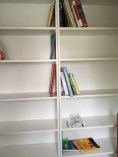
The grown-up books fill higher shelves, partly in case grandchildren want to browse the lower ones for books that are “for” them, but here it begins again: for a good while, Philip Pullman’s Daemon Voices snuggled next to Rob Pope’s English Studies, until Francis Pryor arrived with Steven Pinker and the Opies. Julie Fisher rested against Ralph Waldo Emerson for a while (or was Emerson the one doing the leaning?); Caspar Henderson and Geoffrey Grigson met briefly, as did Jackie Musgrave and T H White.
It’s all a lovely conceit, as if this crowded Tube train of office shelving means that Simon Schama and Chris Stringer will get chatting as their covers touch, or Katharine Briggs
will strike up a conversation with Jane Carroll as they squeeze together. But of course they won’t. It may be that George Monbiot does talk to Sara Maitland, but they don’t do so on my shelves. Here, that’s my job. Because if this blog has point beyond a rather vain showing you (dear Reader) round some of a really quite small collection, it is this: books “talk” to each other only in the person who reads attentively and makes connections. We become passionate about this idea or that, but it is the reader who is in a position to connect playing outdoors as the Last Child in the Woods with the Hermits and the New Monasticism of the eleventh century (Louv and Leyser). Alcuin of York reminisces O quam dulcis vita fuit dum sedebamus in quieti … inter librorum copias, but I might respond O how sweet life is, Blessed Alcuin, where we sit and read in quiet and let the ideas inspire and jolt and fizz and mix…
We are where the debate takes place, where critical thinking emerges. Not reading alone, but thinking and speaking and mulling and writing – and maybe reshelving our ideas in a different order from time to time.


 nicktomjoe