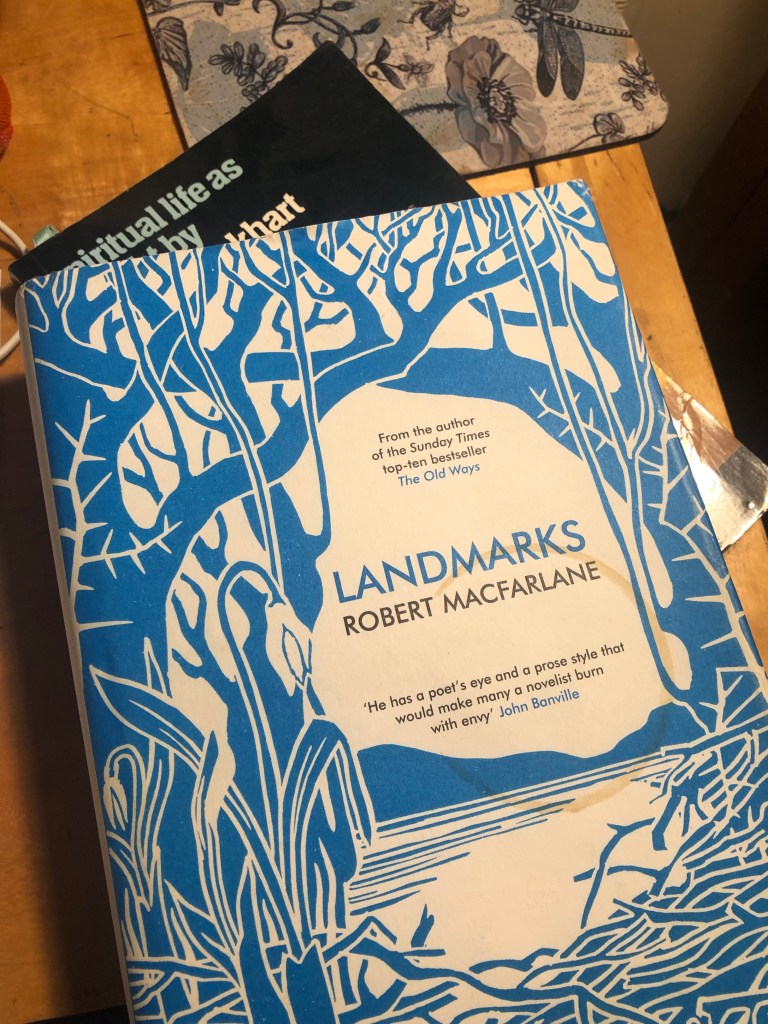
I started this post in February on what I described as “an odd day,” where I had been looking for material on meditation and spirituality, mostly because I was fretting about a postgraduate class on Early Childlhood spirituality that I was due to teach. One book leads to another like something out of The Name of the Rose, so for entirely different reasons than I’ve ended up with, I was looking at Rob Macfarlane’s great book Landmarks. I came across his account of the Kalevala (Landmarks, Ch6, by the way) and Vainamoinen Finds the Lost-Words:
Robert Macfarlane: Landmarks cover
Its hero, Vainamoinen, is trying to build an enchanted ship of oak wood in which he will be able to sail to safety ‘over the rough sea-billows.” But he is unable to conclude his shipbuilding for want of three magic words…
And along with various other things I’ve been reading, here was the image I was looking for – not for my class on spirituality, but actually for an entirely different class on Play. To Macfarlane, the finding of the lost words is the key or maybe even the origin-text, it seems to me, to his – and Jackie Morris’ – beautiful collaboration The Lost Words and the works that have come from it. For me it provides an entry into the search that Vainamoinen undertakes, and with it a search a lot of educationalists are seduced into undertaking: a set of spells from the past that will give us just a few magic words that will enable us to create the way we want to go across the rough seas of educational theory. To get there we have to look all over the place – see Rob Macfarlane’s account where Vainamoinen searches through improbabilities of swallow’s brains, swan’s heads and the like – until we face a place of conflict: in the Kalevala this is a journey over the points of needles, the edges of swords and the blades of axes.
And it struck me that far, far too often, educators spent their time looking for the three magic words that will solve their problems, and that they will seek those words out despite the cost.
Pinning one’s hopes to a single answer – and in the story just cited, a simple formula – is hopeless when critically exploring something as complex as pedagogy. the Education Endowment Foundation (summary review) gets round this by assuming that everyone can sign up to the statement:
Learning requires information to be committed to long-term memory
Acquiring language, developmental considerations would seem to be set aside, alternative provisions and pedagogies forgotten or (as the salivating Twitterati are wont to do) denigrated and mocked, were it not for the statemant that
Our review is founded on the view that translation of evidence from basic science is neither simple nor unproblematic.
So while I had thought of a (deliberately) controversial title for this post:
Why CogSci is Rubbish
To be quickly followed by
Why Forest School is Rubbish
I really have to avoid the cheap tricks and hark back to the word I slipped in earlier in this post
Critically
And it has a lot of work to do, that little word. Who gets to be critical about the work teachers do? Are teachers meant to be professionals? Do they critique their work reflectively? Most topically, given this week’s unhappy occurrences, are we to see teachers as direct agents of Government, QUA[N]GOs like OFSTED, individual ministers and their inner circle, &c., in a trend of disempowerment and control that was certainly well under way by the late Eighties? Or are they reflective workers, whose tasks are quality assured, both internally and through independent scrutiny?
And this is where we come to the points of needles. When the Early Years practitioner comes to articles such as Brain Development and the Role of Experience in the Early Years (Tierney and Nelson, 2009) we read that
….experience shapes the structure of the brain…for healthy development of brain circuits, the individual needs to have healthy experiences
and we might be tempted to take this to mean that this vital role of experience is all. This, however, denies the assertion that
Applying the principles of cognitive science is harder than knowing the principles and one does not necessarily follow from the other. Principles do not determine specific teaching and learning strategies or approaches to implementation.
In the same way, the unreflective CogSci advocate might be tempted to retort “Ah, but this isn’t what I mean by the word ‘learning.’ We are in the Humpty Dumpty world where this exchange is enviaged by Lewis Carroll:
“When I use a word,” Humpty Dumpty said, in a rather scornful tone, “it means just what I choose it to mean – neither more nor less.” “The question is,” said Alice, “whether you can make words mean so many different things.”
The word is either insufficient for the observant practitioner or for the theoretician mindful of where their words will go. The same is true of the unreflective use of ideas such as “freedom” (freedom to be a child) or even “nature:” which brings me back to where I started last month.
It is easy for me to hone in on pedagogy whether underpinned by applied cognitive neuroscience or whittled hazel sticks – but we (I) need to be aware of our own three magic words, those words we try to somehow make their own unspoken axioms. And what would my three magic words be?
When I came back to this post last week I started with the idea of an axiom and, of course, started a Google search. The second question in the list that came up was
Does axiom mean truth?
Do I just assume that spirituality is a thing? Is play not merely a slippery concept but a clumsy agglomeration of phenomena? And what about outdoors – my garden? The Lye Valley? Is my looking at Margaret McMillan a search through ancient lore for The Answer?
Writing a blog about early years pedagogy, the outdoors, and children's literature. Lapses into history and spirituality are not unknown.
View all posts by nicktomjoestory



 nicktomjoe