
“Childhood,” that fluid concept that may (or may not) include infancy and may (or may not) embrace young people up to 18, gets looked at using all sorts of research tools which may (or may not – I’ll stop doing this now) provide valid data. Aries’ own use of visual material has been criticised for its subjectivity in selection and judgment, and I’m sure the four pictures I used in my research presentation could likewise be pulled apart.
What I attempted to do at our Faculty Research Conference was to try to think in terms of methodology to look at a similar event – children playing outdoors – through different media: a four year old’s drawing; an historical photograph; children’s book illustration.
The child’s drawing I have already discussed.
This was the photograph I chose
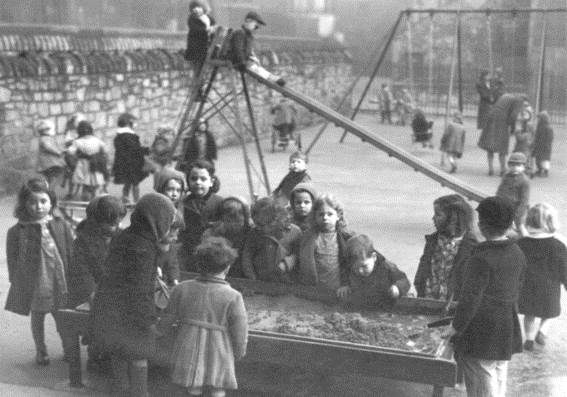
– a substitute for the one I really wanted, from Margaret MacMillan’s passionate plea for Early Childhood provision from 1923, for which I couldn’t get a clear enough reproduction. My only real points here were about how we are unaware, by and large of how “participatory and collaborative” (Pink, 2001:58-9) this is, and if there might be here (Burke, 2001: 117) a “possibility of idealisation” – positive or negative? Is this an ideal – an example of what schools often label “Best Practice”? Or maybe a plea for more of these institutions? Or part of a study of the urban poor – and in contrast to what?
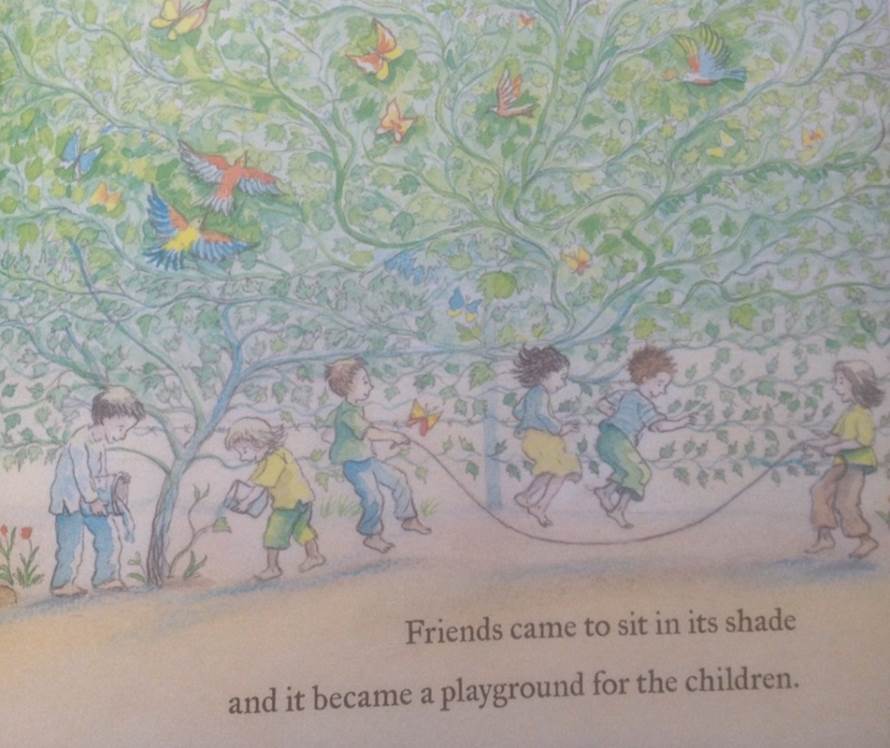
The heart of what I presented was around Michael Foreman’s reflection on his time in Gaza
and Roberto Innocenti’s moving and ambiguous story of a young German child’s encounter with the Holocaust.
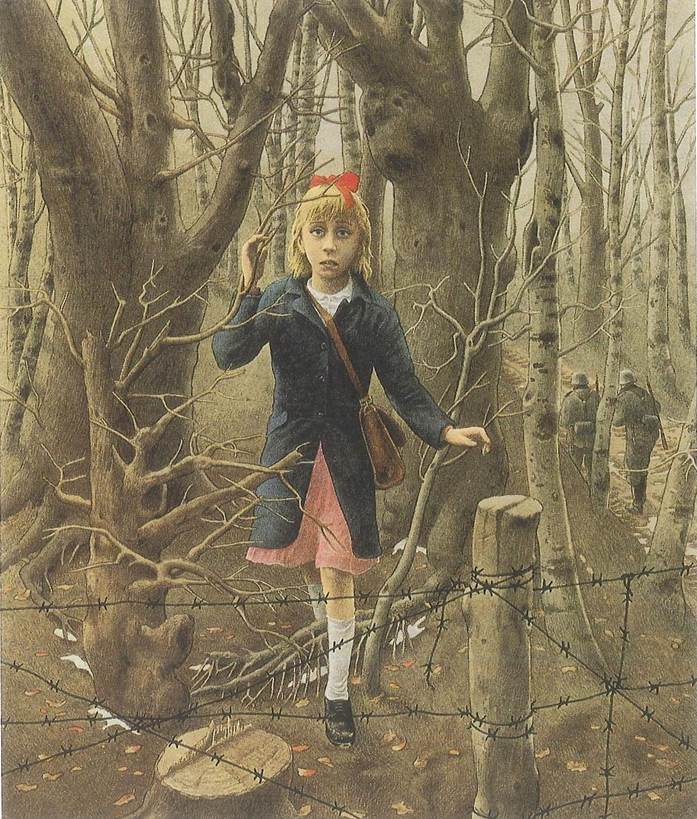
I looked at composition to some extent (what is Innocenti’s girl staring at in horror?), and at the symbolism both illustrators managed to use (e.g. the notion of the vine as the symbol of a flourishing Israel at peace), but all I was really able to do in 15 mins was to suggest that for all three sets of images context is important, and that for the illustrations all this becomes much more complex; in an analysis of illustrations in children’s literature context includes, it seems to me:
- Narrative (what comes before and after the single image)
- Intertextuality (reference in word and image to other works)
- Multiple readership and multiple views
I think I crammed a lot more into 15 mins than this precis suggests – and here are the articles and books I used to help me on my way.
Anning, A and Ring, K (2004) Making Sense of Children’s Drawings. Maidenhead: Open University Press.
Burke, P (2001) Eyewitnessing: the use of images as historical evidence. London: Reaktion Books
Foreman, M (2009) A Child’s Garden. London: Walker Books
Foreman, M (2009) Picture Books and the Environment: a lifelong concern in J Harding et al (eds) Deep into Nature: Ecology, Environment and Children’s Literature. IBBY/NCRCL Papers 15. Lichfield: Pied Piper Publishing
Innocenti, R and McEwan, I (1985) Rose Blanche. London: Red Fox
Pink, S (2001) Doing Visual Ethnography. London: Sage
Pink, S (2008) “Analysing Visual Experience” in M Pickering (ed) Research Methods for Cultural Studies. Edinburgh, Edinburgh University Press.
Rose, G (2001) Visual Methodologies. London: Sage
Rose, G (2014) On the relation between ‘visual research methods’ and contemporary visual culture. The Sociological Review, Vol. 62, 24–46
Sipe, L. (1998). “How Picture Books Work: A Semiotically Framed Theory of Text-Picture Relationships.” Children’s Literature in Education 29(2): 97-108.
Styles, M. and Salisbury., M. (2012). Children’s Picturebooks: the art of visual storytelling London, Laurence King.
 nicktomjoe
Some interesting insights into Childhood. I particularly like the Cowgate Nursery picture. It conjures up images from a time when we didn’t keep fussing over children and prevent them from taking risks. ‘Swings’ in a playground would be unheard of, nowadays due to health and safety and the height of the slide – brilliant. We could learn a lot from times gone by, if only we would trust our instincts.
LikeLike
Yes, it’s interesting how different people – practitioners, academics, young people – look at that picture. The “learn a lot from times gone by” is itself a great comment: have you seen my earlier blog post on nostalgia?
LikeLike